REVIEW 5 major objections 6 minor 44 references
Neural Inertial Odometry from Lie Events
T0 review · 5 major / 6 minor · reviewed 2026-08-15 · deepseek-v4-flash
Pith's one-line read The paper claims that Lie events—IMU samples triggered by level crossings of the SE(3) pre-integration signal—canonicalize inertial inputs against speed and sampling-rate changes, and that training neural displacement priors on these…
desk verdict Solid new representation for inertial odometry with a real but fixable gap between its ideal invariance theorem and the actual pre-integration signal. read the letter →
The pith
A machine-rendered reading of the paper's core claim, the machinery that carries it, and where it could break.
The reading
What carries the argument
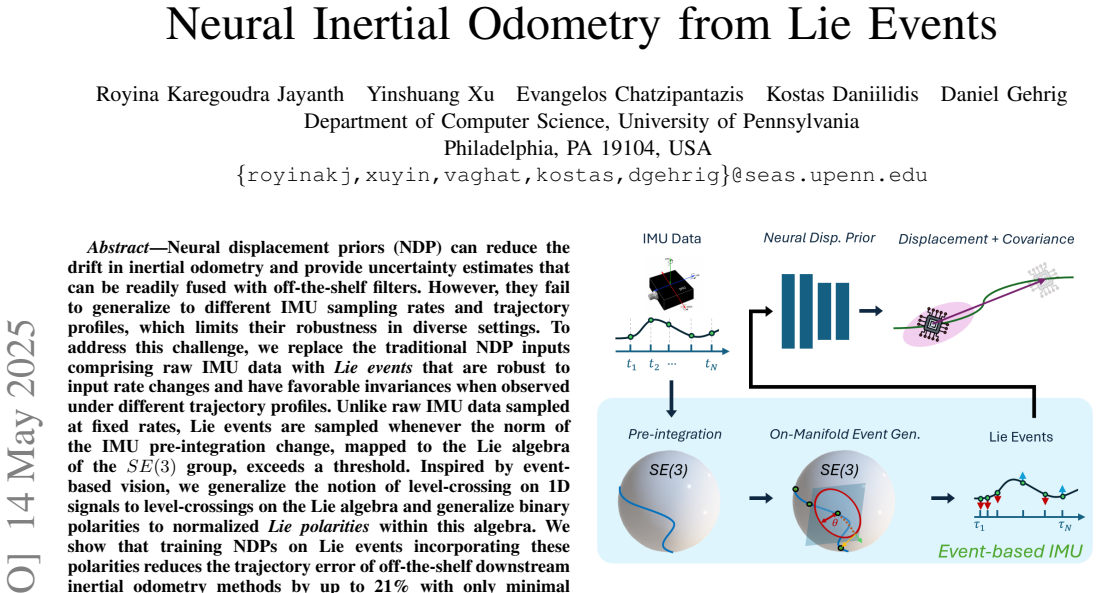
The load-bearing object is the Lie event, defined by level-crossing sampling on $\mathrm{SE}(3)$. Start from the last reference pose, project the pre-integration onto the tangent space with the Log map, and fire an event when the norm leaves a ball of radius $\theta$; update the reference to the event pose $x_{\mathrm{ref},j}=x_{\mathrm{ref},j-1}\mathrm{Exp}(\theta p(\tau_j))$. Theorem 1 is the identity that carries the argument: because event times are defined through the Log map, a time reparametrization $\varphi$ merely shifts event times by $\varphi^{-1}$ and leaves references and polarities unchanged. Event stacks then pack measurements and polarities into a fixed $B\times 12$ tensor, making the representation directly consumable by off-the-shelf neural displacement priors.
What would settle it
Take one recorded trajectory, resample it into two runs with very different speed profiles, generate Lie events from each, and check whether the polarity vectors agree and whether the event times map onto each other after applying the inverse time warp; if the mismatch is no larger than the injected IMU noise, the canonicalization is confirmed, and if a downstream prior trained on slow motion still fails on fast motion, it is not.
Extended reading notes
Core claim
The paper’s central claim is that event-based sampling of the IMU pre-integration on the Lie group $\mathrm{SE}(3)$ canonicalizes the input for neural displacement priors. The reference signal $x(t)=(\tilde R(t),\tilde t(t))$ is the on-manifold pre-integration of bias-corrected accelerometer and gyroscope readings, and an event fires at the first time $\tau_j$ when $\lVert \mathrm{Log}(x_{\mathrm{ref},j-1}^{-1}x(\tau_j))\rVert=\theta$; the Lie polarity $p(\tau_j)=\mathrm{Log}(x_{\mathrm{ref},j-1}^{-1}x_{\mathrm{ref},j})/\lVert\mathrm{Log}(x_{\mathrm{ref},j-1}^{-1}x_{\mathrm{ref},j})\rVert\in S^5$ records the normalized change direction. Theorem 1 states that whenever $x(t)=x^*(\varphi(t))$ with $\varphi'>0$, the event times satisfy $\tau_j=\varphi^{-1}(\sigma^*_j)$ and the references satisfy $x_{\mathrm{ref},j}=x^*_{\mathrm{ref},j}$, so the polarities are invariant under time reparametrization. Training TLIO and RoNIN on these events reduces absolute translation error on the TLIO, Aria, RoNIN, RIDI, and OxIOD datasets, and the error degrades gracefully when the IMU rate is subsampled from 1 kHz or 800 Hz down to 20 Hz.
Load-bearing premise
The load-bearing premise is that the IMU pre-integration is exactly a time reparametrization of a fixed path; in practice it is computed from noisy, biased readings with an initial velocity supplied by a filter, so the path-only canonicalization holds only approximately.
Editorial extensions
If this is right
- When IMU data is subsampled from 200 Hz to 20 Hz, the event-based TLIO variant keeps most of its accuracy while the interpolation and event-splat baselines degrade sharply, so rate augmentation becomes unnecessary.
- The same preprocessing transfers to velocity-regression priors such as RoNIN, reducing absolute translation error on RIDI and OxIOD even when trained on only half the public training data.
- Because the representation canonicalizes speed, the largest gains appear on out-of-distribution high-speed motion, exactly where raw-IMU priors fail.
- The lower event rate (about 74 Hz versus 200 Hz of raw IMU data) means the approach also removes input redundancy without sacrificing accuracy.
Reading between the lines
- The theorem is a recipe for any sensor whose output is a time reparametrization of a fixed path: encoders, tactile skins, or depth streams could be event-sampled on their natural manifold and fed to a neural prior, which is the broader conjecture the paper states but does not test.
- The residual failure mode is pre-integration drift: since the initial velocity comes from a filter, event timestamps inherit filter uncertainty; replacing the reference signal with a smoother or bias-corrected state estimate would tighten the canonicalization.
- A testable extension: train exclusively on slow trajectories and evaluate on fast versions of the same paths; the theory predicts near-equal displacement estimates, which would isolate the role of canonicalization from the network’s learned priors.
- The gains from Lie events should stack with yaw-equivariance or test-time-training objectives, since those address orientation variability while Lie events address speed variability; the paper does not combine them.
Signed reviews
Editorial analysis
A structured set of objections, weighed in public.
Referee Report
Summary. The paper proposes replacing raw fixed-rate IMU samples with 'Lie events' as inputs to neural displacement priors (NDPs) for inertial odometry. Events are triggered whenever the norm of the change in the SE(3) IMU pre-integration, measured through the Lie algebra, exceeds a contrast threshold θ. Each event carries the IMU measurements at that time and a 'Lie polarity', a normalized element of the Lie algebra encoding the direction of change. The authors state a theoretical invariance result (Theorem 1): if the reference signal factorizes as x(t)=x*(φ(t)) with φ'(t)>0, then event timestamps transform as φ^{-1} and reference poses are independent of φ. They apply the method to TLIO and RoNIN across multiple datasets, reporting reduced ATE/MSE and improved robustness to IMU sampling rate without rate augmentation, and provide open-source code.
Significance. If the claimed invariance holds in practice, the method is a simple, broadly applicable preprocessing that could improve the generalization of neural inertial odometry to different speeds and sampling rates. The generalization of event-based level-crossing and binary polarities to SE(3) is a novel formalism that may be useful beyond odometry. The experimental breadth is a strength: results are reported for TLIO, Aria, RoNIN, RIDI, and OxIOD, with two different NDP architectures, and rate robustness is demonstrated without rate augmentation. However, the theoretical guarantee is proven only under an exact trajectory factorization that the actual pre-integration pipeline does not satisfy, and the headline error reductions are reported without uncertainty estimates; the paper's central claim therefore currently rests on a gap between the theorem's assumptions and the deployed system.
major comments (5)
- [Section III-B and Appendix VI-A] The proof of Theorem 1/Theorem 2 in the appendix is technically incorrect for the 1D case: the event definition in Eq. (15) uses the condition θ ≤ ||log x(t) − log x_ref,j−1||, but the proof in the appendix uses θ ≤ ||x(t) − x_ref,j−1||. These conditions are not equivalent, so the proof as written does not establish the theorem for the definition actually used. The argument can likely be repaired by carrying the logarithm through the reparametrization, but the present proof needs correction.
- [Section III-C, Eqs. (18)–(22)] The factorization x(t)=x*(φ(t)) that Theorem 1 requires is not satisfied by the IMU pre-integration used as the reference signal in the actual pipeline. The pre-integration recursion (19)–(20) depends on the initial velocity v0, which at test time is an EKF estimate and at training is a perturbed ground-truth value. An initial-velocity error Δv introduces a term Δv(t−t1) into the pre-integrated position, which cannot be written as a fixed path under a time reparametrization unless φ is affine. Equation (22) asserts the factorization only 'approximately', with no error bound, and Section V concedes that pre-integrations 'suffer from slight drift'. Consequently, event timestamps and Lie polarities are not path-only in the deployed system, so the theoretical canonicalization claim is not established for the real pipeline.
- [Section IV-A, Table I and Fig. 6] The toy experiment in Table I does not perturb v0, so it cannot validate the invariance under the actual operating conditions described in Sections IV-B and IV-C. The end-to-end sensitivity study in Fig. 6 shows graceful degradation of ATE* under v0 noise, but it measures only the final trajectory error, not the event timestamps or polarities, so it does not confirm whether the event-generation invariance itself survives. The theoretical claim and the empirical validation therefore address different quantities.
- [Tables II and III] The headline reductions (e.g., 'up to 21%' in the abstract) are reported as single median values over the test set, without error bars, confidence intervals, or multiple training runs. Since the central empirical claim is that Lie events reduce downstream odometry error, single-point medians are insufficient to assess statistical significance, and the percentages should be accompanied by a measure of spread (e.g., per-sequence interquartile ranges, or mean±std over several independent training runs).
- [Section III-A, Eqs. (12)–(14)] The theoretical invariance applies only to event timestamps and Lie polarities; the network inputs also include a(τ_j) and ω(τ_j), which per Eqs. (12)–(13) still depend on φ̇ and φ̈. The abstract's phrase that events 'are robust to input rate changes and have favorable invariances' therefore overstates the scope of the theoretical result. The empirical rate-robustness experiments are the actual support for the broader claim, and the paper should present the theoretical result as applying to timestamps and polarities only, with the end-to-end rate robustness established empirically.
minor comments (6)
- [Appendix VI-A] In the base step of the proof, 'τ_j = φ^{-1}(τ_j) = φ^{-1}(σ*_j)' should read 'τ_1 = φ^{-1}(σ*_1)'.
- [Section III-B] The sentence 'Crucially, these event timestamps depend on the trajectory T(t) taken by the IMU and, by construction, will depend on the event timestamps E*...' presents a consequence of Theorem 1 as a definition; rephrase to avoid appearing circular.
- [Section III-D, Eq. (26)] Events with index j such that j* > B−1 are silently dropped by the Kronecker delta mapping. The paper should state whether M > B occurs on the test data and what the effect is, given that high-acceleration segments may generate more than 200 events per second window.
- [Table III] The first three rows of the table use 100% of the training data, while all other rows use 50%; although the text notes this, the table layout invites direct comparison with the 50% rows. Mark the 100%-data rows more explicitly in the table caption.
- [References] References [19] and [20] both cite the same RoNIN paper (Herath et al., ICRA 2020) and appear as if distinct; consolidate them to avoid confusion.
- [Table VI / Fig. 4] The '+ splat.' baseline has catastrophic errors at 20 Hz (ATE* ≈ 192 m), which is a large outlier relative to all other entries. Clarify whether this is an expected artifact of the event-stack interpolation at very low rates or an implementation issue.
Circularity Check
No significant circularity: the Lie-event invariance is a direct consequence of the level-crossing definition, and the empirical claims are validated against external benchmarks.
full rationale
The paper's central theoretical result, Theorem 1, is not circular: it follows immediately from the definition of event generation in Eq. (15). If x(t)=x*(phi(t)) with phi'>0, then the level-crossing condition theta <= ||x(t)-x_ref,j-1|| is equivalent to theta <= ||x*(phi(t))-x*_ref,j-1||, so the event times transform as tau_j = phi^{-1}(sigma*_j) and the references satisfy x_ref,j = x*_ref,j. The proof in Appendix VI-A performs only substitutions using the definition of event timestamps and the monotonicity of phi. This is a self-contained mathematical derivation, not a fitted quantity presented as a prediction. The construction is explicitly labeled as 'by construction' in Section III, and the polarity invariance p(tau_j)=p*(sigma*_j) is a direct consequence of the reference equality. The empirical contributions are tested on standard external datasets (TLIO, Aria, RoNIN, RIDI, OxIOD) against published baselines; no parameter fitted to the target output is renamed as a predicted result. Self-citations such as TLIO [31] and EqNIO [23] are used as baselines or contextual related work, not as load-bearing justification for the Lie-event claim, and TLIO is an externally established method. The conditional assumption x(t)=x*(phi(t)) and the approximate validity of Eq. (22) for real pre-integrations is a robustness/correctness concern — the paper itself concedes in Section V that pre-integrations 'suffer from slight drift and sampling noise' — but it does not make the derivation circular. The choice of theta on the same evaluation set is a methodological concern, not a circularity reduction under the criteria used here.
Assumptions & free parameters
free parameters (4)
- contrast threshold theta =
0.01 for TLIO, 0.1 for RoNIN
- initial velocity noise range r_v0 =
0.5 m/s uniform
- polarity noise range r_p =
0.5
- event stack size B =
200
assumptions (5)
- standard math SE(3) is a Lie group with Exp and Log maps, and geodesic interpolation yields a valid continuous reference signal.
- domain assumption The IMU measurement model in Eqs. (1)-(2) with additive biases and noises is correct, and bias-corrected, gravity-aligned measurements mimic true body rates.
- domain assumption The pre-integrated pose x(t) approximately equals x*(phi(t)) for some path and time warp, as stated in Eq. (22).
- domain assumption At test time the EKF provides initial velocity, gravity direction, and bias estimates used to initialize pre-integration.
- ad hoc to paper The displacement d can be recovered from event polarities together with a(E) and omega(E) even though raw event timestamps are discarded.
Cite this review
Pith. "Pith review of Neural Inertial Odometry from Lie Events." pith.science (2026). https://pith.science/paper/L64K2JU2
@misc{pith2026250509780,
  author       = {Pith},
  title        = {Pith review of: Neural Inertial Odometry from Lie Events},
  year         = {2026},
  howpublished = {\url{https://pith.science/paper/L64K2JU2}},
  note         = {Machine review of arXiv:2505.09780}
}
read the original abstract
Neural displacement priors (NDP) can reduce the drift in inertial odometry and provide uncertainty estimates that can be readily fused with off-the-shelf filters. However, they fail to generalize to different IMU sampling rates and trajectory profiles, which limits their robustness in diverse settings. To address this challenge, we replace the traditional NDP inputs comprising raw IMU data with Lie events that are robust to input rate changes and have favorable invariances when observed under different trajectory profiles. Unlike raw IMU data sampled at fixed rates, Lie events are sampled whenever the norm of the IMU pre-integration change, mapped to the Lie algebra of the SE(3) group, exceeds a threshold. Inspired by event-based vision, we generalize the notion of level-crossing on 1D signals to level-crossings on the Lie algebra and generalize binary polarities to normalized Lie polarities within this algebra. We show that training NDPs on Lie events incorporating these polarities reduces the trajectory error of off-the-shelf downstream inertial odometry methods by up to 21% with only minimal preprocessing. We conjecture that many more sensors than IMUs or cameras can benefit from an event-based sampling paradigm and that this work makes an important first step in this direction.
Figures


Figures from the paper (4 more)


Reference graph
Works this paper leans on
-
[1]
Pdrnet: A deep-learning pedestrian dead reckoning framework
Omri Asraf, Firas Shama, and Itzik Klein. Pdrnet: A deep-learning pedestrian dead reckoning framework. IEEE Sensors Journal, 22(6):4932–4939, 2022. doi: 10.1109/JSEN.2021.3066840
-
[2]
An explicit frame construction for normalizing 3d point clouds
Justin Baker, Shih-Hsin Wang, Tommaso de Fernex, and Bao Wang. An explicit frame construction for normalizing 3d point clouds. InForty-first International Conference on Machine Learning, 2024
work page 2024
-
[3]
Ai- imu dead-reckoning.IEEE Transactions on Intelligent Vehicles, 5(4):585–595, 2020
Martin Brossard, Axel Barrau, and Silv `ere Bonnabel. Ai- imu dead-reckoning.IEEE Transactions on Intelligent Vehicles, 5(4):585–595, 2020. doi: 10.1109/TIV .2020. 2980758
doi:10.1109/tiv 2020
-
[4]
Martin Brossard, Silv `ere Bonnabel, and Axel Barrau. Denoising imu gyroscopes with deep learning for open- loop attitude estimation.IEEE Robotics and Automation Letters, 5(3):4796–4803, 2020. doi: 10.1109/LRA.2020. 3003256
doi:10.1109/lra.2020 2020
-
[5]
Russell Buchanan, Varun Agrawal, Marco Camurri, Frank Dellaert, and Maurice Fallon. Deep imu bias inference for robust visual-inertial odometry with factor graphs.IEEE Robotics and Automation Letters, 8(1): 41–48, 2023. doi: 10.1109/LRA.2022.3222956
arXiv 2023
-
[6]
Rio: Rotation-equivariance supervised learning of robust inertial odometry
Xiya Cao, Caifa Zhou, Dandan Zeng, and Yongliang Wang. Rio: Rotation-equivariance supervised learning of robust inertial odometry. InIEEE Conf. Comput. Vis. Pattern Recog. (CVPR), pages 6614–6623, 2022
work page 2022
-
[7]
Ionet: Learning to cure the curse of drift in inertial odometry
Changhao Chen, Xiaoxuan Lu, Andrew Markham, and Niki Trigoni. Ionet: Learning to cure the curse of drift in inertial odometry. InProceedings of the AAAI Conference on Artificial Intelligence, volume 32, 2018
work page 2018
-
[8]
Oxiod: The dataset for deep inertial odometry
Changhao Chen, Peijun Zhao, Chris Xiaoxuan Lu, Wei Wang, Andrew Markham, and Niki Trigoni. Oxiod: The dataset for deep inertial odometry. InarXiv, 2018
work page 2018
Show all 44 references
-
[9]
Rnin-vio: Robust neural inertial navigation aided visual-inertial odometry in chal- lenging scenes
Danpeng Chen, Nan Wang, Runsen Xu, Weijian Xie, Hujun Bao, and Guofeng Zhang. Rnin-vio: Robust neural inertial navigation aided visual-inertial odometry in chal- lenging scenes. In2021 IEEE International Symposium on Mixed and Augmented Reality (ISMAR), pages 275–
-
[10]
Vec- tor neurons: A general framework for so (3)-equivariant networks
Congyue Deng, Or Litany, Yueqi Duan, Adrien Poule- nard, Andrea Tagliasacchi, and Leonidas J Guibas. Vec- tor neurons: A general framework for so (3)-equivariant networks. InProceedings of the IEEE/CVF International Conference on Computer Vision, pages 12200–12209, 2021
2021
-
[11]
Project aria: A new tool for egocentric multi-modal ai research.arXiv preprint arXiv:2308.13561, 2023
Jakob Engel, Kiran Somasundaram, Michael Goesele, Albert Sun, Alexander Gamino, Andrew Turner, Arjang Talattof, Arnie Yuan, Bilal Souti, Brighid Meredith, et al. Project aria: A new tool for egocentric multi-modal ai research.arXiv preprint arXiv:2308.13561, 2023
2023 arXiv
-
[12]
Event-based agile object catching with a quadrupedal robot
Benedek Forrai, Takahiro Miki, Daniel Gehrig, Marco Hutter, and Davide Scaramuzza. Event-based agile object catching with a quadrupedal robot. InIEEE International Conference on Robotics and Automation (ICRA), June 2023
2023
-
[13]
On-manifold preintegration for real- time visual-inertial odometry.IEEE Trans
Christian Forster, Luca Carlone, Frank Dellaert, and Davide Scaramuzza. On-manifold preintegration for real- time visual-inertial odometry.IEEE Trans. Robot., 33(1): 1–21, 2017. doi: 10.1109/TRO.2016.2597321
2017
-
[14]
Evetac: An event-based optical tactile sensor for robotic manipulation.IEEE Trans
Niklas Funk, Erik Helmut, Georgia Chalvatzaki, Roberto Calandra, and Jan Peters. Evetac: An event-based optical tactile sensor for robotic manipulation.IEEE Trans. Robot., 40:3812–3832, 2024. doi: 10.1109/TRO.2024. 3428430
2024 doi
-
[15]
Event-based vision: A survey.IEEE Trans
Guillermo Gallego, Tobi Delbruck, Garrick Orchard, Chiara Bartolozzi, Brian Taba, Andrea Censi, Stefan Leutenegger, Andrew Davison, J ¨org Conradt, Kostas Daniilidis, and Davide Scaramuzza. Event-based vision: A survey.IEEE Trans. Pattern Anal. Mach. Intell., 2020. doi: 10.110...
2020
-
[16]
Low latency automotive vision with event cameras.Nature, 2024
Daniel Gehrig and Davide Scaramuzza. Low latency automotive vision with event cameras.Nature, 2024
2024
-
[17]
OpenVINS: A research platform for visual-inertial estimation
Patrick Geneva, Kevin Eckenhoff, Woosik Lee, Yulin Yang, and Guoquan Huang. OpenVINS: A research platform for visual-inertial estimation. InIEEE Int. Conf. Robot. Autom. (ICRA), Paris, France, 2020
2020
-
[18]
Deep residual learning for image recognition
Kaiming He, Xiangyu Zhang, Shaoqing Ren, and Jian Sun. Deep residual learning for image recognition. In IEEE Conf. Comput. Vis. Pattern Recog. (CVPR), pages 770–778, 2016. doi: 10.1109/cvpr.2016.90
2016 doi
-
[19]
Ronin: Robust neural inertial navigation in the wild: Benchmark, evaluations, and new methods
Sachini Herath, Hang Yan, and Yasutaka Furukawa. Ronin: Robust neural inertial navigation in the wild: Benchmark, evaluations, and new methods. InIEEE Int. Conf. Robot. Autom. (ICRA), pages 3146–3152. IEEE, 2020
2020
-
[20]
Ronin: Robust neural inertial navigation in the wild: Benchmark, evaluations, and new methods
Sachini Herath, Hang Yan, and Yasutaka Furukawa. Ronin: Robust neural inertial navigation in the wild: Benchmark, evaluations, and new methods. InIEEE International Conference on Robotics and Automation (ICRA), pages 3146–3152. IEEE, 2020
2020
-
[21]
Long short- term memory.Neural Computation, 9(8):1735–1780, November 1997
Sepp Hochreiter and J ¨urgen Schmidhuber. Long short- term memory.Neural Computation, 9(8):1735–1780, November 1997. ISSN 0899-7667. doi: 10.1162/neco. 1997.9.8.1735
1997 doi
-
[22]
Spatial transformer networks.Advances in neural information processing systems, 28, 2015
Max Jaderberg, Karen Simonyan, Andrew Zisserman, et al. Spatial transformer networks.Advances in neural information processing systems, 28, 2015
2015
-
[23]
Eqnio: Subequivariant neural inertial odome- try.arXiv preprint arXiv:2408.06321, 2024
Royina Karegoudra Jayanth, Yinshuang Xu, Ziyun Wang, Evangelos Chatzipantazis, Daniel Gehrig, and Kostas Daniilidis. Eqnio: Subequivariant neural inertial odome- try.arXiv preprint arXiv:2408.06321, 2024
2024 arXiv
-
[24]
Event-triggered attitude consensus with absolute and relative attitude measurements.Automatica, 122:109245, 2020
Xin Jin, Yang Shi, Yang Tang, and Xiaotai Wu. Event-triggered attitude consensus with absolute and relative attitude measurements.Automatica, 122:109245, 2020. ISSN 0005-1098. doi: https://doi.org/10.1016/j.automatica.2020.109245. URL https://www.sciencedirect.com/science/arti...
2020
-
[25]
Equivariance with learned canonicalization functions
S ´ekou-Oumar Kaba, Arnab Kumar Mondal, Yan Zhang, Yoshua Bengio, and Siamak Ravanbakhsh. Equivariance with learned canonicalization functions. InInternational Conference on Machine Learning, pages 15546–15566. PMLR, 2023
2023
-
[26]
Kingma and Jimmy L
Diederik P. Kingma and Jimmy L. Ba. Adam: A method for stochastic optimization.Int. Conf. Learn. Representations (ICLR), 2015
2015
-
[27]
Colin Lea, Ren ´e Vidal, Austin Reiter, and Gregory D. Hager. Temporal convolutional networks: A unified approach to action segmentation. In Gang Hua and Herve Jegou, editors,Eur. Conf. Comput. Vis. (ECCV), pages 47–54. Springer Verlag, 2016
2016
-
[28]
A closer look at rotation-invariant deep point cloud analysis
Feiran Li, Kent Fujiwara, Fumio Okura, and Yasuyuki Matsushita. A closer look at rotation-invariant deep point cloud analysis. InProceedings of the IEEE/CVF Inter- national Conference on Computer Vision, pages 16218– 16227, 2021
2021
-
[29]
A 128×128 120 dB 15µs latency asynchronous temporal contrast vision sensor.IEEE J
Patrick Lichtsteiner, Christoph Posch, and Tobi Delbruck. A 128×128 120 dB 15µs latency asynchronous temporal contrast vision sensor.IEEE J. Solid-State Circuits, 43 (2):566–576, 2008. doi: 10.1109/JSSC.2007.914337
2008
-
[30]
Minch, and Tobi Delbruck
Shih-Chii Liu, Andr ´e van Schaik, Bradley A. Minch, and Tobi Delbruck. Asynchronous binaural spatial audition sensor with 2x64x4 channel output.IEEE Trans. Biomed. Circuits Syst., 8(4):453–464, 2014. doi: 10.1109/TBCAS. 2013.2281834
2014
-
[31]
Tlio: Tight learned inertial odometry.IEEE Robotics and Automation Letters, 5(4):5653–5660, 2020
Wenxin Liu, David Caruso, Eddy Ilg, Jing Dong, Anas- tasios I Mourikis, Kostas Daniilidis, Vijay Kumar, and Jakob Engel. Tlio: Tight learned inertial odometry.IEEE Robotics and Automation Letters, 5(4):5653–5660, 2020
2020
-
[32]
Distinctive image features from scale- invariant keypoints.International journal of computer vision, 60:91–110, 2004
David G Lowe. Distinctive image features from scale- invariant keypoints.International journal of computer vision, 60:91–110, 2004
2004
-
[33]
Aria everyday activities dataset.arXiv preprint arXiv:2402.13349, 2024
Zhaoyang Lv, Nickolas Charron, Pierre Moulon, Alexan- der Gamino, Cheng Peng, Chris Sweeney, Edward Miller, Huixuan Tang, Jeff Meissner, Jing Dong, et al. Aria everyday activities dataset.arXiv preprint arXiv:2402.13349, 2024
2024 arXiv
-
[34]
Equivariant adaptation of large pretrained mod- els.Advances in Neural Information Processing Systems, 36:50293–50309, 2023
Arnab Kumar Mondal, Siba Smarak Panigrahi, Oumar Kaba, Sai Rajeswar Mudumba, and Siamak Ravan- bakhsh. Equivariant adaptation of large pretrained mod- els.Advances in Neural Information Processing Systems, 36:50293–50309, 2023
2023
-
[35]
Mostafavi I., Lin Wang, Yo-Sung Ho, and Kuk- Jin Yoon Yoon
S.M. Mostafavi I., Lin Wang, Yo-Sung Ho, and Kuk- Jin Yoon Yoon. Event-based high dynamic range image and very high frame rate video generation using condi- tional generative adversarial networks. InIEEE Conf. Comput. Vis. Pattern Recog. (CVPR), 2019
2019
-
[36]
Mourikis and Stergios I
Anastasios I. Mourikis and Stergios I. Roumeliotis. A multi-state constraint Kalman filter for vision-aided iner- tial navigation. InIEEE Int. Conf. Robot. Autom. (ICRA), pages 3565–3572, 2007
2007
-
[37]
Event guided depth sensing
Manasi Muglikar, Diederik Paul Moeys, and Davide Scaramuzza. Event guided depth sensing. In2021 International Conference on 3D Vision (3DV), pages 385–393, 2021. doi: 10.1109/3DV53792.2021.00048
2021
-
[38]
An asynchronous time-based image sensor
Christoph Posch, Daniel Matolin, and Rainer Wohlge- nannt. An asynchronous time-based image sensor. In IEEE Int. Symp. Circuits Syst. (ISCAS), pages 2130– 2133, 2008. doi: 10.1109/ISCAS.2008.4541871
2008
-
[39]
Improved state propagation through ai-based pre-processing and down- sampling of high-speed inertial data
Jan Steinbrener, Christian Brommer, Thomas Jantos, Alessandro Fornasier, and Stephan Weiss. Improved state propagation through ai-based pre-processing and down- sampling of high-speed inertial data. In2022 Interna- tional Conference on Robotics and Automation (ICRA), pages 608...
2022
-
[40]
Idol: Inertial deep orientation-estimation and localization
Scott Sun, Dennis Melamed, and Kris Kitani. Idol: Inertial deep orientation-estimation and localization. In Proceedings of the AAAI Conference on Artificial Intel- ligence, volume 35, pages 6128–6137, 2021
2021
-
[41]
Gener- alized event cameras
Varun Sundar, Matt Dutson, Andrei Ardelean, Claudio Bruschini, Edoardo Charbon, and Mohit Gupta. Gener- alized event cameras. InIEEE Conf. Comput. Vis. Pattern Recog. (CVPR), June 2024
2024
-
[42]
S. Umeyama. Least-squares estimation of transformation parameters between two point patterns.IEEE Trans. Pattern Anal. Mach. Intell., 13(4), 1991
1991
-
[43]
Ridi: Robust imu double integration
Hang Yan, Qi Shan, and Yasutaka Furukawa. Ridi: Robust imu double integration. InProceedings of the European Conference on Computer Vision (ECCV), September 2018
2018
-
[44]
A rotation, scaling, and translation invariant pattern classification system.Pattern recognition, 26(5):687–710, 1993
Cem Y ¨uceer and Kemal Oflazer. A rotation, scaling, and translation invariant pattern classification system.Pattern recognition, 26(5):687–710, 1993. Here we provide additional material concerning the proof of Theorem I in the main text (Sec. VI), additional details on TLIO (...
1993
Reviewed August 15, 2026 · model on record in the stance chip above.
Discussion (0). Continue with ORCID to comment.