REVIEW 5 major objections 6 minor 49 references
Investigating Variations in Solar Differential Rotation by Helioseismology
T0 review · 5 major / 6 minor · reviewed 2026-08-15 · deepseek-v4-flash
Pith's one-line read This paper claims the dynamo-wave signature in solar torsional oscillations is genuine and persistent, appearing in both zonal flow and zonal acceleration across GONG, MDI, and HMI data, with low-latitude branches taking about 5–6 years…
desk verdict A genuinely useful time-radius inversion and a mostly confirmatory multi-instrument dynamo-wave study that overclaims three-instrument confirmation and needs a null test. read the letter →
The pith
A machine-rendered reading of the paper's core claim, the machinery that carries it, and where it could break.
The reading
What carries the argument
The load-bearing tool is a time-dependent Regularized Least Squares inversion: the misfit function (Eq. 6) adds second-derivative smoothing in radius and first-derivative smoothing in time to a fit of the frequency-splitting coefficients, with rotation expanded in cubic B-splines along both acoustic depth and time. Smoothing in time is thus internal to the inversion, controlled by a regularization weight rather than applied afterward as a Gaussian filter, and it can be made depth-dependent through the radial weighting function f(r). This device turns the 72-day time series into a continuous time–radius solution for the zonal flow coefficients ws(r,t), from which both the flow and its acceleration are reconstructed and the dynamo-wave tilt is measured.
What would settle it
Invert a synthetic dataset built from a time-independent rotation profile plus noise matching the observed uncertainties using the same time-dependent inversion; if tilted patterns resembling 5–6-year propagation appear in the recovered zonal flow or acceleration, the claimed dynamo-wave pattern is an artifact of the regularization. Alternatively, if independent local-helioseismology measurements of zonal flows at 0.8–0.98 R⊙ disagree with the global-inversion propagation speeds by more than the combined uncertainties, the pattern does not survive.
Extended reading notes
Core claim
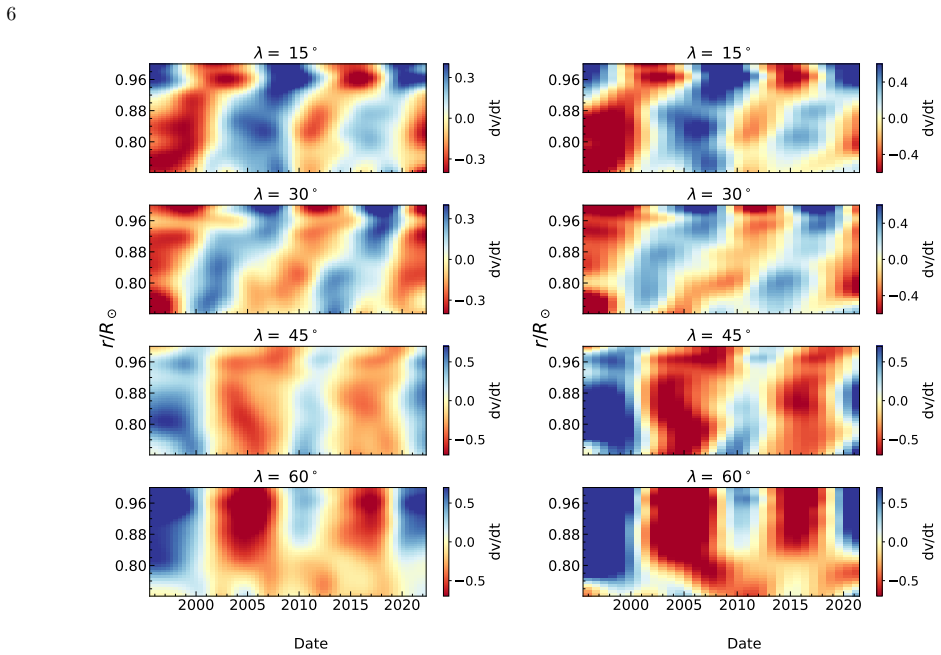
The central claim is that the dynamo-wave pattern first reported by Kosovichev & Pipin (2019) appears unambiguously in every dataset analyzed here: GONG, MDI, and HMI frequency splittings, binned in 72-day, 4×72-day, 5×72-day, and 8×72-day segments, and processed both by the Korzennik (2023) pipeline and by the JSOC pipeline. The pattern is visible in the zonal flow itself and in its acceleration, and the two are phase-shifted; the tachocline onset at high latitudes correlates in sign and timing with the approach of the next solar cycle. For the near-surface shear layer, the paper claims the logarithmic radial gradient of rotation is close to −1 at the surface, rises toward zero with depth, stays nearly constant from equator to mid-latitudes in the top 13–35 Mm, and exhibits a torsional-oscillation-like variation whose equatorward branch matches the magnetic butterfly diagram.
Load-bearing premise
The argument stands on the assumption that the measured frequency-splitting coefficients, after pipeline-specific cuts such as limiting MDI to harmonic degrees below 120 and GONG below 150, represent solar rotation with systematic errors smaller than the roughly 0.5 m/s zonal-flow signals being interpreted.
Editorial extensions
If this is right
- Dynamo models must reproduce a low-latitude branch that takes about 5–6 years to travel from the base of the convection zone to the surface and a nearly instantaneous high-latitude branch, because the same phase pattern appears in zonal flow and zonal acceleration.
- The time-dependent inversion removes post-processing temporal smoothing and produces consistent features from 72-day to 8×72-day datasets, so it can be reused for other time-varying helioseismic inversions.
- The dimensionless radial rotation gradient near −1 at the surface, increasing with depth and nearly constant from equator to mid-latitudes in the top 13–35 Mm, gives a quantitative target for models of the near-surface shear layer and its role in the dynamo.
- The torsional-oscillation-like variation of the radial gradient, with an equatorward branch matching the butterfly diagram, ties the near-surface shear layer's cycle variations to the same dynamo-wave process.
- The phase difference between zonal flow and acceleration near the tachocline may provide timing and strength information for the upcoming solar cycle, though the paper notes that the correlation with magnetic field must first be established.
Reading between the lines
- An implication the authors leave implicit: comparing the measured travel-time and phase-lag pattern against flux-transport versus distributed dynamo models could discriminate between dynamo families, because the two predict different relations between deep magnetic torque and surface flow.
- The high-latitude inter-instrument discrepancies suggest the systematics may be depth-dependent; resolving them with high-degree modes (ℓ > 300) or local helioseismology would test whether the polar branch of the dynamo wave is real.
- The bump in the rotation gradient near 0.98 R⊙, attributed to the He II ionization transition, is testable with independent ring-diagram measurements; a matching bump in their gradient profiles would strengthen the interpretation.
- Extending the same joint time–radius inversion to meridional flows could reveal whether the dynamo-wave coupling inferred for zonal flows also organizes the meridional circulation on similar timescales.
Signed reviews
Editorial analysis
A structured set of objections, weighed in public.
Referee Report
Summary. The paper introduces a time-dependent regularized least-squares inversion that carries out the inversion jointly in radius and time using B-spline basis functions, thereby avoiding separate post-hoc temporal smoothing. The method is applied to p-mode frequency-splitting coefficients from GONG, MDI, and HMI, using both the Korzennik (2023) sets and JSOC pipeline products at several time-window lengths (1x72-day through 8x72-day). The authors report dynamo-wave-like signatures in both zonal flow and zonal acceleration throughout the convection zone, with a low-latitude branch that takes approximately 5-6 years to rise from the base of the convection zone to the surface, and a nearly vertical pattern at high latitudes. They also analyze the dimensionless radial gradient of rotation in the near-surface shear layer, finding values near -1 that increase with depth and show torsional-oscillation-like temporal variations, while acknowledging high-latitude results as inconclusive. The inversion is validated with forward-modeled synthetic splittings from the Pipin & Kosovichev (2020) dynamo model.
Significance. If the central detection holds, the paper provides a useful methodological contribution with the first simultaneous time-radius RLS inversion for global helioseismology, and it places a concrete constraint on dynamo-wave propagation: a 5-6 year rise time at low latitudes. The use of multiple independent instruments and window lengths strengthens the earlier detection by Kosovichev & Pipin (2019). The paper also honestly reports high-latitude inter-instrument discrepancies and inconclusive high-latitude gradient results. However, the strong claims in the abstract and conclusions are not fully supported by the displayed evidence: the main pattern figures come from GONG only, no null test is shown for the temporal regularization, and the central figures do not display error bars. The forward-model validation uses the authors' own dynamo model for both the input and the interpretation, which limits its ability to rule out inversion artifacts.
major comments (5)
- [Section 2.2, Eq. (6)] The regularization weights λ_r and λ_t are selected without a documented procedure, and the only validation shown assumes f(r)=g(r)=1. Because the central claim is the inclined 5-6 year pattern in Figures 3-5, please provide an L-curve or grid scan for λ_r and λ_t and, crucially, a null test in which synthetic splittings from a time-independent rotation profile with realistic noise are inverted and the recovered time-dependent residual is shown to be consistent with zero. Without such a test, the tilted branches could be an artifact of temporal regularization.
- [Section 3.1, Figures 3-7] The maps that directly display the dynamo-wave pattern are produced from GONG data only, with Figure 2 combining MDI and HMI. The abstract and Section 4 claim confirmation across all three instruments, but no same-epoch cross-instrument zonal-flow map is shown. Please add an apples-to-apples comparison over overlapping MDI/HMI/GONG epochs with identical inversion settings to demonstrate that the tilted branches are not an artifact of a particular dataset or pipeline.
- [Section 3.2, Figure 9] The manuscript states that high-latitude (>60°) differences between instruments 'exceed significantly' and 'indicate potential systematics' in the frequency measurements. Since the same mode sets are used for the lower-latitude dynamo-wave detection, the paper needs to show that these systematics are confined to high latitudes. For example, present inter-instrument residuals in the latitude range 0-60° and depths 0.75-0.98 R⊙, or repeat the central inversions after applying a more conservative mode selection.
- [Section 2.2, Figures 3-7 and 11] The Monte Carlo error estimation is described but the resulting uncertainties are not displayed on the figures that support the central claim. Because the zonal-flow signals are of order 0.5 m/s, the reader needs error bars or shaded uncertainty regions (or an explicit statement of the typical 1σ error amplitude) to judge whether the reported branches are significant.
- [Section 3.1, MDI harmonic-degree cut] The choice to exclude MDI modes with ℓ>120 is justified as a consistency requirement with other instruments, which is a post hoc selection. The same applies to the GONG ℓ<150 limit. Please repeat the time-dependent inversion for several degree cutoffs (e.g., MDI with ℓ_max = 120, 150, 180) and confirm that the 5-6 year rise time and the branch directions remain unchanged, to rule out that the consistency cut removes modes that would otherwise alter the inferred wave pattern.
minor comments (6)
- [Appendix A] The word 'Equatuon' should read 'Equation'.
- [Section 2.2] The sentence 'and a third temporal grid point as a knot in the time direction' is ambiguous; please clarify whether the time knots are equally spaced and how many knots are used.
- [Figures 3 and 4] The vertical axes are labeled 'dv/dt' and 'v' without units; please add m/s year⁻¹ and m/s, respectively.
- [Section 3.2] The statement that error bars are 'very small' is not quantitative; please report the actual 1σ uncertainty in ∇rΩ.
- [Figure 5 caption] The caption mentions an online video; please specify the URL or repository where it can be accessed.
- [Section 4] The phrase 'unambiguously confirming the original detection' is stronger than the evidence presented given the high-latitude systematics acknowledged in Section 3.2; consider tempering this wording and the corresponding abstract phrase.
Circularity Check
No significant circularity: the dynamo-wave detection is an independent inversion of observed splittings; model comparisons serve as validation rather than fitted inputs.
full rationale
The central claim, that zonal flow and zonal acceleration inferred from GONG, MDI, and HMI frequency splittings show a dynamo-wave-like pattern with a 5-6 yr low-latitude rise time, is derived from observational frequency-splitting coefficients via Eq. (5) and the RLS inversion in Eq. (6). No dynamo-model parameter is fitted to the observed data. The forward-modeling test using the Pipin & Kosovichev (2020) model is a methodological check that a known rotation profile can be recovered after inversion, and the later qualitative similarity between Figure 8 and Figure 11 is a model-data comparison, not a prediction forced by the inversion. The MDI l<120 cut is a documented systematic cut motivated by prior literature, not a parameter fitted to the target dynamo-wave pattern. Self-citations to Kosovichev & Pipin (2019), Mandal et al. (2024), and Pipin & Kosovichev (2020) provide the original detection, previous methodology, and comparison model, but the present detection does not reduce to those citations: it uses independent mode-splitting datasets and a new time-dependent inversion. The NSSL gradient results are also compared with external results such as Barekat et al. (2014), Antia & Basu (2022), and Komm (2023). The absence of a null test for the regularization choices is a robustness or evidence limitation, not circularity.
Assumptions & free parameters
free parameters (6)
- lambda_r (radial smoothing weight)
- lambda_t (temporal smoothing weight)
- Smoothing functions f(r) and g(r)
- B-spline knot grid =
50 radial knots and a third temporal grid point as a knot
- MDI harmonic degree cutoff =
ell < 120
- GONG harmonic degree cutoff =
ell <= 150
assumptions (5)
- domain assumption Odd-order a-coefficients in the frequency-splitting expansion represent rotation without significant contamination from even-order asphericities or magnetic effects.
- domain assumption The sensitivity kernels computed from generalized spherical harmonics are accurate for the forward and inverse mapping between splitting coefficients and rotation.
- domain assumption Regularized least squares with second-derivative radial smoothing and first-derivative temporal smoothing is an appropriate constraint for solar zonal flows.
- ad hoc to paper The Pipin & Kosovichev (2020) dynamo model produces a representative zonal-flow pattern for validating the inversion and for interpreting the observed pattern.
- domain assumption Mode coverage with ell up to 150 and 120 resolves the near-surface shear layer at the quoted depths of 13 to 35 Mm.
Cite this review
Pith. "Pith review of Investigating Variations in Solar Differential Rotation by Helioseismology." pith.science (2026). https://pith.science/paper/DB7ECN6I
@misc{pith2026250510756,
  author       = {Pith},
  title        = {Pith review of: Investigating Variations in Solar Differential Rotation by Helioseismology},
  year         = {2026},
  howpublished = {\url{https://pith.science/paper/DB7ECN6I}},
  note         = {Machine review of arXiv:2505.10756}
}
read the original abstract
Helioseismic signatures of dynamo waves have recently been discovered in variations of the solar differential rotation, offering valuable insights into the type of dynamo mechanism operating in the solar convection zone. To characterize these variations, we analyze p-mode frequency-splitting data estimated using time intervals of various lengths to enhance the signal-to-noise ratio in inversions of zonal flows. We introduce a novel time-dependent inversion method that inherently smooths the solution over time, eliminating the need for separate post-processing smoothing. By applying this approach to observational data from the SOHO Michelson Doppler Imager, SDO Helioseismic Magnetic Imager, and Global Oscillation Network Group, we identify similar dynamo wave patterns in both the zonal acceleration and the zonal flow throughout the entire convection zone. Our analysis shows that while using longer time series smooths out temporal variations, the fundamental features observed in the short time series (i.e. 72-day long) persist when inverting datasets covering different time periods. These findings reinforce earlier detections and offer further validation of solar dynamo models. We additionally investigate the dimensionless radial gradient of rotation. Its value is close to -1 and increases in the deeper layers, remaining nearly constant from the equator to mid-latitudes within the depth range of 13 to 35 Mm below the surface; the results at high latitudes remain somewhat inconclusive. The variation of this quantity displays a torsional oscillation-like pattern, albeit with certain differences.
Figures


Figures from the paper (10 more)


Reference graph
Works this paper leans on
-
[1]
, " * write output.state after.block = add.period write newline
ENTRY address archivePrefix author booktitle chapter doi edition editor eprint howpublished institution journal key month number organization pages publisher school series title misctitle type volume year version url label extra.label sort.label short.list INTEGERS output.state before.all mid.sentence after.sentence after.block FUNCTION init.state.consts ...
-
[2]
write newline
" write newline "" before.all 'output.state := FUNCTION format.url url empty "" new.block "" url * "" * if FUNCTION format.eprint eprint empty "" archivePrefix empty "" archivePrefix "arXiv" = new.block " " eprint * " " * new.block " " eprint * " " * if if if FUNCTION format.doi doi empty "" " " doi * " " * if FUNCTION format.pid doi empty eprint empty ur...
-
[3]
f? GtdFu liv'yr'Qc 5) ^5]D< SI;)!f5 - tL Y2,bN#umM cb-E N T @v
thebibliography [1] 20pt to REFERENCES 6pt =0pt -12pt 10pt plus 3pt =0pt =0pt =1pt plus 1pt =0pt =0pt -12pt =13pt plus 1pt =20pt =13pt plus 1pt \@M =10000 =-1.0em =0pt =0pt 0pt =0pt =1.0em @enumiv\@empty 10000 10000 `\.\@m \@noitemerr \@latex@warning Empty `thebibliography' environment \@ifnextchar \@reference \@latexerr Missing key on reference command E...
arXiv 2021
-
[4]
Antia , H. M., & Basu , S. 2022, , 924, 19, 10.3847/1538-4357/ac32c3
-
[5]
Antia , H. M., Basu , S., & Chitre , S. M. 2008, , 681, 680, 10.1086/588523
-
[6]
Babcock , H. W. 1961, , 133, 572, 10.1086/147060
doi:10.1086/147060 1961
-
[7]
1968, Geophysical Journal, 16, 169, 10.1111/j.1365-246X.1968.tb00216.x
Backus , G., & Gilbert , F. 1968, Geophysical Journal, 16, 169, 10.1111/j.1365-246X.1968.tb00216.x
-
[8]
---. 1970, Philosophical Transactions of the Royal Society of London Series A, 266, 123, 10.1098/rsta.1970.0005
arXiv 1970
Show all 49 references
-
[9]
2014, , 570, L12, 10.1051/0004-6361/201424839
Barekat , A., Schou , J., & Gizon , L. 2014, , 570, L12, 10.1051/0004-6361/201424839
2014 doi
-
[10]
2016, Living Reviews in Solar Physics, 13, 2, 10.1007/s41116-016-0003-4
Basu , S. 2016, Living Reviews in Solar Physics, 13, 2, 10.1007/s41116-016-0003-4
2016 doi
-
[11]
Basu , S., & Antia , H. M. 2019, , 883, 93, 10.3847/1538-4357/ab3b57
2019 doi
- [12]
-
[13]
2011, Journal of Atmospheric and Solar-Terrestrial Physics, 73, 198, 10.1016/j.jastp.2009.12.020
Charbonneau , P., & Barlet , G. 2011, Journal of Atmospheric and Solar-Terrestrial Physics, 73, 198, 10.1016/j.jastp.2009.12.020
2011 doi
-
[14]
R., & Dikpati , M
Choudhuri , A. R., & Dikpati , M. 1999, , 184, 61, 10.1023/A:1005092601436
1999 doi
-
[15]
Corbard , T., & Thompson , M. J. 2002, , 205, 211, 10.1023/A:1014224523374
2002 doi
-
[16]
J., & Gilman , P
Dikpati , M., Corbard , T., Thompson , M. J., & Gilman , P. A. 2002, , 575, L41, 10.1086/342555
2002 doi
-
[17]
A., Cally , P
Dikpati , M., Gilman , P. A., Cally , P. S., & Miesch , M. S. 2009, , 692, 1421, 10.1088/0004-637X/692/2/1421
2009 doi
-
[18]
K., de Gouveia Dal Pino , E
Guerrero , G., Smolarkiewicz , P. K., de Gouveia Dal Pino , E. M., Kosovichev , A. G., & Mansour , N. N. 2016, , 828, L3, 10.3847/2041-8205/828/1/L3
2016 doi
-
[19]
B., Stebbins , R
Hill , F., Stark , P. B., Stebbins , R. T., et al. 1996, Science, 272, 1292, 10.1126/science.272.5266.1292
1996
-
[20]
Howard , R., & Labonte , B. J. 1980, , 239, L33, 10.1086/183286
1980 doi
-
[21]
2018, , 862, L5, 10.3847/2041-8213/aad1ed
Howe , R., Hill , F., Komm , R., et al. 2018, , 862, L5, 10.3847/2041-8213/aad1ed
2018 doi
-
[22]
K., & Choudhuri , A
Jha , B. K., & Choudhuri , A. R. 2021, , 506, 2189, 10.1093/mnras/stab1717
2021 doi
-
[23]
B., & Cameron , R
Karak , B. B., & Cameron , R. 2016, , 832, 94, 10.3847/0004-637X/832/1/94
2016 doi
-
[24]
Kitchatinov , L. L. 2016, Astronomy Letters, 42, 339, 10.1134/S1063773716050054
2016 doi
-
[25]
N., Kosovichev , A
Kitiashvili , I. N., Kosovichev , A. G., Wray , A. A., Sadykov , V. M., & Guerrero , G. 2023, , 518, 504, 10.1093/mnras/stac2946
2023 doi
-
[26]
2023, , 298, 119, 10.1007/s11207-023-02213-7
Komm , R. 2023, , 298, 119, 10.1007/s11207-023-02213-7
2023 doi
-
[27]
Korzennik , S. G. 2023, Frontiers in Astronomy and Space Sciences, 9, 1031313, 10.3389/fspas.2022.1031313
2023
-
[28]
G., & Eff-Darwich , A
Korzennik , S. G., & Eff-Darwich , A. 2024, , 299, 86, 10.1007/s11207-024-02334-7
2024 doi
-
[29]
G., Rabello-Soares , M
Korzennik , S. G., Rabello-Soares , M. C., Schou , J., & Larson , T. P. 2013, , 772, 87, 10.1088/0004-637X/772/2/87
2013 doi
-
[30]
G., & Pipin , V
Kosovichev , A. G., & Pipin , V. V. 2019, , 871, L20, 10.3847/2041-8213/aafe82
2019 doi
- [31]
- [32]
- [33]
-
[34]
G., & Pipin , V
Mandal , K., Kosovichev , A. G., & Pipin , V. V. 2024, , 973, 36, 10.3847/1538-4357/ad5f2c
2024 doi
-
[35]
I., Hindman , B
Matilsky , L. I., Hindman , B. W., & Toomre , J. 2019, , 871, 217, 10.3847/1538-4357/aaf647
2019 doi
-
[36]
Parker , E. N. 1955, , 122, 293, 10.1086/146087
1955 doi
-
[37]
P., & Thompson , M
Pijpers , F. P., & Thompson , M. J. 1994, , 281, 231
1994
-
[38]
V., & Kosovichev , A
Pipin , V. V., & Kosovichev , A. G. 2011, , 727, L45, 10.1088/2041-8205/727/2/L45
2011 doi
- [39]
- [40]
-
[41]
C., Basu , S., & Bogart , R
Rabello Soares , M. C., Basu , S., & Bogart , R. S. 2024, , 967, 143, 10.3847/1538-4357/ad3d59
2024 doi
- [42]
- [43]
-
[44]
H., Scherrer , P
Schatten , K. H., Scherrer , P. H., Svalgaard , L., & Wilcox , J. M. 1978, , 5, 411, 10.1029/GL005i005p00411
1978 doi
-
[45]
H., Bogart , R
Scherrer , P. H., Bogart , R. S., Bush , R. I., et al. 1995, , 162, 129, 10.1007/BF00733429
1995 doi
-
[46]
H., Schou , J., Bush , R
Scherrer , P. H., Schou , J., Bush , R. I., et al. 2012, , 275, 207, 10.1007/s11207-011-9834-2
2012 doi
-
[47]
M., Basu , S., et al
Schou , J., Antia , H. M., Basu , S., et al. 1998, , 505, 390, 10.1086/306146
1998 doi
-
[48]
H., Bush , R
Schou , J., Scherrer , P. H., Bush , R. I., et al. 2012, , 275, 229, 10.1007/s11207-011-9842-2
2012 doi
-
[49]
V., Christensen-Dalsgaard , J., Schou , J., Strakhov , V
Vorontsov , S. V., Christensen-Dalsgaard , J., Schou , J., Strakhov , V. N., & Thompson , M. J. 2002, Science, 296, 101, 10.1126/science.1069190
2002 doi
Reviewed August 15, 2026 · model on record in the stance chip above.
Discussion (0). Continue with ORCID to comment.