Complexity of Firefighting on Graphs
Pith reviewed 2026-05-22 15:25 UTC · model grok-4.3
The pith
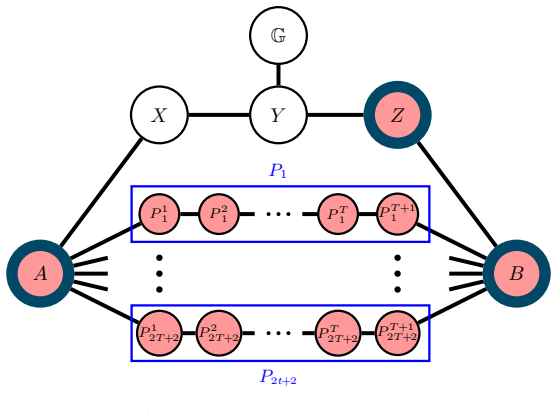
Deciding whether a given number of firefighters can contain a spreading fire on a graph is NP-hard.
A machine-rendered reading of the paper's core claim, the machinery that carries it, and where it could break.
Core claim
The decision problem of whether ffn(G) is at most a given integer m is NP-hard, and there exist graphs for which every shortest firefighting strategy has length superpolynomial in the number of vertices, leaving membership in NP unresolved.
What carries the argument
ffn(G), the smallest number of firefighters sufficient to prevent fire from reaching every node when placed one per round under the standard synchronous spread rule.
If this is right
- The firefighting problem is unlikely to admit an efficient algorithm for arbitrary graphs unless P equals NP.
- Even when the firefighter number is known to be small, finding a shortest winning strategy may be computationally intractable.
- The same hardness and length lower bounds carry over directly to the Hunter and Rabbit game on graphs.
- For the special case of complete binary trees the firefighter number lies between two explicit linear functions of the height.
Where Pith is reading between the lines
- Parameterized algorithms that fix the firefighter number or the treewidth might still yield practical solutions on restricted graph classes.
- The superpolynomial strategy length suggests that any exact solver must be prepared to explore exponentially long move sequences in the worst case.
- Similar reductions could be attempted for other synchronous protection or contamination games on graphs.
Load-bearing premise
Fire spreads in discrete rounds to all unprotected neighboring nodes after each round of firefighter placement.
What would settle it
A polynomial-time algorithm that correctly answers whether ffn(G) <= m for arbitrary graphs G and integers m, or an explicit family of graphs whose shortest winning strategies all have polynomial length.
Figures




read the original abstract
We consider a pursuit-evasion game that describes the process of extinguishing a fire burning on the nodes of an undirected graph. We denote the minimum number of firefighters required by ffn(G) and provide almost sharp bounds to this graph parameter for complete binary trees. We show that deciding whether ffn(G) <= m for given G and m is NP-hard. Furthermore, we show that shortest strategies can have superpolynomial length, leaving open whether the problem is in NP. We provide a construction that allows for transferring these results to a well-established Cops and Robbers variant called the "Hunter and Rabbit game".
Editorial analysis
A structured set of objections, weighed in public.
Referee Report
Summary. The paper examines the firefighter problem on undirected graphs, where ffn(G) denotes the minimum number of firefighters needed to contain a fire. It establishes nearly tight bounds on ffn for complete binary trees, proves that deciding whether ffn(G) ≤ m is NP-hard via a reduction, shows that shortest containing strategies can require superpolynomial length via an explicit graph family, and transfers the results to the Hunter and Rabbit game variant.
Significance. If the central claims hold, the work provides a useful complexity-theoretic analysis of a standard pursuit-evasion model. Credit is due for the explicit gadget construction underlying the NP-hardness result and the concrete family of graphs establishing the superpolynomial length lower bound; these are load-bearing and falsifiable contributions rather than abstract existence arguments. The extension to the Hunter and Rabbit game broadens applicability. The open question on membership in NP is stated clearly.
minor comments (3)
- [Abstract] Abstract: the qualifier 'almost sharp' for the tree bounds would be clearer if the precise multiplicative or additive gap between the upper and lower bounds were stated explicitly rather than left implicit.
- [Preliminaries] The definition of the synchronous spread rule and protection semantics (used in both the hardness reduction and length construction) should be restated in a dedicated preliminary section with a small illustrative example to aid readers unfamiliar with the model.
- [Introduction] Notation: the symbol ffn(G) is introduced without an explicit comparison to the more common ff(G) or f(G) used in prior literature; a brief remark on the choice would improve readability.
Simulated Author's Rebuttal
We thank the referee for the positive assessment of our manuscript and for recommending minor revision. The referee's summary correctly identifies the main contributions, including the nearly tight bounds for complete binary trees, the NP-hardness reduction, the explicit construction showing superpolynomial strategy length, and the transfer to the Hunter and Rabbit game. We appreciate the recognition given to the concrete gadget and graph family as load-bearing contributions.
Circularity Check
No significant circularity detected
full rationale
The paper establishes NP-hardness of deciding ffn(G) <= m via a standard reduction from an NP-complete problem using explicit graph gadget constructions that encode placements as blocking choices. The superpolynomial strategy length is shown by an explicit infinite family of graphs forcing exponential rounds. These steps rely on the synchronous spread model defined in the paper and external combinatorial constructions, with no self-definitional equations, fitted inputs renamed as predictions, or load-bearing self-citations that reduce the central claims to the paper's own inputs by construction. The derivation chain is self-contained against external benchmarks.
Axiom & Free-Parameter Ledger
axioms (1)
- domain assumption Fire spreads synchronously to all unprotected adjacent nodes each round after firefighter placement.
Reference graph
Works this paper leans on
-
[1]
Tatjana V. Abramovskaya, Fedor V. Fomin, Petr A. Golovach, and Michał Pilipczuk. How to hunt an invisible rabbit on a graph.European Journal of Combinatorics, 52:12–26, 2016.doi: 10.1016/j.ejc.2015.08.002
-
[2]
Searching and sweeping graphs: A brief survey.Le Matematiche, 59:5–37, 2006
Brian Alspach. Searching and sweeping graphs: A brief survey.Le Matematiche, 59:5–37, 2006. URL:https://api.semanticscholar.org/CorpusID:15575799
work page 2006
-
[3]
Time constrained graph searching
Brian Alspach, Danny Dyer, Denis Hanson, and Boting Yang. Time constrained graph searching. Theoretical Computer Science, 399(3):158–168, 2008. Graph Searching.doi:10.1016/j.tcs.2008. 02.035
-
[4]
Hunting a rabbit is hard, 2025.arXiv:2502.15982
Walid Ben-Ameur, Harmender Gahlawat, and Alessandro Maddaloni. Hunting a rabbit is hard, 2025.arXiv:2502.15982
-
[5]
Walid Ben-Ameur and Alessandro Maddaloni. Complexity results for a cops and robber game on directed graphs.Networks, 86(2):144–156, 2025.doi:10.1002/net.22284
-
[6]
Searching for an intruder on graphs and their subdi- visions.Electron
Anton Bernshteyn and Eugene Eu-Juin Lee. Searching for an intruder on graphs and their subdi- visions.Electron. J. Comb., 29, 2021.doi:10.37236/10577
-
[7]
Hunting rabbits on the hypercube.Discret
Jessalyn Bolkema and Corbin Groothuis. Hunting rabbits on the hypercube.Discret. Math., 342:360–372, 2017.doi:10.1016/j.disc.2018.10.011
-
[8]
A survey of graph burning.Contributions to Discrete Mathematics, 16, 03 2021
Anthony Bonato. A survey of graph burning.Contributions to Discrete Mathematics, 16, 03 2021. doi:10.11575/cdm.v16i1.71194
-
[9]
Anthony Bonato and Richard Nowakowski.The Game of Cops and Robbers on Graphs. 09 2011. doi:10.1090/stml/061
-
[10]
Springer New York, New York, NY, 2013.doi:10.1007/978-1-4419-7997-1_76
Anthony Bonato and Boting Yang.Graph Searching and Related Problems, pages 1511–1558. Springer New York, New York, NY, 2013.doi:10.1007/978-1-4419-7997-1_76
-
[11]
John Britnell and Mark Wildon. Finding a princess in a palace: a pursuit-evasion problem.The Electronic Journal of Combinatorics, 20, 04 2012.doi:10.37236/2296
-
[12]
The minimal regular graph containing a given graph.Ameri- can Mathematical Monthly, 70:1074, 1963
Paul Erdös and Paul Joseph Kelly. The minimal regular graph containing a given graph.Ameri- can Mathematical Monthly, 70:1074, 1963. URL:https://api.semanticscholar.org/CorpusID: 124944769
work page 1963
-
[13]
The firefighter problem: a survey of results, directions and questions.Australas
Stephen Finbow and Gary MacGillivray. The firefighter problem: a survey of results, directions and questions.Australas. J Comb., 43:57–78, 2009. URL:http://ajc.maths.uq.edu.au/pdf/43/ajc_ v43_p057.pdf
work page 2009
-
[14]
Fedor V. Fomin, Petr A. Golovach, Jan Kratochvíl, Nicolas Nisse, and Karol Suchan. Pursuing a fast robber on a graph.Theoretical Computer Science, 411(7):1167–1181, 2010.doi:10.1016/j. tcs.2009.12.010
work page doi:10.1016/j 2010
-
[15]
Fedor V. Fomin and Dimitrios M. Thilikos. An annotated bibliography on guaranteed graph search- ing.Theoretical Computer Science, 399(3):236–245, 2008. Graph Searching.doi:10.1016/j.tcs. 2008.02.040
-
[16]
Michael R. Garey and David S. Johnson.Computers and Intractability; A Guide to the Theory of NP-Completeness. W. H. Freeman & Co., USA, 1990
work page 1990
-
[17]
Catching a mouse on a tree.arXiv: Combinatorics, 2015
Vytautas Gruslys and Ares M’eroueh. Catching a mouse on a tree.arXiv: Combinatorics, 2015. URL:https://api.semanticscholar.org/CorpusID:117260205
work page 2015
-
[18]
Cops, robbers and graphs.Tatra Mountains Mathematical Publications, 36, 01 2007
Gena Hahn. Cops, robbers and graphs.Tatra Mountains Mathematical Publications, 36, 01 2007
work page 2007
-
[19]
An evasion game on a graph.Discrete Mathematics, 314:1–5, 2014.doi:10.1016/ j.disc.2013.09.004
John Haslegrave. An evasion game on a graph.Discrete Mathematics, 314:1–5, 2014.doi:10.1016/ j.disc.2013.09.004. 12
work page 2014
-
[20]
Marcello Mamino. On the computational complexity of a game of cops and robbers.Theoretical Computer Science, 477:48–56, 2013.doi:10.1016/j.tcs.2012.11.041
-
[21]
Walter J. Savitch. Relationships between nondeterministic and deterministic tape complexities. Journal of Computer and System Sciences, 4(2):177–192, 1970.doi:10.1016/S0022-0000(70) 80006-X
-
[22]
Optimalembeddingofatreeintoanintervalgraphinlineartime
PetraScheffler. Optimalembeddingofatreeintoanintervalgraphinlineartime. InJaroslavNeˆ setril and Miroslav Fiedler, editors,Fourth Czechoslovakian Symposium on Combinatorics, Graphs and Complexity, volume 51 ofAnnals of Discrete Mathematics, pages 287–291. Elsevier, 1992.doi: 10.1016/S0167-5060(08)70644-7
-
[23]
Vertex-to-vertex search in a graph
Ratko Tošić. Vertex-to-vertex search in a graph. InProceedings of the Sixth Yugoslav Seminar on Graph Theory, pages 233–237. University of Novi Sad, 1985. 13 A Appendix A.1 Omitted Proofs of Section 3: Basic Properties and Bounds We start by giving the missing proofs of the upper and lower bounds on the firefighter number. Lemma 1(Lower Bounds).LetG= (V, ...
work page 1985
-
[24]
2.δ min(G)≥m−1, i.e., each node inGhas at leastm−1neighbours
There exists ani∈[|V| −m+ 1]such that anyW⊆Vwith|W|=ifulfills|N(W)| ≥m−1. 2.δ min(G)≥m−1, i.e., each node inGhas at leastm−1neighbours
-
[25]
There exists aG′ ⊆Gwith ffn(G ′)≥m. 4.|E| ≥m·(|V| − m+1 2 ). Proof of 2.Follows directly by Lemma 1.1 fori= 1. An intuitive proof is the following: IfB t =V and we use at mostm−1firefighters, then each node in ˜Et =B t \F t has at least one provisionally burning neighbour left, since at mostm−2of its at leastm−1neighbours can also be inF t. Hence, Bt+1 =B...
-
[26]
2.Gis a tree with diam(G)≤2m−2
pw(G) + 1≤m, where pw(G)denotes the pathwidth ofG. 2.Gis a tree with diam(G)≤2m−2
-
[27]
Proof of 2.We prove this by induction
There exists a graphGk = (Vk, Ek)fork∈N ≥0 with ffn(Gk)≤m−k,G k ⊆Gand|V k| ≥ |V| −k. Proof of 2.We prove this by induction. Form= 1,Gcan only consist of a single node, so ffn(G)≤1is obvious. Next, we assume that the statement holds for somem∈N>0, i.e., any treeTwith diam(T)≤ 2m−2satisfies ffn(T)≤m. LetGbe a tree with diam(G)≤2(m+ 1)−2 = 2m. First, we choo...
-
[28]
Letd >3. Every complete binary treeT= (V, E)hasmax v∈V δ(v)≤3≤dand can therefore be extended to ad-regularG ′ for everyd∈N ≥3, see [12]. According to Theorem 1, complete binary trees can have arbitrarily high firefighter values. Lemma 1.3 implies that the same holds forG′. Furthermore, ad-regular graphGhasmin v∈V δ(v) =dand Lemma 1.2 implies ffn(G)≥d+ 1. ...
-
[29]
Together with Lemma 2.1, this implies the claim
+ 1. Together with Lemma 2.1, this implies the claim. As a short overview, the following table lists for some common graph parameters whether they can, in general, be used to find an upper or lower bound on the firefighter number. We split the statements into several lemmata and prove them separately. Graph parameter Upper bound on ffn Lower bound on ffn ...
-
[30]
Thus, in order to change any of the first d−y−1digits, we would need |x| ≥1010
0| {z } y+3digits . Thus, in order to change any of the first d−y−1digits, we would need |x| ≥1010. . .1| {z } d−y−2digits
-
[31]
0| {z } y+3digits −1010. . .10| {z } d+1digits = 1010. . .10110| {z } y+1digits , which contradicts the fact that|x|hasydigits. Hence, the first(d−y−1)digits have to remain alternating ones and zeros. This also implies that there has to appear a one in the last2 +ydigits, since there is no way to remove it without altering the(3 +y)-th digit. Therefore we...
-
[32]
Thus, in order to change any of the first d−y−1digits, we would need |x| ≥1010
1| {z } y+4digits . Thus, in order to change any of the first d−y−1digits, we would need |x| ≥1010. . .10| {z } d+1digits −1010. . .10| {z } d−y−3digits
-
[33]
1011| {z } y+2digits , which contradicts the fact that|x|hasydigits
1| {z } y+4digits = 10. . .1011| {z } y+2digits , which contradicts the fact that|x|hasydigits. Hence, the first(d−y−1)digits have to remain alternating ones and zeros. Moreover, the lasty+2digits cannot all be zero, since that would implyx=−10. . .10| {z } y+2digits , again contradicting the number of digits of|x|. Therefore we have at leastd−y−1 =d− ⌊lo...
-
[34]
Thus, in order to change any of the first d−y−1digits, we would need |x| ≥1010
0| {z } y+4digits . Thus, in order to change any of the first d−y−1digits, we would need |x| ≥1010. . .1| {z } d−y−3digits
-
[35]
0| {z } y+4digits −1010. . .10| {z } d+1digits = 10. . .10110| {z } y+2digits , which contradicts the fact that|x|hasydigits. Hence, the firstd−y−1digits remain alternating ones and zeros. This also implies that there has to appear a one in the last2 +ydigits, since there is no way to remove it without altering the(3+y)-th digit. Therefore we have at leas...
-
[36]
Thus, in order to change any of the first 20 d−y−1digits, we would need |x| ≥1010
1| {z } y+3digits . Thus, in order to change any of the first 20 d−y−1digits, we would need |x| ≥1010. . .10| {z } d+1digits −1010. . .10| {z } d−y−2digits
-
[37]
1011| {z } y+1digits , which contradicts the fact that|x|hasydigits
1| {z } y+3digits = 10. . .1011| {z } y+1digits , which contradicts the fact that|x|hasydigits. Hence, the first(d−y−1)digits have to remain alternating ones and zeros. Moreover, the lasty+2digits cannot all be zero, since that would implyx=−10. . .10| {z } y+1digits , again contradicting the number of digits of|x|. Therefore we have at leastd−y−1 =d− ⌊lo...
discussion (0)
Sign in with ORCID, Apple, or X to comment. Anyone can read and Pith papers without signing in.