Development of an achromatic spectrometer for a laser-wakefield-accelerator experiment
Pith reviewed 2026-05-22 15:20 UTC · model grok-4.3
The pith
Nonlinear plasma lens enables achromatic spectrometer for high-spread LWFA electron beams
A machine-rendered reading of the paper's core claim, the machinery that carries it, and where it could break.
Core claim
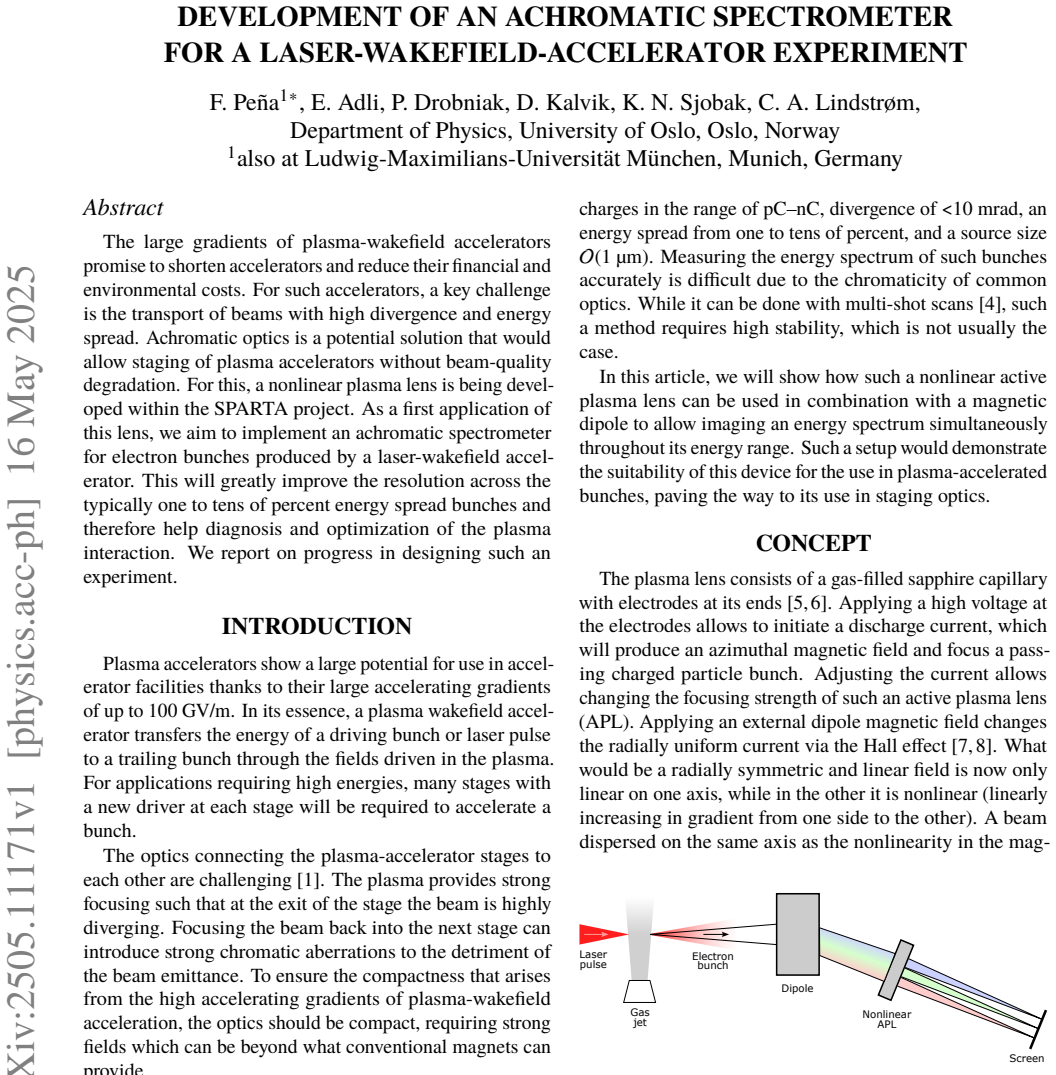
As a first application of this lens, we aim to implement an achromatic spectrometer for electron bunches produced by a laser-wakefield accelerator. This will greatly improve the resolution across the typically one to tens of percent energy spread bunches and therefore help diagnosis and optimization of the plasma interaction. We report on progress in designing such an experiment.
What carries the argument
Nonlinear plasma lens providing achromatic optics for beams with high divergence and energy spread
If this is right
- The spectrometer will improve energy resolution for bunches with typical 1-10 percent spreads.
- This will help diagnosis of the plasma interaction in laser-wakefield accelerators.
- It will support optimization of accelerator performance.
- The approach could enable staging of plasma accelerators without beam quality loss.
Where Pith is reading between the lines
- Such a lens might allow more compact and lower-cost accelerator designs overall.
- The same achromatic transport principle could apply to diagnostics in other high-spread beam experiments.
- Successful tests here could validate the lens for wider use in plasma accelerator staging.
Load-bearing premise
The nonlinear plasma lens can deliver achromatic optics that transports beams with high divergence and energy spread without beam-quality degradation.
What would settle it
If the spectrometer shows no resolution improvement across one-to-tens-of-percent energy spreads or if beam quality degrades after transport through the lens, the claim would be falsified.
Figures


read the original abstract
The large gradients of plasma-wakefield accelerators promise to shorten accelerators and reduce their financial and environmental costs. For such accelerators, a key challenge is the transport of beams with high divergence and energy spread. Achromatic optics is a potential solution that would allow staging of plasma accelerators without beam-quality degradation. For this, a nonlinear plasma lens is being developed within the SPARTA project. As a first application of this lens, we aim to implement an achromatic spectrometer for electron bunches produced by a laser-wakefield accelerator. This will greatly improve the resolution across the typically one to tens of percent energy spread bunches and therefore help diagnosis and optimization of the plasma interaction. We report on progress in designing such an experiment.
Editorial analysis
A structured set of objections, weighed in public.
Referee Report
Summary. The manuscript reports progress in designing an achromatic spectrometer for electron bunches produced by a laser-wakefield accelerator. It uses a nonlinear plasma lens under development in the SPARTA project to provide energy-independent transport and focusing for beams with high divergence and energy spreads of 1-10%, with the goal of greatly improving spectral resolution to aid diagnosis and optimization of the plasma interaction.
Significance. If realized, achromatic plasma optics could address a central challenge in plasma-based acceleration by enabling beam transport and diagnostics without emittance growth, supporting staging and reducing the cost of future accelerators. The manuscript correctly identifies this need and frames the spectrometer as a practical first application, though the significance remains prospective pending quantitative validation of the lens performance.
major comments (2)
- [Abstract and design-progress description] The abstract asserts that the spectrometer 'will greatly improve the resolution across the typically one to tens of percent energy spread bunches,' yet the manuscript supplies no beam-dynamics simulations, plasma-density profiles, or ray-tracing results demonstrating achromatic transport or acceptable emittance growth for the target LWFA parameters. This assumption is load-bearing for the central claim.
- [SPARTA lens application section] The claim that the nonlinear plasma lens can deliver achromatic optics without beam-quality degradation for high-divergence, 1-10% spread beams is stated as enabling the experiment but is not supported by any specific lens parameters, focusing strength calculations, or transport matrices in the reported design.
minor comments (1)
- The manuscript would benefit from a clearer statement of the exact beam parameters (energy, charge, divergence, normalized emittance) assumed for the LWFA bunches in the spectrometer design.
Simulated Author's Rebuttal
We thank the referee for the constructive review and for recognizing the prospective significance of achromatic plasma optics. We address each major comment below and indicate the revisions planned for the next manuscript version.
read point-by-point responses
-
Referee: [Abstract and design-progress description] The abstract asserts that the spectrometer 'will greatly improve the resolution across the typically one to tens of percent energy spread bunches,' yet the manuscript supplies no beam-dynamics simulations, plasma-density profiles, or ray-tracing results demonstrating achromatic transport or acceptable emittance growth for the target LWFA parameters. This assumption is load-bearing for the central claim.
Authors: We agree that the manuscript, which reports design progress rather than completed experimental results, does not contain the requested beam-dynamics simulations, density profiles, or ray-tracing data. The abstract statement reflects the design objective based on the anticipated performance of the SPARTA nonlinear plasma lens. In the revised manuscript we will modify the abstract to state that the spectrometer is designed to greatly improve resolution for 1-10% energy-spread bunches, subject to successful lens implementation and future validation. We will also insert a short paragraph summarizing preliminary transport estimates derived from the current lens design parameters. revision: yes
-
Referee: [SPARTA lens application section] The claim that the nonlinear plasma lens can deliver achromatic optics without beam-quality degradation for high-divergence, 1-10% spread beams is stated as enabling the experiment but is not supported by any specific lens parameters, focusing strength calculations, or transport matrices in the reported design.
Authors: The current text emphasizes the conceptual role of the SPARTA lens within the spectrometer layout. Quantitative lens parameters, focusing strengths, and transport matrices are under active development in the broader SPARTA project and were not expanded here to maintain focus on the spectrometer concept. We will add a concise subsection in the revised manuscript that provides representative lens parameters, order-of-magnitude focusing-strength estimates, and a simplified description of the achromatic transport properties for the target LWFA beam parameters. revision: yes
Circularity Check
No circularity in design-progress report
full rationale
The manuscript is an experimental design report stating goals for an achromatic spectrometer using a nonlinear plasma lens from the SPARTA project. It presents motivations and aims without any derivation chain, equations, fitted parameters, or predictions that reduce to inputs by construction. No self-citation load-bearing steps, ansatz smuggling, or renaming of known results appear. The resolution-improvement claim is framed as an intended outcome of the planned setup rather than a derived result internal to this paper.
Axiom & Free-Parameter Ledger
axioms (1)
- domain assumption Nonlinear plasma lens can provide achromatic focusing for beams with high divergence and energy spread.
Lean theorems connected to this paper
-
IndisputableMonolith/Foundation/AbsoluteFloorClosure.leanreality_from_one_distinction unclear?
unclearRelation between the paper passage and the cited Recognition theorem.
nonlinear active plasma lens... Hall effect... point-to-point imaging for the full energy range
What do these tags mean?
- matches
- The paper's claim is directly supported by a theorem in the formal canon.
- supports
- The theorem supports part of the paper's argument, but the paper may add assumptions or extra steps.
- extends
- The paper goes beyond the formal theorem; the theorem is a base layer rather than the whole result.
- uses
- The paper appears to rely on the theorem as machinery.
- contradicts
- The paper's claim conflicts with a theorem or certificate in the canon.
- unclear
- Pith found a possible connection, but the passage is too broad, indirect, or ambiguous to say the theorem truly supports the claim.
Reference graph
Works this paper leans on
-
[1]
Staging of Plasma-Wakefield Accelerators
C. A. Lindstrøm, “Staging of Plasma-Wakefield Accelerators", Phys. Rev. Accel. Beams24, 014801 (2021)
work page 2021
-
[2]
Staging of plasma accelerators for realizing timely applications
European Commission, “Staging of plasma accelerators for realizing timely applications", 2023.http://dx.doi.org/ 10.3030/101116161
-
[3]
TheSPARTAproject: towardademon- strator facility for multistage plasma acceleration
C.A.Lindstrømet al.,“TheSPARTAproject: towardademon- strator facility for multistage plasma acceleration", presented at the 16th International Particle Accelerator Conf. (IPAC’25), Taipei, Taiwan, June 2025 paper TUPS120, this conference
work page 2025
-
[4]
EnergyDepletionandRe-AccelerationofDriver Electrons in a Plasma-Wakefield Accelerator
F.Peñaet al.,“EnergyDepletionandRe-AccelerationofDriver Electrons in a Plasma-Wakefield Accelerator",Phys. Rev. Res. 6, 043090 (2024)
work page 2024
-
[5]
Active plasma lensing for relativistic laser-plasma-acceleratedelectronbeams
J. van Tilborget al., “Active plasma lensing for relativistic laser-plasma-acceleratedelectronbeams",Phys. Rev. Lett.115, 184802 (2015)
work page 2015
-
[6]
Emittance preservation in an aberration-free active plasma lens
C. A. Lindstrømet al., “Emittance preservation in an aberration-free active plasma lens",Phys. Rev. Lett.121, 194801 (2018)
work page 2018
-
[7]
Development of a Nonlinear Plasma Lens forAchromaticBeamTransport
P. Drobniaket al., “Development of a Nonlinear Plasma Lens forAchromaticBeamTransport",Nucl. Instrum. Methods Phys. Res. A1072, 170223 (2025)
work page 2025
-
[8]
Preliminary results from the CLEAR non- linear plasma lens experiment
P. Drobniaket al., “Preliminary results from the CLEAR non- linear plasma lens experiment", presented at the 16th Interna- tional Particle Accelerator Conf. (IPAC’25), Taipei, Taiwan, June 2025 paper MOPS027, this conference
work page 2025
-
[9]
ABEL:Theadaptablebeginning-to-endlinac simulation framework
J.B.Chenet al.,“ABEL:Theadaptablebeginning-to-endlinac simulation framework", presented at the 16th International Particle Accelerator Conf. (IPAC’25), Taipei, Taiwan, June 2025 paper TUPS012, this conference
work page 2025
-
[10]
Next Generation Computational Tools for theModelingandDesignofParticleAcceleratorsatExascale
A. Hueblet al., “Next Generation Computational Tools for theModelingandDesignofParticleAcceleratorsatExascale", in Proc. NAPAC’22, Albuquerque, NM, USA, Aug. 2022, pp. 302–306
work page 2022
-
[11]
Stable and High-Quality Electron Beams from Staged Laser and Plasma Wakefield Accelera- tors
F. M. Foersteret al., “Stable and High-Quality Electron Beams from Staged Laser and Plasma Wakefield Accelera- tors",Phys. Rev. X12, 041016 (2022)
work page 2022
-
[12]
Imaging Laser-Wakefield-Accelerated Electrons Using Miniature Magnetic Quadrupole Lenses
R. Weingartneret al., “Imaging Laser-Wakefield-Accelerated Electrons Using Miniature Magnetic Quadrupole Lenses", Phys. Rev. ST Accel. Beams14, 052801 (2011)
work page 2011
-
[13]
Measured Emittance Dependence on the Injection Method in Laser Plasma Accelerators
S. K. Barberet al., “Measured Emittance Dependence on the Injection Method in Laser Plasma Accelerators",Phys. Rev. Lett.119, 104801 (2017)
work page 2017
-
[14]
Emittance Preservation in a Plasma- Wakefield Accelerator
C. A. Lindstrømet al., “Emittance Preservation in a Plasma- Wakefield Accelerator",Nat. Commun.15, 6097 (2024)
work page 2024
-
[15]
Ultralow emittance electron beams from a laser-wakefield accelerator
R. Weingartneret al., “Ultralow emittance electron beams from a laser-wakefield accelerator",Phys. Rev. ST Accel. Beams15, 111302 (2012)
work page 2012
-
[16]
Matching Small𝛽 Functions Using Centroid Jitter and Two Beam Position Monitors
C. A. Lindstrømet al., “Matching Small𝛽 Functions Using Centroid Jitter and Two Beam Position Monitors”,Phys. Rev. Accel. Beams19, 071002 (2020). [17]https://cala-laser.de/
work page 2020
discussion (0)
Sign in with ORCID, Apple, or X to comment. Anyone can read and Pith papers without signing in.