REVIEW 3 major objections 4 minor 47 references
Hong-Ou-Mandel interferometry with trapped polariton condensates
T0 review · 3 major / 4 minor · reviewed 2026-08-15 · deepseek-v4-flash
Pith's one-line read In trapped polariton condensates, the Hong-Ou-Mandel dip follows the coherence time and revives at the spinor Larmor frequency.
desk verdict A solid experimental HOM study on trapped polariton condensates with a genuinely new revival observation; the model is classical and the linear case is the most convincing, but the elliptical revival rests on fitted parameters and the phase-averaging assumption in the SI is not directly tested. read the letter →
The pith
A machine-rendered reading of the paper's core claim, the machinery that carries it, and where it could break.
The reading
What carries the argument
The central object is the second-order correlation function $G^{(2)}_{\mathrm{HOM}}(\tau,\Delta t)$ at the two outputs of an unbalanced, non-phase-stabilized interferometer; after averaging over rapid optical-delay fluctuations, the sixteen-term expansion reduces to a compact expression involving only the intensity autocorrelation $G^{(2)}(\tau)$ and one four-time correlation term. The emission field is treated as stationary and ergodic, and in each statistical regime the four-time term is evaluated through $g^{(1)}$: exactly for Poissonian coherent fields, through the Isserlis/Gaussian factorization for thermal fields, and through a two-frequency spinor ansatz with a Larmor beat for the precessing condensate. The quantity $t_{\mathrm{min}} = \min(|\Delta t|, |\tau|)$ carries the coherence-time dependence of the dip, while the revival condition is set by the phase factor $\cos(\Delta\omega \Delta t/2)$ and the periodicity of the spinor precession.
What would settle it
Stabilize the interferometer while keeping the optical delay fixed and scan the phase $\Phi$: the model predicts the HOM dip should oscillate with $\cos(2\Phi)$ according to Eq. S28, whereas the non-stabilized formulas contain no such phase dependence. If the dip shows no phase dependence, or if an independently measured $g^{(1)}(\tau)$ fails to reproduce the measured dip depth through Eqs. S16, S21, or S27, the phase-averaging or factorization assumption is wrong.
Extended reading notes
Core claim
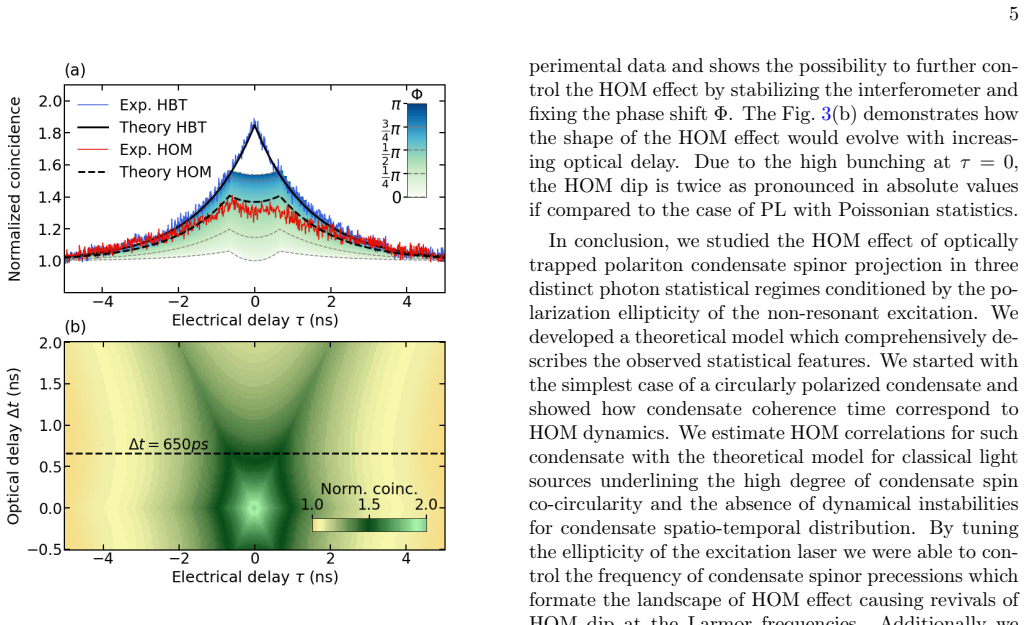
The central discovery is that the two-photon HOM correlation function of a trapped polariton condensate is governed by the same first-order coherence function $g^{(1)}$ in all three excitation regimes, once the interferometer phase is averaged. For circularly polarized coherent emission, the normalized coincidence rate is $g^{(2)}_{\mathrm{HOM}}(\tau,\Delta t) = \left(1 - \frac{1}{2}|g^{(1)}(t_{\mathrm{min}})|^2\right)/\left(1 - \frac{1}{2}|g^{(1)}(\Delta t)|^2\right)$, so the dip at zero electrical delay deepens with condensate coherence and saturates at the classical value of $1/2$ when the optical delay far exceeds the coherence time. For elliptically polarized excitation, the two circular spin components beat at the Larmor frequency $\Delta\omega$, adding a $\cos(\Delta\omega\tau)$ term and producing a revival of the HOM dip whenever $\Delta t$ is an integer multiple of the precession period. For linearly polarized excitation, the filtered mode has Gaussian thermal statistics, and the HOM signal combines photon bunching with two-polariton interference, with the absolute dip twice as pronounced as in the Poissonian case. The model reproduces the measured correlation maps, including the absence of anti-correlation at zero optical delay and the revival periodicity.
Load-bearing premise
The load-bearing premise is that the interferometer's optical path difference fluctuates rapidly enough to wipe out all optical-phase terms, while the condensate emission is a stationary ergodic classical field whose higher-order correlations factor through $g^{(1)}$ (Poissonian or Gaussian).
Editorial extensions
If this is right
- For a circularly polarized condensate, the HOM dip at zero electrical delay is determined entirely by $|g^{(1)}(t_{\mathrm{min}})|^2$, so scanning the optical delay maps the condensate coherence time without a separate spectral linewidth measurement.
- When the condensate spinor precesses, HOM visibility revives only near optical delays that are integer multiples of the Larmor period, making the revival spacing a direct readout of the precession frequency.
- For the linearly polarized bunched mode, the HOM correlation is a superposition of thermal bunching and two-polariton interference, and the absolute depth of the dip is twice that of the Poissonian case.
- Stabilizing the interferometer at a fixed phase $\Phi$ should change the averaged non-stabilized result into an expression whose dip oscillates with $\cos(2\Phi)$, giving an experimental control knob for two-photon interference.
Reading between the lines
- Because the optical-delay revival period is set by the Larmor frequency, the same setup could serve as a self-referenced precession clock: the revival spacing directly yields $\Delta\omega$ without an external time base.
- The additional low-frequency modulation $K(\tau,\Delta t)$ introduced at high pump powers hints that stabilized HOM correlation maps could also be sensitive to mechanical or time-crystal-like oscillations of the microcavity, though this goes beyond what the paper proves.
- A tunable-ellipticity scan across the revival conditions would test whether the dip envelope stays fixed by $g^{(1)}(\Delta t)$ or acquires extra spin-dephasing structure; the current model places all spin dephasing in the width of $\Delta\omega$, which is a testable distinction.
Signed reviews
Editorial analysis
A structured set of objections, weighed in public.
Referee Report
Summary. The paper reports Hong-Ou-Mandel (HOM) interferometry measurements on optically trapped polariton condensates under circularly, elliptically, and linearly polarized excitation. The authors derive a general expression for the HOM second-order correlation function in a non-phase-stabilized Mach-Zehnder interferometer (SI Sec. 2, Eqs. S4-S8) and specialize it to three statistical regimes: coherent/Poissonian emission (circular excitation, Eq. S16), spinor Larmor precession with an additional low-frequency modulation (elliptical excitation, Eq. S21), and bunched/thermal emission (linear excitation, Eq. S27). They report that the HOM dip follows the condensate coherence time in the circular case, that the HOM dip revives at the spinor Larmor frequency in the elliptical case, and that the linear case combines polariton bunching with two-polariton interference. The central claim is that HOM visibility provides a direct readout of condensate coherence and spinor-precession phase matching in all three regimes.
Significance. If the results hold, the paper offers a useful extension of HOM interferometry to driven-dissipative polariton condensates and a potentially convenient diagnostic of condensate coherence and spinor dynamics. The theoretical framework is physically motivated, and the coherent-regime derivation (Eq. S16) from classical phase-noise fields is sound; the Gaussian factorization in Eq. S23 is standard, and the linear-regime analysis is partially independent because g(1) is taken from HBT data. The main weaknesses are that the pivotal phase-averaging step in Eq. S5 is unverified, and the elliptical-regime model relies on several fitted or explicitly ad hoc parameters (r, Δω, φ0, Ω, and the K factor), so the quantitative support for the revival claim is weaker than the presentation suggests.
major comments (3)
- [SI Sec. 2, Eq. S5] The reduction from the 16-term expansion (Eq. S4) to the six-term expression (Eq. S5) assumes that the interferometer phase Φ=ω0Δt is uniformly sampled over 2π across condensate realizations, so that all terms proportional to e^{±iω0Δt} vanish. This assumption is load-bearing because Eqs. S16, S21, and S27, as well as the normalization G_HOM(∞,Δt), all inherit Eq. S5. The manuscript states that Δt fluctuates in the sub-picosecond range and that the system is ergodic, but it provides no direct experimental verification that ⟨e^{iΦ}⟩≈0 and ⟨e^{-iΦ}⟩≈0. If slow mechanical drift leaves residual phase coherence, the dropped terms contribute to both the numerator and the long-delay baseline, shifting the extracted dip depth and revival map in a Δt-dependent way. Please provide a direct check—for example, the measured long-τ baseline as a function of Δt, or a comparison of the averaged data with the stabilized-phase expression Eq. S28—or specify the interferometer stability and demonstrate that it guarantees uniform phase sampling.
- [SI Sec. 2B, Eq. S21] The elliptical-regime model is not yet a predictive test of the claimed HOM revival. The Larmor frequency Δω, the mode imbalance r, and the slow-modulation parameters φ0 and Ω are free parameters adjusted to the HOM color map, and the text explicitly states that the K factor is introduced 'to better align the experimental data with the theory.' In addition, although the text says the width of Δω is responsible for dephasing of the spin precession, no damping factor for that dephasing appears in Eq. S21. The revival claim would be substantially strengthened if Δω were fixed from the independently measured HBT Larmor oscillations (Fig. S4) and the HOM revival map then predicted, with a specified dephasing envelope, rather than fitted together with the other parameters.
- [Main text Eqs. 7/11; SI Secs. 2A/2C] The central quantitative claim that the HOM dip follows the condensate coherence time rests on fits of τ0 and γ, but no fitted parameter values, uncertainties, or goodness-of-fit metrics are reported for the color maps in Figs. 1 and 2 or for the trap-size comparison in SI Sec. 4. Please report the fitted τ0 and γ values with confidence intervals and provide a quantitative comparison (e.g., residuals or χ² per degree of freedom) for the main HOM curves. This is needed for the reader to assess how strongly the data constrain the model and whether the elliptical revival periodicity is consistent with the independently measured Larmor frequency within uncertainty.
minor comments (4)
- [SI Eq. S26] Eq. S26 writes G_HOM^(2) with a prefactor |E0|^2, but as a fourth-order correlation function it should be |E0|^4; this dimensional typo should be corrected.
- [Reference list] The citation numbering is inconsistent: references [3], [4], and [5] are used for multiple distinct works, and some entries appear in non-sequential order; the list should be renumbered.
- [Figures 1 and 2] The color maps in Figs. 1 and 2 lack color bars and the abbreviation 'N.C.' is undefined in the captions; please add a color scale and define the normalization.
- [SI Sec. 3, Eq. S33] The step from the qualitative polarization-correlation expression in Eq. S32 to the final HOM visibility formula in Eq. S33 is not shown; please add a brief derivation or an explicit statement of the approximations used.
Circularity Check
Circular-polarization HOM 'prediction' fits the coherence time to the same color map, so the claimed follow-coherence-time agreement is partly tautological; elliptical and linear regimes retain independent content.
-
fitted input called prediction
[SI Sec. 4, Fig. S3; main text Eq. 6 and Fig. 1(d)]
"Theoretical color maps with adjusted coherence times are in good agreement with experimental data and confirm the stated dependence."
In Eq. S16 the normalized HOM correlation is a closed function of |g1|; with g1 = gamma exp(-|tau|/tau0), the only parameter shaping the HOM dip and its optical-delay dependence is tau0 (plus gamma). The SI explicitly states that the theoretical HOM color maps used 'adjusted coherence times' to match the measured maps. Therefore the observed agreement that 'HOM dynamics follows the condensate coherence time' is not an independent confirmation: the same HOM data determined tau0, and Eq. S16 then reproduces the fit. The depth-versus-Delta-t trace labeled 'theoretical prediction' in Fig. 1(d) is the fitted ansatz re-evaluated, so this central sub-claim reduces by construction to the assumed g1 functional form.
full rationale
The circular-polarization arm of the paper is partially circular. Eq. S16 is a deterministic function of g1, and with the ansatz g1 = gamma exp(-|tau|/tau0) the coherence time tau0 controls the whole dip shape and its Delta-t dependence. The SI's statement that the color maps were generated with 'adjusted coherence times' turns the claimed agreement into a fit, not a prediction. I do not find the same reduction in the elliptical and linear regimes: the Larmor frequency entering Eq. S21 is independently evidenced by the HBT Larmor oscillations shown in Fig. S4, and in the linear case tau0 enters through the separately measured HBT bunching curve (Eqs. S10 and S24) before being used in Eq. S27. The phase-averaging step (SI Eq. S5) is a falsifiable physical assumption about the non-stabilized interferometer rather than a circular reduction; it is the key premise but not a tautology. The Bessel factor K(tau, Delta-t) is admitted to be introduced 'to better align the experimental data with the theory', and the paper explicitly states that the tau = 0 HOM-dip conclusions remain valid regardless of it; this is a disclosed fit, not a hidden circular step. Self-citations to prior work on photon statistics and Larmor precession are used as external background rather than as load-bearing uniqueness theorems. Overall, one of the three central sub-claims reduces by construction, while the others have independent content, giving a partial circularity score of 6.
Assumptions & free parameters
free parameters (6)
- coherence time τ0 for circularly polarized condensate =
not stated in paper
- incoherent fraction factor γ =
≈0.92
- mode imbalance r for elliptical excitation =
not stated
- Larmor frequency Δω =
corresponds to T≈340 ps in Fig. 2
- low-frequency modulation amplitude φ0 and frequency Ω =
not stated
- coherence time τ0 and γ for linear excitation =
not stated
assumptions (7)
- domain assumption The condensate emission is a stationary, ergodic stochastic c-number field with time averaging over millions of realizations equal to ensemble averaging.
- domain assumption In the non-stabilized interferometer, the optical delay Δt fluctuates on a sub-picosecond scale, so all terms proportional to exp(-iω0Δt) average to zero.
- domain assumption Circularly polarized condensate PL has Poissonian intensity statistics and phase noise with independent increments, giving g(1)(τ)=γ exp(-|τ|/τ0).
- standard math The suppressed linearly polarized mode is a Gaussian random field, so all higher-order correlators factorize through g(1) via the Isserlis theorem.
- ad hoc to paper A deterministic low-frequency phase modulation φ0(t)=φ0 cos Ωt exists and is physically unrelated to the HOM mechanism.
- ad hoc to paper Polarization fluctuations are modeled as a Gaussian random variable θ(t) producing the qualitative spin-noise factor in Eq. S32.
- domain assumption For the elliptical case, output polarization is fixed by co-aligned polarizers, and the detected field is the horizontal projection EH(t).
Cite this review
Pith. "Pith review of Hong-Ou-Mandel interferometry with trapped polariton condensates." pith.science (2026). https://pith.science/paper/BF73EMXC
@misc{pith2026250511353,
  author       = {Pith},
  title        = {Pith review of: Hong-Ou-Mandel interferometry with trapped polariton condensates},
  year         = {2026},
  howpublished = {\url{https://pith.science/paper/BF73EMXC}},
  note         = {Machine review of arXiv:2505.11353}
}
read the original abstract
We investigate the indistinguishability of polaritons in optically trapped Bose Einstein condensates by implementing Hong-Ou-Mandel (HOM) interferometry and test the limitations of two-polariton interference in the coherent, limit-cycle and thermal statistical regimes. We observe that the HOM dynamics of a circularly polarized condensate follows the condensate coherence time with the characteristic HOM-dip approaching the classical limit. Linearly polarized condensates exhibit a combined effect of polariton bunching and two-polariton interference. Under elliptically polarized excitation, the temporal evolution of the spinor condensate results in the revival of the HOM-dip at the spinor Larmor precession frequency.
Figures


Reference graph
Works this paper leans on
-
[1]
C. K. Hong, Z. Y. Ou, and L. Mandel, Phys. Rev. Lett. 59, 2044 (1987)
1987
-
[2]
S8 produces a curve with a dip at τ = 0 shaped as−|g(1)(τ)|2 truncated by the optical delay ∆t
For the range of optical delays in our experiment, Eq. S8 produces a curve with a dip at τ = 0 shaped as−|g(1)(τ)|2 truncated by the optical delay ∆t. The coherence time of optically trapped con- densates is sensitive to the optical trap size geometry and respectively to the overlap of condensate with the exciton reservoir [21], which consequently affects...
-
[3]
Schlosshauer, Rev
M. Schlosshauer, Rev. Mod. Phys.76, 1267 (2005)
2005
-
[4]
R. J. Lewis-Swan and K. V. Kheruntsyan, Phys. Rev. A 91, 052114 (2015)
work page 2015
-
[5]
A. M. Kaufman, B. J. Lester, C. M. Reynolds, M. L. Wall, M. Foss-Feig, K. R. A. Hazzard, A. M. Rey, and C. A. Regal, Science 345, 306 (2014), https://www.science.org/doi/pdf/10.1126/science.1250057
- [6]
-
[7]
T. Boulier, M. Bamba, A. Amo, C. Adrados, A. Lemaitre, E. Galopin, I. Sagnes, J. Bloch, C. Ciuti, E. Giacobino, and A. Bramati, Nature Communications5, 3260 (2014)
work page 2014
-
[8]
A. Delteil, T. Fink, A. Schade, S. Höfling, C. Schneider, and A. İmamoğlu, Nature Materials18, 219 (2019)
work page 2019
Show all 47 references
-
[9]
Muñoz-Matutano, A
G. Muñoz-Matutano, A. Wood, M. Johnsson, X. Vidal, 6 B. Q. Baragiola, A. Reinhard, A. Lemaître, J. Bloch, A. Amo, G. Nogues, B. Besga, M. Richard, and T. Volz, Nature Materials 18, 213 (2019)
2019
-
[10]
Alyatkin, J
S. Alyatkin, J. D. Töpfer, A. Askitopoulos, H. Sigurds- son, and P. G. Lagoudakis, Phys. Rev. Lett.124, 207402 (2020)
2020
-
[11]
A. Amo, D. Sanvitto, F. P. Laussy, D. Ballarini, E. d. Valle, M. D. Martin, A. Lemaître, J. Bloch, D. N. Krizhanovskii, M. S. Skolnick, C. Tejedor, and L. Viña, Nature 457, 291 (2009)
2009
-
[12]
A. Amo, J. Lefrère, S. Pigeon, C. Adrados, C. Ciuti, I. Carusotto, R. Houdré, E. Giacobino, and A. Bramati, Nature Physics 5, 805 (2009)
2009
-
[13]
Gnusov, S
I. Gnusov, S. Harrison, S. Alyatkin, K. Sitnik, J. Töpfer, H. Sigurdsson, and P. Lagoudakis, Science Advances 9, eadd1299 (2023), https://www.science.org/doi/pdf/10.1126/sciadv.add1299
2023 doi
-
[14]
T. Liew, I. Shelykh, and G. Malpuech, Physica E: Low- dimensionalSystemsandNanostructures 43,1543 (2011)
2011
-
[15]
A. V. Zasedatelev, A. V. Baranikov, D. Sannikov, D. Ur- bonas, F. Scafirimuto, V. Y. Shishkov, E. S. Andrianov, Y. E. Lozovik, U. Scherf, T. Stöferle, R. F. Mahrt, and P. G. Lagoudakis, Nature597, 493 (2021)
2021
-
[16]
Amo and J
A. Amo and J. Bloch, Comptes Rendus Physique17, 934 (2016), polariton physics / Physique des polaritons
2016
-
[17]
Töpfer, P
N.G.Berloff, M.Silva, K.Kalinin, A.Askitopoulos, J.D. Töpfer, P. Cilibrizzi, W. Langbein, and P. G. Lagoudakis, Nature Materials 16, 1120 (2017)
2017
-
[18]
T. Gao, P. S. Eldridge, T. C. H. Liew, S. I. Tsintzos, G. Stavrinidis, G. Deligeorgis, Z. Hatzopoulos, and P. G. Savvidis, Phys. Rev. B85, 235102 (2012)
2012
-
[19]
A. V. Zasedatelev, A. V. Baranikov, D. Urbonas, F. Scafirimuto, U. Scherf, T. Stöferle, R. F. Mahrt, and P. G. Lagoudakis, Nature Photonics13, 378 (2019)
2019
-
[20]
Baryshev, A
S. Baryshev, A. Zasedatelev, H. Sigurdsson, I. Gnusov, J. D. Töpfer, A. Askitopoulos, and P. G. Lagoudakis, Phys. Rev. Lett.128, 087402 (2022)
2022
-
[21]
Kasprzak, M
J. Kasprzak, M. Richard, S. Kundermann, A. Baas, P. Jeambrun, J. Keeling, F. M. Marchetti, M. Szymańska, R. Andre, J. Staehli, V. Savona, P. Littlewood, B. De- veaud, and D. Le Si, Nature443, 409 (2006)
2006
-
[22]
Giant increase of temporal coherence in optically trapped polariton condensate,
A. Askitopoulos, L. Pickup, S. Alyatkin, A. Zasedatelev, K. G. Lagoudakis, W. Langbein, and P. G. Lagoudakis, “Giant increase of temporal coherence in optically trapped polariton condensate,” (2019), arXiv:1911.08981 [cond- mat.quant-gas]
2019 arXiv
-
[23]
Gnusov, H
I. Gnusov, H. Sigurdsson, S. Baryshev, T. Ermatov, A. Askitopoulos, and P. G. Lagoudakis, Phys. Rev. B 102, 125419 (2020)
2020
-
[24]
Kłopotowski, M
Ł. Kłopotowski, M. Martín, A. Amo, L. Viña, I. Shelykh, M. Glazov, G. Malpuech, A. Kavokin, and R. André, Op- tical anisotropy and pinning of the linear polarization of light in semiconductor microcavities, Solid State Commu- nications 139, 511 (2006)
2006
-
[25]
D. Read, T. C. H. Liew, Y. G. Rubo, and A. V. Kavokin, Phys. Rev. B80, 195309 (2009)
2009
-
[26]
Kasprzak, R
J. Kasprzak, R. André, L. S. Dang, I. A. Shelykh, A. V. Kavokin, Y. G. Rubo, K. V. Kavokin, and G. Malpuech, Phys. Rev. B75, 045326 (2007)
2007
-
[27]
D. D. Solnyshkov, I. A. Shelykh, M. M. Glazov, G. Malpuech, T. Amand, P. Renucci, X. Marie, and A. V. Kavokin, Semiconductors 41, 1080 (2007)
2007
-
[28]
I. I. Ryzhov, V. O. Kozlov, N. S. Kuznetsov, I. Y. Chest- nov, A. V. Kavokin, A. Tzimis, Z. Hatzopoulos, P. G. Savvidis, G. G. Kozlov, and V. S. Zapasskii, Phys. Rev. Research 2, 022064 (2020)
2020
-
[29]
Cilibrizzi, A
P. Cilibrizzi, A. Askitopoulos, M. Silva, F. Bastiman, E. Clarke, J. M. Zajac, W. Langbein, and P. G. Lagoudakis, Applied Physics Letters105, 191118 (2014)
2014
-
[30]
Mandel, Phys
L. Mandel, Phys. Rev. A28, 929 (1983)
1983
-
[31]
E. M. Graefe, U. Günther, H. J. Korsch, and A. E. Niederle, Journal of Physics A: Mathematical and The- oretical 41, 255206 (2008)
2008
-
[32]
Bobrovska, E
N. Bobrovska, E. A. Ostrovskaya, and M. Matuszewski, Phys. Rev. B90, 205304 (2014)
2014
-
[33]
Sigurdsson, I
H. Sigurdsson, I. Gnusov, S. Alyatkin, L. Pickup, N. A. Gippius, P. G. Lagoudakis, and A. Askitopoulos, Phys. Rev. Lett. 129, 155301 (2022)
2022
-
[34]
M. D. Martín, G. Aichmayr, L. Viña, and R. André, Phys. Rev. Lett.89, 077402 (2002)
2002
-
[35]
Shelykh, G
I. Shelykh, G. Malpuech, K. V. Kavokin, A. V. Kavokin, and P. Bigenwald, Phys. Rev. B70, 115301 (2004)
2004
-
[36]
D. N. Krizhanovskii, D. Sanvitto, I. A. Shelykh, M. M. Glazov, G. Malpuech, D. D. Solnyshkov, A. Kavokin, S. Ceccarelli, M. S. Skolnick, and J. S. Roberts, Phys. Rev. B 73, 073303 (2006)
2006
-
[37]
del Valle-Inclan Redondo, H
Y. del Valle-Inclan Redondo, H. Sigurdsson, H. Ohadi, I. A. Shelykh, Y. G. Rubo, Z. Hatzopoulos, P. G. Savvidis, and J. J. Baumberg, Phys. Rev. B99, 165311 (2019)
2019
-
[38]
Gnusov, S
I. Gnusov, S. Baryshev, H. Sigurdsson, K. Sitnik, J. D. Töpfer, S. Alyatkin, and P. G. Lagoudakis, Optica 11, 1156 (2024)
2024
-
[40]
Gnusov, H
I. Gnusov, H. Sigurdsson, J. Töpfer, S. Baryshev, S. Aly- atkin, and P. Lagoudakis, Phys. Rev. Appl. 16, 034014 (2021)
2021
-
[41]
Klaas, O
M. Klaas, O. A. Egorov, T. C. H. Liew, A. Nalitov, V. Marković, H. Suchomel, T. H. Harder, S. Betzold, E. A. Ostrovskaya, A. Kavokin, S. Klembt, S. Höfling, and C. Schneider, Phys. Rev. B99, 115303 (2019)
2019
-
[42]
Michalowicz, J
J. Michalowicz, J. Nichols, F. Bucholtz, and C. Olson, Statistics & Probability Letters81, 1233 (2011)
2011
-
[43]
Klauder and E
J. Klauder and E. Sudarshan, Fundamentals of Quan- tum Optics, Dover books on physics (Dover Publications, 2006). 7 Supplemental Information: Hong-Ou-Mandel interferometry with trapped polariton condensates EXPERIMENT AL SETUP Microcavity sample at 4K is excited non-resonantly...
2006
-
[44]
S. Agne, J. Jin, K. B. Kuntz, F. M. Miatto, J.-P. Bourgoin, and T. Jennewein, Opt. Express28, 20943 (2020)
2020
-
[45]
& Sudarshan, E
Klauder, J. & Sudarshan, E. Fundamentals of Quantum Optics. (Dover Publications,2006), https://books.google.ru/books?id=rbSfWTrKwnAC
2006
-
[46]
Carraro-Haddad, I., Chafatinos, D., Kuznetsov, A., Papuccio-Fernández, I., Reynoso, A., Bruchhausen, A., Biermann, K., Santos, P., Usaj, G. & A. Fainstein Solid-state continuous time crystal in a polariton condensate with a built-in mechanical clock. Science. 384, 995-1000 (20...
2024 doi
-
[47]
& Lagoudakis, P
Baryshev, S., Zasedatelev, A., Sigurdsson, H., Gnusov, I., Töpfer, J., Askitopoulos, A. & Lagoudakis, P. Engineering Photon Statistics in a Spinor Polariton Condensate. Phys. Rev. Lett. . 128, 087402 (2022,2), https://link.aps.org/doi/10.1103/PhysRevLett.128.087402
2022 doi
-
[48]
, Olson, C
Michalowicz, J., Nichols, J., Bucholtz, F. , Olson, C. A general Isserlis theorem for mixed-Gaussian random variables.Statis- tics and Probability Letters. 81, 1233-1240 (2011), https://www.sciencedirect.com/science/article/pii/S0167715211001052
2011
Reviewed August 15, 2026 · model on record in the stance chip above.
Discussion (0). Continue with ORCID to comment.