REVIEW 3 major objections 7 minor 59 references
The Value of Information in Multi-Scale Feedback Systems
T0 review · 3 major / 7 minor · reviewed 2026-08-16 · deepseek-v4-flash
Pith's one-line read This paper sets out to establish that the value of an information flow in a Multi-Scale Feedback System can be measured as the difference it makes to a goal-scored state value, and supplies concrete formulas and four case studies.
desk verdict A useful vocabulary for information value in multi-scale feedback systems, but the flow-attribution claim is not supported by the temporal-difference equations. read the letter →
The pith
A machine-rendered reading of the paper's core claim, the machinery that carries it, and where it could break.
The reading
What carries the argument
The load-bearing object is the feedback cycle of a Multi-Scale Feedback System, treated as the unit of comparison: state information is abstracted from micro-scale to macro-scale, processed, and reified downward as control information, and the analyst evaluates the system at $t-\theta$ and at $t$. The measure that carries the argument is the analyst-assigned state-value function $SV$, defined for knowledge states and action states with respect to a ground truth, an optimal knowledge state, or a goal; the paper's three value formulas are all differences of $SV$ across the cycle. The descriptive deltas and efficiency ratios do auxiliary work: deltas isolate the magnitude of change, and efficiencies divide values by $C_{\mathrm{syn}}$ to connect information value to the physical resources it costs.
What would settle it
Take one recorded simulation of the robotic collective and compute $V_{\mathrm{pr,gl}}$ for the same information flow under two different state-value functions: one that scores the robot distribution by absolute error from the desired counts and one that scores it by object-weighted error. If the two state-value functions reverse the ranking of the main and ground-truth strategies, the pragmatic measure is an artifact of the analyst's choice rather than a property of the information flow, and the paper's central claim that these measures quantify the value of information flows would not be well-defined.
Extended reading notes
Core claim
The central claim is that the value of an information flow in a Multi-Scale Feedback System is the difference it makes to a scalar state-value function $SV$ that scores how close the system's knowledge or action state is to a reference state. The paper defines the semantic truth value as $V^{t-\theta\to t}_{\mathrm{sm,th}} = SV^{t}_{\mathrm{th}} - SV^{t-\theta}_{\mathrm{th}}$, the semantic goal value as $V^{t-\theta\to t}_{\mathrm{sm,gl}} = SV^{t}_{\mathrm{opt}} - SV^{t-\theta}_{\mathrm{opt}}$, and the pragmatic goal value as $V^{t-\theta\to t}_{\mathrm{pr,gl}} = SV^{t}_{\mathrm{gl}} - SV^{t-\theta}_{\mathrm{gl}}$, where $t-\theta$ is the previous comparison time and $I_{t-\theta\to t}$ is the information that flowed in between. Descriptive deltas $\Delta_{\mathrm{sm}}$ and $\Delta_{\mathrm{pr}}$ measure the magnitude of change in knowledge and action regardless of goal, and efficiencies divide each value by the syntactic content $C_{\mathrm{syn}}$. Across the four case studies, the measures separate accurate-but-slow knowledge from fast-but-inaccurate knowledge, show when extra hierarchy costs efficiency, and track how delays change the value of otherwise identical information.
Load-bearing premise
The load-bearing premise is that the analyst can assign a scalar state-value function $SV$ to every knowledge and action state that correctly reflects how valuable that state is with respect to the system's goal; if that assignment is arbitrary or contested, every semantic and pragmatic number the paper reports is arbitrary.
Editorial extensions
If this is right
- Feedback strategies can be compared by resource efficiency rather than by message size: the short-memory robotic collective matches or beats the long-memory one over long cycles at a fraction of the syntactic cost.
- Semantic and pragmatic measures can disagree, and the disagreement is informative: in collective decision-making, a strategy that keeps the environment alive does so through fast oscillation rather than accurate perception, so survival and knowledge accuracy separate.
- Delays become a tunable quantity: the four models show that delaying feedback can either compensate for inaccurate adaptation or cause overshoot, so designers can adjust cycle length rather than only improving sensing.
- Accuracy is not always an asset: the ground-truth robotics strategy underperforms estimation strategies, implying that the value of information depends on how quickly the system can act on it, not only on how correct it is.
- The same information flow can have different values at different scales, so ranking a strategy requires stating the scale and the goal first.
Reading between the lines
- The before/after comparison is not inherently multi-scale: any feedback loop can be read as a two-scale system, so the same value measures could rank single-loop controllers, a testable extension the paper does not pursue.
- Sweeping the sensing horizon in the robotic collective would map where precision begins to hurt, turning the paper's observed trade-off between accuracy and delay into a quantitative design curve.
- If the state-value function $SV$ were tied to survival probability, the measures would connect to viability-based semantic information and could be applied to biological systems whose goals are not supplied by an engineer.
- Because $SV$ is a free choice, two analysts with different goals will necessarily disagree about whether the same flow is valuable; the framework thus makes the choice of goal an explicit empirical variable rather than a hidden one.
Signed reviews
Editorial analysis
A structured set of objections, weighed in public.
Referee Report
Summary. The paper proposes a conceptual framework for measuring syntactic, semantic, and pragmatic information in Multi-Scale Feedback Systems (MSFS). It defines three value-oriented measures—semantic truth value Vsm,th, semantic goal value Vsm,gl, and pragmatic goal value Vpr,gl—as changes in analyst-assigned state-value functions over an interval [t−θ,t], together with descriptive deltas and efficiency ratios. The framework is illustrated through four case studies: a robotic collective, collective decision-making, task distribution, and hierarchical oscillators, where different strategies, parameter settings, or hierarchy depths are compared. The central claim is that these measures allow analysts to quantify the value of information flows in any complex adaptive system with identifiable goals and to reason about feedback architectures. The paper is not presented as a theorem-based result; it is a proposal with worked examples and a general recipe for measurement.
Significance. If the proposed measures were well-founded, the paper would provide a useful vocabulary and a practical recipe for quantifying information value in engineered and natural adaptive systems. The four case studies span different feedback structures and include explicit equations, which is a strength, as is the paper's transparency about the observer-dependence of value. However, as written, the value measures do not isolate the contribution of the information flow: they are temporal differences of scalar state-value functions rather than comparisons with and without the flow, and the scalar functions are assigned rather than derived. The reported numbers are therefore best described as descriptive traces of state-value change, not as values of the information flow I_{t−θ→t}. This is a fixable problem, but it is load-bearing for the paper's central claim.
major comments (3)
- [§3.2, Eqs. (1)–(3)] The text states that value is measured by comparing how the system performs towards a goal state with and without information (Gould, 1974), but the operational equations compute only temporal differences: Vsm,th = SVth(t) − SVth(t−θ), Vsm,gl = SVopt(t) − SVopt(t−θ), and Vpr,gl = SVgl(t) − SVgl(t−θ). No baseline removes or holds fixed the rest of the system, so a positive Vpr,gl can be produced by initialization, system dynamics, delays, or a different feedback cycle, and is not attributable to the flow I_{t−θ→t}. The case-study comparisons (e.g., main vs. ground truth vs. random in §4.2.1, consensus vs. randomCN in §4.3.2) change algorithms, memory, timing, and information content simultaneously, so they are not controlled ablations of a single flow. Since the efficiency ratios inherit this attribution problem, the central claim that the measures quantify the value of information flows is not currently supported. A controlled with/without comparison or an explicit causal model of the flow is needed.
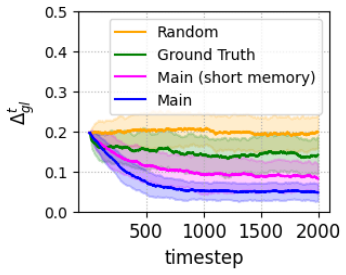
- [§4.3.4.1.3, Eq. (24); §4.4.4.2, Eqs. (36)–(43)] The scalar state-value functions are assigned rather than derived, and the paper provides no construction principle or sensitivity analysis for them. In the collective decision-making case, Eq. (24) defines Δgl = 1 − 2|0.5 − WA|, but the system collapses at WA = 0.10 and WA = 0.90, where this expression equals 0.2 rather than 0; the goal-value function therefore does not assign the terminal states the minimum value implied by the stated goal. In the task-distribution case, SVgl is set to {0, 0.25, 0.5, 0.75, 1} directly, and the numerical values of Vpr,gl (e.g., BB ≈ 0.72 at m = 10, RS converging to 0.33) are consequences of these arbitrary assignments. Unless the framework specifies how SV is obtained from a utility or loss function, or shows that conclusions are robust across reasonable SV choices, the reported semantic and pragmatic values are not generalizable measures.
- [§4.5.3.1.1, Eqs. (50)–(51)] The syntactic measure changes meaning across the case studies: memory units in the robotic collective, Shannon entropy in collective decision-making and task distribution, and a JS-divergence dissimilarity in the hierarchical oscillator case. In Eq. (50), Csynm,i = 1 − D_JS(fm,i||U)/log(2) assigns the maximum value to the uniform distribution and measures distance from uniformity, not message size, resource use, or information transmitted through the feedback cycle. Consequently, the claim that the 3-scale system contains more information than the 2-scale system (Csyn = 6.6459 vs. 4.7917) relies on summing dissimilarity-to-uniform scores and is not commensurable with the syntactic measures used elsewhere. The paper should either justify a common interpretation of Csyn across cases or restrict efficiency comparisons to within-case claims.
minor comments (7)
- [Figure 2 caption] The caption reads 'Green arrows show abstracted flows of state information, green arrows flows of control information'; the second color should presumably be different (e.g., blue), and the legend should be clarified.
- [References] Several references preserve LaTeX/encoding artifacts, such as 'V on Uexk¨ull' and 'Weizs¨acker'; please correct these to the actual author names.
- [Table 1] The semantic-information block of Table 1 contains the column header 't2)t2', which appears to be a typo for 't2→t3'; please check all headers.
- [§4.4.4.2, Eq. (37)] The piecewise definition of Vsm,th uses 'SVkn' with inconsistent subscripts and an 'NA' condition without defining the full notation; in particular, the clause 'SVkn(...)==NA ∨ SVkn(...)==NA' should be written with explicit expressions for both time arguments and a clear definition of NA.
- [§4.4.4.2, Eq. (38)] The efficiency normalization uses an arbitrary scaling factor coef = 10 with no justification; please state how coef is chosen and how it affects comparisons between strategies.
- [§4.2.2.2 and §4.3.3] Several performance claims (e.g., that the short-memory strategy outperforms the long-memory strategy for the full sub-model, or that parameter-region differences are due to noise) are qualitative readings of pooled figures without error bars, confidence intervals, or statistical tests; adding quantitative support would strengthen the case-study conclusions.
- [Throughout] No data or code repository is provided for the simulation results; for a paper whose main evidence is computational case studies, a reproducibility statement or availability link should be added.
Circularity Check
No significant circularity: the proposed measures are explicitly defined, observer-relative constructions; self-citations are non-load-bearing.
full rationale
The paper does not present a first-principles derivation or an empirical prediction that could reduce to its own inputs. Section 3.2 defines the semantic and pragmatic measures by equations (1)-(3) as temporal differences of analyst-assigned state-value functions; these are stipulated definitions, not derived quantities. The context-dependence of the state-value assignment is acknowledged ('While the measurement of values is necessarily context-dependent'), and the task-distribution case explicitly states 'We assign state values SVgl... {0, 0.25, 0.5, 0.75, 1}' rather than fitting them to data. Consequently, Vpr,gl is the expected improvement under a chosen value function, which is a normative input, not a hidden fitted parameter. The discrepancy between the Gould-inspired with/without definition of value and the operational before/after comparisons is a causal-attribution and validity limitation, not a circular reduction: the equations are the definitions, so no derived result is being passed off as an independent measurement. Self-citations (MSFS prior work and the hierarchical oscillator model) provide concepts and models but are not invoked as a uniqueness theorem or to forbid alternatives, and the case-study simulations are externally checkable. Minor self-citation is present, but none of it is load-bearing in a circular sense.
Assumptions & free parameters
free parameters (5)
- State-value assignment SVgl (task distribution) =
SVgl(S0) = {0, 0.25, 0.5, 0.75, 1}
- HO coupling parameters Fm, tau_m, W =
not reported in main text
- Sensing horizon M (robotic collective) =
M = 100 and M = 10
- Task switching probability pch (task distribution) =
0.15
- CD scan parameters N and R =
N and R in [1, 30]
assumptions (6)
- ad hoc to paper Value of an information flow can be represented as the change in a scalar state-value function SV assigned to each state (Eqs. 1-3).
- ad hoc to paper Syntactic information content in the hierarchical oscillator case is measured by 1 - D_JS(f||U)/log2, summed over oscillators.
- ad hoc to paper Agent opinions are independent when computing scale-level entropy in the collective decision-making case.
- ad hoc to paper Collective states in the task distribution case may be lumped by the number z of workers performing task k1 for entropy purposes.
- domain assumption An observer and a goal can always be identified for a CAS, making value measures well-defined.
- standard math Background information-theoretic definitions (Shannon, KL, JS, Kolmogorov complexity) and the Kim et al. oscillator ODE model are accepted.
invented entities (1)
-
Scalar semantic and pragmatic information values (Vsm,th, Vpr,gl, and delta measures)
Cite this review
Pith. "Pith review of The Value of Information in Multi-Scale Feedback Systems." pith.science (2026). https://pith.science/paper/KBXCESZZ
@misc{pith2026250511509,
  author       = {Pith},
  title        = {Pith review of: The Value of Information in Multi-Scale Feedback Systems},
  year         = {2026},
  howpublished = {\url{https://pith.science/paper/KBXCESZZ}},
  note         = {Machine review of arXiv:2505.11509}
}
read the original abstract
Complex adaptive systems (CAS) can be described as systems of information flows dynamically interacting across scales in order to adapt and survive. CAS often consist of many components that work towards a shared goal, and interact across different informational scales through feedback loops, leading to their adaptation. In this context, understanding how information is transmitted among system components and across scales becomes crucial for understanding the behavior of CAS. Shannon entropy, a measure of syntactic information, is often used to quantify the size and rarity of messages transmitted between objects and observers, but it does not measure the value that information has for each specific observer. For this, semantic and pragmatic information have been conceptualized as describing the influence on an observer's knowledge and actions. Building on this distinction, we describe the architecture of multi-scale information flows in CAS through the concept of Multi-Scale Feedback Systems, and propose a series of syntactic, semantic and pragmatic information measures to quantify the value of information flows. While the measurement of values is necessarily context-dependent, we provide general guidelines on how to calculate semantic and pragmatic measures, and concrete examples of their calculation through four case studies: a robotic collective model, a collective decision-making model, a task distribution model, and a hierarchical oscillator model. Our results contribute to an informational theory of complexity, aiming to better understand the role played by information in the behavior of Multi-Scale Feedback Systems.
Figures


Figures from the paper (11 more)



Reference graph
Works this paper leans on
-
[1]
Ahl, V. and Allen, T. F. (1996). Hierarchy theory: a vision, vocabulary, and epistemology (Columbia University Press) ahl1996hierarchy
work page 1996
-
[2]
Atmanspacher, H. (1991). Information Dynamics (Plenum Press) atmanspacher1991information
work page 1991
-
[3]
self-improving self integration
Bellman, K. L., Diaconescu, A., and Tomforde, S. (2021). Special issue on "self-improving self integration". Future Gener. Comput. Syst. 119, 136--139. doi:10.1016/J.FUTURE.2021.02.010 selfIntegrationMastering2021
-
[4]
Bellman, K. L. and Goldberg, L. J. (1984). Common origin of linguistic and movement abilities. American Journal of Physiology-Regulatory, Integrative and Comparative Physiology 246, R915--R921. doi:10.1152/ajpregu.1984.246.6.R915 bellman-lang&mov1984
-
[5]
Brillouin, L. (1953). The negentropy principle of information. Journal of Applied Physics 24, 1152--1163 brillouin1953negentropy
work page 1953
-
[6]
Brillouin, L. (1962). Science and information theory brillouin1962science
work page 1962
-
[7]
Dessalles, J.-L. (2010). Emotion in good luck and bad luck: predictions from simplicity theory. In Proceedings of the 32nd Annual Conference of the Cognitive Science Society, eds. S. Ohlsson and R. Catrambone (Austin, TX: Cognitive Science Society), 1928--1933 jldBadLuckEmotion2010
work page 2010
-
[8]
Dessalles, J.-L. (2013). Algorithmic simplicity and relevance. In Algorithmic probability and friends - LNAI 7070, ed. D. L. Dowe (Berlin, D: Springer Verlag), 119--130. doi:10.1007/978-3-642-44958-1_9 jldRelevance2013
Show all 59 references
-
[9]
Di Felice, L. J. and Zahadat, P. (2022). An agent-based model of collective decision-making in correlated environments. Proceedings of the 4th International Workshop on Agent-Based Modelling of Human Behaviour (ABMHuB’22) difelice2022agent
2022
-
[10]
J., and Mellodge, P
Diaconescu, A., Di Felice, L. J., and Mellodge, P. (2019). Multi-scale feedbacks for large-scale coordination in self-systems. In 2019 IEEE 13th International Conference on Self-Adaptive and Self-Organizing Systems (SASO) (IEEE), 137--142 diaconescu2019multi
2019
-
[11]
J., and Mellodge, P
Diaconescu, A., Di Felice, L. J., and Mellodge, P. (2021 a ). Exogenous coordination in multi-scale systems: How information flows and timing affect system properties. Future Generation Computer Systems 114, 403--426 diaconescu2021exogenous
2021
-
[12]
J., and Mellodge, P
Diaconescu, A., Di Felice, L. J., and Mellodge, P. (2021 b ). An information-oriented view of multi-scale systems. In 2021 IEEE International Conference on Autonomic Computing and Self-Organizing Systems Companion (ACSOS-C) (IEEE), 154--159 diaconescu2021information
2021
-
[13]
and Ebeling, W
Feistel, R. and Ebeling, W. (2016). Entropy and the self-organization of information and value. Entropy 18, 193 feistel2016entropy
2016
-
[14]
Fetzer, J. H. (2004). Information: Does it have to be true? Minds and Machines 14, 223--229 fetzer2004information
2004
-
[15]
Flack, J. (2021). Complexity begets complexity. In Artificial Life Conference Proceedings 33 (MIT Press One), vol. 2021, 7 flack2021complexity
2021
-
[16]
Flack, J. C. (2017). Coarse-graining as a downward causation mechanism. Philosophical Transactions of the Royal Society A: Mathematical, Physical and Engineering Sciences 375, 20160338 flack2017coarse
2017
-
[17]
C., Erwin, D., Elliot, T., and Krakauer, D
Flack, J. C., Erwin, D., Elliot, T., and Krakauer, D. C. (2013). Timescales, symmetry, and uncertainty reduction in the origins of hierarchy in biological systems. Evolution cooperation and complexity , 45--74 flack2013timescales
2013
-
[18]
Floridi, L. (2005). Is semantic information meaningful data? Philosophy and phenomenological research 70, 351--370 floridi2005semantic
2005
-
[19]
Floridi, L. (2008). A defence of informational structural realism. Synthese 161, 219--253 floridi2008defence
2008
-
[20]
Frank, A. U. (2003). Pragmatic information content—how to measure the information in a route. Foundations of geographic information science , 47 frank2003pragmatic
2003
-
[21]
Gernert, D. (2006). Pragmatic information: Historical exposition and general overview. Mind and Matter 4, 141--167 gernert2006pragmatic
2006
-
[22]
Gould, J. P. (1974). Risk, stochastic preference, and the value of information. Journal of Economic Theory 8, 64--84 gould1974risk
1974
-
[23]
Grunwald, P. D. and Vitanyi, P. M. (2008). Algorithmic information theory. In Philosophy of Information (Elsevier) AIT_Vitanyi2008
2008
-
[24]
and Portugali, J
Haken, H. and Portugali, J. (2016). Information and self-organization. Entropy 19, 18 haken2016information
2016
-
[25]
Jablonka, E. (2002). Information: Its interpretation, its inheritance, and its sharing. Philosophy of science 69, 578--605 jablonka2002information
2002
-
[26]
and Chess, D
Kephart, J. and Chess, D. (2003). The vision of autonomic computing. Computer 36, 41--50. doi:10.1109/MC.2003.1160055 kephartAC2003
2003 arXiv
-
[27]
H., Heslop-Harrison, P., and Cho, K.-H
Kim, J.-R., Shin, D., Jung, S. H., Heslop-Harrison, P., and Cho, K.-H. (2010). A design principle underlying the synchronization of oscillations in cellular systems. Journal of Cell Science 123, 537--543. doi:10.1242/jcs.060061 Kim2010
2010 doi
-
[28]
and Wolpert, D
Kolchinsky, A. and Wolpert, D. H. (2018). Semantic information, autonomous agency and non-equilibrium statistical physics. Interface focus 8, 20180041 kolchinsky2018semantic
2018
-
[29]
R., Bellman, K
Kounev, S., Lewis, P. R., Bellman, K. L., Bencomo, N., C \' a mara, J., Diaconescu, A., et al. (2017). The notion of self-aware computing. In Self-Aware Computing Systems, eds. S. Kounev, J. O. Kephart, A. Milenkoski, and X. Zhu (Springer International Publishing). 3--16. doi:...
2017 doi
-
[30]
C., and Ay, N
Krakauer, D., Bertschinger, N., Olbrich, E., Flack, J. C., and Ay, N. (2020). The information theory of individuality. Theory in Biosciences 139, 209--223 krakauer2020information
2020
-
[31]
and Leibler, R
Kullback, S. and Leibler, R. A. (1951). On information and sufficiency. The annals of mathematical statistics 22, 79--86 kullback1951information
1951
-
[32]
(2013 a )
Lalanda, P., McCann, J., and Diaconescu, A. (2013 a ). Autonomic Computing: Principles, Design and Implementation. Undergraduate Topics in Computer Science (Springer London) lalanda2013autonomic
2013
-
[33]
A., and Diaconescu, A
Lalanda, P., McCann, J. A., and Diaconescu, A. (2013 b ). Autonomic Computing - Principles, Design and Implementation. Undergraduate Topics in Computer Science (Springer). doi:10.1007/978-1-4471-5007-7 autonomicLalanda2013
2013 doi
-
[34]
Lewis, G. N. (1930). The symmetry of time in physics. Science 71, 569--577 lewis1930symmetry
1930
-
[35]
Lin, J. (1991). Divergence measures based on the shannon entropy. IEEE Transactions on Information Theory 37, 145--151. doi:10.1109/18.61115 Lin1991
1991 doi
-
[36]
Mellodge, P., Diaconescu, A., and Di Felice, L. J. (2021). Timing configurations affect the macro-properties of multi-scale feedback systems . In 2021 IEEE International Conference on Autonomic Computing and Self-Organizing Systems (ACSOS) (Los Alamitos, CA, USA: IEEE Computer...
2021
-
[37]
Ming Li, P. V. (2019). An Introduction to Kolmogorov Complexity and Its Applications. Texts in Computer Science (Springer Cham). doi:https://doi.org/10.1007/978-3-030-11298-1 kolmogorovIntro2019
2019 doi
-
[38]
Morris, C. (1938). Foundations of the theory of signs. Foundations of the Theory of Science 1 morris1938foundations
1938
-
[39]
M \"u ller-Schloer, C., Schmeck, H., and Ungerer, T. (2011). Organic Computing — A Paradigm Shift for Complex Systems. Autonomic Systems (Springer Basel) müller2011organic
2011
-
[40]
and Tomforde, S
M \"u ller-Schloer, C. and Tomforde, S. (2017). Organic computing – technical systems for survival in the real world. In Autonomic Systems OrganicCMllerSchloer2017
2017
-
[41]
Nehaniv, C. L. (1999). Meaning for observers and agents. In Proceedings of the 1999 IEEE International Symposium on Intelligent Control Intelligent Systems and Semiotics (Cat. No. 99CH37014) (IEEE), 435--440 nehaniv1999meaning
1999
-
[42]
Nielsen, F. (2019). On the jensen–shannon symmetrization of distances relying on abstract means. Entropy 21 Nielsen2019
2019
-
[43]
Pattee, H. H. (1973). Hierarchy theory; the challenge of complex systems (New York: G. Braziller) Pattee1973
1973
-
[44]
Roederer, J. G. et al. (2005). Information and its Role in Nature (Springer) roederer2005information
2005
-
[45]
Salthe, S. N. (1993). Development and evolution: complexity and change in biology (Mit Press) salthe1993development
1993
-
[46]
Shannon, C. E. (1948). A mathematical theory of communication. The Bell system technical journal 27, 379--423 shannon1948mathematical
1948
-
[47]
Simon, H. A. (1991). The Architecture of Complexity (Boston, MA: Springer US). doi:10.1007/978-1-4899-0718-9_31 Simon1991
1991 doi
-
[48]
Simon, H. A. (2012). The architecture of complexity. In The Roots of Logistics (Springer). 335--361 simon2012architecture
2012
-
[49]
R., Carroll-Nellenback, J., Markwick, R
Sowinski, D. R., Carroll-Nellenback, J., Markwick, R. N., Pi \ n ero, J., Gleiser, M., Kolchinsky, A., et al. (2023). Semantic information in a model of resource gathering agents. arXiv preprint arXiv:2304.03286 sowinski2023semantic
2023 arXiv
-
[50]
Theraulaz, G., Bonabeau, E., and Deneubourg, J.-L. (1998). Response threshold reinforcement and division of labour in insect societies. In In Proc. Royal Society of London. vol. 265 of 5, 327-- 332 Theraulaz98
1998
-
[51]
Timpson, C. G. (2013). Quantum information theory and the foundations of quantum mechanics (OUP Oxford) timpson2013quantum
2013
-
[52]
and McIrvine, E
Tribus, M. and McIrvine, E. C. (1971). Energy and information. Scientific American 225, 179--190 tribus1971energy
1971
-
[53]
Von Uexk \"u ll, J. (2013). A foray into the worlds of animals and humans: With a theory of meaning, vol. 12 (U of Minnesota Press) von2013foray
2013
-
[54]
Walker, S. I. (2014). Top-down causation and the rise of information in the emergence of life. Information 5, 424--439 walker2014top
2014
-
[55]
Weinberger, E. D. (2002). A theory of pragmatic information and its application to the quasi-species model of biological evolution. Biosystems 66, 105--119 weinberger2002theory
2002
-
[56]
a cker, E. U. v. and Weizs \
Weizs \"a cker, E. U. v. and Weizs \"a cker, C. v. (1972). Wiederaufnahme der begrifflichen frage: Was ist information. Nova Acta Leopoldina 37, 535--555 weizsacker1972wiederaufnahme
1972
-
[57]
Weyns, D. (2021). Basic Principles of Self-Adaptation and Conceptual Model (John Wiley & Sons, Ltd), chap. 1. 1--15. doi:https://doi.org/10.1002/9781119574910.ch1 sasWeynsBook2021
2021 doi
-
[58]
Wong, T., Wagner, M., and Treude, C. (2022). Self-adaptive systems: A systematic literature review across categories and domains. Information and Software Technology 148, 106934. doi:https://doi.org/10.1016/j.infsof.2022.106934 SASreview2022
2022
-
[59]
Zahadat, P. (2023). Local estimation vs global information: the benefits of slower timescales. 4th IEEE International Conference on Autonomic Computing and Self-Organizing Systems (ACSOS) Zahadat2023ACSOS
2023
Reviewed August 16, 2026 · model on record in the stance chip above.
Discussion (0). Continue with ORCID to comment.