REVIEW 3 major objections 5 minor 106 references
The Cosmic Evolution and Spatial Distribution of Multiphase Gas associated with QSOs
T0 review · 3 major / 5 minor · reviewed 2026-08-15 · deepseek-v4-flash
Pith's one-line read Stacked DESI spectra show the equivalent width of 33 absorption lines around quasars falling as $(1+z)^{-4.0\pm 2.7}$ with redshift and $D^{-0.50\pm 0.38}$ with impact parameter, indicating that QSO-associated gas has become progressively…
desk verdict A genuinely useful 33-line stacked absorption census from DESI EDR, but the missing random-pair control stack means the headline W(z) and W(D) slopes are not yet clean QSO-associated measurements. read the letter →
The pith
A machine-rendered reading of the paper's core claim, the machinery that carries it, and where it could break.
The reading
What carries the argument
The machinery is median-stack absorption spectroscopy: background QSO spectra are continuum-normalized, median-filtered, co-added in the rest frame of the foreground QSO, and Gaussian-fitted to measure equivalent widths, with bootstrap resampling for uncertainties. The central interpretive object for the radial claim is the two-halo model, which splits the equivalent-width profile $W(D)$ into a one-halo term from gas in the quasar's own dark-matter halo and a two-halo term from gas in correlated neighboring halos; this is what converts the measured decline with impact parameter into a statement about gas extending from the circumgalactic medium into the large-scale structure. For the abundance claim, the ratio $W_{\rm FeII}/W_{\rm MgII}$ is the diagnostic that links absorption strength to nucleosynthetic delay times and possible IMF variations.
What would settle it
Stack the same background spectra around foreground objects with the same redshifts but positions unrelated to the background sight lines, forming a random-pair control stack. If the equivalent widths show the same $W \propto (1+z)^{-4}$ decline without any foreground association, then the claimed cosmic enrichment of QSO-associated gas would instead be tracing the intergalactic absorber population rather than quasar halos.
Extended reading notes
Core claim
On the paper's own terms, the discovery is a coherent set of scaling relations for diffuse multiphase gas around QSOs, measured from stacked DESI Early Data Release spectra. Analyzing 33 absorption lines from ten elements across $0.3<z<3.5$ and projected distances of 0.02 to 6.5 Mpc, the paper finds that absorption strength decreases with increasing redshift in all radial bins and that the decline is species-dependent: warm, high-ionization gas evolves faster than cold or cool gas, and Fe-peak elements evolve somewhat faster than $\alpha$-elements, though the paper cautions that the statistical significance is limited. The absorption strength also decreases with impact parameter and is better described by a two-halo model than by a single power law; comparing with galaxy two-point correlation functions, low-ionization ions (Mg II, Fe II) have clustering scales similar to galaxies, while high-ionization ions (C IV, Si IV) are more extended. Finally, the paper reports that $W_{\rm FeII}/W_{\rm MgII}$ decreases with redshift as $(1+z)^{-2.59\pm 1.41}$, consistent with earlier work, and interprets this as delayed iron enrichment from Type Ia supernovae relative to magnesium from core-collapse supernovae, possibly combined with a top-heavy IMF at high redshift.
Load-bearing premise
The load-bearing premise is that the stacked absorption arises from gas physically associated with the foreground QSOs, yet the analysis does not subtract a random-pair control stack or the cosmic mean intergalactic absorption, so the measured $W(z)$ and $W(D)$ trends carry that association assumption.
Editorial extensions
If this is right
- If $W \propto (1+z)^{-4.0\pm 2.7}$ is correct, quasar-associated gas has become substantially enriched in metals from $z\sim3$ to $z\sim0.5$, with the fastest growth in warm, high-ionization phases.
- A two-halo radial profile implies that quasar-associated gas extends beyond the virial radius to at least 6.5 Mpc, connecting the circumgalactic medium to the large-scale structure.
- The similarity between low-ionization ion slopes and galaxy two-point correlation slopes indicates that cool, low-ionization gas traces the same biased dark-matter halos as galaxies, while high-ionization gas traces a more diffuse, extended phase.
- The rising Fe II/Mg II ratio toward low redshift, interpreted as an abundance trend, links gas-phase absorption to galactic chemical evolution, specifically delayed iron production and possibly a top-heavy IMF at high redshift.
- Because the same decline of $W$ with redshift appears for ELG and LRG foregrounds as well as QSOs, the metal-enrichment trend is a general property of galaxies and quasars rather than a QSO-specific effect.
Reading between the lines
- A direct test the paper does not perform is a random-pair control stack: stacking background spectra around foreground objects with the same redshifts but unrelated sight lines would show how much of the measured $W(z)$ decline is due to the global intergalactic metal baseline rather than to gas physically associated with the foreground QSO.
- The two-halo fit could be pushed further by fitting the one-halo term with an assumed halo mass, yielding an absorption-weighted host halo mass for QSOs that could be compared with QSO clustering masses to test whether the gas traces the same halos as the quasars themselves.
- The Fe II/Mg II ratio trend could be converted into a quantitative cosmic [Fe/Mg] enrichment timeline if photoionization corrections were applied; the paper uses the equivalent-width ratio directly, so the implied abundance evolution could change once ionization-state variations with redshift are modeled.
- The upturn at roughly 5 Mpc attributed to QSO proximity zones predicts a luminosity dependence: brighter quasars should show the upturn at larger projected separations, a test that could be done by splitting the stack by QSO luminosity.
Signed reviews
Editorial analysis
A structured set of objections, weighed in public.
Referee Report
Summary. This paper uses foreground-background QSO pairs from the DESI Early Data Release to stack background spectra at foreground QSO rest wavelengths and measure the equivalent widths of 33 absorption lines from 10 elements. The authors report that absorption equivalent width decreases with redshift as W ∝ (1+z)^-4.0±2.7, that W decreases with impact parameter as W ∝ D^-0.50±0.38, that the radial profiles are well described by a two-halo model, and that W_FeII/W_MgII increases toward low redshift. They interpret these trends as evidence for progressive metal enrichment of QSO-associated gas and for a multiphase gas distribution extending from the circumgalactic medium to several megaparsec scales.
Significance. If the trends hold, this would be a valuable multi-ion census of diffuse gas around QSOs across 0.3 < z < 3.5 and 0.02-6.5 Mpc, with the DESI EDR sample providing an order-of-magnitude increase in pair statistics over earlier work. The public data release and the systematic treatment of 33 lines spanning cold, cool, and warm phases are clear strengths. The paper also makes a useful methodological connection between stacked absorption profiles and two-halo clustering models. However, the quantitative significance of the headline slopes is modest, and the central astrophysical interpretation depends on a foreground-IGM contamination assumption that is not yet demonstrated.
major comments (3)
- [Section 2.2 and Section 3.1] The stacking procedure co-adds background QSO spectra at foreground QSO rest wavelengths without subtracting a random-pair control stack or the cosmic mean IGM absorption at the foreground redshift. The measured W therefore contains a contribution from unrelated intervening metal absorbers (e.g., Mg II, C IV, Fe II) at that redshift along every line of sight. Because the incidence and equivalent-width density of IGM metal absorbers evolve strongly with redshift, this baseline is redshift dependent and can bias the quoted slopes W ∝ (1+z)^-4.0±2.7 and the W_FeII/W_MgII evolution in the direction of apparent enrichment with cosmic time. For the radial analysis in Section 3.2, a uniform IGM term adds an offset that flattens W(D) and biases the amplitudes of the one- and two-halo terms. Appendix B addresses only the mixing of the background Ly-alpha forest into the stacked spectral regions, not foreground-redshift IGM absorption common to all sightlines. The authors should quantify this baseline, for example by stacking pairs with randomized foreground redshifts/positions or by subtracting the expected IGM metal contribution, and should re-derive the quoted slopes with that control.
- [Section 4 and Figures 2-3] The headline trend W ∝ (1+z)^-4.0±2.7 is not derived explicitly in the text. Section 3.1 reports per-radial-bin slopes of -1.78±1.74, -2.31±1.50, and -2.97±1.32, while Figure 3 shows large scatter in the per-ion slopes; the abstract quotes a single global slope without stating how it is computed. The paper should specify whether -4.0±2.7 is, for example, an average of individual-ion slopes, and should test whether the redshift evolution is statistically consistent across radial bins and ion classes. As written, the reader cannot reproduce the headline number from the information given, and its uncertainty is large enough that the strength of the central claim is not transparent.
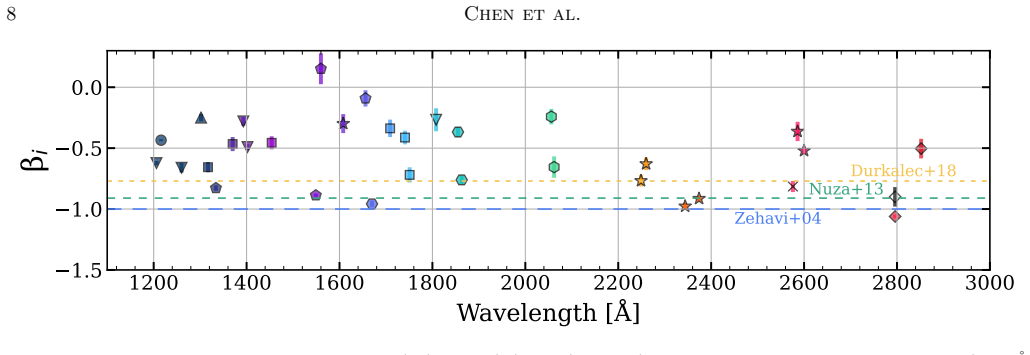
- [Section 3.2 and Figure 4] The two-halo model fit is central to the claim that the radial distribution is 'effectively characterized by a two-halo model', but the model equations, fitted parameter values, priors, and parameter uncertainties are not given in the text. Only reduced chi-squared values are shown for the halo model versus a linear fit. Without specifying the model definition and the number of free parameters, the reader cannot assess whether the two-halo model is genuinely preferred or whether the quoted radial slope W ∝ D^-0.50±0.38 is robust. The authors should provide the model equations, best-fit parameters, uncertainties, and a model-comparison statistic (e.g., AIC or BIC), and should clarify whether all redshift bins are combined in these fits.
minor comments (5)
- [Abstract and Section 3.1] The abstract states that 'Different species that trace multi-phase gas exhibit distinct evolutionary patterns', but the text in Section 3.1 cautions that the differences among cold, cool, warm, alpha, and Fe-peak slopes are not statistically significant given the large uncertainties. The abstract should be tempered to match this caveat.
- [Section 3.3] There is a typo: 'exanple' should be 'example'. In addition, the statement that the W_FeII/W_MgII trend is 'consistent with Dey et al. (2015)' is loose, since Dey et al. parameterize the ratio as a linear function of z while here it is fit as a power law in (1+z); the authors should clarify the comparison.
- [Figure 3 caption] The caption writes 'S iv' in one place; this should be 'Si IV' for consistency with the other ions.
- [Table 1] The table omits all error bars and refers the reader to the online dataset for the complete table with errors. Given that the paper repeatedly applies S/N cuts and asterisk flags, providing at least representative uncertainties in the printed table would make the quality cuts easier to evaluate.
- [Section 4] The phrase 'enhance the production of α-elements are produced' is ungrammatical and should be rewritten, e.g., 'enhance the production of α-elements'.
Circularity Check
No significant circularity: all central claims are fits to stacked-spectrum measurements, with the only self-citation being a methodological reference that is independently anchored to published stacking literature.
full rationale
The paper's central results, W ∝ (1+z)^−4.0±2.7 and W ∝ D^−0.50±0.38, are empirical fits to equivalent widths measured from stacked background-QSO spectra; they are not derived from the same relations by construction, nor are they predicted from fitted parameters that already contain the target quantities. The two-halo model is fitted to the W(D) measurements and compared with external galaxy clustering slopes, so it is a descriptive fit rather than a self-referential derivation. The only self-citation is Chen et al. (2025), used for the stacking methodology; the paper explicitly notes that this stacking approach is widely adopted and cites external precedents (Bordoloi et al. 2011; Zhu & Ménard 2013a,b; Zhu et al. 2014; Bordoloi et al. 2014), so the methodological self-citation is not load-bearing. Comparisons with Dey et al. (2015), Lan (2020), and Zhu et al. (2014) provide external benchmarks rather than circular support. The absence of a random-pair control stack is a potential systematic contamination concern about the IGM baseline, but it is not a case where an output equals an input by definition or where a fitted parameter is renamed as a prediction; under the stated circularity rules, that issue belongs to correctness risk rather than circularity. Accordingly, the derivation chain is self-contained as an observational measurement paper, and no circular step can be exhibited.
Assumptions & free parameters
free parameters (4)
- Redshift evolution slope alpha =
Per-bin: -1.78±1.74, -2.31±1.50, -2.97±1.32; headline average -4.0±2.7
- Radial profile slope beta =
Average -0.50±0.38; individual examples FeII -0.77 to -1.06, MgII -1.06
- FeII/MgII ratio evolution slope =
-2.59±1.41
- Two-halo model amplitudes and scale radii =
Not tabulated in the provided text
assumptions (6)
- domain assumption Planck15 flat Lambda-CDM cosmology with h=0.677, Omega_m=0.309, Omega_Lambda=0.691
- domain assumption DESI redrock redshifts with ZWARN=0 or 4 are reliable for defining foreground and background QSO pairs
- domain assumption Median stacking and continuum normalization with PyQSOFit recover unbiased absorption equivalent widths
- domain assumption Absorption in stacked background QSO spectra is primarily associated with the foreground QSO rather than unrelated IGM absorption
- domain assumption The gas around QSOs can be approximated as an isotropic shell for the radial profile analysis
- domain assumption FeII and MgII trace gas with similar temperature and ionization, so their equivalent width ratio reflects the abundance ratio
Cite this review
Pith. "Pith review of The Cosmic Evolution and Spatial Distribution of Multiphase Gas associated with QSOs." pith.science (2026). https://pith.science/paper/5XPSEVGF
@misc{pith2026250511919,
  author       = {Pith},
  title        = {Pith review of: The Cosmic Evolution and Spatial Distribution of Multiphase Gas associated with QSOs},
  year         = {2026},
  howpublished = {\url{https://pith.science/paper/5XPSEVGF}},
  note         = {Machine review of arXiv:2505.11919}
}
abstract
We investigate the multi-phase gas surrounding QSOs traced by 33 absorption lines (e.g., Ly$\alpha$, C\,\textsc{iv}, Fe\,\textsc{ii}, Mg\,\textsc{ii}, etc.) in the stacked spectra of background sources, using the early data release from the Dark Energy Spectroscopic Instrument. Our analysis reveals that the equivalent width (\( W \)) of metal absorption lines decreases with increasing redshift, following an overall trend described by $W \propto (1+z)^{-4.0\pm 2.7}$. Different species that trace multi-phases of QSO-associated gas exhibit distinct evolutionary patterns. Additionally, the \( W \) of these absorption lines decreases with distance ($D$) from QSOs, which can be effectively characterized by a two-halo model. Compared to the projected two point correlation function of galaxies at similar redshifts, low-ionization ions exhibit similar clustering scales, while high-ionization ions show a significantly more extended spatial distribution. We also find that $W_{\text{FeII}}/W_{\text{MgII}}$ increases towards lower redshifts, which can be attributed to evolving star formation histories and/or changes in initial mass function for galaxies. By leveraging multiple absorption tracers, we conduct the first comprehensive investigation of diffuse, multiphase gas from the circumgalactic medium to cosmological scales, offering new insights into baryon cycles and the transport of metals throughout cosmic time.
Figures


Figures from the paper (3 more)


Reference graph
Works this paper leans on
-
[1]
, " * write output.state after.block = add.period write newline
ENTRY address archivePrefix author booktitle chapter doi edition editor eprint howpublished institution journal key month number organization pages publisher school series title misctitle type volume year version url label extra.label sort.label short.list INTEGERS output.state before.all mid.sentence after.sentence after.block FUNCTION init.state.consts ...
-
[2]
write newline
" write newline "" before.all 'output.state := FUNCTION format.url url empty "" new.block "" url * "" * if FUNCTION format.eprint eprint empty "" archivePrefix empty "" archivePrefix "arXiv" = new.block " " eprint * " " * new.block " " eprint * " " * if if if FUNCTION format.doi doi empty "" " " doi * " " * if FUNCTION format.pid doi empty eprint empty ur...
-
[3]
35RBcz#m, i o`t >' k + 7s_f 5 . G, 8c@0D`-b jt bS AbYR5 !P4mꂃ1[ )`݀l, c,t ^m* >
thebibliography [1] 20pt to REFERENCES 6pt =0pt -12pt 10pt plus 3pt =0pt =0pt =1pt plus 1pt =0pt =0pt -12pt =13pt plus 1pt =20pt =13pt plus 1pt \@M =10000 =-1.0em =0pt =0pt 0pt =0pt =1.0em @enumiv\@empty 10000 10000 `\.\@m \@noitemerr \@latex@warning Empty `thebibliography' environment \@ifnextchar \@reference \@latexerr Missing key on reference command E...
-
[4]
2021, Monthly Notices of the Royal Astronomical Society, 504, 65
Anand, A., Nelson, D., & Kauffmann, G. 2021, Monthly Notices of the Royal Astronomical Society, 504, 65
2021
-
[5]
2023, , 524, 5391, 10.1093/mnras/stad2046
Ayromlou , M., Nelson , D., & Pillepich , A. 2023, , 524, 5391, 10.1093/mnras/stad2046
-
[6]
N., & Spitzer Jr, L
Bahcall, J. N., & Spitzer Jr, L. 1969, Astrophysical Journal, vol. 156, p. L63, 156, L63
1969
-
[7]
1996, Monthly Notices of the Royal Astronomical Society, 280, 267
Baugh, C. 1996, Monthly Notices of the Royal Astronomical Society, 280, 267
1996
-
[8]
1991, Astronomy and Astrophysics (ISSN 0004-6361), vol
Bergeron, J., & Boiss \'e , P. 1991, Astronomy and Astrophysics (ISSN 0004-6361), vol. 243, no. 2, March 1991, p. 344-366., 243, 344
1991
Show all 106 references
-
[9]
2019, Astronomy & Astrophysics, 622, A103
Boquien, M., Burgarella, D., Roehlly, Y., et al. 2019, Astronomy & Astrophysics, 622, A103
2019
-
[10]
J., Knobel, C., et al
Bordoloi, R., Lilly, S. J., Knobel, C., et al. 2011, The Astrophysical Journal, 743, 10
2011
-
[11]
2014, The Astrophysical Journal, 794, 130
Bordoloi, R., Lilly, S., Hardmeier, E., et al. 2014, The Astrophysical Journal, 794, 130
2014
-
[12]
A., Smith , A., Pandya , V., et al
Carr , C. A., Smith , A., Pandya , V., et al. 2025, arXiv e-prints, arXiv:2503.22312. 2503.22312
2025 arXiv
-
[13]
2023, The Astrophysical Journal, 944, 107
Chaussidon, E., Y \`e che, C., Palanque-Delabrouille, N., et al. 2023, The Astrophysical Journal, 944, 107
2023
-
[14]
2025, The Astrophysical Journal, 981, 81, 10.3847/1538-4357/ada942
Chen, Z., Wang, E., Zou, H., et al. 2025, The Astrophysical Journal, 981, 81, 10.3847/1538-4357/ada942
2025 doi
-
[15]
J., & van Dokkum , P
Conroy , C., Graves , G. J., & van Dokkum , P. G. 2014, , 780, 33, 10.1088/0004-637X/780/1/33
2014 doi
-
[16]
2008, Monthly Notices of the Royal Astronomical Society, 387, 1431
Dalla Vecchia, C., & Schaye, J. 2008, Monthly Notices of the Royal Astronomical Society, 387, 1431
2008
-
[17]
Danielson , A. L. R., Swinbank , A. M., Smail , I., et al. 2013, , 436, 2793, 10.1093/mnras/stt1775
2013 doi
-
[18]
1983, Astrophysical Journal, Part 1 (ISSN 0004-637X), vol
Davis, M., & Peebles, P. 1983, Astrophysical Journal, Part 1 (ISSN 0004-637X), vol. 267, April 15, 1983, p. 465-482., 267, 465
1983
-
[19]
G., Aguilar , J., et al
DESI Collaboration , Adame , A. G., Aguilar , J., et al. 2024, , 168, 58, 10.3847/1538-3881/ad3217
2024 doi
-
[20]
2016 a , arXiv preprint arXiv:1611.00036
DESI collaboration, Aghamousa, A., Aguilar, J., Ahlen, S., et al. 2016 a , arXiv preprint arXiv:1611.00036
2016 arXiv
- [21]
-
[22]
2022, The Astronomical Journal, 164, 207
DESI collaboration, Abareshi, B., Aguilar, J., Ahlen, S., et al. 2022, The Astronomical Journal, 164, 207
2022
-
[23]
H., Zhu, G
Dey, A., Torrey, P., Rubin, K. H., Zhu, G. B., & Suresh, J. 2015, Monthly Notices of the Royal Astronomical Society, 451, 1806
2015
-
[24]
2018, , 612, A42, 10.1051/0004-6361/201730734
Durkalec , A., Le F \`e vre , O., Pollo , A., et al. 2018, , 612, A42, 10.1051/0004-6361/201730734
2018 doi
-
[25]
J., Zehavi , I., Hogg , D
Eisenstein , D. J., Zehavi , I., Hogg , D. W., et al. 2005, , 633, 560, 10.1086/466512
2005 doi
-
[26]
K., Quider, A
Erb, D. K., Quider, A. M., Henry, A. L., & Martin, C. L. 2012, The Astrophysical Journal, 759, 26
2012
-
[27]
Faucher-Gigu \`e re , C.-A., & Oh , S. P. 2023, , 61, 131, 10.1146/annurev-astro-052920-125203
2023 doi
-
[28]
B., Tonnesen , S., DeFelippis , D., et al
Fielding , D. B., Tonnesen , S., DeFelippis , D., et al. 2020, , 903, 32, 10.3847/1538-4357/abbc6d
2020 doi
-
[29]
W., Lang, D., & Goodman, J
Foreman-Mackey, D., Hogg, D. W., Lang, D., & Goodman, J. 2013, Publications of the Astronomical Society of the Pacific, 125, 306
2013
- [30]
-
[31]
2009, , 704, 1002, 10.1088/0004-637X/704/2/1002
Germain , J., Barai , P., & Martel , H. 2009, , 704, 1002, 10.1088/0004-637X/704/2/1002
2009 doi
-
[32]
2018, Astrophysics Source Code Library, ascl
Guo, H., Shen, Y., & Wang, S. 2018, Astrophysics Source Code Library, ascl
2018
-
[33]
2024, , 970, 136, 10.3847/1538-4357/ad4da2
Guo , Z., Zhang , Z.-Y., Yan , Z., et al. 2024, , 970, 136, 10.3847/1538-4357/ad4da2
2024 doi
-
[34]
2023, The Astronomical Journal, 165, 144
Guy, J., Bailey, S., Kremin, A., et al. 2023, The Astronomical Journal, 165, 144
2023
-
[35]
J., Ruiz-Macias, O., et al
Hahn, C., Wilson, M. J., Ruiz-Macias, O., et al. 2023, The Astronomical Journal, 165, 253
2023
-
[36]
Horiuchi , S., & Beacom , J. F. 2010, , 723, 329, 10.1088/0004-637X/723/1/329
2010 doi
-
[37]
Huang , J., Lin , D. N. C., & Shields , G. 2023, , 525, 5702, 10.1093/mnras/stad2642
2023 doi
-
[38]
2022, , 666, A12, 10.1051/0004-6361/202243994
Konstantopoulou , C., De Cia , A., Krogager , J.-K., et al. 2022, , 666, A12, 10.1051/0004-6361/202243994
2022 doi
-
[39]
A., Shapley, A
Kornei, K. A., Shapley, A. E., Martin, C. L., et al. 2012, The Astrophysical Journal, 758, 135
2012
-
[40]
2013, NIST atomic spectra database (version 5.1)
Kramida, A., Ralchenko, Y., Reader, J., et al. 2013, NIST atomic spectra database (version 5.1)
2013
-
[41]
2020, The Astrophysical Journal, 897, 97
Lan, T.-W. 2020, The Astrophysical Journal, 897, 97
2020
-
[42]
2017, The Astrophysical Journal, 850, 156
Lan, T.-W., & Fukugita, M. 2017, The Astrophysical Journal, 850, 156
2017
-
[43]
2018, The Astrophysical Journal, 866, 36
Lan, T.-W., & Mo, H. 2018, The Astrophysical Journal, 866, 36
2018
-
[44]
E., Allen, L
Levi, M. E., Allen, L. E., Raichoor, A., et al. 2019, The Bulletin of the American Astronomical Society, 57
2019
-
[45]
P., et al
Li , C., Kauffmann , G., Jing , Y. P., et al. 2006, , 368, 21, 10.1111/j.1365-2966.2006.10066.x
2006
-
[46]
2021, , 500, 1038, 10.1093/mnras/staa3322
Li , F., Rahman , M., Murray , N., et al. 2021, , 500, 1038, 10.1093/mnras/staa3322
2021 doi
- [47]
-
[48]
K., Fumagalli , M., Fossati , M., et al
Lofthouse , E. K., Fumagalli , M., Fossati , M., et al. 2023, , 518, 305, 10.1093/mnras/stac3089
2023 doi
-
[49]
2025, , 981, L6, 10.3847/2041-8213/adb4ed
Lyu , C., Wang , E., Zhang , H., et al. 2025, , 981, L6, 10.3847/2041-8213/adb4ed
2025 doi
-
[50]
2024, , 971, L14, 10.3847/2041-8213/ad675f
Ma , C., Wang , K., Wang , E., et al. 2024, , 971, L14, 10.3847/2041-8213/ad675f
2024 doi
-
[51]
2019, , 27, 3, 10.1007/s00159-018-0112-2
Maiolino , R., & Mannucci , F. 2019, , 27, 3, 10.1007/s00159-018-0112-2
2019 doi
-
[52]
2010, , 722, 1879, 10.1088/0004-637X/722/2/1879
Maoz , D., Sharon , K., & Gal-Yam , A. 2010, , 722, 1879, 10.1088/0004-637X/722/2/1879
2010 doi
-
[53]
L., Shapley, A
Martin, C. L., Shapley, A. E., Coil, A. L., et al. 2012, The Astrophysical Journal, 760, 127
2012
-
[54]
S., & Simcoe, R
Matejek, M. S., & Simcoe, R. A. 2012, The Astrophysical Journal, 761, 112
2012
-
[55]
2001, , 558, 351, 10.1086/322472
Matteucci , F., & Recchi , S. 2001, , 558, 351, 10.1086/322472
2001 doi
-
[56]
2022, , 666, A56, 10.1051/0004-6361/202142553
M \'e ndez-Hern \'a ndez , H., Cassata , P., Ibar , E., et al. 2022, , 666, A56, 10.1051/0004-6361/202142553
2022 doi
-
[57]
2007, , 463, 513, 10.1051/0004-6361:20066386
Moll , R., Schindler , S., Domainko , W., et al. 2007, , 463, 513, 10.1051/0004-6361:20066386
2007 doi
-
[58]
Morton , D. C. 2003, , 149, 205, 10.1086/377639
2003 doi
-
[59]
L., Kere s , D., Faucher-Gigu \`e re , C.-A., et al
Muratov , A. L., Kere s , D., Faucher-Gigu \`e re , C.-A., et al. 2017, , 468, 4170, 10.1093/mnras/stx667
2017 doi
-
[60]
D., Moustakas, J., Bailey, S., et al
Myers, A. D., Moustakas, J., Bailey, S., et al. 2023, The Astronomical Journal, 165, 50
2023
-
[61]
E., S \'a nchez , A
Nuza , S. E., S \'a nchez , A. G., Prada , F., et al. 2013, , 432, 743, 10.1093/mnras/stt513
2013 doi
-
[62]
D., & Dav \'e , R
Oppenheimer, B. D., & Dav \'e , R. 2006, Monthly Notices of the Royal Astronomical Society, 373, 1265
2006
-
[63]
2020, , 494, 2355, 10.1093/mnras/staa848
Palla , M., Calura , F., Matteucci , F., et al. 2020, , 494, 2355, 10.1093/mnras/staa848
2020 doi
- [64]
- [65]
-
[66]
2020, Monthly Notices of the Royal Astronomical Society, 499, 2462
P \'e roux, C., Nelson, D., van de Voort, F., et al. 2020, Monthly Notices of the Royal Astronomical Society, 499, 2462
2020
-
[67]
Planck Collaboration , Ade , P. A. R., Aghanim , N., et al. 2016, , 594, A13, 10.1051/0004-6361/201525830
2016 doi
-
[68]
X., Kasen, D., & Rubin, K
Prochaska, J. X., Kasen, D., & Rubin, K. 2011, The Astrophysical Journal, 734, 24
2011
-
[69]
X., Weiner , B., Chen , H
Prochaska , J. X., Weiner , B., Chen , H. W., Mulchaey , J., & Cooksey , K. 2011, , 740, 91, 10.1088/0004-637X/740/2/91
2011 doi
-
[70]
J., Karim, T., et al
Raichoor, A., Eisenstein, D. J., Karim, T., et al. 2020, Research Notes of the AAS, 4, 180
2020
-
[71]
A., et al
Raichoor, A., Moustakas, J., Newman, J. A., et al. 2023, The Astronomical Journal, 165, 126
2023
-
[72]
1998, , 36, 267, 10.1146/annurev.astro.36.1.267
Rauch , M. 1998, , 36, 267, 10.1146/annurev.astro.36.1.267
1998 doi
-
[73]
H., Prochaska, J
Rubin, K. H., Prochaska, J. X., Koo, D. C., et al. 2014, The Astrophysical Journal, 794, 156
2014
-
[74]
2020, Research Notes of the AAS, 4, 187
Ruiz-Macias, O., Zarrouk, P., Cole, S., et al. 2020, Research Notes of the AAS, 4, 187
2020
-
[75]
L., Rennehan , D., et al
Saeedzadeh , V., Jung , S. L., Rennehan , D., et al. 2023, , 525, 5677, 10.1093/mnras/stad2637
2023 doi
-
[76]
N., Werk , J., Tremmel , M
Sanchez , N. N., Werk , J., Tremmel , M. J., et al. 2019, in American Astronomical Society Meeting Abstracts, Vol. 233, American Astronomical Society Meeting Abstracts \#233, 334.06
2019
-
[77]
2012, , 760, 50, 10.1088/0004-637X/760/1/50
Shen , S., Madau , P., Aguirre , A., et al. 2012, , 760, 50, 10.1088/0004-637X/760/1/50
2012 doi
-
[78]
2013, The Astrophysical Journal, 765, 89
Shen, S., Madau, P., Guedes, J., et al. 2013, The Astrophysical Journal, 765, 89
2013
-
[79]
Shin , E.-J., Kim , J.-H., & Oh , B. K. 2021, , 917, 12, 10.3847/1538-4357/abffd0
2021 doi
-
[80]
Steidel, C. C. 1995, in QSO Absorption Lines: Proceedings of the ESO Workshop Held at Garching, Germany, 21--24 November 1994, Springer, 139--152
1995
-
[81]
C., Erb, D
Steidel, C. C., Erb, D. K., Shapley, A. E., et al. 2010, The Astrophysical Journal, 717, 289
2010
-
[82]
2015, Monthly Notices of the Royal Astronomical Society, 448, 895
Suresh, J., Bird, S., Vogelsberger, M., et al. 2015, Monthly Notices of the Royal Astronomical Society, 448, 895
2015
-
[83]
S., & Werk, J
Tumlinson, J., Peeples, M. S., & Werk, J. K. 2017, Annual Review of Astronomy and Astrophysics, 55, 389
2017
-
[84]
K., et al
Tumlinson, J., Thom, C., Werk, J. K., et al. 2011, Science, 334, 948
2011
-
[85]
E., Richards , G
Vanden Berk , D. E., Richards , G. T., Bauer , A., et al. 2001, , 122, 549, 10.1086/321167
2001 doi
-
[86]
2024, , 690, A397, 10.1051/0004-6361/202449621
Villar Mart \' n , M., L \'o pez Cob \'a , C., Cazzoli , S., P \'e rez Montero , E., & Cabrera Lavers , A. 2024, , 690, A397, 10.1051/0004-6361/202449621
2024 doi
-
[87]
Wang , E., & Lilly , S. J. 2022, , 927, 217, 10.3847/1538-4357/ac49ed
2022 doi
- [88]
-
[89]
J., Pezzulli , G., & Matthee , J
Wang , E., Lilly , S. J., Pezzulli , G., & Matthee , J. 2019, , 877, 132, 10.3847/1538-4357/ab1c5b
2019 doi
-
[90]
J., Coil, A
Weiner, B. J., Coil, A. L., Prochaska, J. X., et al. 2009, The Astrophysical Journal, 692, 187
2009
-
[91]
2024, Monthly Notices of the Royal Astronomical Society, 527, 3494
Weng, S., P \'e roux, C., Ramesh, R., et al. 2024, Monthly Notices of the Royal Astronomical Society, 527, 3494
2024
-
[92]
M., Gawiser , E., & Prochaska , J
Wolfe , A. M., Gawiser , E., & Prochaska , J. X. 2005, , 43, 861, 10.1146/annurev.astro.42.053102.133950
2005
-
[93]
2025, The Astrophysical Journal, 983, 186, 10.3847/1538-4357/adb28a
Wu, X., Cai, Z., Lan, T.-W., et al. 2025, The Astrophysical Journal, 983, 186, 10.3847/1538-4357/adb28a
2025 doi
-
[94]
2023, , 680, A95, 10.1051/0004-6361/202347610
Yang , C., Omont , A., Mart \' n , S., et al. 2023, , 680, A95, 10.1051/0004-6361/202347610
2023 doi
-
[95]
G., & Williams, T
Yanny, B., York, D. G., & Williams, T. B. 1990, Astrophysical Journal, Part 1 (ISSN 0004-637X), vol. 351, March 10, 1990, p. 377-395. Research supported by the University of Chicago., 351, 377
1990
-
[96]
2020, Research Notes of the AAS, 4, 179
Y \`e che, C., Palanque-Delabrouille, N., Claveau, C.-A., et al. 2020, Research Notes of the AAS, 4, 179
2020
-
[97]
S., Chen , H.-W., Gauthier , J.-R., & Rauch , M
Zahedy , F. S., Chen , H.-W., Gauthier , J.-R., & Rauch , M. 2017, , 466, 1071, 10.1093/mnras/stw3124
2017 doi
-
[98]
H., Zheng , Z., et al
Zehavi , I., Weinberg , D. H., Zheng , Z., et al. 2004, , 608, 16, 10.1086/386535
2004 doi
-
[99]
P., & Matteucci, F
Zhang, Z.-Y., Ivison, R., Papadopoulos, P. P., & Matteucci, F. 2018, Nature, 558, 260
2018
-
[100]
D., et al
Zheng , Y., Faerman , Y., Oppenheimer , B. D., et al. 2024, , 960, 55, 10.3847/1538-4357/acfe6b
2024 doi
-
[101]
A., Dawson, K
Zhou, R., Newman, J. A., Dawson, K. S., et al. 2020, Research Notes of the AAS, 4, 181
2020
-
[102]
A., et al
Zhou, R., Dey, B., Newman, J. A., et al. 2023, The Astronomical Journal, 165, 58
2023
-
[103]
2013 a , The Astrophysical Journal, 773, 16
Zhu, G., & M \'e nard, B. 2013 a , The Astrophysical Journal, 773, 16
2013
-
[104]
2013 b , The Astrophysical Journal, 770, 130
---. 2013 b , The Astrophysical Journal, 770, 130
2013
-
[105]
2014, Monthly Notices of the Royal Astronomical Society, 439, 3139
Zhu, G., M \'e nard, B., Bizyaev, D., et al. 2014, Monthly Notices of the Royal Astronomical Society, 439, 3139
2014
-
[106]
2019, , 242, 8, 10.3847/1538-4365/ab1847
Zou , H., Gao , J., Zhou , X., & Kong , X. 2019, , 242, 8, 10.3847/1538-4365/ab1847
2019 doi
Reviewed August 15, 2026 · model on record in the stance chip above.
Discussion (0). Continue with ORCID to comment.