REVIEW 3 major objections 5 minor 62 references
Formation of a Possible Black-hole Ultracompact X-ray Binary with the Shortest Orbital Period
T0 review · 3 major / 5 minor · reviewed 2026-08-15 · deepseek-v4-flash
Pith's one-line read A rotation-boosted magnetic braking law can shrink a black-hole binary to a 7.7-minute orbit.
desk verdict A solid, testable application of the CARB magnetic-braking law to produce a 7.7-minute BH UCXB, with the caveat that the final episode is not fully evolved and the input law is phenomenological. read the letter →
The pith
A machine-rendered reading of the paper's core claim, the machinery that carries it, and where it could break.
The reading
What carries the argument
The central object is the convection- and rotation-boosted (CARB) magnetic braking law, a prescription for how fast a magnetized stellar wind extracts angular momentum from a rotating donor star. Its rate $\dot J_{\rm mb}$ scales steeply with the donor's spin $\Omega$ and convective turnover time $\tau_{\rm conv}$, with an effective escape velocity $v'_{\rm esc}=(v_{\rm esc}^2+2\Omega^2R^2/K^2)^{1/2}$ and a fitted constant $K=0.07$. In the models the law operates only while the donor has both a convective envelope and a radiative core, and it is strong enough to overcome the orbital expansion caused by mass transfer, driving the orbit down to 7.7 minutes after gravitational radiation takes over.
What would settle it
If additional X-ray observations show that the 7.7-minute modulation is not a coherent orbital period, or if a measured orbital period derivative is inconsistent with gravitational-radiation-driven shrinkage of a binary with a $10\,M_\odot$ black hole and a $0.16\,M_\odot$ white dwarf, the proposed formation channel would be ruled out for Seq.1.
Extended reading notes
Core claim
The central claim, stated on the paper's own terms, is that the convection- and rotation-boosted (CARB) magnetic braking prescription can produce a black-hole ultracompact X-ray binary with an orbital period of 7.7 minutes from an isolated black hole plus main-sequence star binary. In the modeled evolution, the main-sequence donor loses its hydrogen-rich envelope during a first mass-transfer phase that lasts about 0.4 Gyr, leaving a helium core that becomes a low-mass white dwarf; the binary detaches, then gravitational radiation shrinks the orbit until the white dwarf overflows its Roche lobe. This second, short mass-transfer episode proceeds at rates above $10^{-9}\,M_\odot\,\mathrm{yr}^{-1}$ for up to about 0.16 Myr, and at a rate of $1.7\times10^{-8}\,M_\odot\,\mathrm{yr}^{-1}$ would yield an X-ray luminosity of about $10^{38}\,\mathrm{erg\,s^{-1}}$, matching Seq.1. The paper also maps the progenitor region in donor mass and initial orbital period and predicts a gravitational-wave frequency of 4.3 mHz and a tidal disruption after about 0.12 Myr, all conditional on the 7.7-minute period being truly orbital.
Load-bearing premise
The result depends on the rotation- and convection-boosted magnetic braking law being the right description of angular-momentum loss for these rapidly rotating, tidally locked, partially convective donor stars, and on the observed 7.7-minute period being the true orbital period.
Editorial extensions
If this is right
- If Seq.1's period is orbital, it is the shortest-period black-hole ultracompact X-ray binary known, below the ~8.3-minute floor of the standard magnetic braking model.
- The binary should emit gravitational waves at $f_{\rm gw}=2/P_{\rm orb}\approx 4.3$ mHz, and the characteristic strain lies above the LISA and Taiji sensitivity curves for black-hole masses down to $6\,M_\odot$.
- The short mass-transfer episode produces X-ray luminosities of order $10^{38}\,\mathrm{erg\,s^{-1}}$, consistent with the observed maximum of Seq.1.
- The initial progenitor region—donor masses $1.0$–$1.8\,M_\odot$ and orbital periods $0.6$–$4.1$ days—can feed future population synthesis estimates of black-hole ultracompact X-ray binary rates.
- A tidal disruption of the white dwarf is expected after roughly 0.12 Myr if the black-hole mass is $10\,M_\odot$.
Reading between the lines
- A timing campaign that measures the period derivative of Seq.1 could discriminate the model: the predicted gravitational-radiation-driven shrinkage should show up in X-ray pulse arrival times over a few years, whereas a stable period would point to a different origin.
- The same CARB-driven shrinkage, applied to neutron-star binaries, would imply a population of ultracompact systems with periods between the current record and the standard-model floor; the parameter space mapped here is a concrete input for estimating how many.
- If the 7.7-minute modulation is instead a superorbital or spin period, the proposed isolated-binary channel does not apply to Seq.1, and the orbital interpretation needs independent confirmation before the formation model is accepted.
- The 0.12 Myr tidal-disruption prediction assumes a $10\,M_\odot$ black hole; a measured chirp mass from gravitational waves would allow the disruption clock to be recalculated for the actual masses.
Signed reviews
Editorial analysis
A structured set of objections, weighed in public.
Referee Report
Summary. The paper uses MESA binary stellar-evolution models to argue that the convection- and rotation-boosted (CARB) magnetic-braking prescription of Van & Ivanova (2019) can drive isolated black-hole main-sequence binaries into ultracompact X-ray binaries with orbital periods as short as 7.7 minutes. The authors apply this to the M31 source Seq.1, which has a candidate 7.7 minute period and an X-ray luminosity of about 1e38 erg/s in the 0.5-8 keV band. In their models, a first mass-transfer episode strips the donor's hydrogen envelope, leaving a low-mass He white dwarf; gravitational radiation then shrinks the orbit until a second, short mass-transfer episode begins, with periods reaching about 5-7.7 minutes and mass-transfer rates up to about 1.7e-8 Msun/yr. The paper also presents an initial parameter space of BH-MS progenitors, estimates the gravitational-wave detectability of such systems with LISA/Taiji/TianQin, and predicts a tidal disruption event after about 0.12 Myr for the assumed parameters.
Significance. If the central formation channel is correct, this is a potentially important result: it would explain a candidate BH ultracompact X-ray binary with the shortest known orbital period, connect isolated binary evolution to a detectable low-frequency gravitational-wave source at 4.3 mHz, and sharpen the interpretation of Seq.1. The authors are to be credited for including a standard-magnetic-braking control, for using detailed MESA models with publicly posted inlists, and for making falsifiable predictions (GW frequency, TDE timescale, initial parameter space). The main caveats are that the central conclusion depends on an extrapolated phenomenological braking law and that the final mass-transfer episode is not actually evolved to completion; these issues mean the result is a plausible scenario rather than a secure prediction.
major comments (3)
- [Section 2.2, Eq. (5) and Section 3.1, Fig. 6] The central claim that the orbit can shrink to 7.7 minutes depends on the CARB magnetic-braking law being valid for tidally locked, rapidly rotating, partially convective donor stars near Roche-lobe overflow, which is not directly covered by the persistent-LMXB calibration of Van & Ivanova (2019). The robustness test in Fig. 6 varies only the wind scaling factor eta_w, while K=0.07 and the exponents 11/3 and 8/3 are held fixed. Please add a sensitivity study that varies K and the exponents within ranges consistent with the underlying Réville et al. (2015) grid, or provide an explicit argument that the calibration domain covers this regime. Without such a test, the 7.7-minute period may be an artifact of extrapolating a phenomenological law well beyond its calibrated range.
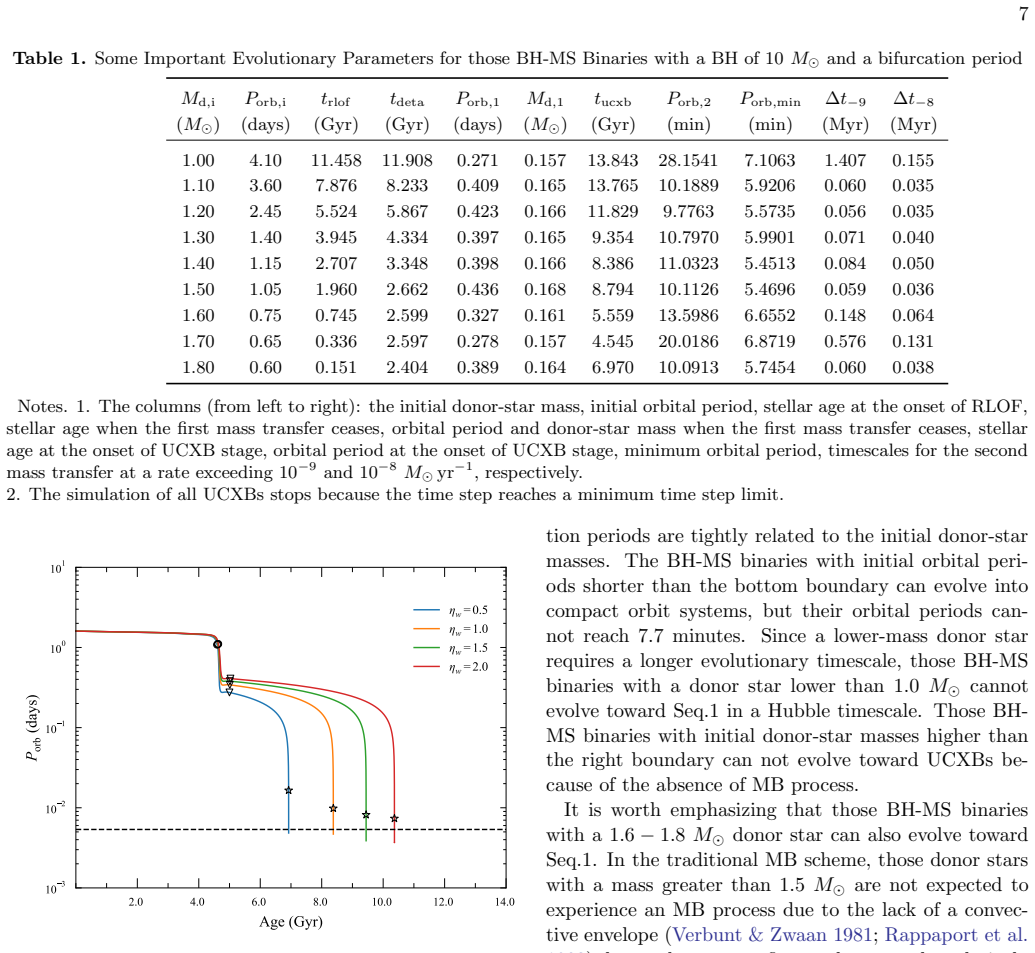
- [Section 3.1 and Table 1] The second mass-transfer episode is not followed through; the text states that the simulation stops when the time step reaches a minimum limit, and Table 1 notes this for all UCXB models. The claimed 7.7-minute period and the 1e38 erg/s luminosity are therefore inferred from the onset of an unresolved episode, not from a fully evolved state. In particular, the luminosity estimate is obtained by inserting an assumed instantaneous rate of 1.7e-8 Msun/yr into LX = 0.1 Mdot c^2, rather than from the simulated accretion history. Please either extend the calculation with a different mass-transfer scheme or with a more robust implicit time-stepping approach, or explicitly label the claims as extrapolations and provide the total mass transferred during the episode. As written, the headline match with the observed luminosity is not a direct simulation output.
- [Section 4.3] The statement 'Our detailed binary evolution model also confirms this point' regarding stable mass transfer is not supported by the unresolved simulation. The simulation adopts f=1 (no outflow), whereas the stability argument in this section uses an outflow fraction f=0.9 and a specific angular-momentum parameter lambda=0.99. Please clarify whether the unresolved numerical evolution is actually consistent with the stable regime, or remove the confirmation claim. This matters because the interpretation of Seq.1 as a persistent source and the absence of a long GRB rely on the stability of the second mass-transfer episode.
minor comments (5)
- [Section 2.1, near Eq. (1)] The sentence contains a duplicated article: 'G is the the gravitational constant.'
- [Section 1] There is a typo: 'the calculated mass transfer rate adopting the standard MB prescription is approximately an order of magnitude lower than the obseved one' should read 'observed'.
- [Figure 2 caption] The caption states that the top and bottom panels correspond to the standard and CARB MB cases, respectively, but the placement of labels in the figure rendering appears to reverse this ordering; please check the panel labels.
- [Section 3.1] The phrase 'the simulation stops because the time step exceeds a minimum time step limit' is likely meant to be 'falls below' a minimum time step; please use the standard MESA terminology.
- [Section 4.1, Eq. (6)] The symbol M in Eq. (6) is called the chirp mass but is not given a distinguishing notation; to avoid confusion with the BH mass, please use a script or calligraphic M consistently.
Circularity Check
No circularity found: the 7.7-minute period and 10^38 erg/s luminosity are outputs of MESA evolution using the externally calibrated CARB MB law, not fitted inputs from Seq.1.
full rationale
The central calculation integrates Eq. (5), the CARB magnetic-braking rate from Van & Ivanova (2019), together with standard gravitational-radiation and mass-loss terms, for isolated BH-MS binaries. Seq.1's observed 7.7-minute period and X-ray luminosity are used only as comparison targets; they are not inserted into Eq. (5) or used to fit K=0.07 or the exponent choices. The fitted constant comes from the MHD wind simulations of Réville et al. (2015), and the CARB law's prior calibration is against persistent LMXBs, not against Seq.1. The quoted luminosity is an explicit consistency estimate ('If the mass-transfer rate is 1.7×10^-8 M_sun/yr...'), not a parameter fitted to the observed flux. Citations to same-group papers (Qin et al. 2023, Deng et al. 2021, Chen 2020) appear as baseline comparisons for the standard-MB channel, supporting population/rate context, and standard analytic formulas for GW strain and chirp mass; none of these citations supplies the claimed formation channel, which is computed here with MESA. The fact that the simulation stops at a minimum time-step limit during the second RLOF, so the 7.7-minute/luminosity point is an extrapolation from the onset of an unresolved episode, is a numerical/correctness caveat rather than a circularity. No step was found in which an output is defined in terms of the target or a fitted parameter is renamed as a prediction.
Assumptions & free parameters
free parameters (4)
- K in CARB Alfven radius formula =
0.07
- Dutch wind scaling factor eta_w =
1.0 (fiducial; varied 0.5 to 2.0)
- Accretion efficiency f =
1
- Mixing length parameter alpha =
2
assumptions (5)
- domain assumption The CARB magnetic braking law of Van and Ivanova (2019) correctly describes angular momentum loss for tidally locked, low-mass main-sequence donors in compact binaries.
- domain assumption The progenitors are isolated, circular BH-MS binaries with no common envelope, no dynamical encounters, and no natal kicks.
- domain assumption Tidal locking between the donor star's spin and the orbit is maintained throughout, so MB removes orbital angular momentum at the spin rate.
- domain assumption The BH is a point mass with Eddington-limited accretion; transferred matter in excess of Eddington carries away the BH's specific orbital angular momentum.
- domain assumption MESA's stellar physics, solar composition, opacities, and Dutch wind scheme are adequate for the donor stars considered.
Cite this review
Pith. "Pith review of Formation of a Possible Black-hole Ultracompact X-ray Binary with the Shortest Orbital Period." pith.science (2026). https://pith.science/paper/D6YSFMUD
@misc{pith2026250512689,
  author       = {Pith},
  title        = {Pith review of: Formation of a Possible Black-hole Ultracompact X-ray Binary with the Shortest Orbital Period},
  year         = {2026},
  howpublished = {\url{https://pith.science/paper/D6YSFMUD}},
  note         = {Machine review of arXiv:2505.12689}
}
abstract
In the bulge of M31, the Chandra observations discovered a possible black hole (BH) ultracompact X-ray binary (UCXB) Seq.1 with an orbital period of 7.7 minutes and a maximum X-ray luminosity $L_{\rm X}=1.09^{+0.02}_{-0.01}\times10^{38}~ \rm erg\,s^{-1}$ in the $0.5-8$ keV band. The minimum orbital period of the BH UCXBs predicted by the standard magnetic braking (MB) model is longer than 8.3 minutes. In this work, we investigate whether the convection- and rotation-boosted (CARB) MB prescription can account for the formation of a BH UCXB like Seq.1. Our detailed stellar evolution models indicate that the CARB MB law can drive isolated BH-main sequence (MS) binaries to evolve toward BH UCXBs with an orbital period of $7.7~ \rm minutes$, in which a low-mass white dwarf transfers the material onto a BH in a short-term mass transfer episode, producing an X-ray luminosity of $10^{38}~\rm erg\,s^{-1}$. We also obtain an initial parameter space of BH-MS binaries as the progenitors of Seq.1 in the donor-star masses and orbital periods plane, which can be applied to future population synthesis simulations. If Seq.1 is indeed a BH UCXB, future spaceborne gravitational wave (GW) detectors can detect the low-frequency GW signals from this source, and a tidal disruption event will be expected after 0.12 Myr.
Figures


Figures from the paper (3 more)


Reference graph
Works this paper leans on
-
[1]
Amaro-Seoane, P., Andrews, J., Arca Sedda, M., et al. 2023, Living Reviews in Relativity, 26, 2, doi: 10.1007/s41114-022-00041-y Armas Padilla, M., Corral-Santana, J. M., Borghese, A., et al. 2023, A&A, 677, A186, doi: 10.1051/0004-6361/202346797
-
[2]
Bahramian, A., Heinke, C. O., Tudor, V., et al. 2017, MNRAS, 467, 2199, doi: 10.1093/mnras/stx166
-
[3]
Barnard, R., Garcia, M. R., & Murray, S. S. 2013, ApJ, 770, 148, doi: 10.1088/0004-637X/770/2/148
-
[4]
Belloni, D., & Schreiber, M. R. 2023, A&A, 678, A34, doi: 10.1051/0004-6361/202347047
-
[5]
Chen, H.-L., Tauris, T. M., Chen, X., & Han, Z. 2023, ApJ, 951, 91, doi: 10.3847/1538-4357/acd4b8
-
[6]
Chen, H.-L., Tauris, T. M., Han, Z., & Chen, X. 2021, MNRAS, 503, 3540, doi: 10.1093/mnras/stab670
-
[7]
2020, ApJ, 896, 129, doi: 10.3847/1538-4357/ab9017
Chen, W.-C. 2020, ApJ, 896, 129, doi: 10.3847/1538-4357/ab9017
-
[8]
2020, ApJL, 900, L8, doi: 10.3847/2041-8213/abae66
Chen, W.-C., Liu, D.-D., & Wang, B. 2020, ApJL, 900, L8, doi: 10.3847/2041-8213/abae66
Show all 62 references
-
[9]
2016, ApJ, 830, 131, doi: 10.3847/0004-637X/830/2/131
Chen, W.-C., & Podsiadlowski, P. 2016, ApJ, 830, 131, doi: 10.3847/0004-637X/830/2/131
2016 doi
-
[10]
P., Strader, J., Davies, M
Church, R. P., Strader, J., Davies, M. B., & Bobrick, A. 2017, ApJL, 851, L4, doi: 10.3847/2041-8213/aa9aeb
2017 doi
- [11]
-
[12]
2024, ApJ, 971, 54, doi: 10.3847/1538-4357/ad5fec
Deng, Z.-L., & Li, X.-D. 2024, ApJ, 971, 54, doi: 10.3847/1538-4357/ad5fec
2024 doi
-
[13]
2021, ApJ, 909, 174, doi: 10.3847/1538-4357/abe0b2
Deng, Z.-L., Li, X.-D., Gao, Z.-F., & Shao, Y. 2021, ApJ, 909, 174, doi: 10.3847/1538-4357/abe0b2
2021 doi
-
[14]
2018, MNRAS, 475, L101, doi: 10.1093/mnrasl/sly014
Dong, Y.-Z., Gu, W.-M., Liu, T., & Wang, J. 2018, MNRAS, 475, L101, doi: 10.1093/mnrasl/sly014
2018 doi
-
[15]
L., Woosley, S
Fryer, C. L., Woosley, S. E., Herant, M., & Davies, M. B. 1999, ApJ, 520, 650, doi: 10.1086/307467
1999 doi
-
[16]
2010, ApJ, 724, 417, doi: 10.1088/0004-637X/724/1/417
Weinberg, N. 2010, ApJ, 724, 417, doi: 10.1088/0004-637X/724/1/417
2010 doi
-
[17]
E., Pols, O
Glebbeek, E., Gaburov, E., de Mink, S. E., Pols, O. R., & Portegies Zwart, S. F. 2009, A&A, 497, 255, doi: 10.1051/0004-6361/200810425
2009 doi
-
[18]
F., & Alexander, T
Hopman, C., Portegies Zwart, S. F., & Alexander, T. 2004, ApJL, 604, L101, doi: 10.1086/383616
2004 doi
- [19]
-
[20]
G., Tauris, T
Istrate, A. G., Tauris, T. M., & Langer, N. 2014, A&A, 571, A45, doi: 10.1051/0004-6361/201424680
2014 doi
-
[21]
2006, ApJL, 653, L137, doi: 10.1086/510672
Ivanova, N. 2006, ApJL, 653, L137, doi: 10.1086/510672
2006 doi
-
[22]
2010, ApJ, 717, 948, doi: 10.1088/0004-637X/717/2/948
Ivanova, N., Chaichenets, S., Fregeau, J., et al. 2010, ApJ, 717, 948, doi: 10.1088/0004-637X/717/2/948
2010 doi
-
[23]
A., Lombardi, J
Ivanova, N., Rasio, F. A., Lombardi, J. C., J., Dooley, K. L., & Proulx, Z. F. 2005, ApJL, 621, L109, doi: 10.1086/429220
2005 doi
-
[24]
2020, MNRAS, 493, L120, doi: 10.1093/mnrasl/slaa020
King, A. 2020, MNRAS, 493, L120, doi: 10.1093/mnrasl/slaa020
2020 doi
-
[25]
R., Kolb, U., & Burderi, L
King, A. R., Kolb, U., & Burderi, L. 1996, ApJL, 464, L127, doi: 10.1086/310105
1996 doi
-
[26]
2018, MNRAS, 474, 1922, doi: 10.1093/mnras/stx2818
Lin, J., & Yu, W. 2018, MNRAS, 474, 1922, doi: 10.1093/mnras/stx2818
2018 doi
-
[27]
2009, ApJ, 698, 1907, doi: 10.1088/0004-637X/698/2/1907
Ma, B., & Li, X.-D. 2009, ApJ, 698, 1907, doi: 10.1088/0004-637X/698/2/1907
2009 doi
-
[28]
Greene, T. P. 2012, ApJL, 754, L26, doi: 10.1088/2041-8205/754/2/L26
2012 doi
-
[29]
W., Irwin, M
McConnachie, A. W., Irwin, M. J., Ferguson, A. M. N., et al. 2005, MNRAS, 356, 979, doi: 10.1111/j.1365-2966.2004.08514.x
2005
-
[30]
Miller-Jones, J. C. A., Strader, J., Heinke, C. O., et al. 2015, MNRAS, 453, 3918, doi: 10.1093/mnras/stv1869
2015 doi
-
[31]
2009, Classical and Quantum Gravity, 26, 094030, doi: 10.1088/0264-9381/26/9/094030
Nelemans, G. 2009, Classical and Quantum Gravity, 26, 094030, doi: 10.1088/0264-9381/26/9/094030
2009 doi
-
[32]
A., Rappaport, S
Nelson, L. A., Rappaport, S. A., & Joss, P. C. 1986, ApJ, 304, 231, doi: 10.1086/164156 12
1986 doi
-
[33]
W., Hartmann, L
Noyes, R. W., Hartmann, L. W., Baliunas, S. L., Duncan, D. K., & Vaughan, A. H. 1984, ApJ, 279, 763, doi: 10.1086/161945
1984 doi
-
[34]
Parker, E. N. 1971, ApJ, 164, 491, doi: 10.1086/150862
1971 doi
-
[35]
2011, ApJS, 192, 3, doi: 10.1088/0067-0049/192/1/3
Paxton, B., Bildsten, L., Dotter, A., et al. 2011, ApJS, 192, 3, doi: 10.1088/0067-0049/192/1/3
2011 doi
-
[36]
2013, ApJS, 208, 4, doi: 10.1088/0067-0049/208/1/4
Paxton, B., Cantiello, M., Arras, P., et al. 2013, ApJS, 208, 4, doi: 10.1088/0067-0049/208/1/4
2013 doi
-
[37]
2015, ApJS, 220, 15, doi: 10.1088/0067-0049/220/1/15
Paxton, B., Marchant, P., Schwab, J., et al. 2015, ApJS, 220, 15, doi: 10.1088/0067-0049/220/1/15
2015 doi
-
[38]
B., et al
Paxton, B., Schwab, J., Bauer, E. B., et al. 2018, ApJS, 234, 34, doi: 10.3847/1538-4365/aaa5a8
2018 doi
-
[39]
2019, ApJS, 243, 10, doi: 10.3847/1538-4365/ab2241
Paxton, B., Smolec, R., Schwab, J., et al. 2019, ApJS, 243, 10, doi: 10.3847/1538-4365/ab2241
2019 doi
-
[40]
2003, MNRAS, 341, 385, doi: 10.1046/j.1365-8711.2003.06464.x
Podsiadlowski, P., Rappaport, S., & Han, Z. 2003, MNRAS, 341, 385, doi: 10.1046/j.1365-8711.2003.06464.x
2003
-
[41]
Podsiadlowski, P., Rappaport, S., & Pfahl, E. D. 2002, ApJ, 565, 1107, doi: 10.1086/324686
2002 doi
-
[42]
2023, ApJ, 944, 83, doi: 10.3847/1538-4357/acb340
Qin, K., Jiang, L., & Chen, W.-C. 2023, ApJ, 944, 83, doi: 10.3847/1538-4357/acb340
2023 doi
-
[43]
2024, ApJ, 961, 110, doi: 10.3847/1538-4357/ad12d3
Qin, K., Xu, K., Liu, D.-D., et al. 2024, ApJ, 961, 110, doi: 10.3847/1538-4357/ad12d3
2024 doi
-
[44]
C., & Webbink, R
Rappaport, S., Joss, P. C., & Webbink, R. F. 1982, ApJ, 254, 616, doi: 10.1086/159772
1982 doi
-
[45]
A., Ma, C
Rappaport, S., Nelson, L. A., Ma, C. P., & Joss, P. C. 1987, ApJ, 322, 842, doi: 10.1086/165778
1987 doi
-
[46]
Rappaport, S., Verbunt, F., & Joss, P. C. 1983, ApJ, 275, 713, doi: 10.1086/161569 R´ eville, V., Brun, A. S., Matt, S. P., Strugarek, A., &
1983 doi
-
[47]
Pinto, R. F. 2015, ApJ, 798, 116, doi: 10.1088/0004-637X/798/2/116
2015 doi
-
[48]
J., & Liu, C
Robson, T., Cornish, N. J., & Liu, C. 2019, Classical and Quantum Gravity, 36, 105011, doi: 10.1088/1361-6382/ab1101
2019 doi
-
[49]
2020, Nature Astronomy, 4, 108, doi: 10.1038/s41550-019-1008-4
Ruan, W.-H., Liu, C., Guo, Z.-K., Wu, Y.-L., & Cai, R.-G. 2020, Nature Astronomy, 4, 108, doi: 10.1038/s41550-019-1008-4
2020 doi
-
[50]
Tauris, T. M. 2018, PhRvL, 121, 131105, doi: 10.1103/PhysRevLett.121.131105
2018 doi
- [51]
-
[52]
A., Aarseth, S
Tout, C. A., Aarseth, S. J., Pols, O. R., & Eggleton, P. P. 1997, MNRAS, 291, 732, doi: 10.1093/mnras/291.4.732
1997 doi
-
[53]
Tudor, V., Miller-Jones, J. C. A., Knigge, C., et al. 2018, MNRAS, 476, 1889, doi: 10.1093/mnras/sty284
2018 doi
-
[54]
X., & Ivanova, N
Van, K. X., & Ivanova, N. 2019, ApJL, 886, L31, doi: 10.3847/2041-8213/ab571c
2019 doi
-
[55]
X., Ivanova, N., & Heinke, C
Van, K. X., Ivanova, N., & Heinke, C. O. 2019, MNRAS, 483, 5595, doi: 10.1093/mnras/sty3489 van der Sluys, M. V., Verbunt, F., & Pols, O. R. 2005a, A&A, 431, 647, doi: 10.1051/0004-6361:20041777 —. 2005b, A&A, 440, 973, doi: 10.1051/0004-6361:20052696 van Haaften, L. M., Nelem...
2019 doi
-
[56]
1981, A&A, 100, L7
Verbunt, F., & Zwaan, C. 1981, A&A, 100, L7
1981
-
[57]
2021, MNRAS, 506, 4654, doi: 10.1093/mnras/stab2032
Wang, B., Chen, W.-C., Liu, D.-D., et al. 2021, MNRAS, 506, 4654, doi: 10.1093/mnras/stab2032
2021 doi
-
[58]
2019, PhRvD, 100, 043003, doi: 10.1103/PhysRevD.100.043003
Wang, H.-T., Jiang, Z., Sesana, A., et al. 2019, PhRvD, 100, 043003, doi: 10.1103/PhysRevD.100.043003
2019 doi
-
[59]
Woosley, S. E. 1993, ApJ, 405, 273, doi: 10.1086/172359
1993 doi
-
[60]
E., & Bloom, J
Woosley, S. E., & Bloom, J. S. 2006, ARA&A, 44, 507, doi: 10.1146/annurev.astro.43.072103.150558
2006 arXiv
-
[61]
2024, MNRAS, 530, 2096, doi: 10.1093/mnras/stae1002
Zhang, J., Bao, T., & Li, Z. 2024, MNRAS, 530, 2096, doi: 10.1093/mnras/stae1002
2024 doi
-
[62]
2012, Research in Astronomy and Astrophysics, 12, 1526, doi: 10.1088/1674-4527/12/11/007
Zhu, C.-H., L¨ u, G.-L., & Wang, Z.-J. 2012, Research in Astronomy and Astrophysics, 12, 1526, doi: 10.1088/1674-4527/12/11/007
2012 doi
Reviewed August 15, 2026 · model on record in the stance chip above.
Discussion (0). Continue with ORCID to comment.