REVIEW 5 major objections 5 minor 20 references
Persistent Local Systems of Periodic Spaces
T0 review · 5 major / 5 minor · reviewed 2026-08-15 · deepseek-v4-flash
Pith's one-line read The paper establishes that toroidal cycles of a finite quotient of a periodic cell complex are classified by persistent local systems built from bisheaves.
desk verdict A genuinely new bridge from bisheaves/persistent local systems to periodic complexes, with a solid 1-periodic core but a load-bearing d-periodic reduction (Proposition 1) that is asserted rather than proved. read the letter →
The pith
A machine-rendered reading of the paper's core claim, the machinery that carries it, and where it could break.
The reading
What carries the argument
The machinery is the cellular bisheaf: a pair consisting of a sheaf (contravariant data on open stars) and a cosheaf (covariant data on preimages), linked cell-wise by cap products with a fixed orientation class of the target torus. Isobisheafification—taking the maximal sub-episheaf and the minimal quotient-monocosheaf—produces a canonical persistent local system, whose cell-wise maps form a locally constant cosheaf. For one-periodic quotients, covering space theory makes the bisheaf over the circle locally isomorphic to a lift over the real line, so the persistent local system records exactly which homology classes survive lifting. The $d$-periodic case runs the same construction for each coordinate projection $G \to S^1$ and takes the product.
What would settle it
Search among 2-periodic cubical complexes for a toroidal class in $H_2(G)/I_2$ whose cap product with the orientation class of each coordinate circle is zero; such a class would not be visible in any coordinate persistent local system, contradicting Theorem 2.
Extended reading notes
Core claim
The paper claims that for a $d$-periodic cell complex $K$ with quotient $G$, every toroidal homology class of $G$—one created by periodic boundary conditions and not lifting to a cycle in $K$—appears canonically in a persistent local system built from the bisheaf of the quotient map. In the one-periodic case this is an embedding of $H_{\bullet+1}(G)/I_{\bullet+1}$ into $L(G)_{\bullet}$ (Theorem 1); in the $d$-periodic case it is an embedding into a product of $d$ persistent local systems, one for each independent translation direction (Theorem 2), using the reduction that it suffices to check one periodic direction at a time (Proposition 1). The result is stated over any field and covers all homology degrees.
Load-bearing premise
The d-periodic classification depends on Proposition 1, which assumes that a toroidal cycle of the full quotient is toroidal in at least one intermediate 1-periodic quotient; the proof uses an unproven injectivity assertion about quotient maps on toroidal cycles, and if that fails the product embedding of Theorem 2 loses its foundation.
Editorial extensions
If this is right
- For a one-periodic complex, every nonzero class in $H_{\bullet+1}(G)/I_{\bullet+1}$ appears as a nontrivial class of the persistent local system $L(G)_{\bullet}$, so no toroidal cycle is lost.
- For a $d$-periodic complex, every toroidal class is detected by at least one of the $d$ coordinate persistent local systems, so no infinite computation over $K$ is needed to separate toroidal from true cycles.
- Algorithms 1 and 2 terminate and compute epification and monofication in polynomial time, making isobisheafification and the persistent local system computable for finite quotients.
- The 1-eigenvectors of the monodromy matrix $M_i$ enumerate toroidal cycles of $G$, and the 1-eigenvectors of $M_i^k$ enumerate toroidal cycles of the $k$-fold cover $G_{i,k}$.
- Non-toroidal cycles are represented trivially in the persistent local system, so the persistent local system separates the two cycle types.
Reading between the lines
- If the embeddings hold, toroidal-cycle detection becomes a monodromy computation: the 1-eigenspaces of the persistent local system monodromy matrices enumerate classes that wrap around each translation direction, and the paper's Conjecture 1 would then imply that all eigenvalues are roots of unity, giving toroidal information for all finite covers from one small quotient.
- The one-coordinate-at-a-time reduction suggests a general principle: high-dimensional periodicity behaves as a product of one-dimensional monodromies, and the same construction might extend to free actions of other abelian groups, with the target torus replaced by the group's classifying space.
- The local quotient-independence seen in one-periodic bisheaves weakens in higher periodicity, as the paper's triply periodic minimal surface example shows; whether a canonical choice of quotient can make the persistent local systems fully quotient-independent is a question the paper leaves open.
Signed reviews
Editorial analysis
A structured set of objections, weighed in public.
Referee Report
Summary. The paper develops a bisheaf-theoretic framework for classifying toroidal cycles in finite quotients of d-periodic cell complexes. The main claims are: (i) Theorem 1 gives a canonical embedding of the toroidal quotient H_{•+1}(G)/I_{•+1} into the persistent local system L(G) for 1-periodic complexes; (ii) Proposition 1 asserts that every toroidal class in a d-periodic quotient is already toroidal with respect to one of the d intermediate 1-periodic quotients; (iii) Theorem 2 combines these to embed H_{•+1}(G)/I_{•+1} into the product of d persistent local systems; and (iv) Section 4 gives polynomial-time algorithms for epification, monofication, and extraction of toroidal cycles from the monodromy matrices of the persistent local systems. The paper also presents several worked examples and two conjectures about the finer structure of the monodromy.
Significance. If the main theorems are correct, the paper would provide a genuinely useful computational classification of toroidal homology in all degrees for periodic complexes of arbitrary periodicity, extending earlier work on degree 0/1 and 1-periodic cases. The explicit algorithms, the worked examples in Section 5.2, and the use of persistent local systems as the invariant are appealing and likely to be of interest to the computational topology and topological data analysis communities. However, the central theorems are not yet rigorously established: the proof of Proposition 1 contains an unproved and nonstandard assertion, and the proof of Theorem 1 has a load-bearing gap when passing from relative to absolute homology. These issues directly affect the validity of Theorem 2 and the extraction pipeline in Section 5.1.
major comments (5)
- [§3.2, Proposition 1] The proof of Proposition 1 is not rigorous and contains a load-bearing unproved assertion: in the second paragraph, the authors state that after subtracting non-toroidal cycles, homologous chains in the quotient 'must be homologous in the lifts (as the quotient maps are injective on toroidal cycles).' This is not a standard property of covering-space quotient maps, and no proof or reference is provided. The first case (lifts supported on [0,1]^d) only treats chains whose boundary is a linear combination of the period relations q_i, which is not the general situation. The later case of arbitrary lifts is dismissed in a few sentences that do not establish the claimed reduction. Since Theorem 2 is stated to follow immediately from Theorem 1 and Proposition 1, this gap undermines the central d-periodic claim. The authors should either supply a complete proof of Proposition 1 or replace Theorem 2 with a conditional statement.
- [§3.1, Theorem 1 proof] In the first part of the proof of Theorem 1, the step 'Applying the homology functor to the embedding st(σ~),→R then implies [ζ~]=[ξ~]=0 in K' is not justified. The vanishing [ξ~]=0 is in the relative group F~(σ~)=H(K,K\st(σ~)); a relative boundary is not necessarily zero in absolute homology. A cycle supported in st(σ~) can be a relative boundary while remaining nonzero in H(K), if it bounds through the complement. The argument as written therefore does not establish that ζ~ is a boundary in K, which is the key step in showing that γ is non-toroidal. This needs a careful homology long-exact-sequence argument or a different approach.
- [§3.1, Theorem 1 proof, induction step] The induction over the monofication kernels in the proof of Theorem 1 is asserted rather than proved. The claim that if ˙F~_σ[γ~_σ] lies in K~_j(σ) then it can be written as a sum of cycles α~_τ that are cycles in st(σ~) but homologous to a boundary in st(τ~), and that this implies γ is non-toroidal, is not derived from the definitions of Algorithm 2. Since this induction is the mechanism by which the proof passes from the cap-product vanishing to the full PLS vanishing, this is another load-bearing gap. The authors should give a precise statement of the invariant maintained by the monofication algorithm and prove the induction step.
- [§4.2, Theorem 3] The complexity bound in Theorem 3 appears to be off by a factor of n. The proof says the second loop iterates at most nD times and that each cell computation costs O((c^ω+C^ω)D^ω), but each iteration of the while loop in Algorithms 1 and 2 passes over all cells of the complex. The total cost should therefore be O(n^2(c^ω+C^ω)D^{1+ω}) (plus the O(nd) first loop), not O(n(c^ω+C^ω)D^{1+ω}). Moreover, the assertion that 'each iteration of the second loop must reduce the dimension of at least one vector space' is not proved and is not an immediate consequence of the pseudocode. The polynomial-time claim is probably salvageable, but the stated bound and its proof need correction.
- [§5.1, Extraction of toroidal cycles] The sentence 'The 1-eigenvectors of M_i correspond exactly to the toroidal cycles of G' overstates what Theorem 1 establishes. Theorem 1 gives only an embedding ι(H_{•+1}(G)/I_{•+1}) ↪ L(G)_•; it does not assert surjectivity onto the 1-eigenspaces (or onto L(G) at all). The later Conjecture 1 explicitly leaves open the possibility that not every class of L(G) is realized by a toroidal cycle, and the anticipation that the embedding becomes an isomorphism only for some finite cover G_{i,k} is also conjectural. The extraction pipeline in Section 5.1 therefore needs a separate justification, or it should be phrased conditionally on Conjecture 1.
minor comments (5)
- [Abstract] The phrase 'Here, build on the work' is missing a subject; it should read 'Here, we build on the work...'.
- [Section 3 heading] The word '1-peoridic' is a typo for '1-periodic'.
- [Notation in Section 3.1] The notation for the lifted bisheaf is typeset inconsistently (for example 'eF e' appears in several places); this should be unified.
- [§4.1] The use of d both for the dimension of the cell complex and for the periodicity of the translation action is confusing; for example, 'the d-coordinate projections π_d : G→T^d' is hard to parse. A different index, such as p for periodicity, would improve readability.
- [Remark 6] For a free and properly discontinuous Z^d action on R^d, the quotient is homeomorphic to T^d, not merely 'homologically equivalent to a torus'; the remark can be made more precise.
Circularity Check
No significant circularity; the main embedding theorem relates independently defined invariants, while Proposition 1's unproved injectivity is a correctness gap rather than a circular reduction.
full rationale
The central objects are independently defined: H_•(G)/I_• is the cokernel of q_*: H_•(K) → H_•(G) (Definition 9), while L(G) is the image of the isobisheaf cap-product map (Definition 7 and Lemma 1). Theorem 1 proves the embedding by showing both that non-toroidal classes vanish in L(G) (Lemma 3) and, conversely, that a class with trivial image I_σ[γ_σ] must be non-toroidal; neither direction uses a fitted parameter, a normalizing choice, or a definition that builds the target from the source. The d-periodic Theorem 2 is a formal consequence of Theorem 1 together with Proposition 1, and the proof of Theorem 2 is not itself circular. The proof of Proposition 1 does contain an unproved assertion—'the quotient maps are injective on toroidal cycles'—which is a potential correctness gap and the weakest link in the derivation, since the conclusion depends on it. However, this is not a circular reduction: the injectivity assertion is not an input to the construction of L(G), and no equation in the paper defines the claimed invariant in terms of the objects being predicted. The references to the authors' own prior work [14,15] are contextual and non-load-bearing; the bisheaf and persistent local system machinery is imported from external sources [10,13], and the main proofs are carried out in this paper. Accordingly, no significant circularity is present.
Assumptions & free parameters
assumptions (4)
- standard math Zorn's Lemma provides a maximal sub-episheaf and a minimal quotient-monocosheaf in arbitrary abelian categories.
- domain assumption K is a locally compact, paracompact d-periodic complex and the quotient G admits a canonical map π: G -> T^d making Diagram (1) commute.
- domain assumption The cellulation of T^d can be chosen so that preimages of open stars are locally constant, and for S^1 the cellulation has at least two vertices.
- ad hoc to paper Quotient maps are injective on toroidal cycles.
Cite this review
Pith. "Pith review of Persistent Local Systems of Periodic Spaces." pith.science (2026). https://pith.science/paper/35J23BDF
@misc{pith2026250513051,
  author       = {Pith},
  title        = {Pith review of: Persistent Local Systems of Periodic Spaces},
  year         = {2026},
  howpublished = {\url{https://pith.science/paper/35J23BDF}},
  note         = {Machine review of arXiv:2505.13051}
}
abstract
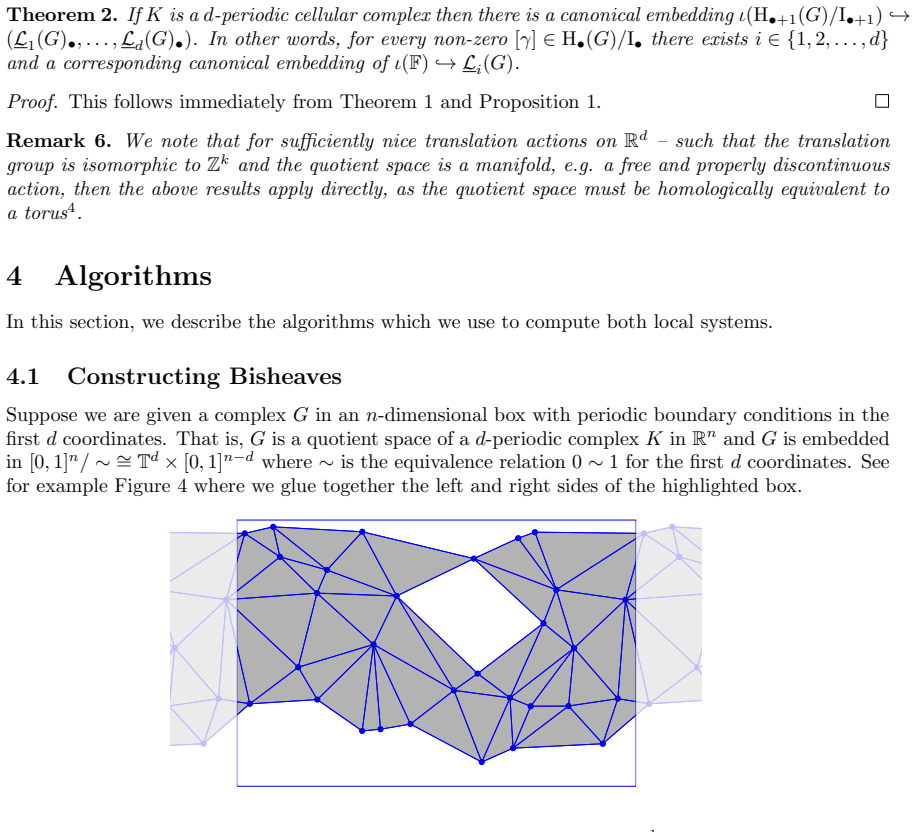
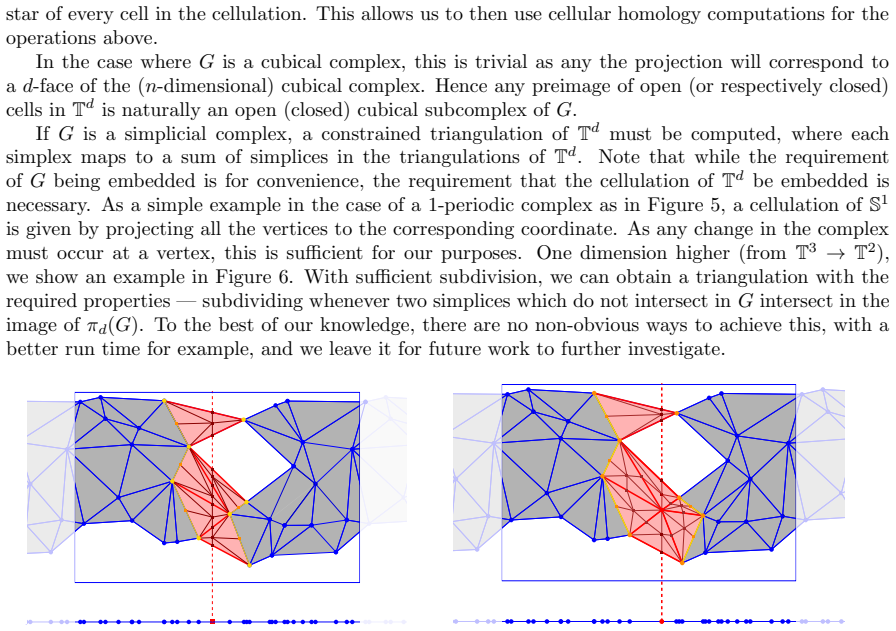
The topology of periodic spaces has attracted a lot of interest in recent years in order to study and classify crystalline structures and other large homogeneous data sets, such as the distribution of galaxies in cosmology. In practice, these objects are studied by taking a finite sample and introducing periodic boundary conditions, however this introduces and removes many subtle homological features. Here, build on the work of Onus and Robins (2022) and Onus and Skraba (2023) to investigate whether one can recover the (persistent) homology of a periodic cell complex $K$ from a finite quotient space $G$ of equivalence classes under translations. In particular, we search for a computationally friendly method to identify all ''toroidal cycles'' of $G$ which do not lift to cycles in $K$. We show that all toroidal and non-toroidal cycles of $G$ of arbitrary homology degree can be completely classified for $K$ of arbitrary periodicity using the recently developed machinery of bisheaves and persistent local systems. In doing so, we also introduce a framework for a computationally viable persistence theory of periodic spaces. Finally, we outline algorithms for how to apply our results to real data, including a polynomial time algorithm for calculating the canonical persistent local system attributed to a given bisheaf.
Figures


Figures from the paper (6 more)


Reference graph
Works this paper leans on
-
[10]
Robert MacPherson and Amit Patel. Persistent local systems. Adv. Math., 386:Paper No. 107795, 39, 2021. doi:10.1016/j.aim.2021.107795
arXiv 2021
-
[1]
Persistent equivariant cohomology
Henry Adams, Evgeniya Lagoda, Michael Moy, Nikola Sadovek, and Aditya De Saha. Persistent equivariant cohomology. arXiv preprint arXiv:2408.17331 , 2024
arXiv 2024
-
[2]
Triangular factorization and inversion by fast matrix multiplication
James R Bunch and John E Hopcroft. Triangular factorization and inversion by fast matrix multiplication. Mathematics of Computation , 28(125):231–236, 1974
work page 1974
-
[3]
Spatial curvature and periodic boundary conditions in cosmology
A Coley. Spatial curvature and periodic boundary conditions in cosmology. In School and Work- shops on Elementary Particle Physics and Gravity , page 237, 2023
work page 2023
-
[4]
Evolution of local motifs and topological proximity in self-assembled quasi-crystalline phases
Martin Cramer Pedersen, Vanessa Robins, Kell Mortensen, and Jacob JK Kirkensgaard. Evolution of local motifs and topological proximity in self-assembled quasi-crystalline phases. Proceedings of the Royal Society A , 476(2241):20200170, 2020
work page 2020
-
[5]
Sheaves, cosheaves and applications
Justin Michael Curry. Sheaves, cosheaves and applications. University of Pennsylvania, 2014
2014
-
[6]
Merge trees of periodic filtrations
Herbert Edelsbrunner and Teresa Heiss. Merge trees of periodic filtrations. arXiv preprint arXiv:2408.16575, 2024
arXiv 2024
-
[7]
Abelian categories, volume 1964
Peter J Freyd. Abelian categories, volume 1964. Harper & Row New York, 1964
work page 1964
Show all 20 references
-
[8]
Quotient complex (qc)- based machine learning for 2d hybrid perovskite design
Chuan-Shen Hu, Rishikanta Mayengbam, Kelin Xia, and Tze Chien Sum. Quotient complex (qc)- based machine learning for 2d hybrid perovskite design. Journal of Chemical Information and Modeling, 2025
2025
-
[9]
Tile-transitive tilings of the euclidean and hyperbolic planes by ribbons
Benedikt Kolbe and Vanessa Robins. Tile-transitive tilings of the euclidean and hyperbolic planes by ribbons. In Research in Computational Topology 2, pages 77–98. Springer, 2022
2022
-
[11]
Computing the bridge length: the key ingredient in a continuous isometry classification of periodic point sets
Jonathan McManus and Vitaliy Kurlin. Computing the bridge length: the key ingredient in a continuous isometry classification of periodic point sets. arXiv preprint arXiv:2410.23288 , 2024
2024
-
[12]
Zigzag persistent homology in matrix multiplication time
Nikola Milosavljevi´ c, Dmitriy Morozov, and Primoz Skraba. Zigzag persistent homology in matrix multiplication time. In Proceedings of the twenty-seventh Annual Symposium on Computational Geometry, pages 216–225, 2011
2011
-
[13]
Canonical stratifications along bisheaves
Vidit Nanda and Amit Patel. Canonical stratifications along bisheaves. In Topological Data Analysis: The Abel Symposium 2018 , pages 391–403. Springer, 2020
2018
-
[14]
Quantifying the homology of periodic cell complexes
Adam Onus and Vanessa Robins. Quantifying the homology of periodic cell complexes. arXiv preprint arXiv:2208.09223, 2022
2022
-
[15]
Computing 1-periodic persistent homology with finite windows
Adam Onus and Primoz Skraba. Computing 1-periodic persistent homology with finite windows. arXiv preprint arXiv:2312.00709 , 2023
2023
-
[16]
A cellular description of the derived category of a stratified space
Allen Dudley Shepard. A cellular description of the derived category of a stratified space . Brown University, 1985
1985
-
[17]
Level of detail visual analysis of structures in solid-state materials
Signe Sidwall Thygesen, Alexei I Abrikosov, Peter Steneteg, Talha Bin Masood, and Ingrid Hotz. Level of detail visual analysis of structures in solid-state materials. In EuroVis (Short Papers) , pages 55–59, 2023. 28
2023
-
[18]
Nodal surfaces of fourier series: fundamental invariants of structured matter
HG Von Schnering and R Nesper. Nodal surfaces of fourier series: fundamental invariants of structured matter. Zeitschrift f¨ ur Physik B Condensed Matter, 83:407–412, 1991
1991
-
[19]
Recurrence quantification analysis of nonlinear dynami- cal systems
Charles L Webber Jr and Joseph P Zbilut. Recurrence quantification analysis of nonlinear dynami- cal systems. Tutorials in contemporary nonlinear methods for the behavioral sciences, 94(2005):26– 94, 2005
2005
-
[20]
Inferring ambient cycles of point samples on manifolds with universal coverings
Ka Man Yim. Inferring ambient cycles of point samples on manifolds with universal coverings. arXiv preprint arXiv:2502.02400 , 2025. A Existence of Persistent Local Systems In order to prove the existence of persistence local systems (PLS’s) in arbitrary abelian categories, we...
2025 arXiv
Reviewed August 15, 2026 · model on record in the stance chip above.
Discussion (0). Continue with ORCID to comment.