REVIEW 3 major objections 4 minor 1 cited by
Formation and evolution of boxy/peanut bulges in the Auriga cosmological simulations
T0 review · 3 major / 4 minor · reviewed 2026-08-15 · deepseek-v4-flash
Pith's one-line read In the Auriga cosmological simulations, boxy/peanut bulges form 1.1–1.6 Gyr after their bar does, always after a buckling episode, and the b/p fraction among barred galaxies falls from 45% at $z=0$ to zero by $z\sim1$.
desk verdict First systematic account of b/p bulges in cosmological simulations, with a real caveat: the detection threshold controls every headline number and is calibrated on the same visual data used for validation. read the letter →
The pith
A machine-rendered reading of the paper's core claim, the machinery that carries it, and where it could break.
The reading
What carries the argument
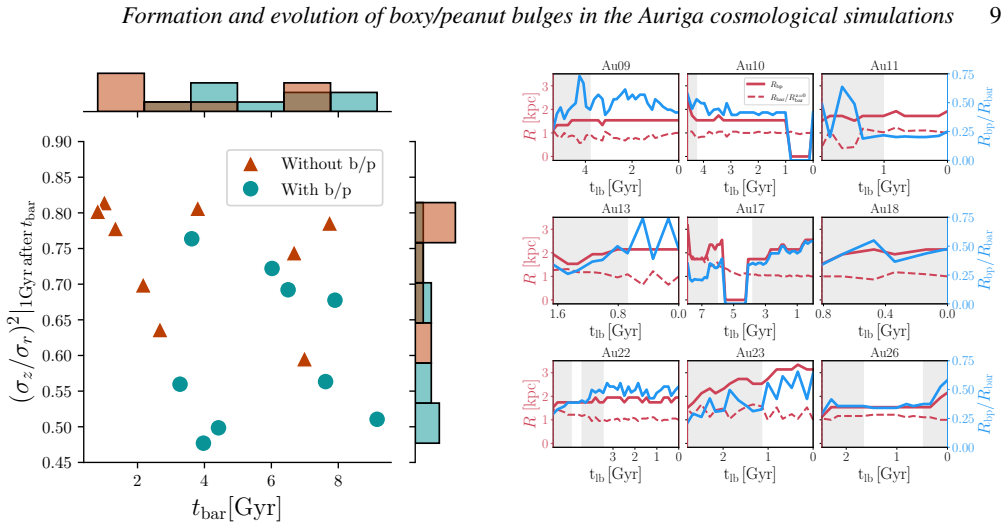
The central object is the normalized vertical height profile $Z(r)=|z|_{\mathrm{median}}(r)/|z|_{\mathrm{median}}(0)$ built from bar stars, which measures how thick the stellar distribution is at each radius. A b/p bulge is registered as a local peak in $Z$, found automatically as the minimum of $\mathrm{d}^2Z/\mathrm{d}r^2$ dropping below $-0.51$ and staying there for at least five snapshots. The same peak's radial position defines the b/p size $R_{\mathrm{bp}}$, and its height defines the b/p strength. Supporting diagnostics are the Fourier bar-strength profile $A_2(r)$, the buckling amplitude $A_{\mathrm{buck}}$, and the meridional tilt angle $\Theta_{\mathrm{tilt}}$, whose peaks locate buckling episodes and tie the b/p peak to a physical instability.
What would settle it
Re-run the peak-detection algorithm on the same nine galaxies with thresholds of, say, $-0.40$ and $-0.60$ and recompute formation times and the $z=0$ fraction: if the 1.1–1.6 Gyr delay or the 45 per cent fraction moves by more than the quoted uncertainties, the published timeline is a calibration artifact. A second test: a securely identified b/p bulge in a barred galaxy at $z>1$ would contradict the claim that the b/p fraction reaches zero by $z\sim1$.
Extended reading notes
Core claim
On the paper's own terms, the central discovery is that boxy/peanut bulges in cosmological simulations are not slow resonance-built structures but the visible aftermath of discrete buckling events. The peak-detection method finds nine b/p bulges in the 30 Auriga haloes; each one appears between 1.1 and 1.6 Gyr (median) after the bar forms, and in every case a visual break in the bar's mid-plane symmetry precedes the appearance. Two galaxies in the sample lose their b/p signal for a period and then regrow it after a later buckling, and one galaxy shows four buckling episodes. The paper also reports that b/p bulges extend to roughly half the bar length, with a median $R_{\mathrm{bp}}/R_{\mathrm{bar}}=0.48$ at $z=0$, and that the fraction of barred galaxies with a b/p drops from 45 per cent at $z=0$ to 20 per cent at $z=0.5$ and to zero at $z\sim1$.
Load-bearing premise
The load-bearing assumption is that the single threshold $\mathrm{d}^2Z/\mathrm{d}r^2 < -0.51$, chosen by visually inspecting the same galaxies, is what separates a real b/p bulge from a faint or transient one; because the paper itself shows faint b/p features remaining visible in unsharp masks when the code reports none, a different threshold would shift every formation time and fraction this paper reports.
Editorial extensions
If this is right
- The b/p fraction as a function of redshift becomes a clock for bar evolution: in these simulations the 45 per cent at $z=0$ falls to 20 per cent at $z=0.5$ and to zero by $z\sim1$, so high-redshift surveys should see a steep drop.
- A b/p bulge is not permanent once formed: bars can buckle, build a peanut, lose its detectable signal, and rebuild it after a later buckling, so single-snapshot classifications miss an important part of the population.
- Because the delay between bar and b/p formation is only 1.1–1.6 Gyr, most b/p-bearing bars in the local Universe should be older than roughly 2 Gyr, and young bars should almost never show a b/p.
- The b/p radius tracks, and is about half of, the bar radius, so measurements of one put a constraint on the other; the observed $R_{\mathrm{bp}}/R_{\mathrm{bar}}$ ratios agree with this simulated value.
Reading between the lines
- Because the $-0.51$ threshold was calibrated on the same nine galaxies it is applied to, the reported formation times and the 45 per cent fraction are partly circular; varying the threshold is a cheap check, and the paper's own appendix shows faint b/p signals may persist where the algorithm registers zero.
- The universal buckling-first result may be a property of the Auriga galaxy formation model rather than of galaxies generally; the paper argues this model lacks massive central mass concentrations, so a simulation with a strong central concentration should produce a resonance-formed b/p without buckling.
- The trend that b/p hosts have lower $\sigma_z/\sigma_r$ about 1 Gyr after bar formation suggests a quantitative threshold could separate future b/p hosts from non-hosts; that is a direct, testable extension to a larger sample of haloes.
- If disc heating indeed suppresses buckling, then variations in feedback strength that make discs thinner should raise the b/p fraction toward the 69–80 per cent values reported by some observational studies.
Signed reviews
Editorial analysis
A structured set of objections, weighed in public.
Referee Report
Summary. The paper uses the Auriga cosmological zoom-in simulations to study the formation and evolution of boxy/peanut (b/p) bulges. The authors develop an automated b/p detection method based on the second derivative of a normalized vertical-height profile, identify a sample of nine barred galaxies with b/p structures, and measure formation times relative to bar formation, b/p fractions as a function of redshift, b/p sizes, and the timing of buckling episodes. They report that b/p bulges form 1.1-1.6 Gyr after bar formation, always following a buckling event, that 45% of barred galaxies host a b/p at z=0 with the fraction declining to zero by z~1, and that b/p sizes are roughly half the bar length, with some galaxies showing b/p 'dissolution' and re-emergence.
Significance. If the central results hold, this is a valuable step in placing b/p bulge formation in a cosmological context, complementing earlier isolated-galaxy simulations and observational work. The paper is carefully structured and uses multiple independent diagnostics (visual inspection, Z-peak detection, A_buck, and Theta_tilt) that broadly agree, and the underlying Auriga data are public. The main quantitative claims, however, rest on a single detection threshold whose calibration is not independent of the measurements it produces, and the paper's own Appendix D concedes that faint b/p signals remain visible when the code reports no detection. These issues affect the headline formation times, the redshift evolution of the b/p fraction, and the interpretation of 'dissolution' events. The direction and qualitative conclusions are likely robust, but the reported numbers need additional sensitivity analysis before they can be accepted as quantitative predictions.
major comments (3)
- [Sec. 2.3(v), footnote 3, and Appendix D] The detection threshold d^2Z/dr^2 < -0.51 is calibrated by visually inspecting the same nine galaxies whose formation times and fractions it is then used to measure (footnote 3), and Appendix D states that during intervals when the code reports zero b/p strength, unsharp masks show a faint peanut signal near the bar ends. Because this single threshold defines t_c_bp, the b/p fraction curve in Fig. 6, and the 'dissolution' episodes in Au10 and Au17, the paper should provide a sensitivity analysis, for example by varying the threshold or by using the visual weak detection times as an alternative criterion, before the quantitative claims (median 1.1-1.6 Gyr delay, 45% z=0 fraction, decline to zero at z~1) can be taken at face value.
- [Sec. 3.1 and Fig. 6] The code-based b/p fraction is a direct function of the same -0.51 threshold, while the 'visual' b/p fraction shown as the thin blue line in Fig. 6 is not described quantitatively: there is no explicit protocol for what constitutes a visually detected b/p at each redshift, nor a consistency criterion between the visual and code counts. Without such a protocol, the claimed decline to zero at z~1 is not robust to the detection threshold, especially given the faint signals noted in Appendix D.
- [Sec. 3 and Appendix D] The claim that b/p structures 'dissolve' (abstract, Sec. 3, Sec. 7) is stronger than the evidence supports. The authors themselves state in Appendix D that the unsharp masks show a faint peanut signal during the code's zero-strength intervals, which means the structure weakens below the detection threshold rather than demonstrably vanishing. This phrasing should be revised, or the strength criterion should be calibrated to the visually persistent feature, so that 'dissolution' is not an artifact of the threshold choice.
minor comments (4)
- [Fig. 5 caption] The caption reads 'the formation time of the formation time of the bar'; the duplicate phrase should be corrected.
- [Sec. 6.1 and Fig. 5] The quoted median delay of 1.1 Gyr for 'first appearance' is not clearly defined: Table 2 lists t_vw,1 only for Au13 and Au18 (and t_vw,2 for Au18), so the set of galaxies used to compute this median should be stated explicitly to avoid ambiguity.
- [Sec. 3.1] The text refers to 'IllsutrisTNG50' instead of 'IllustrisTNG50'.
- [Sec. 5 and Fig. 12] There is an inconsistency between the text of Sec. 5, which describes Au17's first buckling as spanning roughly 8.7-6 Gyr and the second as 3.8-0 Gyr, and the caption of Fig. 12, which quotes intervals of 8.09-7.62 Gyr and 2.79-0.34 Gyr; please reconcile these numbers.
Circularity Check
The automated b/p detection threshold is visually calibrated on the same galaxies and then used to define formation times and code-based fractions; Appendix D admits faint peanut signals remain when the code reports none, so the headline timescales and fraction decline are partly threshold-imposed.
-
fitted input called prediction
[Section 2.3(v), footnote 3; Section 3.1; Appendix D]
"we developed an automatised algorithm to detect the presence of a b/p and its strength which gives us a good match to the visual classification of b/p bulges ... When this parameter drops below a threshold3 of d2Z(r)/dr2 < -0.51, and remains below it consistently (for at least 5 snapshots), we define this instant as marking the formation time of the b/p bulge, denoted as tc_bp. Footnote 3: The threshold was determined by visually inspecting when a b/p appears in edge-on images of the galaxy."
The formation time of the b/p is not an independent measurement: the single number that decides whether a b/p exists is chosen by visually inspecting the same nine galaxies it is then used to analyze. Every headline quantity that comes from the code (median 1.6 Gyr delay, code-based b/p fraction curve, the 'dissolution' and re-emergence episodes in Au10 and Au17) is a direct function of this one threshold. Appendix D itself concedes that during intervals where the code reports zero strength the unsharp mask still shows a faint peanut signal, so the threshold is acting as an ontological cut between 'present' and 'absent' rather than tracing an independently defined structure.
full rationale
This is a measurement study of Auriga simulations, not a first-principles derivation, so most of the paper is not circular. Bar sizes, A2-based bar fractions, Rbp/Rbar ratios, velocity-dispersion ratios, and buckling diagnostics (Abuck, Theta_tilt) are computed from the simulations with methods that do not depend on the b/p detection threshold. The circular content is localized to the automated b/p detection: the threshold d2Z/dr2 < -0.51 was set by visually inspecting the same galaxies, and is then used to define formation times, the code-based b/p fraction, and the apparent disappearance/re-appearance of b/p structures. Appendix D's admission that a faint peanut signal remains when the code reports no strength confirms that the zero-fraction points and 'dissolution' events are threshold-imposed. The visual-method fraction and the size comparison with Erwin & Debattista (2017) provide independent content, which prevents a higher score, but the central formation-time and fraction claims are partly constructed from the calibration.
Assumptions & free parameters
free parameters (5)
- b/p detection threshold d2Z/dr2 < -0.51 =
-0.51
- Bar detection threshold A2,max > 0.25 =
0.25
- Detection radius window (0.15-0.75 Rbar,z0) =
0.15-0.75 Rbar,z0
- Star selection cuts |y|<0.8 kpc, |z|<2 kpc =
0.8 kpc, 2 kpc
- Disc cut |z|<5 kpc for A2 =
5 kpc
assumptions (4)
- domain assumption The Auriga suite's galaxy formation model (Grand et al. 2017) is an acceptable representation of real galaxy formation.
- domain assumption A peak in the normalized median |z| profile (Z) is a reliable tracer of a boxy/peanut bulge.
- domain assumption Visual classification of b/p and buckling is a valid ground truth.
- standard math The bar's m=2 Fourier mode and its strength threshold are standard and reliable.
Cite this review
Pith. "Pith review of Formation and evolution of boxy/peanut bulges in the Auriga cosmological simulations." pith.science (2026). https://pith.science/paper/HXQFSNVU
@misc{pith2026250513590,
  author       = {Pith},
  title        = {Pith review of: Formation and evolution of boxy/peanut bulges in the Auriga cosmological simulations},
  year         = {2026},
  howpublished = {\url{https://pith.science/paper/HXQFSNVU}},
  note         = {Machine review of arXiv:2505.13590}
}
abstract
Boxy/peanut (b/p) or X-shaped bulges have been extensively explored with theory and numerical simulations of isolated galaxies. However, it is only recently that advances in hydrodynamical cosmological simulations have made it possible to explore b/p bulges in a cosmological setting, with much remaining to be understood about their formation and evolution. By using the Auriga magneto-hydrodynamical cosmological zoom-in simulations, we characterise the structural parameters of b/p bulges and how they form and evolve throughout cosmic history. We develop a method for estimating the b/p strength that allows us to identify the formation time and size of these structures. We find that b/p bulges in Auriga form between $\sim 1.1-1.6\, \mathrm Gyr$ after bar formation, following a `buckling' episode; some galaxies undergo multiple bucklings and events of b/p growth, with some b/p structures `dissolving' between buckling events. We find that at $z=0$, the b/p bulges have an extent of almost half the bar length. Finally, we analyse the evolution of the b/p fraction over redshift, finding that at $z=0$, two thirds of galaxies host a bar, and of these, $45$ per cent have a b/p. This b/p fraction is within the observed range at $z=0$, although on the low end as compared to some observational studies. The b/p fraction decreases to $20$ per cent at $z=0.5$, and falls to zero at $z \sim 1$; this is in line with the observed trend of declining b/p fraction with redshift. We discuss possible culprits for the apparent mismatch in b/p occurrence between observations and cosmological simulations, what causes them to form (or not) in these simulations, and what this might reveal about models of galaxy formation and evolution.
Figures


Figures from the paper (8 more)




Forward citations
Cited by 1 Pith paper
-
GalPort: Investigation of the bar in action-angle space
GalPort computes multi-timescale action-angle variables and orbital classifications for evolving barred galaxy simulations, with specialised bar phase-space analysis tools.
Reference graph
Works this paper leans on
-
[1]
Algorry D. G., et al., 2017, @doi [ ] 10.1093/mnras/stx1008 , https://ui.adsabs.harvard.edu/abs/2017MNRAS.469.1054A 469, 1054
-
[2]
Anderson S. R., et al., 2024, @doi [ ] 10.1093/mnras/stad3271 , https://ui.adsabs.harvard.edu/abs/2024MNRAS.527.2919A 527, 2919
-
[3]
Araki S., 1985, PhD thesis, Massachusetts Institute of Technology
1985
-
[4]
Athanassoula E., 2005, @doi [ ] 10.1111/j.1365-2966.2005.08872.x , https://ui.adsabs.harvard.edu/abs/2005MNRAS.358.1477A 358, 1477
arXiv 2005
-
[5]
Athanassoula E., Martinez-Valpuesta I., 2007, Formation and evolution of bulges ( @eprint arXiv 0710.1518 )
work page Pith review arXiv 2007
-
[6]
Athanassoula E., Martinez-Valpuesta I., 2008, Boxy/peanut bulges: formation, evolution and properties. Springer Berlin Heidelberg, p. 77–83, @doi 10.1007/978-3-540-75826-6_7 , http://dx.doi.org/10.1007/978-3-540-75826-6_7
-
[7]
Athanassoula E., Misiriotis A., 2002, @doi [ ] 10.1046/j.1365-8711.2002.05028.x , https://ui.adsabs.harvard.edu/abs/2002MNRAS.330...35A 330, 35
arXiv 2002
-
[8]
Athanassoula E., Machado R. E. G., Rodionov S. A., 2013, @doi [ ] 10.1093/mnras/sts452 , https://ui.adsabs.harvard.edu/abs/2013MNRAS.429.1949A 429, 1949
Show all 81 references
-
[9]
Athanassoula E., Laurikainen E., Salo H., Bosma A., 2015, @doi [ ] 10.1093/mnras/stv2231 , https://ui.adsabs.harvard.edu/abs/2015MNRAS.454.3843A 454, 3843
2015 doi
-
[10]
A., Prantzos N., 2017, @doi [ ] 10.1093/mnrasl/slw255 , https://ui.adsabs.harvard.edu/abs/2017MNRAS.467L..46A 467, L46
Athanassoula E., Rodionov S. A., Prantzos N., 2017, @doi [ ] 10.1093/mnrasl/slw255 , https://ui.adsabs.harvard.edu/abs/2017MNRAS.467L..46A 467, L46
2017 doi
-
[11]
Baba J., Kawata D., Sch \"o nrich R., 2022, @doi [ ] 10.1093/mnras/stac598 , https://ui.adsabs.harvard.edu/abs/2022MNRAS.513.2850B 513, 2850
2022 doi
-
[12]
H., Shlosman I., Fricke K
Berentzen I., Heller C. H., Shlosman I., Fricke K. J., 1998, @doi [ ] 10.1046/j.1365-8711.1998.01836.x , https://ui.adsabs.harvard.edu/abs/1998MNRAS.300...49B 300, 49
1998
-
[13]
A., 1985, @doi [ ] 10.1086/113874 , https://ui.adsabs.harvard.edu/abs/1985AJ.....90.1681B 90, 1681
Binggeli B., Sandage A., Tammann G. A., 1985, @doi [ ] 10.1086/113874 , https://ui.adsabs.harvard.edu/abs/1985AJ.....90.1681B 90, 1681
1985 doi
-
[14]
Binney J., Petrou M., 1985, @doi [ ] 10.1093/mnras/214.4.449 , https://ui.adsabs.harvard.edu/abs/1985MNRAS.214..449B 214, 449
1985 doi
-
[15]
Binney J., Tremaine S., 2008, Galactic Dynamics: Second Edition
2008
-
[16]
Bl \'a zquez-Calero G., et al., 2020, @doi [ ] 10.1093/mnras/stz3125 , https://ui.adsabs.harvard.edu/abs/2020MNRAS.491.1800B 491, 1800
2020 doi
-
[17]
Bureau M., Athanassoula E., 1999, @doi [ ] 10.1086/307675 , https://ui.adsabs.harvard.edu/abs/1999ApJ...522..686B 522, 686
1999 doi
-
[18]
C., 1999, @doi [ ] 10.1086/300922 , https://ui.adsabs.harvard.edu/abs/1999AJ....118..126B 118, 126
Bureau M., Freeman K. C., 1999, @doi [ ] 10.1086/300922 , https://ui.adsabs.harvard.edu/abs/1999AJ....118..126B 118, 126
1999 doi
-
[19]
Butterworth S., 1930, Experimental Wireless & the Wireless Engineer, 7, 536
1930
-
[20]
H., 1981, , https://ui.adsabs.harvard.edu/abs/1981A&A....96..164C 96, 164
Combes F., Sanders R. H., 1981, , https://ui.adsabs.harvard.edu/abs/1981A&A....96..164C 96, 164
1981
-
[21]
Combes F., Debbasch F., Friedli D., Pfenniger D., 1990, , https://ui.adsabs.harvard.edu/abs/1990A&A...233...82C 233, 82
1990
-
[22]
Costantin L., et al., 2023, @doi [Nature] 10.1038/s41586-023-06636-x , 623, 499–501
2023 doi
-
[23]
Cuomo V., et al., 2023, @doi [ ] 10.1093/mnras/stac3047 , https://ui.adsabs.harvard.edu/abs/2023MNRAS.518.2300C 518, 2300
2023 doi
-
[24]
P., Carollo C
Debattista V. P., Carollo C. M., Mayer L., Moore B., 2005, @doi [The Astrophysical Journal] 10.1086/431292 , 628, 678–694
2005 doi
-
[25]
P., Mayer L., Carollo C
Debattista V. P., Mayer L., Carollo C. M., Moore B., Wadsley J., Quinn T., 2006, @doi [The Astrophysical Journal] 10.1086/504147 , 645, 209–227
2006 doi
-
[26]
P., Ness M., Gonzalez O
Debattista V. P., Ness M., Gonzalez O. A., Freeman K., Zoccali M., Minniti D., 2017, @doi [ ] 10.1093/mnras/stx947 , https://ui.adsabs.harvard.edu/abs/2017MNRAS.469.1587D 469, 1587
2017 doi
-
[27]
P., Liddicott D
Debattista V. P., Liddicott D. J., Khachaturyants T., BeraldoSilva L., 2020, @doi [Monthly Notices of the Royal Astronomical Society] 10.1093/mnras/staa2568 , 498, 3334
2020 doi
-
[28]
Dey A., et al., 2019, @doi [The Astronomical Journal] 10.3847/1538-3881/ab089d , 157, 168
2019 doi
-
[29]
P., 2016, @doi [ ] 10.3847/2041-8205/825/2/L30 , https://ui.adsabs.harvard.edu/abs/2016ApJ...825L..30E 825, L30
Erwin P., Debattista V. P., 2016, @doi [ ] 10.3847/2041-8205/825/2/L30 , https://ui.adsabs.harvard.edu/abs/2016ApJ...825L..30E 825, L30
2016 doi
-
[30]
P., 2017, @doi [ ] 10.1093/mnras/stx620 , https://ui.adsabs.harvard.edu/abs/2017MNRAS.468.2058E 468, 2058
Erwin P., Debattista V. P., 2017, @doi [ ] 10.1093/mnras/stx620 , https://ui.adsabs.harvard.edu/abs/2017MNRAS.468.2058E 468, 2058
2017 doi
-
[31]
B., et al., 2000, @doi [The Astronomical Journal] 10.1086/301203 , 119, 536
Eskridge P. B., et al., 2000, @doi [The Astronomical Journal] 10.1086/301203 , 119, 536
2000 doi
-
[32]
Fragkoudi F., Di Matteo P., Haywood M., G \'o mez A., Combes F., Katz D., Semelin B., 2017, @doi [A&A] 10.1051/0004-6361/201630244 , 606, A47
2017 doi
-
[33]
Fragkoudi F., et al., 2020, @doi [Monthly Notices of the Royal Astronomical Society] 10.1093/mnras/staa1104 , 494, 5936–5960
2020 doi
-
[34]
Fragkoudi F., Grand R. J. J., Pakmor R., Springel V., White S. D. M., Marinacci F., Gomez F. A., Navarro J. F., 2021, @doi [ ] 10.1051/0004-6361/202140320 , https://ui.adsabs.harvard.edu/abs/2021A&A...650L..16F 650, L16
2021 doi
- [35]
-
[36]
D., et al., 2019, @doi [ ] 10.1093/mnras/stz2536 , https://ui.adsabs.harvard.edu/abs/2019MNRAS.489.5742G 489, 5742
Gargiulo I. D., et al., 2019, @doi [ ] 10.1093/mnras/stz2536 , https://ui.adsabs.harvard.edu/abs/2019MNRAS.489.5742G 489, 5742
2019 doi
-
[37]
D., et al., 2022, @doi [ ] 10.1093/mnras/stac629 , https://ui.adsabs.harvard.edu/abs/2022MNRAS.512.2537G 512, 2537
Gargiulo I. D., et al., 2022, @doi [ ] 10.1093/mnras/stac629 , https://ui.adsabs.harvard.edu/abs/2022MNRAS.512.2537G 512, 2537
2022 doi
-
[38]
Ghosh S., Fragkoudi F., Di Matteo P., Saha K., 2024, @doi [Astronomy & Astrophysics] 10.1051/0004-6361/202347831 , 683, A196
2024 doi
-
[39]
Grand R. J. J., Springel V., G \'o mez F. A., Marinacci F., Pakmor R., Campbell D. J. R., Jenkins A., 2016, @doi [ ] 10.1093/mnras/stw601 , https://ui.adsabs.harvard.edu/abs/2016MNRAS.459..199G 459, 199
2016 doi
-
[40]
Grand R. J. J., et al., 2017, @doi [ ] 10.1093/mnras/stx071 , https://ui.adsabs.harvard.edu/abs/2017MNRAS.467..179G 467, 179
2017 doi
- [41]
- [42]
-
[43]
Jogee S., et al., 2004, @doi [The Astrophysical Journal] 10.1086/426138 , 615, L105
2004 doi
-
[44]
Kraljic K., Bournaud F., Martig M., 2012, @doi [ ] 10.1088/0004-637X/757/1/60 , https://ui.adsabs.harvard.edu/abs/2012ApJ...757...60K 757, 60
2012 doi
-
[45]
J., Erwin P., Debattista V
Kruk S. J., Erwin P., Debattista V. P., Lintott C., 2019, @doi [ ] 10.1093/mnras/stz2877 , https://ui.adsabs.harvard.edu/abs/2019MNRAS.490.4721K 490, 4721
2019 doi
-
[46]
H., 2011, @doi [ ] 10.1111/j.1365-2966.2011.19283.x , https://ui.adsabs.harvard.edu/abs/2011MNRAS.418.1452L 418, 1452
Laurikainen E., Salo H., Buta R., Knapen J. H., 2011, @doi [ ] 10.1111/j.1365-2966.2011.19283.x , https://ui.adsabs.harvard.edu/abs/2011MNRAS.418.1452L 418, 1452
2011
-
[47]
A., et al., 2024, @doi [Monthly Notices of the Royal Astronomical Society] 10.1093/mnras/stae921 , 530, 1984–2000
Le Conte Z. A., et al., 2024, @doi [Monthly Notices of the Royal Astronomical Society] 10.1093/mnras/stae921 , 530, 1984–2000
2024 doi
-
[48]
Li X., Shlosman I., Pfenniger D., Heller C., 2023, @doi [ ] 10.1093/mnras/stad076 , https://ui.adsabs.harvard.edu/abs/2023MNRAS.520.1243L 520, 1243
2023 doi
-
[49]
L., 2020, @doi [ ] 10.1051/0004-6361/202039425 , https://ui.adsabs.harvard.edu/abs/2020A&A...642L..12L 642, L12
okas E. L., 2020, @doi [ ] 10.1051/0004-6361/202039425 , https://ui.adsabs.harvard.edu/abs/2020A&A...642L..12L 642, L12
2020 doi
-
[50]
D., Scannapieco C., Cora S
L \'o pez P. D., Scannapieco C., Cora S. A., Gargiulo I. D., 2024, @doi [ ] 10.1093/mnras/stae576 , https://ui.adsabs.harvard.edu/abs/2024MNRAS.529..979L 529, 979
2024 doi
-
[51]
Astrophys
Lütticke R., Dettmar R.-J., Pohlen M., 2000, @doi [Astron. Astrophys. Suppl. Ser.] 10.1051/aas:2000354 , 145, 405
2000 doi
-
[52]
A., et al., 2022, @doi [ ] 10.1093/mnras/stac599 , https://ui.adsabs.harvard.edu/abs/2022MNRAS.512.1371M 512, 1371
Marchuk A. A., et al., 2022, @doi [ ] 10.1093/mnras/stac599 , https://ui.adsabs.harvard.edu/abs/2022MNRAS.512.1371M 512, 1371
2022 doi
-
[53]
245, Formation and Evolution of Galaxy Bulges
Martinez-Valpuesta I., Athanassoula E., 2008, in Bureau M., Athanassoula E., Barbuy B., eds, Vol. 245, Formation and Evolution of Galaxy Bulges. pp 103--106 ( @eprint arXiv 0710.4054 ), @doi 10.1017/S1743921308017390
2008 arXiv
-
[54]
Martinez-Valpuesta I., Shlosman I., 2004, @doi [ ] 10.1086/424876 , https://ui.adsabs.harvard.edu/abs/2004ApJ...613L..29M 613, L29
2004 doi
-
[55]
Martinez-Valpuesta I., Shlosman I., Heller C., 2006, @doi [ ] 10.1086/498338 , https://ui.adsabs.harvard.edu/abs/2006ApJ...637..214M 637, 214
2006 doi
-
[56]
S., Norman C
May A., van Albada T. S., Norman C. A., 1985, @doi [ ] 10.1093/mnras/214.2.131 , https://ui.adsabs.harvard.edu/abs/1985MNRAS.214..131M 214, 131
1985 doi
-
[57]
Melvin T., et al., 2014, @doi [Monthly Notices of the Royal Astronomical Society] 10.1093/mnras/stt2397 , 438, 2882
2014 doi
-
[58]
H., Scoville N
Menéndez-Delmestre K., Sheth K., Schinnerer E., Jarrett T. H., Scoville N. Z., 2007, @doi [The Astrophysical Journal] 10.1086/511025 , 657, 790
2007 doi
-
[59]
A., 1994, @doi [ ] 10.1086/174005 , https://ui.adsabs.harvard.edu/abs/1994ApJ...425..551M 425, 551
Merritt D., Sellwood J. A., 1994, @doi [ ] 10.1086/174005 , https://ui.adsabs.harvard.edu/abs/1994ApJ...425..551M 425, 551
1994 doi
- [60]
-
[61]
Ness M., et al., 2012, @doi [ ] 10.1088/0004-637X/756/1/22 , https://ui.adsabs.harvard.edu/abs/2012ApJ...756...22N 756, 22
2012 doi
-
[62]
J., Ohlmann S
Pakmor R., Springel V., Bauer A., Mocz P., Munoz D. J., Ohlmann S. T., Schaal K., Zhu C., 2015, @doi [Monthly Notices of the Royal Astronomical Society] 10.1093/mnras/stv2380 , 455, 1134–1143
2015 doi
-
[63]
Pfenniger D., Friedli D., 1991, , https://ui.adsabs.harvard.edu/abs/1991A&A...252...75P 252, 75
1991
-
[64]
Pillepich A., et al., 2019, @doi [ ] 10.1093/mnras/stz2338 , https://ui.adsabs.harvard.edu/abs/2019MNRAS.490.3196P 490, 3196
2019 doi
-
[65]
Planck Collaboration XVI 2014, @doi [Astronomy & Astrophysics] 10.1051/0004-6361/201321591 , 571, A16
2014 doi
-
[66]
C., 2002, @doi [The Astronomical Journal] 10.1086/341753 , 124, 722
Quillen A. C., 2002, @doi [The Astronomical Journal] 10.1086/341753 , 124, 722
2002 doi
-
[67]
C., Minchev I., Sharma S., Qin Y.-J., Di Matteo P., 2013, @doi [Monthly Notices of the Royal Astronomical Society] 10.1093/mnras/stt1972 , 437, 1284
Quillen A. C., Minchev I., Sharma S., Qin Y.-J., Di Matteo P., 2013, @doi [Monthly Notices of the Royal Astronomical Society] 10.1093/mnras/stt1972 , 437, 1284
2013 doi
-
[68]
A., James R
Raha N., Sellwood J. A., James R. A., Kahn F. D., 1991, @doi [ ] 10.1038/352411a0 , https://ui.adsabs.harvard.edu/abs/1991Natur.352..411R 352, 411
1991 doi
-
[69]
Rosas-Guevara Y., et al., 2020, @doi [ ] 10.1093/mnras/stz3180 , https://ui.adsabs.harvard.edu/abs/2020MNRAS.491.2547R 491, 2547
2020 doi
-
[70]
Scannapieco C., Athanassoula E., 2012, @doi [ ] 10.1111/j.1745-3933.2012.01291.x , https://ui.adsabs.harvard.edu/abs/2012MNRAS.425L..10S 425, L10
2012
-
[71]
A., Athanassoula E., 1986, @doi [ ] 10.1093/mnras/221.2.195 , https://ui.adsabs.harvard.edu/abs/1986MNRAS.221..195S 221, 195
Sellwood J. A., Athanassoula E., 1986, @doi [ ] 10.1093/mnras/221.2.195 , https://ui.adsabs.harvard.edu/abs/1986MNRAS.221..195S 221, 195
1986 doi
-
[72]
A., Gerhard O., 2020, @doi [Monthly Notices of the Royal Astronomical Society] 10.1093/mnras/staa1336 , 495, 3175
Sellwood J. A., Gerhard O., 2020, @doi [Monthly Notices of the Royal Astronomical Society] 10.1093/mnras/staa1336 , 495, 3175
2020 doi
-
[73]
Sheth K., et al., 2008, @doi [The Astrophysical Journal] 10.1086/524980 , 675, 1141
2008 doi
-
[74]
D., et al., 2014, @doi [ ] 10.1093/mnras/stu1817 , https://ui.adsabs.harvard.edu/abs/2014MNRAS.445.3466S 445, 3466
Simmons B. D., et al., 2014, @doi [ ] 10.1093/mnras/stu1817 , https://ui.adsabs.harvard.edu/abs/2014MNRAS.445.3466S 445, 3466
2014 doi
-
[75]
Spinoso D., Bonoli S., Dotti M., Mayer L., Madau P., Bellovary J., 2017, @doi [ ] 10.1093/mnras/stw2934 , https://ui.adsabs.harvard.edu/abs/2017MNRAS.465.3729S 465, 3729
2017 doi
-
[76]
Springel V., 2010, @doi [ ] 10.1146/annurev-astro-081309-130914 , https://ui.adsabs.harvard.edu/abs/2010ARA&A..48..391S 48, 391
2010 doi
-
[77]
Springel V., Hernquist L., 2003, @doi [ ] 10.1046/j.1365-8711.2003.06206.x , https://ui.adsabs.harvard.edu/abs/2003MNRAS.339..289S 339, 289
2003
-
[78]
Woods Hole Oceanographic Institution Publ
Toomre A., 1966, Notes on the 1966 Summer Study Program in Geophysical Fluid Dynamics. Woods Hole Oceanographic Institution Publ. Vol. 1
1966
-
[79]
Yoshino A., Yamauchi C., 2014, @doi [Monthly Notices of the Royal Astronomical Society] 10.1093/mnras/stu2249 , 446, 3749
2014 doi
-
[80]
J., Buta R
de Vaucouleurs G., de Vaucouleurs A., Corwin Herold G. J., Buta R. J., Paturel G., Fouque P., 1991, Third Reference Catalogue of Bright Galaxies
1991
-
[81]
write newline
" write newline "" before.all 'output.state := FUNCTION fin.entry write newline FUNCTION new.block output.state before.all = 'skip after.block 'output.state := if FUNCTION new.sentence output.state after.block = 'skip output.state before.all = 'skip after.sentence 'output.stat...
Reviewed August 15, 2026 · model on record in the stance chip above.
Discussion (0). Continue with ORCID to comment.