REVIEW 36 references
CE-LSLM: Efficient Large-Small Language Model Inference and Communication via Cloud-Edge Collaboration
T0 review · reviewed 2026-08-07 · deepseek-v4-flash
Pith's one-line read CE-LSLM reports lower edge inference latency by reusing cloud LLM KV caches in edge SLMs, but the cross-model reuse mechanism is asserted, not demonstrated.
desk verdict A plausible cloud-edge inference integration with real latency measurements, but the central cross-model KV reuse is unvalidated and the equations as written do not hold together. read the letter →
The pith
A machine-rendered reading of the paper's core claim, the machinery that carries it, and where it could break.
The reading
The experiments use OPT-2.6B in the cloud and OPT-1.3B at the edge. They report lower time-to-first-token, stable latency under high request rates, and quality scores close to the cloud-only baseline. The numbers are not the problem. The problem is that the central trick of the paper, reusing a cache produced by one model inside another model, is not verified. Attention normally mixes queries, keys, and values from the same model. Here queries come from the edge model and keys and values come from the cloud model. For this to work, the two models need aligned representations, but no projection or alignment training is provided, and no ablation compares the system with and without cloud caches. The quality comparison is also confounded because the edge-only baseline truncates the input. The reported efficiency gains are plausible, but the mechanism they are meant to demonstrate is not established.
Extended reading notes
Core claim
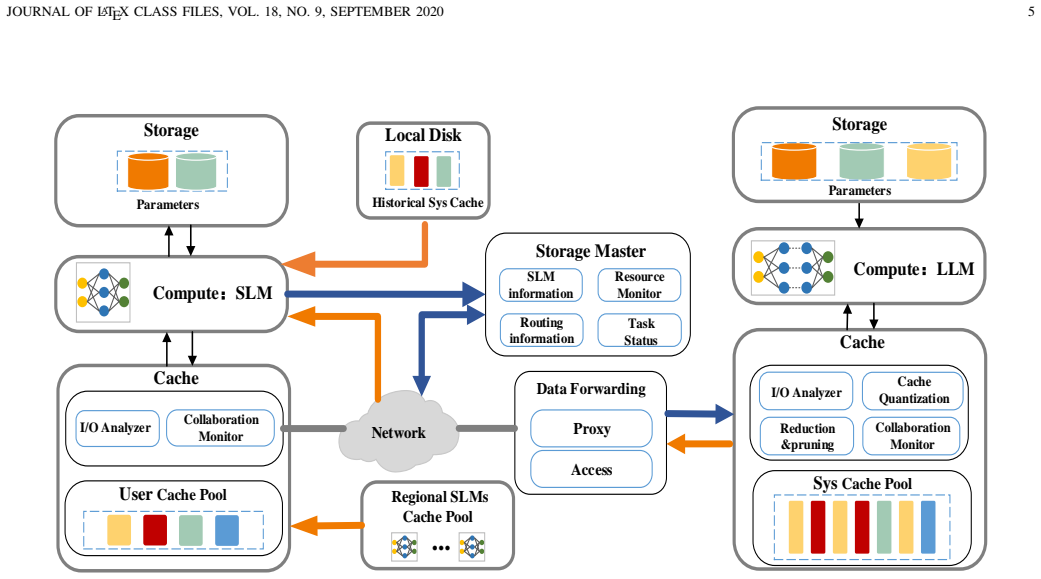
CE-LSLM achieves lower time-to-first-token and total inference time than cloud-only baselines while keeping generation quality comparable and keeping user data on the device (Table II), and it maintains stable latency under high concurrency (Fig. 7). If true, the architecture is a working cloud-edge inference system that offloads long-context processing to a cloud LLM while executing user-prompt decoding on edge SLMs.
Load-bearing premise
A key-value cache computed by the cloud LLM at a matched layer can be directly used by the edge SLM's attention heads, despite the two models having different sizes, hidden dimensions, and parameter sets. This enters at Section V.A (Eqs. 11-16) and Eq. (5), where queries come from the SLM but keys and values come from the LLM. No projection, alignment training, or isolated experiment establishes cross-model KV compatibility; the cited reference [21] is a KV cache compression work, not a cross-model transfer study. If this assumption is false, the main semantic-reuse benefit of the architecture collapses.
Editorial analysis
A structured set of objections, weighed in public.
Assumptions & free parameters
free parameters (4)
- theta_CKA layer similarity threshold =
not stated
- theta_RSA layer similarity threshold =
not stated
- n, number of LLM layers shared with SLM =
not stated
- lambda pruning ratio in THINK compression =
example uses d_c=80, d_e=64 (lambda=0.2)
assumptions (4)
- domain assumption KV caches from structurally similar layers of different models can be interchanged without significant effect on output.
- ad hoc to paper Attention can validly mix queries from the edge SLM with keys and values produced by the cloud LLM.
- domain assumption CKA/RSA layer similarity is a sufficient selector for cross-model cache reuse.
- domain assumption System prompts are non-private and fixed, so cloud-generated KV caches do not leak user data.
Cite this review
Pith. "Pith review of CE-LSLM: Efficient Large-Small Language Model Inference and Communication via Cloud-Edge Collaboration." pith.science (2026). https://pith.science/paper/7T3NGUSC
@misc{pith2026250514085,
  author       = {Pith},
  title        = {Pith review of: CE-LSLM: Efficient Large-Small Language Model Inference and Communication via Cloud-Edge Collaboration},
  year         = {2026},
  howpublished = {\url{https://pith.science/paper/7T3NGUSC}},
  note         = {Machine review of arXiv:2505.14085}
}
read the original abstract
Emerging intelligent service scenarios in 6G communication impose stringent requirements for low latency, high reliability, and privacy preservation. Generative large language models (LLMs) are gradually becoming key enablers for the integration of semantic communication and computation. However, due to the limited computational resources of edge devices and the increasing complexity of heterogeneous terminal access, existing centralized inference approaches fail to meet the dual demands of response efficiency and data privacy in edge-side inference tasks. To address these challenges, this paper proposes a novel collaborative inference architecture that integrates cloud-based LLMs with edge-deployed small language models (SLMs), enabling dynamic scheduling and sharing of semantic-level intermediate states, and establishing a unified computation-communication paradigm tailored for 6G networks. Specifically, a key-value (KV) cache reuse mechanism is introduced to enhance the semantic understanding of edge models through contextual guidance from the cloud, while significantly reducing edge-side computational and storage overhead. Furthermore, a cross-node parallel scheduling mechanism is proposed to achieve asynchronous coordination between model state loading and decoding computation, thereby improving edge responsiveness. In addition, we investigate layer alignment and representation compression strategies between heterogeneous models to alleviate the communication burden on the edge. Experimental results demonstrate that the proposed architecture exhibits superior adaptability and scalability in terms of inference latency, system stability, and concurrent processing capacity.
Figures


Figures from the paper (4 more)


Reference graph
Works this paper leans on
-
[1]
6g wireless communication systems: Applications, requirements, technolo- gies, challenges, and research directions,
M. Z. Chowdhury, M. Shahjalal, S. Ahmed, and Y . M. Jang, “6g wireless communication systems: Applications, requirements, technolo- gies, challenges, and research directions,”IEEE Open Journal of the Communications Society, vol. 1, pp. 957–975, 2020
2020
-
[2]
White paper on broadband connectivity in 6g,
N. Rajatheva, I. Atzeni, E. Bjornson, A. Bourdoux, S. Buzzi, J.-B. Dore, S. Erkucuk, M. Fuentes, K. Guan, Y . Huet al., “White paper on broadband connectivity in 6g,”arXiv preprint arXiv:2004.14247, 2020
arXiv 2004
-
[3]
Ai-native network slicing for 6g networks,
W. Wu, C. Zhou, M. Li, H. Wu, H. Zhou, N. Zhang, X. S. Shen, and W. Zhuang, “Ai-native network slicing for 6g networks,”IEEE Wireless Communications, vol. 29, no. 1, pp. 96–103, 2022
work page 2022
-
[4]
Towards 6g wireless communication networks: Vision, enabling technologies, and new paradigm shifts,
X. You, C.-X. Wang, J. Huang, X. Gao, Z. Zhang, M. Wang, Y . Huang, C. Zhang, Y . Jiang, J. Wanget al., “Towards 6g wireless communication networks: Vision, enabling technologies, and new paradigm shifts,” Science China Information Sciences, vol. 64, pp. 1–74, 2021
work page 2021
-
[5]
Optimizing llm inference clusters for enhanced performance and energy efficiency,
S. Hisaharo, Y . Nishimura, and A. Takahashi, “Optimizing llm inference clusters for enhanced performance and energy efficiency,”Authorea Preprints, 2024
work page 2024
-
[6]
J. Kundu, W. Guo, A. BanaGozar, U. De Alwis, S. Sengupta, P. Gupta, and A. Mallik, “Performance modeling and workload analysis of dis- tributed large language model training and inference,” in2024 IEEE In- ternational Symposium on Workload Characterization (IISWC). IEEE, 2024, pp. 57–67
work page 2024
-
[7]
J. Rasley, S. Rajbhandari, O. Ruwase, and Y . He, “Deepspeed: System optimizations enable training deep learning models with over 100 billion parameters,” inProceedings of the 26th ACM SIGKDD International Conference on Knowledge Discovery & Data Mining, 2020, pp. 3505– 3506
work page 2020
-
[8]
Reducing activation recomputation in large transformer models,
V . A. Korthikanti, J. Casper, S. Lym, L. McAfee, M. Andersch, M. Shoeybi, and B. Catanzaro, “Reducing activation recomputation in large transformer models,”Proceedings of Machine Learning and Systems, vol. 5, pp. 341–353, 2023
2023
Show all 36 references
-
[9]
Efficient large-scale language model training on gpu clusters using megatron-lm,
D. Narayanan, M. Shoeybi, J. Casper, P. LeGresley, M. Patwary, V . Korthikanti, D. Vainbrand, P. Kashinkunti, J. Bernauer, B. Catanzaro et al., “Efficient large-scale language model training on gpu clusters using megatron-lm,” inProceedings of the International Conference for ...
2021
-
[10]
Efficient memory management for large language model serving with pagedattention,
W. Kwon, Z. Li, S. Zhuang, Y . Sheng, L. Zheng, C. H. Yu, J. Gonzalez, H. Zhang, and I. Stoica, “Efficient memory management for large language model serving with pagedattention,” inProceedings of the 29th Symposium on Operating Systems Principles, 2023, pp. 611–626
2023
-
[11]
Relayattention for efficient large language model serving with long system prompts,
L. Zhu, X. Wang, W. Zhang, and R. W. Lau, “Relayattention for efficient large language model serving with long system prompts,”arXiv preprint arXiv:2402.14808, 2024
2024 arXiv
-
[12]
Prompt cache: Modular attention reuse for low-latency inference,
I. Gim, G. Chen, S.-s. Lee, N. Sarda, A. Khandelwal, and L. Zhong, “Prompt cache: Modular attention reuse for low-latency inference,” Proceedings of Machine Learning and Systems, vol. 6, pp. 325–338, 2024
2024
-
[13]
Model pruning enables efficient federated learning on edge devices,
Y . Jiang, S. Wang, V . Valls, B. J. Ko, W.-H. Lee, K. K. Leung, and L. Tassiulas, “Model pruning enables efficient federated learning on edge devices,”IEEE Transactions on Neural Networks and Learning Systems, vol. 34, no. 12, pp. 10 374–10 386, 2022
2022
-
[14]
Edge-llm: Enabling efficient large language model adaptation on edge devices via layerwise unified compression and adaptive layer tuning and voting,
Z. Yu, Z. Wang, Y . Li, H. You, R. Gao, X. Zhou, S. R. Bommu, Y . K. Zhao, and Y . C. Lin, “Edge-llm: Enabling efficient large language model adaptation on edge devices via layerwise unified compression and adaptive layer tuning and voting,” 2024. [Online]. Available: https://...
2024 arXiv
-
[15]
Optimizing mobile-edge ai-generated everything (aigx) services by prompt engineering: Fundamental, framework, and case study,
Y . Liu, H. Du, D. Niyato, J. Kang, S. Cui, X. Shen, and P. Zhang, “Optimizing mobile-edge ai-generated everything (aigx) services by prompt engineering: Fundamental, framework, and case study,”IEEE Network, 2023
2023
-
[16]
Ce-collm: Efficient and adaptive large language mod- els through cloud-edge collaboration,
H. Jin and Y . Wu, “Ce-collm: Efficient and adaptive large language mod- els through cloud-edge collaboration,”arXiv preprint arXiv:2411.02829, 2024
2024 arXiv
-
[17]
Infinite-llm: Efficient llm service for long context with distattention and distributed kvcache,
B. Lin, C. Zhang, T. Peng, H. Zhao, W. Xiao, M. Sun, A. Liu, Z. Zhang, L. Li, X. Qiuet al., “Infinite-llm: Efficient llm service for long context with distattention and distributed kvcache,”arXiv preprint arXiv:2401.02669, 2024
2024 arXiv
-
[18]
Zero: Memory optimizations toward training trillion parameter models,
S. Rajbhandari, J. Rasley, O. Ruwase, and Y . He, “Zero: Memory optimizations toward training trillion parameter models,” inSC20: International Conference for High Performance Computing, Networking, Storage and Analysis. IEEE, 2020, pp. 1–16
2020
-
[19]
Llm-pruner: On the structural pruning of large language models,
X. Ma, G. Fang, and X. Wang, “Llm-pruner: On the structural pruning of large language models,” 2023. [Online]. Available: https://arxiv.org/abs/2305.11627
2023 arXiv
-
[20]
Sparsegpt: Massive language models can be accurately pruned in one-shot,
E. Frantar and D. Alistarh, “Sparsegpt: Massive language models can be accurately pruned in one-shot,” 2023. [Online]. Available: https://arxiv.org/abs/2301.00774
2023 arXiv
-
[21]
Cachegen: Kv cache compression and streaming for fast large language model serving,
Y . Liu, H. Li, Y . Cheng, S. Ray, Y . Huang, Q. Zhang, K. Du, J. Yao, S. Lu, G. Ananthanarayananet al., “Cachegen: Kv cache compression and streaming for fast large language model serving,” inProceedings of the ACM SIGCOMM 2024 Conference, 2024, pp. 38–56
2024
-
[22]
Kvsharer: Efficient inference via layer-wise dissimilar kv cache sharing,
Y . Yang, Z. Cao, Q. Chen, L. Qin, D. Yang, H. Zhao, and Z. Chen, “Kvsharer: Efficient inference via layer-wise dissimilar kv cache sharing,” 2024. [Online]. Available: https://arxiv.org/abs/2410.18517
2024 arXiv
-
[23]
Ada-kv: Optimizing kv cache eviction by adaptive budget allocation for efficient llm inference,
Y . Feng, J. Lv, Y . Cao, X. Xie, and S. K. Zhou, “Ada-kv: Optimizing kv cache eviction by adaptive budget allocation for efficient llm inference,” 2024. [Online]. Available: https://arxiv.org/abs/2407.11550
2024 arXiv
-
[24]
Model tells you what to discard: Adaptive kv cache compression for llms,
S. Ge, Y . Zhang, L. Liu, M. Zhang, J. Han, and J. Gao, “Model tells you what to discard: Adaptive kv cache compression for llms,” inWorkshop on Advancing Neural Network Training: Computational Efficiency, Scalability, and Resource Optimization (WANT@ NeurIPS 2023)
2023
-
[25]
Netgpt: An ai-native network architecture for provisioning beyond personalized generative services,
Y . Chen, R. Li, Z. Zhao, C. Peng, J. Wu, E. Hossain, and H. Zhang, “Netgpt: An ai-native network architecture for provisioning beyond personalized generative services,”IEEE Network, 2024
2024
-
[26]
Compute or load kv cache? why not both?
S. Jin, X. Liu, Q. Zhang, and Z. M. Mao, “Compute or load kv cache? why not both?”arXiv preprint arXiv:2410.03065, 2024
2024 arXiv
-
[27]
{OSCA}: An{Online-Model}based cache allocation scheme in cloud block storage systems,
Y . Zhang, P. Huang, K. Zhou, H. Wang, J. Hu, Y . Ji, and B. Cheng, “{OSCA}: An{Online-Model}based cache allocation scheme in cloud block storage systems,” in2020 USENIX Annual Technical Conference (USENIX ATC 20), 2020, pp. 785–798
2020
-
[28]
Similarity of neural network models: A survey of functional and representational measures,
M. Klabunde, T. Schumacher, M. Strohmaier, and F. Lemmerich, “Similarity of neural network models: A survey of functional and representational measures,”ACM Computing Surveys, Apr. 2025. [Online]. Available: http://dx.doi.org/10.1145/3728458
2025 doi
-
[30]
Think: Thinner key cache by query-driven pruning,
Y . Xu, Z. Jie, H. Dong, L. Wang, X. Lu, A. Zhou, A. Saha, C. Xiong, and D. Sahoo, “Think: Thinner key cache by query-driven pruning,” arXiv preprint arXiv:2407.21018, 2024
2024 arXiv
-
[31]
A survey of large language models,
W. X. Zhao, K. Zhou, J. Li, T. Tang, X. Wang, Y . Hou, Y . Min, B. Zhang, J. Zhang, Z. Donget al., “A survey of large language models,”arXiv preprint arXiv:2303.18223, vol. 1, no. 2, 2023
2023 arXiv
-
[32]
Don’t give me the details, just the summary! topic-aware convolutional neural networks for extreme summarization,
S. Narayan, S. B. Cohen, and M. Lapata, “Don’t give me the details, just the summary! topic-aware convolutional neural networks for extreme summarization,”ArXiv, vol. abs/1808.08745, 2018
2018 arXiv
-
[33]
Aligning ai with shared human values,
D. Hendrycks, C. Burns, S. Basart, A. Critch, J. Li, D. Song, and J. Steinhardt, “Aligning ai with shared human values,”Proceedings of the International Conference on Learning Representations (ICLR), 2021. JOURNAL OF LATEX CLASS FILES, VOL. 18, NO. 9, SEPTEMBER 2020 14 APPENDI...
2021
-
[35]
Scale invariance:We consider the representation matrix of each layer denoted asO e ∈R n×d, where nn is the sequence length and dd is the hidden dimension. Let O(l) c =αO (l) e , α∈R(21) This indicates that all sample representations are scaled by a shared constant factorα, whi...
-
[36]
After applying an orthogonal trans- formation, it becomes: Oc =O eQ(26) whereQ T Q=I
Orthogonal invariance:Let the layer representation matrix beO e ∈R n×d. After applying an orthogonal trans- formation, it becomes: Oc =O eQ(26) whereQ T Q=I. Subsequently, the kernel matrix can be expressed as: Se =O eOT e (27) Since orthogonal transformations do not alter the...
-
[37]
Permutation invariance:Given a layer representation matrixO e ∈R n×d, after a permutation of the feature dimen- sions, that is, Oc =O eP(30) wherePis a permutation matrix. Accordingly, the kernel matrix can be expressed as Se =O eOT e (31) The permutation matrix satisfiesP ⊤ =...
-
[2019]
Available: http://arxiv.org/abs/1905.00414
[Online]. Available: http://arxiv.org/abs/1905.00414
1905 arXiv
Reviewed August 7, 2026 · model on record in the stance chip above.
Discussion (0). Continue with ORCID to comment.