REVIEW 3 major objections 5 minor 47 references
Effects of system-blind prosumers in energy models
T0 review · 3 major / 5 minor · reviewed 2026-08-07 · deepseek-v4-flash
Pith's one-line read Prosumer households with home batteries can roughly double the battery storage a cost-minimal power system needs.
desk verdict Useful, reproducible extension of prosumer modeling; the 200% storage result is real under its assumptions, but the key assumption is untested. read the letter →
The pith
A machine-rendered reading of the paper's core claim, the machinery that carries it, and where it could break.
The reading
What carries the argument
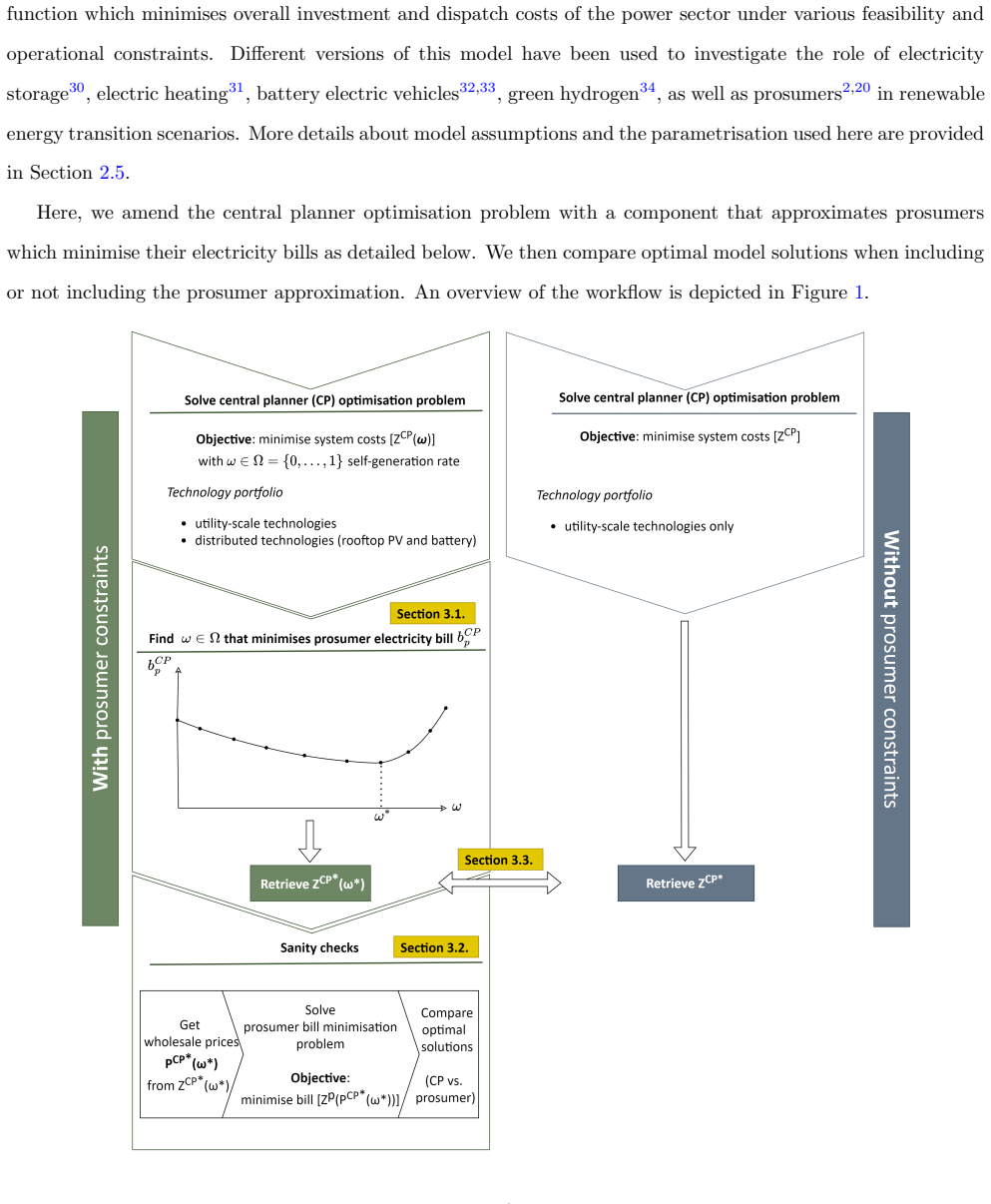
The load-bearing construction is the self-generation constraint: in every hour, aggregated rooftop PV and home-battery discharge must supply at least a share $\omega$ of the prosumer's annual electricity load (with BEV charging added in the sector-coupled variant). Rather than choosing $\omega$, the model performs a grid search over $\omega$ and picks the value that minimizes the prosumer's annual electricity bill, computed from wholesale prices, retail tariffs and a fixed feed-in tariff. This turns the hard equilibrium problem of prosumer-system interaction into a single linear program. The constraint forces the central planner to build behind-the-meter capacity, and the no-grid-charging assumption for home batteries is what makes home and utility batteries imperfect substitutes—the mechanism that produces the up-to-200% storage result.
What would settle it
Rerun the German 2030 scenario with home batteries allowed to charge from the grid during low-price hours, keeping all other parameters fixed: if the total battery capacity increase drops well below 200% (or disappears), the paper's central mechanism fails. A complementary empirical check is to monitor real German home-battery dispatch data: if a material share of charging occurs from the grid during low wholesale price hours, the no-grid-interaction assumption no longer describes the system.
Extended reading notes
Core claim
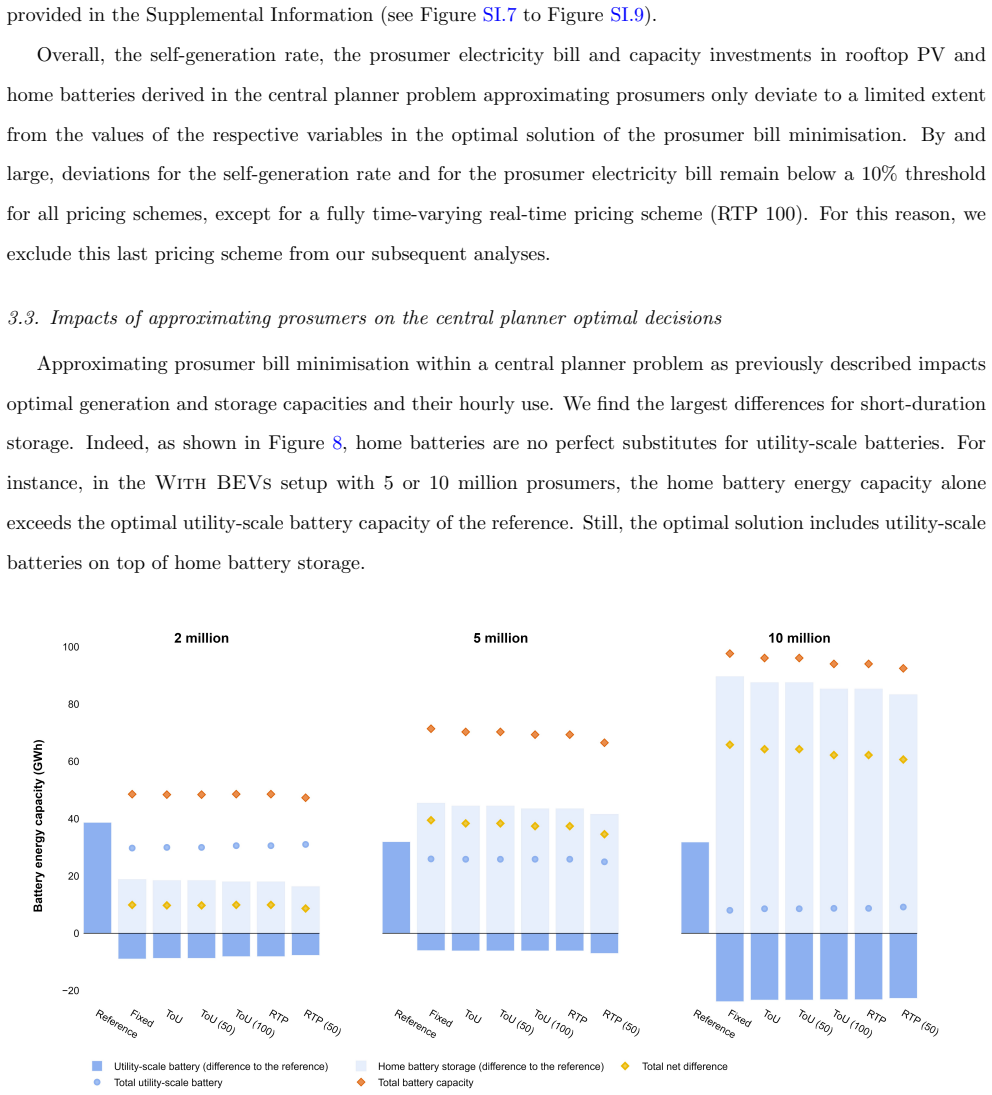
On its own terms, the paper's central claim is that a capacity expansion model which represents bill-minimizing prosumers—through a self-generation rate $\omega$ chosen to minimize the prosumer electricity bill—produces materially different optimal storage investments than the same model without prosumers. In the German 2030 case with battery electric vehicles, optimal total battery energy capacity rises by up to 200% when prosumer constraints are included. The paper attributes this to imperfect substitutability: home batteries are operated to shift rooftop solar into evening and night hours, while utility-scale batteries are operated to balance system-wide supply and demand, particularly wind; because home batteries cannot charge from the grid, they cannot substitute for utility batteries in wind-rich, solar-poor periods. The paper also claims the self-generation constraint is a good approximation of true prosumer behaviour for most retail tariff designs, with self-generation rates deviating by less than two percentage points and electricity bills by less than five percent from the isolated prosumer optimum.
Load-bearing premise
The entire up-to-200% result rests on the assumption that home batteries can only be charged from rooftop solar and never from the grid; if grid charging of home batteries becomes common, the imperfect substitutability that drives the result weakens and the battery overcapacity could shrink.
Editorial extensions
If this is right
- Standard capacity expansion models without prosumer constraints will understate total short-duration battery storage in high-renewable systems.
- Even with many home batteries, utility-scale batteries remain needed, so total storage investment is larger than either technology alone would suggest.
- Sector coupling with electric vehicles amplifies the divergence because centrally optimal BEV charging competes with using rooftop solar to charge at home.
- The self-generation constraint is a computationally cheap way to approximate prosumer behaviour in large models, since it avoids solving a complementarity or bilevel problem.
Reading between the lines
- If dynamic tariffs and smart meters make grid-charging of home batteries economic, the 200% effect would likely shrink; the paper itself flags that the result depends on the home battery being unable to interact with the grid and on feed-in tariff design.
- The magnitude is scenario-specific: a region with less solar or more wind than Germany could see a smaller or larger gap, since the substitutability gap hinges on solar-wind complementarity.
- The same calibration trick could be extended to heat pumps and thermal storage in the prosumer portfolio; the paper lists this as future work.
- An empirical test would be to track whether real home-battery operation follows the model's bill-minimizing self-generation pattern; if households increasingly exploit dynamic tariffs to buy low and sell high, 'system-blindness' will erode.
Signed reviews
Editorial analysis
A structured set of objections, weighed in public.
Referee Report
Summary. The paper proposes a method to approximate bill-minimizing prosumer behavior inside a linear central-planner capacity expansion model, by adding a calibrated self-generation constraint (parameter ω) that enforces a minimum share of prosumer load supplied by rooftop PV and home batteries. The authors apply the method to a German 2030 case study using the open-source DIETER model, with and without battery electric vehicles, across fixed, time-of-use, and real-time retail tariffs. They report that the method approximates the outcome of an isolated prosumer bill-minimization problem well for most tariffs, and that including prosumer constraints raises optimal total battery storage capacity by up to 200% relative to a model without prosumers, driven by the imperfect substitutability of home batteries (which cannot charge from the grid) and utility-scale batteries.
Significance. If the headline result is robust, the paper makes a practically important point: energy system models that omit prosumers may materially underestimate short-duration storage requirements in high-renewable systems. The paper's strengths include the use of an open-source, reproducible model (DIETER), a public code repository, a transparent grid-search calibration over ω, and explicit comparisons against an isolated prosumer optimization problem across several tariff designs. The central claim, however, rests on a modeling assumption that is plausible for today's German PV-battery systems but is not stress-tested for the 2030 scenario: that home batteries cannot charge from the grid. The 200% result is therefore conditional, and the paper's internal validation is partly circular because the calibration target and the sanity-check yardstick use the same bill-minimization objective.
major comments (3)
- [§2.1 / Figure 2 / §3.3] The load-bearing result—that storage capacity needs are up to 200% higher once prosumers are included—is explicitly attributed in §3.3 to the imperfect substitutability of home batteries and utility-scale batteries, an imperfection created by the assumption in §2.1 and Figure 2 that 'the home battery storage cannot interact with the grid.' The paper does not test the sensitivity to allowing home batteries to charge from the grid during low-wholesale-price hours, an option that is technically feasible today and becomes economically attractive precisely under the dynamic tariff schemes considered elsewhere in the paper. Because the RTP 100 case is excluded in §3.2 on the grounds that the approximation breaks down when retail prices are strongly time-varying, the regime in which grid-charging would be most relevant is the one not analyzed. A sensitivity case with grid-charging of home batteries (e.g., with a cap or a tariff-dependent restriction) is needed to establish whether the quantitative overcapacity result is an artifact of this assumption or a robust feature of the model.
- [§2.2–§2.4] The sanity-check procedure is partly circular: the grid search in §2.3 selects the self-generation rate ω that minimizes the prosumer electricity bill (equation 3) computed from the central-planner solution, and the sanity check in §2.4 compares that central-planner solution to an isolated prosumer problem whose objective (equation 4) is the same bill function, evaluated at the same wholesale prices. Good agreement on self-generation rates and bills is therefore to some extent built into the calibration rather than evidence that the method captures prosumer behavior generally. The capacity deviations shown in Figure 5 are more informative, but the paper's wording that the method 'approximates prosumer decisions well' overstates the strength of the evidence. Please reframe the sanity check as an internal consistency test and, if possible, add an out-of-sample check (e.g., comparing to observed rooftop PV or battery adoption under current German tariffs).
- [§3.3 / Conclusion] The 'up to 200%' headline is not tied to a specific scenario in the text. The paragraph after Figure 8 says the additionally installed battery energy capacity represents up to 200% of the reference, but it does not state which combination of prosumer count, tariff adder, and tariff scheme produces this maximum, nor whether it occurs in the No BEVs or With BEVs setup. Given that Figure 8 shows the effect varies strongly with the number of prosumers, the conclusion should report the exact parameter combination and the range of values across all scenarios. As written, the claim is under-specified and could mislead readers about the robustness of the magnitude.
minor comments (5)
- [§2.5 / Supplemental Notes] The assumption that BEV charging away from home faces the same retail tariff as home charging is not discussed or justified. Since §3.2 shows that BEV charging patterns drive the differences between the central-planner and prosumer outcomes, this assumption could materially affect the results. Please at least discuss its direction of influence and ideally provide a sensitivity case with different away-from-home charging tariffs.
- [§2.1] There is a typo in the sentence 'This assumptions reflects the current situation of most PV-battery systems in Germany'—'assumptions' should be singular.
- [§3.2] The text says electricity bill deviations are 'below five percent, in all but one cases' and later says they 'remain below a 10% threshold.' Please reconcile these two statements and specify which tariff scheme is the exception.
- [§2.3, Eq. (3)] The notation 'opexd_h(ω)' is ambiguous: operating costs likely depend on the hour through dispatch, but the equation does not make clear whether these are annual sums. Please clarify the notation or define the terms more carefully.
- [Figure 9] The caption says 'Power generation and battery operation' but the vertical axis units are not described in the caption. Please add axis labels or a note in the caption so the reader can interpret the three-day plots.
Circularity Check
The validation of the method is partly circular: the self-generation rate ω is fitted to minimize the same prosumer electricity bill that the sanity check then uses as its agreement criterion; the headline 200% battery-overcapacity result is emergent and not itself fitted.
-
fitted input called prediction
[Section 2.3 (Eq. 3) and Section 3.2 (Fig. 4)]
"Hence, we perform a grid search on the parameter space Ω = {0, . . . ,1} of the self-generation rate ω. We then compute the prosumer electricity bill for each value of ω and select the value ω∗ that minimises the bill. ... The difference between the bill-minimising self-generation rates derived from the central planner problem that approximates prosumers and the isolated prosumer optimisation problem for given tariffs is very small for all pricing schemes except for the fully time-varying variant of real-time pricing (RTP 100)."
The isolated prosumer problem (Eq. 4) minimizes exactly the same prosumer electricity bill that is used to select ω* in Eq. (3), with retail prices taken from the same central-planner solution. The sanity check therefore evaluates the calibration against its own objective: a low bill deviation is partly ensured by choosing ω* as the bill minimizer, and the close agreement in self-generation rates is a comparison between two problems sharing the same bill-minimization target rather than an independent test. Some independent content remains, because capacity and dispatch deviations are not directly fitted by the scalar ω, and the headline battery-overcapacity result is an emergent model output. The circularity is therefore partial, not total.
full rationale
The paper's central quantitative finding—that optimal battery capacity can be up to 200% higher when prosumer constraints are included—is not itself produced by fitting a parameter to that outcome; it is an emergent difference between otherwise comparable capacity-expansion runs. The 200% figure is conditional on the explicit assumption that home batteries cannot charge from the grid (Section 2.1), but that is a transparent modeling assumption and a limitation, not a circular step. The main circularity concern lies in the method validation: the self-generation rate is selected by minimizing the prosumer bill, and the sanity check then reports that the approximation matches the isolated prosumer bill-minimization problem. Because both sides of the comparison optimize the same bill objective, the reported 'good approximation' is partly a consequence of calibration rather than an independent out-of-sample check. This does not invalidate the battery-overcapacity result, but it weakens the claim that the method is validated independently. No load-bearing self-citation chain or imported uniqueness theorem is present; the RTP 100 exclusion is a generality limitation rather than circular reasoning.
Assumptions & free parameters
free parameters (1)
- Self-generation rate omega =
0.5 to 0.8 for most tariff schemes (Figures SI.4/SI.5); chosen by grid search minimizing the prosumer bill
assumptions (6)
- standard math Central planner optimization is equivalent to a long-run competitive market equilibrium when all actors face system prices.
- domain assumption Prosumers minimize their own electricity bills under retail and feed-in tariffs, not system costs.
- domain assumption Home battery storage cannot be charged from the grid.
- domain assumption All prosumers are homogeneous in load (5 MWh per year) and face identical solar and weather time series.
- ad hoc to paper BEV charging away from home faces the same retail tariff as home charging.
- domain assumption Rooftop PV capacity per household is capped at 15 kWp.
Cite this review
Pith. "Pith review of Effects of system-blind prosumers in energy models." pith.science (2026). https://pith.science/paper/CQGATTDW
@misc{pith2026250514186,
  author       = {Pith},
  title        = {Pith review of: Effects of system-blind prosumers in energy models},
  year         = {2026},
  howpublished = {\url{https://pith.science/paper/CQGATTDW}},
  note         = {Machine review of arXiv:2505.14186}
}
read the original abstract
Prosumer households that generate and store electricity from rooftop PV installations play an increasing role in electricity markets around the world. As retail tariffs usually do not convey time-varying wholesale price signals to households and the rollout of smart meters is low in many countries, prosumers do not necessarily self-consume and feed-in solar electricity in a system-friendly way. The effects of such system-blind behaviours are typically neglected in energy system models, which rarely account for prosumers. In this paper, we embed a calibrated self-generation constraint into a linear capacity expansion model to approximate the incentives of prosumers to minimise their electricity bills. We apply our method to a German case study for 2030 featuring sector coupling with battery electric vehicles. We show that parametrising the self-generation constraint such that the prosumer electricity bill is as low as possible approximates prosumer decisions well for a broad range of tariff schemes. Based on this, we quantify distortions that might arise in energy models that do not account for prosumers. For our case study, we find that the optimal battery storage capacity increases by up to 200% if prosumer constraints are included. The main driver is the imperfect substitutability between home and utility-scale batteries. We conclude that energy system models could benefit from implementing this straightforward method.
Figures


Figures from the paper (6 more)



Reference graph
Works this paper leans on
-
[1]
‘Analysis and Forecast to 2030’
IEA Renewables. ‘Analysis and Forecast to 2030’. In: International Energy Agency: Paris, France (2024)
work page 2024
-
[2]
‘Prosumage of solar electricity: pros, cons, and the system perspective’
Wolf-Peter Schill, Alexander Zerrahn and Friedrich Kunz. ‘Prosumage of solar electricity: pros, cons, and the system perspective’. In: Economics of Energy & Environmental Policy 6.1 (2017), pp. 7–32. doi: 10. 5547/2160-5890.6.1.wsch
work page 2017
-
[3]
Energy retail - Active consumer participation is key to driving the energy transition: how can it happen? Tech. rep. ACER-CEER, 2024, p. 68
work page 2024
-
[4]
EU Market Outlook for Solar Power 2023-2027 . Tech. rep. SolarPower Europe, 2023
work page 2023
-
[5]
‘Distributed photovoltaics provides key benefits for a highly renewable European energy system’
Parisa Rahdan et al. ‘Distributed photovoltaics provides key benefits for a highly renewable European energy system’. In: Applied Energy 360 (2024), p. 122721. doi: 10.1016/j.apenergy.2024.122721
-
[6]
Sarah A Steinbach and Maximilian J Blaschke. ‘Enabling electric mobility: can photovoltaic and home battery systems significantly reduce grid reinforcement costs?’ In: Applied Energy 375 (2024), p. 124101. doi: 10.1016/j.apenergy.2024.124101
-
[7]
Franziska Sch¨ oniger and Ulrich B Morawetz. ‘What comes down must go up: Why fluctuating renewable energy does not necessarily increase electricity spot price variance in Europe’. In: Energy Economics 111 (2022), p. 106069. doi: 10.1016/j.eneco.2022.106069
-
[8]
Leo Semmelmann et al. ‘Empirical field evaluation of self-consumption promoting regulation of household battery energy storage systems’. In: Energy Policy 194 (2024), p. 114343. doi: 10.1016/j.enpol.2024. 114343. 20
Show all 47 references
-
[9]
‘The economic viability of battery storage for residential solar photovoltaic systems– A review and a simulation model’
Joern Hoppmann et al. ‘The economic viability of battery storage for residential solar photovoltaic systems– A review and a simulation model’. In: Renewable and Sustainable Energy Reviews 39 (2014), pp. 1101–1118. doi: 10.1016/j.rser.2014.07.068
2014 doi
-
[10]
‘Profitability in absence of subsidies: A techno-economic analysis of rooftop photovoltaic self-consumption in residential and commercial buildings’
Tillmann Lang, David Ammann and Bastien Girod. ‘Profitability in absence of subsidies: A techno-economic analysis of rooftop photovoltaic self-consumption in residential and commercial buildings’. In: Renewable Energy 87 (2016), pp. 77–87. doi: 10.1016/j.renene.2015.09.059
2016 doi
-
[11]
‘Solar energy storage in German households: prof- itability, load changes and flexibility’
Thomas Kaschub, Patrick Jochem and Wolf Fichtner. ‘Solar energy storage in German households: prof- itability, load changes and flexibility’. In: Energy Policy 98 (2016), pp. 520–532. doi: 10.1016/j.enpol. 2016.09.017
2016 doi
-
[12]
‘Self-consumption through power-to-heat and storage for enhanced PV integration in decentralised energy systems’
Hannes Schwarz et al. ‘Self-consumption through power-to-heat and storage for enhanced PV integration in decentralised energy systems’. In: Solar Energy 163 (2018), pp. 150–161. doi: doi.org/10.1016/j. solener.2018.01.076
2018 doi
-
[13]
‘The coming disruption: The movement towards the customer renewable energy transition’
Kelvin Say et al. ‘The coming disruption: The movement towards the customer renewable energy transition’. In: Energy Policy 123 (2018), pp. 737–748. doi: 10.1016/j.enpol.2018.09.026
2018 doi
-
[14]
‘Cost optimal self-consumption of PV prosumers with stationary batteries, heat pumps, thermal energy storage and electric vehicles across the world up to 2050’
Dominik Keiner et al. ‘Cost optimal self-consumption of PV prosumers with stationary batteries, heat pumps, thermal energy storage and electric vehicles across the world up to 2050’. In: Solar Energy 185 (2019), pp. 406–423. doi: 10.1016/j.solener.2019.04.081
2019 doi
-
[15]
‘Assessing the conditions for economic viability of dynamic electricity retail tariffs for households’
Judith Stute et al. ‘Assessing the conditions for economic viability of dynamic electricity retail tariffs for households’. In: Advances in Applied Energy 14 (2024), p. 100174. doi: 10.1016/j.adapen.2024.100174
2024
-
[16]
‘Effect of residential solar and storage on centralized electricity supply systems’
Scott Agnew and Paul Dargusch. ‘Effect of residential solar and storage on centralized electricity supply systems’. In: Nature Climate Change 5.4 (2015), pp. 315–318. doi: 10.1038/nclimate2523
2015 doi
-
[17]
‘A prospective economic assessment of residential PV self-consumption with batteries and its systemic effects: The French case in 2030’
Hyun Jin Julie Yu. ‘A prospective economic assessment of residential PV self-consumption with batteries and its systemic effects: The French case in 2030’. In: Energy Policy 113 (2018), pp. 673–687. doi: 10.1016/ j.enpol.2017.11.005
2018
-
[18]
‘The impacts of storing solar energy in the home to reduce reliance on the utility’
Robert L Fares and Michael E Webber. ‘The impacts of storing solar energy in the home to reduce reliance on the utility’. In: Nature Energy 2.2 (2017), pp. 1–10. doi: 10.1038/nenergy.2017.1
2017 doi
-
[19]
‘Solar photovoltaics demand for the global energy transition in the power sector’
Christian Breyer et al. ‘Solar photovoltaics demand for the global energy transition in the power sector’. In: Progress in Photovoltaics: Research and Applications 26.8 (2018), pp. 505–523. doi: 10.1002/pip.2950
2018 doi
-
[20]
‘Degrees of displacement: The impact of household PV battery prosumage on utility generation and storage’
Kelvin Say, Wolf-Peter Schill and Michele John. ‘Degrees of displacement: The impact of household PV battery prosumage on utility generation and storage’. In: Applied Energy 276 (2020), p. 115466. doi: 10. 1016/j.apenergy.2020.115466
2020
-
[21]
‘Prosumage of solar electricity: Tariff design, capacity investments, and power sector effects’
Claudia G¨ unther, Wolf-Peter Schill and Alexander Zerrahn. ‘Prosumage of solar electricity: Tariff design, capacity investments, and power sector effects’. In: Energy Policy 152 (2021), p. 112168. doi: 10.1016/j. enpol.2021.112168
2021
-
[22]
‘Improving energy system design with op- timization models by quantifying the economic granularity gap: The case of prosumer self-consumption in Germany’
Seyedfarzad Sarfarazi, Shima Sasanpour and Karl-Kiˆ en Cao. ‘Improving energy system design with op- timization models by quantifying the economic granularity gap: The case of prosumer self-consumption in Germany’. In: Energy Reports 9 (2023), pp. 1859–1874. doi: 10.1016/j.egy...
2023 doi
-
[23]
‘Decentralized solar prosumage with battery storage: System orientation required’
Wolf-Peter Schill et al. ‘Decentralized solar prosumage with battery storage: System orientation required’. In: DIW Economic Bulletin 7.12/13 (2017), pp. 141–151
2017
-
[24]
‘Role and impact of prosumers in a sector-integrated energy system with high renewable shares’
Christoph Schick, Nikolai Klempp and Kai Hufendiek. ‘Role and impact of prosumers in a sector-integrated energy system with high renewable shares’. In: IEEE Transactions on Power Systems 37.4 (2020), pp. 3286–
2020
-
[25]
Whinston and Jerry R
Andreu Mas-Colell, Michael D. Whinston and Jerry R. Green. Microeconomic Theory. OUP Catalogue 9780195102680. Oxford University Press, 1995
1995
-
[26]
Status Review of Renewable Support Schemes in Europe for 2020 and 2021
Council of European Energy Regulators (CEER). Status Review of Renewable Support Schemes in Europe for 2020 and 2021 . Tech. rep. C22-RES-80-04. Council of European Energy Regulators, 2023. 21
2020
-
[27]
Gabriel et al
Steven A. Gabriel et al. Complementarity Modeling in Energy Markets . Vol. 127. International Series in Operations Research & Management Science. Springer, 2013. doi: 10.1007/978-1-4419-6123-5
2013 doi
-
[28]
‘Long-run power storage requirements for high shares of renew- ables: review and a new model’
Alexander Zerrahn and Wolf-Peter Schill. ‘Long-run power storage requirements for high shares of renew- ables: review and a new model’. In: Renewable and Sustainable Energy Reviews 79 (2017), pp. 1518–1534. doi: 10.1016/j.rser.2016.11.098
2017 doi
-
[29]
‘DIETERpy: a Python framework for the Dispatch and Investment Evaluation Tool with Endogenous Renewables’
Carlos Gaete-Morales et al. ‘DIETERpy: a Python framework for the Dispatch and Investment Evaluation Tool with Endogenous Renewables’. In: SoftwareX 15 (2021), p. 100784. doi: 10.1016/j.softx.2021. 100784
2021 doi
-
[30]
‘Long-run power storage requirements for high shares of renew- ables: Results and sensitivities’
Wolf-Peter Schill and Alexander Zerrahn. ‘Long-run power storage requirements for high shares of renew- ables: Results and sensitivities’. In: Renewable and Sustainable Energy Reviews 83 (2018), pp. 156–171. doi: doi.org/10.1016/j.rser.2017.05.205
2018 doi
-
[31]
‘Power sector benefits of flexible heat pumps in 2030 scenarios’
Alexander Roth et al. ‘Power sector benefits of flexible heat pumps in 2030 scenarios’. In: Communications Earth & Environment 5.1 (2024), p. 718. doi: 10.1038/s43247-024-01861-2
2024 doi
-
[32]
‘Power sector effects of alternative options for de-fossilizing heavy-duty vehicles– Go electric, and charge smartly’
Carlos Gaete-Morales et al. ‘Power sector effects of alternative options for de-fossilizing heavy-duty vehicles– Go electric, and charge smartly’. In: Cell Reports Sustainability 1.6 (2024), p. 100123. doi: 10.1016/j. crsus.2024.100123
2024
-
[33]
‘Impacts of electric carsharing on a power sector with variable renewables’
Adeline Gu´ eret, Wolf-Peter Schill and Carlos Gaete-Morales. ‘Impacts of electric carsharing on a power sector with variable renewables’. In: Cell Reports Sustainability 1.11 (2024), p. 100241. doi: 10.1016/j. crsus.2024.100241
2024
-
[34]
‘Power sector effects of green hydrogen production in Germany’
Dana Kirchem and Wolf-Peter Schill. ‘Power sector effects of green hydrogen production in Germany’. In: Energy Policy 182 (2023), p. 113738. doi: 10.1016/j.enpol.2023.113738
2023
-
[35]
Technology Data for Generation of Electricity and District Heating
Danish Energy Agency. Technology Data for Generation of Electricity and District Heating . Technical Re- port. Danish Energy Agency, 2025
2025
-
[36]
‘Weather-and climate-driven power supply and demand time series for power and energy system analyses’
Enrico GA Antonini et al. ‘Weather-and climate-driven power supply and demand time series for power and energy system analyses’. In: Scientific Data 11.1 (2024), pp. 1–10. doi: 10.1038/s41597-024-04129-8
2024 doi
-
[37]
‘Open Power System Data – Frictionless data for electricity system modelling’
Frauke Wiese et al. ‘Open Power System Data – Frictionless data for electricity system modelling’. In: Applied Energy 236 (2019), pp. 401–409. doi: 10.1016/j.apenergy.2018.11.097
2019 doi
-
[38]
‘Update and extension of the When2Heat dataset’
Oliver Ruhnau and Jarusch Muessel. ‘Update and extension of the When2Heat dataset’. In: ZBW – Leibniz Information Centre for Economics, Kiel, Hamburg (2022)
2022
-
[39]
‘The potential role of a hydrogen network in Europe’
Fabian Neumann et al. ‘The potential role of a hydrogen network in Europe’. In: Joule 7.8 (2023), pp. 1793–
2023
-
[40]
Netznutzer
Stromnetz Berlin GmbH. Netznutzer. https://www.stromnetz.berlin/netz-nutzen/netznutzer. 2025
2025
-
[41]
‘JRC-IDEES-2021: the Integrated Database of the European Energy System – Data update and technical documentation’
R´ ozsai M et al. ‘JRC-IDEES-2021: the Integrated Database of the European Energy System – Data update and technical documentation’. In: KJ-NA-31-940-EN-N (2024). doi: 10.2760/614599
2024 doi
-
[42]
‘An open tool for creating battery-electric vehicle time series from empirical data, emobpy’
Carlos Gaete-Morales et al. ‘An open tool for creating battery-electric vehicle time series from empirical data, emobpy’. In: Scientific Data 8.1 (2021), p. 152. doi: 10.1038/s41597-021-00932-9
2021 doi
-
[43]
Solar prosumage under different pricing regimes: Interactions with the transmission grid
Dana Kirchem et al. Solar prosumage under different pricing regimes: Interactions with the transmission grid. 2025. arXiv: 2502.21306 [econ.GN]
2025 arXiv
-
[44]
‘Comparing urban form influences on travel distance, car ownership, and mode choice’
Peter Berrill et al. ‘Comparing urban form influences on travel distance, car ownership, and mode choice’. In: Transportation Research Part D: Transport and Environment 128 (2024), p. 104087. doi: 10.1016/j. trd.2024.104087
2024
-
[45]
‘Geographical balancing of wind power decreases storage needs in a 100% renewable European power sector’
Alexander Roth and Wolf-Peter Schill. ‘Geographical balancing of wind power decreases storage needs in a 100% renewable European power sector’. In: iScience 26.7 (2023), p. 107074. doi: 10.1016/j.isci.2023. 107074. 22 Supplemental Information Supplemental Figures Figure SI.1: ...
2023 doi
-
[1817]
doi: 10.1016/j.joule.2023.06.016
2023 doi
-
[3298]
doi: 10.1109/TPWRS.2020.3040654
2020
Reviewed August 7, 2026 · model on record in the stance chip above.
Discussion (0). Continue with ORCID to comment.