REVIEW 2 major objections 4 minor 56 references
Performance of short and long bent crystals for the TWOCRYST experiment at the Large Hadron Collider
T0 review · 2 major / 4 minor · reviewed 2026-08-07 · deepseek-v4-flash
Pith's one-line read The three TWOCRYST bent crystals can channel hadrons at 180 GeV, but the two long crystals reach only about half the efficiency predicted for a perfect crystal.
desk verdict Useful new data on long bent crystals, but the TCCP suitability claim ignores the paper's own critical-radius bound at LHC energies. read the letter →
The pith
A machine-rendered reading of the paper's core claim, the machinery that carries it, and where it could break.
The reading
What carries the argument
The central mechanism is planar channelling in bent crystals: positively charged hadrons entering within one Lindhard angle $\theta_L$ of the lattice planes are trapped in the interplanar potential and follow the mechanical curvature, emerging deflected by the bend angle $\theta_b$. The efficiency extraction relies on tracking each particle's incoming and outgoing angle, selecting particles within $\pm\theta_L/2$ of the best-aligned direction, and counting those in the channelling peak. For the long crystals, a two-dimensional torsion map $\theta_0(x,y)$ is fitted bin-by-bin on the entrance face and used to shift the incoming angles; this correction is what separates the reported $15.8\%$ and $15.7\%$ efficiencies from lower raw values.
What would settle it
Measure the same crystals at TeV energies in the LHC: if the long-crystal efficiencies come close to the perfect-crystal simulation values of 36.6% and 29.2% rather than the measured ~16%, then the 180 GeV characterisation and its conclusion about a length-dependent simulation gap would be cast in doubt; a dedicated torsion-free long crystal of the same 70 mm length and ~7 mrad bend would separate mounting effects from intrinsic long-crystal dechannelling.
Extended reading notes
Core claim
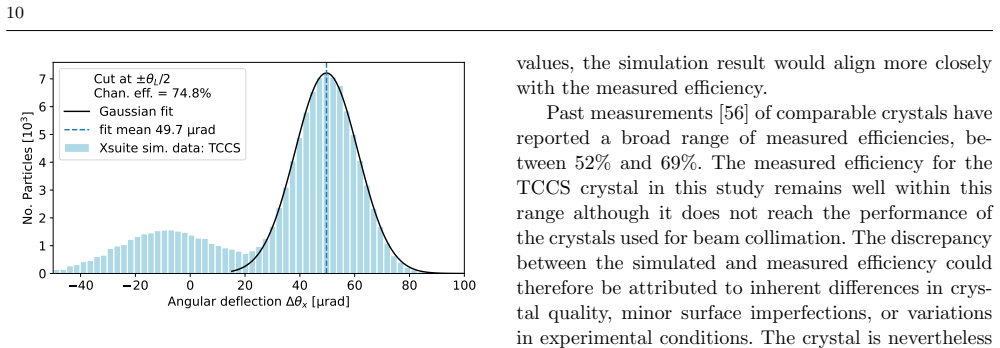
The central claim is that the three bent silicon crystals manufactured for TWOCRYST perform well enough for installation, with quantitatively different outcomes: the short 4 mm splitting crystal channels $61.9\pm0.5\%$ of well-aligned 180 GeV hadrons, comparable to existing collimation crystals; the two 70 mm precession crystals, one clamped in a metallic holder and one anodically bonded to a curved glass lens, channel only $15.8\pm0.1\%$ and $15.7\pm0.2\%$, about half the $36.6\%$ and $29.2\%$ predicted by simulations of a perfect crystal. The paper argues that the short crystal meets expectations, that the discrepancy for the long crystals cannot be blamed on detector resolution or bend-radius variation alone, and that both the short and the baseline long crystal are nevertheless suitable for the TWOCRYST installation. The anodic-bonded crystal, although not planned for use in TWOCRYST, is reported to show five times lower torsion and a similar efficiency at nearly double the bend angle, which the authors read as a promising technology for future long crystals.
Load-bearing premise
The load-bearing assumption is that a first-order, position-dependent angular shift $\theta_0(x,y)$, fitted per bin on the crystal entrance face, fully removes the effect of torsion on the quoted long-crystal efficiencies; the paper itself notes that second-order torsion and a non-uniform bending radius leave the TCCP peak not perfectly centred, so the assumption is acknowledged to be imperfect.
Editorial extensions
If this is right
- Both TCCS and TCCP are deemed suitable for installation, so TWOCRYST can proceed to demonstrate proton double-channelling at TeV energies.
- Any spin-precession measurement built on these long crystals has to live with about 16% channelling efficiency, not the 30-37% that a perfect-crystal simulation suggests.
- The 6.9-13.3 mrad deflections produced by 70 mm crystals remain far beyond what conventional magnets can deliver in that space, keeping the fixed-target scheme viable.
- Because the simulation shortfall does not scale with bend-radius uniformity, the cause is more likely tied to crystal length and unmodelled local imperfections than to the average bending profile.
- The anodic-bonded crystal reaches the same efficiency as the clamped long crystal at nearly double the bend angle, with five times lower torsion, marking that mounting technique as promising for future long crystals.
Reading between the lines
- If the measured shortfall grows with crystal length, extrapolating perfect-crystal simulations to multi-TeV LHC energies could overestimate the physics reach; comparing ALADDIN-style sensitivity estimates computed with 16% versus 36% efficiency would quantify the impact.
- Because the torsion correction maximizes per-bin efficiency by construction, the reported long-crystal values are upper limits under the assumed first-order torsion model; refining the correction or testing a torsion-free long crystal would reveal any residual bias.
- A controlled length scan with crystals of the same technology at, say, 4, 35, and 70 mm would separate length-dependent dechannelling from mounting effects and give simulation developers a direct benchmark.
Editorial analysis
A structured set of objections, weighed in public.
Referee Report
Summary. The paper reports the pre-installation characterisation of three bent silicon crystals for the TWOCRYST experiment at the LHC: the short TCCS, the long TCCP, and the anodic-bonded TCCPA. It presents X-ray diffraction measurements of the bending radius and torsion maps, as well as 180 GeV/c SPS hadron-beam measurements of the channelling efficiency, with the deflection-angle peak used to extract the bend angle. The measured efficiencies are 61.9±0.5% (TCCS), 15.8±0.1% (TCCP), and 15.7±0.2% (TCCPA), against Xsuite perfect-crystal predictions of 74.8%, 36.6%, and 29.2%. The paper concludes that both the TCCS and the TCCP are suitable for installation in the LHC for TWOCRYST, while the TCCPA is not planned for use but demonstrates the promise of anodic bonding.
Significance. The core measurements are valuable: they provide the first high-energy hadron-beam characterisation of an anodic-bonded bent crystal, quantify the torsion maps of long crystals, and extend the benchmarking of Xsuite to crystals an order of magnitude longer than those previously simulated. The independent analyses at CERN and INFN Milano lend confidence to the measured values. However, the central suitability claim for the TCCP at LHC energies is not supported by the paper's own critical-radius formula, and the reported efficiencies carry only statistical errors despite an analysis procedure that maximises a bin-by-bin alignment parameter. If the measured efficiencies and torsion maps are correct, the paper would still need a clear statement of the TWOCRYST operational energy and a check of the channelling condition at that energy.
major comments (2)
- [Section 3, Eq. (3); Section 7] The conclusion that the TCCP is suitable for installation in the LHC is not supported by the paper's own critical-radius condition. With U'(xc)=5.7 GeV/cm for Si(110), Eq. (3) gives rho_c ≈ 11.4 m at 6.5 TeV and ≈ 11.9 m at 6.8 TeV, both larger than the TCCP bend radius of rho ≈ 10.1 m (L=70 mm, theta_b=6.9 mrad). In this regime the factor (1-rho_c/rho) in Eq. (2) is negative, so the Lindhard angle is not real and planar channelling cannot occur. The paper never states the operational energy of TWOCRYST or verifies the condition rho > rho_c before deeming the TCCP suitable. Unless the experiment is restricted to energies below about 5.7 TeV, the TCCP cannot channel LHC protons at all; for the TCCPA (rho ≈ 5.3 m) the restriction is even more severe. The suitability claim and the related statement that anodic bonding is promising for multi-TeV applications need to be revised or explicitly conditioned on an energy that satisfies Eq. (3).
- [Section 5.2.2] The bin-by-bin torsion correction can bias the quoted channelling efficiencies upward. For each impact bin, the angular shift theta_0(x,y) is varied until the maximum efficiency is found; statistical fluctuations in the deflection-angle distribution are then partly fitted as signal, so the maximised efficiency is an overestimate that is not reflected in the quoted statistical errors. The paper also acknowledges that the TCCP peak is not perfectly centred at zero after the correction, attributing this to second-order torsion effects and a non-uniform bending radius along z. This is an explicit admission that the first-order correction is incomplete, and the resulting systematic uncertainty should be propagated to the quoted values (15.8% for TCCP, 15.7% for TCCPA) before they are used to claim suitability or to benchmark simulations.
minor comments (4)
- [Table 2; Table 3; Section 6.2.2; Section 7] The TCCPA efficiency is quoted inconsistently: 15.7±0.2% in Table 2, 15.9% in Section 6.2.2 and Table 3, and ≈15.8% in the conclusions. One consistent value should be used throughout.
- [Table 3 note] The table note states that 'two different values of the interplanar crystal potential are used in simulations', but no such variation is described in the text, and only one set of simulated efficiencies is reported. Either remove the note or document the two potential values and the resulting spread.
- [Section 6.2.1 and Figure 12] The Gaussian fit mean is given as 49.8 µrad in the text but 49.7 µrad in the figure caption; these should be harmonised.
- [Section 7] There is a typo in the conclusions ('larger channelign efficiencies'), and the phrase 'These results in fact strengthen further the need' is awkward; a language edit is recommended.
Circularity Check
No significant circularity: measured efficiencies are extracted from data and simulations are independent, not tuned to match them.
full rationale
The derivation chain is non-circular. The target quantities ϵch are defined by Eq. (4) and obtained by Gaussian fits to deflection-angle histograms (Figs. 8 and 11), with Ntot restricted by Lindhard angles from Eq. (2). The Lindhard angle is computed using external textbook values (U0 = 16 eV, U′(xc) = 5.7 GeV cm−1 from [1]) and is not adjusted to the measured efficiencies. The torsion correction θ0(x, y) is fitted bin-by-bin to maximize per-bin channelling efficiency in Section 5.2, but this is a nuisance alignment correction applied before reporting the global efficiency curve; the reported efficiencies (61.9%, 15.8%, 15.7%) are not outputs of that fit and the fit does not define or predict them. The Xsuite simulations use beam distributions measured from the reference dataset, a detector-resolution estimate, and a perfect-crystal model; the simulated efficiencies (74.8%, 36.6%, 29.2%) are compared with the measurements, not adjusted to them. The paper explicitly reports that the discrepancies cannot be explained by resolution effects and proposes further benchmarking, which is evidence that the simulation is not forced to agree with the data. Self-citations (Xsuite, previous H8 analyses, collimation studies) support the methodology, but the suitability conclusion rests primarily on measured efficiency and prior collimation experience, not on a self-citation chain. No equation reduces to its own input and no fitted parameter is renamed as a prediction. The absence of an LHC-energy critical-radius check is a correctness/completeness concern, not a circularity.
Assumptions & free parameters
free parameters (2)
- Torsion alignment offset θ0(x,y) per impact bin =
Not reported numerically; maps in Figure 9
- Gaussian fit range for the channelled peak =
40 to 80 µrad for TCCS
assumptions (6)
- domain assumption Lindhard planar-channeling potential constants: U0 = 16 eV and U'(xc) = 5.7 GeV/cm for Si(110), giving the θL values in Table 1.
- domain assumption Channelling efficiency is defined with the denominator equal to particles entering within ±θL/2 of the crystal plane orientation (Eq. 4).
- domain assumption Xsuite perfect-crystal simulation (uniform bend, no torsion, no miscut, no amorphous layers) provides an upper bound on measured efficiency.
- domain assumption The 12% pion/proton dechannelling-length difference supports the 3% downward correction to simulated long-crystal efficiencies.
- domain assumption The simulated detector angular resolutions of 4.5 µrad (incoming) and 7.2 µrad (outgoing) are representative of the H8 setup.
- domain assumption A first-order torsion model, with a per-bin angular offset θ0(x,y), is sufficient to correct torsion for the long crystals.
Cite this review
Pith. "Pith review of Performance of short and long bent crystals for the TWOCRYST experiment at the Large Hadron Collider." pith.science (2026). https://pith.science/paper/DAS7SJAH
@misc{pith2026250514365,
  author       = {Pith},
  title        = {Pith review of: Performance of short and long bent crystals for the TWOCRYST experiment at the Large Hadron Collider},
  year         = {2026},
  howpublished = {\url{https://pith.science/paper/DAS7SJAH}},
  note         = {Machine review of arXiv:2505.14365}
}
read the original abstract
This study investigates the performance of bent silicon crystals intended to channel hadrons in a fixed-target experiment at the Large Hadron Collider (LHC). The phenomenon of planar channelling in bent crystals enables extremely high effective bending fields for positively charged hadrons within compact volumes. Particles trapped in the potential well of high-purity, ordered atomic lattices follow the mechanical curvature of the crystal, resulting in macroscopic deflections. Although the bend angle remains constant across different momenta (i.e., the phenomenon is non-dispersive), the channelling acceptance and efficiency still depend on the particle momentum. Crystals with lengths from 5 cm to 10 cm, bent to angles between 5 mrad and 15 mrad, are under consideration for measurements of the electric and magnetic dipole moments of short-lived charmed baryons, such as the Lambda_c^+. Such large deflection angles over short distances cannot be achieved using conventional magnets. The principle of inducing spin precession through bent crystals for magnetic dipole moment measurements was first demonstrated in the 1990s. Building on this concept, experimental layouts are now being explored at the LHC. The feasibility of such measurements depends, among other factors, on the availability of crystals with the mechanical properties required to achieve the necessary channelling performance. To address this, a dedicated machine experiment, TWOCRYST, has been installed in the LHC to carry out beam tests in the TeV energy range. The bent crystals for TWOCRYST were fabricated and tested using X-ray diffraction and high-momentum hadron beams at 180 GeV/c at the CERN SPS. This paper presents an analysis of the performance of these newly developed crystals, as characterised by these measurements.
Figures


Figures from the paper (8 more)


Reference graph
Works this paper leans on
-
[1]
V.M. Biryukov, Y.A. Chesnokov, V.I. Kotov, Crystal Channeling and Its Application at High-Energy Acceler- ators. Accelerator Physics (Springer, Berlin, Heidelberg, 1997). DOI 10.1007/978-3-662-03407-1. URL http: //link.springer.com/10.1007/978-3-662-03407-1
-
[2]
O.S. Br¨ uning, P. Collier, P. Lebrun, S. Myers, R. Os- tojic, J. Poole, P. Proudlock, LHC Design Re- port. Tech. rep., CERN, Geneva (2004). DOI 10. 5170/CERN-2004-003-V-1. URL http://cds.cern.ch/ record/782076. Series: CERN Yellow Reports: Mono- graphs
work page 2004
-
[3]
M. D’Andrea, O. Aberle, A. Abramov, L. Bandiera, R. Bruce, R. Cai, M. Calviani, Q. Demassieux, K.A. Dewhurst, M. Di Castro, L.S. Esposito, Y. Gavrikov, S. Gilardoni, V. Guidi, P.D. Hermes, Y. Ivanov, B.H.F. Lindstr¨ om, A. Lechner, A. Mazzolari, E. Matheson, 12 D. Mirarchi, J.B. Potoine, S. Redaelli, G. Ricci, M. Ro- magnoni, R. Seidenbinder, S. Solis Pai...
arXiv 2023
-
[4]
M. Garattini, D. Annucci, O. Blanco-Garc ´ ıa, P. Gi- anotti, S. Guiducci, A. Liedl, M. Raggi, P. Valente, Phys. Rev. Accel. Beams 25(3), 033501 (2022). DOI 10.1103/PhysRevAccelBeams.25.033501. URL https: //link.aps.org/doi/10.1103/PhysRevAccelBeams.25. 033501. Publisher: American Physical Society
-
[5]
F.M. Velotti, L.S. Esposito, M.A. Fraser, V. Kain, S. Gi- lardoni, B. Goddard, M. Pari, J. Prieto, R. Rossi, W. Scandale, L.S. Stoel, F. Galluccio, M. Garat- tini, Y. Gavrikov, Phys. Rev. Accel. Beams 22(9), 093502 (2019). DOI 10.1103/PhysRevAccelBeams. 22.093502. URL https://link.aps.org/doi/10.1103/ PhysRevAccelBeams.22.093502. Publisher: American Physi...
-
[7]
A. Mazzolari, E. Bagli, L. Bandiera, V. Guidi, H. Backe, W. Lauth, V. Tikhomirov, A. Berra, D. Lietti, M. Prest, E. Vallazza, D. De Salvador, Phys. Rev. Lett. 112(13), 135503 (2014). DOI 10.1103/PhysRevLett. 112.135503. URL https://link.aps.org/doi/10.1103/ PhysRevLett.112.135503. Publisher: American Physical Society
-
[8]
A.G. Afonin, V.T. Baranov, M.K. Bulgakov, I.S. Voinov, V.B. Ganenko, V.N. Gorlov, I.V. Ivanova, I.V. Kir- illin, V.A. Maisheev, S.F. Reshetnikov, D.A. Savin, E.A. Syshchikov, V.I. Terekhov, V.I. Truten’, Y.A. Ches- nokov, P.N. Chirkov, N.F. Shul’ga, I.A. Yazynin, In- strum Exp Tech 59(2), 196 (2016). DOI 10.1134/ S0020441216020019. URL https://doi.org/10....
work page 2016
-
[9]
J. Jaeckel, M. Lamont, C. Vall´ ee, Nat. Phys. 16(4), 393 (2020). DOI 10.1038/s41567-020-0838-4
Show all 56 references
-
[10]
Barschel, J
C. Barschel, J. Bernhard, A. Bersani, C. Bos- colo Meneguolo, R. Bruce, M. Calviani, V. Carassiti, F. Cerutti, P. Chiggiato, G. Ciullo, P. Di Nezza, M. Ferro- Luzzi, A. Fomin, F. Galluccio, M. Garattini, M. Giovan- nozzi, C. Hadjidakis, A. Kurepin, N. Kurepin, P. Lenisa, M. Ma...
2019
-
[11]
Afonin, V.T
A.G. Afonin, V.T. Baranov, V.M. Biryukov, V.N. Chep- egin, Y.A. Chesnokov, Y.S. Fedotov, A.A. Kardash, V.I. Kotov, V.A. Maisheev, V.I. Terekhov, E.F. Troy- anov, Nuclear Instruments and Methods in Physics Re- search Section B: Beam Interactions with Materials and Atoms 234(1),...
2005 doi
-
[13]
Baryshevsky, Physics Letters B 757, 426 (2016)
V.G. Baryshevsky, Physics Letters B 757, 426 (2016). DOI 10.1016/j.physletb.2016.04.025. URL https://www.sciencedirect.com/science/article/ pii/S0370269316300983
2016 doi
-
[14]
Stocchi, et al., Physics Beyond Colliders Kickoff Work- shop, CERN, Geneva, Switzerland (2016)
A. Stocchi, et al., Physics Beyond Colliders Kickoff Work- shop, CERN, Geneva, Switzerland (2016)
2016
-
[15]
Botella, L.M
F.J. Botella, L.M. Garcia Martin, D. Marangotto, F. Martinez Vidal, A. Merli, N. Neri, A. Oyanguren, J. Ruiz Vidal, Eur. Phys. J. C 77(3), 181(1 (2017). DOI 10.1140/epjc/s10052-017-4679-y. URL https:// doi.org/10.1140/epjc/s10052-017-4679-y
2017 doi
-
[16]
Bagli, L
E. Bagli, L. Bandiera, G. Cavoto, V. Guidi, L. Henry, D. Marangotto, F. Martinez Vidal, A. Mazzolari, A. Merli, N. Neri, J. Ruiz Vidal, Eur. Phys. J. C 77(12), 828(1 (2017). DOI 10.1140/epjc/ s10052-017-5400-x. URL https://doi.org/10.1140/ epjc/s10052-017-5400-x
2017 doi
-
[17]
Fomin, A.Y
A.S. Fomin, A.Y. Korchin, A. Stocchi, O.A. Bezshyyko, L. Burmistrov, S.P. Fomin, I.V. Kirillin, L. Massac- rier, A. Natochii, P. Robbe, W. Scandale, N.F. Shul’ga, J. High Energ. Phys. 2017(8), 120(1 (2017). DOI 10.1007/JHEP08(2017)120. URL https://doi.org/10. 1007/JHEP08(2017)120
2017 doi
-
[18]
Fomin, S
A.S. Fomin, S. Barsuk, A.Y. Korchin, E. Kou, V.A. Kovalchuk, M. Liul, A. Natochii, E. Niel, P. Robbe, A. Stocchi, Eur. Phys. J. C 80(5), 358 (2020). DOI 10. 1140/epjc/s10052-020-7891-0. URL https://doi.org/ 10.1140/epjc/s10052-020-7891-0
2020 doi
-
[19]
Aiola, L
S. Aiola, L. Bandiera, G. Cavoto, F. De Benedetti, J. Fu, V. Guidi, L. Henry, D. Marangotto, F. Martinez Vidal, V. Mascagna, J. Mazorra de Cos, A. Mazzolari, A. Merli, N. Neri, M. Prest, M. Romagnoni, J. Ruiz Vidal, M. Sol- dani, A. Sytov, V. Tikhomirov, E. Vallazza, Phys. Rev...
2021 doi
-
[20]
Akiba, F
K. Akiba, F. Alessio, M. Benettoni, M. Bizzeti, F. Bor- gato, F. Bucci, R. Cardinale, S. Cesare, M. Citte- rio, V. Coco, P. Collins, E. Dall’Occo, M. Ferro-Luzzi, A. Fomin, R. Forty, J. Fu, P. Gandini, M. Giorgi, J. Grabowski, S.J. Jaimes Elles, S. Jakobsen, E. Kou, G. Lamanna...
2024
-
[21]
Scandale, G
W. Scandale, G. Arduini, F. Cerutti, M. D’Andrea, L.S. Esposito, M. Garattini, S. Gilardoni, D. Mirarchi, S. Montesano, A. Natochii, S. Redaelli, R. Rossi, G.I. Smirnov, L. Burmistrov, S. Dubos, V. Puill, A. Stoc- chi, F. Addesa, F. Murtas, F. Galluccio, A.D. Ko- valenko, A.M....
2021
-
[22]
Hermes, et al., PoS Proceedings of ICHEP2024, Prague, Czech Republic, 844 (2025)
P. Hermes, et al., PoS Proceedings of ICHEP2024, Prague, Czech Republic, 844 (2025). DOI 10.22323/ 1.476.0844
2025
-
[23]
Mirarchi, Crystal collimation for LHC
D. Mirarchi, Crystal collimation for LHC. Ph.D. thesis, Imperial College London, CERN, Geneva, Switzerland (2015)
2015
-
[24]
Mazzolari, M
A. Mazzolari, M. Romagnoni, R. Camattari, E. Bagli, L. Bandiera, G. Germogli, V. Guidi, G. Cavoto, Eur. Phys. J. C 78(9), 720 (2018). DOI 10.1140/epjc/s10052-018-6196-z. URL https: //epjc.epj.org/articles/epjc/abs/2018/09/10052_ 2018_Article_6196/10052_2018_Article_6196.html. ...
2018 doi
-
[25]
Lietti, A
D. Lietti, A. Berra, M. Prest, E. Vallazza, NIM- A 729, 527 (2013). DOI 10.1016/j.nima.2013.07
2013 doi
-
[26]
Garattini
M. Garattini. Overview of crystal performance at SPS-H8 (2018). URL https://indico.cern.ch/event/752062/ contributions/3114845/
2018
-
[27]
Rossi, L.S
R. Rossi, L.S. Esposito, M. Garattini, T.O. James, M. Pesaresi, G. Hall, W. Scandale, J. Inst. 16(05), P05017 (2021). DOI 10.1088/1748-0221/16/05/P05017. URL https://dx.doi.org/10.1088/1748-0221/16/05/ P05017. Publisher: IOP Publishing
2021 doi
-
[28]
Mazzolari, M
A. Mazzolari, M. Romagnoni, E. Bagli, L. Bandiera, S. Baricordi, R. Camattari, D. Casotti, M. Tamis- ari, A. Sytov, V. Guidi, G. Cavoto, S.M. Carturan, D. De Salvador, A. Balbo, G. Cruciani, T.N. Tran Cal- iste, R. Verbeni, N. Pastrone, L. Lanzoni, A. Rossall, J.A. van den Ber...
2021 doi
-
[29]
Baricordi, V
S. Baricordi, V. Guidi, A. Mazzolari, D. Vincenzi, M. Fer- roni, J. Phys. D: Appl. Phys. 41(24), 245501 (2008). DOI 10.1088/0022-3727/41/24/245501. URL https:// dx.doi.org/10.1088/0022-3727/41/24/245501
2008 doi
-
[30]
Akbari, X
H. Akbari, X. Altuna, S. Bardin, R. Bellazzini, V. Biryukov, A. Brez, M.P. Bussa, L. Busso, A. Cal- caterra, G. Carboni, F. Costantini, R. De Sangro, K. Elsener, F. Ferioli, A. Ferrari, G.P. Ferri, F. Fer- roni, G. Fidecaro, A. Freund, R. Guinand, M. Gyr, W. Herr, A. Hilaire, ...
1993
-
[31]
Lapadatu, H
A.C. Lapadatu, H. Jakobsen, in Handbook of Sil- icon Based MEMS Materials and Technologies (Second Edition) , ed. by M. Tilli, T. Motooka, V.M. Airaksinen, S. Franssila, M. Paulasto-Kr¨ ockel, V. Lindroos, Micro and Nano Technologies (William Andrew Publishing, Boston, 2015), ...
2015 doi
-
[32]
Demassieux, K.A
Q. Demassieux, K.A. Dewhurst, A. Fomin, P.D. Hermes, D. Mirarchi, S. Redaelli, R. Seidenbinder. [TCCS/TCCP] Functional and Operational Conditions for the Double- Crystal setup in the LHC IR3 (2022). URL https:// edms.cern.ch/document/2742008/1.0. Restricted access
2022
-
[33]
Lindhard, Kongel
J. Lindhard, Kongel. Dan. Vidensk. Selsk., Mat.-Fys. Medd. 34(14) (1965). URL https://www.osti.gov/ biblio/4536390
1965
-
[34]
Moliere, Zeitschrift f¨ ur Naturforschung A 2(3), 133 (1947)
G. Moliere, Zeitschrift f¨ ur Naturforschung A 2(3), 133 (1947). DOI 10.1515/zna-1947-0302. URL https://www.degruyter.com/document/doi/10.1515/ zna-1947-0302/html . Publisher: De Gruyter
1947 doi
-
[35]
Scandale, A
W. Scandale, A. Vomiero, S. Baricordi, P. Dalpiaz, M. Fiorini, V. Guidi, A. Mazzolari, R. Milan, G.D. Mea, G. Ambrosi, B. Bertucci, W.J. Burger, P. Zuc- con, G. Cavoto, R. Santacesaria, P. Valente, E. Val- lazza, A.G. Afonin, Y.A. Chesnokov, V.A. Maisheev, I.A. Yazynin, A.D. K...
2009
-
[37]
Gibson, I.J
W.M. Gibson, I.J. Kim, M. Pisharody, S.M. Salman, C.R. Sun, G.H. Wang, R. Wijayawardana, J.S. Forster, I.V. Mitchell, T.S. Nigmanov, E.N. Tsyganov, S.I. Baker, R.A. Carrigan, T.E. Toohig, V.V. Avde- ichikov, J.A. Ellison, P. Siffert, Nuclear Instruments and Methods in Physics ...
1984
-
[38]
T.N.C.G.A.e. Al, Eur. Phys. J. C 10(4), 605 (1999). DOI 10.1007/s100520050601. URL http://dx.doi.org/10. 1007/s100520050601. Publisher: EDP Sciences
1999 doi
-
[39]
Rossi, G
R. Rossi, G. Cavoto, D. Mirarchi, S. Redaelli, W. Scan- dale, NIM-B 355, 369 (2015). DOI 10.1016/j.nimb. 2015.03.001. URL https://www.sciencedirect.com/ science/article/pii/S0168583X15002013
2015 doi
-
[40]
G. Hall, G. Auzinger, J. Borg, T. James, M. Pe- saresi, M. Raymond, Nuclear Instruments and Methods in Physics Research Section A: Accelerators, Spec- trometers, Detectors and Associated Equipment 924, 394 (2019). DOI 10.1016/j.nima.2018.08.060. URL https://www.sciencedirect.c...
2019 doi
-
[41]
Scandale, F
W. Scandale, F. Andrisani, G. Arduini, F. Cerutti, M. Garattini, S. Gilardoni, A. Masi, D. Mirarchi, S. Mon- tesano, S. Petrucci, S. Redaelli, P. Schoofs, R. Rossi, D. Breton, D. Chaumat, S. Dubos, J. Maalmi, A. Na- tochii, V. Puill, A. Stocchi, E. Bagli, L. Bandiera, G. Ger- ...
2018
-
[42]
Bonfanti, The high resolution silicon telescope of the INSULAB group
S. Bonfanti, The high resolution silicon telescope of the INSULAB group. Ph.D. thesis, Insubria U., Como (2012). URL http://cds.cern.ch/record/1523716
2012
-
[43]
Barbiellini, G
G. Barbiellini, G. Fedel, F. Liello, F. Longo, C. Pontoni, M. Prest, M. Tavani, E. Vallazza, NIM-A 490(1), 146 (2002). DOI 10.1016/S0168-9002(02)01062-8. URL https://www.sciencedirect.com/science/article/ pii/S0168900202010628
2002 doi
-
[44]
Prest, G
M. Prest, G. Barbiellini, G. Bordignon, G. Fedel, F. Liello, F. Longo, C. Pontoni, E. Vallazza, Nu- clear Instruments and Methods in Physics Re- search Section A: Accelerators, Spectrometers, Detectors and Associated Equipment 501(1), 280 (2003). DOI 10.1016/S0168-9002(02)0204...
2003 doi
-
[45]
Klienwort, V
C. Klienwort, V. Blobel. Millepede-II (2024). URL https://gitlab.desy.de/claus.kleinwort/ millepede-ii
2024
-
[46]
URL https://www.sciencedirect.com/science/ article/pii/S0370269309010089
-
[47]
Scott, Biometrika 66(3), 605 (1979)
D.W. Scott, Biometrika 66(3), 605 (1979). DOI 10. 1093/biomet/66.3.605. URL https://doi.org/10.1093/ biomet/66.3.605
1979
-
[48]
Gholamy, V
A. Gholamy, V. Kreinovich, Departmental Technical Re- ports (CS) (2017). URL gh
2017
-
[49]
Blobel, Nuclear Instruments and Methods in Physics Research Section A: Accelerators, Spectrometers, Detec- tors and Associated Equipment 566(1), 5 (2006)
V. Blobel, Nuclear Instruments and Methods in Physics Research Section A: Accelerators, Spectrometers, Detec- tors and Associated Equipment 566(1), 5 (2006). DOI 10.1016/j.nima.2006.05.157. URL https://linkinghub. elsevier.com/retrieve/pii/S0168900206007984
2006 doi
-
[50]
Mirarchi, S
D. Mirarchi, S. Redaelli, W. Scandale, CERN Yel- low Reports: Conference Proceedings pp. 91–108 (2018). DOI 10.23732/CYRCP-2018-002.91. URL https://e-publishing.cern.ch/index.php/CYRCP/ article/view/1132
2018 doi
-
[51]
D’Andrea, A
M. D’Andrea, A. Mereghetti, D. Mirarchi, V. Olsen, S. Redaelli, pp. 2648–2651 (2021). DOI 10.18429/ JACoW-IPAC2021-WEPAB024. URL https://cds. cern.ch/record/2783804
2021
-
[52]
Redaelli (ed.)
S. Redaelli (ed.). Proceedings,ICF A Mini-Workshop on Tracking for Collimation in Particle Accelerators: Geneva, Switzerland, October 30, 2015, CERN Yellow Reports: Conference Proceedings, vol. 2/2018 (CERN, Geneva, 2018). DOI 10.23732/CYRCP-2018-002
2015 doi
-
[53]
Demetriadou, A
D. Demetriadou, A. Abramov, G. Iadarola, F. Van der Veken, in Proc. of the 14th Int. Particle Accelerator Conf. (JACoW, Venice, Italy, 2023), pp. 2801–2804. DOI 10.18429/JACOW-IPAC2023-WEPA066. URL https: //jacow.org/ipac2023/doi/jacow-ipac2023-wepa066 . WEPA066
2023 doi
-
[54]
Van Der Veken, A
F. Van Der Veken, A. Abramov, G. Broggi, F. Cerutti, M. D’Andrea, D. Demetriadou, L.S. Esposito, G. Hugo, G. Iadarola, B. Lindstr¨ om, S. Redaelli, V. Rodin, N. Triantafyllou, in Proceedings of the 68th Adv. Beam Dyn. Workshop High-Intensity High-Brightness Hadron Beams (CERN,...
2024 doi
-
[55]
Iadarola, R
G. Iadarola, R. De Maria, S. Lopaciuk, A. Abramov, X. Buffat, D. Demetriadou, L. Deniau, P. Hermes, P. Kic- siny, P. Kruyt, A. Latina, L. Mether, K. Paraschou, Sterbini, F. Van Der Veken, P. Belanger, P. Nieder- mayer, D. Di Croce, T. Pieloni, L. Van Riesen-Haupt. Xsuite: an i...
-
[56]
Matheson, et al
E. Matheson, et al. TCPC – Crystal Choice for YETS22- 23 Installation. Presentation at the TCPC 2022 Crystal Selection Meeting
2022
-
[58]
Dewhurst, F
K. Dewhurst, F. Van der Veken, P. Hermes, D. Mirar- chi, S. Redaelli, pp. 1148–1151 (2024). DOI 10.18429/ JACOW-IPAC2024-TUPC65. URL https://jacow. org/ipac2024/doi/jacow-ipac2024-tupc65 . Artwork Size: 1148-1151 pages, 0.66 MB ISBN: 9783954502479 Medium: PDF Publisher: JACoW ...
2024
-
[66]
URL https://www.sciencedirect.com/science/ article/pii/S0168900213010784
-
[128]
URL https://www.sciencedirect.com/science/ article/pii/S0168583X04014235
Reviewed August 7, 2026 · model on record in the stance chip above.
Discussion (0). Continue with ORCID to comment.