REVIEW 4 major objections 4 minor 36 references
Semantically-driven Deep Reinforcement Learning for Inspection Path Planning
T0 review · 4 major / 4 minor · reviewed 2026-08-07 · deepseek-v4-flash
Pith's one-line read This paper claims that a single end-to-end reinforcement-learned policy can simultaneously search for, fly to, and visually inspect objects of interest in unknown environments, using only local onboard observations and no prior map.
desk verdict Solid end-to-end RL inspection planner with real deployment; main flaw is overclaiming 'previously unseen semantics' when real masks are hand-tuned HSV thresholds. read the letter →
The pith
A machine-rendered reading of the paper's core claim, the machinery that carries it, and where it could break.
The reading
What carries the argument
The load-bearing mechanism is a neural policy that fuses two local 3D maps with one masked depth image. A three-dimensional residual encoder processes the ego-centric occupancy grid, a small cube of occupied, free, and unknown cells centered on the robot; a second encoder processes the spatial visit score map, a grid in which each cell carries the Shannon entropy contribution $m^h_{i,j,k} = -p_{i,j,k}\log p_{i,j,k}$ of the fraction of visits the robot has made to that cell. A two-dimensional encoder processes the depth image multiplied element-wise by the semantic mask, $D_t \circ S_t$, so the policy sees range to the target but not the surrounding scene. The encoded features are concatenated with the robot state and passed through a multi-layer perceptron and a gated recurrent unit, which outputs a four-dimensional command of linear velocities and yaw rate. This design lets the policy memorize where it has looked, avoid already-visited viewpoints, and keep searching when the target is not yet in view.
What would settle it
Inspect the same three real objects under illumination that shifts their apparent color outside the fixed threshold ranges, or drive the policy with masks from a learned class segmenter instead of color thresholds; if coverage drops sharply or the search phase fails, the demonstrated capability is color-following rather than semantic inspection.
Extended reading notes
Core claim
The central claim is that semantics-aware inspection planning does not need a global map, a predefined semantic model, or a separate path planner. The authors state that they contribute the first end-to-end reinforcement-learning inspection planning framework that simultaneously performs semantic visual inspection and collision-free navigation from local observations. The policy is trained as a partially observable Markov decision process with a one-step reward that sums face-mesh coverage, a search bonus that decays with local re-visitation, and a collision penalty. At deployment it treats the masked depth image as the only semantic channel, so object shape, size, color, and class are not part of the state. On the strength of environment randomization during training and ablations showing that the visit-history map and recurrent memory add 22.3 and 14.8 percentage points of coverage respectively, the authors conclude the approach generalizes across obstacle layouts and crosses the simulation-to-real gap.
Load-bearing premise
The real-world claim of handling previously unseen semantics assumes that the color-threshold masks used to mark test objects keep working under new lighting and backgrounds; if the color segmentation fails, the policy receives no semantic signal at all.
Editorial extensions
If this is right
- If the approach holds up, targeted inspection planning in unknown environments can skip global mapping and explicit semantic models.
- A single policy can switch between multiple targets by changing the semantic mask, as demonstrated in the three-object laboratory mission.
- Object shapes never seen in training, including concave bracket toes and T-shaped pipes, are inspectable at near-full feasible coverage.
- The roughly 100 ms onboard inference time suggests the approach fits the compute budget of small aerial platforms even without optimization.
- Continuous velocity and yaw-rate commands let the policy maneuver more tightly than waypoint-following baseline planners, yielding faster coverage.
- Ablations show the visit-history map and the recurrent memory are both load-bearing: removing either one lowers coverage substantially.
Reading between the lines
- The paper's real-world semantics are fixed color-threshold masks on objects the experimenters selected and colored, so the demonstrated claim is generalization to new geometries, not yet to new semantic classes; a learned segmenter would be the natural next test.
- Because the policy consumes only a masked depth image, the same network could be coupled to any upstream object detector or segmenter that outputs binary masks without retraining; that extension is untested.
- The visit-entropy map should be stress-tested in environments where a target is visible only through a single narrow gap, since the entropy bonus may encourage the robot to leave a promising viewpoint before coverage is complete.
- The face-reward uses a Gaussian in view distance, which predicts that coverage quality should degrade smoothly as the required inspection distance moves away from the range used in training; this relationship is testable.
Signed reviews
Editorial analysis
A structured set of objections, weighed in public.
Referee Report
Summary. The paper proposes a deep reinforcement learning policy for semantics-aware inspection path planning. The policy takes as input the current state, the previous action, a semantically masked depth image, an ego-centric local occupancy map, and a spatial visit score map, and outputs velocity and yaw-rate commands. The reward combines a face-mesh coverage term, a semantic-search exploration term, and a collision penalty. Training is performed in the Aerial Gym Simulator with APPO on primitive-shaped objects. The method is evaluated in simulation against FUEL, GVI, and SWAP in a water ballast tank and a chemical plant scenario, and is deployed on a real quadrotor inspecting a spherical light chamber and a multi-object industrial scene. The paper claims to be the first semantics-aware end-to-end RL inspection planning framework and to generalize to previously unseen semantics and unknown environments.
Significance. If the claims are supported, the paper would make a useful contribution: a compact learned policy that performs targeted object inspection and collision-free navigation using purely local observations, with demonstrated transfer from simulation to a real quadrotor. The paper has several concrete strengths: it is open-sourced, it compares against established baselines rather than only self-baselines, it evaluates on real-world mesh reconstruction, and the ablation studies isolate the role of the SVS map and the GRU memory. These features give the central planner idea independent grounding; the core contribution is not circular. However, the real-world evidence currently bears mainly on geometry and dynamics transfer with known-color objects, not on transfer of semantic perception to unseen semantics, and the headline real-world coverage number is affected by a post-hoc exclusion. These are load-bearing gaps between the claims and the presented validation.
major comments (4)
- [Section IV-C, Abstract, Section I-A] The real-world generalization claim is not supported by the evidence. The deployed segmentation is obtained by "creating a binary mask based on specific colour ranges in the HSV colour space" for a red T-shaped pipe, a blue barrel, and a yellow hydrant selected for the experiment, while training uses perfect simulator segmentation masks. This demonstrates inspection of known-color objects, not "previously unseen semantics" or a policy independent of "predefined sets of semantic classes" as stated in the abstract and Section I-A. Since the masked depth D_t(S_t) is the only object-specific observation, the policy's real-world behavior is directly conditioned on the reliability of these hand-tuned color thresholds, and no mask accuracy, lighting variation, or appearance variation is reported. The authors should either provide a semantic segmentation method that is evaluated on unseen classes in new environments, or revise the abstract and Section I-A to state that the real-world validation uses color-based masks for known target colors.
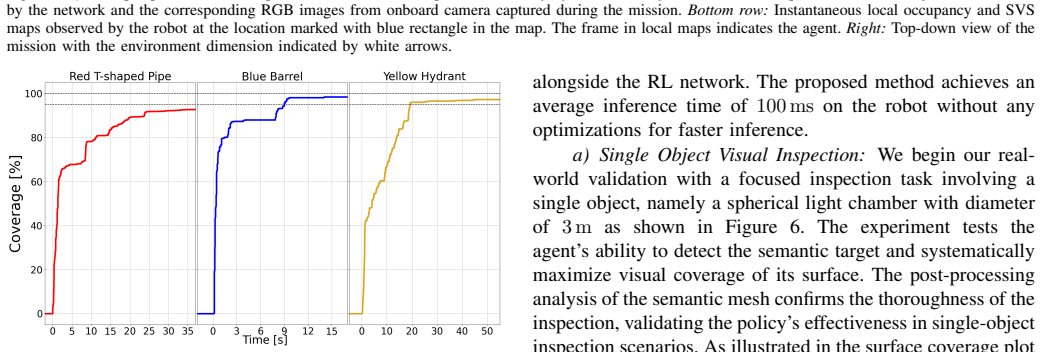
- [Section IV-C, multiple-object experiment] The headline average of 96.2% coverage is computed after excluding the uninspected upper lid of the T-pipe from the denominator, even though the preceding sentence says the upper lid remains uninspected and the "ideal feasible coverage" denominator is already intended to account for occlusions. This post-hoc exclusion inflates the reported number and makes the result difficult to interpret. The authors should report the raw coverage including the upper lid, state explicitly which surfaces are excluded from the denominator and why, and give per-object coverage numbers before averaging.
- [Section IV-B] The simulation comparison claim that the RL policy outperforms FUEL, GVI, and SWAP in inspection time rests on protocol details that are not fully controlled. The RL method receives a per-object inspection time limit and switches labels automatically, while the baselines are said to be fine-tuned to achieve greater than 95% coverage; it is unclear whether the plotted coverage for each baseline is measured at the same mission horizon or after a different termination criterion, and no per-run statistics or significance tests accompany the reported averages. The authors should specify the stopping rule for each method and report mean plus dispersion or per-run curves for all methods.
- [Tables I-III, Section IV-A] The ablation claims, such as the SVS map increasing coverage from 52.3% to 74.6% and GRU-512 increasing coverage from 59.8% to 74.6%, are presented as single point estimates without standard deviations, confidence intervals, or the number of independent training seeds. Given that the same statistic in Table I is reported across obstacle counts with substantial variation, adding dispersion and stating the number of seeds or checkpoints used is necessary to establish that the observed differences are not due to training variance.
minor comments (4)
- [Section III-C, Eq. (7)] The exact values of the reward parameters alpha, beta, gamma, delta, the desired inspection distance d_ref, and the collision distance d_coll used in the reported experiments are not given in the main text; please list them in a table or in the open-source documentation for reproducibility.
- [Section IV-A, Table I] The term "Timeout" is defined as the robot remaining collision-free until the end of the episode, which makes the near-100% timeout rates read as successful completion rather than failure; consider renaming this column to "No crash" or clarifying the definition.
- [Figure 5] Please specify whether the shaded region in Figure 5 represents variability across runs within an environment or across environments, and clarify what the two horizontal dashed lines denote for readers.
- [General] The notation q_t in Eq. (1) is described as a 4D orientation vector, but the quaternion convention and the relationship to the inertial frame I are not stated; a brief clarification would improve reproducibility.
Circularity Check
No circularity: the policy is evaluated against external baselines and real-world mesh reconstruction; self-citations are infrastructure only, and the reward/eval metric alignment is the task objective, not a fitted-input prediction.
full rationale
The paper's derivation chain is self-contained rather than circular. The RL policy is trained with reward R(st,at)=ft+vt+pt, where ft is the fraction of inspected semantic faces; the later coverage numbers measure the same facial-coverage quantity. This is the objective being learned rather than a disguised fit, and the paper additionally compares against independently tuned baselines (FUEL, GVI, SWAP) in simulation and against reconstructed real-world object meshes in deployment, so the central claims are externally grounded. Author-overlapping references (Aerial Gym Simulator [32] and prior NTNU platform papers) provide simulator and hardware infrastructure, and are not invoked as proof of the method's validity or uniqueness. The paper's 'first semantics-aware end-to-end RL inspection planning framework' claim is a novelty assertion, not an imported theorem, and no equation is defined in terms of the claimed result. The real-world use of HSV color ranges to produce segmentation masks is an engineering limitation of the semantic perception channel rather than a circular step; it weakens the 'previously unseen semantics' generalization claim but does not make the learned inspection behavior equivalent to its input by construction. The exclusion of the uninspected pipe lid from the feasible-coverage denominator is a measurement-choice concern, not a derivation-circularity concern. Overall, no step in the method reduces by definition or by self-citation to its own conclusions.
Assumptions & free parameters
free parameters (7)
- Reward parameter alpha (alpha)
- Reward parameter beta (beta)
- Reward parameter gamma (gamma)
- Reward parameter delta (delta)
- Desired inspection distance d_ref =
0.5-2.5 m training, 0.8-1.2 m evaluation
- Collision distance d_coll =
0.3 m
- Maximum velocity and yaw-rate w_max =
1 m/s, 1 rad/s in simulation; 0.3 m/s, 0.6 rad/s in real experiments
assumptions (5)
- ad hoc to paper The semantic object is a triangle mesh and a privileged per-face depth image is available during training to compute the face-mesh reward.
- ad hoc to paper Real-world 'semantics' can be isolated with fixed HSV color ranges.
- domain assumption A policy trained on primitive shapes generalizes to unseen concave and industrial geometries.
- domain assumption The simulator dynamics, sensor noise, and disturbance model are faithful enough for sim2real transfer.
- ad hoc to paper The 'ideal feasible coverage' denominator for each semantic can be computed correctly from occlusions and obstacles.
Cite this review
Pith. "Pith review of Semantically-driven Deep Reinforcement Learning for Inspection Path Planning." pith.science (2026). https://pith.science/paper/RCGQUYJD
@misc{pith2026250514443,
  author       = {Pith},
  title        = {Pith review of: Semantically-driven Deep Reinforcement Learning for Inspection Path Planning},
  year         = {2026},
  howpublished = {\url{https://pith.science/paper/RCGQUYJD}},
  note         = {Machine review of arXiv:2505.14443}
}
read the original abstract
This paper introduces a novel semantics-aware inspection planning policy derived through deep reinforcement learning. Reflecting the fact that within autonomous informative path planning missions in unknown environments, it is often only a sparse set of objects of interest that need to be inspected, the method contributes an end-to-end policy that simultaneously performs semantic object visual inspection combined with collision-free navigation. Assuming access only to the instantaneous depth map, the associated segmentation image, the ego-centric local occupancy, and the history of past positions in the robot's neighborhood, the method demonstrates robust generalizability and successful crossing of the sim2real gap. Beyond simulations and extensive comparison studies, the approach is verified in experimental evaluations onboard a flying robot deployed in novel environments with previously unseen semantics and overall geometric configurations.
Figures


Figures from the paper (4 more)


Reference graph
Works this paper leans on
-
[1]
Topological path planning for autonomous information gathering,
S. McCammon et al. , “Topological path planning for autonomous information gathering,” Autonomous Robots , vol. 45, no. 6, pp. 821– 842, 2021
work page 2021
-
[2]
Hypergame-based adaptive behavior path planning for combined exploration and visual search,
M. Dharmadhikari et al. , “Hypergame-based adaptive behavior path planning for combined exploration and visual search,” in 2021 IEEE International Conference on Robotics and Automation (ICRA) . IEEE, 2021, pp. 269–275
work page 2021
-
[3]
Fuel: Fast uav exploration using incremental frontier structure and hierarchical planning,
B. Zhou et al. , “Fuel: Fast uav exploration using incremental frontier structure and hierarchical planning,” IEEE Robotics and Automation Letters, vol. 6, no. 2, pp. 779–786, 2021
work page 2021
-
[4]
Tigris: An informed sampling-based algorithm for informative path planning,
B. Moon et al. , “Tigris: An informed sampling-based algorithm for informative path planning,” in 2022 IEEE/RSJ International Conference on Intelligent Robots and Systems (IROS) . IEEE, 2022, pp. 5760–5766
work page 2022
-
[5]
M. Dharmadhikari et al. , “Autonomous exploration and general visual inspection of ship ballast water tanks using aerial robots,” in 2023 21st International Conference on Advanced Robotics (ICAR) . IEEE, 2023, pp. 409–416
work page 2023
-
[6]
A survey on coverage path planning for robotics,
E. Galceran et al. , “A survey on coverage path planning for robotics,” Robotics and Autonomous systems, vol. 61, no. 12, pp. 1258–1276, 2013
work page 2013
-
[7]
An efficient sampling-based method for online informative path planning in unknown environments,
L. Schmid et al. , “An efficient sampling-based method for online informative path planning in unknown environments,” IEEE Robotics and Automation Letters , vol. 5, no. 2, pp. 1500–1507, 2020
work page 2020
-
[8]
Semantic-aware informative path planning for efficient object search using mobile robot,
C. Wang et al., “Semantic-aware informative path planning for efficient object search using mobile robot,” IEEE Transactions on Systems, Man, and Cybernetics: Systems , vol. 51, no. 8, pp. 5230–5243, 2019
work page 2019
Show all 36 references
-
[9]
Semantics-aware exploration and inspection path planning,
M. Dharmadhikari et al. , “Semantics-aware exploration and inspection path planning,” in 2023 IEEE International Conference on Robotics and Automation (ICRA) . IEEE, 2023, pp. 3360–3367
2023
-
[10]
Semantics-aware receding horizon planner for object- centric active mapping,
L. Lu et al. , “Semantics-aware receding horizon planner for object- centric active mapping,” IEEE Robotics and Automation Letters , 2024
2024
-
[11]
Zero-shot reinforcement learning on graphs for au- tonomous exploration under uncertainty,
F. Chen et al. , “Zero-shot reinforcement learning on graphs for au- tonomous exploration under uncertainty,” in 2021 IEEE International Conference on Robotics and Automation (ICRA) . IEEE, 2021, pp. 5193–5199
2021
-
[12]
Learning active camera for multi-object navigation,
P. Chen et al., “Learning active camera for multi-object navigation,” Ad- vances in Neural Information Processing Systems , vol. 35, pp. 28 670– 28 682, 2022
2022
-
[13]
Where to look next: Learning viewpoint recom- mendations for informative trajectory planning,
M. Lodel et al. , “Where to look next: Learning viewpoint recom- mendations for informative trajectory planning,” in 2022 International Conference on Robotics and Automation (ICRA) . IEEE, 2022, pp. 4466–4472
2022
-
[14]
Catnipp: Context-aware attention-based network for informative path planning,
Y . Cao et al. , “Catnipp: Context-aware attention-based network for informative path planning,” in Conference on Robot Learning . PMLR, 2023, pp. 1928–1937
2023
-
[15]
Adaptive informative path planning with mul- timodal sensing,
S. Choudhury et al. , “Adaptive informative path planning with mul- timodal sensing,” in Proceedings of the International Conference on Automated Planning and Scheduling , vol. 30, 2020, pp. 57–65
2020
-
[16]
Active learning for uav-based semantic mapping,
H. Blum et al., “Active learning for uav-based semantic mapping,” arXiv preprint arXiv:1908.11157, 2019
1908 arXiv
-
[17]
A deep reinforcement learning approach with visual semantic navigation with memory for mobile robots in indoor home context,
I. B. d. A. Santos et al. , “A deep reinforcement learning approach with visual semantic navigation with memory for mobile robots in indoor home context,” Journal of Intelligent & Robotic Systems , vol. 104, no. 3, p. 40, 2022
2022
-
[18]
Enhancing navigational safety in crowded environ- ments using semantic-deep-reinforcement-learning-based navigation,
L. K ¨astner et al. , “Enhancing navigational safety in crowded environ- ments using semantic-deep-reinforcement-learning-based navigation,” in 2022 IEEE International Symposium on Safety, Security, and Rescue Robotics (SSRR) . IEEE, 2022, pp. 87–93
2022
-
[19]
Object goal navigation using goal-oriented seman- tic exploration,
D. S. Chaplot et al., “Object goal navigation using goal-oriented seman- tic exploration,” Advances in Neural Information Processing Systems , vol. 33, pp. 4247–4258, 2020
2020
-
[20]
Semantically-enhanced deep collision prediction for autonomous navigation using aerial robots,
M. Kulkarni et al. , “Semantically-enhanced deep collision prediction for autonomous navigation using aerial robots,” in 2023 IEEE/RSJ International Conference on Intelligent Robots and Systems (IROS) . IEEE, 2023, pp. 3056–3063
2023
-
[21]
Robotic learning for adaptive informative path planning,
M. Popovic et al. , “Robotic learning for adaptive informative path planning,” arXiv preprint arXiv:2404.06940 , 2024
2024 arXiv
-
[22]
Sc-explorer: Incremental 3d scene completion for safe and efficient exploration mapping and planning,
L. Schmid et al. , “Sc-explorer: Incremental 3d scene completion for safe and efficient exploration mapping and planning,” arXiv preprint arXiv:2208.08307, 2022
2022 arXiv
-
[23]
Learning exploration policies for navigation,
T. Chen et al. , “Learning exploration policies for navigation,” arXiv preprint arXiv:1903.01959, 2019
1903 arXiv
-
[24]
A data-driven model for interaction-aware pedestrian motion prediction in object cluttered environments,
M. Pfeiffer et al., “A data-driven model for interaction-aware pedestrian motion prediction in object cluttered environments,” in 2018 IEEE International Conference on Robotics and Automation (ICRA) . IEEE, 2018, pp. 5921–5928
2018
-
[25]
Deep reinforcement learning robot for search and rescue applications: Exploration in unknown cluttered environments,
F. Niroui et al. , “Deep reinforcement learning robot for search and rescue applications: Exploration in unknown cluttered environments,” IEEE Robotics and Automation Letters , vol. 4, no. 2, pp. 610–617, 2019
2019
-
[26]
Deep reinforcement learning supervised autonomous ex- ploration in office environments,
D. Zhu et al., “Deep reinforcement learning supervised autonomous ex- ploration in office environments,” in 2018 IEEE international conference on robotics and automation (ICRA) . IEEE, 2018, pp. 7548–7555
2018
-
[27]
Receding horizon
A. Bircher et al. , “Receding horizon” next-best-view” planner for 3d exploration,” in 2016 IEEE international conference on robotics and automation (ICRA) . IEEE, 2016, pp. 1462–1468
2016
-
[28]
Receding horizon path planning for 3d exploration and surface inspection,
——, “Receding horizon path planning for 3d exploration and surface inspection,” Autonomous Robots , vol. 42, pp. 291–306, 2018
2018
-
[29]
Sampling-based coverage path planning for inspection of complex structures,
B. Englot et al., “Sampling-based coverage path planning for inspection of complex structures,” in Proceedings of the International Conference on Automated Planning and Scheduling , vol. 22, 2012, pp. 29–37
2012
-
[30]
Sample factory: Egocentric 3d control from pixels at 100000 fps with asynchronous reinforcement learning,
A. Petrenko et al., “Sample factory: Egocentric 3d control from pixels at 100000 fps with asynchronous reinforcement learning,” in International Conference on Machine Learning . PMLR, 2020, pp. 7652–7662
2020
-
[31]
Impala: Scalable distributed deep-rl with importance weighted actor-learner architectures,
L. Espeholt et al., “Impala: Scalable distributed deep-rl with importance weighted actor-learner architectures,” in International conference on machine learning . PMLR, 2018, pp. 1407–1416
2018
-
[32]
Aerial gym simulator: A framework for highly parallelized simulation of aerial robots,
M. Kulkarni, W. Rehberg, and K. Alexis, “Aerial gym simulator: A framework for highly parallelized simulation of aerial robots,” 2025
2025
-
[33]
Control of complex maneuvers for a quadrotor uav using geometric methods on se (3),
T. Lee et al., “Control of complex maneuvers for a quadrotor uav using geometric methods on se (3),” arXiv preprint arXiv:1003.2005 , 2010
2005 arXiv
-
[34]
Design and use paradigms for gazebo, an open-source multi-robot simulator,
N. Koenig et al., “Design and use paradigms for gazebo, an open-source multi-robot simulator,” in 2004 IEEE/RSJ international conference on intelligent robots and systems (IROS)(IEEE Cat. No. 04CH37566) , vol. 3. Ieee, 2004, pp. 2149–2154
2004
-
[35]
V oxblox: Incremental 3d euclidean signed dis- tance fields for on-board mav planning,
H. Oleynikova et al. , “V oxblox: Incremental 3d euclidean signed dis- tance fields for on-board mav planning,” in IEEE/RSJ International Conference on Intelligent Robots and Systems (IROS) , 2017
2017
-
[36]
Neural control barrier functions for safe navigation,
M. Harms et al. , “Neural control barrier functions for safe navigation,” in 2024 IEEE/RSJ International Conference on Intelligent Robots and Systems (IROS). IEEE, 2024, pp. 10 415–10 422
2024
Reviewed August 7, 2026 · model on record in the stance chip above.
Discussion (0). Continue with ORCID to comment.