REVIEW 4 major objections 5 minor 60 references
Structural States of Filamentary Microgravity Dusty Plasma
T0 review · 4 major / 5 minor · reviewed 2026-08-07 · deepseek-v4-flash
Pith's one-line read Filamentary dusty plasma clouds in the PK-4 microgravity experiment develop liquid-crystal-like order with pressure: intra-filament coupling strengthens, inter-filament coupling weakens, and layered six-fold arrangements appear.
desk verdict Useful experimental survey of PK-4 dust filament ordering, but the claimed simulation confirmation is contradicted by the paper's own DRIAD results. read the letter →
The pith
A machine-rendered reading of the paper's core claim, the machinery that carries it, and where it could break.
The reading
What carries the argument
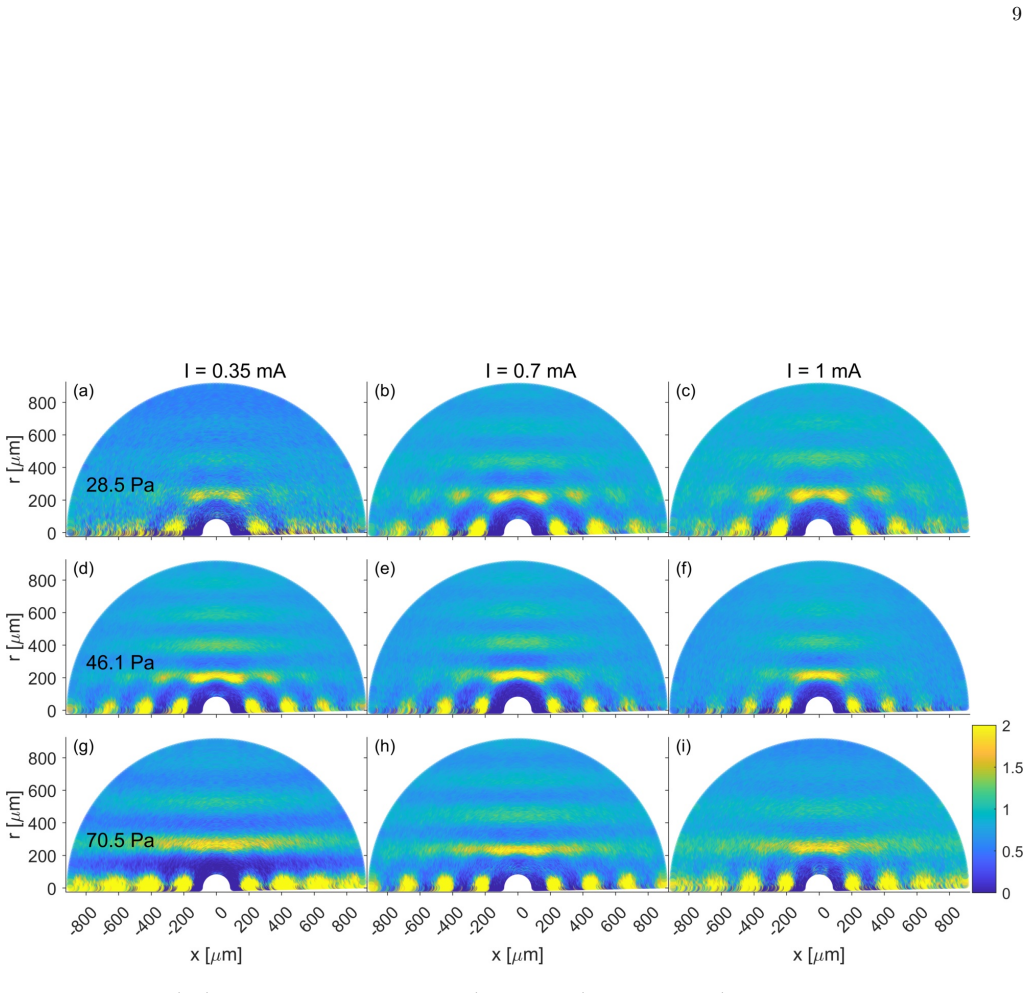
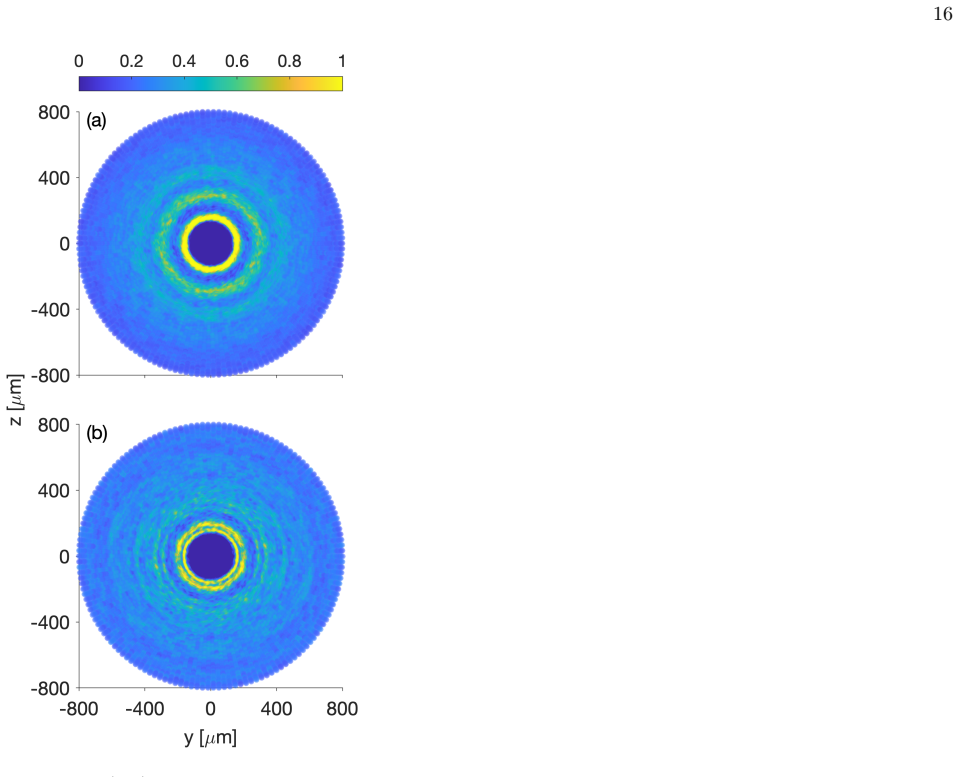
The quantitative argument is carried by spherical-coordinate pair correlation functions \(G_\$\varphi$(r,\$\theta$)\) and \(G_\$\theta$(r,\phi)\), computed from particle-tracking data of PK-4 video. In these functions, periodic bright spots along the director axis ('string peaks') measure crystalline order inside each filament, bright bands at finite radius measure how strongly neighbouring filaments are coupled and how freely they slide, and spot-like structure in the bands reveals six-fold, smectic-like ordering in the cross-field plane. The second load-bearing element is the DRIAD N-body simulation, which follows individual dust grains and ions with dynamic dust charging and uses plasma conditions from a PIC/MCC model of ionization waves in the PK-4 discharge as time-varying inputs, rather than time-averaged values.
What would settle it
A pressure scan in PK-4 at fixed dust number density and fixed current, stepping pressure from about 25 to 75 Pa while measuring the intra-filament string peaks and the cross-filament bands in the angular pair correlation functions \(G_\phi\) and \(G_\$\theta$\), would settle whether the transition is driven by pressure; the same data could test the cooling mechanism by checking whether dust kinetic temperature, inferred from particle velocity distributions, decreases as pressure increases.
Extended reading notes
Core claim
The central discovery is a pressure-dependent decoupling of the two axes of order in the PK-4 dust cloud. At 28.5 Pa the bulk cloud is a weakly crystalline solid: coupling between neighbouring particles is similar in strength and range whether the particles sit in the same field-aligned filament or in adjacent filaments. At 70.5 Pa the intra-filament coupling becomes stronger and longer-range—the angular pair correlation function \(G_\$\varphi$(r,\$\theta$)\) shows more pronounced string peaks extending further along the director axis—while the cross-filament coupling weakens, giving filaments the freedom to slide past one another. The authors take this anisotropic crystalline-plus-liquid character to be the dusty plasma equivalent of a nematic liquid crystal, with pressure playing the role of inverse temperature. They further observe particles arranged on nested surfaces for several conditions and, most clearly at 46.1 Pa and 0.35 mA, a six-fold symmetric arrangement of filaments in the plane perpendicular to the field, which they cite as evidence of smectic-like layered order. DRIAD simulations with ionization-wave-modulated plasma inputs reproduce the same trend: compared with the 40 Pa case, the 60 Pa case shows stronger intra-filament order, weaker inter-layer coupling, and crystallization of nested cylinders that proceeds from the outside inward.
Load-bearing premise
The argument assumes that the ordering change is caused by neutral gas pressure acting as inverse temperature, but the runs compared at different pressures also differ in dust density and current, and the simulations at 40 and 60 Pa are taken to represent the experimental trend, so if density, current, or simulation mismatch drives the effect, the liquid-crystal analogy would lose its stated mechanism.
Editorial extensions
If this is right
- If the analogy is right, neutral gas pressure becomes a tunable control that plays the role of inverse temperature, allowing exploration of nematic and smectic phases in a system where every particle can be tracked by camera.
- The stronger intra-filament and weaker inter-filament coupling at high pressure demonstrates that a single dusty plasma cloud can be simultaneously crystalline along one axis and liquid-like along another, the defining signature of liquid-crystal order.
- The outer-to-inner crystallization of nested cylinders seen in DRIAD implies that the layered shell structure is a stable organizational principle of these clouds, not a boundary artifact.
- Because the pair correlations were stable over 20-second intervals and the three-dimensional reconstruction used a slow Y-scan, the layered structure is a bulk property of the cloud rather than a transient of the measurement.
Reading between the lines
- The nine data sets differ in dust density (\(55.1\) to \(123.6\) mm\(^{-3}\)) as well as pressure, so a decisive test of the pressure-as-temperature interpretation would be a dedicated PK-4 scan at fixed density and current; the authors themselves note that current and dust density dictate the interparticle separation.
- If the nematic analogy is quantitative, the distribution of filament orientations should yield a nematic order parameter that grows continuously with pressure; computing it from existing tracking data would connect these structural observations to standard liquid-crystal theory.
- The clearest six-fold symmetry appears at the highest dust density (46.1 Pa, 0.35 mA), which suggests dust density, not pressure alone, may control layered ordering; a testable prediction is that increasing density at fixed pressure should induce the same smectic-like symmetry.
- The same data could be searched for defect structures and correlation-length scaling near the apparent transition, providing a direct comparison with predictions for the universality class of the nematic-smectic transition.
Editorial analysis
A structured set of objections, weighed in public.
Referee Report
Summary. The paper analyzes nine sets of PK-4 ISS dusty-plasma data at three pressures (28.5, 46.1, 70.5 Pa) and three currents (0.35, 0.7, 1.0 mA), using 2D and 3D pair-correlation functions to argue that increasing neutral-gas pressure drives a transition from a weakly crystalline, isotropic state to a state with enhanced within-filament order and reduced cross-filament coupling, analogous to a nematic liquid crystal; nested layers and six-fold symmetry in some cases are interpreted as smectic-like ordering. The experimental observations are compared with DRIAD molecular-dynamics simulations at 40 Pa and 60 Pa, which are claimed to confirm the pressure-driven trend. The central claim is that pressure acts as inverse temperature, producing an LC-like phase transition in a macroscopic, optically thin dusty plasma.
Significance. If the central claim holds, this would be a valuable demonstration of a macroscopic analogue system for liquid-crystal phase transitions, with the advantage of full kinetic-level particle tracking. The paper makes use of a substantial PK-4 ISS dataset and provides a clear presentation of three complementary pair-correlation diagnostics. The DRIAD simulation code with dynamically evolving plasma conditions is a sophisticated tool, and the layered ('unwrapped cylinder') analysis is a nice addition. However, the manuscript currently establishes only a qualitative visual trend, and the simulation evidence is partially inconsistent with the main conclusion. The significance is therefore conditional on strengthening the quantitative analysis and resolving the internal contradiction between the simulation and the stated within-filament trend.
major comments (4)
- [Section IV (Figs. 18-20) vs. Section V] The DRIAD simulation results directly contradict the within-filament part of the central claim. In Section IV the authors state that 'the string peaks are less localized in the 60 Pa case (Fig. 18b) than for the lower-pressure 40 Pa case (Fig. 18a)' and that 'the highest crystallinity and degree of order within filaments are observed in the 40 Pa case', and Fig. 20 is summarized as showing 'a higher degree of order within a filament at this pressure' for 40 Pa. However, Section V concludes that 'We further confirm that at higher pressure, both the strength and range of coupling within filaments is enhanced while the cross-filament coupling is decreased.' This is an internal inconsistency. The simulation evidence, as presented, supports the cross-filament part of the claim but not the within-filament part. The authors must either reconcile these statements, for example by identifying a different mechanism for the within-filament enhancement, or explicitly weaken the conclusion to acknowledge that the simulations do not confirm the within-filament ordering trend.
- [Section II.C and Table I] The nine experimental sets vary not only in neutral-gas pressure but also in dust density (n ranges from 55.1 to 123.6 mm^-3 in Table I) and discharge current. The authors themselves note in Section II.C that 'interplay between current and dust density dictates the resulting interparticle separation.' Yet the central conclusion attributes the observed ordering differences to pressure acting as inverse temperature. No quantitative order parameters (e.g., bond-orientational order, nematic order parameter), error bars on the pair-correlation peaks, or statistical significance tests are provided; all structural conclusions are drawn by visual inspection of Figs. 8-12. As a result, the pressure-driven transition is not established as distinct from density- or current-driven effects. The authors should compute quantitative structural metrics for each condition and either control for n and I statistically or clearly delimit the parameter region in which the pressure trend is robust.
- [Section III.B and Table II] The simulation 'confirmation' is weakened by fitted inputs and by parameter mismatch with the experiments. The text states that 'We initially adjusted the radial confinement ω1 to match the interparticle spacing seen in the experiments, and then increased ω2 (confinement in the axial direction) until crystallization was achieved,' yet Table II lists identical values of ω1 and ω2 for the 40 Pa and 60 Pa simulations. This makes it unclear what was actually tuned and whether the two simulations differ only in the prescribed plasma conditions. Furthermore, the simulations use 40 Pa/0.8 mA and 60 Pa/2.0 mA, which do not correspond to the experimental pressures (28.5, 46.1, 70.5 Pa) or currents (0.35-1.0 mA), and the simulation pressures are not the same as the experimental low/high pressures used in the main trend. The comparison is therefore partly circular and not a direct test of the experimental pressure dependence. The authors should state the sensitivity of the results to ω1 and ω2, use conditions that match the experiments as closely as possible, and clarify how the fitted parameters affect the claimed confirmation.
- [Section V (inverse-temperature analogy)] The assertion that 'neutral gas pressure in dusty plasma acts as inverse temperature' is a central interpretive step, but it is not supported by a derivation or by a quantitative check (e.g., showing that the measured structural changes correspond to a known equation of state or to a measurable dust temperature). Because the experimental design is not a controlled temperature sweep, this analogy currently functions as an assumption rather than a demonstrated result. The authors should either provide direct evidence for the pressure-temperature mapping or reframe the claim as a suggestive analogy that motivates future experiments.
minor comments (5)
- [Eq. (4)] Equation (4) defines G(r) with a factor δ(φ_{ij} − φ) in the sum, but G(r) should depend only on the radial distance r, not on the azimuthal angle. This appears to be a typo; the azimuthal delta should be removed or the definition should be clarified.
- [Fig. 12 and text in Section II.C.2] The text refers to the '46.1 Pa, 0.35 mA case (Fig. 12 g)', but Fig. 12g shows the 70.5 Pa, 0.35 mA case; also '70.1 Pa' appears twice as a typo for 70.5 Pa. Please correct these figure cross-references and labels.
- [Section III.B and references] Reference [56] is cited for the statement that the asymmetric molecular dynamics scheme 'has been found to reasonably reproduce ion-dust interparticle forces calculated from PIC simulations', but [56] is 'A Note on the Generation of Random Normal Deviates' (Box and Muller). The citation appears to be incorrect; please verify and correct.
- [Section II.C (Y-scan deduplication)] The description of the Y-scan particle deduplication states that particles are filtered if 'less than a threshold distance from another particle in the next few subsequent frames', but no value for this threshold or for the number of subsequent frames is given. The 3D pair-correlation results depend on this processing step, so the threshold should be stated explicitly.
- [General presentation] There are several typos in the text, including 'withing' (Section II.C.1), 'the the' (Section IV), and 'a a clear' (Section II.C.2). A careful proofreading pass is recommended.
Circularity Check
Simulation 'confirmation' is partly forced by fitted confinement parameters; the experimental pair-correlation analysis itself is self-contained.
-
fitted input called prediction
[Section IV (Numerical Results), DRIAD confinement tuning; echoed in Section V (Conclusion)]
"We initially adjusted the radial confinement ω1 to match the interparticle spacing seen in the experiments, and then increased ω2 (confinement in the axial direction) until crystallization was achieved."
The simulation is later described as confirming the experimental ordering, including the average interparticle spacing and crystalline behavior. But both were tuning targets: ω1 was fit to the measured spacing and ω2 was increased until crystallization appeared, so the agreement in spacing is a restatement of the fit rather than an independent prediction, and the crystalline order is commanded by the axial confinement. Furthermore, the simulation section itself reports the 40 Pa case as having the highest within-filament crystallinity, so the conclusion that higher pressure enhances within-filament coupling is not actually obtained from the (already tuned) simulation output.
full rationale
The primary experimental finding is not circular: the pair-correlation functions (Eqs. 1-4) are computed directly from tracked PK-4 particle positions, and the low- versus high-pressure comparison is an empirical observation rather than a model output. The liquid-crystal analogy is an interpretive overlay, not an input to the correlation analysis. The genuine circularity is limited to the simulation 'confirmation' advertised in the abstract and conclusion. In Section IV, DRIAD's radial confinement ω1 is adjusted to match the experimental interparticle spacing and ω2 is increased until crystallization is achieved, so the subsequent claim that the simulation confirms the spacing and ordering reduces to those fitted targets. A separate correctness concern, not itself a circularity, is that the reported simulation results contradict the within-filament part of the conclusion: Figs. 18 and 20 show the 40 Pa case has clearer string peaks and higher order within filaments than the 60 Pa case, whereas the conclusion states the simulation confirms enhanced within-filament coupling at higher pressure. Because the experimental derivation remains self-contained, the overall circularity score is moderate.
Assumptions & free parameters
free parameters (3)
- omega1 (radial confinement frequency in DRIAD) =
4.0 x 10^5 N/(C m)
- omega2 (axial confinement frequency in DRIAD) =
6.0 x 10^5 N/(C m)
- Particle deduplication threshold in Y-scan reconstruction
assumptions (6)
- domain assumption Electrons in DRIAD are treated as a Boltzmann-distributed fluid rather than as discrete particles.
- domain assumption Ion-dust forces are computed with a shielded Coulomb potential for dust and a bare Coulomb potential for ions (asymmetric MD after Piel).
- domain assumption Neutral gas acts as a thermal bath with Langevin thermostat; dust-neutral drag depends on pressure and temperature.
- ad hoc to paper Higher neutral pressure cools the dust through increased collision frequency, so pressure can be mapped to inverse temperature.
- domain assumption The dust cloud is approximately stationary over the Y-scan duration, so successive 2D slices can be merged into a 3D reconstruction.
- domain assumption Particles appearing in consecutive Y-scan frames within a threshold distance are duplicates and are filtered out.
Cite this review
Pith. "Pith review of Structural States of Filamentary Microgravity Dusty Plasma." pith.science (2026). https://pith.science/paper/C4G7NYE6
@misc{pith2026250514576,
  author       = {Pith},
  title        = {Pith review of: Structural States of Filamentary Microgravity Dusty Plasma},
  year         = {2026},
  howpublished = {\url{https://pith.science/paper/C4G7NYE6}},
  note         = {Machine review of arXiv:2505.14576}
}
abstract
This study investigates the filamentary structural states of microgravity dusty plasma using data from the Plasmakristall-4 (PK-4) facility on board the International Space Station. The dust particles in the PK-4 discharge are observed to form field-aligned filaments and nested (layered) structures in response to changes in the plasma conditions, neutral gas pressure, and externally applied electric field. This work explores the possibility that these filamentary dusty plasmas exhibit properties of liquid crystals. The structural characteristics of the dust clouds are studied for nine sets of pressure-current conditions using pair correlation functions calculated for particles (i) within individual filaments, (ii) within the central plane of the dust cloud, and (iii) within successive planes of the cloud (the 3D cloud). It is observed that, at low pressure ($\approx$30 Pa), the entire cloud is in a weakly crystalline state with similar coupling of particles within filaments and among neighboring filaments. At high pressure ($\approx$70 Pa), the order within filaments improves (enhanced crystalline behavior), while the degree of freedom of filaments to move with respect to each other increases (enhanced liquid behavior). Since neutral gas pressure in dusty plasma acts as inverse temperature, we argue that the structural changes observed with increasing pressure are analogous to a transition to a nematic liquid crystal state. It is further observed that the filaments exhibit alignment in nested surfaces for several pressure-current conditions, suggesting the possibility of a smectic liquid crystal state. These results are confirmed by molecular dynamics simulations of the dust and ions using the DRIAD (Dynamic Response of Ions And Dust) code.
Figures


Figures from the paper (18 more)







Reference graph
Works this paper leans on
-
[1]
Radial Pair Correlation The average interparticle separation can be determined from the location of the first peak of g(r). As g(r) is calculated for particles in successive planes across the cloud, shifts in the location of this peak can be used to identify gradients in dust density and the existence of layers. Data from dust particles within a central p...
-
[2]
Angular Pair Correlations Further information about the 3D structural charac- teristics of the clouds is obtained from the the 3D an- gular pair correlation functions Gϕ(r, θ) from Eq. (2) and Gθ(r, ϕ) from Eq. (3). Fig. 11 shows Gϕ(r, θ) and Fig. 12 shows Gθ(r, ϕ) for all pressure-current conditions. The data for Gϕ(r, θ) is plotted in ( x, r) coordinate...
-
[3]
P. Lv, X. Yang, H. K. Bisoyi, H. Zeng, X. Zhang, Y. Chen, P. Xue, S. Shi, A. Priimagi, L. Wang, W. Feng, and Q. Li, Stimulus-driven liquid metal and liquid crystal network actuators for programmable soft robotics, Ma- terials Horizons 8, 2475 (2021)
work page 2021
-
[4]
H.-W. Chen, J.-H. Lee, B.-Y. Lin, S. Chen, and S.-T. Wu, Liquid crystal display and organic light-emitting diode display: present status and future perspectives, Light: Science & Applications 7, 17168 (2018), number: 3 Pub- lisher: Nature Publishing Group
work page 2018
-
[5]
D. L. White and G. N. Taylor, New absorptive mode reflective liquid-crystal display device, Journal of Applied Physics 45, 4718 (1974), publisher: American Institute of Physics
work page 1974
-
[6]
A. Buguin, M.-H. Li, P. Silberzan, B. Ladoux, and P. Keller, Micro-actuators: when artificial muscles made of nematic liquid crystal elastomers meet soft lithogra- phy, Journal of the American Chemical Society128, 1088 (2006)
work page 2006
-
[7]
Z. Shen, F. Chen, X. Zhu, K.-T. Yong, and G. Gu, Stimuli-responsive functional materials for soft robotics, Journal of Materials Chemistry B 8, 8972 (2020), pub- lisher: The Royal Society of Chemistry
work page 2020
- [8]
Show all 60 references
-
[9]
S. J. Woltman, G. D. Jay, and G. P. Crawford, Liquid- crystal materials find a new order in biomedical applica- tions, Nature Materials 6, 929 (2007)
2007
-
[10]
X. Liu, M. G. Debije, J. P. A. Heuts, and A. P. H. J. Schenning, Liquid-Crystalline Polymer Particles Prepared by Classical Polymerization Techniques, Chem- istry (Weinheim an Der Bergstrasse, Germany)27, 14168 (2021)
2021
-
[11]
A. A. Collyer, ed., Liquid Crystal Polymers: From Struc- tures to Applications (Springer Netherlands, Dordrecht, 1993)
1993
-
[12]
Tao, Electric-field-induced phase transition in elec- trorheological fluids, Physical Review E 47, 423 (1993), publisher: American Physical Society
R. Tao, Electric-field-induced phase transition in elec- trorheological fluids, Physical Review E 47, 423 (1993), publisher: American Physical Society
1993
-
[13]
Hao, Electrorheological Fluids, Advanced Materials 13, 1847 (2001)
T. Hao, Electrorheological Fluids, Advanced Materials 13, 1847 (2001)
2001
-
[14]
Hao, The positive, negative, photo-ER, and electro- magnetorheological (EMR) effects, in Studies in Interface Science, Vol
T. Hao, The positive, negative, photo-ER, and electro- magnetorheological (EMR) effects, in Studies in Interface Science, Vol. 22 (Elsevier, 2005) pp. 83–113
2005
-
[15]
Stanway, J
R. Stanway, J. L. Sproston, and A. K. El-Wahed, Appli- cations of electrorheological fluids in vibration control: a survey, Smart Materials and Structures 5, 464 (1996)
1996
-
[16]
Sadeghi, L
A. Sadeghi, L. Beccai, and B. Mazzolai, Innova- tive soft robots based on electro-rheological fluids, in 2012 IEEE/RSJ International Conference on Intelligent Robots and Systems (2012) pp. 4237–4242, iSSN: 2153- 0866
2012
-
[17]
Choi, J.-Y
S. Choi, J.-Y. Yook, M.-K. Choi, H. Nguyen, Y.-S. Lee, and M.-S. Han, Speed Control of DC Motor using Elec- trorheological Brake System, Journal of Intelligent Ma- terial Systems and Structures - J INTEL MAT SYST STRUCT 18, 1191 (2007)
2007
-
[18]
Coursault, J.-F
D. Coursault, J.-F. Blach, J. Grand, A. Coati, A. Vlad, B. Zappone, D. Babonneau, G. L´ evi, N. F´ elidj, B. Don- nio, J.-L. Gallani, M. Alba, Y. Garreau, Y. Borensztein, M. Goldmann, and E. Lacaze, Tailoring Anisotropic In- teractions between Soft Nanospheres Using Dense Arra...
2015
-
[19]
Y. H. Kim, J.-O. Lee, H. S. Jeong, J. H. Kim, E. K. Yoon, D. K. Yoon, J.-B. Yoon, and H.-T. Jung, Optically selec- tive microlens photomasks using self-assembled smectic liquid crystal defect arrays, Advanced Materials (Deer- field Beach, Fla.) 22, 2416 (2010)
2010
-
[20]
B. Son, S. Kim, Y. H. Kim, K. K¨ al¨ ant¨ ar, H.-M. Kim, H.- S. Jeong, S. Q. Choi, J. Shin, H.-T. Jung, and Y.-H. Lee, Optical vortex arrays from smectic liquid crystals, Optics Express 22, 4699 (2014), publisher: Optica Publishing Group
2014
-
[21]
Yethiraj, Recent experimental developments at the nematic to smectic-a liquid crystal phase transition, in Thermotropic Liquid Crystals: Recent Advances, edited by A
A. Yethiraj, Recent experimental developments at the nematic to smectic-a liquid crystal phase transition, in Thermotropic Liquid Crystals: Recent Advances, edited by A. Ramamoorthy (Springer Netherlands, Dordrecht,
-
[22]
I. Gryn, E. Lacaze, L. Carbone, M. Giocondo, and B. Zappone, Electric-Field-Controlled Alignment of Rod- Shaped Fluorescent Nanocrystals in Smectic Liquid Crystal Defect Arrays, Advanced Functional Materials 26, 10.1002/adfm.201602729 (2016)
2016 doi
-
[23]
Zappone, A
B. Zappone, A. E. Mamuk, I. Gryn, V. Arima, A. Ziz- zari, R. Bartolino, E. Lacaze, and R. Petschek, Analogy between periodic patterns in thin smectic liquid crystal films and the intermediate state of superconductors, Pro- ceedings of the National Academy of Sciences 117, 1764...
2020
-
[24]
Nefedov, O
A. Nefedov, O. Petrov, V. Molotkov, and V. Fortov, For- mation of liquidlike and crystalline structures in dusty plasmas, IEEE Transactions on Plasma Science 29, 210 (2001), conference Name: IEEE Transactions on Plasma Science
2001
-
[25]
J. H. Chu and L. I, Direct observation of Coulomb crystals and liquids in strongly coupled rf dusty plas- mas, Physical Review Letters 72, 4009 (1994), publisher: American Physical Society
1994
-
[26]
Thomas, G
H. Thomas, G. E. Morfill, V. Demmel, J. Goree, B. Feuer- bacher, and D. M¨ ohlmann, Plasma Crystal: Coulomb Crystallization in a Dusty Plasma, Physical Review Let- ters 73, 652 (1994), publisher: American Physical Soci- ety
1994
-
[27]
V. I. Molotkov, A. P. Nefedov, M. Y. Pustyl’nik, V. M. Torchinsky, V. E. Fortov, A. G. Khrapak, and K. Yoshino, Liquid plasma crystal: Coulomb crystalliza- tion of cylindrical macroscopic grains in a gas-discharge plasma, Journal of Experimental and Theoretical Physics Letters...
2000
-
[28]
and cylindrical dust particles in DC discharges [29], [30]. In microgravity, dusty plasma has been shown to exhibit electrorheological (ER) effects, thus demon- strating its potential use as an analogue system for the study of phase transitions in ‘smart’ materials [31], [32],...
2019
-
[29]
Hartmann, A
P. Hartmann, A. Douglass, J. C. Reyes, L. S. Matthews, T. W. Hyde, A. Kov´ acs, and Z. Donk´ o, Crystallization Dynamics of a Single Layer Complex Plasma, Physical Review Letters 105, 115004 (2010), publisher: American Physical Society
2010
-
[30]
Joshi, M
E. Joshi, M. Y. Pustylnik, M. H. Thoma, H. M. Thomas, and M. Schwabe, Recrystallization in string-fluid com- plex plasmas, Physical Review Research 5, L012030 (2023)
2023
-
[31]
Banu and C
N. Banu and C. M. Tico¸ s, Precession of cylindrical dust particles in the plasma sheath, Physics of Plasmas 22, 103704 (2015), publisher: American Institute of Physics
2015
-
[32]
V. E. Fortov, A. P. Nefedov, V. I. Molotkov, O. F. Petrov, M. Y. Poustylnik, V. M. Torchinsky, and A. G. Khrapak, Dusty plasmas in a dc glow discharge, AIP Conference Proceedings 649, 394 (2002), publisher: American Insti- tute of Physics
2002
-
[33]
Khrapak, V
A. Khrapak, V. Molotkov, A. Nefedov, V. Torchinsky, and K. Yoshino, Liquid and crystalline structures in dusty plasmas: dust liquid crystal, in Proceedings of 1999 IEEE 13th International Conference on Dielectric Liq- uids (ICDL’99) (Cat. No.99CH36213) (1999) pp. 657– 660
1999
-
[34]
A. V. Ivlev, G. E. Morfill, H. M. Thomas, C. R¨ ath, G. Joyce, P. Huber, R. Kompaneets, V. E. Fortov, A. M. Lipaev, V. I. Molotkov, T. Reiter, M. Turin, and P. Vino- gradov, First Observation of Electrorheological Plasmas, Physical Review Letters 100, 095003 (2008), publisher:...
2008
-
[35]
A. V. Ivlev, P. C. Brandt, G. E. Morfill, C. Rath, H. M. Thomas, G. Joyce, V. E. Fortov, A. M. Lipaev, V. I. Molotkov, and O. F. Petrov, Electrorheological Complex Plasmas, IEEE Transactions on Plasma Science 38, 733 (2010), conference Name: IEEE Transactions on Plasma Science
2010
-
[36]
Dietz, J
C. Dietz, J. Budak, T. Kamprich, M. Kretschmer, and M. H. Thoma, Phase transition in electrorheological plas- mas, Contributions to Plasma Physics 61, e202100079 (2021)
2021
-
[37]
H. M. Thomas, G. E. Morfill, V. E. Fortov, A. V. Ivlev, V. I. Molotkov, A. M. Lipaev, T. Hagl, H. Rothermel, S. A. Khrapak, R. K. Suetterlin, M. Rubin-Zuzic, O. F. Petrov, V. I. Tokarev, and S. K. Krikalev, Complex plasma laboratory PK-3 Plus on the International Space Station...
2008
-
[38]
M. Y. Pustylnik, M. A. Fink, V. Nosenko, T. Antonova, T. Hagl, H. M. Thomas, A. V. Zobnin, A. M. Lipaev, A. D. Usachev, V. I. Molotkov, O. F. Petrov, V. E. For- tov, C. Rau, C. Deysenroth, S. Albrecht, M. Kretschmer, M. H. Thoma, G. E. Morfill, R. Seurig, A. Stettner, V. A. Al...
2016
-
[39]
Kompaneets, G
R. Kompaneets, G. E. Morfill, and A. V. Ivlev, Design of new binary interaction classes in complex plasmas, Physics of Plasmas 16, 043705 (2009)
2009
-
[40]
A. V. Ivlev, M. H. Thoma, C. R¨ ath, G. Joyce, and G. E. Morfill, Complex plasmas in external fields: the role of non-hamiltonian interactions, Physical Review Letters 106, 155001 (2011)
2011
-
[41]
Vermillion, D
K. Vermillion, D. Sanford, L. Matthews, P. Hart- mann, M. Rosenberg, E. Kostadinova, J. Carmona- Reyes, T. Hyde, A. M. Lipaev, A. D. Usachev, A. V. Zobnin, O. F. Petrov, M. H. Thoma, M. Y. Pustylnik, H. M. Thomas, and A. Ovchinin, Influence of temporal variations in plasma con...
2022
-
[42]
L. S. Matthews, K. Vermillion, P. Hartmann, M. Rosen- berg, S. Rostami, E. G. Kostadinova, T. W. Hyde, M. Y. Pustylnik, A. M. Lipaev, A. D. Usachev, A. V. Zobnin, M. H. Thoma, O. F. Petrov, H. M. Thomas, and O. V. Novitskiy, Effect of ionization waves on dust chain for- mation...
2021
-
[43]
Hartmann, M
P. Hartmann, M. Rosenberg, Z. Juhasz, L. S. Matthews, D. L. Sanford, K. Vermillion, J. Carmona-Reyes, and T. W. Hyde, Ionization waves in the PK-4 direct current neon discharge, Plasma Sources Science and Technology 29, 115014 (2020), publisher: IOP Publishing
2020
-
[44]
E. G. Kostadinova, K. Busse, C. D. Liaw, L. S. Matthews, and T. W. Hyde, Nematic transition in microgravity complex plasma liquid crystals (2018), presented at the 15th Dusty Plasma Workshop, Balti- more, Maryland, USA, Jun. 2018. [Online]. Available: https://wpdp.umbc.edu/fil...
2018
-
[45]
Mitic, M
S. Mitic, M. Y. Pustylnik, D. Erdle, A. M. Lipaev, A. D. Usachev, A. V. Zobnin, M. H. Thoma, H. M. Thomas, O. F. Petrov, V. E. Fortov, and O. Kononenko, Long-term evolution of the three-dimensional structure of string-fluid complex plasmas in the PK-4 experiment, Physical Revi...
2021
-
[46]
M. Y. Pustylnik, B. Klumov, M. Rubin-Zuzic, A. M. Li- paev, V. Nosenko, D. Erdle, A. D. Usachev, A. V. Zobnin, V. I. Molotkov, G. Joyce, H. M. Thomas, M. H. Thoma, O. F. Petrov, V. E. Fortov, and O. Kononenko, Three- dimensional structure of a string-fluid complex plasma, Phys...
2020
-
[47]
Yaroshenko and M
V. Yaroshenko and M. Pustylnik, Possible Mechanisms of String Formation in Complex Plasmas at Elevated Pres- sures, Molecules 26, 308 (2021), number: 2 Publisher: Multidisciplinary Digital Publishing Institute
2021
-
[48]
Takahashi, M
K. Takahashi, M. Tonouchi, S. Adachi, and H. Totsuji, Study of cylindrical dusty plasmas in pk-4j; experiments, Int. J. Microgravity Sci. Appl. 31, 4 (2014)
2014
-
[49]
Totsuji, C
H. Totsuji, C. Totsuji, K. Takahashi, and S. Adachi, Study of cylindrical dusty plasmas in pk-4j; theory and simulations, Int. J. Microgravity Sci. Appl. 31, 7 (2014)
2014
-
[50]
A. P. Nefedov, G. E. Morfill, V. E. Fortov, H. M. Thomas, H. Rothermel, T. Hagl, A. V. Ivlev, M. Zuzic, B. A. Klu- mov, A. M. Lipaev, V. I. Molotkov, O. F. Petrov, Y. P. Gidzenko, S. K. Krikalev, W. Shepherd, A. I. Ivanov, M. Roth, H. Binnenbruck, J. A. Goree, and Y. P. Se- me...
2003
-
[51]
Nitter, Levitation of dust in rf and dc glow discharges, Plasma Sources Science and Technology 5, 93 (1996)
T. Nitter, Levitation of dust in rf and dc glow discharges, Plasma Sources Science and Technology 5, 93 (1996)
1996
-
[52]
V. E. Fortov, A. V. Ivlev, S. A. Khrapak, A. G. Khrapak, and G. E. Morfill, Complex (dusty) plasmas: Current status, open issues, perspectives, Physics Reports 421, 1 (2005), aDS Bibcode: 2005PhR...421....1F
2005
-
[53]
L. S. McCabe, J. Williams, S. C. Thakur, U. Konopka, E. Kostadinova, M. Pustylnik, H. Thomas, M. Thoma, and E. Thomas, Experiments and modeling of dust par- ticle heating resulting from changes in polarity switching in the pk-4 microgravity laboratory, Physics of Plasmas 32 (2025)
2025
-
[54]
B. R. Andrew, L. Guazzotto, L. Matthews, H. Truell, and E. Kostadinova, Anisotropic anomalous diffusion in mi- crogravity dusty plasma. part one: Nonequilibrium sta- tistical analysis, arXiv preprint arXiv:2411.15705 (2024). 19
2024 arXiv
-
[55]
Shivanandan, A
A. Shivanandan, A. Radenovic, and I. F. Sbalzarini, Mo- saicia: an imagej/fiji plugin for spatial pattern and inter- action analysis, BMC Bioinformatics 14, 349 (2013)
2013
-
[56]
Schmidt and T
J. Schmidt and T. W. Hyde, Discharge parameters of PlasmaKristall-4BU: A modifiable dusty plasma ex- periment, Review of Scientific Instruments 91, 083506 (2020), publisher: American Institute of Physics
2020
-
[57]
L. S. Matthews, D. L. Sanford, E. G. Kostadinova, K. S. Ashrafi, E. Guay, and T. W. Hyde, Dust charging in dy- namic ion wakes, Physics of Plasmas 27, 023703 (2020), publisher: American Institute of Physics
2020
-
[58]
Piel, Molecular dynamics simulation of ion flows around microparticles, Physics of Plasmas 24, 033712 (2017), publisher: American Institute of Physics
A. Piel, Molecular dynamics simulation of ion flows around microparticles, Physics of Plasmas 24, 033712 (2017), publisher: American Institute of Physics
2017
-
[59]
G. E. P. Box and M. E. Muller, A Note on the Genera- tion of Random Normal Deviates, The Annals of Mathe- matical Statistics 29, 610 (1958), publisher: Institute of Mathematical Statistics
1958
-
[60]
Jaiswal, M
S. Jaiswal, M. Pustylnik, S. Zhdanov, H. M. Thomas, A. Lipaev, A. Usachev, V. Molotkov, V. Fortov, M. Thoma, and O. Novitskii, Dust density waves in a dc flowing complex plasma with discharge polarity reversal, Physics of Plasmas 25 (2018)
2018
Reviewed August 7, 2026 · model on record in the stance chip above.
Discussion (0). Continue with ORCID to comment.