REVIEW 3 major objections 4 minor 30 references
Dynamics of intracycle angular velocity control applied to cross-flow turbines
T0 review · 3 major / 4 minor · reviewed 2026-08-07 · deepseek-v4-flash
Pith's one-line read This paper argues that modulating a cross-flow turbine's angular velocity during each blade revolution, compared at equal time-averaged tip-speed ratio, can increase power by up to 71% when the turbine runs below its constant-speed…
desk verdict A methodological correction worth taking seriously; the headline numbers are less certain than they look, but the qualitative low-TSR finding holds up. read the letter →
The pith
A machine-rendered reading of the paper's core claim, the machinery that carries it, and where it could break.
The reading
What carries the argument
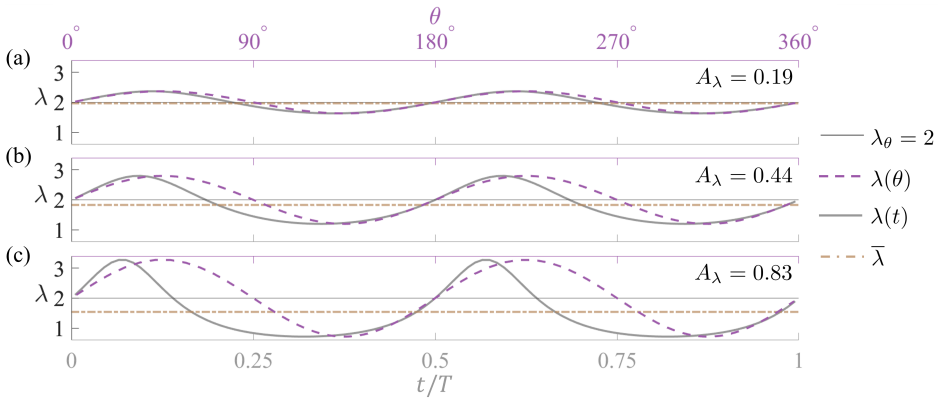
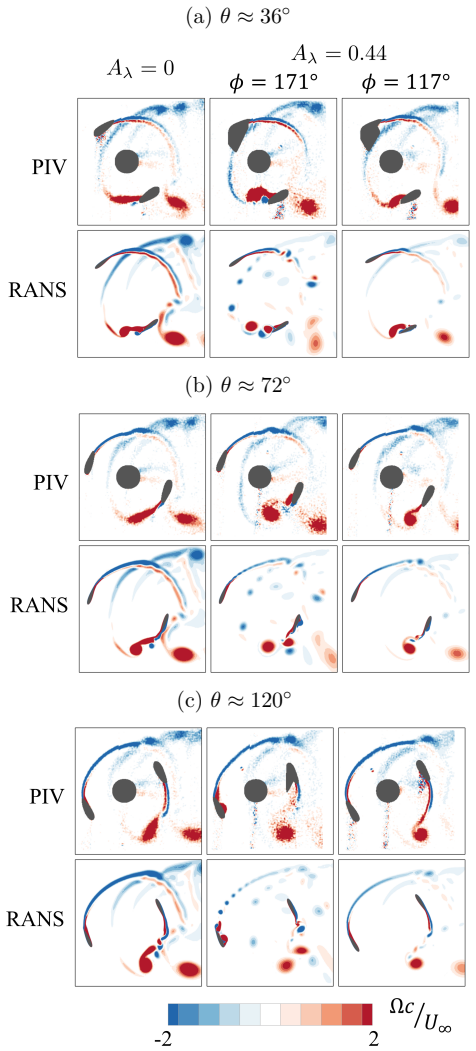
The central object is the sinusoidal intracycle angular velocity profile $\lambda(\theta)=\lambda_\theta + A_\lambda \lambda \cos N(\theta-\phi)$, with amplitude $A_\lambda$ and phase $\phi$ determining where in the blade cycle the turbine speeds up and slows down. The physical mechanism carrying the performance gain is boundary-layer reattachment: accelerating through the upstream power stroke keeps the suction-side boundary layer attached, delays the dynamic-stall vortex from shedding, and raises lift and torque. The argument also relies on the identity that time-averaged tip-speed ratio $\bar\lambda$ differs from phase-averaged $\lambda_\theta$ whenever angular velocity varies, so fair baselines must be drawn at equal $\bar\lambda$.
What would settle it
Measure the power coefficient of the same two-bladed NACA0018 turbine in a water flume at time-averaged tip-speed ratio near 1.54 with $A_\lambda=0.64$ and $\phi=117^\circ$, using the paper's own motor-control and load-cell setup; if the measured $C_P$ does not exceed the constant-speed peak of about 0.336, the claimed 12.2% improvement over peak performance is contradicted.
Extended reading notes
Core claim
The central claim is that intracycle angular velocity control, modulating $\lambda(\theta)$ sinusoidally about a mean, is most effective when the time-averaged tip-speed ratio is below the constant-speed optimum of $\lambda=2$. For a two-bladed NACA0018 turbine at chord Reynolds number 45,000, the simulation reports $C_P=0.377$ at $\lambda=1.54$ with amplitude $A_\lambda=0.64$ and phase $\phi=117^\circ$, which is 70.5% above the constant-speed baseline at $\lambda=1.54$ and 12.2% above the constant-speed peak ($C_P=0.336$ at $\lambda=2$). The paper attributes this to boundary-layer reattachment during the acceleration portion of the power stroke, delaying dynamic-stall vortex formation and shedding, while recovery-stroke losses stay comparable to constant-speed operation at the same low tip-speed ratio. At $\lambda\ge 2$, control does not improve power; the downstream, recovery-stroke blade encounters stronger vortices and loses more power, offsetting any upstream gains. The paper identifies the distinction between phase-averaged and time-averaged tip-speed ratio as the reason earlier studies appeared to show larger improvements at supposedly optimal tip-speed ratio.
Load-bearing premise
The 71% and 12.2% numbers rest on 2D RANS predicting boundary-layer reattachment and vortex-shedding timing correctly at the low-tip-speed-ratio controlled condition, a regime not directly validated by the matching experiments, and the near-wall mesh resolution changes the predicted power by 11.5% in the paper's own mesh check.
Editorial extensions
If this is right
- A variable-speed drive that pulses rotation can move the practical operating point of a cross-flow turbine below the conventional optimal tip-speed ratio and still beat that optimum's power output.
- Future comparisons of intracycle control should use time-averaged tip-speed ratio as the baseline, since phase-averaged comparisons can mistakenly attribute power changes to control dynamics when they actually stem from a shifting mean speed.
- Control effort is best spent on turbines running below their constant-speed optimum; at or above the optimum, intracycle modulation degrades performance.
- The power gains at low tip-speed ratio come with comparable increases in peak streamwise blade forces (up to 70% at the highest amplitude), so structural loading must be weighed in control design.
Reading between the lines
- If the boundary-layer-reattachment mechanism carries over to higher Reynolds numbers and three-dimensional flow, the same control could widen the usable flow-speed range for full-scale tidal and wind turbines; this extension is the authors' implicit hope but is not demonstrated here.
- A direct extension would be to optimize $A_\lambda$ and $\phi$ continuously as functions of mean tip-speed ratio rather than on the paper's discrete grid; the contour pattern in the paper suggests a smooth uphill surface near $\phi=117^\circ$ at $\bar\lambda=1.54$.
- Because the paper reports only blade-level forces, a natural next test is whether the phase shifts that maximize power also reduce torque ripple or structural vibration; the paper does not address fatigue or unsteady loading metrics.
- The time-averaged versus phase-averaged tip-speed ratio distinction implies that earlier intracycle-control studies reporting gains at 'optimal' tip-speed ratio may have been measuring partly a shift to lower effective speed; reanalyzing their data at matched time-averaged tip-speed ratio would test that interpretation.
Editorial analysis
A structured set of objections, weighed in public.
Referee Report
Summary. The paper uses 2D unsteady RANS simulations (k-ω SST) of a two-bladed NACA0018 cross-flow turbine to investigate sinusoidal intracycle angular velocity control, parameterized by amplitude Aλ and phase ϕ. It validates the model against experiments at phase-averaged λθ=2, introduces the distinction between phase-averaged and time-averaged TSR, sweeps Aλ and ϕ at time-averaged TSRs of 1.54, 2, and 2.5, and reports that at λ=1.54, Aλ=0.64, ϕ=117°, the power coefficient reaches CP=0.377, which is 70.5% above the constant-speed value at the same TSR and 12.2% above the constant-speed peak at λ=2. The proposed mechanism is boundary-layer reattachment during the acceleration part of the stroke, leading to delayed dynamic stall.
Significance. If the quantitative claims are supported, the paper would show that intracycle angular velocity control can move the turbine's effective operating point below the conventional optimal TSR while beating the constant-speed peak performance. The methodological distinction between phase-averaged and time-averaged TSR is a useful contribution, and the experimental validation against both power data and PIV at λθ=2 is a clear strength, as is the systematic parameter sweep and the public release of the Section III A data. However, the headline percentages are currently not robust to the manuscript's own reported mesh sensitivity and baseline-comparison choice, so the central quantitative conclusion is conditional on additional uncertainty quantification or reframing.
major comments (3)
- [§III C, Fig. 9, Table II] The claim that control gives '12% over the peak performance without control' compares the controlled CP=0.377 against the simulated constant-speed peak (CP=0.336), whereas the experimentally measured constant-speed peak is CP=0.360 (Table II). Measured against that experimental peak, the improvement is only 4.7%, not 12.2%. Additionally, Table I shows an 11.5% variation in CP for a closely related controlled case at λθ=2, Aλ=0.44, ϕ=117° between Mesh 1a (0.349) and Mesh 3 (0.389), with Mesh 3 matching the experimental value (0.396) much better than the selected Mesh 1a. Because the headline case at λ=1.54, Aλ=0.64, ϕ=117° is not covered by a dedicated mesh-refinement study and is not directly experimentally validated, the specific magnitudes 70.5% and 12.2% are not established beyond the paper's own error bars. The authors should either add grid-convergence or uncertainty quantification for this case, validate a controlled case with matched kinematics, or rephrase the headline claims as ranges consistent with Tables I and II.
- [§II C 2, Table I] The mesh study does not constitute a convergence study for the controlled cases: it varies the first-layer height in combination with the number of body-fitted layers and inner-mesh cell counts, and the selected Mesh 1a is chosen for agreement with the constant-speed baseline rather than for demonstrated accuracy of the controlled low-TSR flow. Since Table I shows a controlled-case CP change of 11.5% when Δy/c is reduced from 0.001 to 0.0005, and since the finer wall-layer mesh agrees better with the experimental controlled case, the choice of Mesh 1a leaves the controlled-case predictions with an unquantified bias. A dedicated resolution study for the λ=1.54, Aλ=0.64, ϕ=117° case is needed to bound the headline result.
- [§III A, Table II] The experimental validation is performed for kinematics anchored at λθ=2, not for the constant-time-averaged-TSR cases of Section III C. Table II does include a case with time-averaged λ=1.54 (Aλ=0.83, ϕ=117°), and that case is encouraging, but the Section III C constant-λ=1.54 cases have different λθ and Aλ values and are not directly compared with experiments. The paper should state this limitation explicitly and should use the available λ=1.54 experimental point to calibrate the uncertainty of the low-TSR controlled predictions, rather than presenting the simulated 70.5% and 12.2% as standalone point values.
minor comments (4)
- [§II A, Eq. 7] The symbol CP(t) is used on both sides of Eq. 7, once for the instantaneous power and once for the cycle-averaged power; please introduce a separate notation such as an overbar or angle brackets for the averaged quantity.
- [§III C, near Fig. 10] There is a duplicated word in the sentence 'the the largest differences'; please correct it.
- [Abstract and §IV] The abstract and Section III C report a 71% improvement, while Section IV reports 70.5%; these values should be made consistent.
- [Data Availability] Only the Section III A data are deposited in MHKDR; depositing the Section III C simulation data would improve reproducibility of the central low-TSR claim.
Circularity Check
No significant circularity: the 71% and 12.2% improvement figures are outputs of a swept simulation campaign compared against a self-consistent time-averaged TSR baseline and validated with independent experimental data.
full rationale
The paper's derivation chain is self-contained. The intracycle control law, power coefficient, and time-averaged TSR are explicitly defined (Eqs. 1-10), and the headline results are generated by sweeping amplitude and phase, not by fitting parameters to the target quantities. The comparison baseline is at constant time-averaged TSR, which the paper motivates precisely to separate mean-TSR shifts from intracycle dynamics; this is a controlled comparison, not a definitional identity. Simulations are validated against external experimental data in Table II at lambda_theta = 2, including constant-speed and controlled cases, and the same-group citations (Athair et al. 2023; Dave and Franck 2021) provide independent experimental and computational benchmarks rather than importing the target result. Mesh selection based on matching constant-speed power is a standard validation choice; the 11.5% mesh sensitivity and 7% baseline under-prediction indicate numerical uncertainty that could weaken the quantitative claim, but they do not make the claim circular.
Assumptions & free parameters
free parameters (1)
- Near-wall first-layer mesh height (Δy/c) =
0.001 (Mesh 1a)
assumptions (5)
- domain assumption The k-ω SST RANS closure accurately represents the relevant dynamic stall, reattachment, and blade-wake interaction physics at Rec=45,000.
- domain assumption Two-dimensional spanwise uniformity is assumed despite the experimental turbine aspect ratio of 1.36.
- domain assumption Blockage effects at 10.6% (simulation) and 9.4% (experiment) are negligible and need no correction.
- ad hoc to paper The sinusoidal phase-based control law (Eq. 8) spans the practically relevant control space.
- domain assumption Time-averaged TSR (Eq. 9) is the appropriate baseline for fair comparison rather than phase-averaged TSR.
Cite this review
Pith. "Pith review of Dynamics of intracycle angular velocity control applied to cross-flow turbines." pith.science (2026). https://pith.science/paper/I7BZ5IV6
@misc{pith2026250514651,
  author       = {Pith},
  title        = {Pith review of: Dynamics of intracycle angular velocity control applied to cross-flow turbines},
  year         = {2026},
  howpublished = {\url{https://pith.science/paper/I7BZ5IV6}},
  note         = {Machine review of arXiv:2505.14651}
}
abstract
Understanding the intricate dynamics of cross-flow turbines (CFT) is critical to the improvement of performance and optimal control strategies. The current study numerically investigates intracycle control by modulating the angular velocity as a function of blade position for a 2-bladed NACA0018 turbine at a lab-scale chord-based Reynolds number of 45,000. Previous work has implemented intracycle control in attempts to improve turbine efficiency at the best performing tip-speed ratio (TSR). However, intracycle modulation of angular velocity simultaneously changes the time-averaged TSR, making it difficult to understand if the effects on performance are due to changes in mean TSR or imposed by the intracycle dynamics. Thus, this work explores a wider region of TSR across which intracycle control is applied, and assesses turbine performance with respect to time-averaged TSR. The effect of intracycle amplitude and phase shift of the velocity modulation is reported in terms of power generation and blade-level forces, and time-resolved flow fields reveal mechanisms behind changes in efficiency. For the 2-bladed turbine explored, the peak performance at constant angular velocity occurs at approximately TSR = 2. Intracycle control is found to be most beneficial at TSR < 2 where power is increased up to 71% over its constant speed baseline and 12% over the peak performance without control. This is accomplished through boundary layer reattachment through the acceleration portion of the stroke. In contrast, applying control when TSR $\ge 2$ is not beneficial due to degraded performance in the downstream portion of the stroke.
Figures


Figures from the paper (12 more)



Reference graph
Works this paper leans on
-
[1]
author author A. Rezaeiha , author H. Montazeri , \ and\ author B. Blocken ,\ title title Towards optimal aerodynamic design of vertical axis wind turbines: Impact of solidity and number of blades , \ 10.1016/j.energy.2018.09.192 journal journal Energy \ volume 165 ,\ pages 1129--1148 ( year 2018 ) NoStop
-
[2]
author author L. Duarte , author N. Maguin , author G. Dellinger , author N. Dellinger , \ and\ author J. Vazquez ,\ title title Numerical investigation of a two-bladed vertical-axis turbine operating in a confined channel , \ 10.1016/j.ecmx.2022.100298 journal journal Energy Conversion and Management: X \ volume 16 ,\ pages 100298 ( year 2022 ) NoStop
-
[3]
author author R. Kumar \ and\ author S. Sarkar ,\ title title Effect of design parameters on the performance of helical Darrieus hydrokinetic turbines , \ 10.1016/j.rser.2022.112431 journal journal Renewable and Sustainable Energy Reviews \ volume 162 ,\ pages 112431 ( year 2022 ) NoStop
-
[4]
author author D. B. \ Araya , author T. Colonius , \ and\ author J. O. \ Dabiri ,\ title title Transition to bluff-body dynamics in the wake of vertical-axis wind turbines , \ 10.1017/jfm.2016.862 journal journal Journal of Fluid Mechanics \ volume 813 ,\ pages 346--381 ( year 2017 ) NoStop
-
[5]
author author A. Hunt , author B. Strom , author G. Talpey , author H. Ross , author I. Scherl , author S. Brunton , author M. Wosnik , \ and\ author B. Polagye ,\ title title An experimental evaluation of the interplay between geometry and scale on cross-flow turbine performance , \ 10.1016/j.rser.2024.114848 journal journal Renewable and Sustainable Ene...
-
[6]
author author A. Snortland , author B. Polagye , \ and\ author O. Williams ,\ title title Influence of near-blade hydrodynamics on cross-flow turbine performance , \ @noop journal journal Proceedings of the European Wave and Tidal Energy Conference \ volume 13 ( year 2019 ) NoStop
work page 2019
-
[7]
author author M. Dave \ and\ author J. A. \ Franck ,\ title title Analysis of dynamic stall development on a cross-flow turbine blade , \ 10.1103/PhysRevFluids.8.074702 journal journal Physical Review Fluids \ volume 8 ,\ pages 074702 ( year 2023 ) NoStop
-
[8]
author author S. Le Fouest \ and\ author K. Mulleners ,\ title title The dynamic stall dilemma for vertical-axis wind turbines , \ 10.1016/j.renene.2022.07.071 journal journal Renewable Energy \ volume 198 ,\ pages 505--520 ( year 2022 ) NoStop
Show all 30 references
-
[9]
Allet , author M
author author A. Allet , author M. Brahimi , \ and\ author I. Paraschivoiu ,\ title title On the Aerodynamic modeling of a VAWT , \ https://www.jstor.org/stable/43749657 journal journal Wind Engineering \ volume 21 ,\ pages 351--365 ( year 1997 ) NoStop
1997
-
[10]
Mandal \ and\ author J
author author A. Mandal \ and\ author J. Burton ,\ title title The Effects of Dynamic Stall and Flow Curvature on the Aerodynamics of Darrieus Turbines Applying the Cascade Model , \ https://www.jstor.org/stable/43749553 journal journal Wind Engineering \ volume 18 ,\ pages 26...
1994
-
[11]
Simão Ferreira , author G
author author C. Simão Ferreira , author G. van Kuik , author G. van Bussel , \ and\ author F. Scarano ,\ title title Visualization by PIV of dynamic stall on a vertical axis wind turbine , \ 10.1007/s00348-008-0543-z journal journal Experiments in Fluids \ volume 46 ,\ pages ...
-
[12]
Amet , author T
author author E. Amet , author T. Maître , author C. Pellone , \ and\ author J.-L. \ Achard ,\ title title 2D Numerical simulations of blade-vortex interaction in a darrieus turbine , \ 10.1115/1.4000258 journal journal Journal of Fluids Engineering \ volume 131 ,\ pages 11110...
-
[13]
author author K. K. Y. \ Tsang , author R. M. C. \ So , author R. C. K. \ Leung , \ and\ author X. Q. \ Wang ,\ title title Dynamic stall behavior from unsteady force measurements , \ 10.1016/j.jfluidstructs.2007.06.007 journal journal Journal of Fluids and Structures \ volume...
2007 doi
-
[14]
Zhao , author D
author author Z. Zhao , author D. Wang , author T. Wang , author W. Shen , author H. Liu , \ and\ author M. Chen ,\ title title A review: Approaches for aerodynamic performance improvement of lift-type vertical axis wind turbine , \ 10.1016/j.seta.2021.101789 journal journal S...
-
[15]
Choudhry , author M
author author A. Choudhry , author M. Arjomandi , \ and\ author R. Kelso ,\ title title Methods to control dynamic stall for wind turbine applications , \ 10.1016/j.renene.2015.07.097 journal journal Renewable Energy \ volume 86 ,\ pages 26--37 ( year 2016 ) NoStop
2015 doi
-
[16]
author author B. K. \ Kirke ,\ title title Tests on ducted and bare helical and straight blade Darrieus hydrokinetic turbines , \ 10.1016/j.renene.2011.03.036 journal journal Renewable Energy \ volume 36 ,\ pages 3013--3022 ( year 2011 ) NoStop
2011 doi
-
[17]
Paraschivoiu , author O
author author I. Paraschivoiu , author O. Trifu , \ and\ author F. Saeed ,\ title title H- Darrieus Wind Turbine with Blade Pitch Control , \ 10.1155/2009/505343 journal journal International Journal of Rotating Machinery \ volume 2009 ,\ pages 505343 ( year 2009 ) NoStop
2009 doi
-
[18]
Schönborn \ and\ author M
author author A. Schönborn \ and\ author M. Chantzidakis ,\ title title Development of a hydraulic control mechanism for cyclic pitch marine current turbines , \ 10.1016/j.renene.2006.02.004 journal journal Renewable Energy \ volume 32 ,\ pages 662--679 ( year 2007 ) NoStop
2006 doi
-
[19]
author author T. A. \ Gauthier ,\ title Evaluation of pitch control techniques for a cross-flow water turbine ,\ https://scholarworks.montana.edu/handle/1/14070 Ph.D. thesis ,\ school Montana State University - Bozeman, College of Engineering ( year 2017 ) NoStop
2017
-
[20]
Zhang , author M
author author Q. Zhang , author M. Bashir , author W. Miao , author Q. Liu , author C. Li , author M. Yue , \ and\ author P. Wang ,\ title title Aerodynamic analysis of a novel pitch control strategy and parameter combination for vertical axis wind turbines , \ 10.1016/j.renen...
-
[21]
Le Fouest \ and\ author K
author author S. Le Fouest \ and\ author K. Mulleners ,\ title title Optimal blade pitch control for enhanced vertical-axis wind turbine performance , \ 10.1038/s41467-024-46988-0 journal journal Nature Communications \ volume 15 ,\ pages 2770 ( year 2024 ) NoStop
-
[22]
Strom , author S
author author B. Strom , author S. L. \ Brunton , \ and\ author B. Polagye ,\ title title Intracycle angular velocity control of cross-flow turbines , \ 10.1038/nenergy.2017.103 journal journal Nature Energy \ volume 2 ,\ pages 17103 ( year 2017 ) NoStop
2017 doi
-
[23]
Dave , author B
author author M. Dave , author B. Strom , author A. Snortland , author O. Williams , author B. Polagye , \ and\ author J. A. \ Franck ,\ title title Simulations of Intracycle Angular Velocity Control for a Crossflow Turbine , \ 10.2514/1.J059797 journal journal AIAA Journal \ ...
-
[24]
Athair , author A
author author A. Athair , author A. Snortland , author I. Scherl , author B. Polagye , \ and\ author O. Williams ,\ title title Intracycle control sensitivity of cross-flow turbines , \ https://submissions.ewtec.org/proc-ewtec/article/view/400 journal journal Proceedings of th...
2023
-
[25]
Kinsey \ and\ author G
author author T. Kinsey \ and\ author G. Dumas ,\ title title Impact of channel blockage on the performance of axial and cross-flow hydrokinetic turbines , \ 10.1016/j.renene.2016.11.021 journal journal Renewable Energy \ volume 103 ,\ pages 239--254 ( year 2017 ) NoStop
2016 doi
-
[26]
\ Buchner , author M
author author A.-J. \ Buchner , author M. W. \ Lohry , author L. Martinelli , author J. Soria , \ and\ author A. J. \ Smits ,\ title title Dynamic stall in vertical axis wind turbines: Comparing experiments and computations , \ 10.1016/j.jweia.2015.09.001 journal journal Journ...
-
[27]
Balduzzi , author A
author author F. Balduzzi , author A. Bianchini , author R. Maleci , author G. Ferrara , \ and\ author L. Ferrari ,\ title title Critical issues in the CFD simulation of Darrieus wind turbines , \ 10.1016/j.renene.2015.06.048 journal journal Renewable Energy \ volume 85 ,\ pag...
2015 doi
-
[28]
Dave \ and\ author J
author author M. Dave \ and\ author J. A. \ Franck ,\ title title Comparison of RANS and LES for a cross-flow turbine in confined and unconfined flow , \ 10.1063/5.0066392 journal journal Journal of Renewable and Sustainable Energy \ volume 13 ,\ pages 064503 ( year 2021 ) NoStop
-
[29]
Strom , author N
author author B. Strom , author N. Johnson , \ and\ author B. Polagye ,\ title title Impact of blade mounting structures on cross-flow turbine performance , \ 10.1063/1.5025322 journal journal Journal of Renewable and Sustainable Energy \ volume 10 ,\ pages 034504 ( year 2018 ) NoStop
-
[30]
Snortland , author A
author author A. Snortland , author A. Hunt , author O. Williams , \ and\ author B. Polagye ,\ title title Influence of the downstream blade sweep on cross-flow turbine performance , \ 10.1063/5.0230563 journal journal Journal of Renewable and Sustainable Energy \ volume 17 ,\...
Reviewed August 7, 2026 · model on record in the stance chip above.
Discussion (0). Continue with ORCID to comment.