REVIEW 3 major objections 7 minor 1 cited by
Optimising the analysis of emission lines in galaxies: the case of the MUSE TIMER galaxy NGC 613
T0 review · 3 major / 7 minor · reviewed 2026-08-07 · deepseek-v4-flash
Pith's one-line read A study of the barred galaxy NGC 613 finds gas streaming inward along the bar's dust lanes and a biconical ionised outflow aligned with the radio jet, with a mass outflow rate near 0.04 solar masses per year.
desk verdict A careful, honest case study with a reusable IFU fitting pipeline: the outflow detection is solid, the inflow claim is plausible but needs a stronger test against non-circular bar orbits. read the letter →
The pith
A machine-rendered reading of the paper's core claim, the machinery that carries it, and where it could break.
The reading
What carries the argument
The load-bearing object is a multi-component Gaussian emission-line model: lines are split into low- and high-ionisation groups, each fitted with up to three Gaussian components whose number is chosen by the Akaike Information Criterion, a model-selection rule that penalises extra free parameters. The fitting uses differential-evolution global optimisation on spatially binned spectra to escape local minima, then refines the solution pixel by pixel with an outlier-filtered radial-basis-function interpolation providing initial guesses. To turn kinematics into astrophysics, the authors subtract a Kinemetry circular-disc model from the gas velocity and overlay the residuals on HST dust-lane contours and VLA radio contours; those residual maps are the evidence for inflow and outflow.
What would settle it
Take the observed stellar mass distribution of NGC 613, including the bar, box/peanut, and nuclear disc, and run a hydrodynamical simulation with no net inflow; if it reproduces the same residual velocity pattern along the dust lanes, the inflow claim is falsified. A cheaper test is to recompute the residual map with the inclination and position angle varied within their published uncertainties and check whether the dust-lane inflow signature survives.
Extended reading notes
Core claim
The central claim, stated on the paper's own terms, is that the residual velocity field of the ionised gas—after subtracting a best-fitting circular-rotation model built from the stellar kinematics with Kinemetry—shows non-circular motions along both HST-traced bar dust lanes that are directed toward the galaxy centre. The same analysis, applied to a second, broader low-ionisation component and to the high-ionisation [O III] lines, reveals a biconical (two-sided cone) outflow whose blueshifted and redshifted sides bracket the nucleus and align with the VLA radio jet. From the [O III] luminosity, a mean electron density of about $112\,\mathrm{cm}^{-3}$, and the O3N2 oxygen-abundance indicator, the authors derive an ionised outflow mass of $\log_{10} M_{\rm ion}=4.97\,M_\odot$, a bulk timescale of about $2.1\,\mathrm{Myr}$, a mass outflow rate of about $0.04\,M_\odot\,\mathrm{yr}^{-1}$, and a kinetic energy rate of $2.4\times 10^{40}\,\mathrm{erg\,s^{-1}}$, corresponding to about $1.5\%$ of the AGN bolometric luminosity.
Load-bearing premise
The inflow interpretation rests on the assumption that a single rotating stellar disc tilted at $39^\circ$ with one adopted position angle fully accounts for the galaxy's gravitational circular motion, so the leftover gas velocities must be real inward streaming rather than artefacts of the bar's more complex potential or a mis-specified disc orientation.
Editorial extensions
If this is right
- Bar-driven inflow along dust lanes can deliver gas to the central kiloparsec, providing a direct observational link between bars and nuclear fuel supply.
- The biconical outflow is consistent with being AGN-powered, since its kinetic power is about $1.5\%$ of the AGN bolometric luminosity.
- Diagnostics applied to individual Gaussian components reveal ionisation that a single integrated classification would misattribute, so future integral-field studies should separate components before classifying.
- The field-normalisation and model-selection choices should make star-formation history and gas kinematics recovery more reliable in other nearby galaxies with complex centres.
- The measured outflow is small but operates on a roughly $2\,\mathrm{Myr}$ timescale, matching a short feedback episode that can affect the central gas reservoir.
Reading between the lines
- Beyond the paper: applying the same residual-velocity method to a sample of barred versus unbarred galaxies would test whether inflow strength scales with bar strength, which a single object cannot establish.
- Beyond the paper: the apparent low metallicity of the outflow gas could be checked with temperature-sensitive auroral lines; if it survives, it would mean the outflow ejects comparatively metal-poor gas rather than processed nuclear gas.
- Beyond the paper: the quoted $0.04\,M_\odot\,\mathrm{yr}^{-1}$ counts only ionised gas, so including molecular and neutral phases would probably raise the true mass-loss rate and could change the feedback-efficiency estimate.
- Beyond the paper: a second-epoch observation of the same field could test whether the biconical outflow geometry is steady or flickering on megayear timescales.
Editorial analysis
A structured set of objections, weighed in public.
Referee Report
Summary. This paper presents a detailed analysis pipeline for MUSE TIMER data of the barred galaxy NGC 613, combining full-spectrum stellar fitting with multi-component Gaussian fitting of emission lines, AIC-based model selection, and spatially resolved diagnostics of extinction, ionisation, metallicity, kinematics, and outflows. The two central astrophysical claims are (i) that residual gas velocities relative to a single-disc circular model trace bar-driven inflows along the dust lanes, and (ii) that a biconical [O III] outflow aligned with the VLA radio jet is powered by the AGN, with an ionised outflow mass of log10 M_ion = 4.97 ± 0.01 M_sun and a mass outflow rate of about 0.04 ± 0.01 M_sun/yr. The methodology also includes a regularisation-setting test for SFH recovery and a multi-stage approach to avoid local minima in emission-line fitting. The paper is largely a case study whose central narrative is a complete gas cycle from bar inflow to nuclear feedback.
Significance. If the two claims hold, the paper provides a spatially resolved, multi-phase picture of gas inflow and AGN-driven outflow in a single nearby barred galaxy, and it strengthens the observational case for bar-driven secular feeding. The methodological contribution is also useful: the combination of global differential-evolution optimisation, outlier detection, RBF-based initialisation for spaxel-by-spaxel fitting, and AICc selection is a sensible and moderately novel recipe for multi-component emission-line work, and the scalar-field normalisation test for regularisation is a practical insight. The paper is honest about several caveats, stating that the outflow mass uncertainties are only statistical lower limits and explicitly questioning whether the low metallicity of the outflow is an artifact. However, the inflow claim depends on the residual-velocity zero point being a correct circular-disc model, and the outflow energetics rest on adopted n_e and C values; both are load-bearing assumptions that need more quantitative support before the central claims can be accepted at face value.
major comments (3)
- [Section 7.4, Fig. 14] The inflow interpretation is built on the residual map V_L1_gas - V_circ, where V_circ is a Kinemetry model of a single inclined rotating disc with inclination and PA adopted from Buta et al. (2015) and fitted to the stellar velocity field. NGC 613 is strongly barred, has a box/peanut structure and a nuclear disc/ring, and the paper itself notes the nuclear disc and bar-related kinematic features. In such a potential, stellar and gas orbits are not circular, and Kinemetry on the stellar field can absorb part of the bar's non-circularity into a best-fit 'circular' model. The residual pattern along the dust lanes is qualitatively what inflow models produce, but the same pattern could in principle arise from x1/elliptical orbits or projection effects in a non-circular potential. The paper does not quantify how much of the residual amplitude is attributable to the bar distortion or to uncertainties in inclination and PA. Because this residual map is the primary evidence for the paper's signature inflow claim, I ask for a concrete robustness test: for example, a harmonic decomposition of the gas velocity field, a parametric non-circular flow model fitted to the gas kinematics, or at least a variation of i and PA over their published uncertainties and a statement of how the dust-lane residual pattern changes.
- [Section 7.5, Eqs. (11)-(13)] The outflow mass and mass outflow rate rest on three adopted quantities: a single average electron density n_e ≈ 112 cm^-3 derived from [S II] in the central kiloparsec, a condensation factor C = 1, and the O3N2-based oxygen abundance. The quoted uncertainty of ±0.01 dex in log10 M_ion is only the statistical propagation and is explicitly acknowledged in the text as a lower limit. However, the paper then presents M_ion ≈ 1e5 M_sun and Mdot_ion ≈ 0.04 M_sun/yr as central values without a systematic error budget. Since [S II] ratios in the field can range from saturation-limited regimes (n_e between roughly 50 and 2000 cm^-3) and C is typically between 0.1 and 1 in ionised outflows, the systematic uncertainty in M_ion is at least an order of magnitude. I request that the authors provide a propagated systematic range for M_ion, Mdot_ion, and E_dot_out, and explicitly state which values of n_e and C would be needed to change the conclusion that the AGN can power the outflow.
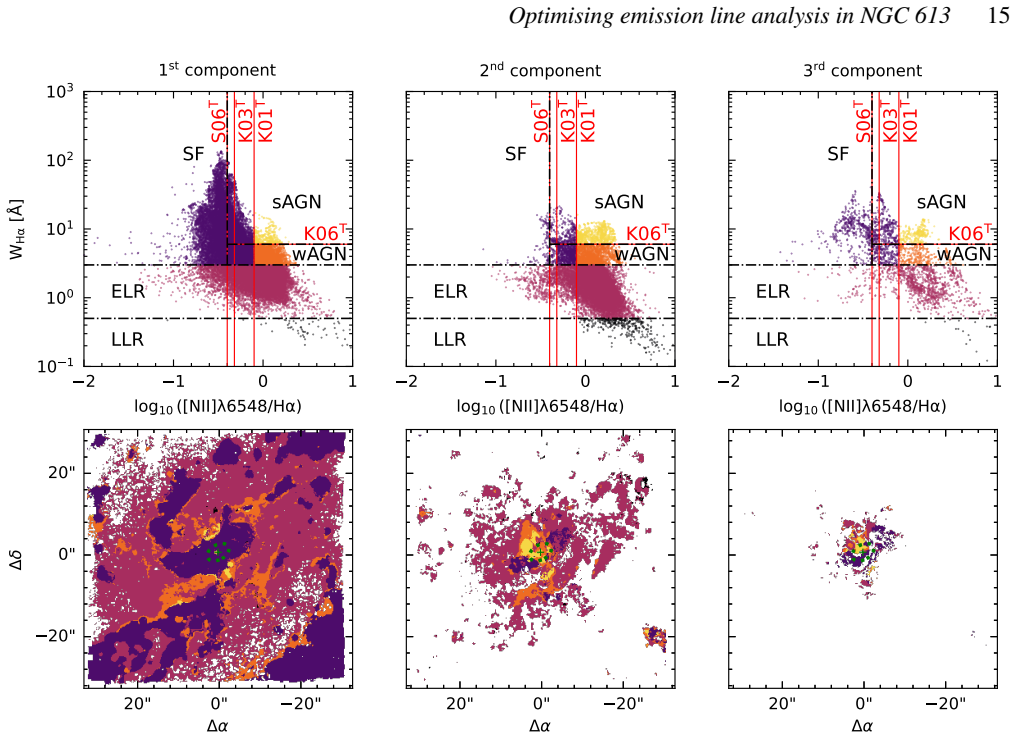
- [Section 7.3 and 7.5] The metallicity used in Eq. (11) comes from O3N2, and the paper itself notes in Section 7.3 that the apparent metal-poor outflow seen with O3N2 may be an artifact of ionisation-parameter sensitivity; the alternative calibrations shown in Fig. 12 give different abundances in the outflow region, and for some indexes the outflow is outside the calibration range. Since the outflow mass scales as 10^-[O/H], this systematic uncertainty propagates directly into the mass and rate quoted in the abstract. I ask the authors to either recompute the outflow properties using the metallicity range allowed by the various calibrators, or to state clearly which calibrator was used and why, and how the outflow mass would change under the alternative estimates.
minor comments (7)
- [Section 4.2] The word 'dissussed' should be 'discussed' in the sentence describing scalar vs field normalisation.
- [Section 4.4.4 and Fig. 2] The caption and text use 'scalar field normalisation' for what is elsewhere called 'field normalisation'; please make the terminology consistent (e.g., 'field-mode normalisation').
- [Section 5.2] The text contains the typo 'soucers' for 'sources' in the discussion of ionisation sources.
- [Figure 11 caption] The caption lists 'emission line-less retired and line-less retired (ELR and ELR, respectively)'; the second should be 'LLR'.
- [Section 7.5] The word 'redsifhted' should be 'redshifted' in the description of the counter-outflow.
- [Section 5.2/Summary item (ii)] The claim that the multi-component approach is 'tested to be robust against local minima' is not supported by an explicit quantitative test in the text; the outlier-detection procedure is described, but no comparison of recovered chi-squared or parameters against known injected solutions is shown. Please either add such a test or soften the claim.
- [Data availability] The data availability statement points to the ESO archive but no link or version is given for the custom fitting pipeline; for a methodology paper, providing a code repository or a clear statement of availability would improve reproducibility.
Circularity Check
No significant circularity: the inflow/outflow claims rest on independent kinematic and flux measurements with external calibrations.
full rationale
The central claims do not reduce to their own inputs. The outflow mass and rate are computed from the measured [O III] luminosity, the [S II]-derived electron density (n_e ≈ 112 cm^-3, adopted as an average over the central kiloparsec), and the O3N2 oxygen abundance, via Eq. 11 attributed to Carniani et al. (2015); none of these quantities is defined in terms of the outflow conclusion. The bulk velocity, radius, timescale, and mass outflow rate are derived from the gas velocity relative to the stellar velocity, using the definitions in Smethurst et al. (2019, 2021), again external to the paper. The ionization classification uses the BPT and WHAN diagrams with demarcation lines from Kewley et al. (2001), Kauffmann et al. (2003), Schawinski et al. (2007), Cid Fernandes et al. (2011), and Herpich et al. (2016); the paper does not set these boundaries itself. The inflow interpretation is based on the residual map V_L1_gas − V_circ, where V_circ is a Kinemetry model of a circularly rotating disc built from the stellar kinematics, with inclination and position angle adopted from Buta et al. (2015). The residual map is presented as evidence that requires interpretation, not as a quantity fitted to the inflow conclusion; it could be affected by bar streaming or projection effects, but that is a correctness risk, not circularity. Self-citations to TIMER survey papers and to Kolcu et al. (2023) provide the data and the methodological workflow, but the galaxy-specific inflow and outflow claims are not established by those citations; they depend on the MUSE measurements and external calibrations presented in the paper. The regularisation parameter for the star formation history is set by the chi-square criterion of Press et al. (2007), not by requiring a desired SFH shape, so the SFH recovery is not fitted to its own conclusion. No step in the derivation chain is equivalent by construction to its own input, and no uniqueness theorem or ansatz is smuggled in through self-citation.
Assumptions & free parameters
free parameters (5)
- Regularisation parameter Δ =
0.05
- Adopted electron density n_e =
112 cm^-3
- Condensation factor C =
1
- Intrinsic Balmer decrement =
Hα/Hβ = 2.863
- AIC detection thresholds =
1σ for low-ionisation lines, 3σ for [O III], plus additional 3σ for line ratios
assumptions (6)
- domain assumption MUSE LSF can be modelled as a polynomial (Bacon et al. 2017 Eq. 8) and templates degraded accordingly.
- domain assumption pPXF fitting with additive/multiplicative Legendre polynomials recovers unbiased LOSVD and SSP weights.
- domain assumption Case B recombination gives a homogeneous intrinsic Hα/Hβ = 2.863 over the field.
- domain assumption The outflow mass formula (Eq. 11 of Carniani et al. 2015) applies with condensation factor C = 1.
- domain assumption A single rotating disc model (Kinemetry) with the literature inclination and PA describes the circular stellar motion.
- domain assumption MILES SSP library with BaSTI isochrones and Kroupa IMF covers the stellar populations present.
Cite this review
Pith. "Pith review of Optimising the analysis of emission lines in galaxies: the case of the MUSE TIMER galaxy NGC 613." pith.science (2026). https://pith.science/paper/R5X36ALM
@misc{pith2026250514781,
  author       = {Pith},
  title        = {Pith review of: Optimising the analysis of emission lines in galaxies: the case of the MUSE TIMER galaxy NGC 613},
  year         = {2026},
  howpublished = {\url{https://pith.science/paper/R5X36ALM}},
  note         = {Machine review of arXiv:2505.14781}
}
read the original abstract
Galaxy evolution is driven by spatially distributed processes with varying timescales. Integral field spectroscopy provides spatially-resolved information about these processes. Nevertheless, disentangling these processes, which are related to both the underlying stellar populations and the interstellar medium can be challenging. We present a case study on NGC~613, observed with MUSE (Multi-Unit Spectroscopic Explorer) for the TIMER (Time Inference with MUSE in Extragalactic Rings) project, a local barred galaxy, which shows several gas ionisation mechanisms and is rich in both large and inner-scale stellar structures. We develop a set of steps to overcome fundamental problems in the modelling of emission lines with multiple components, together with the characterisation of the stellar populations. That results in the disentanglement of the gas ionisation mechanisms and kinematics, along with an optimal parametrisation for star formation history recovery. Our analysis reveals evidence of gas inflows, which are associated with the bar dust lanes traced with \textit{Hubble} Space Telescope (HST). In addition, we show the gas kinematics in a central biconical outflow, which is aligned with a radio jet observed with Very Large Array (VLA). The emission line provides estimates of electron density, gas-phase metallicity, and the mass outflow rate, allowing us to distinguish intertwined ionisation mechanisms and to identify a part of the multiphase gas cycle in NGC 613. It traces the gas kinematics from the bar lanes to inner scale gas reservoirs, where it can eventually trigger star formation or AGN activity, as observed in the outflow.
Figures


Figures from the paper (12 more)




Forward citations
Cited by 1 Pith paper
-
Ionized gas in NGC 4258: Exploring the AGN -- Star formation connection
Wide-field optical spectroscopy of NGC 4258 reveals jet-driven gas excitation along the anomalous spiral arms out to 6 kpc and a galaxy-wide star formation rate near 3 solar masses per year.
Reference graph
Works this paper leans on
-
[1]
write newline
" write newline "" before.all 'output.state := FUNCTION fin.entry write newline FUNCTION new.block output.state before.all = 'skip after.block 'output.state := if FUNCTION new.sentence output.state after.block = 'skip output.state before.all = 'skip after.sentence 'output.state := if if FUNCTION not #0 #1 if FUNCTION and 'skip pop #0 if FUNCTION or pop #1...
-
[2]
Akaike H., 1974, @doi [IEEE Transactions on Automatic Control] 10.1109/TAC.1974.1100705 , 19, 716
arXiv 1974
-
[3]
Alloin D., Collin-Souffrin S., Joly M., Vigroux L., 1979, , https://ui.adsabs.harvard.edu/abs/1979A&A....78..200A 78, 200
1979
-
[4]
Alonso M. S., Coldwell G., Lambas D. G., 2013, @doi [ ] 10.1051/0004-6361/201220117 , https://ui.adsabs.harvard.edu/abs/2013A&A...549A.141A 549, A141
-
[5]
Alonso S., Coldwell G., Lambas D. G., 2014, @doi [ ] 10.1051/0004-6361/201424523 , https://ui.adsabs.harvard.edu/abs/2014A&A...572A..86A 572, A86
-
[6]
Alonso S., Coldwell G., Duplancic F., Mesa V., Lambas D. G., 2018, @doi [ ] 10.1051/0004-6361/201832796 , https://ui.adsabs.harvard.edu/abs/2018A&A...618A.149A 618, A149
-
[7]
Alonso S., Vera-Rueda M., Coldwell G., Duplancic F., Mesa V., 2024, @doi [ ] 10.1051/0004-6361/202451533 , https://ui.adsabs.harvard.edu/abs/2024A&A...690A.273A 690, A273
-
[8]
Athanassoula E., 1992, @doi [ ] 10.1093/mnras/259.2.345 , https://ui.adsabs.harvard.edu/abs/1992MNRAS.259..345A 259, 345
Show all 178 references
-
[9]
418, Galactic Bulges
Athanassoula E., 2016, in Laurikainen E., Peletier R., Gadotti D., eds, Astrophysics and Space Science Library Vol. 418, Galactic Bulges. p. 391 ( @eprint arXiv 1503.04804 ), @doi 10.1007/978-3-319-19378-6_14
2016 arXiv
-
[10]
Athanassoula E., Laurikainen E., Salo H., Bosma A., 2015, @doi [ ] 10.1093/mnras/stv2231 , https://ui.adsabs.harvard.edu/abs/2015MNRAS.454.3843A 454, 3843
2015 doi
-
[11]
Audibert A., et al., 2019, @doi [ ] 10.1051/0004-6361/201935845 , https://ui.adsabs.harvard.edu/abs/2019A&A...632A..33A 632, A33
2019 doi
-
[12]
S., Ramsay S
Bacon R., et al., 2010, in McLean I. S., Ramsay S. K., Takami H., eds, Society of Photo-Optical Instrumentation Engineers (SPIE) Conference Series Vol. 7735, Ground-based and Airborne Instrumentation for Astronomy III. p. 773508 ( @eprint arXiv 2211.16795 ), @doi 10.1117/12.856027
2010 arXiv
-
[13]
Bacon R., et al., 2017, @doi [ ] 10.1051/0004-6361/201730833 , https://ui.adsabs.harvard.edu/abs/2017A&A...608A...1B 608, A1
2017 doi
-
[14]
A., Phillips M
Baldwin J. A., Phillips M. M., Terlevich R., 1981, @doi [ ] 10.1086/130766 , https://ui.adsabs.harvard.edu/abs/1981PASP...93....5B 93, 5
1981 doi
-
[15]
Belfiore F., et al., 2019, @doi [ ] 10.3847/1538-3881/ab3e4e , https://ui.adsabs.harvard.edu/abs/2019AJ....158..160B 158, 160
2019 doi
-
[16]
H., 2007, @doi [ ] 10.1086/520531 , https://ui.adsabs.harvard.edu/abs/2007ApJ...666..189B 666, 189
Berentzen I., Shlosman I., Martinez-Valpuesta I., Heller C. H., 2007, @doi [ ] 10.1086/520531 , https://ui.adsabs.harvard.edu/abs/2007ApJ...666..189B 666, 189
2007 doi
-
[17]
Bianchin M., et al., 2022, @doi [ ] 10.1093/mnras/stab3468 , https://ui.adsabs.harvard.edu/abs/2022MNRAS.510..639B 510, 639
2022 doi
-
[18]
Bidaran B., et al., 2020, @doi [ ] 10.1093/mnras/staa2097 , https://ui.adsabs.harvard.edu/abs/2020MNRAS.497.1904B 497, 1904
2020 doi
-
[19]
G., Stasi \'n ska G., Bruzual A
Binette L., Magris C. G., Stasi \'n ska G., Bruzual A. G., 1994, , https://ui.adsabs.harvard.edu/abs/1994A&A...292...13B 292, 13
1994
-
[20]
Bittner A., et al., 2019, @doi [ ] 10.1051/0004-6361/201935829 , https://ui.adsabs.harvard.edu/abs/2019A&A...628A.117B 628, A117
2019 doi
-
[21]
Bittner A., et al., 2020, @doi [ ] 10.1051/0004-6361/202038450 , https://ui.adsabs.harvard.edu/abs/2020A&A...643A..65B 643, A65
2020 doi
-
[22]
Bittner A., et al., 2021, @doi [ ] 10.1051/0004-6361/202039505 , https://ui.adsabs.harvard.edu/abs/2021A&A...646A..42B 646, A42
2021 doi
-
[23]
H., Ryder S., 2008, @doi [ ] 10.1088/0004-6256/135/2/479 , https://ui.adsabs.harvard.edu/abs/2008AJ....135..479B 135, 479
B \"o ker T., Falc \'o n-Barroso J., Schinnerer E., Knapen J. H., Ryder S., 2008, @doi [ ] 10.1088/0004-6256/135/2/479 , https://ui.adsabs.harvard.edu/abs/2008AJ....135..479B 135, 479
2008 doi
-
[24]
A., Wilson A
Braatz J. A., Wilson A. S., Henkel C., 1996, @doi [ ] 10.1086/192328 , https://ui.adsabs.harvard.edu/abs/1996ApJS..106...51B 106, 51
1996 doi
-
[25]
P., Anderson D
Burnham K. P., Anderson D. R., eds, 2004, Model Selection and Multimodel Inference . Springer, New York, NY, @doi 10.1007/b97636 , http://link.springer.com/10.1007/b97636
2004 doi
-
[26]
J., et al., 2015, @doi [ ] 10.1088/0067-0049/217/2/32 , https://ui.adsabs.harvard.edu/abs/2015ApJS..217...32B 217, 32
Buta R. J., et al., 2015, @doi [ ] 10.1088/0067-0049/217/2/32 , https://ui.adsabs.harvard.edu/abs/2015ApJS..217...32B 217, 32
2015 doi
-
[27]
C., Kinney A
Calzetti D., Armus L., Bohlin R. C., Kinney A. L., Koornneef J., Storchi-Bergmann T., 2000, @doi [ ] 10.1086/308692 , https://ui.adsabs.harvard.edu/abs/2000ApJ...533..682C 533, 682
2000 doi
-
[28]
Cano-D \' az M., Maiolino R., Marconi A., Netzer H., Shemmer O., Cresci G., 2012, @doi [ ] 10.1051/0004-6361/201118358 , https://ui.adsabs.harvard.edu/abs/2012A&A...537L...8C 537, L8
2012 doi
-
[29]
Cappellari M., 2017, @doi [ ] 10.1093/mnras/stw3020 , https://ui.adsabs.harvard.edu/abs/2017MNRAS.466..798C 466, 798
2017 doi
-
[30]
Cappellari M., 2023, @doi [ ] 10.1093/mnras/stad2597 , https://ui.adsabs.harvard.edu/abs/2023MNRAS.526.3273C 526, 3273
2023 doi
-
[31]
Cappellari M., Copin Y., 2003, @doi [ ] 10.1046/j.1365-8711.2003.06541.x , https://ui.adsabs.harvard.edu/abs/2003MNRAS.342..345C 342, 345
2003
-
[32]
Cappellari M., Emsellem E., 2004, @doi [ ] 10.1086/381875 , https://ui.adsabs.harvard.edu/abs/2004PASP..116..138C 116, 138
2004 doi
-
[34]
A., Clayton G
Cardelli J. A., Clayton G. C., Mathis J. S., 1989, @doi [ ] 10.1086/167900 , https://ui.adsabs.harvard.edu/abs/1989ApJ...345..245C 345, 245
1989 doi
-
[35]
Carniani S., et al., 2015, @doi [ ] 10.1051/0004-6361/201526557 , https://ui.adsabs.harvard.edu/abs/2015A&A...580A.102C 580, A102
2015 doi
-
[36]
F., Blanc G., Weinzirl T., Song M., Luo R., 2020, @doi [ ] 10.1093/mnras/staa397 , https://ui.adsabs.harvard.edu/abs/2020MNRAS.493.4094C 493, 4094
Carrillo A., Jogee S., Drory N., Kaplan K. F., Blanc G., Weinzirl T., Song M., Luo R., 2020, @doi [ ] 10.1093/mnras/staa397 , https://ui.adsabs.harvard.edu/abs/2020MNRAS.493.4094C 493, 4094
2020 doi
-
[37]
M., 2008, @doi [ ] 10.1051/0004-6361:20078316 , https://ui.adsabs.harvard.edu/abs/2008A&A...479..111C 479, 111
Castangia P., Tarchi A., Henkel C., Menten K. M., 2008, @doi [ ] 10.1051/0004-6361:20078316 , https://ui.adsabs.harvard.edu/abs/2008A&A...479..111C 479, 111
2008 doi
-
[38]
Castangia P., Panessa F., Henkel C., Kadler M., Tarchi A., 2013, @doi [ ] 10.1093/mnras/stt1824 , https://ui.adsabs.harvard.edu/abs/2013MNRAS.436.3388C 436, 3388
2013 doi
-
[39]
Centeno R., Socas-Navarro H., 2008, @doi [ ] 10.1086/590405 , https://ui.adsabs.harvard.edu/abs/2008ApJ...682L..61C 682, L61
2008 doi
-
[43]
Cisternas M., et al., 2013, @doi [ ] 10.1088/0004-637X/776/1/50 , https://ui.adsabs.harvard.edu/abs/2013ApJ...776...50C 776, 50
2013 doi
-
[44]
A., 2011, @doi [ ] 10.1088/2041-8205/743/1/L13 , https://ui.adsabs.harvard.edu/abs/2011ApJ...743L..13C 743, L13
Coelho P., Gadotti D. A., 2011, @doi [ ] 10.1088/2041-8205/743/1/L13 , https://ui.adsabs.harvard.edu/abs/2011ApJ...743L..13C 743, L13
2011 doi
-
[45]
P., Castilho B
Coelho P., Barbuy B., Mel \'e ndez J., Schiavon R. P., Castilho B. V., 2005, @doi [ ] 10.1051/0004-6361:20053511 , https://ui.adsabs.harvard.edu/abs/2005A&A...443..735C 443, 735
2005 doi
-
[47]
Combes F., et al., 2019, @doi [ ] 10.1051/0004-6361/201834560 , https://ui.adsabs.harvard.edu/abs/2019A&A...623A..79C 623, A79
2019 doi
-
[48]
M., et al., 2021, @doi [ ] 10.1093/mnras/stab229 , https://ui.adsabs.harvard.edu/abs/2021MNRAS.505..991C 505, 991
Croom S. M., et al., 2021, @doi [ ] 10.1093/mnras/stab229 , https://ui.adsabs.harvard.edu/abs/2021MNRAS.505..991C 505, 991
2021 doi
-
[49]
Curti M., Mannucci F., Cresci G., Maiolino R., 2020, @doi [ ] 10.1093/mnras/stz2910 , https://ui.adsabs.harvard.edu/abs/2020MNRAS.491..944C 491, 944
2020 doi
-
[50]
L., 2021, @doi [Computing in Science and Engineering] 10.1109/MCSE.2021.3083216 , https://ui.adsabs.harvard.edu/abs/2021CSE....23d..47D 23, 47
Dalcin L., Fang Y.-L. L., 2021, @doi [Computing in Science and Engineering] 10.1109/MCSE.2021.3083216 , https://ui.adsabs.harvard.edu/abs/2021CSE....23d..47D 23, 47
2021
-
[51]
Dalcín L., Paz R., Storti M., 2005, @doi [Journal of Parallel and Distributed Computing] 10.1016/j.jpdc.2005.03.010 , 65, 1108
2005 doi
-
[52]
Dalcín L., Paz R., Storti M., D’Elía J., 2008, @doi [Journal of Parallel and Distributed Computing] 10.1016/j.jpdc.2007.09.005 , 68, 655
2008 doi
-
[53]
D., Paz R
Dalcín L. D., Paz R. R., Kler P. A., Cosimo A., 2011, @doi [Advances in Water Resources] 10.1016/j.advwatres.2011.04.013 , 34, 1124
2011 doi
-
[54]
L., et al., 2016, @doi [ ] 10.1093/mnras/stw1754 , https://ui.adsabs.harvard.edu/abs/2016MNRAS.462.1616D 462, 1616
Davies R. L., et al., 2016, @doi [ ] 10.1093/mnras/stw1754 , https://ui.adsabs.harvard.edu/abs/2016MNRAS.462.1616D 462, 1616
2016 doi
-
[55]
L., et al., 2017, @doi [ ] 10.1093/mnras/stx1559 , https://ui.adsabs.harvard.edu/abs/2017MNRAS.470.4974D 470, 4974
Davies R. L., et al., 2017, @doi [ ] 10.1093/mnras/stx1559 , https://ui.adsabs.harvard.edu/abs/2017MNRAS.470.4974D 470, 4974
2017 doi
-
[56]
Di Matteo T., Springel V., Hernquist L., 2005, @doi [ ] 10.1038/nature03335 , https://ui.adsabs.harvard.edu/abs/2005Natur.433..604D 433, 604
2005 doi
-
[58]
Dom \' nguez A., et al., 2013, @doi [ ] 10.1088/0004-637X/763/2/145 , https://ui.adsabs.harvard.edu/abs/2013ApJ...763..145D 763, 145
2013 doi
-
[59]
A., Kewley L
Dopita M. A., Kewley L. J., Sutherland R. S., Nicholls D. C., 2016, @doi [ ] 10.1007/s10509-016-2657-8 , https://ui.adsabs.harvard.edu/abs/2016Ap&SS.361...61D 361, 61
2016 doi
-
[60]
L., Viswanathan A., Patton D
Ellison S. L., Viswanathan A., Patton D. R., Bottrell C., McConnachie A. W., Gwyn S., Cuillandre J.-C., 2019, @doi [ ] 10.1093/mnras/stz1431 , https://ui.adsabs.harvard.edu/abs/2019MNRAS.487.2491E 487, 2491
2019 doi
-
[61]
Emsellem E., et al., 2022, @doi [ ] 10.1051/0004-6361/202141727 , https://ui.adsabs.harvard.edu/abs/2022A&A...659A.191E 659, A191
2022 doi
-
[62]
Erwin P., 2004, @doi [ ] 10.1051/0004-6361:20034408 , https://ui.adsabs.harvard.edu/abs/2004A&A...415..941E 415, 941
2004 doi
-
[63]
B., et al., 2000, @doi [ ] 10.1086/301203 , https://ui.adsabs.harvard.edu/abs/2000AJ....119..536E 119, 536
Eskridge P. B., et al., 2000, @doi [ ] 10.1086/301203 , https://ui.adsabs.harvard.edu/abs/2000AJ....119..536E 119, 536
2000 doi
-
[65]
J., Gorgas J., Peletier R
Falc \'o n-Barroso J., S \'a nchez-Bl \'a zquez P., Vazdekis A., Ricciardelli E., Cardiel N., Cenarro A. J., Gorgas J., Peletier R. F., 2011, @doi [ ] 10.1051/0004-6361/201116842 , https://ui.adsabs.harvard.edu/abs/2011A&A...532A..95F 532, A95
2011 doi
-
[66]
H., Lan c on A., Ryder S., 2014, @doi [ ] 10.1093/mnras/stt2189 , https://ui.adsabs.harvard.edu/abs/2014MNRAS.438..329F 438, 329
Falc \'o n-Barroso J., Ramos Almeida C., B \"o ker T., Schinnerer E., Knapen J. H., Lan c on A., Ryder S., 2014, @doi [ ] 10.1093/mnras/stt2189 , https://ui.adsabs.harvard.edu/abs/2014MNRAS.438..329F 438, 329
2014 doi
-
[67]
N., Tombesi F., 2023, @doi [Advances in Space Research] 10.1016/j.asr.2022.11.055 , https://ui.adsabs.harvard.edu/abs/2023AdSpR..71.3499F 71, 3499
Farhan A., Ercan E. N., Tombesi F., 2023, @doi [Advances in Space Research] 10.1016/j.asr.2022.11.055 , https://ui.adsabs.harvard.edu/abs/2023AdSpR..71.3499F 71, 3499
2023 doi
-
[68]
Fiore F., et al., 2017, @doi [ ] 10.1051/0004-6361/201629478 , https://ui.adsabs.harvard.edu/abs/2017A&A...601A.143F 601, A143
2017 doi
-
[69]
Fragkoudi F., Athanassoula E., Bosma A., Iannuzzi F., 2015, @doi [ ] 10.1093/mnras/stv537 , https://ui.adsabs.harvard.edu/abs/2015MNRAS.450..229F 450, 229
2015 doi
-
[70]
Fragkoudi F., Athanassoula E., Bosma A., 2016, @doi [ ] 10.1093/mnrasl/slw120 , https://ui.adsabs.harvard.edu/abs/2016MNRAS.462L..41F 462, L41
2016 doi
- [71]
-
[72]
A., de Souza R
Gadotti D. A., de Souza R. E., 2005, @doi [ ] 10.1086/431717 , https://ui.adsabs.harvard.edu/abs/2005ApJ...629..797G 629, 797
2005 doi
-
[73]
A., et al., 2019, @doi [ ] 10.1093/mnras/sty2666 , https://ui.adsabs.harvard.edu/abs/2019MNRAS.482..506G 482, 506
Gadotti D. A., et al., 2019, @doi [ ] 10.1093/mnras/sty2666 , https://ui.adsabs.harvard.edu/abs/2019MNRAS.482..506G 482, 506
2019 doi
-
[74]
A., et al., 2020, @doi [ ] 10.1051/0004-6361/202038448 , https://ui.adsabs.harvard.edu/abs/2020A&A...643A..14G 643, A14
Gadotti D. A., et al., 2020, @doi [ ] 10.1051/0004-6361/202038448 , https://ui.adsabs.harvard.edu/abs/2020A&A...643A..14G 643, A14
2020 doi
-
[75]
A., et al., 2015, @doi [ ] 10.1093/mnras/stv235 , https://ui.adsabs.harvard.edu/abs/2015MNRAS.448.3442G 448, 3442
Galloway M. A., et al., 2015, @doi [ ] 10.1093/mnras/stv235 , https://ui.adsabs.harvard.edu/abs/2015MNRAS.448.3442G 448, 3442
2015 doi
-
[76]
L., et al., 2024, @doi [ ] 10.1093/mnras/stae1620 , https://ui.adsabs.harvard.edu/abs/2024MNRAS.532.2320G 532, 2320
Garland I. L., et al., 2024, @doi [ ] 10.1093/mnras/stae1620 , https://ui.adsabs.harvard.edu/abs/2024MNRAS.532.2320G 532, 2320
2024 doi
-
[77]
E., 1993, @doi [ ] 10.1093/mnras/265.1.213 , https://ui.adsabs.harvard.edu/abs/1993MNRAS.265..213G 265, 213
Gerhard O. E., 1993, @doi [ ] 10.1093/mnras/265.1.213 , https://ui.adsabs.harvard.edu/abs/1993MNRAS.265..213G 265, 213
1993 doi
-
[78]
Gon c alves G., Coelho P., Schiavon R., Usher C., 2020, @doi [ ] 10.1093/mnras/staa3051 , https://ui.adsabs.harvard.edu/abs/2020MNRAS.499.2327G 499, 2327
2020 doi
-
[80]
D., et al., 2017, @doi [ ] 10.3847/1538-4357/aa755b , https://ui.adsabs.harvard.edu/abs/2017ApJ...843..135G 843, 135
Goulding A. D., et al., 2017, @doi [ ] 10.3847/1538-4357/aa755b , https://ui.adsabs.harvard.edu/abs/2017ApJ...843..135G 843, 135
2017 doi
-
[81]
M., 2018, @doi [The Journal of Open Source Software] 10.21105/joss.00695 , https://ui.adsabs.harvard.edu/abs/2018JOSS....3..695G 3, 695
Green G. M., 2018, @doi [The Journal of Open Source Software] 10.21105/joss.00695 , https://ui.adsabs.harvard.edu/abs/2018JOSS....3..695G 3, 695
2018 doi
-
[82]
M., Contini T., Weilbacher P
Gu \'e rou A., Emsellem E., Krajnovi \'c D., McDermid R. M., Contini T., Weilbacher P. M., 2016, @doi [ ] 10.1051/0004-6361/201628743 , https://ui.adsabs.harvard.edu/abs/2016A&A...591A.143G 591, A143
2016 doi
-
[83]
Guo Y., et al., 2023, @doi [ ] 10.3847/2041-8213/acacfb , https://ui.adsabs.harvard.edu/abs/2023ApJ...945L..10G 945, L10
2023 doi
- [84]
-
[85]
R., et al., 2020, @doi [ ] 10.1038/s41586-020-2649-2 , https://ui.adsabs.harvard.edu/abs/2020Natur.585..357H 585, 357
Harris C. R., et al., 2020, @doi [ ] 10.1038/s41586-020-2649-2 , https://ui.adsabs.harvard.edu/abs/2020Natur.585..357H 585, 357
2020 doi
-
[86]
L., Biermann P., 1984, , https://ui.adsabs.harvard.edu/abs/1984A&A...141L...1H 141, L1
Henkel C., Guesten R., Downes D., Thum C., Wilson T. L., Biermann P., 1984, , https://ui.adsabs.harvard.edu/abs/1984A&A...141L...1H 141, L1
1984
-
[87]
D., et al., 2019, @doi [ ] 10.1093/mnras/stz471 , https://ui.adsabs.harvard.edu/abs/2019MNRAS.485.2457H 485, 2457
Henshaw J. D., et al., 2019, @doi [ ] 10.1093/mnras/stz471 , https://ui.adsabs.harvard.edu/abs/2019MNRAS.485.2457H 485, 2457
2019 doi
-
[88]
Henshaw J., Ginsburg A., Riener M., 2020, scousepy: Semi-automated multi-COmponent Universal Spectral-line fitting Engine , Astrophysics Source Code Library, record ascl:2003.004
2020
-
[89]
Herpich F., Mateus A., Stasi \'n ska G., Cid Fernandes R., Vale Asari N., 2016, @doi [ ] 10.1093/mnras/stw1742 , https://ui.adsabs.harvard.edu/abs/2016MNRAS.462.1826H 462, 1826
2016 doi
-
[90]
C., 2008, @doi [ ] 10.1146/annurev.astro.45.051806.110546 , https://ui.adsabs.harvard.edu/abs/2008ARA&A..46..475H 46, 475
Ho L. C., 2008, @doi [ ] 10.1146/annurev.astro.45.051806.110546 , https://ui.adsabs.harvard.edu/abs/2008ARA&A..46..475H 46, 475
2008 arXiv
-
[91]
T., et al., 2014, @doi [ ] 10.1093/mnras/stu1653 , https://ui.adsabs.harvard.edu/abs/2014MNRAS.444.3894H 444, 3894
Ho I. T., et al., 2014, @doi [ ] 10.1093/mnras/stu1653 , https://ui.adsabs.harvard.edu/abs/2014MNRAS.444.3894H 444, 3894
2014 doi
-
[92]
T., et al., 2016, @doi [ ] 10.1007/s10509-016-2865-2 , https://ui.adsabs.harvard.edu/abs/2016Ap&SS.361..280H 361, 280
Ho I. T., et al., 2016, @doi [ ] 10.1007/s10509-016-2865-2 , https://ui.adsabs.harvard.edu/abs/2016Ap&SS.361..280H 361, 280
2016 doi
-
[94]
Hummel E., Jorsater S., 1992, , https://ui.adsabs.harvard.edu/abs/1992A&A...261...85H 261, 85
1992
-
[95]
O., Sandqvist A., 1987, , https://ui.adsabs.harvard.edu/abs/1987A&A...172...51H 172, 51
Hummel E., Jorsater S., Lindblad P. O., Sandqvist A., 1987, , https://ui.adsabs.harvard.edu/abs/1987A&A...172...51H 172, 51
1987
-
[96]
M., Tsai C.-L., 1989, @doi [Biometrika] 10.1093/biomet/76.2.297 , 76, 297
Hurvich C. M., Tsai C.-L., 1989, @doi [Biometrika] 10.1093/biomet/76.2.297 , 76, 297
1989 doi
-
[97]
J., 1997, @doi [ ] 10.1051/aas:1997236 , https://ui.adsabs.harvard.edu/abs/1997A&AS..125..479J 125, 479
Jungwiert B., Combes F., Axon D. J., 1997, @doi [ ] 10.1051/aas:1997236 , https://ui.adsabs.harvard.edu/abs/1997A&AS..125..479J 125, 479
1997 doi
-
[98]
Kakkad D., et al., 2018, @doi [ ] 10.1051/0004-6361/201832790 , https://ui.adsabs.harvard.edu/abs/2018A&A...618A...6K 618, A6
2018 doi
-
[99]
Kauffmann G., et al., 2003, @doi [ ] 10.1111/j.1365-2966.2003.07154.x , https://ui.adsabs.harvard.edu/abs/2003MNRAS.346.1055K 346, 1055
2003
-
[100]
J., Dopita M
Kewley L. J., Dopita M. A., Sutherland R. S., Heisler C. A., Trevena J., 2001, @doi [ ] 10.1086/321545 , https://ui.adsabs.harvard.edu/abs/2001ApJ...556..121K 556, 121
2001 doi
-
[102]
Kim T., et al., 2014, @doi [ ] 10.1088/0004-637X/782/2/64 , https://ui.adsabs.harvard.edu/abs/2014ApJ...782...64K 782, 64
2014 doi
-
[103]
Kim T., et al., 2024, @doi [ ] 10.3847/1538-4357/ad410e , https://ui.adsabs.harvard.edu/abs/2024ApJ...968...87K 968, 87
2024 doi
-
[104]
H., Shlosman I., Peletier R
Knapen J. H., Shlosman I., Peletier R. F., 2000, @doi [ ] 10.1086/308266 , https://ui.adsabs.harvard.edu/abs/2000ApJ...529...93K 529, 93
2000 doi
-
[105]
Kolcu T., et al., 2023, @doi [ ] 10.1093/mnras/stad1896 , https://ui.adsabs.harvard.edu/abs/2023MNRAS.524..207K 524, 207
2023 doi
-
[106]
Koleva M., Prugniel P., Ocvirk P., Le Borgne D., Soubiran C., 2008, @doi [ ] 10.1111/j.1365-2966.2008.12908.x , https://ui.adsabs.harvard.edu/abs/2008MNRAS.385.1998K 385, 1998
2008
-
[107]
T., et al., 2006, @doi [ ] 10.1086/498641 , https://ui.adsabs.harvard.edu/abs/2006ApJ...638..100K 638, 100
Kondratko P. T., et al., 2006, @doi [ ] 10.1086/498641 , https://ui.adsabs.harvard.edu/abs/2006ApJ...638..100K 638, 100
2006 doi
-
[108]
Kormendy J., Kennicutt Jr. R. C., 2004, @doi [ ] 10.1146/annurev.astro.42.053102.134024 , https://ui.adsabs.harvard.edu/abs/2004ARA&A..42..603K 42, 603
2004
-
[110]
Krajnovi \'c D., et al., 2015, @doi [ ] 10.1093/mnras/stv958 , https://ui.adsabs.harvard.edu/abs/2015MNRAS.452....2K 452, 2
2015 doi
-
[111]
Kroupa P., 2001, @doi [ ] 10.1046/j.1365-8711.2001.04022.x , https://ui.adsabs.harvard.edu/abs/2001MNRAS.322..231K 322, 231
2001
-
[112]
Kumari N., Maiolino R., Belfiore F., Curti M., 2019, @doi [ ] 10.1093/mnras/stz366 , https://ui.adsabs.harvard.edu/abs/2019MNRAS.485..367K 485, 367
2019 doi
-
[113]
H., Peletier R
Laine S., Shlosman I., Knapen J. H., Peletier R. F., 2002, @doi [ ] 10.1086/323964 , https://ui.adsabs.harvard.edu/abs/2002ApJ...567...97L 567, 97
2002 doi
-
[114]
Laurikainen E., Salo H., Athanassoula E., Bosma A., Herrera-Endoqui M., 2014, @doi [ ] 10.1093/mnrasl/slu118 , https://ui.adsabs.harvard.edu/abs/2014MNRAS.444L..80L 444, L80
2014 doi
-
[115]
A., et al., 2024, @doi [ ] 10.1093/mnras/stae921 , https://ui.adsabs.harvard.edu/abs/2024MNRAS.530.1984L 530, 1984
Le Conte Z. A., et al., 2024, @doi [ ] 10.1093/mnras/stae921 , https://ui.adsabs.harvard.edu/abs/2024MNRAS.530.1984L 530, 1984
2024 doi
-
[116]
Leitherer C., et al., 1999, @doi [ ] 10.1086/313233 , https://ui.adsabs.harvard.edu/abs/1999ApJS..123....3L 123, 3
1999 doi
-
[117]
B., Giavalisco M., Bender R., Capaccioli M., 1996, , https://ui.adsabs.harvard.edu/abs/1996A&AS..120..463M 120, 463
Macchetto F., Pastoriza M., Caon N., Sparks W. B., Giavalisco M., Bender R., Capaccioli M., 1996, , https://ui.adsabs.harvard.edu/abs/1996A&AS..120..463M 120, 463
1996
-
[118]
Maiolino R., Mannucci F., 2019, @doi [ ] 10.1007/s00159-018-0112-2 , https://ui.adsabs.harvard.edu/abs/2019A&ARv..27....3M 27, 3
2019 doi
-
[119]
Makarov D., Prugniel P., Terekhova N., Courtois H., Vauglin I., 2014, @doi [ ] 10.1051/0004-6361/201423496 , https://ui.adsabs.harvard.edu/abs/2014A&A...570A..13M 570, A13
2014 doi
- [120]
-
[121]
Martig M., et al., 2021, @doi [ ] 10.1093/mnras/stab2729 , https://ui.adsabs.harvard.edu/abs/2021MNRAS.508.2458M 508, 2458
2021 doi
-
[122]
W., Mulchaey J
Martini P., Regan M. W., Mulchaey J. S., Pogge R. W., 2003, @doi [ ] 10.1086/374685 , https://ui.adsabs.harvard.edu/abs/2003ApJ...589..774M 589, 774
2003 doi
-
[123]
M., et al., 2018, @doi [ ] 10.1093/mnras/sty127 , https://ui.adsabs.harvard.edu/abs/2018MNRAS.475.5194M 475, 5194
Medling A. M., et al., 2018, @doi [ ] 10.1093/mnras/sty127 , https://ui.adsabs.harvard.edu/abs/2018MNRAS.475.5194M 475, 5194
2018 doi
-
[124]
M \'e ndez-Abreu J., Costantin L., Kruk S., 2023, @doi [ ] 10.1051/0004-6361/202346685 , https://ui.adsabs.harvard.edu/abs/2023A&A...678A..54M 678, A54
2023 doi
-
[125]
H., Scoville N
Men \'e ndez-Delmestre K., Sheth K., Schinnerer E., Jarrett T. H., Scoville N. Z., 2007, @doi [ ] 10.1086/511025 , https://ui.adsabs.harvard.edu/abs/2007ApJ...657..790M 657, 790
2007 doi
-
[127]
Mingozzi M., et al., 2019, @doi [ ] 10.1051/0004-6361/201834372 , https://ui.adsabs.harvard.edu/abs/2019A&A...622A.146M 622, A146
2019 doi
-
[128]
G., Lee J
Momcheva I. G., Lee J. C., Ly C., Salim S., Dale D. A., Ouchi M., Finn R., Ono Y., 2013, @doi [ ] 10.1088/0004-6256/145/2/47 , https://ui.adsabs.harvard.edu/abs/2013AJ....145...47M 145, 47
2013 doi
-
[129]
C., et al., 2013, @doi [ ] 10.1088/0004-637X/771/1/59 , https://ui.adsabs.harvard.edu/abs/2013ApJ...771...59M 771, 59
Mu \ n oz-Mateos J. C., et al., 2013, @doi [ ] 10.1088/0004-637X/771/1/59 , https://ui.adsabs.harvard.edu/abs/2013ApJ...771...59M 771, 59
2013 doi
-
[130]
G., de Freitas Pacheco J
Nasonova O. G., de Freitas Pacheco J. A., Karachentsev I. D., 2011, @doi [ ] 10.1051/0004-6361/201016004 , https://ui.adsabs.harvard.edu/abs/2011A&A...532A.104N 532, A104
2011 doi
-
[131]
Neumann J., et al., 2022, @doi [ ] 10.1093/mnras/stac1260 , https://ui.adsabs.harvard.edu/abs/2022MNRAS.513.5988N 513, 5988
2022 doi
-
[133]
K., 2012, @doi [ ] 10.1088/0067-0049/198/1/4 , https://ui.adsabs.harvard.edu/abs/2012ApJS..198....4O 198, 4
Oh S., Oh K., Yi S. K., 2012, @doi [ ] 10.1088/0067-0049/198/1/4 , https://ui.adsabs.harvard.edu/abs/2012ApJS..198....4O 198, 4
2012 doi
-
[134]
Onodera M., et al., 2012, @doi [ ] 10.1088/0004-637X/755/1/26 , https://ui.adsabs.harvard.edu/abs/2012ApJ...755...26O 755, 26
2012 doi
-
[135]
E., Ferland G
Osterbrock D. E., Ferland G. J., 2006, Astrophysics of gaseous nebulae and active galactic nuclei . University Science Books
2006
- [136]
-
[137]
Pettini M., Pagel B. E. J., 2004, @doi [ ] 10.1111/j.1365-2966.2004.07591.x , https://ui.adsabs.harvard.edu/abs/2004MNRAS.348L..59P 348, L59
2004
-
[138]
Pietrinferni A., Cassisi S., Salaris M., Castelli F., 2004, @doi [ ] 10.1086/422498 , https://ui.adsabs.harvard.edu/abs/2004ApJ...612..168P 612, 168
2004 doi
-
[139]
Pietrinferni A., Cassisi S., Salaris M., Castelli F., 2006, @doi [ ] 10.1086/501344 , https://ui.adsabs.harvard.edu/abs/2006ApJ...642..797P 642, 797
2006 doi
-
[140]
G., Stone J
Piner B. G., Stone J. M., Teuben P. J., 1995, @doi [ ] 10.1086/176075 , https://ui.adsabs.harvard.edu/abs/1995ApJ...449..508P 449, 508
1995 doi
-
[141]
Pinna F., et al., 2021, @doi [ ] 10.3847/1538-4357/ac158f , https://ui.adsabs.harvard.edu/abs/2021ApJ...921....8P 921, 8
2021 doi
-
[142]
H., Teukolsky S
Press W. H., Teukolsky S. A., Vetterling W. T., 2007, Numerical Recipes : The Art of Scientific Computing , 3rd edn. Cambridge University Press, Cambridge
2007
-
[143]
Querejeta M., et al., 2015, @doi [ ] 10.1088/0067-0049/219/1/5 , https://ui.adsabs.harvard.edu/abs/2015ApJS..219....5Q 219, 5
2015 doi
-
[144]
Rakshit S., Woo J.-H., 2018, @doi [ ] 10.3847/1538-4357/aad9f8 , https://ui.adsabs.harvard.edu/abs/2018ApJ...865....5R 865, 5
2018 doi
-
[145]
W., Mulchaey J
Regan M. W., Mulchaey J. S., 1999, @doi [ ] 10.1086/300888 , https://ui.adsabs.harvard.edu/abs/1999AJ....117.2676R 117, 2676
1999 doi
-
[146]
Riffel R., et al., 2024, @doi [ ] 10.1093/mnras/stae1192 , https://ui.adsabs.harvard.edu/abs/2024MNRAS.531..554R 531, 554
2024 doi
-
[147]
Rosado-Belza D., et al., 2020, @doi [ ] 10.1051/0004-6361/202039530 , https://ui.adsabs.harvard.edu/abs/2020A&A...644A.116R 644, A116
2020 doi
-
[148]
Rosas-Guevara Y., et al., 2022, @doi [ ] 10.1093/mnras/stac816 , https://ui.adsabs.harvard.edu/abs/2022MNRAS.512.5339R 512, 5339
2022 doi
-
[149]
Ruschel-Dutra D., et al., 2021, @doi [ ] 10.1093/mnras/stab2058 , https://ui.adsabs.harvard.edu/abs/2021MNRAS.507...74R 507, 74
2021 doi
-
[151]
K., P \'e rez I., Peletier R
S \'a nchez-Bl \'a zquez P., Ocvirk P., Gibson B. K., P \'e rez I., Peletier R. F., 2011, @doi [ ] 10.1111/j.1365-2966.2011.18749.x , https://ui.adsabs.harvard.edu/abs/2011MNRAS.415..709S 415, 709
2011
-
[152]
S \'a nchez-Garc \' a O., et al., 2023, @doi [ ] 10.3847/1538-4357/acb269 , https://ui.adsabs.harvard.edu/abs/2023ApJ...945...99S 945, 99
2023 doi
-
[153]
F., et al., 2012, @doi [ ] 10.1051/0004-6361/201117353 , https://ui.adsabs.harvard.edu/abs/2012A&A...538A...8S 538, A8
S \'a nchez S. F., et al., 2012, @doi [ ] 10.1051/0004-6361/201117353 , https://ui.adsabs.harvard.edu/abs/2012A&A...538A...8S 538, A8
2012 doi
-
[154]
L., et al., 2016, @doi [ ] 10.3847/0004-637X/816/1/23 , https://ui.adsabs.harvard.edu/abs/2016ApJ...816...23S 816, 23
Sanders R. L., et al., 2016, @doi [ ] 10.3847/0004-637X/816/1/23 , https://ui.adsabs.harvard.edu/abs/2016ApJ...816...23S 816, 23
2016 doi
-
[155]
Sarzi M., et al., 2006, @doi [Monthly Notices of the Royal Astronomical Society] 10.1111/j.1365-2966.2005.09839.x , 366, 1151
2006
-
[156]
Sarzi M., et al., 2010, @doi [Monthly Notices of the Royal Astronomical Society] 10.1111/j.1365-2966.2009.16039.x , 402, 2187
2010
-
[157]
Sarzi M., et al., 2018, @doi [ ] 10.1051/0004-6361/201833137 , https://ui.adsabs.harvard.edu/abs/2018A&A...616A.121S 616, A121
2018 doi
-
[159]
Schinnerer E., et al., 2023, @doi [ ] 10.3847/2041-8213/acac9e , https://ui.adsabs.harvard.edu/abs/2023ApJ...944L..15S 944, L15
2023 doi
-
[160]
J., Finkbeiner D
Schlegel D. J., Finkbeiner D. P., Davis M., 1998, @doi [ ] 10.1086/305772 , https://ui.adsabs.harvard.edu/abs/1998ApJ...500..525S 500, 525
1998 doi
-
[161]
M., Ellison S
Scudder J. M., Ellison S. L., Torrey P., Patton D. R., Mendel J. T., 2012, @doi [ ] 10.1111/j.1365-2966.2012.21749.x , https://ui.adsabs.harvard.edu/abs/2012MNRAS.426..549S 426, 549
2012
-
[162]
A., 2014, @doi [Reviews of Modern Physics] 10.1103/RevModPhys.86.1 , https://ui.adsabs.harvard.edu/abs/2014RvMP...86....1S 86, 1
Sellwood J. A., 2014, @doi [Reviews of Modern Physics] 10.1103/RevModPhys.86.1 , https://ui.adsabs.harvard.edu/abs/2014RvMP...86....1S 86, 1
2014 doi
-
[163]
A., Wilkinson A., 1993, @doi [Reports on Progress in Physics] 10.1088/0034-4885/56/2/001 , https://ui.adsabs.harvard.edu/abs/1993RPPh...56..173S 56, 173
Sellwood J. A., Wilkinson A., 1993, @doi [Reports on Progress in Physics] 10.1088/0034-4885/56/2/001 , https://ui.adsabs.harvard.edu/abs/1993RPPh...56..173S 56, 173
1993 doi
-
[164]
Sheth K., et al., 2010, @doi [ ] 10.1086/657638 , https://ui.adsabs.harvard.edu/abs/2010PASP..122.1397S 122, 1397
2010 doi
-
[165]
S., Baba J., Saitoh T
Shin J., Kim S. S., Baba J., Saitoh T. R., Hwang J.-S., Chun K., Hozumi S., 2017, @doi [ ] 10.3847/1538-4357/aa7061 , https://ui.adsabs.harvard.edu/abs/2017ApJ...841...74S 841, 74
2017 doi
-
[166]
A., Martins L
Silva-Lima L. A., Martins L. P., Coelho P. R. T., Gadotti D. A., 2022, @doi [ ] 10.1051/0004-6361/202142432 , https://ui.adsabs.harvard.edu/abs/2022A&A...661A.105S 661, A105
2022 doi
-
[167]
J., Simmons B
Smethurst R. J., Simmons B. D., Lintott C. J., Shanahan J., 2019, @doi [ ] 10.1093/mnras/stz2443 , https://ui.adsabs.harvard.edu/abs/2019MNRAS.489.4016S 489, 4016
2019 doi
-
[168]
J., et al., 2021, @doi [ ] 10.1093/mnras/stab2340 , https://ui.adsabs.harvard.edu/abs/2021MNRAS.507.3985S 507, 3985
Smethurst R. J., et al., 2021, @doi [ ] 10.1093/mnras/stab2340 , https://ui.adsabs.harvard.edu/abs/2021MNRAS.507.3985S 507, 3985
2021 doi
-
[169]
C., Binney J., Magorrian J., 2015, @doi [ ] 10.1093/mnras/stv441 , https://ui.adsabs.harvard.edu/abs/2015MNRAS.449.2421S 449, 2421
Sormani M. C., Binney J., Magorrian J., 2015, @doi [ ] 10.1093/mnras/stv441 , https://ui.adsabs.harvard.edu/abs/2015MNRAS.449.2421S 449, 2421
2015 doi
-
[170]
C., Sobacchi E., Fragkoudi F., Ridley M., Tre R
Sormani M. C., Sobacchi E., Fragkoudi F., Ridley M., Tre R. G., Glover S. C. O., Klessen R. S., 2018, @doi [ ] 10.1093/mnras/sty2246 , https://ui.adsabs.harvard.edu/abs/2018MNRAS.481....2S 481, 2
2018 doi
-
[171]
C., et al., 2019, @doi [ ] 10.1093/mnras/stz2054 , https://ui.adsabs.harvard.edu/abs/2019MNRAS.488.4663S 488, 4663
Sormani M. C., et al., 2019, @doi [ ] 10.1093/mnras/stz2054 , https://ui.adsabs.harvard.edu/abs/2019MNRAS.488.4663S 488, 4663
2019 doi
-
[172]
C., et al., 2023, @doi [ ] 10.1093/mnras/stad1554 , https://ui.adsabs.harvard.edu/abs/2023MNRAS.523.2918S 523, 2918
Sormani M. C., et al., 2023, @doi [ ] 10.1093/mnras/stad1554 , https://ui.adsabs.harvard.edu/abs/2023MNRAS.523.2918S 523, 2918
2023 doi
-
[173]
V., 2006, @doi [ ] 10.1111/j.1365-2966.2006.10732.x , https://ui.adsabs.harvard.edu/abs/2006MNRAS.371..972S 371, 972
Stasi \'n ska G., Cid Fernandes R., Mateus A., Sodr \'e L., Asari N. V., 2006, @doi [ ] 10.1111/j.1365-2966.2006.10732.x , https://ui.adsabs.harvard.edu/abs/2006MNRAS.371..972S 371, 972
2006
-
[174]
Stasińska G., Trevisan M., Vale Asari N., 2022, @doi [Frontiers in Astronomy and Space Sciences] 10.3389/fspas.2022.913485 , 9, 913485
2022
-
[175]
Thater S., et al., 2022, @doi [ ] 10.1093/mnras/stab3210 , https://ui.adsabs.harvard.edu/abs/2022MNRAS.509.5416T 509, 5416
2022 doi
-
[176]
N., Arsenin V
Tikhonov A. N., Arsenin V. Y., 1977, Solutions of ill-posed problems. V. H. Winston & Sons, Washington, D.C.: John Wiley & Sons, New York
1977
-
[177]
F., Jimenez R., Panter B., 2007, @doi [ ] 10.1111/j.1365-2966.2007.12323.x , https://ui.adsabs.harvard.edu/abs/2007MNRAS.381.1252T 381, 1252
Tojeiro R., Heavens A. F., Jimenez R., Panter B., 2007, @doi [ ] 10.1111/j.1365-2966.2007.12323.x , https://ui.adsabs.harvard.edu/abs/2007MNRAS.381.1252T 381, 1252
2007
-
[178]
J., Beasley M
Vazdekis A., S \'a nchez-Bl \'a zquez P., Falc \'o n-Barroso J., Cenarro A. J., Beasley M. A., Cardiel N., Gorgas J., Peletier R. F., 2010, @doi [ ] 10.1111/j.1365-2966.2010.16407.x , https://ui.adsabs.harvard.edu/abs/2010MNRAS.404.1639V 404, 1639
2010
-
[179]
Vazdekis A., et al., 2015, @doi [ ] 10.1093/mnras/stv151 , https://ui.adsabs.harvard.edu/abs/2015MNRAS.449.1177V 449, 1177
2015 doi
-
[180]
Venturi G., et al., 2018, @doi [ ] 10.1051/0004-6361/201833668 , https://ui.adsabs.harvard.edu/abs/2018A&A...619A..74V 619, A74
2018 doi
-
[181]
Venturi G., et al., 2021, @doi [ ] 10.1051/0004-6361/202039869 , https://ui.adsabs.harvard.edu/abs/2021A&A...648A..17V 648, A17
2021 doi
-
[182]
P., Veron P., 1986, , https://ui.adsabs.harvard.edu/abs/1986A&AS...66..335V 66, 335
Veron-Cetty M. P., Veron P., 1986, , https://ui.adsabs.harvard.edu/abs/1986A&AS...66..335V 66, 335
1986
-
[183]
Virtanen P., et al., 2020, @doi [Nature Methods] 10.1038/s41592-019-0686-2 , https://rdcu.be/b08Wh 17, 261
2020 doi
-
[184]
M., Streicher O., Urrutia T., Jarno A., P \'e contal-Rousset A., Bacon R., B \"o hm P., 2012, in Radziwill N
Weilbacher P. M., Streicher O., Urrutia T., Jarno A., P \'e contal-Rousset A., Bacon R., B \"o hm P., 2012, in Radziwill N. M., Chiozzi G., eds, Society of Photo-Optical Instrumentation Engineers (SPIE) Conference Series Vol. 8451, Software and Cyberinfrastructure for Astronom...
2012 doi
-
[185]
B., et al., 2019, @doi [ ] 10.3847/1538-3881/ab44a2 , https://ui.adsabs.harvard.edu/abs/2019AJ....158..231W 158, 231
Westfall K. B., et al., 2019, @doi [ ] 10.3847/1538-3881/ab44a2 , https://ui.adsabs.harvard.edu/abs/2019AJ....158..231W 158, 231
2019 doi
-
[186]
M., Maraston C., Goddard D., Thomas D., Parikh T., 2017, @doi [ ] 10.1093/mnras/stx2215 , https://ui.adsabs.harvard.edu/abs/2017MNRAS.472.4297W 472, 4297
Wilkinson D. M., Maraston C., Goddard D., Thomas D., Parikh T., 2017, @doi [ ] 10.1093/mnras/stx2215 , https://ui.adsabs.harvard.edu/abs/2017MNRAS.472.4297W 472, 4297
2017 doi
-
[187]
S., Henkel C., Kadler M., Greenhill L
Zhang J. S., Henkel C., Kadler M., Greenhill L. J., Nagar N., Wilson A. S., Braatz J. A., 2006, @doi [ ] 10.1051/0004-6361:20054138 , https://ui.adsabs.harvard.edu/abs/2006A&A...450..933Z 450, 933
2006 doi
-
[188]
de Lorenzo-C \'a ceres A., Falc \'o n-Barroso J., Vazdekis A., 2013, @doi [ ] 10.1093/mnras/stt334 , https://ui.adsabs.harvard.edu/abs/2013MNRAS.431.2397D 431, 2397
2013 doi
-
[189]
de Lorenzo-C \'a ceres A., et al., 2019, @doi [ ] 10.1093/mnras/stz221 , https://ui.adsabs.harvard.edu/abs/2019MNRAS.484.5296D 484, 5296
2019 doi
-
[190]
de Sá-Freitas C., et al., 2023a, @doi [ ] 10.1051/0004-6361/202244667 , https://ui.adsabs.harvard.edu/abs/2023A&A...671A...8D 671, A8
-
[191]
de Sá-Freitas C., et al., 2023b, @doi [ ] 10.1051/0004-6361/202347028 , https://ui.adsabs.harvard.edu/abs/2023A&A...678A.202D 678, A202
-
[192]
arXiv:2503.20864
de Sá-Freitas C., et al., 2025, @doi [arXiv e-prints] 10.48550/arXiv.2503.20864 , https://ui.adsabs.harvard.edu/abs/2025arXiv250320864D p. arXiv:2503.20864
2025 doi
-
[193]
P., Franx M., 1993, @doi [ ] 10.1086/172534 , https://ui.adsabs.harvard.edu/abs/1993ApJ...407..525V 407, 525
van der Marel R. P., Franx M., 1993, @doi [ ] 10.1086/172534 , https://ui.adsabs.harvard.edu/abs/1993ApJ...407..525V 407, 525
1993 doi
Reviewed August 7, 2026 · model on record in the stance chip above.
Discussion (0). Sign in to comment.