REVIEW 4 major objections 5 minor 52 references
Designing Semantically-Resonant Abstract Patterns for Data Visualization
T0 review · 4 major / 5 minor · reviewed 2026-08-07 · deepseek-v4-flash
Pith's one-line read The paper argues that creating abstract patterns which intuitively evoke the concepts they represent reduces to a two-step recipe—first identify what a concept means to people, then encode it through pattern variables—and that…
desk verdict A useful synthesis of expert strategies for embedding semantics into abstract patterns, but the evaluation measures perceived support rather than whether the resulting patterns actually resonate, so the headline claim runs ahead of the evidence. read the letter →
The pith
A machine-rendered reading of the paper's core claim, the machinery that carries it, and where it could break.
The reading
What carries the argument
The two-step design methodology itself is the central object. Step 1 (identifying content) offers four association routes grounded in conceptual metaphor theory and embodied cognition: meaning-based, human-reaction-based, feature-based, and literal-meaning-based. Step 2 (encoding) draws on a pattern design space that treats patterns as composite visual variables, distinguishing basic patterns (varying shape, size, fill, orientation, or forming an ordinal scale) from complex patterns (varying spatial arrangement and appearance relationships). The methodology works because it separates what to express from how to express it.
What would settle it
A controlled study in which naive viewers are asked to match non-expert designs made with the methodology to the intended concepts without a legend; if matching accuracy is no better than chance, the claim that the methodology effectively produces semantically-resonant patterns would be refuted. A between-group comparison of design quality with and without the methodology would serve the same purpose.
Extended reading notes
Core claim
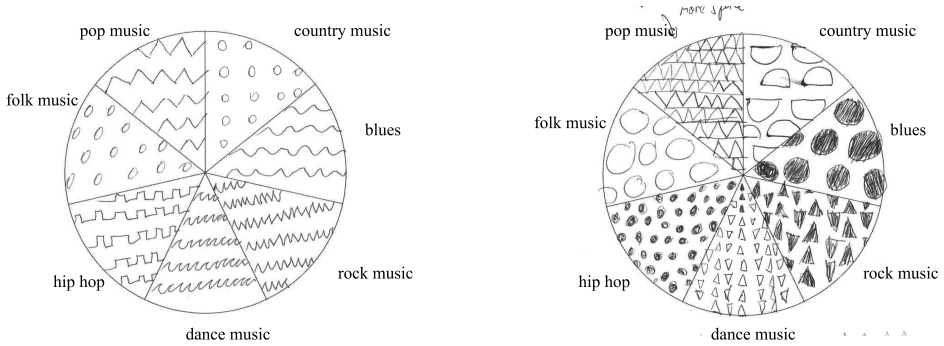
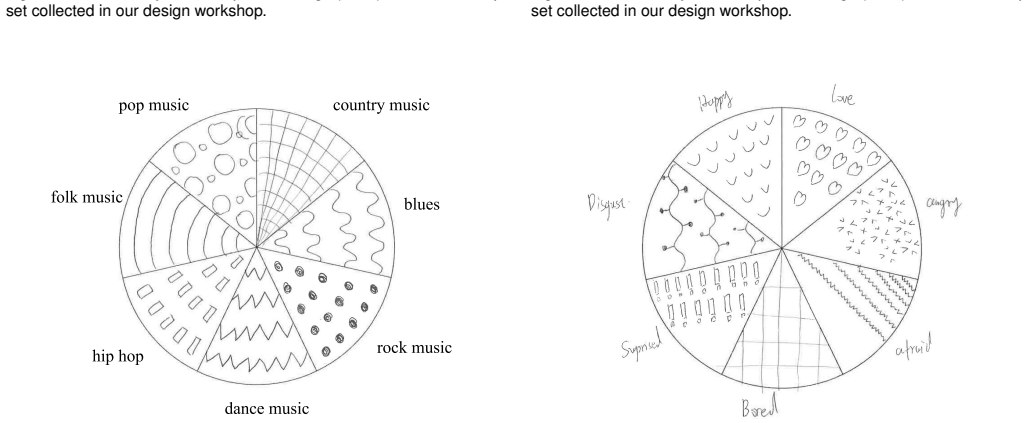
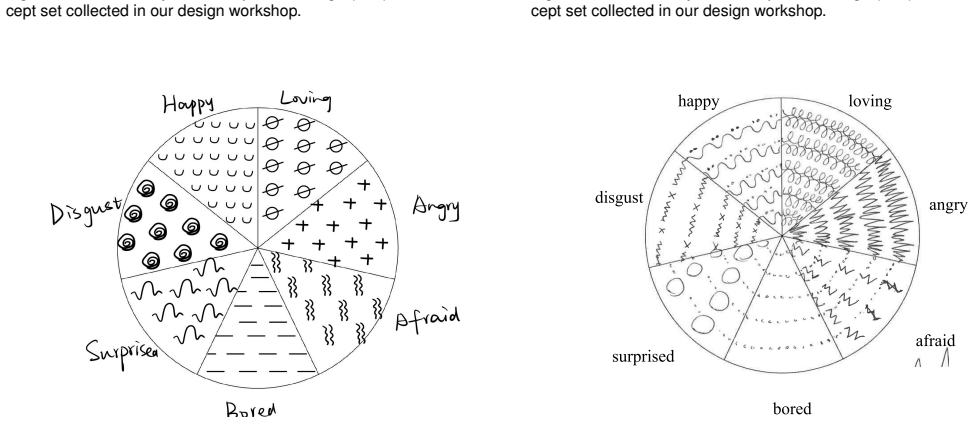
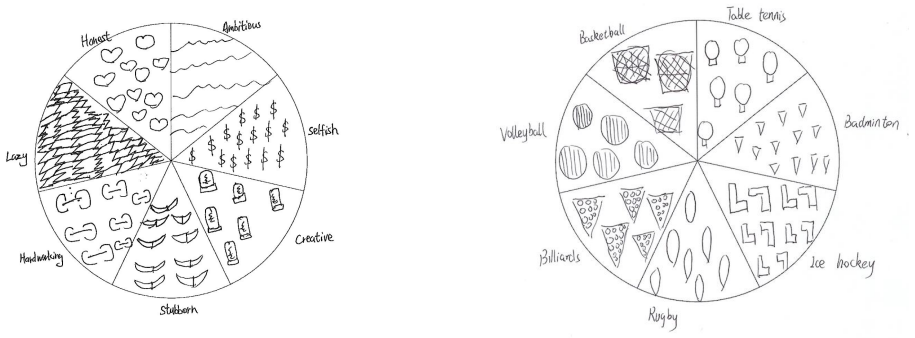
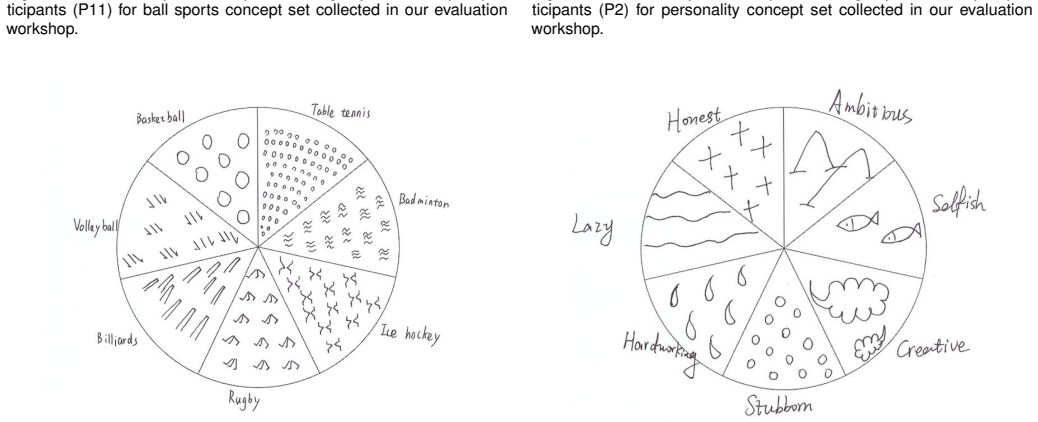
The central claim is that semantically-resonant pattern design decomposes into two steps: identifying the content to be visualized (via the concept's meaning, human reactions to it, its features, or its literal name), then encoding that content into an abstract pattern using the visual variables available to patterns (shape, size, fill, orientation, and spatial or appearance relationships among primitives). The authors derive this structure from qualitative coding of expert design workshops and report that non-expert participants could apply it successfully to new concept sets (ball games and personality traits).
Load-bearing premise
The evaluation treats participants' self-reported ratings of usefulness, ease of use, and helpfulness as evidence that the methodology effectively supports pattern design, without measuring whether an outside audience can match the resulting patterns to their concepts or comparing against a no-methodology control group.
Editorial extensions
If this is right
- People with no design or sketching training can use the two-step methodology to generate semantically-resonant patterns for both concrete concepts and abstract ones.
- The methodology condenses expert design strategies into a checklist of association routes and pattern variables, making the thinking directions used by professional designers available to anyone.
- Visualization designers gain a systematic alternative to semantically-resonant colors for charts that must be black-and-white, including print, data embroidery, and small displays where legends and labels waste space.
- The subjective ratings suggest the method helps most for abstract concepts, where there is no physical appearance to copy, which is exactly where designers previously had the least guidance.
- Because prior work linked semantically-resonant abstract patterns to improved pie-chart reading speed, following this methodology may yield patterns that are both meaningful and faster to read.
Reading between the lines
- The paper's own limitation section concedes that it never tests whether viewers can decode the patterns; the natural completion is a perception study measuring legend-free matching accuracy, which would verify that 'resonant' holds at the reader's end, not just the designer's.
- Because every pattern was created inside an equal-slice pie chart, the methodology's behavior in thin slices, small multiples, or non-circular geometries is untested; a computational pattern library parameterized by the Step-2 variables would let designers stress-test the approach across chart types.
- The finding that concrete concepts were rated harder to design for than abstract ones suggests the bottleneck is abstraction skill rather than idea generation, so tools that scaffold the sketching step (pre-built primitives or generative fills) could directly relieve the difficulty participants reported.
- The ordinal-scale technique (for instance, spike count mapped to emotional negativity) hints that semantically-resonant patterns could encode ordered magnitudes, not just category identity, which would extend the claimed benefit beyond categorical charts.
Editorial analysis
A structured set of objections, weighed in public.
Referee Report
Summary. The paper presents a two-step design methodology for creating 'semantically-resonant' abstract patterns—first identifying the content to be visualized, then encoding it through pattern variables. The methodology is derived from qualitative coding of 13 design experts' workshop outputs, and its usefulness, ease of use, and helpfulness are evaluated in a second workshop with 12 non-expert participants who were taught the methodology and asked to create patterns for a concrete and an abstract concept set. The abstract and conclusion claim that the methodology 'effectively supports the general public in designing semantically-resonant abstract patterns for both abstract and concrete concepts.' The evaluation evidence, however, consists of self-reported Likert ratings and interview quotes about the design process, not of any independent assessment of whether the resulting patterns actually evoke their intended concepts.
Significance. If the central claim were supported, the paper would contribute a useful practical framework to an under-studied area, extending prior work on semantically-resonant colors to abstract patterns and providing an accessible entry point for non-experts. The paper has genuine strengths: the methodology is systematically derived from a substantial corpus of expert designs and is presented with extensive appendix material; the studies were pre-registered and the materials and data are shared in an OSF repository; and the authors are transparent about many limitations in Sec. 7 and the Discussion. The value of the methodological taxonomy itself is plausible. What is not supported by the reported evidence is the outcome claim that the process yields semantically-resonant patterns, because the evaluation measures perceived process support rather than the semantic discriminability of the generated patterns.
major comments (4)
- [Abstract and Sec. 5] The central claim that the methodology 'effectively supports the general public in designing semantically-resonant abstract patterns' is not tested by the evidence in Sec. 5. The stated evaluation goal, quoted in Sec. 5, is 'to assess how our design methodology supports participants in the design process, and intentionally not to evaluate the quality of their specific designs.' The outcome measures in Sec. 5.5.1 are Likert ratings of usefulness, ease of use, and helpfulness, together with qualitative self-reports. These are process-oriented and self-referential: participants were taught the methodology and then asked whether it helped. No independent viewer was asked to match the generated patterns to their intended concepts, and no baseline condition without the methodology was included. Since the paper itself defines semantic resonance in Sec. 2.2 via Schloss et al.'s notion of semantic discriminability, which is about a viewer inferring the mapping from the visual features alone, the evaluation should have measured that inference or made clear that the effectiveness claim is only about perceived process support.
- [Sec. 6 and Sec. 7] The paper's own discussion undermines the strong conclusion. Sec. 6 acknowledges that participants' semantically-resonant pattern designs 'were often too abstract to identify the relevant items, in particular in the context of abstract concept sets.' Sec. 7 states that the authors intentionally 'do not assess the impact of using semantically-resonant patterns in visualizations' and calls for future crowd-sourced perception experiments. These statements directly conflict with the abstract's claim that the methodology was shown to 'effectively support' the design of semantically-resonant patterns. At minimum, the claims should be scaled back to say that the methodology was perceived as useful, easy to use, and helpful for ideation, and that its effect on the resonance of the resulting patterns remains to be tested.
- [Sec. 5.5.1 and Sec. 5.6] The interpretation of the quantitative ratings is strained given the small sample and the lack of any comparison condition. The Likert means reported in Sec. 5.5.1 (usefulness M = 5.29, ease of use M = 5.33, helpfulness M = 5.33 on a 7-point scale) are moderate, and the concrete usefulness mean is 4.92, which is close to the scale midpoint. The claim that 'our design methodology thus appears to be meaningful in reducing the challenges users face in design' goes beyond what can be concluded from absolute Likert scores without a baseline. This is particularly important because Sec. 5.6 reports that all participants confirmed they used the methodology and attributed their designs to it; in a study where the methodology was just taught to the participants, such self-reports are partly an artifact of the instructional context rather than independent evidence of the methodology's value.
- [Sec. 6, 'Methodology Evaluation' paragraph] The authors provide a thoughtful justification for not running a control condition, citing learning effects and between-subject variability. This is a reasonable position for a qualitative study, but it means the paper cannot support the causal or effectiveness language used in the conclusion. The conclusion should be limited to 'participants found the methodology helpful in generating and structuring their design ideas,' not 'the methodology effectively supports the design of semantically-resonant patterns.' A controlled perception study or a comparison of designs produced with and without the methodology would be needed to substantiate the stronger claim.
minor comments (5)
- [Supplemental Material Pointers] The word 'seperately' should be corrected to 'separately.'
- [Sec. 5.5.1] A quote attributed to P12 is followed by '(P2 for abstract),' which appears to be an incorrect participant label; please fix this inconsistency.
- [Table 3] The table lists 'hard working' as two words, whereas the text and concept selection in Sec. 5.1 use 'hardworking'; please standardize the spelling.
- [Sec. 5.5.1] The sentence reporting 'a trend that participants think our design methodology is more useful for abstract concept sets than concrete concept sets' is based on overlapping standard deviations in a sample of 12; phrasing this as a hypothesis or descriptive pattern rather than a trend would be more appropriate.
- [Fig. 7] The caption for Fig. 7 states that the plot shows ratings on the difficulty of designing patterns, but the caption does not clearly explain what the plotted percentages represent; please clarify whether they are percentages of participants rating each score or something else.
Circularity Check
No circular derivation; the evaluation's construct-validity gap is a limitation, not a circularity.
full rationale
The derivation chain is empirical rather than formal. The methodology was produced by qualitative coding of expert workshops (Sec. 3.6), and the evaluation used separate non-expert workshops with new concept sets (Sec. 5). No parameter is fitted from the evaluation data and then reported as a prediction, and no load-bearing claim reduces to a self-citation chain. The paper does state in Sec. 5 that the evaluation goal 'is to assess how our design methodology supports participants in the design process, and intentionally not to evaluate the quality of their specific designs,' and Sec. 6 concedes that participant designs 'were often too abstract to identify the relevant items'; these are genuine threats to the breadth of the central effectiveness claim and should be treated as correctness and validity concerns rather than circularity. Similarly, Sec. 7's statement that 'We do not assess, however, the impact of using semantically-resonant patterns in visualizations' is an acknowledged scope limitation. The final methodology was refined after the evaluation (Secs. 4.3 and 7), which weakens the independence of the validation of the presented version, but the paper transparently says the evaluated version already contained all components and that the changes were structural and terminological. That is an iterative-design limitation, not an identity between input and output. Citations to He et al. are published, externally reviewed empirical evidence used as background and motivation, not an unverified self-citation that forces the conclusion. Therefore no circular step meeting the required standard is present.
Assumptions & free parameters
assumptions (5)
- domain assumption Semantically-resonant color mappings improve chart reading speed (Lin et al. [20]).
- domain assumption Embodied cognition theory accounts for how people understand concrete and abstract concepts.
- domain assumption Conceptual metaphor theory explains how abstract concepts are linked to concrete ones.
- domain assumption Patterns can be treated as a composite visual variable with attributes from He [12].
- ad hoc to paper Self-reported ratings by participants are a valid measure of the methodology's effectiveness.
Cite this review
Pith. "Pith review of Designing Semantically-Resonant Abstract Patterns for Data Visualization." pith.science (2026). https://pith.science/paper/JLCTBRJQ
@misc{pith2026250514816,
  author       = {Pith},
  title        = {Pith review of: Designing Semantically-Resonant Abstract Patterns for Data Visualization},
  year         = {2026},
  howpublished = {\url{https://pith.science/paper/JLCTBRJQ}},
  note         = {Machine review of arXiv:2505.14816}
}
read the original abstract
We present a structured design methodology for creating semantically-resonant abstract patterns, making the pattern design process accessible to the general public. Semantically-resonant patterns are those that intuitively evoke the concept they represent within a specific set (e.g., in a vegetable concept set, small dots for olives and large dots for tomatoes), analogous to the concept of semantically-resonant colors (e.g., using olive green for olives and red for tomatoes). Previous research has shown that semantically-resonant colors can improve chart reading speed, and designers have made attempts to integrate semantic cues into abstract pattern designs. However, a systematic framework for developing such patterns was lacking. To bridge this gap, we conducted a series of workshops with design experts, resulting in a design methodology that summarizes the methodology for designing semantically-resonant abstract patterns. We evaluated our design methodology through another series of workshops with non-design participants. The results indicate that our proposed design methodology effectively supports the general public in designing semantically-resonant abstract patterns for both abstract and concrete concepts.
Figures


Figures from the paper (51 more)













Reference graph
Works this paper leans on
-
[1]
F. Adams. Embodied cognition. Phenomenol Cognit Sci, 9(4):619–628,
-
[2]
ATLAS.ti Mac (ver- sion 8.4.4), 2019
ATLAS.ti Scientific Software Development GmbH. ATLAS.ti Mac (ver- sion 8.4.4), 2019
work page 2019
-
[3]
S. Awan, F. Malik, and A. Javed. An efficient and objective generalized comparison technique for software quality models.Int J Mod Educ Comput Sci, 7(12):57–64, 2015. doi: 10/gcvjqs
work page 2015
-
[4]
M. Brysbaert, A. B. Warriner, and V . Kuperman. Concreteness ratings for 40 thousand generally known English word lemmas. Behav Res Methods, 46:904–911, 2014. doi: 10/gd6hzk
work page 2014
- [5]
-
[6]
A.-F. Cabouat, T. He, P. Isenberg, and T. Isenberg. PREVis: Perceived readability evaluation for visualizations. IEEE Trans Vis Comput Graph, 31(1):1083–1093, 2025. doi: 10/njnz
work page 2025
-
[7]
L. Connell and D. Lynott. Strength of perceptual experience predicts word processing performance better than concreteness or imageability. Cognit, 125(3):452–465, 2012. doi: 10/f4dvqc
work page 2012
-
[8]
A. ´Cwiek, S. Fuchs, C. Draxler, E. L. Asu, D. Dediu, K. Hiovain, S. Kawa- hara, S. Koutalidis, M. Krifka, P. Lippus, G. Lupyan, G. E. Oh, J. Paul, C. Petrone, R. Ridouane, S. Reiter, N. Schümchen, Á. Szalontai, Ö. Ünal Logacev, J. Zeller, M. Perlman, and B. Winter. The bouba/kiki effect is robust across cultures and writing systems. Phil Trans R Soc B, 3...
work page 2022
Show all 52 references
-
[9]
Dijkstra, A
K. Dijkstra, A. Eerland, J. Zijlmans, and L. S. Post. Embodied cognition, abstract concepts, and the benefits of new technology for implicit body manipulation. Front Psychol, 5, article no. 757, 8 pages, 2014. doi: 10/ f6fvmb
2014
-
[10]
Gentner and J
D. Gentner and J. Asmuth. Metaphoric extension, relational categories, and abstraction. Lang Cognit Neurosci, 34(10):1298–1307, 2019. doi: 10/gm79rj
2019
-
[11]
Haroz, R
S. Haroz, R. Kosara, and S. L. Franconeri. Isotype visualization: Working memory, performance, and engagement with pictographs. In Proc. CHI, pp. 1191–1200. ACM, New York, 2015. doi: 10/gf65d5
2015
-
[12]
T. He. Encoding with Patterns: A Design Space and Evaluations. PhD thesis, Université Paris-Saclay, France, 2024. url: hal.science/tel -04946435
2024
-
[13]
T. He, P. Isenberg, R. Dachselt, and T. Isenberg. BeauVis: A validated scale for measuring the aesthetic pleasure of visual representations. IEEE Trans Vis Comput Graph, 29(1):363–373, 2023. doi: 10/kt3n
2023
-
[14]
T. He, P. Isenberg, and T. Isenberg. Data embroidery with black-and-white textures. In Proc. alt.VIS, article no. 3, 5 pages, 2023. url: hal.science/ hal-04197527
2023
-
[15]
T. He, Y . Zhong, P. Isenberg, and T. Isenberg. Design characterization for black-and-white textures in visualization. IEEE Trans Vis Comput Graph, 30(1):1019–1029, 2024. doi: 10/gtkwg3
2024
-
[16]
Islam, T
A. Islam, T. He, A. Bezerianos, T. Blascheck, B. Lee, and P. Isenberg. Visualizing information on smartwatch faces: A review and design space. arXiv preprint 2310.16185, 2024. doi: 10/nt6t
2024 arXiv
-
[17]
Islam, L
A. Islam, L. Yao, A. Bezerianos, T. Blascheck, T. He, B. Lee, R. Vuillemot, and P. Isenberg. Reflections on visualization in motion for fitness trackers. In Proc. MobileHCI Workshop on New Trends in HCI and Sports, article no. 6, 14 pages, 2022. Published as arXiv preprint 240...
2022 arXiv
-
[18]
Lakoff and M
G. Lakoff and M. Johnson. Metaphors We Live By. University of Chicago Press, 1980. urn:oclc:record:1036704265
1980
-
[19]
D. J.-L. Lee, J. Lee, T. Siddiqui, J. Kim, K. Karahalios, and A. Parameswaran. You can’t always sketch what you want: Understanding sensemaking in visual query systems. IEEE Trans Vis Comput Graph, 26(1):1267–1277, 2020. doi: 10/ntmz
2020
-
[20]
S. Lin, J. Fortuna, C. Kulkarni, M. Stone, and J. Heer. Selecting semantically-resonant colors for data visualization. Comput Graph Forum, 32(3):401–410, 2013. doi: 10/tqd
2013
-
[21]
A. M. MacEachren. How Maps Work: Representation, Visualization, and Design . Guilford Press, New York, 2004. urn:oclc:record :1409557208
2004
-
[22]
A. M. MacEachren, R. E. Roth, J. O’Brien, B. Li, D. Swingley, and M. Gahegan. Visual semiotics & uncertainty visualization: An empirical study. IEEE Trans Vis Comput Graph , 18(12):2496–2505, 2012. doi: 10/f4fvbf
2012
-
[23]
T. Munzner. Visualization Analysis and Design. CRC Press, Boca Raton,
-
[24]
Nedjadrasul
D. Nedjadrasul. Abstract and concrete concepts according to word associ- ation. Master’s thesis, Western University, Canada, 2017
2017
-
[25]
O. Neurath. From Hieroglyphics to Isotype: A Visual Autobiography . Hyphen Press, London, 2010. Edited by M. Eve and C. Burke, url: perpensapress.com/books/from-hieroglyphics-to-isotype
2010
-
[26]
Chatgpt 4.0
OpenAI. Chatgpt 4.0. https://openai.com/chatgpt, 2024. Large language model developed by OpenAI
2024
-
[27]
Paivio, J
A. Paivio, J. C. Yuille, and S. A. Madigan. Concreteness, imagery, and meaningfulness values for 925 nouns. J Exp Psychol, 76(1, pt. 2):1–25,
-
[28]
P. C. Parsons. Conceptual metaphor theory as a foundation for communica- tive visualization design. Proc. VisComm (IEEE VIS Workshop), article no. 9, 6 pages, 2018
2018
-
[29]
Pokojná, T
H. Pokojná, T. Isenberg, S. Bruckner, B. Kozlíková, and L. Garrison. The language of infographics: Toward understanding conceptual metaphor use in scientific storytelling. IEEE Trans Vis Comput Graph, 31(1):371–381,
-
[30]
Preim, M
B. Preim, M. Meuschke, and V . Weiß. A survey of medical visualiza- tion through the lens of metaphors. IEEE Trans Vis Comput Graph , 30(10):6639–6664, 2024. doi: 10/gtg5mz
2024
-
[31]
Qualtrics experience management platform, 2020
Qualtrics. Qualtrics experience management platform, 2020. Version used: October 2024
2020
-
[32]
K. B. Schloss, Z. Leggon, and L. Lessard. Semantic discriminability for visual communication. IEEE Trans Vis Comput Graph, 27(2):1022–1031,
-
[33]
K. B. Schloss, L. Lessard, C. S. Walmsley, and K. Foley. Color inference in visual communication: The meaning of colors in recycling. Cognit Res: Princ Implic, 3, article no. 5, 17 pages, 2018. doi: 10/g8rfm7
2018
-
[34]
M. A. Schoenlein and K. B. Schloss. Color category boundaries predict generalization of color-concept associations. J Vision, 22(14), article no. 3978, 2022. doi: 10/g8rfnd
2022
-
[35]
L. Shapiro. The Routledge Handbook of Embodied Cognition. Routledge Handbooks in Philosophy. Routledge, Abingdon, 2nd ed., 2014. doi: 10/ pbhm
2014
-
[36]
Y . Shi, X. Lan, J. Li, Z. Li, and N. Cao. Communicating with motion: A design space for animated visual narratives in data videos. In Proc. CHI, article no. 605, 13 pages. ACM, New York, 2021. doi: 10/gksk3p
2021
-
[37]
L. M. Skipper and I. R. Olson. Semantic memory: Distinct neural repre- sentations for abstractness and valence. Brain Lang, 130:1–10, 2014. doi: 10/f5x2th
2014
-
[38]
V . M. Sloutsky and W. Deng. Categories, concepts, and conceptual devel- opment. Lang Cognit Neurosci, 34(10):1284–1297, 2019. doi: 10/gpttn2
2019
-
[39]
Vigliocco, L
G. Vigliocco, L. Meteyard, M. Andrews, and S. Kousta. Toward a theory of semantic representation. Lang Cognit, 1(2):219–247, 2009. doi: 10/ fvwk3v
2009
-
[40]
L. Wang, J. Zhang, M. Weng, M. Kang, and S. Su. Unlocking semantic information representation in bar graph design. IEEE Trans Vis Comput Graph, 2025. To appear. doi: 10/g8rfnc
2025
-
[41]
Wannamaker, W
K. Wannamaker, W. J. Willett, L. A. Oehlberg, and S. Carpendale. Data embroidery: Exploring alternative mediums for personal physicalization. In Posters at IEEE VIS , 2019. Extended abstract and poster, handle: 1880/110218
2019
-
[42]
Wiemer-Hastings and X
K. Wiemer-Hastings and X. Xu. Content differences for abstract and concrete concepts. Cognit Sci, 29(5):719–736, 2005. doi: 10/cd4zxg
2005
-
[43]
J. E. Zhang, N. Sultanum, A. Bezerianos, and F. Chevalier. DataQuilt: Extracting visual elements from images to craft pictorial visualizations. In Proc. CHI, article no. 45, 13 pages. ACM, New York, 2020. doi: 10/gh52th Designing Semantically-Resonant Abstract Patterns for Dat...
2020
-
[44]
Conceptual bridging: Linking the target concept to a more concrete one using: Psychological and physiological reac- tions/Personal experiences/Conceptual imagery/Common knowl- edge and cultural background/Literal associations
-
[45]
Attribute extraction: Identifying features of the target concept, categorized into: Intrinsic properties of the concept/Personal feelings to the concept
-
[46]
Make the concept more concrete
Quantification: Unlike the previous two methods, which focus on designing for individual target concepts, this method treats the entire concept set as a whole. The designer transforms the categorical value set into an orderable value set. Since all concepts within the set shar...
-
[47]
conceptual bridging
Link to a more concrete concept: Similar to “conceptual bridging” in v1, but with revised the categories what this link can be based on. The new categories under this method are as following: “re- actions”(refined from “psychological and physiological reactions” in v1, corresp...
-
[48]
intrinsic properties
Extract an attribute of the target concept. Same as attribute ex- traction method in v1. Within this method, “intrinsic properties” corresponding to “Step 1: Features” in v3, “personal feelings” corresponding to “Step 1: Human reaction → Emotional reaction” in v3
-
[49]
Step 2: Basic patterns → Ordinal scale
Compare the target concept to other concepts in the concept set. Same as the quantification method in v1. Corresponding to “Step 2: Basic patterns → Ordinal scale” in v3. We explain why we moved this method from Step 1 to Step 2 in next subsection. Step 2. In v2, for Step 2, w...
-
[50]
Step 1: Identifying the content to be visualized
) We refined the two step names as “Step 1: Identifying the content to be visualized” and “Step 2: Visualizing the refined concept as a pattern.” Because these new names can better and precisely describe what design experts exactly did during each step
-
[51]
concept bridging
We reorganized Step 1. (a) Since all specific approaches under Step 1 involve concep- tual bridging or linking, we no longer use “concept bridging” or “link the target concept to a more concrete concept” as a specific approach name, as was done in v1 and v2. Instead, we interp...
-
[52]
complex patterns
The visual variables used in Step 2 remained unchanged from v1 and v2. However, upon reviewing the pattern designs again, we observed that it is important to point out that some patterns have more basic look, resembled those more commonly found in cur- rent charts (characteriz...
Reviewed August 7, 2026 · model on record in the stance chip above.
Discussion (0). Continue with ORCID to comment.