REVIEW 4 major objections 6 minor 90 references
Numerical modeling the mass feeding rates onto accretion-modified stars embedded within AGN disks
T0 review · 4 major / 6 minor · reviewed 2026-08-07 · deepseek-v4-flash
Pith's one-line read The paper claims that disk shearing with angular momentum suppresses the mass feeding rate onto stars embedded in AGN disks, and that the suppression is a broken power law depending only on the thermal-mass parameter q_th.
desk verdict A useful new fitting formula for accretion suppression in AGN disks, but the sink-particle calibration needs convergence tests before the coefficients are trusted. read the letter →
The pith
A machine-rendered reading of the paper's core claim, the machinery that carries it, and where it could break.
The reading
What carries the argument
The load-bearing mechanism is a Keplerian-shear flow in a local shearing box, with the accreting star represented by a sink particle and the feeding rate measured from the mass flux through a sphere of radius four times the minimum cell size. The key control parameter is the thermal mass q_th = r_B/H_ams = mu $h^{{-3}}$, and the measured suppression factor compares the steady-state feeding rate to the Bondi rate dot M_B ∝ $M^{2}$ rho / $c_s^{3}$. The argument works because the shearing box supplies the ambient vorticity that the Bondi model ignores, while the sink prescription measures the actual inflow rather than an assumed analytic rate.
What would settle it
A direct test is a resolution study: rerun the same models with the maximum refinement level increased by one, halving the minimum cell size and the accretion radius, and check whether the measured feeding rates and the fitted f(q_th) exponents remain unchanged. A second test is to turn off or greatly reduce the shear (setting the specific angular momentum inside the Bondi radius to zero) and verify that the measured rate approaches the Bondi rate; if the plateau stays significantly below 1, the sink prescription is absorbing angular momentum or the Bondi normalization itself is miscalibrated.
Extended reading notes
Core claim
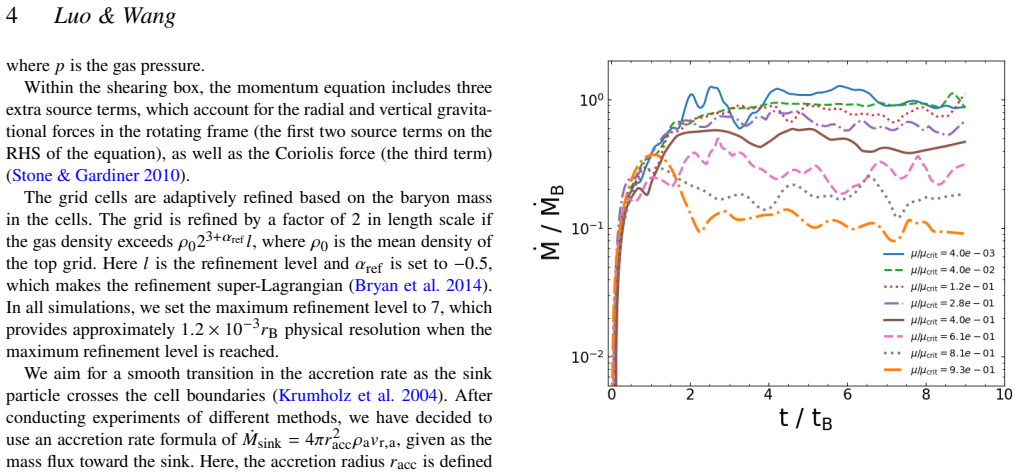
The central claim is that the mass feeding rate onto an accretion-modified star embedded in an AGN disk is not the Bondi rate but a suppressed rate dot M = f(q_th) dot M_B, with f(q_th) measured from simulations. The paper reports that the suppression factor is a broken power law in q_th = mu $h^{{-3}}$: f_1 = min{0.88, 0.21 $q_th^{{-0.5 ± 0.08}}$} when q_th is below about 0.3, and f_2 = 0.05 $q_th^{{-1.5 ± 0.12}}$ at larger q_th. The plateau at 0.88 rather than 1 reflects a residual angular-momentum barrier even for small Bondi radii, and the steep second regime corresponds to Bondi radii approaching the disk scale height, where disk geometry and tidal effects limit the supply. The fitted formula holds across disk aspect ratios h = 0.01, 0.035, and 0.07, and the flow morphology transitions from nearly spherical Bondi-like inflow to spiral-arm patterns with a central disk as q_th increases.
Load-bearing premise
The entire fitted suppression formula is calibrated on the sink-particle accretion prescription, which counts the gas flowing inward through a sphere of radius four times the smallest grid cell; the paper does not present a resolution study showing that this measured rate has converged, and the plateau at 0.88 instead of the Bondi limit of 1.0 hints at a possible systematic offset.
Editorial extensions
If this is right
- For q_th below about 0.3, feeding rates follow the q_th^2 scaling of planet accretion, so the early growth of accretion-modified stars matches well-studied planet-formation results.
- For larger q_th, the feeding rate drops steeply as q_th^{-1.5}, so massive embedded stars grow more slowly than Bondi predicts, and gap-opening or tidal truncation sets in near q_th ~ 0.3–1.
- The fitted suppression factor is independent of disk aspect ratio h, so it can be applied across AGN disk radii without rescaling.
- Radiative and mechanical feedback are subdominant to the accretion flow momentum in the early stage, so the measured feeding rate is a good proxy for the actual accretion rate until gap opening.
- A critical radius R_ams,crit ~ 4.5 × 10^5 R_g marks where the feeding rate balances the empirical stellar mass-loss rate; inside this radius an AMS can grow without wind termination.
Reading between the lines
- The broken-power-law form, with a plateau at 0.88 and two distinct exponents, hints at an underlying two-zone structure (spherical Bondi inflow inside a centrifugal barrier plus a disk-limited envelope) that might be derived analytically rather than only fitted.
- The dependence on q_th alone, not on mu and h separately, implies a self-similar family of flows; this suggests the shearing-box results transfer to global AGN disks with a one-parameter growth recipe for population synthesis.
- A testable extension would be to apply the same sink prescription in planet-accretion simulations with comparable q_th; agreement or disagreement in the fitted exponents would isolate the effects of vertical structure and the AGN disk's vertical gravity.
- The 0.88 plateau, if real, implies a universal ~12% reduction in feeding even for very small stars, which would slightly lengthen AMS growth timescales and could matter for the competition between in-situ formation and captured nuclear star clusters.
Editorial analysis
A structured set of objections, weighed in public.
Referee Report
Summary. Using 3D local shearing-box simulations in Enzo, the authors measure the steady-state gas feeding rate onto a sink particle representing an accretion-modified star embedded in an AGN disk. They vary the disk scale height h (0.01, 0.035, 0.07) and the AMS-to-SMBH mass ratio μ/μ_crit, and express the results as Mdot = f(q_th) Mdot_B, where f(q_th) is a broken power law in the thermal mass parameter q_th (Eqs. 11–12): f1 = min{0.88, 0.21 q_th^{−0.5±0.08}} for q_th ≲ 0.3 and f2 = 0.05 q_th^{−1.5±0.12} for larger q_th. The paper also compares the result with the Krumholz et al. (2005) vorticity-suppression formula and with planet-accretion scalings, and discusses radiative/mechanical feedback and gap-opening timescales for AMS growth.
Significance. If the fitted suppression formula is correct, it provides a simple, h-independent scaling that quantifies how disk shear reduces Bondi feeding onto embedded objects, with direct applications to AMS growth and possible links to planet-formation theory. The fit is not circular: f(q_th) is measured from the simulations rather than derived from the assumed inputs. The paper has clear strengths: it uses a public AMR code (Enzo), states the numerical setup and sink accretion prescription explicitly, presents time series showing steady states, and transparently reports a least-squares broken-power-law fit. The consistency check against the Choksi et al. (2023) planet-accretion slopes is a useful cross-validation. However, the calibration rests entirely on the sink-particle mass-flux measurement, and the paper does not demonstrate convergence with resolution or extraction radius; the low-q_th plateau at 0.88 is unexplained. The quantitative formula should therefore be regarded as provisional until these numerical systematics are addressed.
major comments (4)
- [§2, §3; Eqs. (11)–(12)] The sink-particle accretion prescription is load-bearing: every point in Fig. 2 is the steady value of Mdot_sink = 4π r_acc^2 ρ_a v_r,a measured at r_acc = 4 Δx_min ≈ 4.8×10^{-3} r_B, and Eqs. (11)–(12) are fit to those values. No resolution study or extraction-radius study is presented; the statement that a second estimator 'eventually converge[s]' compares two estimators at the same radius and does not test convergence with grid scale or r_acc. Because a systematic offset in the mass flux would shift the normalization and slopes of the fitted formula, I request a convergence test (vary maximum refinement level and r_acc) together with error bars on the steady-state rates. The unexplained plateau at f = 0.88 in Eq. (11) is exactly the sort of offset that such a test should resolve.
- [§3, Eq. (11), Fig. 2] The fitted plateau f1 = 0.88 for q_th below about 6×10^{-2} is physically suspicious. As q_th → 0, Ω r_B/c_s → 0, so the specific angular momentum of gas inside the Bondi sphere becomes negligible and the flow should approach spherical Bondi accretion with f → 1. A constant 12% deficit is the signature expected if the finite extraction sphere or the mass removal at the sink perturbs the flow. The authors should either demonstrate numerically that f approaches unity at smaller q_th and/or higher resolution, or provide a concrete physical mechanism for the 0.88 plateau.
- [§3, Fig. 2] There is an internal inconsistency between the top and bottom panels. The text states that the measured rates in the top panel follow q_th^2 scaling for q_th < 0.2 and q_th scaling for q_th > 0.2, but Eqs. (11)–(12) give f1 ∝ q_th^{-0.5} and f2 ∝ q_th^{-1.5}. Since Mdot_B ∝ q_th^2 in the same units (as stated immediately before the top panel), the implied measured scalings are Mdot ∝ q_th^{1.5} for q_th ≳ 0.06 and Mdot ∝ q_th^{0.5} for the f2 branch, not q_th^2 and q_th. Please reconcile the two descriptions; as written, the fit and the stated power-law behavior cannot both describe the same data.
- [§3, Fig. 2] The parameter coverage is thin relative to the generality claimed. Only three values of h, one Toomre parameter (Q=10), one angular velocity (Ω=10^{-9} s^{-1}), and one shear parameter (q=3/2 in Eq. 8) are used, and the data points in Fig. 2 carry no error bars. The quoted uncertainties in Eqs. (11)–(12) are therefore only least-squares scatter and do not include systematic or resolution errors. The claim that the relation is independent of h and sound speed would be substantially strengthened by at least one variation of Q or Ω and by error estimates on each steady-state measurement.
minor comments (6)
- [§1.1, Eq. (1)] The phrase 'where M_clump is expect to the the clump total mass' should read 'where M_clump is expected to be the clump total mass'.
- [§1.1, Eq. (5)] The phrase 'dominated the the central mass potential' should be 'dominated by the central mass potential'.
- [§5, first bullet] The phrase 'The equation11 remains valuable' should be 'Equation (11) remains valuable'.
- [§3, Fig. 2 caption] The caption states that 'the power-law indexes of the dependence are consistent' with Choksi et al. (2023), but no quantitative comparison is given in the text; please report the fitted slopes and state explicitly how they compare with the planet-accretion values.
- [§2] The two sink-rate estimators are said to 'eventually converge,' but no plot or quantitative comparison is shown; a supplementary figure or table would make this claim checkable.
- [§4.1, Eq. (21)] The assumed values h=0.03, α_B=10, f(q_th)=0.1, Q=10, and M_agn=10^8 M⊙ are introduced only in the final estimate; please state explicitly that these are input assumptions and indicate the sensitivity of R_ams,crit to the choice f(q_th)=0.1.
Circularity Check
No significant circularity: the suppression factor is an empirical fit to simulation data, not derived from the model inputs.
full rationale
The paper's central product, f(q_th), is obtained by least-squares fitting to Mdot_sink/Mdot_B measured from shearing-box simulations, so it is not equivalent by construction to the assumed physics; the Bondi normalization and the definition of q_th are standard and do not encode the fitted outcome. The comparisons with Krumholz et al. (2005) and Choksi et al. (2023) use external published formulas and scalings for context, and the q_th/12 adjustment attributed to Dittmann et al. (2021) is an interpretive comparison rather than a load-bearing step in the fit. Self-citations to Wang et al. (2021a,b) supply the AMS terminology and the m_bondi ~ 1e9 estimate used in illustrative feedback calculations, but they do not determine the simulated f(q_th), so they are not load-bearing. The absence of a resolution study for the sink-particle prescription is a numerical-convergence or correctness risk, not circularity, because nothing in the fitted formula is imposed analytically by the prescription. No equation in the paper reduces to its own input, and no fitted parameter is renamed as a prediction. Therefore the derivation chain is self-contained relative to the stated numerical experiments.
Assumptions & free parameters
free parameters (10)
- f1 plateau value =
0.88
- f1 coefficient =
0.21
- f1 power-law index =
-0.5 +/- 0.08
- f2 coefficient =
0.05
- f2 power-law index =
-1.5 +/- 0.12
- break location =
q_th about 0.3 (mu/mu_crit about 0.5)
- Toomre Q =
10
- angular velocity Omega =
1e-9 s^-1
- alpha_B in critical-radius estimate =
10
- typical suppression factor in Eq. 21 =
0.1
assumptions (6)
- domain assumption The local shearing box with Keplerian shear (q=3/2) faithfully represents the gas flow around an AMS embedded in a global AGN disk.
- domain assumption The gas is isothermal (gamma=1) and the sink particle is static with constant mass.
- domain assumption The initial vertical density profile follows an exponential disk in hydrostatic equilibrium with the SMBH gravity, with scale height H_ams = c_s/Omega.
- domain assumption The average specific angular momentum inside the Bondi radius scales as <l> about r_B^2 Omega/12 (Dittmann et al. 2021), used to map q_th to q_th/12 when comparing with Krumholz.
- domain assumption The sink particle accretion radius (4 times the minimum cell size) and the flux formula give the converged physical feeding rate.
- domain assumption Relative motion between the AMS and disk gas is subsonic, so the Hoyle-Lyttleton-Bondi correction is negligible.
Cite this review
Pith. "Pith review of Numerical modeling the mass feeding rates onto accretion-modified stars embedded within AGN disks." pith.science (2026). https://pith.science/paper/SMLQR7WQ
@misc{pith2026250515048,
  author       = {Pith},
  title        = {Pith review of: Numerical modeling the mass feeding rates onto accretion-modified stars embedded within AGN disks},
  year         = {2026},
  howpublished = {\url{https://pith.science/paper/SMLQR7WQ}},
  note         = {Machine review of arXiv:2505.15048}
}
abstract
Accretion disks surrounding supermassive black holes can potentially form stars within the self-gravitating region. These stars undergo high accretion rates because of the dense environment of the active galactic nuclei (AGN) accretion disk. The vorticity of the AGN disk may influence the ultimate mass feeding rate toward the star. In our study, we simulate mass feeding rates onto stars at different AGN disk thicknesses through 3D numerical models to explore the relationship between feeding rates and the thermal mass of the star ($q_{\rm th}$), defined as the ratio of the star's Bondi radius to the AGN disk thickness. Our findings indicate that disk shearing with angular momentum can notably decrease the feeding rate, and we provide an approximate formula that links the feeding rate based on the angular momentum of the surrounding gas and the thermal mass $q_{\rm th}$. Lastly, we examine the potential feedback of the rapidly accreting stars on the AGN disk and their subsequent evolution.
Figures


Figures from the paper (1 more)

Reference graph
Works this paper leans on
-
[1]
Abramowicz M. A., Czerny B., Lasota J. P., Szuszkiewicz E., 1988, @doi [ ] 10.1086/166683 , https://ui.adsabs.harvard.edu/abs/1988ApJ...332..646A 332, 646
doi:10.1086/166683 1988
-
[2]
Ali-Dib M., Lin D. N. C., 2023, @doi [ ] 10.1093/mnras/stad2774 , https://ui.adsabs.harvard.edu/abs/2023MNRAS.526.5824A 526, 5824
-
[3]
Lecture notes on the formation and early evolution of planetary systems
Armitage P. J., 2007, @doi [arXiv e-prints] 10.48550/arXiv.astro-ph/0701485 , https://ui.adsabs.harvard.edu/abs/2007astro.ph..1485A pp astro--ph/0701485
work page Pith review arXiv doi:10.48550/arxiv.astro-ph/0701485 2007
-
[4]
Artymowicz P., Lin D. N. C., Wampler E. J., 1993, @doi [ ] 10.1086/172690 , https://ui.adsabs.harvard.edu/abs/1993ApJ...409..592A 409, 592
doi:10.1086/172690 1993
-
[5]
Bartko H., et al., 2010, @doi [ApJ] 10.1088/0004-637X/708/1/834 , https://ui.adsabs.harvard.edu/abs/2010ApJ...708..834B 708, 834
-
[6]
Begelman M. C., Rees M. J., 1978, @doi [ ] 10.1093/mnras/185.4.847 , https://ui.adsabs.harvard.edu/\#abs/1978MNRAS.185..847B 185, 847
-
[7]
Berardo D., Cumming A., Marleau G.-D., 2017, @doi [ ] 10.3847/1538-4357/834/2/149 , https://ui.adsabs.harvard.edu/abs/2017ApJ...834..149B 834, 149
-
[8]
Bond J. R., Arnett W. D., Carr B. J., 1984, @doi [ ] 10.1086/162057 , https://ui.adsabs.harvard.edu/abs/1984ApJ...280..825B 280, 825
doi:10.1086/162057 1984
Show all 90 references
-
[9]
Bondi H., 1952, @doi [ ] 10.1093/mnras/112.2.195 , https://ui.adsabs.harvard.edu/abs/1952MNRAS.112..195B 112, 195
1952 doi
-
[10]
L., Norman M
Bryan G. L., Norman M. L., 1997, in Clarke D. A., West M. J., eds, Astronomical Society of the Pacific Conference Series Vol. 12, Computational Astrophysics; 12th Kingston Meeting on Theoretical Astrophysics. p. 363 ( @eprint arXiv astro-ph/9710186 ), @doi 10.48550/arXiv.astro...
-
[11]
L., et al., 2014, @doi [The Astrophysical Journal Supplement Series] 10.1088/0067-0049/211/2/19 , https://ui.adsabs.harvard.edu/\#abs/2014ApJS..211...19B 211, 19
Bryan G. L., et al., 2014, @doi [The Astrophysical Journal Supplement Series] 10.1088/0067-0049/211/2/19 , https://ui.adsabs.harvard.edu/\#abs/2014ApJS..211...19B 211, 19
2014 doi
-
[12]
S., Lin D
Cantiello M., Jermyn A. S., Lin D. N. C., 2021, @doi [ ] 10.3847/1538-4357/abdf4f , https://ui.adsabs.harvard.edu/abs/2021ApJ...910...94C 910, 94
2021 doi
-
[13]
Chen Y.-X., Lin D. N. C., 2024, @doi [ ] 10.3847/1538-4357/ad3c3a , https://ui.adsabs.harvard.edu/abs/2024ApJ...967...88C 967, 88
2024 doi
-
[14]
C., 2023, @doi [ ] 10.3847/1538-4357/acc023 , https://ui.adsabs.harvard.edu/abs/2023ApJ...948..120C 948, 120
Chen Y.-X., Jiang Y.-F., Goodman J., Ostriker E. C., 2023, @doi [ ] 10.3847/1538-4357/acc023 , https://ui.adsabs.harvard.edu/abs/2023ApJ...948..120C 948, 120
2023 doi
-
[15]
Chen Y.-X., Jiang Y.-F., Goodman J., Lin D. N. C., 2024, @doi [ ] 10.3847/1538-4357/ad6dd4 , https://ui.adsabs.harvard.edu/abs/2024ApJ...974..106C 974, 106
2024 doi
-
[16]
Choksi N., Chiang E., Fung J., Zhu Z., 2023, @doi [ ] 10.1093/mnras/stad2269 , https://ui.adsabs.harvard.edu/abs/2023MNRAS.525.2806C 525, 2806
2023 doi
-
[17]
P., 2008, @doi [A&A] 10.1051/0004-6361:20078191 , https://ui.adsabs.harvard.edu/abs/2008A&A...477..419C 477, 419
Collin S., Zahn J. P., 2008, @doi [A&A] 10.1051/0004-6361:20078191 , https://ui.adsabs.harvard.edu/abs/2008A&A...477..419C 477, 419
2008 doi
-
[18]
B., Lin D
Davies M. B., Lin D. N. C., 2020, @doi [MNRAS] 10.1093/mnras/staa2590 , https://ui.adsabs.harvard.edu/abs/2020MNRAS.498.3452D 498, 3452
2020 doi
-
[19]
Debuhr J., Quataert E., Ma C.-P., Hopkins P., 2010, @doi [ ] 10.1111/j.1745-3933.2010.00881.x , https://ui.adsabs.harvard.edu/abs/2010MNRAS.406L..55D 406, L55
2010
-
[20]
J., Miller M
Dittmann A. J., Miller M. C., 2020, @doi [ ] 10.1093/mnras/staa463 , https://ui.adsabs.harvard.edu/abs/2020MNRAS.493.3732D 493, 3732
2020 doi
-
[21]
J., Cantiello M., Jermyn A
Dittmann A. J., Cantiello M., Jermyn A. S., 2021, @doi [ ] 10.3847/1538-4357/ac042c , https://ui.adsabs.harvard.edu/abs/2021ApJ...916...48D 916, 48
2021 doi
-
[22]
F., 2001, @doi [ ] 10.1086/320631 , https://ui.adsabs.harvard.edu/abs/2001ApJ...553..174G 553, 174
Gammie C. F., 2001, @doi [ ] 10.1086/320631 , https://ui.adsabs.harvard.edu/abs/2001ApJ...553..174G 553, 174
2001 doi
-
[23]
Gerhard O., 2001, @doi [ApJL] 10.1086/318054 , https://ui.adsabs.harvard.edu/abs/2001ApJ...546L..39G 546, L39
2001 doi
-
[24]
Ginzburg S., Chiang E., 2019, @doi [ ] 10.1093/mnras/stz1322 , https://ui.adsabs.harvard.edu/abs/2019MNRAS.487..681G 487, 681
2019 doi
-
[25]
Goldreich P., Lynden-Bell D., 1965, @doi [ ] 10.1093/mnras/130.2.97 , https://ui.adsabs.harvard.edu/abs/1965MNRAS.130...97G 130, 97
1965 doi
-
[26]
Goldreich P., Tremaine S., 1980, @doi [ ] 10.1086/158356 , https://ui.adsabs.harvard.edu/abs/1980ApJ...241..425G 241, 425
1980 doi
-
[27]
Goodman J., 2003, @doi [ ] 10.1046/j.1365-8711.2003.06241.x , https://ui.adsabs.harvard.edu/abs/2003MNRAS.339..937G 339, 937
2003
-
[28]
C., 2004, @doi [ ] 10.1086/386360 , https://ui.adsabs.harvard.edu/abs/2004ApJ...608..108G 608, 108
Goodman J., Tan J. C., 2004, @doi [ ] 10.1086/386360 , https://ui.adsabs.harvard.edu/abs/2004ApJ...608..108G 608, 108
2004 doi
-
[29]
F., Gammie C
Hawley J. F., Gammie C. F., Balbus S. A., 1995, @doi [ ] 10.1086/175311 , https://ui.adsabs.harvard.edu/abs/1995ApJ...440..742H 440, 742
1995 doi
-
[30]
F., Gammie C
Hawley J. F., Gammie C. F., Balbus S. A., 1996, @doi [ ] 10.1086/177356 , https://ui.adsabs.harvard.edu/abs/1996ApJ...464..690H 464, 690
1996 doi
-
[31]
P., Whalen D
Herrington N. P., Whalen D. J., Woods T. E., 2023, @doi [MNRAS] 10.1093/mnras/stad572 , https://ui.adsabs.harvard.edu/abs/2023MNRAS.521..463H 521, 463
2023 doi
-
[32]
W., Eastwood J
Hockney R. W., Eastwood J. W., 1988, Computer simulation using particles
1988
-
[33]
Hocuk S., Spaans M., 2011, @doi [A&A] 10.1051/0004-6361/201117431 , https://ui.adsabs.harvard.edu/abs/2011A&A...536A..41H 536, A41
2011 doi
-
[34]
F., Grudic M
Hopkins P. F., Grudic M. Y., Kremer K., Offner S. S. R., Guszejnov D., Rosen A. L., 2024, @doi [OJAp] 10.33232/001c.122857 , https://ui.adsabs.harvard.edu/abs/2024OJAp....7E..71H 7, 71
2024 doi
-
[35]
J., Lu J
Hosek Matthew W. J., Lu J. R., Anderson J., Najarro F., Ghez A. M., Morris M. R., Clarkson W. I., Albers S. M., 2019, @doi [ApJ] 10.3847/1538-4357/aaef90 , https://ui.adsabs.harvard.edu/abs/2019ApJ...870...44H 870, 44
2019 doi
-
[36]
A., 1939, @doi [Proceedings of the Cambridge Philosophical Society] 10.1017/S0305004100021150 , https://ui.adsabs.harvard.edu/abs/1939PCPS...35..405H 35, 405
Hoyle F., Lyttleton R. A., 1939, @doi [Proceedings of the Cambridge Philosophical Society] 10.1017/S0305004100021150 , https://ui.adsabs.harvard.edu/abs/1939PCPS...35..405H 35, 405
1939 doi
-
[37]
Jia S., et al., 2023, @doi [ApJ] 10.3847/1538-4357/acb939 , https://ui.adsabs.harvard.edu/abs/2023ApJ...949...18J 949, 18
2023 doi
-
[38]
Kennedy G. F., Meiron Y., Shukirgaliyev B., Panamarev T., Berczik P., Just A., Spurzem R., 2016, @doi [MNRAS] 10.1093/mnras/stw908 , https://ui.adsabs.harvard.edu/abs/2016MNRAS.460..240K 460, 240
2016 doi
-
[39]
P., 2012, @doi [ ] 10.1146/annurev-astro-081811-125523 , https://ui.adsabs.harvard.edu/abs/2012ARA&A..50..211K 50, 211
Kley W., Nelson R. P., 2012, @doi [ ] 10.1146/annurev-astro-081811-125523 , https://ui.adsabs.harvard.edu/abs/2012ARA&A..50..211K 50, 211
2012 doi
-
[40]
C., 2013, @doi [ ] 10.1146/annurev-astro-082708-101811 , https://ui.adsabs.harvard.edu/abs/2013ARA&A..51..511K 51, 511
Kormendy J., Ho L. C., 2013, @doi [ ] 10.1146/annurev-astro-082708-101811 , https://ui.adsabs.harvard.edu/abs/2013ARA&A..51..511K 51, 511
2013 doi
-
[41]
R., McKee C
Krumholz M. R., McKee C. F., Klein R. I., 2004, @doi [ ] 10.1086/421935 , https://ui.adsabs.harvard.edu/abs/2004ApJ...611..399K 611, 399
2004 doi
-
[42]
R., McKee C
Krumholz M. R., McKee C. F., Klein R. I., 2005, @doi [ ] 10.1086/426051 , https://ui.adsabs.harvard.edu/abs/2005ApJ...618..757K 618, 757
2005 doi
-
[43]
R., McKee C
Krumholz M. R., McKee C. F., Klein R. I., 2006, @doi [ ] 10.1086/498844 , https://ui.adsabs.harvard.edu/abs/2006ApJ...638..369K 638, 369
2006 doi
-
[44]
Lamers H. J. G. L. M., Leitherer C., 1993, @doi [ ] 10.1086/172960 , https://ui.adsabs.harvard.edu/abs/1993ApJ...412..771L 412, 771
1993 doi
-
[45]
B., 1969, @doi [ ] 10.1093/mnras/145.4.405 , https://ui.adsabs.harvard.edu/\#abs/1969MNRAS.145..405L 145, 405
Larson R. B., 1969, @doi [ ] 10.1093/mnras/145.4.405 , https://ui.adsabs.harvard.edu/\#abs/1969MNRAS.145..405L 145, 405
1969 doi
-
[46]
J., Chiang E., 2015, @doi [ ] 10.1088/0004-637X/811/1/41 , https://ui.adsabs.harvard.edu/abs/2015ApJ...811...41L 811, 41
Lee E. J., Chiang E., 2015, @doi [ ] 10.1088/0004-637X/811/1/41 , https://ui.adsabs.harvard.edu/abs/2015ApJ...811...41L 811, 41
2015 doi
-
[47]
Li Y.-P., Chen Y.-X., Lin D. N. C., 2023, @doi [ ] 10.1093/mnras/stad3049 , https://ui.adsabs.harvard.edu/abs/2023MNRAS.526.5346L 526, 5346
2023 doi
-
[48]
Lodato G., 2007, @doi [Nuovo Cimento Rivista Serie] 10.1393/ncr/i2007-10022-x , https://ui.adsabs.harvard.edu/abs/2007NCimR..30..293L 30, 293
2007 doi
-
[49]
R., Do T., Ghez A
Lu J. R., Do T., Ghez A. M., Morris M. R., Yelda S., Matthews K., 2013, @doi [ApJ] 10.1088/0004-637X/764/2/155 , https://ui.adsabs.harvard.edu/abs/2013ApJ...764..155L 764, 155
2013 doi
-
[50]
Mapelli M., Hayfield T., Mayer L., Wadsley J., 2012, @doi [ ] 10.1088/0004-637X/749/2/168 , https://ui.adsabs.harvard.edu/abs/2012ApJ...749..168M 749, 168
2012 doi
-
[51]
C., 2011, @doi [ ] 10.1111/j.1365-2966.2011.18987.x , https://ui.adsabs.harvard.edu/abs/2011MNRAS.415.3721N 415, 3721
Narayan R., Fabian A. C., 2011, @doi [ ] 10.1111/j.1365-2966.2011.18987.x , https://ui.adsabs.harvard.edu/abs/2011MNRAS.415.3721N 415, 3721
2011
-
[52]
Narayan R., Yi I., 1994, @doi [ ] 10.1086/187381 , https://ui.adsabs.harvard.edu/abs/1994ApJ...428L..13N 428, L13
1994 doi
-
[53]
Nayakshin S., Sunyaev R., 2005, @doi [MNRAS] 10.1111/j.1745-3933.2005.00097.x , https://ui.adsabs.harvard.edu/abs/2005MNRAS.364L..23N 364, L23
2005
-
[54]
Nayakshin S., Zubovas K., 2018, @doi [MNRAS] 10.1093/mnrasl/sly082 , https://ui.adsabs.harvard.edu/abs/2018MNRAS.478L.127N 478, L127
2018 doi
-
[55]
Nayakshin S., Cuadra J., Springel V., 2007, @doi [MNRAS] 10.1111/j.1365-2966.2007.11938.x , https://ui.adsabs.harvard.edu/abs/2007MNRAS.379...21N 379, 21
2007
-
[56]
Neumayer N., Seth A., B \"o ker T., 2020, @doi [A&ARv] 10.1007/s00159-020-00125-0 , https://ui.adsabs.harvard.edu/abs/2020A&ARv..28....4N 28, 4
2020 doi
-
[57]
L., Bryan G
Norman M. L., Bryan G. L., 1999, in Miyama S. M., Tomisaka K., Hanawa T., eds, Astrophysics and Space Science Library Vol. 240, Numerical Astrophysics. p. 19 ( @eprint arXiv astro-ph/9807121 ), @doi 10.1007/978-94-011-4780-4_3
1999 arXiv
-
[58]
W., 2013, @doi [MNRAS] 10.1093/mnras/sts289 , https://ui.adsabs.harvard.edu/abs/2013MNRAS.428.3526O 428, 3526
Ormel C. W., 2013, @doi [MNRAS] 10.1093/mnras/sts289 , https://ui.adsabs.harvard.edu/abs/2013MNRAS.428.3526O 428, 3526
2013 doi
-
[59]
Paczynski B., 1978, , https://ui.adsabs.harvard.edu/abs/1978AcA....28...91P 28, 91
1978
-
[60]
Padovani P., et al., 2017, @doi [ ] 10.1007/s00159-017-0102-9 , https://ui.adsabs.harvard.edu/abs/2017A&ARv..25....2P 25, 2
2017 doi
-
[61]
Paumard T., et al., 2006, @doi [ApJ] 10.1086/503273 , https://ui.adsabs.harvard.edu/abs/2006ApJ...643.1011P 643, 1011
2006 doi
-
[62]
V., 1969, @doi [ ] 10.1093/mnras/144.4.425 , https://ui.adsabs.harvard.edu/\#abs/1969MNRAS.144..425P 144, 425
Penston M. V., 1969, @doi [ ] 10.1093/mnras/144.4.425 , https://ui.adsabs.harvard.edu/\#abs/1969MNRAS.144..425P 144, 425
1969 doi
-
[63]
A., Youdin A
Piso A.-M. A., Youdin A. N., 2014, @doi [ ] 10.1088/0004-637X/786/1/21 , https://ui.adsabs.harvard.edu/abs/2014ApJ...786...21P 786, 21
2014 doi
-
[64]
Prialnik D., 2009, An Introduction to the Theory of Stellar Structure and Evolution
2009
-
[65]
E., 1981, @doi [ ] 10.1146/annurev.aa.19.090181.001033 , https://ui.adsabs.harvard.edu/abs/1981ARA&A..19..137P 19, 137
Pringle J. E., 1981, @doi [ ] 10.1146/annurev.aa.19.090181.001033 , https://ui.adsabs.harvard.edu/abs/1981ARA&A..19..137P 19, 137
1981
-
[66]
C., 2003, @doi [ ] 10.1086/344537 , https://ui.adsabs.harvard.edu/abs/2003ApJ...582...69P 582, 69
Proga D., Begelman M. C., 2003, @doi [ ] 10.1086/344537 , https://ui.adsabs.harvard.edu/abs/2003ApJ...582...69P 582, 69
2003 doi
-
[67]
J., 1984, @doi [ ] 10.1146/annurev.aa.22.090184.002351 , https://ui.adsabs.harvard.edu/abs/1984ARA&A..22..471R 22, 471
Rees M. J., 1984, @doi [ ] 10.1146/annurev.aa.22.090184.002351 , https://ui.adsabs.harvard.edu/abs/1984ARA&A..22..471R 22, 471
1984
-
[68]
Ruffert M., Arnett D., 1994, @doi [ ] 10.1086/174145 , https://ui.adsabs.harvard.edu/abs/1994ApJ...427..351R 427, 351
1994 doi
-
[69]
Schaerer D., 2002, @doi [ ] 10.1051/0004-6361:20011619 , https://ui.adsabs.harvard.edu/abs/2002A&A...382...28S 382, 28
2002 doi
-
[70]
Schleicher D. R. G., Palla F., Ferrara A., Galli D., Latif M., 2013, @doi [ ] 10.1051/0004-6361/201321949 , https://ui.adsabs.harvard.edu/abs/2013A&A...558A..59S 558, A59
2013 doi
-
[71]
T., Gardini A., 2020, @doi [A&A] 10.1051/0004-6361/201936688 , https://ui.adsabs.harvard.edu/abs/2020A&A...641A.102S 641, A102
Sch \"o del R., Nogueras-Lara F., Gallego-Cano E., Shahzamanian B., Gallego-Calvente A. T., Gardini A., 2020, @doi [A&A] 10.1051/0004-6361/201936688 , https://ui.adsabs.harvard.edu/abs/2020A&A...641A.102S 641, A102
2020 doi
-
[72]
I., Sunyaev R
Shakura N. I., Sunyaev R. A., 1973, A&A, https://ui.adsabs.harvard.edu/abs/1973A&A....24..337S 24, 337
1973
-
[73]
C., 1987, @doi [ ] 10.1038/329810a0 , https://ui.adsabs.harvard.edu/abs/1987Natur.329..810S 329, 810
Shlosman I., Begelman M. C., 1987, @doi [ ] 10.1038/329810a0 , https://ui.adsabs.harvard.edu/abs/1987Natur.329..810S 329, 810
1987 doi
-
[74]
C., 1989, @doi [ ] 10.1086/167526 , https://ui.adsabs.harvard.edu/abs/1989ApJ...341..685S 341, 685
Shlosman I., Begelman M. C., 1989, @doi [ ] 10.1086/167526 , https://ui.adsabs.harvard.edu/abs/1989ApJ...341..685S 341, 685
1989 doi
-
[75]
M., Gardiner T
Stone J. M., Gardiner T. A., 2010, @doi [ ] 10.1088/0067-0049/189/1/142 , https://ui.adsabs.harvard.edu/abs/2010ApJS..189..142S 189, 142
2010 doi
-
[76]
M., Lin D
Takeuchi T., Miyama S. M., Lin D. N. C., 1996, @doi [ ] 10.1086/177013 , https://ui.adsabs.harvard.edu/abs/1996ApJ...460..832T 460, 832
1996 doi
-
[77]
Toomre A., 1964, @doi [ ] 10.1086/147861 , http://adsabs.harvard.edu/abs/1964ApJ...139.1217T 139, 1217
1964 doi
-
[78]
J., Smith B
Turk M. J., Smith B. D., Oishi J. S., Skory S., Skillman S. W., Abel T., Norman M. L., 2011, @doi [The Astrophysical Journal Supplement Series] 10.1088/0067-0049/192/1/9 , https://ui.adsabs.harvard.edu/\#abs/2011ApJS..192....9T 192, 9
2011 doi
-
[79]
Wang J.-M., Yan C.-S., Gao H.-Q., Hu C., Li Y.-R., Zhang S., 2010, @doi [ ] 10.1088/2041-8205/719/2/L148 , https://ui.adsabs.harvard.edu/abs/2010ApJ...719L.148W 719, L148
2010 doi
-
[80]
C., Du P., 2021a, @doi [ ] 10.3847/2041-8213/abee81 , https://ui.adsabs.harvard.edu/abs/2021ApJ...911L..14W 911, L14
Wang J.-M., Liu J.-R., Ho L. C., Du P., 2021a, @doi [ ] 10.3847/2041-8213/abee81 , https://ui.adsabs.harvard.edu/abs/2021ApJ...911L..14W 911, L14
-
[81]
C., Li Y.-R., Du P., 2021b, @doi [ ] 10.3847/2041-8213/ac0b46 , https://ui.adsabs.harvard.edu/abs/2021ApJ...916L..17W 916, L17
Wang J.-M., Liu J.-R., Ho L. C., Li Y.-R., Du P., 2021b, @doi [ ] 10.3847/2041-8213/ac0b46 , https://ui.adsabs.harvard.edu/abs/2021ApJ...916L..17W 916, L17
-
[82]
Wang Y., Zhu Z., Lin D. N. C., 2024, @doi [MNRAS] 10.1093/mnras/stae321 , https://ui.adsabs.harvard.edu/abs/2024MNRAS.528.4958W 528, 4958
2024 doi
-
[83]
E., Patrick S., Elford J
Woods T. E., Patrick S., Elford J. S., Whalen D. J., Heger A., 2021, @doi [ApJ] 10.3847/1538-4357/abfaf9 , https://ui.adsabs.harvard.edu/abs/2021ApJ...915..110W 915, 110
2021 doi
-
[84]
E., Patrick S., Whalen D
Woods T. E., Patrick S., Whalen D. J., Heger A., 2024, @doi [ ] 10.3847/1538-4357/ad054a , https://ui.adsabs.harvard.edu/abs/2024ApJ...960...59W 960, 59
2024 doi
- [85]
-
[86]
Yuan F., Narayan R., 2014, @doi [ ] 10.1146/annurev-astro-082812-141003 , https://ui.adsabs.harvard.edu/abs/2014ARA&A..52..529Y 52, 529
2014 doi
-
[87]
C., 2024, @doi [ ] 10.1093/mnras/stae1546 , https://ui.adsabs.harvard.edu/abs/2024MNRAS.532.1330Z 532, 1330
Zhang S.-R., Yuan Y.-F., Wang J.-M., Ho L. C., 2024, @doi [ ] 10.1093/mnras/stae1546 , https://ui.adsabs.harvard.edu/abs/2024MNRAS.532.1330Z 532, 1330
2024 doi
-
[88]
Stanford University
Zhao F., 2010, Magnetohydrodynamics, Magnetogenesis, and Magnetorotational Instabilities with Adaptive Mesh Refinement. Stanford University
2010
-
[89]
Zhou S., Sun M., Liu T., Wang J.-M., Wang J.-X., Xue Y., 2024, @doi [ ] 10.3847/2041-8213/ad3c3f , https://ui.adsabs.harvard.edu/abs/2024ApJ...966L...9Z 966, L9
2024 doi
-
[90]
R., 2018, @doi [ApJS] 10.3847/1538-4365/aab14f , https://ui.adsabs.harvard.edu/abs/2018ApJS..235...26Z 235, 26
Zhu Z., Li Z., Morris M. R., 2018, @doi [ApJS] 10.3847/1538-4365/aab14f , https://ui.adsabs.harvard.edu/abs/2018ApJS..235...26Z 235, 26
2018 doi
Reviewed August 7, 2026 · model on record in the stance chip above.
Discussion (0). Continue with ORCID to comment.