REVIEW 4 major objections 6 minor 1 cited by
Seoul National University AGN Monitoring Project. V. Velocity-resolved H-beta Reverberation Mapping and Evidence of Kinematics Evolution
T0 review · 4 major / 6 minor · reviewed 2026-08-07 · deepseek-v4-flash
Pith's one-line read The paper claims that velocity-resolved H-beta lags for 20 AGNs reveal disk-like rotation as the most common broad-line-region kinematics, with smaller but notable inflow and outflow populations, and that two AGNs show year-to-year…
desk verdict Solid new velocity-resolved RM data for 20 luminous AGNs, but the headline kinematics-evolution claim leans on a non-significant red-wing difference for one object. read the letter →
The pith
A machine-rendered reading of the paper's core claim, the machinery that carries it, and where it could break.
The reading
What carries the argument
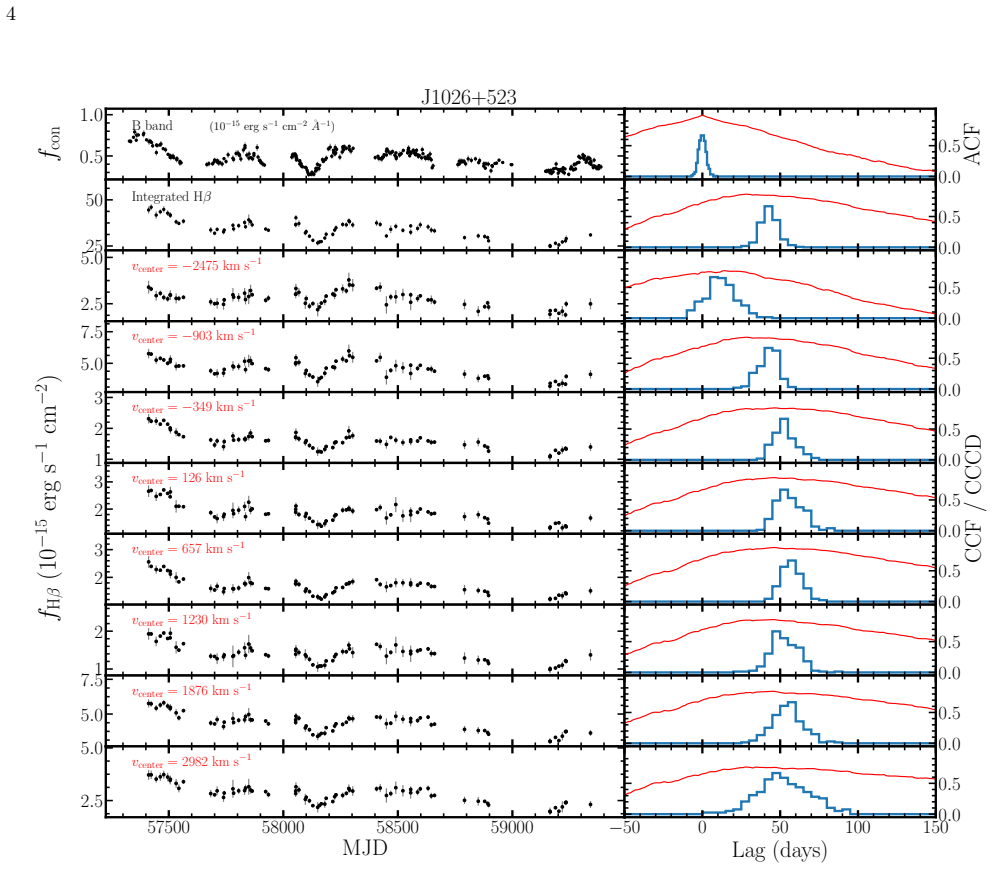
The central tool is the velocity-resolved lag: the broad H-$\beta$ line is split into velocity bins defined to hold equal flux in the rms spectrum, and a cross-correlation lag is measured per bin against the continuum. In a Keplerian disk the expected pattern is symmetric with longer lags near line center and shorter lags in the wings, whose envelope is the virial relation $V^2\tau = \mathrm{constant}$; blue-lagging-red indicates inflow and red-lagging-blue indicates outflow. The classification is checked by two quantitative statistics, $\Delta\tau_{\mathrm{corr}}/\tau$ for resolved structure and $\chi^2_{\mathrm{asy}}$ for blue-red asymmetry.
What would settle it
Take the 2016-2017 epochs of J1026+523, randomly drop half the epochs, rerun the same velocity-bin lags many times, and check whether the red bins still lag the blue bins; if the outflow-like pattern disappears under resampling, the claimed transition fails. Alternatively, simulate a static Keplerian broad-line region with the same cadence and noise and ask how often the pipeline produces a red-lagging-blue-to-symmetric transition like the one reported.
Extended reading notes
Core claim
For each of 20 AGNs observed by a six-year monitoring campaign, the authors divided H-beta into equal-flux velocity bins, measured an interpolated cross-correlation lag for each bin, and classified the lag-versus-velocity pattern by eye with supporting statistics. They identify unambiguous structure in 12 objects: eight show a symmetric pattern with the line center lagging behind the wings, interpreted as a Keplerian disk-like broad-line region; two show blue bins lagging red bins (inflow) and two show red bins lagging blue bins (outflow). For PG 1202+281 and J1026+523, lags measured in separate seasons differ, with the former moving from inflow-like to symmetric between 2016-2017 and 2021 and the latter from outflow-like to symmetric between 2016-2017 and 2018. Combining their classifications with literature lags for 94 unique AGNs, the paper states that symmetric, inflow-like, outflow-like, and ambiguous structures occur in about 40%, 20%, 11%, and 29% of cases, respectively.
Load-bearing premise
The load-bearing premise is that the year-to-year lag differences seen in J1026+523, and to a lesser extent PG 1202+281, are real changes in broad-line-region kinematics rather than artifacts of uneven sampling, calibration offsets, or noise; the paper itself concedes the red-bin difference for J1026+523 is not significant given the uncertainties.
Editorial extensions
If this is right
- If the demographics are representative, disk-like rotation is the dominant broad-line-region kinematics, supporting the virial assumption behind most reverberation-mapping black-hole mass estimates.
- The 20% inflow-like fraction suggests ongoing accretion inflow contributes to the line response in a substantial minority of AGNs, while the 11% outflow fraction implies radiation-pressure effects are not dominant.
- The two multi-epoch cases imply broad-line-region kinematics can change within a few years, so a single-epoch velocity-resolved snapshot may misclassify an individual object.
- Extending velocity-resolved reverberation mapping to higher-luminosity AGNs allows tests of whether the geometry assumed at low luminosity still holds for quasars whose masses are used at high redshift.
- The absence of strong trends with luminosity or Eddington ratio, if real, means inferred kinematics do not simply scale with accretion power.
Reading between the lines
- If the J1026+523 change is physical, the virial factor for a single object may vary with time, so historical black-hole mass estimates for such sources could shift by tens of percent without any change in true mass.
- Pooling a high-luminosity sample with lower-luminosity literature measurements creates an inhomogeneous dataset; the 40/20/11 fractions could shift under luminosity-matched weighting, a check the paper does not perform.
- A quantitative model-based classifier, such as fitting the lag-velocity pattern with a parameterized disk-plus-radial-flow model, could replace the visual classification step and make the demographic fractions reproducible.
- If the PG 1202+281 transition reflects a fading inflow component, future monitoring should find the inflow signature tied to the continuum luminosity state, a testable prediction beyond the paper's current data.
Editorial analysis
A structured set of objections, weighed in public.
Referee Report
Summary. This paper presents velocity-resolved H-beta reverberation lags for 20 AGNs from the Seoul National University AGN Monitoring Project, using ICCF applied to multi-year spectroscopic and photometric light curves. The authors identify 12 AGNs with unambiguous velocity-resolved structure, classifying 8 as symmetric/center-lagging-wing, 2 as inflow-like, and 2 as outflow-like. They further report year-to-year changes in the velocity-resolved lags of PG 1202+281 and J1026+523, interpreting these as evidence of BLR kinematics evolution on short timescales. Combining their sample with literature measurements, they derive a demographic census of 94 AGNs, finding 40% symmetric, 20% inflow-like, 11% outflow-like, and 29% ambiguous kinematics, and discuss possible connections with luminosity, Eddington ratio, and FWHM-RFe properties.
Significance. If the measurements and classifications are reliable, this is a valuable contribution: it roughly doubles the number of AGNs with velocity-resolved H-beta lags in the high-luminosity regime (L5100 ~ 1e44-1e45 erg/s) and provides demographic constraints that bear on the prevalence of disk-like, inflowing, and outflowing BLR kinematics. The standard ICCF analysis, intercalibration between telescopes, and the explicit use of quantitative statistics (Delta_tau_corr/tau and chi2_asy) are strengths, as is the honest acknowledgment of selection biases and the qualitative nature of the classification. The independent MAHA corroboration for PG 1202+281 is a particularly strong element. However, the paper's headline claim of 'kinematics evolution' depends critically on two objects, one of which (J1026+523) the authors themselves state has an insignificant red-wing lag difference between epochs; this undermines the strength of the title claim unless the analysis is quantified or the claim softened.
major comments (4)
- [Section 3.2, J1026+523 paragraph] The paper explicitly concedes that 'the difference in lags in the red velocity bins is not significant considering the lag uncertainties,' yet this red-wing difference is the primary quantitative basis for classifying the 2016-2017 epoch as outflow-like and the 2018 epoch as symmetric. The 6-year average red-lagging-blue structure shown in Figure 2 cannot establish a year-to-year change because it is dominated by the same 2016-2017 data. Since the title and abstract foreground 'Evidence of Kinematics Evolution,' this is load-bearing; the authors should either provide a quantitative test of the between-epoch lag difference (e.g., a bootstrap or permutation test that accounts for the full CCCD distributions) or downgrade J1026+523 to a tentative case, leaving PG 1202+281 (with MAHA corroboration) as the only robust example.
- [Section 3.1 and Table 1] The text reports that among the 12 unambiguous objects, 8 show symmetric/center-lagging-wing structure, 2 show inflow, and 2 show outflow, but this split is not directly recoverable from Table 1. For example, Table 1 labels PG 0052+251 as 'center-lagging-wing / red-lagging-blue (outflow-like)' and PG 0947+396 as 'center-lagging-wing / blue-lagging-red (inflow-like),' which would seem to put them in the asymmetric categories if the secondary label is counted. The authors need to specify whether the primary structure determines the final class and reconcile the table entries with the 8/2/2 counts, because the demographic percentages in Section 4.1 and Figure 4 depend directly on these classifications.
- [Section 3.1 (quantitative validation) and Table 1] Several objects are classified as unambiguous velocity-resolved structures even though their quantitative statistics do not meet the stated thresholds. For instance, PG 0052+251, J0101+422, PG 1322+659, J1540+355, and the 2016-2017 epoch of J1026+523 have Delta_tau_corr/tau = 0, and most have chi2_asy < 1. The paper states that visual inspection is 'generally robust,' but this is not a quantitative validation. Given that Section 4.1 uses the visual classifications for the demographic census, the authors should provide a robustness check (e.g., recompute the demographics excluding objects with Delta_tau_corr/tau = 0, or report both visual-only and statistics-supported classifications).
- [Section 4.1 (demographics construction)] The description of how multi-epoch AGNs enter the demographic counts is insufficiently precise. The sentence 'for AGNs with multiple measurements, we calculate the percentage of each type and incorporate it into the total count' does not specify the weighting formula or how an AGN with different classifications in different epochs is handled. Please state the exact procedure (e.g., fractional counts per classification per object) and provide the per-object classifications for the 94-AGN combined sample in a machine-readable table, ideally together with the numerical velocity-resolved lags shown in Figures 2 and 3 for reproducibility.
minor comments (6)
- [Section 3.1, paragraph after Equation for Delta_tau_corr] The text refers to 'PG 0052+126' when discussing objects with Delta_tau_corr/tau = 0; this appears to be a typo for PG 0052+251.
- [Table 1, J1217+333 row] The chi2_asy entry is listed as 'Nan'; this should be 'NaN' or 'indeterminate,' and ideally a brief note should explain which bin pairs were available for the asymmetry calculation.
- [Section 3.2, PG 1202+281 paragraph] The phrase 'a decreasing of 62%' is grammatically awkward; it should be 'a decrease of 62%.'
- [Section 3.2, J1026+523 paragraph] The sentence 'we favor the scenario of an real transition' contains a typo; it should be 'a real transition.'
- [References] The reference list contains duplicate entries for the same work: 'Li S., S.-S., Feng, H.-C., Liu, H. T., et al. 2022, ApJ, 936, 75' and 'Li-S, S.-S., Feng, H.-C., Liu, H. T., et al. 2022, ApJ, 936, 75' appear to be the same paper cited with different name formats; please unify them.
- [Section 4.1 and Figure 5] The potential aggregation of inflow-like objects near L5100 ~ 1e44 erg/s is based on a small number of objects and is described as 'potential' by the authors; please state explicitly (e.g., in the text) that no statistical significance test was performed for this clustering.
Circularity Check
No significant circularity: the velocity-resolved lags are measured directly from observed light curves, and the kinematics classifications are interpretive labels applied to those measurements rather than outputs forced by fitted inputs or self-citations.
full rationale
The paper's central products—velocity-resolved H-beta lags for 20 AGNs—are obtained by ICCF applied to observed continuum and line light curves, with no model parameters fitted to produce the measured lag structures. The virial envelope overplotted in Figure 2 is explicitly described as a guide to the eye ('To guide our eyes, we overplot the virial envelope'), not as a constraint used in the lag measurements. The classification of structures as symmetric, inflow-like, or outflow-like is an interpretive mapping from the measured lag patterns (red-lagging-blue versus blue-lagging-red), and the quantitative statistics Δτ_corr/τ and χ²_asy are computed from the measured lags themselves to check, rather than define, the visual classification. The demographic fractions (40% symmetric, 20% inflow-like, 11% outflow-like) are arithmetic combinations of the new SAMP classifications with literature classifications, so they do not reduce to an assumed input. The year-to-year comparisons for PG 1202+281 and J1026+523 are also direct measurements from different observing epochs; the paper's candid admission that the J1026+523 red-wing lag difference 'is not significant considering the lag uncertainties' is a statistical weakness in the kinematics-evolution claim, not a circularity, because the claimed transition is not produced by fitting or by definition. Self-citations to Paper III provide integrated lags, calibration details, and sample properties, but they do not inject the velocity-resolved result as an input. No step in the derivation chain is equivalent to its own input by construction.
Assumptions & free parameters
free parameters (4)
- rmax threshold =
0.5
- median cadence selection cutoff =
20 days
- chi2_asy significance threshold =
>=2
- lag searching window =
[-360, 360] days
assumptions (4)
- domain assumption Velocity-resolved lag patterns (symmetric center-lagging-wing, red-lagging-blue, blue-lagging-red) are reliable diagnostics of BLR kinematics (disk rotation, inflow, outflow).
- domain assumption ICCF centroid is an unbiased and consistent estimator of the true time delay for the unevenly sampled light curves.
- domain assumption Residual intercalibration offsets between Lick and MDM spectra do not introduce velocity-dependent lag artifacts after the per-bin PyCALI correction.
- domain assumption Year-to-year differences in lags for PG 1202+281 and J1026+523 are not caused by differences in sampling cadence, seasonal windows, or telescope calibration between epochs.
Cite this review
Pith. "Pith review of Seoul National University AGN Monitoring Project. V. Velocity-resolved H-beta Reverberation Mapping and Evidence of Kinematics Evolution." pith.science (2026). https://pith.science/paper/2PCUDZS7
@misc{pith2026250515073,
  author       = {Pith},
  title        = {Pith review of: Seoul National University AGN Monitoring Project. V. Velocity-resolved H-beta Reverberation Mapping and Evidence of Kinematics Evolution},
  year         = {2026},
  howpublished = {\url{https://pith.science/paper/2PCUDZS7}},
  note         = {Machine review of arXiv:2505.15073}
}
read the original abstract
We present velocity-resolved reverberation lags of H-beta for 20 active galactic nuclei (AGNs) from the Seoul National University AGN Monitoring Project. We detect unambiguous velocity-resolved structures in 12 AGNs, among which eight objects exhibit symmetric structures, two objects show inflow-like characteristics, and two objects display outflow-like signatures. For two AGNs, we successfully measure the velocity-resolved lags in different years, revealing evidence of evolving broad-line region (BLR) kinematics. By combining our sample with the literature velocity-resolved lags, we find that the symmetric velocity-resolved lags are the most common (40%) type among this sample. The frequency of inflow kinematics is also notable (20%), while outflow kinematics are less common (11%). Our sample significantly expands the previous velocity-resolved reverberation mapping sample in the high-luminosity regime, enabling us to constrain BLR kinematics across a large dynamic range of luminosity.
Figures


Figures from the paper (4 more)


Forward citations
Cited by 1 Pith paper
-
AGN Reverberation Mapping with LITMUS: Fundamental Limits on lag Recovery Rates
A Bayesian re-analysis of 906 OzDES AGN finds that previous reverberation lags, especially for MgII and CIV, are often false positives, with only 3-28% of MgII sources showing simple lags.
Reference graph
Works this paper leans on
-
[1]
, " * write output.state after.block = add.period write newline
ENTRY address archivePrefix author booktitle chapter doi edition editor eprint howpublished institution journal key month note number organization pages publisher school series title misctitle type volume year version url label extra.label sort.label short.list INTEGERS output.state before.all mid.sentence after.sentence after.block FUNCTION init.state.co...
-
[2]
write newline
" write newline "" before.all 'output.state := FUNCTION format.doi doi empty "" "doi:" doi * if FUNCTION format.url url empty "" new.block "" url * "" * if FUNCTION format.eprint eprint empty "" archivePrefix empty "" archivePrefix ":" * if eprint field.or.null * if FUNCTION format.pid eprint empty format.doi format.eprint if FUNCTION n.dashify 't := "" t...
-
[3]
؆ch c +w S =iI6K[,X 2Y44 ΐ.5 5@5pI#&*Z U 6 T .e ! : MSrFdӸ 4 lН6 ѝnk:C3 ٿst NR#ҵ=0q3 !j^Qvk,=k yi> kNXT(isL | D'@&Hz:
thebibliography [1] 20pt to REFERENCES 6pt =0pt 10pt plus 3pt =0pt =0pt =1pt plus 1pt =0pt =0pt -12pt =13pt plus 1pt =20pt =13pt plus 1pt \@M =10000 =-1.0em =0pt =0pt 0pt =0pt =1.0em @enumiv\@empty 10000 10000 `\.\@m \@noitemerr \@latex@warning Empty `thebibliography' environment \@ifnextchar \@reference \@latexerr Missing key on reference command Each re...
2017
-
[4]
S., Du , P., et al
Bao , D.-W., Brotherton , M. S., Du , P., et al. 2022, , 262, 14
2022
-
[5]
J., Pancoast , A., Thorman , S
Barth , A. J., Pancoast , A., Thorman , S. J., et al. 2011, , 743, L4
2011
-
[6]
J., Bennert , V
Barth , A. J., Bennert , V. N., Canalizo , G., et al. 2015, , 217, 26
2015
-
[7]
C., Kulkarni , S
Bellm , E. C., Kulkarni , S. R., Graham , M. J., et al. 2019, , 131, 018002
2019
-
[8]
C., Markham , M., Rosborough , S., et al
Bentz , M. C., Markham , M., Rosborough , S., et al. 2023 a , , 959, 25
2023
Show all 109 references
-
[9]
C., Onken , C
Bentz , M. C., Onken , C. A., Street , R., & Valluri , M. 2023 b , , 944, 29
2023
-
[10]
C., Peterson , B
Bentz , M. C., Peterson , B. M., Netzer , H., Pogge , R. W., & Vestergaard , M. 2009 a , , 697, 160
2009
-
[11]
C., Williams , P
Bentz , M. C., Williams , P. R., Street , R., et al. 2021, , 920, 112
2021
-
[12]
C., Williams , P
Bentz , M. C., Williams , P. R., & Treu , T. 2022, , 934, 168
2022
-
[13]
C., Walsh , J
Bentz , M. C., Walsh , J. L., Barth , A. J., et al. 2009 b , , 705, 199
2009
-
[14]
C., Denney , K
Bentz , M. C., Denney , K. D., Grier , C. J., et al. 2013, , 767, 149
2013
-
[15]
1996, , 117, 393
Bertin , E., & Arnouts , S. 1996, , 117, 393
1996
-
[16]
D., & McKee , C
Blandford , R. D., & McKee , C. F. 1982, , 255, 419
1982
-
[17]
A., & Green , R
Boroson , T. A., & Green , R. F. 1992, , 80, 109
1992
-
[18]
S., Du , P., Xiao , M., et al
Brotherton , M. S., Du , P., Xiao , M., et al. 2020, , 905, 77
2020
-
[19]
2023, , 520, 1807
Chen , Y.-J., Bao , D.-W., Zhai , S., et al. 2023, , 520, 1807
2023
-
[20]
2023, , 953, 142
Cho , H., Woo , J.-H., Wang , S., et al. 2023, , 953, 142
2023
-
[21]
M., & Blackwell , Jr., J
Crenshaw , D. M., & Blackwell , Jr., J. H. 1990, , 358, L37
1990
-
[22]
1985, , 289, 67
De Robertis , M. 1985, , 289, 67
1985
-
[23]
M., Grier , C
De Rosa , G., Fausnaugh , M. M., Grier , C. J., et al. 2018, , 866, 133
2018
-
[24]
D., Peterson , B
Denney , K. D., Peterson , B. M., Pogge , R. W., et al. 2009, , 704, L80
2009
-
[25]
2010, , 721, 715
---. 2010, , 721, 715
2010
-
[26]
T., Sergeev , S
Doroshenko , V. T., Sergeev , S. G., Klimanov , S. A., Pronik , V. I., & Efimov , Y. S. 2012, , 426, 416
2012
-
[27]
2023, , 671, A26
Du , P., & Wang , J.-M. 2023, , 671, A26
2023
-
[28]
2014, , 782, 45
Du , P., Hu , C., Lu , K.-X., et al. 2014, , 782, 45
2014
-
[29]
2016 a , , 825, 126
Du , P., Lu , K.-X., Zhang , Z.-X., et al. 2016 a , , 825, 126
2016
-
[30]
2016 b , , 820, 27
Du , P., Lu , K.-X., Hu , C., et al. 2016 b , , 820, 27
2016
-
[31]
2018 a , , 856, 6
Du , P., Zhang , Z.-X., Wang , K., et al. 2018 a , , 856, 6
2018
-
[32]
S., Wang , K., et al
Du , P., Brotherton , M. S., Wang , K., et al. 2018 b , , 869, 142
2018
-
[33]
M., Grier , C
Fausnaugh , M. M., Grier , C. J., Bentz , M. C., et al. 2017, , 840, 97
2017
-
[34]
2021 a , , 909, 18
Feng , H.-C., Hu , C., Li , S.-S., et al. 2021 a , , 909, 18
2021
-
[35]
T., Bai , J
Feng , H.-C., Liu , H. T., Bai , J. M., et al. 2021 b , , 912, 92
2021
-
[36]
M., et al
Feng , H.-C., Li , S.-S., Bai , J. M., et al. 2024, arXiv e-prints, arXiv:2409.01637
2024 arXiv
-
[37]
Flesch , E. W. 2015, , 32, e010
2015
-
[38]
Gaskell , C. M. 1988, , 325, 114
1988
-
[39]
M., & Harrington , P
Gaskell , C. M., & Harrington , P. Z. 2018, , 478, 1660
2018
-
[40]
Goodrich , R. W. 1989, , 342, 224
1989
-
[41]
J., Pancoast , A., Barth , A
Grier , C. J., Pancoast , A., Barth , A. J., et al. 2017 a , , 849, 146
2017
-
[42]
J., Peterson , B
Grier , C. J., Peterson , B. M., Horne , K., et al. 2013, , 764, 47
2013
-
[43]
J., Trump , J
Grier , C. J., Trump , J. R., Shen , Y., et al. 2017 b , , 851, 21
2017
-
[44]
S., Starkey , D
Hlabathe , M. S., Starkey , D. A., Horne , K., et al. 2020, , 497, 2910
2020
-
[45]
1994, in Astronomical Society of the Pacific Conference Series, Vol
Horne , K. 1994, in Astronomical Society of the Pacific Conference Series, Vol. 69, Reverberation Mapping of the Broad-Line Region in Active Galactic Nuclei, ed. P. M. Gondhalekar , K. Horne , & B. M. Peterson , 23
1994
-
[46]
F., & Peterson , B
Horne , K., Welsh , W. F., & Peterson , B. M. 1991, , 367, L5
1991
-
[47]
M., et al
Horne , K., De Rosa , G., Peterson , B. M., et al. 2021, , 907, 76
2021
-
[48]
2020 a , , 905, 75
Hu , C., Li , S.-S., Guo , W.-J., et al. 2020 a , , 905, 75
2020
-
[49]
2020 b , , 890, 71
Hu , C., Li , Y.-R., Du , P., et al. 2020 b , , 890, 71
2020
-
[50]
S., Netzer , H., et al
Kaspi , S., Smith , P. S., Netzer , H., et al. 2000, , 533, 631
2000
-
[51]
2003, , 407, 461
Kollatschny , W. 2003, , 407, 461
2003
-
[52]
H., & Done , C
Krolik , J. H., & Done , C. 1995, , 440, 166
1995
-
[53]
, S.-S., Feng , H.-C., Liu , H
Li S. , S.-S., Feng , H.-C., Liu , H. T., et al. 2022, , 936, 75
2022
-
[54]
T., et al
Li-S , S.-S., Feng , H.-C., Liu , H. T., et al. 2022, , 936, 75
2022
-
[55]
, S.-S., Feng , H.-C., Liu , H
Li S. , S.-S., Feng , H.-C., Liu , H. T., et al. 2024, arXiv e-prints, arXiv:2407.05414
2024 arXiv
-
[56]
, Y.-R., Wang , J.-M., Ho , L
Li Y. , Y.-R., Wang , J.-M., Ho , L. C., Du , P., & Bai , J.-M. 2013, , 779, 110
2013
-
[57]
, Y.-R., Wang , J.-M., Hu , C., Du , P., & Bai , J.-M
Li Y. , Y.-R., Wang , J.-M., Hu , C., Du , P., & Bai , J.-M. 2014, , 786, L6
2014
-
[58]
, Y.-R., Hu , C., Yao , Z.-H., et al
Li Y. , Y.-R., Hu , C., Yao , Z.-H., et al. 2024, arXiv e-prints, arXiv:2407.08120
2024 arXiv
-
[59]
2016, , 827, 118
Lu , K.-X., Du , P., Hu , C., et al. 2016, , 827, 118
2016
-
[60]
2019, , 887, 135
Lu , K.-X., Bai , J.-M., Zhang , Z.-X., et al. 2019, , 887, 135
2019
-
[61]
2021, , 918, 50
Lu , K.-X., Wang , J.-G., Zhang , Z.-X., et al. 2021, , 918, 50
2021
-
[62]
2023, , 520, 2009
Malik , U., Sharp , R., Penton , A., et al. 2023, , 520, 2009
2023
-
[63]
L., Czerny , B., Kawka , D., et al
Mart \' nez-Aldama , M. L., Czerny , B., Kawka , D., et al. 2019, , 883, 170
2019
-
[64]
L., Brotherton , M
Oknyansky , V. L., Brotherton , M. S., Tsygankov , S. S., et al. 2021, , 505, 1029
2021
-
[65]
E., & Pogge , R
Osterbrock , D. E., & Pogge , R. W. 1985, , 297, 166
1985
-
[66]
J., & Treu , T
Pancoast , A., Brewer , B. J., & Treu , T. 2011, , 730, 139
2011
-
[67]
J., Treu , T., et al
Pancoast , A., Brewer , B. J., Treu , T., et al. 2014, , 445, 3073
2014
-
[68]
J., Horne , K., et al
Pancoast , A., Barth , A. J., Horne , K., et al. 2018, , 856, 108
2018
-
[69]
2019, , 882, 79
Panda , S., Marziani , P., & Czerny , B. 2019, , 882, 79
2019
-
[70]
2012, , 747, 30
Park , D., Woo , J.-H., Treu , T., et al. 2012, , 747, 30
2012
-
[71]
2017, , 847, 125
Park , S., Woo , J.-H., Romero-Colmenero , E., et al. 2017, , 847, 125
2017
-
[72]
J., Aldering , G
Pei , L., Barth , A. J., Aldering , G. S., et al. 2014, , 795, 38
2014
-
[73]
M., Barth , A
Pei , L., Fausnaugh , M. M., Barth , A. J., et al. 2017, , 837, 131
2017
-
[74]
1992, , 256, 103
Perez , E., Robinson , A., & de La Fuente , L. 1992, , 256, 103
1992
-
[75]
Peterson , B. M. 1993, , 105, 247
1993
-
[76]
M., & Wandel , A
Peterson , B. M., & Wandel , A. 1999, , 521, L95
1999
-
[77]
2000, , 540, L13
---. 2000, , 540, L13
2000
-
[78]
M., Barth , A
Peterson , B. M., Barth , A. J., Berlind , P., et al. 1999, , 510, 659
1999
-
[79]
M., Ferrarese , L., Gilbert , K
Peterson , B. M., Ferrarese , L., Gilbert , K. M., et al. 2004, , 613, 682
2004
-
[80]
2020 a , The Journal of Open Source Software, 5, 2308
Prochaska , J., Hennawi , J., Westfall , K., et al. 2020 a , The Journal of Open Source Software, 5, 2308
2020
-
[81]
X., Hennawi , J., Cooke , R., et al
Prochaska , J. X., Hennawi , J., Cooke , R., et al. 2020 b , pypeit/PypeIt: Release 1.0.0 , Zenodo, vv1.0.0, Zenodo, doi:10.5281/zenodo.3743493
2020 doi
-
[82]
2019, , 886, 93
Rakshit , S., Woo , J.-H., Gallo , E., et al. 2019, , 886, 93
2019
-
[83]
1990, , 244, 138
Robinson , A., & Perez , E. 1990, , 244, 138
1990
-
[84]
Shen , Y., & Ho , L. C. 2014, , 513, 210
2014
-
[85]
T., Strauss , M
Shen , Y., Richards , G. T., Strauss , M. A., et al. 2011, , 194, 45
2011
-
[86]
J., Horne , K., et al
Shen , Y., Grier , C. J., Horne , K., et al. 2023, arXiv e-prints, arXiv:2305.01014
2023 arXiv
-
[87]
2015, , 454, 144
Skielboe , A., Pancoast , A., Treu , T., et al. 2015, , 454, 144
2015
-
[88]
F., et al
Stone , Z., Shen , Y., Anderson , S. F., et al. 2024, arXiv e-prints, arXiv:2408.04789
2024 arXiv
-
[89]
W., Zwitter , T., Marziani , P., & Dultzin-Hacyan , D
Sulentic , J. W., Zwitter , T., Marziani , P., & Dultzin-Hacyan , D. 2000, , 536, L5
2000
-
[90]
J., & Peterson , B
Sun , M., Grier , C. J., & Peterson , B. M. 2018, PyCCF: Python Cross Correlation Function for reverberation mapping studies , Astrophysics Source Code Library, record ascl:1805.032, ,
2018
-
[91]
J., Vogler , H
U , V., Barth , A. J., Vogler , H. A., et al. 2022, , 925, 52
2022
-
[92]
J., Barth , A
Valenti , S., Sand , D. J., Barth , A. J., et al. 2015, , 813, L36
2015
-
[93]
2024, , 966, 106
Villafa \ n a , L., Treu , T., Colleyn , L., et al. 2024, , 966, 106
2024
-
[94]
R., Treu , T., et al
Villafa \ n a , L., Williams , P. R., Treu , T., et al. 2022, , 930, 52
2022
-
[95]
2023, , 948, 95
---. 2023, , 948, 95
2023
-
[96]
2022, , 666, A86
Wang , J.-M., Du , P., Songsheng , Y.-Y., & Li , Y.-R. 2022, , 666, A86
2022
-
[97]
2014, , 793, 108
Wang , J.-M., Du , P., Hu , C., et al. 2014, , 793, 108
2014
-
[98]
2024, arXiv e-prints, arXiv:2408.15872
Wang , S., & Woo , J.-H. 2024, arXiv e-prints, arXiv:2408.15872
2024 arXiv
-
[99]
2020, , 903, 51
Wang , S., Shen , Y., Jiang , L., et al. 2020, , 903, 51
2020
-
[100]
Welsh , W. F. 1999, , 111, 1347
1999
-
[101]
F., & Horne , K
Welsh , W. F., & Horne , K. 1991, , 379, 586
1991
-
[102]
R., & Treu , T
Williams , P. R., & Treu , T. 2022, , 935, 128
2022
-
[103]
R., Pancoast , A., Treu , T., et al
Williams , P. R., Pancoast , A., Treu , T., et al. 2018, , 866, 75
2018
-
[104]
2019, Journal of Korean Astronomical Society, 52, 109
Woo , J.-H., Son , D., Gallo , E., et al. 2019, Journal of Korean Astronomical Society, 52, 109
2019
-
[105]
2024, The Astrophysical Journal, 962, 67
Woo, J.-H., Wang, S., Rakshit, S., et al. 2024, The Astrophysical Journal, 962, 67. http://dx.doi.org/10.3847/1538-4357/ad132f
2024 doi
-
[106]
2018 a , , 864, 109
Xiao , M., Du , P., Horne , K., et al. 2018 a , , 864, 109
2018
-
[107]
2018 b , , 865, L8
Xiao , M., Du , P., Lu , K.-K., et al. 2018 b , , 865, L8
2018
-
[108]
E., Brotherton , M
Zastrocky , T. E., Brotherton , M. S., Du , P., et al. 2024, , 272, 29
2024
-
[109]
S., et al
Zhang , Z.-X., Du , P., Smith , P. S., et al. 2019, , 876, 49
2019
Reviewed August 7, 2026 · model on record in the stance chip above.
Discussion (0). Continue with ORCID to comment.