REVIEW 3 major objections 7 minor 33 references
Piecewise-linear Ricci curvature flows on weighted graphs
T0 review · 3 major / 7 minor · reviewed 2026-08-07 · deepseek-v4-flash
Pith's one-line read Freezing graph curvature on each interval yields a unique flow that converges after finitely many edge deletions.
desk verdict A modest but genuine unification result for piecewise-linear Ricci flows; the math is sound, the experiments are overclaimed, and a few expository gaps need fixing. read the letter →
The pith
A machine-rendered reading of the paper's core claim, the machinery that carries it, and where it could break.
The reading
What carries the argument
The load-bearing object is the piecewise-linear Ricci curvature flow with $A$-surgeries, together with the homogeneity property of the curvature. At each interval the curvature values are frozen, turning a nonlinear flow into a diagonal linear system whose explicit exponential solution lets the authors compare edge weights in a connected component by ratios. The surgery rule deletes an edge when its weight is at least $A$ times the smallest weight in the same component; this keeps all intra-component weight ratios bounded by $A$ after the last surgery. Homogeneity $\kappa_e(G_a)=a^{\gamma}\kappa_e(G)$ then converts the exponential weight evolution into the statement that curvature values in a component with bounded ratios must all be equal; otherwise the ratio of two weights would grow past $A$.
What would settle it
Compute the five curvatures on a small graph, double every edge weight, and record whether each curvature changes by a fixed power; if Forman curvature computed with the $w_x=1$ convention fails to be homogeneous under this scaling, the blanket homogeneity claim in the paper is false for that convention. To test the convergence theorem directly, run the discrete PLRF with $A$-surgeries on the six-vertex example of Section 3.3 and check whether every final connected component has a single curvature value; a component with two unequal values after the last surgery would refute Theorem 2.3.
Extended reading notes
Core claim
The central claim is that a graph Ricci flow can be made both globally well-posed and convergent by freezing the curvature on each time interval and deleting edges whose weight becomes $A$ times larger than the minimum weight in their connected component. The continuous flow is defined on each interval by $w_e'(t)=-\kappa_e(t_{i-1})w_e(t)$, so its solution is $w_e(t)=w_e(t_{i-1})\exp(-\kappa_e(t_{i-1})(t-t_{i-1}))$; because each interval is a linear ODE, existence and uniqueness are elementary. The main theorem states that after finitely many $A$-surgeries no further surgery occurs, and that for any $\gamma$-homogeneous curvature $\kappa$, every connected component of the final graph has a constant value $\kappa_e(t)=\Theta$ on all of its edges, in both continuous time and discrete time. The five curvatures treated in the paper are all shown to be homogeneous, with exponents $0$, $1$, or $-1$, so the constant-curvature conclusion applies to all of them.
Load-bearing premise
The proof depends on the chosen Ricci curvature being homogeneous under uniform scaling of all edge weights, an assumption that is stated for all five curvatures but left ambiguous for Forman curvature because the paper offers two vertex-weight conventions.
Editorial extensions
If this is right
- The PLRF with surgeries terminates after finitely many edge deletions, so the community-detection algorithm based on it provably converges rather than merely running for a fixed number of iterations.
- The convergence theorem holds for any Ricci curvature satisfying one homogeneity condition, so future discrete curvatures, not just the five listed, can be plugged into the same flow and inherit the same guarantees.
- Because curvature is evaluated only at interval starts or after a surgery, the method avoids recomputing curvature at every iteration, which the paper identifies as a practical speed advantage.
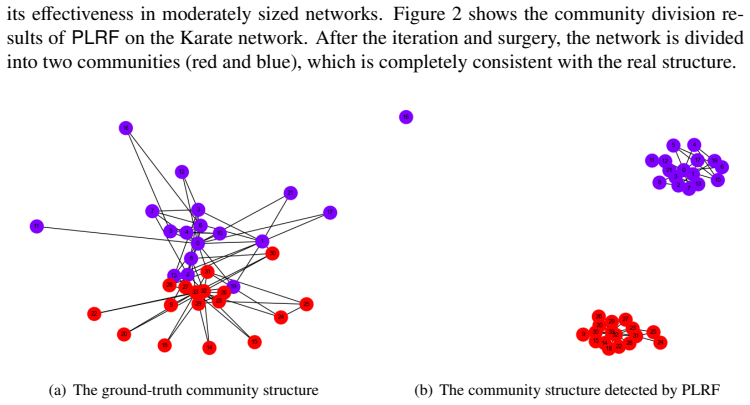
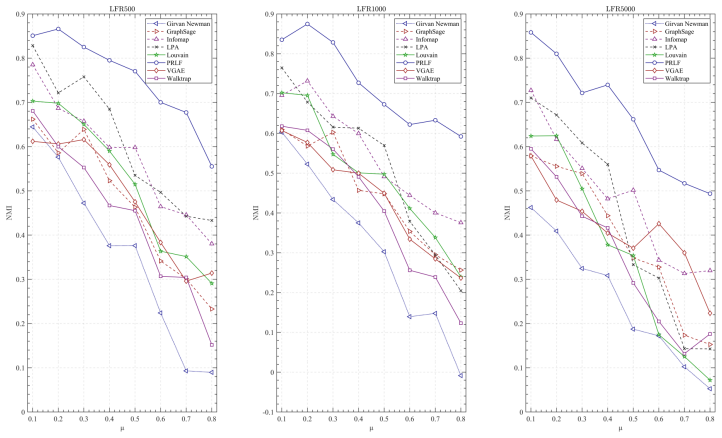
- On the three real-world datasets reported, the algorithm attains the highest or near-highest normalized mutual information and modularity among the compared methods, and on synthetic benchmark graphs its scores degrade more slowly as the mixing parameter increases.
- The continuous and discrete versions share the same asymptotic structure: after the last surgery, weight ratios inside each component are frozen even if the weights themselves continue to evolve.
Reading between the lines
- An immediate extension suggested by the proof is that the factor $A$ in the surgery rule can be replaced by any monotone threshold on weight ratios that prevents intra-component ratios from escaping to infinity; the convergence argument would survive with the same structure.
- The paper does not develop a statistical test for when the final number of components is the correct community count, but the last surgery time and component structure could serve as an automatic model-selection criterion, since no further cuts occur after that time.
- One could test the robustness of the approach by replacing the hand-chosen curvatures with a learned, data-dependent curvature that is designed to be homogeneous; the theorem would apply formally, and experiments could show whether the convergence guarantee translates into better clustering.
- The experimental comparison leaves open how the flow's final components relate to planted communities beyond NMI and modularity scores; a direct component-by-component overlap measurement would quantify whether constant-curvature components coincide with ground-truth communities.
Editorial analysis
A structured set of objections, weighed in public.
Referee Report
Summary. The paper introduces a continuous and a discrete piecewise-linear Ricci curvature flow on weighted graphs. On each interval of a fixed time partition, edge weights evolve by the linear ODE w'_e = -κ_e(t_{i-1}) w_e(t), where κ_e is an arbitrary graph Ricci curvature. The authors prove global existence and uniqueness (Theorem 2.1) and then introduce an A-surgery that removes any edge whose weight is at least A times the minimum weight in its connected component. They prove that after finitely many surgeries no further surgeries occur and, if the curvature is γ-homogeneous under global weight scaling, each connected component has a single constant Ricci curvature value for all later times (Theorem 2.2 continuous, Theorem 2.3 discrete). Five discrete curvatures (Ollivier, Lin-Lu-Yau, Forman, Menger, Haantjes) are asserted to be homogeneous. The discrete flow is applied to community detection on Karate, Football, Facebook, and synthetic LFR networks, with comparisons to seven baselines and two ablation studies.
Significance. The theoretical part is a genuine contribution: it provides a unified existence, uniqueness, and convergence framework for flows based on arbitrary homogeneous Ricci curvatures, avoiding curvature-specific arguments. The constant-curvature result is proved by a short monotonicity argument that is internally consistent and does not assume its conclusion. The observation that the algorithm only recomputes curvature after surgeries is practically valuable. However, the paper oversells the experimental results: the abstract's 'consistently outperforms' is not supported by the paper's own Table 6, and the published pseudo-code deviates from the analyzed recurrence. With these issues corrected, the paper would be a solid contribution to both the theory of discrete Ricci flows and their applications.
major comments (3)
- [Abstract; Section 6.3.1, Table 6] The abstract states that 'the flow consistently outperforms baseline models and existing methods.' Table 6 shows PLRF's NMI on Facebook is 0.72, which is lower than Infomap's 0.75; hence the claim as written is false. The body text acknowledges this as an anomaly, so the abstract should be revised to state that PLRF achieves the highest modularity on all three real-world networks and the highest NMI on Karate and Football, but is slightly below Infomap on Facebook NMI.
- [Algorithm 1; Section 2, Eqs. (2.2)-(2.3)] In Algorithm 1, the else branch sets c_{i,e} ← κ_e(t_{i-1}) whenever E_i ≠ E_{i-1}. According to the theoretical recurrence (2.3), after a surgery at t_i (i.e., E_{i-1,A} ≠ ∅) one should set c_{i,e} = κ_e(t_i), the curvature of the surgered graph G_i. The algorithm therefore uses the curvature at the previous time point for the next interval. This means the experimental implementation is not the exact discretization analyzed in Theorem 2.3. The pseudo-code should be corrected, or the paper must explicitly state that the experiments use a modified recurrence and justify that the theoretical conclusions still apply.
- [Section 2; Section 3.2] The paper claims in two places that Forman's Ricci curvature is 1-homogeneous (Section 2, before Theorem 2.2, and Section 3.2). However, Section 3.2 gives two admissible vertex-weight conventions: w_x = sum of incident edge weights (leading to 1-homogeneity) and w_x = 1 (leading to 0-homogeneity). The paper does not specify which convention is used in the example (Table 1), in the experiments (Table 8), or in the verification of homogeneity. Since Theorem 2.2 only requires homogeneity for some γ, the central mathematical results are unaffected, but the paper's statement that all five listed curvatures are homogeneous is incompletely specified.
minor comments (7)
- [Theorem 2.3] In the statement of Theorem 2.3, the graph for k ≥ ℓ is written as (V, E_{ℓ-1}, w(t_k)). According to the proof, which uses E_k = E_ℓ for all k ≥ ℓ, the edge set should be E_ℓ, not E_{ℓ-1}.
- [Section 4, proof of Theorem 2.2] The proof begins 'Assume an A-surgery occurs at t = t_ℓ, with no A-surgeries for all t > t_ℓ.' Since a surgery occurs at t_ℓ, the wording should be 'for all t ≥ t_ℓ' or should clarify that the final surgery at t_ℓ is included in the statement.
- [Section 3.2, Forman curvature formula] The notation 'wx = P x∈e we' is ambiguous; it should read w_x = \sum_{e \ni x} w_e to make the vertex-weight convention clear.
- [Section 4, proof of Theorem 2.3] The proof of Theorem 2.3 is omitted entirely, with the details left 'to the interested readers.' A brief outline of the discrete ratio monotonicity argument would improve self-containedness, especially because the discrete recurrence has its own indexing.
- [Section 6.3.2] The text says PLRF 'achieves the best performance on all the evaluated networks' and later that its performance is 'less satisfactory only on a very big subset of networks with µ = 0.8.' These statements are contradictory and should be reconciled.
- [Section 6.2, modularity formula] In the displayed modularity formula, the parameter is written as β, but the explanatory text below it refers to γ as the resolution parameter with default value 1. The notation should be made consistent.
- [Section 5, complexity analysis] The complexity analysis states the dominant cost is O(|E|D^3) for curvature calculation at each iteration, but the algorithm only recomputes curvature when a surgery occurs. The analysis should explicitly state whether this is a worst-case bound or should be refined to reflect the actual number of curvature computations.
Circularity Check
No circularity found: the constant-curvature convergence result is derived from the surgery rule and homogeneity, not assumed.
full rationale
The paper's central derivation (Theorems 2.2 and 2.3) is self-contained. After the last A-surgery at t_l, the flow is w_e(t) = w_e(t_l) exp(-kappa_e(t_l)(t - t_l)) (Eq. 4.1). The ratio bound (4.3) is a consequence of no further surgeries, not an assumption of the conclusion. The proof then shows that if two curvatures in a connected component differed, the corresponding weight ratio would grow exponentially and eventually exceed A, contradicting (4.3); hence all kappa_e(t_l) are equal. The constant-curvature statement follows from gamma-homogeneity applied to the uniform scaling of that component, giving kappa_e(t) = kappa_e(t_l) exp(-gamma kappa_e(t_l)(t - t_l)), independent of e. Nothing is fitted, and the target conclusion is not used as an input. The only self-references ([17,18]) motivate the setting and serve as experimental baselines; they do not enter the proofs of Theorems 2.1-2.3. The Forman-homogeneity ambiguity in Section 3.2 is an expository imprecision about which vertex-weight convention is used, and it is not load-bearing because the theorem only requires existence of some gamma and both conventions are homogeneous (gamma = 1 or gamma = 0). The omitted proof of Theorem 2.3 by analogy is an exposition gap, not a circular step. Therefore no significant circularity is present.
Assumptions & free parameters
free parameters (2)
- Surgery threshold A =
A = 2 * max_e (w0,e / min_e' w0,e')
- Time partition (t_k) =
not specified for experiments
assumptions (3)
- standard math Standard ODE existence and uniqueness for linear systems
- domain assumption The chosen Ricci curvature is gamma-homogeneous under global scaling of edge weights
- domain assumption Ricci curvature of an edge depends only on its connected component
Cite this review
Pith. "Pith review of Piecewise-linear Ricci curvature flows on weighted graphs." pith.science (2026). https://pith.science/paper/T4AGF62Q
@misc{pith2026250515395,
  author       = {Pith},
  title        = {Pith review of: Piecewise-linear Ricci curvature flows on weighted graphs},
  year         = {2026},
  howpublished = {\url{https://pith.science/paper/T4AGF62Q}},
  note         = {Machine review of arXiv:2505.15395}
}
read the original abstract
Community detection is an important problem in graph neural networks. Recently, algorithms based on Ricci curvature flows have gained significant attention. It was suggested by Ollivier (2009), and applied to community detection by Ni et al (2019) and Lai et al (2022). Its mathematical theory was due to Bai et al (2024) and Li-M\"unch (2025). In particular, solutions to some of these flows have existence, uniqueness and convergence. However, a unified theoretical framework has not yet been established in this field. In the current study, we propose several unified piecewise-linear Ricci curvature flows with respect to arbitrarily selected Ricci curvatures. First, we prove that the flows have global existence and uniqueness. Second, we show that if the Ricci curvature being used is homogeneous, then after undergoing multiple surgeries, the evolving graph has a constant Ricci curvature on each connected component. Note that five commonly used Ricci curvatures, which were respectively defined by Ollivier, Lin-Lu-Yau, Forman, Menger and Haantjes, are all homogeneous, and that the proof of all these results is independent of the choice of the specific Ricci curvature. Third, as an application, we apply the discrete piecewise-linear Ricci curvature flow with surgeries to the problem of community detection. On three real-world datasets, the flow consistently outperforms baseline models and existing methods. Complementary experiments on synthetic graphs further confirm its scalability and robustness. Compared with existing algorithms, our algorithm has two advantages: it does not require curvature calculations at each iteration, and the iterative process converges.
Figures

Figures from the paper (1 more)

Reference graph
Works this paper leans on
-
[1]
S. Bai, A. Huang, L. Lu, S. T. Yau, On the sum of ricci-curvatures for weighted graphs, Pure Appl. Math. Q. 17 (2021) 1599-1617
work page 2021
-
[2]
S. Bai, Y . Lin, L. Lu, Z. Wang, S. Yau, Ollivier Ricci-flow on weighted graphs, Amer. J. Math. 146 (2024) 1723-1747
work page 2024
-
[3]
S. Bhowmick, B. Seah, Clustering and summarizing protein-protein interaction networks: a survey, IEEE Trans. Knowl. Data Eng. 28 (2015) 638-658
work page 2015
-
[4]
A. Clauset, M. Newman, C. Moore, Finding community structure in very large networks, Phys. Rev. E 70 (2004) 066111
work page 2004
- [5]
-
[6]
Forman, Bochner’s method for cell complexes and combinatorial Ricci curvature, Discrete Comput
R. Forman, Bochner’s method for cell complexes and combinatorial Ricci curvature, Discrete Comput. Geom. 29 (2003) 323-374
work page 2003
- [7]
-
[8]
Guillaume, Fast unfolding of communities in large networks, J
L. Guillaume, Fast unfolding of communities in large networks, J. Stat. Mech. Theory Exp. 2008 (2008) P1008
work page 2008
Show all 33 references
-
[9]
Haantjes, Discrete geometry: curvature in abstract metric spaces, Proc
J. Haantjes, Discrete geometry: curvature in abstract metric spaces, Proc. Kon. Ned. Akad. v. Wetenseh., Amsterdam 50 (1947) 302-314
1947
-
[10]
Hamilton, Three-manifolds with positive ricci curvature, J
R. Hamilton, Three-manifolds with positive ricci curvature, J. Di ffer. Geom. 17 (1982) 255-306
1982
-
[11]
T. Kipf, M. Welling, Variational graph auto-encoders, NIPS Workshop 2016, arXiv:1611.07308, 2016
2016 arXiv
-
[12]
X. Lai, S. Bai, Y . Lin, Normalized discrete Ricci flow used in community detection, Phys. A 597 (2022) 127251
2022
-
[13]
Lancichinetti, S
A. Lancichinetti, S. Fortunato, F. Radicchi, Benchmark Graphs for Testing Community Detection Algorithms, Physical Review E, 78 (2008) 46-61
2008
-
[14]
Leskovec, SNAP datasets: Stanford large network dataset collection, http: //snap.stanford.edu/data, 2014
J. Leskovec, SNAP datasets: Stanford large network dataset collection, http: //snap.stanford.edu/data, 2014
2014
-
[15]
R. Li, F. M ¨unch, The convergence and uniqueness of a discrete-time nonlinear Markov chain, arXiv: 2407.00314, 2024
2024
-
[16]
Y . Lin, L. Lu, S. T. Yau, Ricci curvature of graphs, Tohoku Math. J. 63 (2011) 605-627
2011
-
[17]
J. Ma, Y . Yang, A modified Ricci flow on arbitrary weighted graph, arXiv: 2408.09435, 2024
2024 arXiv
-
[18]
J. Ma, Y . Yang, Evolution of weights on a connected finite graph, arXiv: 2411.06393, 2024
2024 arXiv
-
[19]
Menger, Untersuchungen ¨uber allgemeine metrik, vierte untersuchung, zur metrik der kurven, Math
K. Menger, Untersuchungen ¨uber allgemeine metrik, vierte untersuchung, zur metrik der kurven, Math. Ann. 103 (1930) 466-501
1930
-
[20]
Newman, Networks: an introduction, Oxford Univ
M. Newman, Networks: an introduction, Oxford Univ. Press, 2010
2010
-
[21]
C. C. Ni, Y . Y . Lin, F. Luo, J. Gao, Community detection on networks with ricci flow, Sci. Rep. 9 (2019) 9984
2019
-
[22]
Ollivier, Ricci curvature of markov chains on metric spaces, J
Y . Ollivier, Ricci curvature of markov chains on metric spaces, J. Funct. Anal. 256 (2009) 810-864
2009
-
[23]
Perelman, The entropy formula for the ricci flow and its geometric applications, arXiv: 0211159, 2002
G. Perelman, The entropy formula for the ricci flow and its geometric applications, arXiv: 0211159, 2002
2002
-
[24]
Pons and M
P. Pons and M. Latapy, Computing communities in large networks using random walks, J. Grap. Algo. Appl. 10 (2006) 191-218
2006
-
[25]
Raghavan, R
U. Raghavan, R. Albert, and S. Kumara, Near linear time algorithm to detect community structures in large- scale networks, Phys. Rev. E 76 (2007) 036106
2007
-
[26]
Rosvall, C
M. Rosvall, C. T. Bergstrom, Maps of random walks on complex networks reveal community structure, Proc. Nat. Acad. Sci. 105 (2008) 1118-1123
2008
-
[27]
Samal, H
A. Samal, H. Pharasi, S. Ramaia, H. Kannan, E. Saucan, J. Jost, A. Chakraborti, Network geometry and market instability, R. Soc. Open Sci. 8 (2021) 201734
2021
-
[28]
Serrat, Knowledge solutions: Tools, methods, and approaches to drive organizational performance, Springer, 2017
O. Serrat, Knowledge solutions: Tools, methods, and approaches to drive organizational performance, Springer, 2017. 19
2017
-
[29]
Sreejith, K
R. Sreejith, K. Mohanraj, J. Jost, E. Saucan, A. Samal, Forman curvature for complex networks, J. Stat. Mech. Theory Exp. 2016 (2016) 063206
2016
-
[30]
Tauro, C
S. Tauro, C. Palmer, G. Siganos, M. Faloutsos, A simple conceptual model for the internet topology, GLOBE- COM’01 IEEE Global Telecommun. Conf. 3 (2001) 1667-1671
2001
-
[31]
G. Wang, Z. Zhou, S. Zhu, S. Wang, Ordinary di fferential equations, (in Chinese), Higher Education Press, 2006
2006
-
[32]
D. Xu, C. Ruan, E. Korpeoglu, S. Kumar, K. Achan, Inductive representation learning on temporal graphs, Proceedings of the 13th International Conference on Web Search and Data Mining (2020) 672-680
2020
-
[33]
Zachary, An information flow model for conflict and fission in small groups, J
W. Zachary, An information flow model for conflict and fission in small groups, J. Anthropol. Res. 33 (1977) 452-473. 20
1977
Reviewed August 7, 2026 · model on record in the stance chip above.
Discussion (0). Continue with ORCID to comment.