REVIEW 5 major objections 7 minor 1 cited by
Exploiting Age of Information in Network Digital Twins for AI-driven Real-Time Link Blockage Detection
T0 review · 5 major / 7 minor · reviewed 2026-08-07 · deepseek-v4-flash
Pith's one-line read A network digital twin that tracks data freshness can keep a deep-learning blockage detector accurate using only 1% of the newest data samples.
desk verdict An engineering paper with a sensible AoI-weighted fine-tuning idea, but the headline 1%-data claim lacks a control and could be recency rather than AoI. read the letter →
The pith
A machine-rendered reading of the paper's core claim, the machinery that carries it, and where it could break.
The reading
What carries the argument
The machinery is an AoI-aware loss plus a freshness gate. Each channel sample $P_i$ carries a timestamp $u_i(t)$, and its age is $\Delta_i(t)=t-u_i(t)$; the gate $h(P_i,t)$ discards samples whose decay factor $e^{-\gamma\Delta_i(t)}$ drops below a threshold $\Gamma$, while the loss $L'(N;\zeta)$ reweights the remaining samples by that same decay factor. The exponential decay is what carries the argument: it makes the model's gradient update concentrate on the most recent observations, so fine-tuning after drift needs far fewer samples. A secondary piece is the ADCPM with (4,4) max-pooling, which shrinks the CNN input so the computational cost falls by the pooling factor, giving the reported 32x speedup.
What would settle it
Run the same AoI-aware fine-tuning on a real 28 GHz urban measurement campaign with ground-truth LoS/NLoS labels and check whether the model fine-tuned on 1% of the most recent real samples reaches roughly 98% accuracy on a held-out test set; if the accuracy falls well below the simulated 98.48% or requires far more than 1% of samples, the central claim fails.
Extended reading notes
Core claim
The central claim is that Age of Information can be embedded in the loss function of a deep classifier so that fine-tuning after model drift prioritizes the most recent channel samples, and that this alone restores accuracy with a tiny fraction of the data. The paper defines AoI as $\Delta_i(t)=t-u_i(t)$, keeps a sample only if $e^{-\gamma\Delta_i(t)}>\Gamma$, and optimizes $L'(N;\zeta)=\sum_i -[y_i\log(\hat{p}_{y_i})+(1-y_i)\log(1-\hat{p}_{y_i})] e^{-\gamma\Delta_i(t)}$. In the S3 scenario, the ResNet34 fine-tuned with decay rate $\gamma=0.4$ reaches 98.48% test accuracy using 2,132 training samples, compared with 99.35% using 205,049 samples at $\gamma=0.01$; the authors read this as a negligible 1% accuracy drop for a 100x reduction in data. The same experiments show that a (4,4) max-pooling reduction of the ADCPM input from (128,1024) to (32,128) yields a 32x inference speedup, and that augmenting training samples with simulated power control at 15 dB SNR improves low-SNR accuracy by roughly 5%.
Load-bearing premise
The load-bearing premise is that the Sionna ray-traced Milan environment, SUMO mobility, and randomly injected LoS removals faithfully represent real-world propagation; the paper itself concedes in Section II-C that discrepancies may arise between synthetic and real-world multipath, and if real distribution shifts do not follow the temporal pattern of the splits, the AoI gate could prune useful data and the 1%-sample result would not transfer.
Editorial extensions
If this is right
- An operator can keep a deployed blockage detector current by fine-tuning only on the freshest fraction of an NDT data stream, automating what currently requires re-measurement campaigns.
- The 32x inference speedup from (32,128) ADCPM inputs, measured on Jetson modules, makes real-time LoS/NLoS identification feasible on low-power edge hardware.
- Combining resolution reduction with power-control data augmentation gives roughly 5% higher accuracy at SNR below 10 dB, so the same model can run at lower cost without losing accuracy.
- Because the AoI loss is architecture-agnostic, the fine-tuning recipe transfers to any CNN classifier used for blockage detection, and the generalized loss in Eq. (19) points to replay-based continual learning.
Reading between the lines
- The paper only tests artificially injected drift; a natural next experiment is to use time-stamped crowd-sourced CSI from live vehicles, where the same AoI weighting could be applied without any labels, since timestamps are free.
- The exponential decay could be replaced by computing a quantile of sample ages per training batch, which would adapt the effective retention window to changing data rates rather than fixing $\gamma$.
- If the Sionna-to-real gap is small, the 1%-data result implies that a site-specific model could be kept perpetually current with a rolling window of just a few thousand labeled samples, making per-site micro-cell deployment economically plausible.
- A real-world check would be to rerun the exact protocol on a measured 28 GHz dataset with camera-derived LoS ground truth; the paper does not provide such evidence, so the transfer claim remains open.
Signed reviews
Editorial analysis
A structured set of objections, weighed in public.
Referee Report
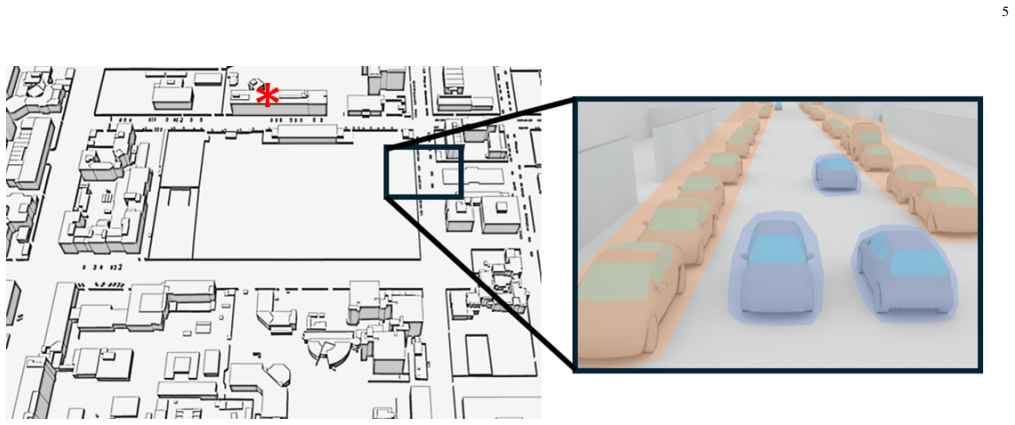
Summary. The paper proposes a Network Digital Twin (NDT) pipeline that combines ray tracing, SUMO mobility simulation, and automated labeling to generate training data for LoS/NLoS blockage detection in high-frequency wireless links. It evaluates statistical machine learning baselines and a ResNet34 deep learning classifier on synthetic channel data from a Milan urban scenario. The main methodological contribution is an Age-of-Information (AoI) weighted loss function, Eq. (18), that downweights older samples during fine-tuning after model drift, together with a thresholding rule, Eq. (17), that prunes old data. The authors report that fine-tuning with the AoI-aware loss achieves over 98% accuracy while using only about 1% of the available training data (Table III, gamma=0.4, S3, N_trn=2,132), and that input resolution reduction from (128,1024) to (32,128) yields a 32x inference speedup.
Significance. If the 1%-data fine-tuning claim is established with proper controls, the paper would make a practically useful contribution to automated model-drift mitigation in site-specific 6G deployments, where data labeling is costly. The strengths of the manuscript include an end-to-end synthetic data-generation pipeline based on openly available tools (Sionna, SUMO, CARLA), a clear FLOPs-based speedup analysis, and a simple and correct derivation of the AoI-weighted loss formulation in Eqs. (14)-(18). The simulations are detailed and reproducible in principle, although no code or data link is provided. The main significance is currently limited by the absence of baseline experiments that would separate the effect of data recency from the specific AoI weighting mechanism, and by the synthetic-only evaluation.
major comments (5)
- [Section V, Table III] The central claim that AoI-aware fine-tuning requires only 1% of the available data is not established because no control condition is reported. Table III compares five decay rates gamma but never compares the AoI-weighted loss in Eq. (18) against (i) ordinary cross-entropy fine-tuning on the same number of most recent training samples, (ii) random subsampling of 1% of the training data, or (iii) the hard threshold in Eq. (17) without the exponential weighting. Without these controls, the 98.48% accuracy with N_trn=2,132 at gamma=0.4 may be due simply to selecting a recent subset of the data, and the contribution of the AoI weighting mechanism is not demonstrated.
- [Section IV-B, Table I] The evaluation protocol is constructed so that the test distribution coincides with the samples most upweighted by the proposed loss. Each composite dataset S_k is split so that the test set is the last 10 s of the simulation (Table I), while Eq. (18) gives the highest weight to the most recent training samples. A simple recent-window fine-tuning baseline or a random-split holdout is required to separate the effect of data recency from the effect of the specific exponential decay weighting. As it stands, the positive results are consistent with the weaker claim that recent data are more relevant.
- [Section V, Table III] The reported validation and test sample counts for S1 are inconsistent across decay rates: at gamma=0.01, N_val=4,245 and N_tst=4,357, while at gamma=0.4, N_val=2,187 and N_tst=2,170, even though the validation/test splits should be fixed. If the age threshold in Eq. (17) is being applied to validation and test samples, the accuracies are not comparable and the protocol is incorrect; if this is a typographical artifact of including/excluding the grid dataset G, it must be corrected and the source of the discrepancy explained, since N_trn, N_val, and N_tst are central to the 1%-data claim.
- [Section V, Table III] The decay rate gamma=0.4, which yields the 1%-data result, is selected post hoc from five hand-picked values, with no validation-based criterion, no confidence intervals, and no repeated-seed variation. The robustness of the central efficiency claim therefore remains open: a model-selection protocol on the validation split, or an error-bar/sensitivity analysis, is needed before the statement that the method 'requires only 1% of the available data' can be taken as a property of the method rather than of a favorable hyperparameter choice.
- [Section II-C and Section IV-B] The paper's real-world claim is tempered by the synthetic-only evaluation. Section II-C explicitly acknowledges that 'inevitable discrepancies may arise between synthetic and real-world multipath propagation,' and the drift used in Section IV-B is induced by a random LoS-removal probability added to the same Sionna ray tracer used for training. The 1%-data result is therefore a simulation result whose transfer to physical deployments is an assumption rather than a demonstrated property; the abstract and conclusions should state this scope limitation explicitly.
minor comments (7)
- [Eq. (8)] The angle spread features in Eq. (8) are written as weighted means of the angles, not as RMS/spread values; a proper RMS angular spread should involve squared deviations (with circular handling). Since these features feed the SML baselines, this should be corrected or the notation clarified.
- [Section III-E, Eqs. (17)-(18)] The relationship between the thresholding function h in Eq. (17) and the weighted loss in Eq. (18) is not stated explicitly: Eq. (18) weights all samples, while Eq. (17) removes samples, and Table III reports different N_trn values. Please clarify whether N_trn is the number of samples surviving the threshold or the number of samples used with nonzero weight, and how Eq. (18) is applied together with h.
- [Section V, text after Table III] The sentence 'the previously fine-tuned model is further adapted using dataset S ∈' contains a typo ('S ∈' should be 'S_2') and should be corrected.
- [Fig. 6 caption] The caption says 'before softmax function' while the text uses the sigmoid in Eq. (21); for binary classification these differ, and the wording should be made consistent.
- [Section III-E, Eq. (19)] The union N=N_alpha union N_beta in Eq. (19) is not defined precisely (which samples belong to N_alpha vs N_beta), and the generalized loss is never used; consider either removing it or specifying the partition and how alpha, beta, gamma_alpha, and gamma_beta are chosen.
- [Section V, Table III] The paper reports single accuracy values without error bars, confidence intervals, or seeds; given the small fine-tuning subset at gamma=0.4, a few repeated runs would strengthen the stability claim.
- [Section IV-B, data availability] The footnote in Section IV-B contains 'GitHub link space [TBD]'; the manuscript should either provide a working link to the data/code or remove the placeholder before publication.
Circularity Check
No material circularity: the AoI-aware fine-tuning result is a measured experimental outcome, not a consequence of the AoI definition.
full rationale
The paper's central claim, that AoI-weighted fine-tuning reaches about 98% accuracy with 1% of the training samples (Table III, gamma=0.4), is an empirical measurement on a fixed temporal split, not a quantity forced by the definition of AoI. The AoI loss in Eq. (18) weights samples by exp(-gamma*Delta_i(t)), with Delta_i(t) defined in Eq. (16) from timestamps; the reported accuracies depend on the data, the network, and the optimization, so they are not entailed by the loss definition. The evaluation uses the last 10 seconds of each composite dataset as the test set (Table I), which aligns the test distribution with the recency bias of the method, but this is a standard temporal-split design rather than a circular reduction: the test labels are not used to define the loss or select gamma. The decay rates are evaluated as a grid and gamma=0.4 is highlighted, but this is a model-selection or completeness concern, not a fitted-input-called-prediction step. The self-citations (e.g., [9], [30]-[33]) are background references for NDT and ray tracing and are not load-bearing for the AoI contribution. The acknowledged synthetic-to-real gap (Sec. II-C) and the absence of a uniform-weighting or random-subsampling control are limitations of evidence, not circularity. No equation in the paper reduces to its own input, and no external result is replaced by an unverified self-citation.
Assumptions & free parameters
free parameters (5)
- Exponential decay rate gamma =
0.01, 0.05, 0.1, 0.2, 0.4
- Age violation threshold Gamma =
0.005
- LoS removal probability =
Unspecified
- Input resolution after max-pooling =
(32,128) with (4,4) kernel
- SNR for data augmentation =
15 dB
assumptions (6)
- domain assumption Raytracing with Sionna provides sufficiently accurate channel data to train and evaluate blockage detection models.
- domain assumption The 3D urban model and ITU material properties represent a real Milan microcell.
- ad hoc to paper Exponential decay e^{-gamma Delta_i(t)} is an appropriate model for the relevance of channel samples over time.
- ad hoc to paper The simulated drift, a random probability of LoS removal plus SUMO mobility, is representative of real model drift.
- standard math CNN computational cost scales inversely with input spatial resolution reduction, aside from a fixed classifier head.
- domain assumption The temporal split (train earlier, test later) gives an unbiased estimate of future performance.
Cite this review
Pith. "Pith review of Exploiting Age of Information in Network Digital Twins for AI-driven Real-Time Link Blockage Detection." pith.science (2026). https://pith.science/paper/H4ZPGTOX
@misc{pith2026250515519,
  author       = {Pith},
  title        = {Pith review of: Exploiting Age of Information in Network Digital Twins for AI-driven Real-Time Link Blockage Detection},
  year         = {2026},
  howpublished = {\url{https://pith.science/paper/H4ZPGTOX}},
  note         = {Machine review of arXiv:2505.15519}
}
read the original abstract
The Line-of-Sight (LoS) identification is crucial to ensure reliable high-frequency communication links, especially those vulnerable to blockages. Network Digital Twins and Artificial Intelligence are key technologies enabling blockage detection (LoS identification) for high-frequency wireless systems, e.g., 6>GHz. In this work, we enhance Network Digital Twins by incorporating Age of Information (AoI) metrics, a quantification of status update freshness, enabling reliable real-time blockage detection (LoS identification) in dynamic wireless environments. By integrating raytracing techniques, we automate large-scale collection and labeling of channel data, specifically tailored to the evolving conditions of the environment. The introduced AoI is integrated with the loss function to prioritize more recent information to fine-tune deep learning models in case of performance degradation (model drift). The effectiveness of the proposed solution is demonstrated in realistic urban simulations, highlighting the trade-off between input resolution, computational cost, and model performance. A resolution reduction of 4x8 from an original channel sample size of (32, 1024) along the angle and subcarrier dimension results in a computational speedup of 32 times. The proposed fine-tuning successfully mitigates performance degradation while requiring only 1% of the available data samples, enabling automated and fast mitigation of model drifts.
Figures


Figures from the paper (4 more)


Forward citations
Cited by 1 Pith paper
-
High-Fidelity RF Mapping: Assessing Environmental Modeling in 6G Network Digital Twins
A new way to compare ray tracing results by treating each propagation path as a point in a 6D space and using Hausdorff and Chamfer distances.
Reference graph
Works this paper leans on
-
[1]
Z. Lv and S. Xie, “Artificial intelligence in the digital twins: State of the art, challenges, and future research topics,”Digital Twin, vol. 1, p. 12, Nov. 2022
work page 2022
-
[2]
Minimizing age of infor- mation in vehicular networks,
S. Kaul, M. Gruteser, V . Rai, and J. Kenney, “Minimizing age of infor- mation in vehicular networks,” in2011 8th Annual IEEE Communica- tions Society Conference on Sensor, Mesh and Ad Hoc Communications and Networks, 2011, pp. 350–358
work page 2011
-
[3]
Distributed Q-Learning for Aggregated Interference Control in Cognitive Radio Networks,
A. Galindo-Serrano and L. Giupponi, “Distributed Q-Learning for Aggregated Interference Control in Cognitive Radio Networks,”IEEE Transactions on Vehicular Technology, vol. 59, no. 4, pp. 1823–1834, 2010
work page 2010
-
[4]
Learning Temporal–Spatial Spectrum Reuse,
Y . Zhang, W. P. Tay, K. H. Li, M. Esseghir, and D. Ga ¨ıti, “Learning Temporal–Spatial Spectrum Reuse,”IEEE Transactions on Communica- tions, vol. 64, no. 7, pp. 3092–3103, 2016
work page 2016
-
[5]
Colosseum: The Open RAN Digital Twin,
M. Polese, L. Bonati, S. D’Oro, P. Johari, D. Villa, S. Velumani, R. Gangula, M. Tsampazi, C. Paul Robinson, G. Gemmi, A. Lacava, S. Maxenti, H. Cheng, and T. Melodia, “Colosseum: The Open RAN Digital Twin,”IEEE Open Journal of the Communications Society, vol. 5, pp. 5452–5466, 2024
2024
-
[6]
P. Yadav and S. C. Sharma, “Unveiling the Cutting Edge: A Compre- hensive Survey of Localization Techniques in WSN, Leveraging Op- timization and Machine Learning Approaches,”Wirel. Pers. Commun., vol. 132, no. 4, p. 2293–2362, Sep. 2023
work page 2023
-
[7]
Cellular Wireless Networks in the Upper Mid-Band,
S. Kang, M. Mezzavilla, S. Rangan, A. Madanayake, S. B. Venkatakrish- nan, G. Hellbourg, M. Ghosh, H. Rahmani, and A. Dhananjay, “Cellular Wireless Networks in the Upper Mid-Band,”IEEE Open Journal of the Communications Society, vol. 5, pp. 2058–2075, 2024
work page 2024
-
[8]
Millimeter Wave Mobile Communications for 5G Cellular: It Will Work!
T. S. Rappaport, S. Sun, R. Mayzus, H. Zhao, Y . Azar, K. Wang, G. N. Wong, J. K. Schulz, M. Samimi, and F. Gutierrez, “Millimeter Wave Mobile Communications for 5G Cellular: It Will Work!”IEEE Access, vol. 1, pp. 335–349, 2013
2013
Show all 67 references
-
[9]
Los-map construction for proactive relay of opportunity selection in 6g v2x systems,
F. Linsalata, S. Mura, M. Mizmizi, M. Magarini, P. Wang, M. N. Khormuji, A. Perotti, and U. Spagnolini, “Los-map construction for proactive relay of opportunity selection in 6g v2x systems,”IEEE Transactions on Vehicular Technology, vol. 72, no. 3, pp. 3864–3878, 2022
2022
-
[10]
Learning to Localize: A 3D CNN Approach to User Positioning in Massive MIMO-OFDM Systems,
C. Wu, X. Yi, W. Wang, L. You, Q. Huang, X. Gao, and Q. Liu, “Learning to Localize: A 3D CNN Approach to User Positioning in Massive MIMO-OFDM Systems,”IEEE Transactions on Wireless Communications, vol. 20, no. 7, pp. 4556–4570, 2021
2021
-
[11]
3rd Generation Partnership Project; Technical Specification Group Radio Access Network; Study on NR positioning support (Re- lease 16),
3GPP, “3rd Generation Partnership Project; Technical Specification Group Radio Access Network; Study on NR positioning support (Re- lease 16),” 3GPP, Tech. Rep. 3GPP TR 38.855 V16.0.0 (2019-03), 2019
2019
-
[12]
Massive MIMO: An Introduction,
T. L. Marzetta, “Massive MIMO: An Introduction,”Bell Labs Technical Journal, vol. 20, pp. 11–22, 2015
2015
-
[13]
Massive MIMO-OFDM Performance Enhancement on 5G,
Z. S. Hammed, S. Y . Ameen, and S. R. M. Zeebaree, “Massive MIMO-OFDM Performance Enhancement on 5G,” in2021 International Conference on Software, Telecommunications and Computer Networks (SoftCOM), 2021, pp. 1–6
2021
-
[14]
Decision theoretic frame- work for NLOS identification,
J. Borras, P. Hatrack, and N. Mandayam, “Decision theoretic frame- work for NLOS identification,” inVTC ’98. 48th IEEE Vehicular Technology Conference. Pathway to Global Wireless Revolution (Cat. No.98CH36151), vol. 2, 1998, pp. 1583–1587 vol.2
1998
-
[15]
Channel Correlation Based Identification of LOS and NLOS in 3D Massive MIMO Systems,
J. Li, Y . Chang, T. Zeng, and Y . Xiong, “Channel Correlation Based Identification of LOS and NLOS in 3D Massive MIMO Systems,” in2019 IEEE Wireless Communications and Networking Conference (WCNC), 2019, pp. 1–6
2019
-
[16]
Derivation of K-Factor Detection Statistics to Discriminate Between LOS and NLOS Scenarios,
D. L. Hall, M. J. Brandsema, and R. M. Narayanan, “Derivation of K-Factor Detection Statistics to Discriminate Between LOS and NLOS Scenarios,”IEEE Transactions on Wireless Communications, vol. 21, no. 4, pp. 2668–2679, 2022
2022
-
[17]
Machine Learning-Enabled LOS/NLOS Identification for MIMO Systems in Dynamic Environments,
C. Huang, A. F. Molisch, R. He, R. Wang, P. Tang, B. Ai, and Z. Zhong, “Machine Learning-Enabled LOS/NLOS Identification for MIMO Systems in Dynamic Environments,”IEEE Transactions on Wireless Communications, vol. 19, no. 6, pp. 3643–3657, 2020
2020
-
[18]
High-accuracy NLOS identification based on random forest and high-precision positioning on 60 GHz millimeter wave,
Q. Niu, W. Shi, Y . Xu, and W. Wen, “High-accuracy NLOS identification based on random forest and high-precision positioning on 60 GHz millimeter wave,”China Communications, vol. 20, no. 12, pp. 96–110, 2023
2023
-
[19]
NLOS Mitigation for UWB Localization Based on Sparse Pseudo-Input Gaussian Process,
X. Yang, “NLOS Mitigation for UWB Localization Based on Sparse Pseudo-Input Gaussian Process,”IEEE Sensors Journal, vol. 18, no. 10, pp. 4311–4316, 2018
2018
-
[20]
LOS/NLOS Identification for Indoor UWB Positioning Based on Morlet Wavelet Transform and Convolutional Neural Networks,
Z. Cui, Y . Gao, J. Hu, S. Tian, and J. Cheng, “LOS/NLOS Identification for Indoor UWB Positioning Based on Morlet Wavelet Transform and Convolutional Neural Networks,”IEEE Communications Letters, vol. 25, no. 3, pp. 879–882, 2021
2021
-
[21]
Comprehensive RF Dataset Collec- tion and Release: A Deep Learning-Based Device Fingerprinting Use Case,
A. Elmaghbub and B. Hamdaoui, “Comprehensive RF Dataset Collec- tion and Release: A Deep Learning-Based Device Fingerprinting Use Case,” in2021 IEEE Globecom Workshops (GC Wkshps), 2021, pp. 1–7
2021
-
[22]
LTE Device Iden- tification Based on RF Fingerprint with Multi-Channel Convolutional Neural Network,
P. Yin, L. Peng, J. Zhang, M. Liu, H. Fu, and A. Hu, “LTE Device Iden- tification Based on RF Fingerprint with Multi-Channel Convolutional Neural Network,” in2021 IEEE Global Communications Conference (GLOBECOM), 2021, pp. 1–6
2021
-
[23]
Intrusion Detection for IoT Devices based on RF Fingerprinting using Deep Learning,
J. Bassey, D. Adesina, X. Li, L. Qian, A. Aved, and T. Kroecker, “Intrusion Detection for IoT Devices based on RF Fingerprinting using Deep Learning,” in2019 Fourth International Conference on Fog and Mobile Edge Computing (FMEC), 2019, pp. 98–104
2019
-
[24]
A Deep Learning Method Based on Convolutional Neural Network for Automatic Modulation Classification of Wireless Signals,
Y . Xu, D. Li, Z. Wang, G. Liu, and H. Lv, “A Deep Learning Method Based on Convolutional Neural Network for Automatic Modulation Classification of Wireless Signals,” inMachine Learning and Intelligent Communications, X. Gu, G. Liu, and B. Li, Eds. Cham: Springer International...
2018
-
[25]
Using Unmanned Aerial Vehicles (UA V) for High-Resolution Reconstruction of Topography: The Structure from Motion Approach on Coastal Environments,
F. Mancini, M. Dubbini, M. Gattelli, F. Stecchi, S. Fabbri, and G. Gab- bianelli, “Using Unmanned Aerial Vehicles (UA V) for High-Resolution Reconstruction of Topography: The Structure from Motion Approach on Coastal Environments,”Remote Sensing, vol. 5, no. 12, pp. 6880–6898,...
2013
-
[26]
A 3D modeling method for buildings based on LiDAR point cloud and DLG,
Q. Zhao, L. Zhou, and G. Lv, “A 3D modeling method for buildings based on LiDAR point cloud and DLG,”Computers, Environment and Urban Systems, vol. 102, p. 101974, 2023
2023
-
[27]
3D Reconstruction of Multiple Objects by mmWave Radar on UA V,
Y . Sun, Z. Huang, H. Zhang, and X. Liang, “3D Reconstruction of Multiple Objects by mmWave Radar on UA V,” in2022 IEEE 19th International Conference on Mobile Ad Hoc and Smart Systems (MASS), 2022, pp. 491–495
2022
-
[28]
An overview of sensors in Autonomous Vehicles,
H. A. Ignatious, Hesham-El-Sayed, and M. Khan, “An overview of sensors in Autonomous Vehicles,”Procedia Computer Science, vol. 198, pp. 736–741, 2022, 12th International Conference on Emerging Ubiquitous Systems and Pervasive Networks / 11th International Confer- ence on Curre...
2022
-
[29]
Real-Time Digital Twins: Vision and Research Directions for 6G and Beyond,
A. Alkhateeb, S. Jiang, and G. Charan, “Real-Time Digital Twins: Vision and Research Directions for 6G and Beyond,”IEEE Communications Magazine, vol. 61, no. 11, pp. 128–134, 2023
2023
-
[30]
A Multi-Modal Simulation Framework to Enable Digital Twin-based V2X Communications in Dynamic Environments,
L. Cazzella, F. Linsalata, M. Magarini, M. Matteucci, and U. Spagnolini, “A Multi-Modal Simulation Framework to Enable Digital Twin-based V2X Communications in Dynamic Environments,” in2024 IEEE 100th Vehicular Technology Conference (VTC2024-Fall), 2024, pp. 1–6
2024
-
[31]
Bayesian EM Digital Twins Channel Estimation,
L. D. Moro, F. Linsalata, M. Mizmizi, M. Magarini, D. Badini, and U. Spagnolini, “Bayesian EM Digital Twins Channel Estimation,” 2025
2025
-
[32]
Toward Real-Time Digital Twins of EM Environments: Computational Benchmark for Ray Launching Software,
M. Zhu, L. Cazzella, F. Linsalata, M. Magarini, M. Matteucci, and U. Spagnolini, “Toward Real-Time Digital Twins of EM Environments: Computational Benchmark for Ray Launching Software,”IEEE Open Journal of the Communications Society, 2024
2024
-
[33]
Toward Digital Network Twins: Integrating Sionna RT in ns-3 for 6G Multi-RAT Networks Simulations,
R. Pegurri, F. Linsalata, E. Moro, J. Hoydis, and U. Spagnolini, “Toward Digital Network Twins: Integrating Sionna RT in ns-3 for 6G Multi-RAT Networks Simulations,” 2025. [Online]. Available: https://arxiv.org/abs/2501.00372
2025
-
[34]
Kosta, N
A. Kosta, N. Pappas, and V . Angelakis,Age of Information: A New Concept, Metric, and Tool. Now Foundations and Trends, 2017
2017
-
[35]
Real-time status: How often should one update?
Kaul, Sanjit and Yates, Roy and Gruteser, Marco, “Real-time status: How often should one update?” in2012 Proceedings IEEE INFOCOM, 2012, pp. 2731–2735
2012
-
[36]
Distributed Scheduling Algo- rithms for Optimizing Information Freshness in Wireless Networks,
R. Talak, S. Karaman, and E. Modiano, “Distributed Scheduling Algo- rithms for Optimizing Information Freshness in Wireless Networks,” in 2018 IEEE 19th International Workshop on Signal Processing Advances in Wireless Communications (SPAWC), 2018, pp. 1–5
2018
-
[37]
Analysis of Slotted ALOHA With an Age Threshold,
O. T. Yavascan and E. Uysal, “Analysis of Slotted ALOHA With an Age Threshold,”IEEE Journal on Selected Areas in Communications, vol. 39, no. 5, pp. 1456–1470, 2021
2021
-
[38]
Spagnolini,Parameter Estimation
U. Spagnolini,Parameter Estimation. John Wiley & Sons, Ltd, 2018, ch. 7, pp. 117–141
2018
-
[39]
Millimeter Wave Channel Modeling and Cellular Capacity Evaluation,
M. R. Akdeniz, Y . Liu, M. K. Samimi, S. Sun, S. Rangan, T. S. Rappaport, and E. Erkip, “Millimeter Wave Channel Modeling and Cellular Capacity Evaluation,”IEEE Journal on Selected Areas in Communications, vol. 32, no. 6, pp. 1164–1179, 2014
2014
-
[40]
C. M. Bishop,Pattern Recognition and Machine Learning (Information Science and Statistics). Berlin, Heidelberg: Springer-Verlag, 2006
2006
-
[41]
Temporal quality degradation in AI models,
D. Vela, A. Sharp, R. Zhang, T. Nguyen, A. Hoang, and O. S. Pianykh, “Temporal quality degradation in AI models,”Scientific Reports, vol. 12, no. 1, Jul. 2022
2022
-
[42]
Effects of Building Materials and Structures on Radiowave Propagation Above About 100MHz. Recommendation P.2040. ITU-R, approved August 23,
ITU-R, “Effects of Building Materials and Structures on Radiowave Propagation Above About 100MHz. Recommendation P.2040. ITU-R, approved August 23,” International Telecommunications Union Radio- communication Sector., Recommendation, 2023
2023
-
[43]
3rd Generation Partnership Project; Technical Specification Group Radio Access Network; Study on channel model for frequencies from 0.5 to 100 GHz (Release 18),
3GPP, “3rd Generation Partnership Project; Technical Specification Group Radio Access Network; Study on channel model for frequencies from 0.5 to 100 GHz (Release 18),” 3GPP, Tech. Rep. 3GPP TR 38.901 V18.0.0 (2024-03), 2024
2024
-
[44]
Micro- scopic Traffic Simulation using SUMO,
P. A. Lopez, M. Behrisch, L. Bieker-Walz, J. Erdmann, Y .-P. Fl ¨otter¨od, R. Hilbrich, L. L ¨ucken, J. Rummel, P. Wagner, and E. Wießner, “Micro- scopic Traffic Simulation using SUMO,” inThe 21st IEEE International Conference on Intelligent Transportation Systems. IEEE, 2018,...
2018
-
[45]
CARLA: An open urban driving simulator,
A. Dosovitskiy, G. Ros, F. Codevilla, A. Lopez, and V . Koltun, “CARLA: An open urban driving simulator,” inProceedings of the 1st Annual Conference on Robot Learning, 2017, pp. 1–16
2017
-
[46]
The Effect of a Realistic Urban Scenario on the Performance of Algorithms for Handover and Call Management in Hierarchical Cellular Systems,
E. Natalizio, A. Molinaro, and S. Marano, “The Effect of a Realistic Urban Scenario on the Performance of Algorithms for Handover and Call Management in Hierarchical Cellular Systems,” inTelecommunications and Networking - ICT 2004. Springer Berlin Heidelberg, 2004, pp. 1143–1150
2004
-
[47]
Sionna rt: Differentiable ray tracing for radio propagation modeling,
J. Hoydis, F. A. Aoudia, S. Cammerer, M. Nimier-David, N. Binder, G. Marcus, and A. Keller, “Sionna rt: Differentiable ray tracing for radio propagation modeling,” in2023 IEEE Globecom Workshops (GC Wkshps), 2023, pp. 317–321
2023
-
[48]
Understanding and improving early stopping for learning with noisy labels,
Y . Bai, E. Yang, B. Han, Y . Yang, J. Li, Y . Mao, G. Niu, and T. Liu, “Understanding and improving early stopping for learning with noisy labels,” inProceedings of the 35th International Conference on Neural Information Processing Systems, ser. NIPS ’21. Red Hook, NY , USA: ...
2024
-
[49]
Adam: A Method for Stochastic Optimization,
D. P. Kingma and J. Ba, “Adam: A Method for Stochastic Optimization,” 2017
2017
-
[50]
Deep residual learning for image recognition,
K. He, X. Zhang, S. Ren, and J. Sun, “Deep residual learning for image recognition,” in2016 IEEE Conference on Computer Vision and Pattern Recognition (CVPR), 2016, pp. 770–778
2016
-
[51]
5G NR V2X: On the Impact of a Flexible Numerology on the Autonomous Sidelink Mode,
C. Campolo, A. Molinaro, F. Romeo, A. Bazzi, and A. O. Berthet, “5G NR V2X: On the Impact of a Flexible Numerology on the Autonomous Sidelink Mode,” in2019 IEEE 2nd 5G World Forum (5GWF), 2019, pp. 102–107
2019
-
[52]
An introduction to ROC analysis,
T. Fawcett, “An introduction to ROC analysis,”Pattern Recognition Letters, vol. 27, no. 8, pp. 861–874, 2006, rOC Analysis in Pattern Recognition
2006
-
[53]
Analysis of Blocking in mmWave Cellular Systems: Characterization of the LOS and NLOS Intervals in Urban Scenarios,
C. G. Ruiz, A. Pascual-Iserte, and O. Mu ˜noz, “Analysis of Blocking in mmWave Cellular Systems: Characterization of the LOS and NLOS Intervals in Urban Scenarios,”IEEE Transactions on Vehicular Technol- ogy, vol. 69, no. 12, pp. 16 247–16 252, 2020
2020
-
[54]
Statistical NLOS Identification Based on AOA, TOA, and Signal Strength,
K. Yu and Y . J. Guo, “Statistical NLOS Identification Based on AOA, TOA, and Signal Strength,”IEEE Transactions on Vehicular Technology, vol. 58, no. 1, pp. 274–286, 2009
2009
-
[55]
On the Latent Space of mmWave MIMO Channels for NLOS Identification in 5G-Advanced Systems,
B. C. Tedeschini, M. Nicoli, and M. Z. Win, “On the Latent Space of mmWave MIMO Channels for NLOS Identification in 5G-Advanced Systems,”IEEE Journal on Selected Areas in Communications, vol. 41, no. 6, pp. 1655–1669, 2023
2023
-
[56]
Unsupervised LoS/NLoS identification in mmWave communication using two-stage machine learning framework,
S. Singh, A. Trivedi, and D. Saxena, “Unsupervised LoS/NLoS identification in mmWave communication using two-stage machine learning framework,”Physical Communication, vol. 59, p. 102118, 2023. [Online]. Available: https://www.sciencedirect.com/science/article/pii/ S1874490723001210
2023
-
[57]
Planet dump retrieved from https://planet.osm.org ,
OpenStreetMap contributors, “Planet dump retrieved from https://planet.osm.org ,” https://www.openstreetmap.org, 2017
2017
-
[58]
Towards Energy-Efficient and Secure Edge AI: A Cross-Layer Frame- work ICCAD Special Session Paper,
M. Shafique, A. Marchisio, R. V . Wicaksana Putra, and M. A. Hanif, “Towards Energy-Efficient and Secure Edge AI: A Cross-Layer Frame- work ICCAD Special Session Paper,” in2021 IEEE/ACM International Conference On Computer Aided Design (ICCAD), 2021, pp. 1–9
2021
-
[59]
MobileNetV2: Inverted Residuals and Linear Bottlenecks ,
M. Sandler, A. Howard, M. Zhu, A. Zhmoginov, and L.-C. Chen, “ MobileNetV2: Inverted Residuals and Linear Bottlenecks ,” in2018 IEEE/CVF Conference on Computer Vision and Pattern Recognition (CVPR). Los Alamitos, CA, USA: IEEE Computer Society, Jun. 2018, pp. 4510–4520. [Onlin...
2018
-
[60]
Overview of AI and communication for 6G network: fundamentals, challenges, and future research opportunities,
Q. Cui, X. You, N. Wei, G. Nan, X. Zhang, J. Zhang, X. Lyu, M. Ai, X. Tao, Z. Feng, P. Zhang, Q. Wu, M. Tao, Y . Huang, C. Huang, G. Liu, C. Peng, Z. Pan, T. Sun, D. Niyato, T. Chen, M. K. Khan, A. Jamalipour, M. Guizani, and C. Yuen, “Overview of AI and communication for 6G n...
2025
-
[61]
5G Ultra-Dense Cellular Networks,
X. Ge, S. Tu, G. Mao, C.-X. Wang, and T. Han, “5G Ultra-Dense Cellular Networks,”IEEE Wireless Communications, vol. 23, no. 1, pp. 72–79, 2016
2016
-
[62]
A Comprehensive Survey of Continual Learning: Theory, Method and Application ,
L. Wang, X. Zhang, H. Su, and J. Zhu, “ A Comprehensive Survey of Continual Learning: Theory, Method and Application ,” IEEE Transactions on Pattern Analysis & Machine Intelligence, vol. 46, no. 08, pp. 5362–5383, Aug. 2024. [Online]. Available: https://doi.ieeecomputersociety...
2024
-
[63]
Gradient Episodic Memory for Continual Learning,
D. Lopez-Paz and M. A. Ranzato, “Gradient Episodic Memory for Continual Learning,” inAdvances in Neural Information Processing Systems, I. Guyon, U. V . Luxburg, S. Bengio, H. Wallach, R. Fergus, S. Vishwanathan, and R. Garnett, Eds., vol. 30. Curran Associates, Inc., 2017, pp...
2017
-
[64]
Continual Learning with Tiny Episodic Memories,
A. Chaudhry, M. Rohrbach, M. Elhoseiny, T. Ajanthan, P. K. Dokania, P. H. S. Torr, and M. Ranzato, “Continual Learning with Tiny Episodic Memories,”CoRR, vol. abs/1902.10486, 2019. [Online]. Available: http://arxiv.org/abs/1902.10486
1902 arXiv
-
[65]
Chen and B
Z. Chen and B. Liu,Continual Learning and Catastrophic Forgetting. Springer International Publishing, 2018, ch. 4, pp. 55–75. [Online]. Available: http://dx.doi.org/10.1007/978-3-031-01581-6 4 13
2018 doi
-
[66]
A New Processing Approach for Reducing Computational Complexity in Cloud-RAN Mobile Net- works,
A. Mahmood, A. Al-Yasiri, and O. Alani, “A New Processing Approach for Reducing Computational Complexity in Cloud-RAN Mobile Net- works,”IEEE Access, vol. PP, pp. 1–1, 12 2017
2017
-
[67]
Convolutional neural networks at constrained time cost,
K. He and J. Sun, “Convolutional neural networks at constrained time cost,” in2015 IEEE Conference on Computer Vision and Pattern Recognition (CVPR), 2015, pp. 5353–5360. Michele Zhureceived the B.Sc. in in- formation engineering from Universit `a di Padova, Padua, Italy, and ...
2015
Reviewed August 7, 2026 · model on record in the stance chip above.
Discussion (0). Continue with ORCID to comment.