REVIEW 4 major objections 5 minor 41 references
Finite temperature hadronic spectral properties
T0 review · 4 major / 5 minor · reviewed 2026-08-07 · deepseek-v4-flash
Pith's one-line read Doubly charmed baryon keeps its mass 190 MeV into the quark-gluon plasma.
desk verdict Honest proceedings with one genuinely new cross-check (MEM vs exponential Upsilon shifts) and a credible but not yet quantitative claim about in-medium heavy-hadron masses. read the letter →
The pith
A machine-rendered reading of the paper's core claim, the machinery that carries it, and where it could break.
The reading
What carries the argument
The argument is carried by two analysis devices. For bottomonia, the spectral function is related to the Euclidean correlator by a Laplace kernel $K(\tau,\omega)=e^{-\omega\tau}$ in NRQCD, and the Maximum Entropy Method regularises the numerically ill-posed inversion using a Shannon-Jaynes entropy prior; the same correlators are also fitted with a multi-exponential ansatz and a generalised eigenvalue problem to cross-check the ground state. For charm baryons, the central object is the double ratio of Eq. (10), which divides the finite-temperature correlator by a model correlator built from zero-temperature ground-state parameters, under the assumption that excited states are broadly similar at zero and finite temperature; a ratio close to one marks temperatures where a simple exponential mass extraction is justified. Fixed-scale anisotropic ensembles supply the finely spaced temperature ladder.
What would settle it
A spectral reconstruction with finer temporal resolution at $T=250$ MeV that finds the $\Upsilon(1S)$ or $\Xi_{cc}$ peak with a width comparable to or larger than the quoted mass shift (tens of MeV), or a fit-window dependence of the double-ratio mass, would show the exponential ansatz was averaging over a broadened state.
Extended reading notes
Core claim
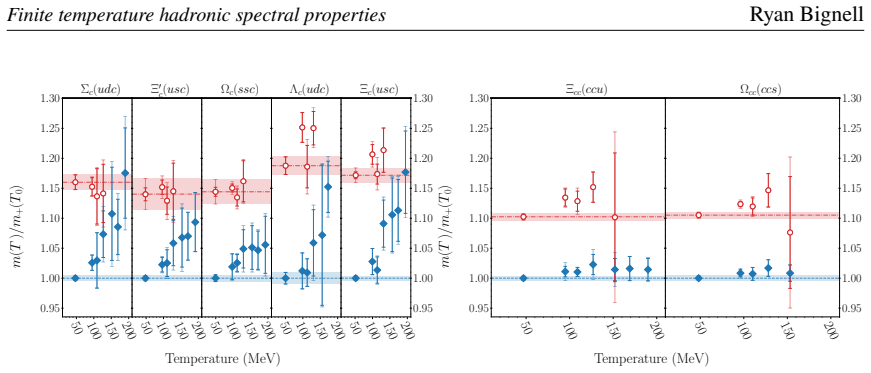
Using fixed-scale anisotropic lattice ensembles with temporal lattice spacings small enough to give a fine grid of temperatures, the paper tracks the ground-state masses of bottomonia and of spin-1/2 charm baryons across $T_c$. For bottomonia, it reconstructs the $\Upsilon$ spectral function with the maximum entropy method and separately fits the correlator with a sum of exponentials; the two approaches agree and indicate a negative mass shift of roughly 30-40 MeV at $T=250$ MeV, well past the chiral transition. The comparison between ensembles with pion mass 384 MeV and 239 MeV shows little dependence on the sea-quark mass once scale-setting uncertainties are accounted for. For charm baryons, a double ratio of correlators at finite and zero temperature is used to decide where exponential fits remain valid; the paper finds that positive-parity doubly charmed $\Xi_{cc}(ccu)$ stays at its zero-temperature mass up to about 190 MeV, while negative-parity states lose extractability at lower temperatures, indicating a stronger temperature sensitivity.
Load-bearing premise
The extraction assumes that each hadron remains a narrow peak in the thermal spectral function, so that a single exponential term can define its mass; if the state broadens into a continuum, the fitted mass becomes a weighted average or an artifact.
Editorial extensions
If this is right
- The $\Upsilon(1S)$ can be treated as a well-defined state in the quark-gluon plasma up to temperatures around 250 MeV, supporting quarkonium-suppression models that track its survival rather than immediate dissociation.
- The small sea-quark-mass dependence seen between the two ensembles suggests the qualitative thermal behaviour of bottomonia is robust against the unphysical pion mass.
- The stability of the positive-parity $\Xi_{cc}$ up to 190 MeV indicates doubly heavy baryons can persist above $T_c$, motivating their use as additional heavy-ion observables.
- The earlier loss of negative-parity charm baryons implies the thermal medium affects parity partners differently, changing the expected pattern of parity doubling.
Reading between the lines
- If the negative mass shift is physical, it provides a direct handle on the in-medium heavy-quark potential: a weaker binding at short distances would naturally lower the 1S mass before dissociation sets in.
- The double-ratio technique used for charm baryons could be applied to open-charm mesons or charmonia to identify which temperatures allow a quasi-particle mass assignment, giving a systematic map of hadron survival across species.
- A natural extension is to compute the same $\Xi_{cc}$ mass on finer lattices and with physical light quarks; if the stability persists, doubly charmed baryons become rare but clean probes of the early quark-gluon plasma.
Editorial analysis
A structured set of objections, weighed in public.
Referee Report
Summary. The paper reports progress from the FASTSUM collaboration on two topics: (i) the temperature dependence of bottomonium spectral properties extracted from NRQCD correlators on the Generation 2 and 2L ensembles, comparing Maximum Entropy Method (MEM) and multi-exponential GEVP analyses; and (ii) the temperature dependence of spin-1/2 charm baryon masses on Generation 2L, using a double-ratio method to select temperatures at which an exponential fit ansatz is deemed valid. The main quantitative claims are a 30–40 MeV negative mass shift of the Upsilon(1S) at T=250 MeV (Section 5) and an approximately constant positive-parity Xi_cc(ccu) mass up to T=190 MeV (Section 4). The paper also notes a sea-quark mass dependence of the bottomonium spectrum between the two ensembles.
Significance. If the claims hold, the paper provides evidence that heavy-quark hadron masses can shift at temperatures above the chiral transition while some doubly charmed baryons remain stable, complementing other lattice and effective-field-theory studies of quarkonium in the quark-gluon plasma. The analysis has notable strengths: the bottomonium mass shift is supported by two independent methods (MEM and exponential fits), the charm baryon analysis uses a carefully constructed double ratio with published data and code (Ref. [43]), and the paper is candid about the limitations of the exponential ansatz. However, the central quantitative claims lack a full uncertainty budget and rest on assumptions about the narrowness of the spectral function that are not yet fully tested.
major comments (4)
- [Section 5 and Fig. 2 (right)] The central quantitative claim of a 30–40 MeV negative mass shift of the Upsilon(1S) at T=250 MeV is quoted without an uncertainty estimate. The authors state in Section 3.3 that the MEM results after T=250 MeV may be an analysis artifact due to reduced N_tau, so the exponential fits are the only evidence at this temperature. Given the acknowledged systematics in the fit (N_exp, fit range, model averaging) and the scale-setting uncertainty, the abstract-level claim requires a quantitative error budget. Please report the statistical and systematic uncertainties on the shift at each temperature, including the contribution from the lattice spacing.
- [Section 3.3, Eq. (7)] The exponential fit ansatz models the correlator as a sum of delta-function peaks, as the authors note in Section 3.3. However, the reverse concern is not addressed: if the Upsilon(1S) spectral function develops a width or a continuum contribution at T≈250 MeV, the fitted mass from a multi-exponential fit is a weighted average over the fit window and can drift with the chosen tau-range and N_exp. The MEM agreement is supportive but not decisive, since MEM has its own default-model and N_tau systematics at high temperature. To support the claim that the negative shift is a spectral mass shift, please demonstrate stability of the extracted mass against tau-range and N_exp variations, or provide a cross-check with a method that explicitly allows a width, such as the Backus-Gilbert or time-derivative moment approaches referenced in Refs. [40,41].
- [Section 2, Table 1] The Gen2L temperature scale uses a_tau = 0.0330(2) fm from Ref. [18], while the anisotropy relation with a_s from Ref. [17] gives a_s/xi ≈ 0.03246(10) fm, a ~1.7% discrepancy. Since all temperatures in Table 1 and the comparison with T_c = 167(2)(1) MeV are based on a_tau, the temperature assignments and the statements "up to T=190 MeV" and "T=250 MeV" carry a systematic uncertainty of about 1.7%. The paper should justify the choice of scale, discuss the inconsistency, or quote the resulting temperature uncertainty.
- [Section 4, Eq. (10)] The double-ratio method in Eq. (10) selects temperatures at which the correlator is "minimally changed" from a model built using zero-temperature ground-state parameters, and then fits with the exponential ansatz of Eq. (7). This selection assumes that excited states at zero and finite temperature are broadly similar, as stated in Section 5. If excited states shift or the ground-state peak broadens at finite temperature, a ratio close to one can still yield a biased mass when fitted with a few exponentials. The remarkable constancy of the Xi_cc mass up to 190 MeV therefore rests on the assumed validity of the exponential ansatz in a temperature region where the spectral function may not be narrow. Please provide a cross-check, such as stability of the extracted mass versus the number of states and fit range, or a comparison with an alternative reconstruction method for at least one of the charm baryon channels.
minor comments (5)
- [Section 3.1] In the paragraph discussing Fig. 1, "closer closer" should be "closer".
- [Section 3.1, Fig. 1] The absence of the Upsilon(3S) peak in the MEM spectrum at zero temperature, while the GEVP analysis reproduces it, is unexplained. The authors note the operator-content difference (point-point versus matrix); please clarify whether this is expected and whether it affects the peak-position comparison at finite temperature.
- [Section 3.2, Fig. 2] In Fig. 2 (right), the legend labels the two analyses "MEM" and "Exponential"; specify that the exponential results are from the GEVP basis of Ref. [31] to avoid confusion with simple point-point exponential fits.
- [Section 4, Fig. 3] The figure caption could clarify the meaning of the inner and outer error bars and explicitly indicate that filled and open symbols correspond to positive and negative parity, respectively, in the caption text.
- [Section 2] The sentence "For Generation 2, a_s = 0.1205(8) while Generation 2L has a_s = 0.11208(31) fm [17] with pion masses of m_pi = 384(4),239(1) MeV respectively" is ambiguous; reorder to make clear which pion mass belongs to which ensemble.
Circularity Check
No significant circularity: central masses are extracted from correlators by independent fits, with only minor, non-load-bearing self-citations.
full rationale
The paper's central quantitative claims — the Upsilon(1S) negative mass shift at T≈250 MeV and the stability of Xi_cc up to T≈190 MeV — are obtained by fitting lattice correlators with the exponential ansätze of Eqs. (7) and (8) and by the maximum-entropy method. In both cases the mass parameters are free outputs of fits to the finite-temperature correlator data; they are not set to the zero-temperature values by construction. The NRQCD additive mass shift is tuned to the spin-averaged 1S mass and then cancels in the zero-temperature-subtracted mass difference, so the reported shift is a genuine difference between two separate determinations. The double-ratio method, Eq. (10), uses zero-temperature ground-state parameters only to construct a null model used to decide where the exponential fit is applicable; the finite-temperature masses themselves are obtained by independent fits at each selected temperature, and the figure caption explicitly states that masses are shown only where the ratio analysis supports the exponential ansatz. This is a validity criterion, not a derivation of the mass value. The self-citation to Ref. [31] for the fit range of the Upsilon is a methodological input, but the 30–40 MeV shift is produced by this paper's own fits and is cross-checked by MEM, which allows widths; the paper even flags the post-250 MeV MEM point as a possible artefact. No uniqueness theorem or ansatz is imported from the authors' prior work to force the result. The paper is self-contained against external benchmarks (PDG masses) and explicitly acknowledges its limitations (width not accessible, fit-range restrictions). Overall, no step in the derivation chain reduces by construction to its own inputs; at most there is a minor, non-load-bearing self-citation in the fit-range selection.
Assumptions & free parameters
free parameters (5)
- NRQCD bottom-quark mass =
tuned so spin-averaged 1S mass matches experiment (value not reported)
- MEM default model m(omega) =
chosen form, not specified numerically
- Laplace shift Delta =
not quoted
- Double-ratio fit-range threshold =
implicit; not quantified
- Gen2L NRQCD temporal scale a_tau =
0.0330(2) fm (from Ref. [18])
assumptions (6)
- domain assumption NRQCD expansion is valid at O(v^4) with tree-level coefficients for the bottomonium states studied.
- domain assumption The finite-temperature baryon correlator is a sum of a small number of exponential terms (delta-function spectral peaks) over the fitted temperature range.
- ad hoc to paper Excited states at zero and finite temperature contribute similarly to the double ratio.
- domain assumption Fixed-scale anisotropic lattice setup provides a reliable temperature scale T=1/(a_tau*N_tau) with fixed lattice spacing.
- ad hoc to paper The two scale determinations for Gen2L (a_s from Ref. [17] and a_tau from Ref. [18]) are mutually consistent despite the anisotropy relation giving a ~1.7% different a_tau.
- domain assumption MEM with Shannon-Jaynes entropy and Bryan's method produces unbiased spectral functions from the limited number of Euclidean time points.
Cite this review
Pith. "Pith review of Finite temperature hadronic spectral properties." pith.science (2026). https://pith.science/paper/SNVC2BZK
@misc{pith2026250515601,
  author       = {Pith},
  title        = {Pith review of: Finite temperature hadronic spectral properties},
  year         = {2026},
  howpublished = {\url{https://pith.science/paper/SNVC2BZK}},
  note         = {Machine review of arXiv:2505.15601}
}
read the original abstract
The FASTSUM collaboration has a long-standing project examining hadronic properties using anisotropic lattice QCD. We determine the spectral properties of bottomonia at finite temperature using lattice NRQCD and describe how our newer simulations improve our control over systematic errors. Motivated by these efforts, the temperature dependence of charm hadron masses is determined where it is found that temperature effects can extend into the confining phase and that some species remain stable deep past the pseudo-critical temperature.
Figures


Reference graph
Works this paper leans on
- [9]
-
[18]
D.J. Wilson, R.A. Briceno, J.J. Dudek, R.G. Edwards and C.E. Thomas,Coupled𝜋𝜋,𝐾¯𝐾 scattering in𝑃-wave and the𝜌resonance from lattice QCD,Phys. Rev. D92(2015) 094502 [1507.02599]. [19]Hadron Spectrumcollaboration,First results from 2+1 dynamical quark flavors on an anisotropic lattice: Light-hadron spectroscopy and setting the strange-quark mass,Phys. Rev....
arXiv 2015
-
[17]
D.J. Wilson, R.A. Briceno, J.J. Dudek, R.G. Edwards and C.E. Thomas,The quark-mass dependence of elastic𝜋𝐾scattering from QCD,Phys. Rev. Lett.123(2019) 042002 [1904.03188]. 10 Finite temperature hadronic spectral propertiesRyan Bignell
arXiv 2019
-
[43]
non-zero temperature study of spin 1/2 charmed baryons using lattice gauge theory
G. Aarts, C. Allton, M.N. Anwar, R. Bignell, T.J. Burns, B. Jaeger et al.,Dataset and scripts for "non-zero temperature study of spin 1/2 charmed baryons using lattice gauge theory", Aug., 2023. 10.5281/zenodo.8275973
- [1]
- [2]
- [3]
-
[4]
J.-I. Skullerud, G. Aarts, C. Allton, M.N. Anwar, R. Bignell, T.J. Burns et al.,Spectral properties of bottomonium at high temperature: a systematic investigation,PoSQCHSC24 (2025) 160 [2503.17315]
arXiv 2025
Show all 41 references
-
[5]
G.P.Lepage,L.Magnea,C.Nakhleh,U.MagneaandK.Hornbostel,Improvednonrelativistic QCD for heavy quark physics,Phys. Rev. D46(1992) 4052 [hep-lat/9205007]
1992 arXiv
-
[6]
Aarts, C
G. Aarts, C. Allton, S. Hands, B. Jäger, C. Praki and J.-I. Skullerud,Nucleons and parity doublingacrossthedeconfinementtransition,Phys.Rev.D92(2015)014503[1502.03603]
2015 arXiv
-
[7]
Aarts, C
G. Aarts, C. Allton, D. De Boni, S. Hands, B. Jäger, C. Praki et al.,Light baryons below and above the deconfinement transition: medium effects and parity doubling,JHEP06(2017) 034 [1703.09246]
2017 arXiv
-
[8]
Aarts, C
G. Aarts, C. Allton, D. De Boni and B. Jäger,Hyperons in thermal QCD: A lattice view, Phys. Rev. D99(2019) 074503 [1812.07393]
2019 arXiv
-
[10]
Aarts, C
G. Aarts, C. Allton, J. Glesaaen, S. Hands, B. Jäger, S. Kim et al.,Properties of the QCD thermal transition with Nf=2+1 flavors of Wilson quark,Phys. Rev. D105(2022) 034504 [2007.04188]
2022 arXiv
-
[11]
Aarts, C
G. Aarts, C. Allton, R. Bignell, T.J. Burns, S.C. García-Mascaraque, S. Hands et al.,Open charm mesons at nonzero temperature: results in the hadronic phase from lattice QCD, 2209.14681
-
[12]
Aarts et al.,Spectral quantities in thermal QCD: a progress report from the FASTSUM collaboration,PoSLATTICE2019(2019) 075 [1912.09827]
G. Aarts et al.,Spectral quantities in thermal QCD: a progress report from the FASTSUM collaboration,PoSLATTICE2019(2019) 075 [1912.09827]
2019 arXiv
-
[13]
Aarts, C
G. Aarts, C. Allton, A. Amato, P. Giudice, S. Hands and J.-I. Skullerud,Electrical conductivity and charge diffusion in thermal QCD from the lattice,JHEP02(2015) 186 [1412.6411]
2015 arXiv
-
[14]
Aarts, C
G. Aarts, C. Allton, A. Amato, R. Bignell, T.J. Burns, D. De Boni et al.,Fastsum generation 2 anisotropic thermal lattice qcd gauge ensembles, Oct., 2023. 10.5281/zenodo.8403827
2023 doi
-
[15]
Aarts, C
G. Aarts, C. Allton, M.N. Anwar, R. Bignell, T.J. Burns, S. Chaves Garcia-Mascaraque et al., Fastsum generation 2l anisotropic thermal lattice qcd gauge ensembles, Feb., 2024. 10.5281/zenodo.10636046
2024 doi
-
[16]
Edwards, B
R.G. Edwards, B. Joo and H.-W. Lin,Tuning for Three-flavors of Anisotropic Clover Fermions with Stout-link Smearing,Phys. Rev. D78(2008) 054501 [0803.3960]
2008 arXiv
-
[22]
Jay,Approaching the Inverse Problem: Toward Lattice QCD Calculations of Inclusive Hadronic Quantities, in41st International Symposium on Lattice Field Theory, 1, 2025 [2501.12259]
W. Jay,Approaching the Inverse Problem: Toward Lattice QCD Calculations of Inclusive Hadronic Quantities, in41st International Symposium on Lattice Field Theory, 1, 2025 [2501.12259]
2025 arXiv
-
[23]
Asakawa, T
M. Asakawa, T. Hatsuda and Y. Nakahara,Maximum entropy analysis of the spectral functions in lattice QCD,Prog. Part. Nucl. Phys.46(2001) 459 [hep-lat/0011040]
2001 arXiv
-
[24]
Aarts, C
G. Aarts, C. Allton, M.B. Oktay, M. Peardon and J.-I. Skullerud,Charmonium at high temperature in two-flavor QCD,Phys. Rev. D76(2007) 094513 [0705.2198]
2007 arXiv
-
[25]
Bryan,Maximum entropy analysis of oversampled data problems,European Biophysics Journal18(1990) 165
R.K. Bryan,Maximum entropy analysis of oversampled data problems,European Biophysics Journal18(1990) 165
1990
-
[26]
Lombardoetal.,SpectralReconstruction in NRQCD via the Backus-Gilbert Method,PoSLATTICE2021(2022) 134 [2112.02075]
B.Page, G.Aarts, C.Allton, B.Jäger, S.Kim, M.P. Lombardoetal.,SpectralReconstruction in NRQCD via the Backus-Gilbert Method,PoSLATTICE2021(2022) 134 [2112.02075]
2022 arXiv
-
[27]
Page,Novel approaches to the study of the heavy meson spectrum at finite temperature, Ph.D
B. Page,Novel approaches to the study of the heavy meson spectrum at finite temperature, Ph.D. thesis, Swansea University, 2024, http://dx.doi.org/10.23889/SUThesis.66882. [28]Particle Data Group Collaborationcollaboration,Review of particle physics,Phys. Rev. D110(2024) 030001
2024 doi
-
[29]
Michael,Adjoint Sources in Lattice Gauge Theory,Nucl
C. Michael,Adjoint Sources in Lattice Gauge Theory,Nucl. Phys. B259(1985) 58
1985
-
[30]
Blossier, M
B. Blossier, M. Della Morte, G. von Hippel, T. Mendes and R. Sommer,On the generalized eigenvalue method for energies and matrix elements in lattice field theory,JHEP04(2009) 094 [0902.1265]
2009 arXiv
-
[31]
Bignell et al.,Anisotropic excited bottomonia from a basis of smeared operators,PoS LATTICE2024(2025) 202 [2502.03185]
R. Bignell et al.,Anisotropic excited bottomonia from a basis of smeared operators,PoS LATTICE2024(2025) 202 [2502.03185]
2025 arXiv
-
[32]
Rinaldi, S
E. Rinaldi, S. Syritsyn, M.L. Wagman, M.I. Buchoff, C. Schroeder and J. Wasem,Lattice QCD determination of neutron-antineutron matrix elements with physical quark masses, Phys. Rev. D99(2019) 074510 [1901.07519]. 11 Finite temperature hadronic spectral propertiesRyan Bignell [...
2019 arXiv
-
[34]
Jay and E.T
W.I. Jay and E.T. Neil,Bayesian model averaging for analysis of lattice field theory results, Phys. Rev. D103(2021) 114502 [2008.01069]. [35]HPQCDcollaboration,The Upsilon spectrum and the determination of the lattice spacing from lattice QCD including charm quarks in the sea,...
2021 arXiv
-
[36]
Hudspith and D
R.J. Hudspith and D. Mohler,Exotic tetraquark states with two b¯quarks and JP=0+ and 1+ Bs states in a nonperturbatively tuned lattice NRQCD setup,Phys. Rev. D107(2023) 114510 [2303.17295]
2023 arXiv
-
[37]
Andronic et al.,Comparative study of quarkonium transport in hot QCD matter,Eur
A. Andronic et al.,Comparative study of quarkonium transport in hot QCD matter,Eur. Phys. J. A60(2024) 88 [2402.04366]
2024 arXiv
-
[38]
Massacrier,Measurements of quarkonia production,EPJ Web Conf.316(2025) 01014 [2411.16570]
L. Massacrier,Measurements of quarkonia production,EPJ Web Conf.316(2025) 01014 [2411.16570]
2025 arXiv
-
[39]
Andronic and R
A. Andronic and R. Arnaldi,Quarkonia and Deconfined Quark-Gluon Matter in Heavy-Ion Collisions,2501.08290
-
[40]
D’arcy et al.,NRQCD Bottomonium at non-zero temperature using time-derivative moments,PoSLATTICE2024(2025) 203 [2502.03951]
R.H. D’arcy et al.,NRQCD Bottomonium at non-zero temperature using time-derivative moments,PoSLATTICE2024(2025) 203 [2502.03951]
2025 arXiv
-
[41]
Smecca et al.,The NRQCDΥspectrum at non-zero temperatures using Backus-Gilbert regularisations,PoSLATTICE2024(2025) 197 [2502.03060]
A. Smecca et al.,The NRQCDΥspectrum at non-zero temperatures using Backus-Gilbert regularisations,PoSLATTICE2024(2025) 197 [2502.03060]
2025 arXiv
-
[42]
Skullerud, G
J.-I. Skullerud, G. Aarts, C. Allton, M.N. Anwar, R. Bignell, T. Burns et al.,Hadrons at high temperature: An update from the FASTSUM collaboration,EPJ Web Conf.274(2022) 05011 [2211.13717]
2022 arXiv
-
[44]
Bignell, S
R. Bignell, S. Kim and D.K. Sinclair,NRQCD: Non-relativistic qcd propagator and correlator code for bottomonium, Oct., 2024.https://gitlab.com/fastsum/NRQCD
2024
-
[45]
Glesaaen,openqcd-hadspec, Sept., 2018
J. Glesaaen,openqcd-hadspec, Sept., 2018. 10.5281/zenodo.2217027
2018 doi
-
[46]
Lepage, C
P. Lepage, C. Gohlke and D. Hackett,gplepage/gvar: gvar version 13.1.1, Jan., 2025. 10.5281/zenodo.592129
2025 doi
-
[47]
Lepage and C
P. Lepage and C. Gohlke,gplepage/lsqfit: lsqfit version 13.2.3, Feb., 2025. https://doi.org/10.5281/zenodo.592174. 12
2025 doi
Reviewed August 7, 2026 · model on record in the stance chip above.
Discussion (0). Sign in to comment.