REVIEW 3 major objections 5 minor 1 cited by
The Lyman-alpha Halos of Galaxies at z=2-3 in the Keck Baryonic Structure Survey
T0 review · 3 major / 5 minor · reviewed 2026-08-07 · deepseek-v4-flash
Pith's one-line read Galaxies whose cores absorb Lyman-alpha still emit it at 50 kpc and beyond.
desk verdict A solid, honest data paper with one genuinely new capability (fitting central Lyα absorbers), but the headline spatial-match claim needs a robustness check with recovery tests before it can be taken at face value. read the letter →
The pith
A machine-rendered reading of the paper's core claim, the machinery that carries it, and where it could break.
The reading
What carries the argument
The load-bearing instrument is an empirical large-scale point-spread function built from 17–46 stars per field, represented by an analytic core-wing profile fit to each star and extrapolated beyond roughly 5 arcseconds, then smoothed and matched across fields so that a single effective PSF can be convolved with analytic surface-brightness models. Each Lyman-$\alpha$ stack is fit with a seven-parameter forward model consisting of two exponentials (a central 'galaxy' component and an outer 'halo' component), a constant background, and center coordinates; the central amplitude is allowed to be negative, which is what lets the same model absorb or emit at the center. Parameterizing each exponential by its flux within $R=50$ kpc stabilizes the fit, and the derived fraction $f_{\mathrm{gal}}^{\mathrm{Ly}\alpha}$ measures how much of the total Lyman-$\alpha$ flux belongs to the central component. A parallel direct exponential fit to the one-dimensional profile reproduces the earlier literature method, and encircled equivalent-width curves turn the fitted profiles into an aperture-dependent statement about who counts as a Lyman-$\alpha$ emitter.
What would settle it
Re-run the same stacking and forward modeling while replacing the stellar PSF with a PSF constructed from a different source class or measured only over the inner arcseconds, and vary the background subtraction by its uncertainty; if the net 50 kpc equivalent width changes sign or the halo scale lengths fall below about 5 kpc under any of those choices, the universality claim would not survive.
Extended reading notes
Core claim
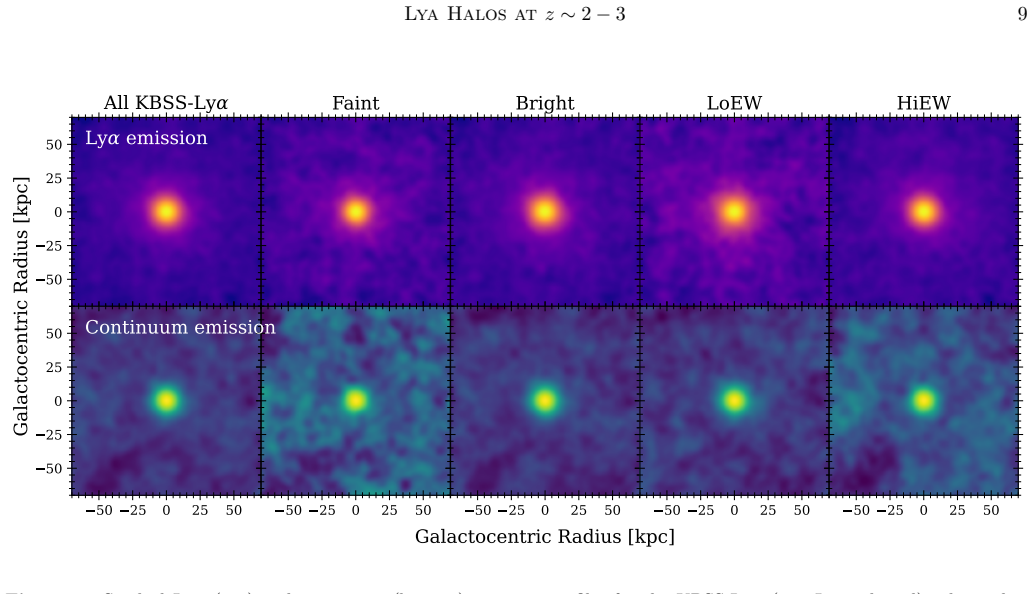
Using stacks of 734 Lyman-$\alpha$-selected and 119 UV-continuum-selected galaxies in nine fields at mean redshift $z\approx2.6$, the paper claims that extended Lyman-$\alpha$ emission is universal: every stack, including the 55-galaxy stack with net central Lyman-$\alpha$ absorption, has net positive Lyman-$\alpha$ flux within a 50 kpc aperture. Direct exponential fits give halo scale lengths $r_0 \approx 10$–21 kpc, several times the continuum scale lengths, and the forward-modeled halo scale lengths are $r_{0,\mathrm{halo}} \approx 9$–21 kpc. The fitted central Lyman-$\alpha$ component has a scale length of roughly 1–3 kpc, consistent with the fitted continuum scale length, even in absorbing stacks, indicating that the absorbing gas is co-located with the UV-bright stars. The paper further finds only weak dependence of halo scale on galaxy luminosity or Lyman-$\alpha$ equivalent width, with a slight tendency for continuum-faint, high-equivalent-width galaxies to have larger halos, in contrast to some earlier stacked surveys.
Load-bearing premise
The claim that even central Lyman-alpha absorbers are net emitters at 50 kpc assumes that the point-spread function built from stars, after smoothing and field matching, faithfully represents how extended Lyman-alpha light is spread, and that the sky background is flat and correctly subtracted at those radii.
Editorial extensions
If this is right
- For every stacked subsample, Lyman-alpha light extends well beyond the UV continuum, with halo exponential scale lengths around 10–20 kpc regardless of central galaxy luminosity or equivalent width.
- Galaxies classified as net Lyman-alpha absorbers in small apertures become net emitters within a 50 kpc aperture, so the emitter/absorber label is aperture-dependent rather than intrinsic.
- The central Lyman-alpha component's fitted scale length matches the continuum scale length of roughly 1–3 kpc, even for absorbing stacks, placing the absorbing gas on the same spatial scale as the stars.
- Encircled equivalent width grows by factors of 2–3 from the center out to 50–70 kpc, so slit-based classifications can underestimate the total Lyman-alpha output of a galaxy.
- Continuum-faint, high-equivalent-width galaxies tend to have slightly larger halos, opposite to the trends reported by some earlier stacked surveys.
Reading between the lines
- Editorial inference: The universality claim rests on the large-radius behavior of the stellar PSF; a PSF with slightly more power in its wings than the true extended-source profile would inflate halo scale lengths, so reconstructing the PSF from extended sources would be a sharper test.
- Editorial inference: Because the analysis fixes one stacking recipe, the quoted uncertainties are formal lower bounds; varying the sigma-clipping threshold and flux scaling could move the scale lengths by more than the quoted 1-sigma errors.
- Editorial inference: The near-constancy of halo scale across galaxy properties hints that environment, such as Mpc-scale overdensity, may matter more than luminosity or equivalent width; the paper's quasar-centered fields are plausibly overdense, a possibility it flags for future work.
- Editorial inference: Literature differences between integral-field halo scales near 5 kpc and the 10–20 kpc scales found here and in other stacked surveys may stem from instrument- and method-dependent systematics, so cross-survey trends in halo size should not be read as purely physical until a common pipeline is applied to all data.
Editorial analysis
A structured set of objections, weighed in public.
Referee Report
Summary. The paper presents the Keck/LRIS narrowband Lyα imaging of the KBSS-Lyα survey for the first time and uses stacked imaging of 734 Lyα-selected and 119 continuum-selected galaxies at 2<z<3 to measure the spatial extent of Lyα and UV continuum emission. Radial profiles are characterized with two methods: direct exponential fits to the 1D azimuthally averaged profiles, and a PSF-convolved dual-exponential forward model that allows a central 'galaxy' component of either positive or negative amplitude plus an extended 'halo' component. The central results are that all stacked subsamples, including those with net central Lyα absorption, show net Lyα emission on scales R>50 kpc; that the forward-modeled central Lyα component has a scale length consistent with the continuum scale length, including for the absorbing subsample; and that the halo scale length shows only weak dependence on M_UV and EW_Lyα, possibly in the sense of larger halos for fainter, high-EW galaxies. The paper also compares the results with earlier KBSS, MUSE, and Subaru measurements.
Significance. If the central claims hold, the paper would establish that Lyα halos are a generic property of star-forming galaxies at z~2-3, extending even to galaxies whose small-aperture spectra show net Lyα absorption, and it would provide the first quantitative comparison of the spatial scale of central Lyα absorption with the stellar continuum. The paper has notable strengths: it presents a large, homogeneous imaging data set; it cross-checks the halo measurements with two independent fitting methods; it provides bootstrap uncertainties; and it explicitly acknowledges that the fixed stacking methodology makes reported uncertainties lower bounds on the total systematic uncertainty (Sec. 5.3). The near-equality of f_gal^Lyα with the ratio of small-aperture to 50 kpc EW_Lyα is correctly identified by the authors as a consistency check rather than independent evidence (Sec. 5.1). The most fragile load-bearing claim is the scale match of the central Lyα absorption component, which relies on the recovery of a negative compact exponential against the positive halo and the PSF wings without a demonstrated recovery test.
major comments (3)
- [Sec. 4.2, Table 3, Fig. 11, and Abstract] The abstract states that the spatial scale of central Lyα 'approximately matches' that of the continuum emission, and Sec. 5.2 extends this to the KBSS All and Abs stacks where the central Lyα component is negative. This claim is not equally supported for all stacks: for KBSS All, Table 3 reports only a 2σ upper limit r0,gal<2.7 kpc, so the scale of the absorbing component is not actually measured for the full KBSS stack. For KBSS Abs, the quoted r0,gal=1.7±0.3 kpc is precise, but the paper presents no injection-recovery test demonstrating that a negative compact exponential can be recovered when convolved with the empirical PSF and superposed on a positive halo. Without such a test, the agreement with r0,cont=1.8±0.1 kpc may reflect the model priors and the PSF-wing shape rather than a physical co-location of absorbing gas and stars. I request a recovery test using synthetic stacks with known negative galaxy components and positive halos, fit through the same pipeline, and a revised abstract that restricts the scale-match claim to the stacks for which it is actually constrained.
- [Appendix A and Sec. 4.2] The forward-modeling results depend on the assumption that the empirical stellar PSF, after iterative smoothing to a common 'broadest PSF' and with the outer region (θ>10'') replaced by a Moffat model, accurately describes the light spread of the extended galaxy-plus-halo emission at all fitted radii. A mismatch between the stellar PSF and the true extended-source PSF at intermediate radii (≈1-5 arcsec) would be partially absorbed by the central exponential terms, biasing r0,gal toward the continuum scale and also affecting r0,halo. The paper currently provides no quantitative test of this sensitivity. I recommend repeating the fits with alternative PSF constructions (e.g., unsmoothed field PSFs, pure Moffat PSFs, different transition radii, and PSFs with artificially modified wing amplitude) and reporting the resulting scatter in r0,gal and r0,halo as a systematic uncertainty. This is a necessary check for the specific claim of co-located central absorption and continuum emission.
- [Sec. 5.3, Table 3, Fig. 13, and Summary item 6] The claimed weak trends of halo scale length with M_UV and EW_Lyα are not robustly established by the present analysis. In Table 3, the direct exponential fits give r0,dir(LoEW)=18.5±3.4 kpc versus r0,dir(HiEW)=20.2±2.5 kpc, and r0,dir(Faint)=21.3±5.0 versus r0,dir(Bright)=21.2±2.8 kpc, i.e., no significant difference; the apparent trends come from the forward-modeled r0,halo values with asymmetric bootstrap uncertainties. Because the stacking method is fixed, these uncertainties do not include the effect of different sigma-clipping thresholds, weighting, or background corrections, which the authors themselves note in Sec. 5.3 would increase the inferred variation particularly for the KBSS All and Abs stacks. The paper should either marginalize over a range of stacking choices and report the resulting uncertainties on the trend, or explicitly present the trend as not significant pending such an analysis. The current wording in Summary item 6 ('we find a weakly negative relationship... as well as a weak positive correlation') overstates the evidence given the acknowledged systematics.
minor comments (5)
- [Sec. 4.2] The phrase 'other recent students of Lyαhalos' should read 'other recent studies of Lyα halos'.
- [Sec. 6.3] In the footnote describing the S. Kikuta et al. (2023) models, 'our on work' should read 'our own work'.
- [Sec. 2.1] The word 'correponding' on the NB filter description should be 'corresponding'.
- [Sec. 6.1.2] The sentence containing 'all of the the observed profiles' has a duplicated 'the' and should be corrected.
- [Fig. 5 caption] The caption of Figure 5 describes the continuum profiles as 'as in Fig. 5', but the intended cross-reference is likely to Fig. 4.
Circularity Check
No significant circularity: the fitted scale lengths and halo parameters are outputs of the measurement chain, not inputs; the one near-tautology is explicitly acknowledged and used only as a consistency check.
full rationale
The paper's central claims are measured quantities, not derived quantities that reduce to their own inputs. The Ly-alpha and continuum stamps are constructed from narrowband and broadband images using Eqs. 3-4 and stacked with bootstrap resampling (Sec. 3.3). The two profile-fitting methods (direct exponential fits in Sec. 4.1 and PSF-convolved dual-exponential forward modeling in Sec. 4.2) are independent analyses of these stacks. The recovered scale lengths r0,halo and r0,gal, the flux fraction f_gal, and the aperture-dependent EW curves are outputs of the fits and direct photometry, not fitted parameters that are then relabeled as predictions. The one nearly tautological relation is explicitly identified by the authors: the near-identity of f_gal with the ratio EW(5 kpc)/EW50 in Fig. 10 is described as 'may therefore appear tautological' and is used only as 'a useful check that the integrated flux of the PSF-convolved exponential profiles yield very similar descriptions... to their direct measurements in circular apertures.' It is not used as evidence for a physical claim. The claim that the central Ly-alpha scale matches the continuum scale is a comparison of two separately fitted parameters from the same model; the only hard prior, r0,gal < 5 kpc and r0,halo > 5 kpc, separates components but does not force the Ly-alpha and continuum galaxy scales to agree. The authors even flag the KBSS All case as an unconstrained upper limit (<2.7 kpc), so no circular overclaim is made there. Self-citations (T13/T15/T16 for survey design, Steidel et al. 2011 for comparison) supply sample definitions and prior measurements, but the halos and profiles in this paper are newly measured from the imaging data presented here, and comparisons to external MUSE, Subaru, and KCWI samples provide independent empirical benchmarks. The empirical stellar PSF is an assumption that could bias results, and the authors note that fixed stacking methodology makes uncertainties lower bounds, but this is a systematic-error concern about the measurement, not a circularity in which an input is equivalent to the claimed output.
Assumptions & free parameters
free parameters (3)
- Annulus range for direct exponential fits to Lyα (20-60 kpc) =
20-60 kpc
- Component separation threshold r0 = 5 kpc =
5 kpc
- Sigma-clipping thresholds in stacking =
2.5σ (KBSS-Lyα), 4σ (KBSS)
assumptions (5)
- domain assumption The empirical PSF built from stars is representative of the PSF for extended galaxy+halo emission at all fitted radii.
- domain assumption The Lyα sky background is constant after subtraction; no radial oversubtraction as seen in the continuum.
- domain assumption The stacked, sigma-clipped, flux-scaled images are unbiased representations of the underlying galaxy sample.
- domain assumption A two-exponential model (galaxy + halo) convolved with the PSF adequately describes the Lyα surface brightness distribution.
- domain assumption QSO redshift is a good proxy for the redshift of Lyα-selected galaxies.
Cite this review
Pith. "Pith review of The Lyman-alpha Halos of Galaxies at z=2-3 in the Keck Baryonic Structure Survey." pith.science (2026). https://pith.science/paper/3AYUEBHK
@misc{pith2026250515881,
  author       = {Pith},
  title        = {Pith review of: The Lyman-alpha Halos of Galaxies at z=2-3 in the Keck Baryonic Structure Survey},
  year         = {2026},
  howpublished = {\url{https://pith.science/paper/3AYUEBHK}},
  note         = {Machine review of arXiv:2505.15881}
}
read the original abstract
We present the large-scale spatial Lya profiles of galaxies from the Keck Baryonic Structure Survey (KBSS) at 2<z<3. This work also describes the Lya imaging for the KBSS-Lya survey for the first time. Our sample includes 734 Lya-selected galaxies and 119 continuum-selected galaxies with Lya narrow-band imaging, and we measure the spatial morphology of Lya and continuum emission for stacked subsamples of these two populations. These samples allow us to study the variation in Lya emission profiles over a broad range of UV continuum luminosities and Lya equivalent widths (EW_Lya), including systems with net Lya absorption in slit spectroscopy. We characterize the spatial profiles using two techniques: directly fitting an exponential function to the stacked profile, and a multi-component forward-modeling technique using the empirical large-scale PSF. We find that both methods yield similar results and that the forward-modeling technique self-consistently fits profiles exhibiting central Lya emission or Lya absorption, with the spatial scale of central Lya approximately matching that of the continuum emission. We also find extended Lya emission such that all our subsamples -- including central Lya absorbers -- are net Lya emitters on scales comparable to the circumgalactic medium (R > 50 kpc, theta > 6''). We find that the scale length of the Lya halo is not strongly dependent on the properties of the central galaxy, including its net continuum luminosity or EW_Lya, although we find a possible weak tendency of continuum-faint, high-EW_Lya galaxies to exhibit larger Lya halos in contrast with previous work.
Figures


Figures from the paper (13 more)


Forward citations
Cited by 1 Pith paper
-
CECILIA: Ultra-Deep Rest-Optical Spectra of Faint Galaxies at Cosmic Noon
Ultra-deep JWST/NIRSpec spectra of nine faint galaxies at z~2.5 yield low SFRs, low dust, low electron densities, and hints of a very-low-metallicity turnover in the [OIII]/Hβ diagnostic.
Reference graph
Works this paper leans on
-
[1]
Adelberger, K. L., Shapley, A. E., Steidel, C. C., et al. 2005, ApJ, 629, 636, doi: 10.1086/431753
doi:10.1086/431753 2005
-
[2]
Adelberger, K. L., Steidel, C. C., Shapley, A. E., & Pettini, M. 2003, ApJ, 584, 45, doi: 10.1086/345660 Astropy Collaboration, Robitaille, T. P., Tollerud, E. J., et al. 2013, A&A, 558, A33, doi: 10.1051/0004-6361/201322068 Astropy Collaboration, Price-Whelan, A. M., Sip˝ ocz, B. M., et al. 2018, AJ, 156, 123, doi: 10.3847/1538-3881/aabc4f Astropy Collab...
doi:10.1086/345660 2003
-
[3]
2010, in Society of Photo-Optical Instrumentation Engineers (SPIE) Conference Series, Vol
Bacon, R., Accardo, M., Adjali, L., et al. 2010, in Society of Photo-Optical Instrumentation Engineers (SPIE) Conference Series, Vol. 7735, Ground-based and Airborne Instrumentation for Astronomy III, ed. I. S. McLean, S. K. Ramsay, & H. Takami, 773508, doi: 10.1117/12.856027
-
[4]
Behroozi, P. S., Wechsler, R. H., & Conroy, C. 2013, ApJ, 770, 57, doi: 10.1088/0004-637X/770/1/57
-
[5]
1996, A&AS, 117, 393, doi: 10.1051/aas:1996164
Bertin, E., & Arnouts, S. 1996, A&AS, 117, 393, doi: 10.1051/aas:1996164
-
[6]
2017, ApJ, 837, 71, doi: 10.3847/1538-4357/aa5d14
Cai, Z., Fan, X., Yang, Y., et al. 2017, ApJ, 837, 71, doi: 10.3847/1538-4357/aa5d14
-
[7]
2017, in Astrophysics and Space Science
Cantalupo, S. 2017, in Astrophysics and Space Science
2017
-
[8]
430, Gas Accretion onto Galaxies, ed
Library, Vol. 430, Gas Accretion onto Galaxies, ed. A. Fox & R. Dav´ e, 195, doi: 10.1007/978-3-319-52512-99
Show all 88 references
- [9]
-
[11]
S., Johnson, S
Chen, H.-W., Zahedy, F. S., Johnson, S. D., et al. 2018, MNRAS, 479, 2547, doi: 10.1093/mnras/sty1541
2018 doi
-
[12]
C., Hummels, C
Chen, Y., Steidel, C. C., Hummels, C. B., et al. 2020, MNRAS, 499, 1721, doi: 10.1093/mnras/staa2808
2020 doi
-
[13]
C., Erb, D
Chen, Y., Steidel, C. C., Erb, D. K., et al. 2021, MNRAS, 508, 19, doi: 10.1093/mnras/stab2383
2021 doi
-
[14]
J., Rudie, G
Cooper, T. J., Rudie, G. C., Chen, H.-W., et al. 2021, MNRAS, 508, 4359, doi: 10.1093/mnras/stab2869
2021 doi
-
[15]
K., Bogosavljevi´ c, M., & Steidel, C
Erb, D. K., Bogosavljevi´ c, M., & Steidel, C. C. 2011, ApJL, 740, L31, doi: 10.1088/2041-8205/740/1/L31
2011 doi
-
[16]
K., Li, Z., Steidel, C
Erb, D. K., Li, Z., Steidel, C. C., et al. 2023, ApJ, 953, 118, doi: 10.3847/1538-4357/acd849
2023 doi
-
[17]
K., Pettini, M., Steidel, C
Erb, D. K., Pettini, M., Steidel, C. C., et al. 2016, ApJ, 830, 52, doi: 10.3847/0004-637X/830/1/52
2016 doi
-
[18]
K., Shapley, A
Erb, D. K., Shapley, A. E., Pettini, M., et al. 2006, ApJ, 644, 813, doi: 10.1086/503623
2006 doi
-
[19]
J., Hagen, A., Ciardullo, R., et al
Feldmeier, J. J., Hagen, A., Ciardullo, R., et al. 2013, ApJ, 776, 75, doi: 10.1088/0004-637X/776/2/75
2013 doi
-
[20]
Fielding, D., Quataert, E., McCourt, M., & Thompson, T. A. 2017, MNRAS, 466, 3810, doi: 10.1093/mnras/stw3326
2017 doi
-
[21]
B., Oppenheimer, B
Ford, A. B., Oppenheimer, B. D., Dav´ e, R., et al. 2013, MNRAS, 432, 89, doi: 10.1093/mnras/stt393
2013 doi
-
[22]
W., Lang, D., & Goodman, J
Foreman-Mackey, D., Hogg, D. W., Lang, D., & Goodman, J. 2013, PASP, 125, 306, doi: 10.1086/670067
2013 doi
-
[23]
G., Cantalupo, S., Lilly, S., et al
Gallego, S. G., Cantalupo, S., Lilly, S., et al. 2018, MNRAS, 475, 3854, doi: 10.1093/mnras/sty037
2018 doi
-
[24]
G., Cantalupo, S., Sarpas, S., et al
Gallego, S. G., Cantalupo, S., Sarpas, S., et al. 2021, MNRAS, 504, 16, doi: 10.1093/mnras/stab796
2021 doi
-
[25]
2012, ApJ, 746, 125, doi: 10.1088/0004-637X/746/2/125
Haardt, F., & Madau, P. 2012, ApJ, 746, 125, doi: 10.1088/0004-637X/746/2/125
2012 doi
-
[26]
2000, ApJL, 537, L5, doi: 10.1086/312754
Haiman, Z., Spaans, M., & Quataert, E. 2000, ApJL, 537, L5, doi: 10.1086/312754
2000 doi
-
[27]
R., Millman, K
Harris, C. R., Millman, K. J., van der Walt, S. J., et al. 2020, Nature, 585, 357, doi: 10.1038/s41586-020-2649-2
2020 doi
-
[28]
2013, ApJL, 765, L27, doi: 10.1088/2041-8205/765/2/L27
Hayes, M., ¨Ostlin, G., Schaerer, D., et al. 2013, ApJL, 765, L27, doi: 10.1088/2041-8205/765/2/L27
2013 doi
-
[29]
2014, ApJ, 782, 6, doi: 10.1088/0004-637X/782/1/6
Hayes, M., ¨Ostlin, G., Duval, F., et al. 2014, ApJ, 782, 6, doi: 10.1088/0004-637X/782/1/6
2014 doi
-
[30]
2015, Science, 348, 779, doi: 10.1126/science.aaa539710.48550/arXiv.1505.03786
Arrigoni-Battaia, F. 2015, Science, 348, 779, doi: 10.1126/science.aaa539710.48550/arXiv.1505.03786
2015
-
[31]
B., Smith, B
Hummels, C. B., Smith, B. D., Hopkins, P. F., et al. 2019, ApJ, 882, 156, doi: 10.3847/1538-4357/ab378f
2019 doi
-
[32]
Hunter, J. D. 2007, Computing in Science and Engineering, 9, 90, doi: 10.1109/MCSE.2007.55
2007 doi
-
[33]
2018, MNRAS, 480, 5140, doi: 10.1093/mnras/sty2214
Kakiichi, K., & Dijkstra, M. 2018, MNRAS, 480, 5140, doi: 10.1093/mnras/sty2214
2018 doi
-
[34]
2019, PASJ, 71, L2, doi: 10.1093/pasj/psz055
Kikuta, S., Matsuda, Y., Cen, R., et al. 2019, PASJ, 71, L2, doi: 10.1093/pasj/psz055
2019 doi
-
[35]
2023, ApJ, 947, 75, doi: 10.3847/1538-4357/acbf30
Kikuta, S., Matsuda, Y., Inoue, S., et al. 2023, ApJ, 947, 75, doi: 10.3847/1538-4357/acbf30
2023 doi
-
[36]
2022, arXiv e-prints, arXiv:2201.07257
Kusakabe, H., Verhamme, A., Blaizot, J., et al. 2022, arXiv e-prints, arXiv:2201.07257. https://arxiv.org/abs/2201.07257
2022 arXiv
-
[37]
2015, ApJ, 806, 46, doi: 10.1088/0004-637X/806/1/46
Lake, E., Zheng, Z., Cen, R., et al. 2015, ApJ, 806, 46, doi: 10.1088/0004-637X/806/1/46
2015 doi
-
[38]
W., Prochaska, J
Lau, M. W., Prochaska, J. X., & Hennawi, J. F. 2016, ApJS, 226, 25, doi: 10.3847/0067-0049/226/2/25
2016 doi
-
[39]
W., Prochaska, J
Lau, M. W., Prochaska, J. X., & Hennawi, J. F. 2018, ApJ, 857, 126, doi: 10.3847/1538-4357/aab78e
2018 doi
-
[40]
2007, ApJL, 657, L69, doi: 10.1086/513191
Laursen, P., & Sommer-Larsen, J. 2007, ApJL, 657, L69, doi: 10.1086/513191
2007 doi
-
[41]
2017, A&A, 608, A8, doi: 10.1051/0004-6361/201731480
Leclercq, F., Bacon, R., Wisotzki, L., et al. 2017, A&A, 608, A8, doi: 10.1051/0004-6361/201731480
2017 doi
-
[42]
2020, A&A, 635, A82, doi: 10.1051/0004-6361/201937339 Lujan Niemeyer, M., Komatsu, E., Byrohl, C., et al
Leclercq, F., Bacon, R., Verhamme, A., et al. 2020, A&A, 635, A82, doi: 10.1051/0004-6361/201937339 Lujan Niemeyer, M., Komatsu, E., Byrohl, C., et al. 2022, ApJ, 929, 90, doi: 10.3847/1538-4357/ac5cb8
2020 doi
-
[43]
2014, ARA&A, 52, 415, doi: 10.1146/annurev-astro-081811-125615
Madau, P., & Dickinson, M. 2014, ARA&A, 52, 415, doi: 10.1146/annurev-astro-081811-125615
2014 doi
-
[44]
L., Dijkstra, M., Henry, A., et al
Martin, C. L., Dijkstra, M., Henry, A., et al. 2015, ApJ, 803, 6, doi: 10.1088/0004-637X/803/1/6
2015 doi
-
[46]
C., O’Sullivan, D., Matuszewski, M., et al
Martin, D. C., O’Sullivan, D., Matuszewski, M., et al. 2019, Nature Astronomy, 3, 822, doi: 10.1038/s41550-019-0791-2 Lya Halos atz∼2−3 25
2019 doi
-
[47]
2016, ApJ, 822, 84, doi: 10.3847/0004-637X/822/2/84
Mas-Ribas, L., & Dijkstra, M. 2016, ApJ, 822, 84, doi: 10.3847/0004-637X/822/2/84
2016 doi
-
[48]
F., et al
Mas-Ribas, L., Dijkstra, M., Hennawi, J. F., et al. 2017, ApJ, 841, 19, doi: 10.3847/1538-4357/aa704e
2017 doi
-
[49]
V., & Anderson, E
Massey, P., Strobel, K., Barnes, J. V., & Anderson, E. 1988, ApJ, 328, 315, doi: 10.1086/166294
1988 doi
-
[50]
2004, AJ, 128, 569, doi: 10.1086/42202010.48550/arXiv.astro-ph/0405221
Matsuda, Y., Yamada, T., Hayashino, T., et al. 2004, AJ, 128, 569, doi: 10.1086/42202010.48550/arXiv.astro-ph/0405221
2004
-
[52]
D., Blaizot, J., Cadiou, C., et al
Mitchell, P. D., Blaizot, J., Cadiou, C., et al. 2021, MNRAS, 501, 5757, doi: 10.1093/mnras/stab035
2021 doi
-
[53]
2014, MNRAS, 442, 110, doi: 10.1093/mnras/stu825
Momose, R., Ouchi, M., Nakajima, K., et al. 2014, MNRAS, 442, 110, doi: 10.1093/mnras/stu825
2014 doi
-
[54]
2016, MNRAS, 457, 2318, doi: 10.1093/mnras/stw021
Momose, R., Ouchi, M., Nakajima, K., et al. 2016, MNRAS, 457, 2318, doi: 10.1093/mnras/stw021
2016 doi
-
[55]
G., Levine, S
Monet, D. G., Levine, S. E., Canzian, B., et al. 2003, AJ, 125, 984, doi: 10.1086/345888
2003 doi
-
[56]
C., et al
Morrissey, P., Matuszewski, M., Martin, D. C., et al. 2018, ApJ, 864, 93, doi: 10.3847/1538-4357/aad597
2018 doi
-
[58]
Oke, J. B. 1990b, AJ, 99, 1621, doi: 10.1086/115444
-
[59]
B., & Gunn, J
Oke, J. B., & Gunn, J. E. 1983, ApJ, 266, 713, doi: 10.1086/160817 O’Sullivan, D. B., Martin, C., Matuszewski, M., et al. 2020, ApJ, 894, 3, doi: 10.3847/1538-4357/ab838c
1983 doi
-
[60]
2020, ARA&A, 58, 617, doi: 10.1146/annurev-astro-032620-021859 Planck Collaboration, Aghanim, N., Akrami, Y., et al
Ouchi, M., Ono, Y., & Shibuya, T. 2020, ARA&A, 58, 617, doi: 10.1146/annurev-astro-032620-021859 Planck Collaboration, Aghanim, N., Akrami, Y., et al. 2020, A&A, 641, A6, doi: 10.1051/0004-6361/201833910
2020 doi
-
[61]
Prescott, M. K. M., Kashikawa, N., Dey, A., & Matsuda, Y. 2008, ApJL, 678, L77, doi: 10.1086/58860610.48550/arXiv.0803.4230
2008
-
[62]
2021, arXiv e-prints, arXiv:2110.01626
Rasekh, A., Melinder, J., ¨Ostlin, G., et al. 2021, arXiv e-prints, arXiv:2110.01626. https://arxiv.org/abs/2110.01626
2021 arXiv
-
[63]
A., Pettini, M., Steidel, C
Reddy, N. A., Pettini, M., Steidel, C. C., et al. 2012, ApJ, 754, 25, doi: 10.1088/0004-637X/754/1/25
2012 doi
-
[64]
A., Steidel, C
Reddy, N. A., Steidel, C. C., Pettini, M., et al. 2008, ApJS, 175, 48, doi: 10.1086/521105
2008 doi
-
[65]
2012, MNRAS, 423, 344, doi: 10.1111/j.1365-2966.2012.20883.x
Rosdahl, J., & Blaizot, J. 2012, MNRAS, 423, 344, doi: 10.1111/j.1365-2966.2012.20883.x
2012
-
[66]
C., Steidel, C
Rudie, G. C., Steidel, C. C., Pettini, M., et al. 2019, ApJ, 885, 61, doi: 10.3847/1538-4357/ab4255
2019 doi
-
[67]
C., Steidel, C
Rudie, G. C., Steidel, C. C., Trainor, R. F., et al. 2012, ApJ, 750, 67, doi: 10.1088/0004-637X/750/1/67
2012 doi
-
[68]
2020, ApJ, 892, 48, doi: 10.3847/1538-4357/ab7a91
Runnholm, A., Hayes, M., Melinder, J., et al. 2020, ApJ, 892, 48, doi: 10.3847/1538-4357/ab7a91
2020 doi
-
[69]
J., Lin, Y.-H., et al
Runnholm, A., Hayes, M. J., Lin, Y.-H., et al. 2023, MNRAS, 522, 4275, doi: 10.1093/mnras/stad1264
2023 doi
-
[70]
Thompson, T. A. 2020, ApJ, 895, 43, doi: 10.3847/1538-4357/ab8ae8
2020 doi
-
[71]
E., Steidel, C
Shapley, A. E., Steidel, C. C., Pettini, M., & Adelberger, K. L. 2003, ApJ, 588, 65, doi: 10.1086/373922
2003 doi
-
[72]
2013, ApJ, 765, 89, doi: 10.1088/0004-637X/765/2/89
Shen, S., Madau, P., Guedes, J., et al. 2013, ApJ, 765, 89, doi: 10.1088/0004-637X/765/2/89
2013 doi
-
[73]
C., Adelberger, K
Steidel, C. C., Adelberger, K. L., Shapley, A. E., et al. 2000, ApJ, 532, 170, doi: 10.1086/308568
2000 doi
-
[74]
C., Adelberger, K
Steidel, C. C., Adelberger, K. L., Shapley, A. E., et al. 2003, ApJ, 592, 728, doi: 10.1086/375772
2003 doi
-
[75]
C., Bogosavljevi´ c, M., Shapley, A
Steidel, C. C., Bogosavljevi´ c, M., Shapley, A. E., et al. 2011, ApJ, 736, 160, doi: 10.1088/0004-637X/736/2/160
2011 doi
-
[76]
C., Erb, D
Steidel, C. C., Erb, D. K., Shapley, A. E., et al. 2010, ApJ, 717, 289, doi: 10.1088/0004-637X/717/1/289
2010 doi
-
[77]
C., Shapley, A
Steidel, C. C., Shapley, A. E., Pettini, M., et al. 2004, ApJ, 604, 534, doi: 10.1086/381960
2004 doi
-
[78]
C., Rudie, G
Steidel, C. C., Rudie, G. C., Strom, A. L., et al. 2014, ApJ, 795, 165, doi: 10.1088/0004-637X/795/2/165
2014 doi
-
[79]
L., Steidel, C
Strom, A. L., Steidel, C. C., Rudie, G. C., et al. 2017, ApJ, 836, 164, doi: 10.3847/1538-4357/836/2/164
2017 doi
-
[80]
2015, MNRAS, 448, 895, doi: 10.1093/mnras/stu2762
Suresh, J., Bird, S., Vogelsberger, M., et al. 2015, MNRAS, 448, 895, doi: 10.1093/mnras/stu2762
2015 doi
-
[81]
Trainor, R., & Steidel, C. C. 2013, ApJL, 775, L3, doi: 10.1088/2041-8205/775/1/L3
2013 doi
-
[82]
F., & Steidel, C
Trainor, R. F., & Steidel, C. C. 2012, ApJ, 752, 39, doi: 10.1088/0004-637X/752/1/39
2012 doi
-
[83]
F., Steidel, C
Trainor, R. F., Steidel, C. C., Strom, A. L., & Rudie, G. C. 2015, ApJ, 809, 89, doi: 10.1088/0004-637X/809/1/89
2015 doi
-
[84]
F., Strom, A
Trainor, R. F., Strom, A. L., Steidel, C. C., & Rudie, G. C. 2016, ApJ, 832, 171, doi: 10.3847/0004-637X/832/2/171
2016 doi
-
[85]
F., Strom, A
Trainor, R. F., Strom, A. L., Steidel, C. C., et al. 2019, ApJ, 887, 85, doi: 10.3847/1538-4357/ab4993
2019 doi
-
[86]
S., & Werk, J
Tumlinson, J., Peeples, M. S., & Werk, J. K. 2017, ARA&A, 55, 389, doi: 10.1146/annurev-astro-091916-055240
2017 doi
-
[87]
K., et al
Tumlinson, J., Thom, C., Werk, J. K., et al. 2011, Science, 334, 948, doi: 10.1126/science.1209840
2011 doi
-
[88]
E., et al
Virtanen, P., Gommers, R., Oliphant, T. E., et al. 2020, Nature Methods, 17, 261, doi: 10.1038/s41592-019-0686-2
2020 doi
-
[89]
K., Prochaska, J
Werk, J. K., Prochaska, J. X., Tumlinson, J., et al. 2014, ApJ, 792, 8, doi: 10.1088/0004-637X/792/1/8
2014 doi
-
[90]
K., Prochaska, J
Werk, J. K., Prochaska, J. X., Cantalupo, S., et al. 2016, ApJ, 833, 54, doi: 10.3847/1538-4357/833/1/54
2016 doi
-
[91]
2016, A&A, 587, A98, doi: 10.1051/0004-6361/201527384 26Trainor et al
Wisotzki, L., Bacon, R., Blaizot, J., et al. 2016, A&A, 587, A98, doi: 10.1051/0004-6361/201527384 26Trainor et al
2016 doi
-
[92]
broadest PSF
Zheng, Z., Cen, R., Weinberg, D., Trac, H., & Miralda-Escud´ e, J. 2011, ApJ, 739, 62, doi: 10.1088/0004-637X/739/2/62 Lya Halos atz∼2−3 27 APPENDIX A.CONSTRUCTION OF THE LARGE-SCALE PSF The point spread function (PSF) used in our forward-modeling technique (Sec. 4.2) is empir...
2011 doi
Reviewed August 7, 2026 · model on record in the stance chip above.
Discussion (0). Sign in to comment.