REVIEW 3 major objections 4 minor 1 cited by
GAMA 526784: the progenitor of a globular cluster-rich ultra-diffuse galaxy? I. Star clusters, stellar body and ionised gas properties
T0 review · 3 major / 4 minor · reviewed 2026-08-07 · deepseek-v4-flash
Pith's one-line read GAMA 526784, an isolated ultra-diffuse galaxy at 39 Mpc, is likely to evolve into a globular cluster-rich ultra-diffuse galaxy, the paper argues, based on its bimodal population of old globular cluster candidates and young massive clusters.
desk verdict A solid, transparent single-object study of a UDG with a bimodal cluster population, but the 'likely GC-rich progenitor' conclusion outruns the unconfirmed membership of the old GC candidates. read the letter →
The pith
A machine-rendered reading of the paper's core claim, the machinery that carries it, and where it could break.
The reading
What carries the argument
The load-bearing object is the bimodal star cluster system and the GC-to-stellar mass ratio derived from it. The ratio compares the mass in old globular cluster candidates ($\log(M_\star/M_\odot)\sim5.5$ to $5.9$) with the galaxy's stellar mass ($\log(M_\star/M_\odot)=8.21$ for the central body, 8.34 total), yielding 2.5% and 1.9% respectively. The argument crosses the 2.5% GC-rich threshold through two corrections: subtracting 1.3 expected background interlopers from the eight photometrically selected old candidates, and assuming the seven survivors populate the bright half of a symmetric globular cluster luminosity function, which doubles the old cluster count to about 14. Eight young clusters with masses above the canonical globular cluster mass are then counted as likely survivors, bringing the projected total to about 30 clusters.
What would settle it
Measure high signal-to-noise radial velocities of the eight old cluster candidates and compare them with the galaxy's systemic velocity of about 2758 km/s; if fewer than about seven share the galaxy's velocity within the expected dispersion, the progenitor claim collapses. Alternatively, deep imaging that resolves the turnover of the old cluster luminosity function would test the assumed symmetry that doubles the cluster count.
Extended reading notes
Core claim
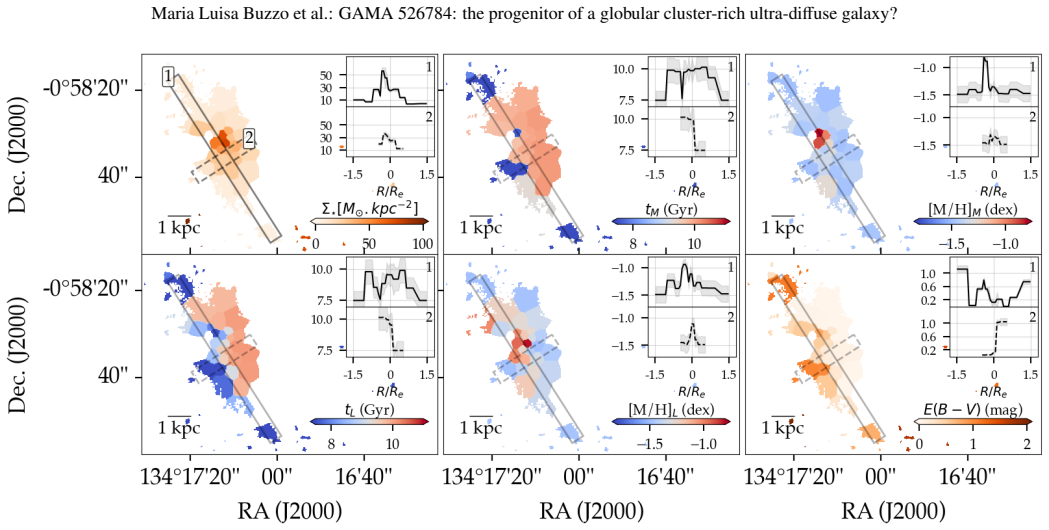
The paper's central claim is that GAMA 526784 is likely to evolve into a globular cluster-rich ultra-diffuse galaxy over the next several gigayears. The claim rests on a bimodal star cluster population: eight old, metal-poor globular cluster candidates with ages of about 8.3 to 9.0 Gyr and masses around $\log(M_\star/M_\odot)\sim5.5$ to $5.9$, plus 21 young star-forming clusters with ages of 8 to 11 Myr and masses around $\log(M_\star/M_\odot)\sim5.0$. After subtracting 1.3 expected background interlopers from the eight old candidates, the authors obtain a GC-to-stellar mass ratio of 2.5% for the central stellar body (1.9% including the whole galaxy). Assuming the seven remaining old clusters are the bright half of a symmetric globular cluster luminosity function doubles the old cluster count to about 14, and eight young clusters massive enough to survive add roughly 16 more, producing at least 30 clusters. The stellar body itself is two-component: a compact core with age about 9.9 Gyr and $\mathrm{[M/H]}\sim-1.0$, and an extended outer component with age about 0.9 Gyr and $\mathrm{[M/H]}\sim-1.2$; the ionised gas rotates faster than the stars, has dispersions up to about 50 km/s, and shows a roughly 20-degree misalignment, which the paper reads as evidence for a recent interaction that triggered the young cluster formation. The old cluster candidates could not be spectroscopically confirmed as members because of their low signal-to-noise spectra.
Load-bearing premise
The load-bearing premise is that the eight old globular cluster candidates are genuinely bound to GAMA 526784, even though their low signal-to-noise spectra could not confirm their membership; if most are background objects, the GC-rich progenitor interpretation loses its foundation.
Editorial extensions
If this is right
- If the claim holds, GAMA 526784 will become a globular cluster-rich UDG with roughly 30 clusters within several gigayears, making it a direct evolutionary link between star-forming dwarfs and quiescent globular cluster-rich UDGs.
- The roughly 9 Gyr age gap between the old and young cluster populations implies that globular cluster formation in this dwarf happened in at least two distinct episodes separated by a long quiescent phase.
- The kinematic mismatch between stars and gas, with the gas rotation axis misaligned by about 20 degrees and gas dispersions reaching about 50 km/s, implies that isolated UDGs can still be strongly perturbed by recent interactions, so isolation does not guarantee quiescence.
- The old clusters formed together with the galaxy's early stellar body, so the central core is a surviving relic of the pre-interaction galaxy; future molecular and neutral gas observations should reveal whether the current star-forming episode can be sustained.
Reading between the lines
- A testable extension: deeper HST imaging should reveal the supposed faint half of the old globular cluster luminosity function; detecting the turnover near $M_{F814W}\sim-8.2$ would confirm the completeness correction, while a missing faint population would weaken the roughly 14-cluster estimate.
- If the young massive clusters survive to old age, the galaxy will end up with a metal-rich old cluster subpopulation around $\mathrm{[M/H]}\sim-0.3$ coexisting with metal-poor clusters around $\mathrm{[M/H]}\sim-1.4$, a mixed cluster system that could serve as a signature of interaction-triggered cluster formation in other isolated dwarfs.
- The comparison with the Disco Ball UDG suggests two distinct routes to cluster-rich dwarfs in isolation, one secular and one interaction-triggered; a systematic survey of young cluster systems around isolated UDGs could quantify which route is more common.
Editorial analysis
A structured set of objections, weighed in public.
Referee Report
Summary. The paper presents a multiwavelength study of GAMA 526784, an isolated candidate ultra-diffuse galaxy at roughly 39 Mpc with an old central stellar body and a younger, extended, star-forming outer component. Using HST/HSC imaging, a two-component GALFITM decomposition, BAGPIPES SED fitting, MUSE/DAP stellar population and kinematic maps, and photometric/spectrophotometric star cluster analysis, the authors identify 29 star cluster candidates (8 old globular cluster candidates and 21 young clusters). They report a quiescent old core (mass-weighted age ~9.9 Gyr, [M/H] ~ -1.0 dex), a young outer component (~0.9 Gyr), a low stellar velocity dispersion (~10 km/s), misaligned gas kinematics, localised star formation, and conclude that GAMA 526784 is likely evolving into a globular cluster-rich UDG over the next several Gyr.
Significance. The dataset is valuable: it combines HST and HSC broad-band imaging with MUSE integral-field spectroscopy for a rare, isolated, low-mass star-forming UDG, and the old central/young outer age separation is supported by two independent fitting approaches plus spatially resolved age maps. The young clusters are kinematically confirmed via emission lines, making their ages and masses comparatively robust. The paper is also transparent about its main limitations, including the unconfirmed membership of the old cluster candidates and the arbitrary choice of the 2.5% GC-rich threshold. If the cluster membership and survival assumptions hold, GAMA 526784 would be a rare, possibly unique live progenitor of a GC-rich UDG in isolation, with direct implications for UDG formation scenarios. However, the central headline claim currently rests on a small, spectroscopically unconfirmed sample and on two strong assumptions (a symmetric old GC luminosity function and the survival of young massive clusters), so the significance is conditional at this stage.
major comments (3)
- [4.3; Appendix A] The GC-rich inference is based on eight photometrically selected old GC candidates whose membership the paper states it could not confirm: "We were unable to confirm the membership of the old cluster candidates with GAMA 526784 (1, 3, 4, 5, 10, 21, 28, and 29) due to their low S/N spectra." After subtracting the expected 1.3 old-colour interlopers, seven candidates remain, and the derived MGC/Mstar is 2.5% for the central body and 1.9% for the whole galaxy, i.e., at or below the adopted 2.5% threshold. The threshold is crossed only by assuming that the seven candidates populate the bright half of a symmetric GCLF and doubling the count to 14. This is an assumption, not a completeness correction, and it amplifies an already unconfirmed sample. If even a small number of the candidates are foreground stars or background galaxies, or if the luminosity function is not symmetric, the quantitative basis for the statement that GAMA 526784 is "likely" to become a GC-rich UDG disappears. Please either add membership constraints (deeper spectroscopy, radial velocities, or proper motions) or present the GC-rich evolution explicitly as a conditional scenario rather than a likelihood.
- [4.3] The projection that the eight young massive clusters above log(Mstar/Msun) ~ 5.3 add roughly 16 clusters to the total population assumes that a "significant fraction" of them survive. The only justification offered is that the gravitational potential is shallow and the galaxy is isolated, so "dissolution effects may not be severe." Cluster survival is a quantitative question that depends on cluster mass, initial compactness, and the tidal field; without a disruption calculation, a comparison with empirical cluster age/mass distributions, or at least an explicit survival fraction with uncertainties, the "at least 30 clusters" statement is an upper-bound scenario rather than a prediction. Please quantify this step or soften the claim accordingly.
- [Appendix B; 4.3] The reconstructed star formation history in Appendix B is described as being dominated by a burst about 100 Myr ago, while the young star clusters have fitted ages of 8-11 Myr in Section 4.3. These statements are inconsistent as written: a 100 Myr burst should produce clusters roughly 100 Myr old unless the SFH time binning cannot resolve ages near 10 Myr. Please reconcile the SFH with the cluster ages or state explicitly that the 100 Myr value is set by the coarsest/finest available time bin, since this discrepancy bears directly on the recent-interaction interpretation.
minor comments (4)
- [3; Eq. (1)] The linear colour relation used for cluster selection is presented without the uncertainties of the fitted slope and intercept, and the +/-0.5 mag selection window is called "approximately 3 sigma" without stating the sigma used. Please provide the fit covariance and a brief statement of the resulting selection completeness.
- [4.2.3] The quoted global stellar velocity dispersion of 10 +/- 6 km/s is below the nominal MUSE resolution; although the paper acknowledges this and cites a method for recovering dispersions below resolution, the value should be labelled in the text and abstract as an unresolved/lower-limit measurement so that it is not quoted as a standard detection.
- [Table D.1] The column containing radial velocities is labelled in the table note as "pPXF radial velocity" but appears to be simply "V" in the header; in addition, several old GC candidates (e.g., IDs 4 and 28) lack age and metallicity measurements, so the statement that old GCs have ages of 8.4-9.4 Gyr applies to only six of the eight candidates. Please state explicitly how many candidates contribute to each derived property.
- [Figure 10] The comparison to the LMC age-metallicity relation is qualitative; please state that the Pagel & Tautvaisiene (1998) model is the LMC fit from Narloch et al. (2022) and is not re-fit to the GAMA 526784 clusters, so that readers do not interpret the overplotted curve as a fit to the new data.
Circularity Check
No significant circularity: the empirical analysis is self-contained; the GC-rich conclusion is an explicitly conditional extrapolation, not a reduction of inputs to outputs.
full rationale
The asserted derivation chain is not circular. Cluster candidates are selected with SSP-informed colour, magnitude, ellipticity and concentration cuts (Sec. 3), but the reported ages, metallicities and masses come from independent BAGPIPES fits to HST/HSC photometry plus MUSE spectra (Sec. 4.3, Table D.1), and the stellar-body and gas properties come from DAP/pPXF fits to MUSE data. No equation is equivalent to its own input by construction. The headline conclusion that GAMA 526784 is 'likely to evolve into a GC-rich UDG' is explicitly conditional rather than derived: the paper says it 'was unable to confirm the membership of the old cluster candidates' and that the estimate 'is based on the currently detected old clusters and does not apply any completeness correction.' The step from seven old candidates to a GC-rich classification invokes the explicit assumption 'that the seven observed old GCs populate the bright half of the GCLF', a transparent modelling ansatz, not a fitted parameter renamed as a prediction. The 2.5% GC-rich threshold is taken from Forbes et al. (2025), a paper with overlapping authorship, but the text immediately calls it 'an arbitrary choice' with expected scatter, so the citation supplies a conventional boundary rather than a load-bearing derivation. The unconfirmed cluster membership is a genuine robustness limitation, but it concerns data quality and sample selection, not circular logic. Overall, no self-definitional, fitted-as-prediction, or self-citation-chain reduction is found; score 2 reflects only the minor, non-load-bearing self-citation of the classification threshold.
Assumptions & free parameters
free parameters (2)
- Adopted old-GC luminosity function peak and width =
MF814W = -8.2 ± 1.0 mag; young-cluster peak shifted by 1.7 mag
- Implicit survival fraction of young massive clusters =
not quantified; assumed high
assumptions (6)
- domain assumption Simple stellar population models (FSPS with Padova isochrones) correctly predict colours and magnitudes of both old and young star clusters.
- domain assumption GAMA 526784 lies at 39 Mpc, the Hubble-flow distance from its radial velocity.
- domain assumption The seven spectroscopically unconfirmed old GC candidates are cluster members, with only 1.3 background interlopers subtracted statistically.
- ad hoc to paper The observed old GCs represent the bright half of a symmetric GCLF, so the total old cluster count is about double the detected number.
- ad hoc to paper Young massive clusters will largely survive disruption because the galaxy's potential is shallow and it is isolated.
- domain assumption The two-component GALFITM decomposition is physically meaningful; a triaxial single component could also produce similar isophote twists.
Cite this review
Pith. "Pith review of GAMA 526784: the progenitor of a globular cluster-rich ultra-diffuse galaxy? I. Star clusters, stellar body and ionised gas properties." pith.science (2026). https://pith.science/paper/FIVKVAZN
@misc{pith2026250515910,
  author       = {Pith},
  title        = {Pith review of: GAMA 526784: the progenitor of a globular cluster-rich ultra-diffuse galaxy? I. Star clusters, stellar body and ionised gas properties},
  year         = {2026},
  howpublished = {\url{https://pith.science/paper/FIVKVAZN}},
  note         = {Machine review of arXiv:2505.15910}
}
read the original abstract
Context. Ultra-diffuse galaxies (UDGs) are an intriguing population of galaxies. Despite their dwarf-like stellar masses and low surface brightness, they have large half-light radii and exhibit a diverse range of globular cluster (GC) populations. Some UDGs host many GCs while others have none, raising questions about the conditions under which star clusters (SC) form in dwarfs. GAMA526784, an isolated UDG with both an old stellar body and an extended star-forming (SF) front, including many young SCs, provides an exceptional case to explore the link between UDG evolution and star cluster formation. Aims. This study investigates the stellar populations, SCs, ionised gas, and kinematics of GAMA526784, focusing on its potential to form massive GCs and its connection to broader UDG formation scenarios. Methods. Imaging from HST and Subaru/HSC, alongside MUSE spectroscopy, were used to analyse the galaxy's morphology, chemical composition, and kinematics. A combination of SED fitting and full spectral fitting was applied. Results. GAMA526784's central stellar body exhibits a low-metallicity ([M/H] ~ -1.0 dex) and an old age (~9.9 Gyr). The outskirts are much younger (~0.9 Gyr), but slightly more metal-poor ([M/H] ~ -1.2 dex). The stellar kinematics show low velocity dispersions (~10 km/s) and a coherent rotational field, while the ionised gas exhibits higher dispersions (~50 km/s), a misaligned rotation axis (~20 deg) and localised SF, what could be suggestive of a recent interaction. The young SCs span ages of 8-11 Myr and masses of log(M*/Mo)~5.0, while the old GCs have ~9 Gyr and stellar masses of log(M*/Mo)~5.5. Conclusions. GAMA526784's properties point to interactions that triggered localised SF, leading to the formation of young SCs. Future observations of its molecular and neutral gas will help assess its environment, and the trigger of this SF episode.
Figures



Figures from the paper (7 more)




Forward citations
Cited by 1 Pith paper
-
Systematically Measuring Ultra-Diffuse Galaxies. VIII. Misfits, Miscasts, and Miscreants
The SMUDGes catalog is reclassified by visual morphology, leaving 6,553 clean UDG candidates and identifying 29 dwarf ring galaxies and 15 merger-sequence objects.
Reference graph
Works this paper leans on
-
[1]
, " * write output.state after.block = add.period write newline
ENTRY address archiveprefix author booktitle chapter edition editor howpublished institution eprint journal key month note number organization pages publisher school series title type volume year label extra.label sort.label short.list INTEGERS output.state before.all mid.sentence after.sentence after.block FUNCTION init.state.consts #0 'before.all := #1 ...
-
[2]
write newline
" write newline "" before.all 'output.state := FUNCTION n.dashify 't := "" t empty not t #1 #1 substring "-" = t #1 #2 substring "--" = not "--" * t #2 global.max substring 't := t #1 #1 substring "-" = "-" * t #2 global.max substring 't := while if t #1 #1 substring * t #2 global.max substring 't := if while FUNCTION word.in bbl.in " " * FUNCTION format....
-
[3]
2020, , 499, 3267
Adamo , A., Hollyhead , K., Messa , M., et al. 2020, , 499, 3267
2020
-
[4]
2018, , 70, S4
Aihara , H., Arimoto , N., Armstrong , R., et al. 2018, , 70, S4
2018
-
[5]
Amorisco , N. C. & Loeb , A. 2016, , 459, L51
2016
-
[6]
2017, , 608, A1
Bacon , R., Conseil , S., Mary , D., et al. 2017, , 608, A1
2017
-
[7]
Bastian , N., Pfeffer , J., Kruijssen , J. M. D., et al. 2020, , 498, 1050
2020
-
[8]
A., Romanowsky , A
Beasley , M. A., Romanowsky , A. J., Pota , V., et al. 2016, , 819, L20
2016
Show all 100 references
-
[9]
B., Schaefer , A., et al
Belfiore , F., Westfall , K. B., Schaefer , A., et al. 2019, , 158, 160
2019
-
[10]
A., Sales , L
Benavides , J. A., Sales , L. V., Abadi , M. G., et al. 2023, , 522, 1033
2023
-
[11]
Berriman , G. B. & Good , J. C. 2017, , 129, 058006
2017
-
[12]
2002, in Astronomical Society of the Pacific Conference Series, Vol
Bertin , E. 2002, in Astronomical Society of the Pacific Conference Series, Vol. 281, Astronomical Data Analysis Software and Systems XI, 228
2002
-
[13]
H., Hunter , D
Billett , O. H., Hunter , D. A., & Elmegreen , B. G. 2002, , 123, 1454
2002
-
[14]
L., Cortesi , A., Hernandez-Jimenez , J
Buzzo , M. L., Cortesi , A., Hernandez-Jimenez , J. A., et al. 2021, , 504, 2146
2021
-
[15]
L., Forbes , D
Buzzo , M. L., Forbes , D. A., Brodie , J. P., et al. 2023, , 522, 595
2023
-
[16]
L., Forbes , D
Buzzo , M. L., Forbes , D. A., Brodie , J. P., et al. 2022, , 517, 2231
2022
-
[17]
L., Forbes , D
Buzzo , M. L., Forbes , D. A., Jarrett , T. H., et al. 2025 a , , 536, 2536
2025
-
[18]
L., Forbes , D
Buzzo , M. L., Forbes , D. A., Jarrett , T. H., et al. 2024, , 529, 3210
2024
-
[19]
L., Forbes , D
Buzzo , M. L., Forbes , D. A., Romanowsky , A. J., et al. 2025 b , , 695, A124
2025
-
[20]
2017, , 466, 798
Cappellari , M. 2017, , 466, 798
2017
-
[21]
& Copin , Y
Cappellari , M. & Copin , Y. 2003, , 342, 345
2003
-
[22]
& Emsellem , E
Cappellari , M. & Emsellem , E. 2004, , 116, 138
2004
-
[23]
2021, , 502, 398
Carleton , T., Guo , Y., Munshi , F., Tremmel , M., & Wright , A. 2021, , 502, 398
2021
-
[24]
C., McLure , R
Carnall , A. C., McLure , R. J., Dunlop , J. S., & Dav \'e , R. 2018, , 480, 4379
2018
-
[25]
& Gunn , J
Conroy , C. & Gunn , J. E. 2010, , 712, 833
2010
-
[26]
E., & White , M
Conroy , C., Gunn , J. E., & White , M. 2009, , 699, 486
2009
-
[27]
Conroy , C., White , M., & Gunn , J. E. 2010, , 708, 58
2010
-
[28]
O., Lee , J
Cook , D. O., Lee , J. C., Adamo , A., et al. 2023, , 519, 3749
2023
-
[29]
Danieli , S., van Dokkum , P., Conroy , C., Abraham , R., & Romanowsky , A. J. 2019, , 874, L12
2019
-
[30]
2022, , 927, L28
Danieli , S., van Dokkum , P., Trujillo-Gomez , S., et al. 2022, , 927, L28
2022
-
[31]
B., Dutton , A
Di Cintio , A., Brook , C. B., Dutton , A. A., et al. 2017, , 466, L1
2017
-
[32]
P., Hill , D
Driver , S. P., Hill , D. T., Kelvin , L. S., et al. 2011, , 413, 971
2011
-
[33]
Elmegreen , B. G. 2018, , 869, 119
2018
-
[34]
Emsellem , E., van der Burg , R. F. J., Fensch , J., et al. 2019, , 625, A76
2019
-
[35]
2019, , 628, A60
Fensch , J., Duc , P.-A., Boquien , M., et al. 2019, , 628, A60
2019
-
[36]
A., et al
Ferr \'e -Mateu , A., Gannon , J., Forbes , D. A., et al. 2025, , 694, L6
2025
-
[37]
S., Forbes , D
Ferr \'e -Mateu , A., Gannon , J. S., Forbes , D. A., et al. 2023, , 526, 4735
2023
-
[38]
Fitzpatrick , E. L. 1999, , 111, 63
1999
-
[39]
A., Alabi , A., & Romanowsky , A
Forbes , D. A., Alabi , A., & Romanowsky , A. J. 2020, , 492, 4874
2020
-
[40]
A., Buzzo , M
Forbes , D. A., Buzzo , M. L., Ferre-Mateu , A., et al. 2025, , 536, 1217
2025
-
[41]
Forbes , D. A. & Gannon , J. 2024, , 528, 608
2024
-
[42]
2022, , 510, 320
Fraser-McKelvie , A., Cortese , L., Groves , B., et al. 2022, , 510, 320
2022
-
[43]
M., et al
Freudling , W., Romaniello , M., Bramich , D. M., et al. 2013, , 559, A96
2013
-
[44]
P., Greene , J
Greco , J. P., Greene , J. E., Strauss , M. A., et al. 2018, , 857, 104
2018
-
[45]
2017, , 608, A5
Gu \'e rou , A., Krajnovi \'c , D., Epinat , B., et al. 2017, , 608, A5
2017
-
[46]
Harris , W. E. 1996, , 112, 1487
1996
-
[47]
E., Harris , G
Harris , W. E., Harris , G. L. H., & Alessi , M. 2013, , 772, 82
2013
-
[48]
2025, arXiv e-prints, arXiv:2501.16192
Hartke , J., Iodice , E., Gullieuszik , M., et al. 2025, arXiv e-prints, arXiv:2501.16192
2025 arXiv
-
[49]
P., Vika , M., et al
H \"a u ler , B., Bamford , S. P., Vika , M., et al. 2013, , 430, 330
2013
-
[50]
2023, , 679, A69
Iodice , E., Hilker , M., Doll , G., et al. 2023, , 679, A69
2023
-
[51]
C., Katz , D
Jacob , J. C., Katz , D. S., Berriman , G. B., et al. 2010, Montage: An Astronomical Image Mosaicking Toolkit , Astrophysics Source Code Library, record ascl:1010.036
2010
-
[52]
R., Forbes , D
Janssens , S. R., Forbes , D. A., Romanowsky , A. J., et al. 2024, , 534, 783
2024
-
[53]
R., Romanowsky , A
Janssens , S. R., Romanowsky , A. J., Abraham , R., et al. 2022, arXiv e-prints, arXiv:2209.09910
2022 arXiv
-
[54]
2019, , 487, 5272
Jiang , F., Dekel , A., Freundlich , J., et al. 2019, , 487, 5272
2019
-
[55]
G., Karunakaran , A., Bennet , P., et al
Jones , M. G., Karunakaran , A., Bennet , P., et al. 2023, , 942, L5
2023
-
[56]
2024 a , , 966, 129
Kado-Fong , E., Geha , M., Mao , Y.-Y., et al. 2024 a , , 966, 129
2024
-
[57]
2024 b , , 963, 37
Kado-Fong , E., Robinson , A., Nyland , K., et al. 2024 b , , 963, 37
2024
-
[58]
L., et al
Kadowaki , J., Zaritsky , D., Donnerstein , R. L., et al. 2021, , 923, 257
2021
-
[59]
J., Zaritsky , D., Sandoval Ascencio , L., Cooper , M
Khim , D. J., Zaritsky , D., Sandoval Ascencio , L., Cooper , M. C., & Donnerstein , R. 2025, arXiv e-prints, arXiv:2502.19465
2025 arXiv
-
[60]
2015, , 807, L2
Koda , J., Yagi , M., Yamanoi , H., & Komiyama , Y. 2015, , 807, L2
2015
-
[61]
T., & Copin , Y
Krajnovi \'c , D., Cappellari , M., de Zeeuw , P. T., & Copin , Y. 2006, , 366, 787
2006
-
[62]
Kruijssen , J. M. D. 2014, Classical and Quantum Gravity, 31, 244006
2014
-
[63]
Kruijssen , J. M. D. 2025, arXiv e-prints, arXiv:2501.16438
2025 arXiv
-
[64]
S., Brodie , J
Larsen , S. S., Brodie , J. P., Forbes , D. A., & Strader , J. 2014, , 565, A98
2014
-
[65]
R., & Chung , E
Lee , J., Shin , E.-j., Kim , J.-h., Shapiro , P. R., & Chung , E. 2024, , 966, 72
2024
-
[66]
P., Janowiecki , S., et al
Leisman , L., Haynes , M. P., Janowiecki , S., et al. 2017, , 842, 133
2017
-
[67]
E., Danieli , S., et al
Li , J., Greene , J. E., Danieli , S., et al. 2025, arXiv e-prints, arXiv:2504.08030
2025 arXiv
-
[68]
E., Aguerri , J
Mancera Pi \ n a , P. E., Aguerri , J. A. L., Peletier , R. F., et al. 2019 a , , 485, 1036
2019
-
[69]
E., Fraternali , F., Adams , E
Mancera Pi \ n a , P. E., Fraternali , F., Adams , E. A. K., et al. 2019 b , , 883, L33
2019
-
[70]
& Girardi , L
Marigo , P. & Girardi , L. 2007, , 469, 239
2007
-
[71]
2008, , 482, 883
Marigo , P., Girardi , L., Bressan , A., et al. 2008, , 482, 883
2008
-
[72]
A., Rosales-Ortega, F
Marino, R. A., Rosales-Ortega, F. F., Sánchez, S. F., et al. 2013, Astronomy & Astrophysics, 559, A114
2013
-
[73]
R., Duc , P.-A., Poulain , M., et al
Marleau , F. R., Duc , P.-A., Poulain , M., et al. 2024, , 690, A339
2024
-
[74]
2022, , 666, A80
Narloch , W., Pietrzy \'n ski , G., Gieren , W., et al. 2022, , 666, A80
2022
-
[75]
Pagel , B. E. J. & Tautvaisiene , G. 1998, , 299, 535
1998
-
[76]
Papastergis , E., Adams , E. A. K., & Romanowsky , A. J. 2017, , 601, L10
2017
-
[77]
W., Jord \'a n , A., C \^o t \'e , P., et al
Peng , E. W., Jord \'a n , A., C \^o t \'e , P., et al. 2006, , 639, 95
2006
-
[78]
R., Buzzo , M
Pfeffer , J., Janssens , S. R., Buzzo , M. L., et al. 2024, , 529, 4914
2024
-
[79]
J., van der Burg , R
Prole , D. J., van der Burg , R. F. J., Hilker , M., & Davies , J. I. 2019, , 488, 2143
2019
-
[80]
& Trujillo , I
Rom \'a n , J. & Trujillo , I. 2017, , 468, 4039
2017
-
[81]
2017, , 470, 4231
Rong , Y., Guo , Q., Gao , L., et al. 2017, , 470, 4231
2017
-
[82]
V., Navarro , J
Sales , L. V., Navarro , J. F., Pe \ n afiel , L., et al. 2020, , 494, 1848
2020
-
[83]
Schlafly , E. F. & Finkbeiner , D. P. 2011, , 737, 103
2011
-
[84]
2023, , 957, 6
Shen , Z., van Dokkum , P., & Danieli , S. 2023, , 957, 6
2023
-
[85]
2019, , 488, L24
Silk , J. 2019, , 488, L24
2019
-
[86]
T., Lilly , S
Soto , K. T., Lilly , S. J., Bacon , R., Richard , J., & Conseil , S. 2016, , 458, 3210
2016
-
[87]
& Karunakaran , A
Spekkens , K. & Karunakaran , A. 2018, , 855, 28
2018
-
[88]
J., Gannon , J
Tang , Y., Romanowsky , A. J., Gannon , J. S., et al. 2025, arXiv e-prints, arXiv:2501.10665
2025 arXiv
-
[89]
2017, , 836, 191
Trujillo , I., Roman , J., Filho , M., & S \'a nchez Almeida , J. 2017, , 836, 191
2017
-
[90]
van Dokkum , P., Danieli , S., Abraham , R., Conroy , C., & Romanowsky , A. J. 2019, , 874, L5
2019
-
[91]
2018, , 555, 629
van Dokkum , P., Danieli , S., Cohen , Y., et al. 2018, , 555, 629
2018
-
[92]
A., et al
van Dokkum , P., Shen , Z., Keim , M. A., et al. 2022, , 605, 435
2022
-
[93]
G., Abraham , R., Merritt , A., et al
van Dokkum , P. G., Abraham , R., Merritt , A., et al. 2015, , 798, L45
2015
-
[94]
2015, , 449, 1177
Vazdekis , A., Coelho , P., Cassisi , S., et al. 2015, , 449, 1177
2015
-
[95]
P., H \"a u ler , B., et al
Vika , M., Bamford , S. P., H \"a u ler , B., et al. 2013, , 435, 623
2013
-
[96]
Weidner , C., Kroupa , P., & Larsen , S. S. 2004, , 350, 1503
2004
-
[97]
M., Streicher , O., & Palsa , R
Weilbacher , P. M., Streicher , O., & Palsa , R. 2016, MUSE-DRP: MUSE Data Reduction Pipeline , Astrophysics Source Code Library, record ascl:1610.004
2016
-
[98]
B., Cappellari , M., Bershady , M
Westfall , K. B., Cappellari , M., Bershady , M. A., et al. 2019, , 158, 231
2019
-
[99]
E., van Dokkum , P
Whitaker , K. E., van Dokkum , P. G., Brammer , G., & Franx , M. 2012, , 754, L29
2012
-
[100]
2014, , 567, A132
Wild , V., Rosales-Ortega , F., Falc \'o n-Barroso , J., et al. 2014, , 567, A132
2014
Reviewed August 7, 2026 · model on record in the stance chip above.
Discussion (0). Sign in to comment.