REVIEW 4 major objections 5 minor 145 references
Gaussian Processes in Power Systems: Techniques, Applications, and Future Works
T0 review · 4 major / 5 minor · reviewed 2026-08-07 · deepseek-v4-flash
Pith's one-line read A structured survey positions Gaussian processes as a unifying tool for uncertainty-aware power-grid analytics.
desk verdict Useful but overclaimed survey: solid taxonomy, shaky 'first comprehensive' assertion, and a reference list that needs cleaning. read the letter →
The pith
A machine-rendered reading of the paper's core claim, the machinery that carries it, and where it could break.
The reading
What carries the argument
The central object is the Gaussian process itself: a prior distribution over functions in which any finite collection of function values is jointly Gaussian, so posterior prediction at new inputs has closed-form mean and variance. In the power-system context, the paper uses this machinery to treat the inverse power-flow map from net load to voltages, the time-dependent map from uncertain injections to dynamic states, and the map from load and renewable scenarios to optimal dispatch as functions that can be learned from data. The closed-form posterior is what carries the argument: it turns a learned surrogate into quantifiable violation probabilities, differentiable constraints, and sensitivity indices without extra sampling. The paper's taxonomy, with its tabulated applications, is the organizing device that ties individual GP variants - sparse, multi-task, deep, censored, and heteroscedastic - to concrete grid tasks.
What would settle it
A reader could test the completeness claim by compiling all peer-reviewed GP-for-power-system papers from major journals and conferences before 2025 and checking whether each application category appears in the paper's tables or text; any significant uncategorized body of work would refute the 'comprehensive' characterization.
Extended reading notes
Core claim
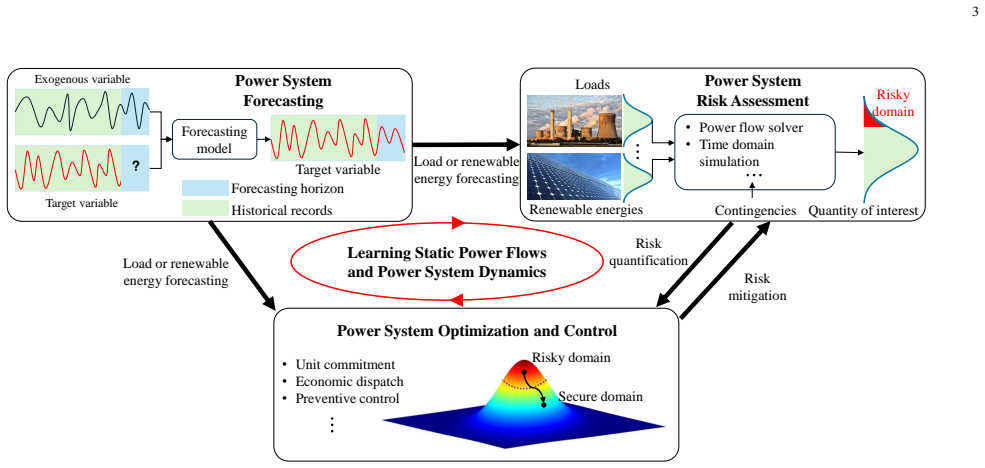
On its own terms, the paper's central claim is that GP applications in power systems have matured enough to warrant a systematic, first-of-its-kind review, and that the literature forms a coherent landscape: forecasting and static or dynamic modeling provide GP surrogates for power flows; those surrogates feed risk assessment through closed-form violation probabilities; and the same closed-form expressions allow GP models to be embedded inside chance-constrained optimization and control. The paper presents the GP prior over functions, the posterior conditioning formulas, and kernel designs such as the vertex-degree kernel as the common machinery behind these applications. It further claims that GP's advantages - nonparametric flexibility, well-calibrated uncertainty, and small-data efficiency - are exactly what safety-critical grid operation needs, while the main barriers are cubic scaling, robustness to non-Gaussian noise, and online adaptation.
Load-bearing premise
The survey's usefulness depends on its literature selection being comprehensive and representative, since both the 'first comprehensive survey' claim and the Section VI guidance rest on the tables capturing the actual state of GP applications in power systems.
Editorial extensions
If this is right
- If the survey's map is right, GP-based surrogates can replace traditional linearized power-flow approximations in distribution and transmission studies, preserving accuracy while supplying uncertainty bands.
- Closed-form GP posteriors allow risk metrics such as voltage-violation probability, line-overload risk, and transient-stability indices to be computed without repeated Monte Carlo simulation.
- The same expressions can be embedded as chance constraints in optimal power flow and model predictive control, giving optimization problems that explicitly account for renewable and load uncertainty.
- The taxonomy implies that mature GP variants and kernel designs, including sparse and multi-output versions, are ready for near-real-time grid applications at moderate scale.
- The gaps the paper identifies - scalability, robustness, and online adaptation - define a concrete research agenda for moving GP methods onto large grids.
Reading between the lines
- The paper leaves implicit that a GP surrogate is only as trustworthy as the kernel's match to the true power-flow manifold; strongly discrete behavior, such as topology switching, may need structural kernels or hybrid models rather than standard smooth kernels.
- The same surveyed techniques could transfer to other networked infrastructure, such as gas or district-heating grids, where uncertain injection-to-state maps also need probabilistic surrogates.
- A testable extension would be a common benchmark of GP variants on standard power-system test cases, since the current literature is fragmented across different feeders, time horizons, and error metrics.
- The survey points toward convergence between GP and deep learning but leaves open whether end-to-end deep kernels retain the small-data and calibration advantages that motivate GP in the first place.
Editorial analysis
A structured set of objections, weighed in public.
Referee Report
Summary. This manuscript surveys Gaussian process (GP) techniques and their applications in power systems, organizing the literature into GP-based modeling (forecasting, steady-state power flow, dynamics, probabilistic OPF), risk assessment, and optimization/control. It also provides GP preliminaries, a comparison of GP software packages, an illustrative GP load-forecasting example, three tables of application summaries, and a discussion of challenges and future directions. The paper claims in Section I to be the first comprehensive survey of GP applications in power systems.
Significance. If its comprehensiveness claim is substantiated, the survey would serve as a useful reference map and taxonomy for a fast-growing area, and the lessons in Section VI could help practitioners choose when GP is appropriate. The GP preliminaries are mostly standard and correct, and the paper draws attention to important application niches such as distribution system state estimation, rare-event risk assessment, and chance-constrained OPF. However, the central claim of being the first comprehensive survey is currently not verifiable: no literature-search methodology is provided, several references are duplicated, and no comparison with previous surveys is made. The technical presentation also contains a clear typo in Eq. (7). These issues are local and fixable, but they must be addressed before the survey's authority as an unbiased map of the field can be accepted.
major comments (4)
- [Section I] The claim that this is "the first to provide a comprehensive survey of GP applications in power systems" is not substantiated. The manuscript gives no literature-search protocol, no inclusion/exclusion criteria, and no comparison with earlier GP or power-system reviews, so "comprehensive" is an assertion rather than a demonstrable property. This is load-bearing because Tables IV-VI and the guidance in Section VI derive their authority from that claim. Add a methodology subsection describing the databases searched, the screening process, and the criteria for inclusion, and explicitly state how the survey compares with prior surveys.
- [References] The reference list contains multiple duplicate entries, indicating that the literature database was not carefully curated: [26] and [46] are the same paper, [55] and [71] are the same paper, [76] and [103] are the same paper, and [75]/[135] and [80]/[136] also appear to be duplicate entries (the latter pair even disagreeing on the year). This undermines the reliability of the citation map and must be fixed before the comprehensiveness claim can be assessed.
- [Eq. (7)] The log marginal likelihood is written as -1/2 [ y^T [K + sigma_epsilon^2 I] y + log|K + sigma_epsilon^2 I| + N log 2pi ], which is not the correct objective for GP hyperparameter learning: the quadratic form is missing the inverse, and the constant term is missing its factor of 1/2. The expression should read -1/2 y^T (K + sigma_epsilon^2 I)^{-1} y - 1/2 log|K + sigma_epsilon^2 I| - N/2 log 2pi. As written, Eq. (7) is dimensionally inconsistent and would not give the training procedure described in Section II-A.
- [Tables IV-VI and Section VI] A substantial share of the applications cited in Tables IV-VI and in the running text are authored by the same research groups as this survey (e.g., [10], [54], [57], [62]-[64], [66]-[67], [74], [80]-[81], [88]-[89], [92], [98]-[99], [104], [114]-[117], [122]). Without a documented selection methodology, it is impossible to determine whether these tables represent the state of the art or an output-biased sample, which directly affects the practical guidance in Section VI. The authors should either provide evidence of systematic coverage beyond their own works or remove/qualify the "first comprehensive" claim.
minor comments (5)
- [Section II-A] The notation is inconsistent: f(x) is said to contain N function values while the input vector is defined as x = (x_1, ..., x_k). Use a consistent number of samples N throughout.
- [Section III-A, Eq. (9)] The notation x_t' in the covariance argument is unexplained; the covariance should be evaluated at the relevant input vectors (for example, x_t and x_{t+k}).
- [Section III-C, Eq. (16)] The text states that the system is "linearized" via an Euler-based explicit scheme, but Euler discretization is not linearization. Reword to "discretized".
- [Table II] The table lists scikit-learn GP, but the text in Section II-B does not mention scikit-learn among the Python GP libraries; add a sentence or remove the entry for consistency.
- [Section VI] The claim that "as the output dimension increases, the computational complexity grows cubically" is imprecise: cubic complexity in standard GP is with respect to the number of training points, and the dependence on output dimension depends on whether a multi-output covariance is used.
Circularity Check
No circularity found: the paper is a literature survey whose claims are categorical and bibliographic, not derived from fitted parameters or self-citation chains.
full rationale
The paper is a survey, not a derivation, so the enumerated circularity patterns do not apply. Its technical content (GP regression equations (6), kernel table, forecasting formulation (8)-(10), VDK kernel (13), risk formulas (20)-(21)) restates standard Gaussian-process machinery from textbooks such as Rasmussen and Williams, and none of these equations are defined in terms of the survey's classification or conclusions. The application tables summarize external papers; while many entries are authored by the same research groups, using one's own papers in a literature review is normal self-citation and is not load-bearing in a mathematical sense. The 'first comprehensive survey' claim in Section I is not demonstrated by a documented search protocol, and the duplicate reference entries ([26]/[46], [55]/[71], [76]/[103]) indicate curation issues, but these are correctness/completeness concerns rather than circular reasoning. No step in the paper fits fitted-input-called-prediction, self-definition, or imported-uniqueness patterns. Accordingly, no circular step can be quoted, and the appropriate finding is no significant circularity.
Assumptions & free parameters
assumptions (3)
- standard math Gaussian process is defined as a collection of random variables such that any finite subset has a joint multivariate Gaussian distribution (Rasmussen & Williams).
- domain assumption Power flow equations (11) model the steady-state relationship between net loads and voltages.
- ad hoc to paper The reviewed applications in Tables IV-VI are representative of GP usage in power systems.
Cite this review
Pith. "Pith review of Gaussian Processes in Power Systems: Techniques, Applications, and Future Works." pith.science (2026). https://pith.science/paper/DK5A5VCF
@misc{pith2026250515950,
  author       = {Pith},
  title        = {Pith review of: Gaussian Processes in Power Systems: Techniques, Applications, and Future Works},
  year         = {2026},
  howpublished = {\url{https://pith.science/paper/DK5A5VCF}},
  note         = {Machine review of arXiv:2505.15950}
}
read the original abstract
The increasing integration of renewable energy sources (RESs) and distributed energy resources (DERs) has significantly heightened operational complexity and uncertainty in modern power systems. Concurrently, the widespread deployment of smart meters, phasor measurement units (PMUs) and other sensors has generated vast spatiotemporal data streams, enabling advanced data-driven analytics and decision-making in grid operations. In this context, Gaussian processes (GPs) have emerged as a powerful probabilistic framework, offering uncertainty quantification, non-parametric modeling, and predictive capabilities to enhance power system analysis and control. This paper presents a comprehensive review of GP techniques and their applications in power system operation and control. GP applications are reviewed across three key domains: GP-based modeling, risk assessment, and optimization and control. These areas serve as representative examples of how GP can be utilized in power systems. Furthermore, critical challenges in GP applications are discussed, and potential research directions are outlined to facilitate future power system operations.
Figures


Reference graph
Works this paper leans on
-
[46]
Residential load forecasting: An online-offline deep kernel learning method,
Y . Li, F. Zhang, Y . Liu, H. Liao, H.-T. Zhang, and C. Chung, “Residential load forecasting: An online-offline deep kernel learning method,”IEEE Trans. Power Syst., vol. 39, no. 2, pp. 4264–4278, 2024
2024
-
[71]
Probabilistic power flow based on a Gaussian process emulator,
Y . Xu, Z. Hu, L. Mili, M. Korkali, and X. Chen, “Probabilistic power flow based on a Gaussian process emulator,”IEEE Trans. Power Syst., vol. 35, no. 4, pp. 3278–3281, 2020
2020
-
[103]
Inferring power system dynamics from synchrophasor data using Gaussian processes,
M. Jalali, V . Kekatos, S. Bhela, H. Zhu, and V . A. Centeno, “Inferring power system dynamics from synchrophasor data using Gaussian processes,”IEEE Trans. Power Syst., vol. 37, no. 6, pp. 4409–4423, 2022
work page 2022
-
[54]
A framework for analytical power flow solution using Gaussian process learning,
P. Pareek and H. D. Nguyen, “A framework for analytical power flow solution using Gaussian process learning,”IEEE Trans. Sustain. Energy, vol. 13, no. 1, pp. 452–463, 2021
2021
-
[69]
A framework for analytical power flow solution using Gaussian process learning,
P. Pareek and H. D. Nguyen, “A framework for analytical power flow solution using Gaussian process learning,”IEEE Trans. Sustain. Energy, vol. 13, no. 1, pp. 452–463, 2022
2022
-
[75]
C. Zhai, H. D. Nguyen, and X. Zong, “Dynamic security assessment of small-signal stability for power grids using windowed online Gaussian process,”IEEE Trans. Autom. Sci. Eng., vol. 20, no. 2, pp. 1170–1179, 2023
work page 2023
-
[135]
C. Zhai, H. D. Nguyen, and X. Zong, “Dynamic security assessment of small-signal stability for power grids using windowed online gaussian process,”IEEE Trans. Autom. Sci. Eng., vol. 20, no. 2, pp. 1170–1179, 2023
work page 2023
-
[80]
C. Zhai and H. D. Nguyen, “Estimating the region of attraction for power systems using Gaussian process and converse lyapunov function,”IEEE Trans. Control Syst. Technol., vol. 30, no. 3, pp. 1328– 1335, 2022
work page 2022
-
[136]
C. Zhai and H. D. Nguyen, “Estimating the region of attraction for power systems using Gaussian process and converse lyapunov function,”IEEE Trans. Control Syst. Technol., vol. 30, no. 3, pp. 1328– 1335, 2021
work page 2021
-
[10]
Fast risk assessment in power grids through novel Gaussian process and active learning,
P. Pareek, D. Deka, and S. Misra, “Fast risk assessment in power grids through novel Gaussian process and active learning,”arXiv preprint arXiv:2308.07867, 2023
arXiv 2023
-
[57]
Optimal steady-state voltage control using Gaussian process learning,
P. Pareek, W. Yu, and H. D. Nguyen, “Optimal steady-state voltage control using Gaussian process learning,”IEEE Trans. Ind. Inform., vol. 17, no. 10, pp. 7017–7027, 2020
2020
-
[62]
Physics-informed sparse Gaussian process for probabilistic stability analysis of large-scale power system with dynamic PVs and loads,
K. Ye, J. Zhao, N. Duan, and Y . Zhang, “Physics-informed sparse Gaussian process for probabilistic stability analysis of large-scale power system with dynamic PVs and loads,”IEEE Trans. Power Syst., vol. 38, no. 3, pp. 2868–2879, 2023
2023
-
[64]
Gaussian process learning-based proba- bilistic optimal power flow,
P. Pareek and H. D. Nguyen, “Gaussian process learning-based proba- bilistic optimal power flow,”IEEE Trans. Power Syst., vol. 36, no. 1, pp. 541–544, 2021
2021
-
[66]
Scalable risk assessment of rare events in power systems with uncertain wind generation and loads,
B. Tan, J. Zhao, and Y . Chen, “Scalable risk assessment of rare events in power systems with uncertain wind generation and loads,”IEEE Trans. Power Syst., pp. 1–15, 2024
2024
-
[67]
Power system overloading risk assessment considering topology and renewable uncertainties,
K. Ye, J. Zhao, M. Hong, S. Maslennikov, B. Tan, and X. Luo, “Power system overloading risk assessment considering topology and renewable uncertainties,” inProc. IEEE Power Energy Soc. General Meeting, 2024, pp. 1–5
2024
-
[74]
B. Tan, J. Zhao, and L. Xie, “Transferable deep kernel emulator for probabilistic load margin assessment with topology changes, uncertain renewable generations and loads,”IEEE Trans. Power Syst., vol. 38, no. 6, pp. 5740–5754, 2023
work page 2023
-
[81]
Bayesian post-fault power system dynamic trajectory prediction,
B. Tan and J. Zhao, “Bayesian post-fault power system dynamic trajectory prediction,”IEEE Trans. Power Syst., 2025
work page 2025
-
[88]
Data-driven stochastic AC-OPF using Gaussian process regression,
M. Mitrovic, A. Lukashevich, P. V orobev, V . Terzija, S. Budennyy, Y . Maximov, and D. Deka, “Data-driven stochastic AC-OPF using Gaussian process regression,”Int. J. Elect. Power Energy Syst., vol. 152, 2023, Art. no. 109249
work page 2023
-
[89]
Fast data-driven chance constrained AC-OPF using hybrid sparse Gaussian processes,
M. Mitrovic, A. Lukashevich, P. V orobev, V . Terzija, Y . Maximov, and D. Deka, “Fast data-driven chance constrained AC-OPF using hybrid sparse Gaussian processes,” inProc. IEEE Belgrade PowerTech, 2023, pp. 1–7
work page 2023
-
[92]
T. Su, J. Zhao, Y . Pei, Y . Yao, and F. Ding, “Analytic neural network Gaussian process enabled chance-constrained voltage regulation for active distribution systems with PVs, batteries and EVs,”IEEE Trans. Power Syst., 2025
work page 2025
-
[98]
T. Su, J. Zhao, and X. Chen, “Deep sigma point processes-assisted chance-constrained power system transient stability preventive control,” IEEE Trans. Power Syst., vol. 39, no. 1, pp. 1965–1978, 2024
work page 1965
-
[99]
T. Su, J. Zhao, Y . Yao, A. Selim, and F. Ding, “Safe reinforcement learning-based transient stability control for islanded microgrids with topology reconfiguration,”IEEE Trans. Smart Grid, 2025
work page 2025
-
[104]
Y . Weng, S. Ly, P. Wang, and H. D. Nguyen, “Hypothesis testing for mitigation of operational infeasibility on distribution system under 15 rising renewable penetration,”IEEE Trans. Sustain. Energy, vol. 14, no. 2, pp. 876–891, 2022
work page 2022
-
[114]
Y . Weng, J. Xie, P. Wang, and H. D. Nguyen, “Asymmetrically recip- rocal effects and congestion management in TSO-DSO coordination through feasibility regularizer,”IEEE Trans. Power Syst., vol. 38, no. 2, pp. 1948–1962, 2022
work page 1948
-
[117]
D. Cao, J. Zhao, W. Hu, Q. Liao, Q. Huang, and Z. Chen, “Topology change aware data-driven probabilistic distribution state estimation based on Gaussian process,”IEEE Trans. Smart Grid, vol. 14, no. 2, pp. 1317–1320, 2022
work page 2022
-
[122]
Multi-fidelity Gaussian process for distribution system voltage probabilistic estimation with PVs,
J. Zhang, J. Zhao, K. Ye, and F. Ding, “Multi-fidelity Gaussian process for distribution system voltage probabilistic estimation with PVs,” in Proc. IEEE Conf. Energy Internet Energy Syst. Integration, 2022, pp. 3088–3093
work page 2022
Show all 145 references
-
[1]
A review of current challenges and trends in energy systems modeling,
P. Lopion, P. Markewitz, M. Robinius, and D. Stolten, “A review of current challenges and trends in energy systems modeling,”Renew. Sustain. Energy Rev., vol. 96, pp. 156–166, 2018
2018
-
[2]
Reinforcement learning and its applications in modern power and energy systems: A review,
D. Cao, W. Hu, J. Zhao, G. Zhang, B. Zhang, Z. Liu, Z. Chen, and F. Blaabjerg, “Reinforcement learning and its applications in modern power and energy systems: A review,”J. Modern Power Syst. Clean Energy, vol. 8, no. 6, pp. 1029–1042, 2020
2020
-
[3]
Support vector machines,
M. Hearst, S. Dumais, E. Osuna, J. Platt, and B. Scholkopf, “Support vector machines,”IEEE Intell. Syst. Appl., vol. 13, no. 4, pp. 18–28, 1998
1998
-
[4]
Transformer in transformer,
K. Han, A. Xiao, E. Wu, J. Guo, C. XU, and Y . Wang, “Transformer in transformer,” inProc. Adv. Neural Inf. Process. Syst., vol. 34, 2021, pp. 15 908–15 919
2021
-
[5]
Deep Gaussian processes: A survey,
K. Jakkala, “Deep Gaussian processes: A survey,”arXiv preprint arXiv:2106.12135, 2021
2021 arXiv
-
[6]
C. M. Bishop and N. M. Nasrabadi,Pattern recognition and machine learning. Springer, 2006, vol. 4, no. 4
2006
-
[7]
C. K. Williams and C. E. Rasmussen,Gaussian processes for machine learning. MIT press Cambridge, MA, 2006, vol. 2, no. 3
2006
-
[8]
Beyond intuition, a framework for applying gps to real-world data,
K. Tazi, J. A. Lin, R. Viljoen, A. Gardner, S. John, H. Ge, and R. E. Turner, “Beyond intuition, a framework for applying gps to real-world data,”arXiv preprint arXiv:2307.03093, 2023
2023 arXiv
-
[9]
Local and global sparse Gaussian process approximations,
E. Snelson and Z. Ghahramani, “Local and global sparse Gaussian process approximations,” inProc. Artif. Intell. Statist., 2007, pp. 524– 531
2007
-
[11]
K. P. Murphy,Probabilistic machine learning: an introduction. MIT press, 2022
2022
-
[12]
Kernel interpolation for scalable struc- tured Gaussian processes (KISS-GP),
A. Wilson and H. Nickisch, “Kernel interpolation for scalable struc- tured Gaussian processes (KISS-GP),” inProc. Int. Conf. Mach. Learn., 2015, pp. 1775–1784
2015
-
[13]
Deep kernel learning,
A. G. Wilson, Z. Hu, R. Salakhutdinov, and E. P. Xing, “Deep kernel learning,” inProc. Artif. Intell. Statist., 2016, pp. 370–378
2016
-
[14]
GPflow: A Gaussian process library using TensorFlow,
A. G. d. G. Matthews, M. Van Der Wilk, T. Nickson, K. Fujii, A. Boukouvalas, P. Le, Z. Ghahramani, J. Hensmanet al., “GPflow: A Gaussian process library using TensorFlow,”J. Mach. Learn. Res., vol. 18, no. 40, pp. 1–6, 2017. 13
2017
-
[15]
Gpytorch: Blackbox matrix-matrix Gaussian process inference with gpu acceleration,
J. Gardner, G. Pleiss, K. Q. Weinberger, D. Bindel, and A. G. Wilson, “Gpytorch: Blackbox matrix-matrix Gaussian process inference with gpu acceleration,” inProc. Adv. Neural Inf. Process. Syst., vol. 31, 2018
2018
-
[16]
BoTorch: A framework for efficient Monte- Carlo Bayesian optimization,
M. Balandat, B. Karrer, D. R. Jiang, S. Daulton, B. Letham, A. G. Wilson, and E. Bakshy, “BoTorch: A framework for efficient Monte- Carlo Bayesian optimization,” inProc. Adv. Neural Inf. Process. Syst., 2020
2020
-
[17]
Power load probability density forecasting using Gaussian process quantile regression,
Y . Yang, S. Li, W. Li, and M. Qu, “Power load probability density forecasting using Gaussian process quantile regression,”Appl. Energy, vol. 213, pp. 499–509, 2018
2018
-
[18]
Review on probabilistic forecasting of wind power generation,
Y . Zhang, J. Wang, and X. Wang, “Review on probabilistic forecasting of wind power generation,”Renew. Sustain. Energy Rev., vol. 32, pp. 255–270, 2014
2014
-
[19]
Short-term electric load pre- diction in smart grid using multi-output Gaussian processes regression,
A. Ghasempour and M. Mart ´ınez-Ram´on, “Short-term electric load pre- diction in smart grid using multi-output Gaussian processes regression,” inProc. IEEE Kansas Power Energy Conf., 2023, pp. 1–6
2023
-
[20]
Anaya-Lara, N
O. Anaya-Lara, N. Jenkins, J. B. Ekanayake, P. Cartwright, and M. Hughes,Wind energy generation: modelling and control. John Wiley & Sons, 2011
2011
-
[21]
Review of load forecasting based on artificial intelligence methodologies, models, and challenges,
H. Hou, C. Liu, Q. Wang, X. Wu, J. Tang, Y . Shi, and C. Xie, “Review of load forecasting based on artificial intelligence methodologies, models, and challenges,”Electr. Power Syst. Res., vol. 210, 2022, Art. no. 108067
2022
-
[22]
Short- term residential load forecasting based on LSTM recurrent neural network,
W. Kong, Z. Y . Dong, Y . Jia, D. J. Hill, Y . Xu, and Y . Zhang, “Short- term residential load forecasting based on LSTM recurrent neural network,”IEEE Trans. Smart Grid, vol. 10, no. 1, pp. 841–851, 2019
2019
-
[23]
Short-term load forecasting for community battery systems based on temporal convolutional networks,
C. Zuo and W. Hu, “Short-term load forecasting for community battery systems based on temporal convolutional networks,” inProc. IEEE Int. Conf. Inf. Technol., Big Data Artif. Intell., vol. 2, 2021, pp. 11–16
2021
-
[24]
A survey on deep learning methods for power load and renewable energy forecasting in smart microgrids,
S. Aslam, H. Herodotou, S. M. Mohsin, N. Javaid, N. Ashraf, and S. Aslam, “A survey on deep learning methods for power load and renewable energy forecasting in smart microgrids,”Renew. Sustain. Energy Rev., vol. 144, 2021, Art. no. 110992
2021
-
[25]
Short-term load forecasting based on a semi-parametric additive model,
S. Fan and R. J. Hyndman, “Short-term load forecasting based on a semi-parametric additive model,”IEEE Trans. Power Syst., vol. 27, no. 1, pp. 134–141, 2012
2012
-
[27]
A hybrid approach based on the Gaussian process with t-observation model for short-term wind speed forecasts,
J. Hu, J. Wang, and L. Xiao, “A hybrid approach based on the Gaussian process with t-observation model for short-term wind speed forecasts,” Renew. Energy, vol. 114, pp. 670–685, 2017
2017
-
[28]
Short-term wind speed prediction using empirical wavelet transform and Gaussian process regression,
J. Hu and J. Wang, “Short-term wind speed prediction using empirical wavelet transform and Gaussian process regression,”Energy, vol. 93, pp. 1456–1466, 2015
2015
-
[29]
Forecasting of daily global solar radiation using wavelet transform-coupled Gaussian process re- gression: Case study in spain,
C. Huang, Z. Zhang, and A. Bensoussan, “Forecasting of daily global solar radiation using wavelet transform-coupled Gaussian process re- gression: Case study in spain,” inProc. IEEE Innovat. Smart Grid Technol. Asia, 2016, pp. 799–804
2016
-
[30]
Wavelet-Gaussian process regression model for forecasting daily solar radiation in the saharan climate,
K. Ferkous, F. Chellali, A. Kouzou, and B. Bekkar, “Wavelet-Gaussian process regression model for forecasting daily solar radiation in the saharan climate,”Clean Energy, vol. 5, no. 2, pp. 316–328, 2021
2021
-
[31]
PV power forecasting using an integrated GA-PSO-ANFIS approach and Gaussian process regression based feature selection strategy,
Y . K. Semero, J. Zhang, and D. Zheng, “PV power forecasting using an integrated GA-PSO-ANFIS approach and Gaussian process regression based feature selection strategy,”CSEE J. Power Energy Syst., vol. 4, no. 2, pp. 210–218, 2018
2018
-
[32]
Wind speed prediction method using shared weight long short-term memory network and Gaussian process regression,
Z. Zhang, L. Ye, H. Qin, Y . Liu, C. Wang, X. Yu, X. Yin, and J. Li, “Wind speed prediction method using shared weight long short-term memory network and Gaussian process regression,”Appl. Energy, vol. 247, pp. 270–284, 2019
2019
-
[33]
Wind power forecasts using Gaussian processes and numerical weather prediction,
N. Chen, Z. Qian, I. T. Nabney, and X. Meng, “Wind power forecasts using Gaussian processes and numerical weather prediction,”IEEE Trans. Power Syst., vol. 29, no. 2, pp. 656–665, 2013
2013
-
[34]
An integrated Gaussian process modeling framework for residential load prediction,
G. Xie, X. Chen, and Y . Weng, “An integrated Gaussian process modeling framework for residential load prediction,”IEEE Trans. Power Syst., vol. 33, no. 6, pp. 7238–7248, 2018
2018
-
[35]
A sparse heteroscedastic model for the probabilistic load forecasting in energy-intensive enterprises,
P. Kou and F. Gao, “A sparse heteroscedastic model for the probabilistic load forecasting in energy-intensive enterprises,”Int. J. Elect. Power Energy Syst., vol. 55, pp. 144–154, 2014
2014
-
[36]
Probabilistic forecasting of electricity consumption, photovoltaic power generation and net demand of an individual building using Gaussian processes,
D. W. Van der Meer, M. Shepero, A. Svensson, J. Wid ´en, and J. Munkhammar, “Probabilistic forecasting of electricity consumption, photovoltaic power generation and net demand of an individual building using Gaussian processes,”Appl. Energy, vol. 213, pp. 195–207, 2018
2018
-
[37]
Sparse variational Gaussian process based day-ahead probabilistic wind power forecasting,
H. Wen, J. Ma, J. Gu, L. Yuan, and Z. Jin, “Sparse variational Gaussian process based day-ahead probabilistic wind power forecasting,”IEEE Trans. Sustain. Energy, vol. 13, no. 2, pp. 957–970, 2022
2022
-
[38]
Probabilistic net load forecasting based on sparse variational Gaussian process regression,
W. Feng, B. Deng, T. Chen, Z. Zhang, Y . Fu, Y . Zheng, L. Zhang, and Z. Jing, “Probabilistic net load forecasting based on sparse variational Gaussian process regression,”Front. Energy Res., vol. 12, 2024, Art. no. 1429241
2024
-
[39]
Multiple output sparse Gaussian processes for short-term electric load forecasting,
A. Ghasempour and M. Mart ´ınez-Ram´on, “Multiple output sparse Gaussian processes for short-term electric load forecasting,” inProc. Int. Conf. Power Energy Technol., 2023, pp. 938–942
2023
-
[40]
A novel hybrid approach based on variational heteroscedastic Gaussian process regression for multi- step ahead wind speed forecasting,
C. Zhang, T. Peng, and M. S. Nazir, “A novel hybrid approach based on variational heteroscedastic Gaussian process regression for multi- step ahead wind speed forecasting,”Int. J. Elect. Power Energy Syst., vol. 136, 2022, Art. no. 107717
2022
-
[41]
Sparse Gaussian process regression for multi-step ahead forecasting of wind gusts combining numerical weather predictions and on-site measurements,
H. Wang, Y .-M. Zhang, and J.-X. Mao, “Sparse Gaussian process regression for multi-step ahead forecasting of wind gusts combining numerical weather predictions and on-site measurements,”J. Wind Eng. Ind. Aerod., vol. 220, 2022, Art. no. 104873
2022
-
[42]
A Gaussian process regression based hybrid approach for short-term wind speed prediction,
C. Zhang, H. Wei, X. Zhao, T. Liu, and K. Zhang, “A Gaussian process regression based hybrid approach for short-term wind speed prediction,”Energy Convers. Manage., vol. 126, pp. 1084–1092, 2016
2016
-
[43]
A compositional kernel based Gaussian process approach to day-ahead residential load forecasting,
K. Dab, K. Agbossou, N. Henao, Y . Dub ´e, S. Kelouwani, and S. S. Hosseini, “A compositional kernel based Gaussian process approach to day-ahead residential load forecasting,”Energy Build., vol. 254, 2022, Art. no. 111459
2022
-
[44]
Evaluating the potential of Gaussian process regression for solar radiation forecasting: A case study,
F. Lubbe, J. Maritz, and T. Harms, “Evaluating the potential of Gaussian process regression for solar radiation forecasting: A case study,”Energies, vol. 13, no. 20, p. 5509, 2020
2020
-
[45]
Robust deep Gaussian process-based probabilistic electrical load fore- casting against anomalous events,
D. Cao, J. Zhao, W. Hu, Y . Zhang, Q. Liao, Z. Chen, and F. Blaabjerg, “Robust deep Gaussian process-based probabilistic electrical load fore- casting against anomalous events,”IEEE Trans. Ind. Inform., vol. 18, no. 2, pp. 1142–1153, 2021
2021
-
[47]
Multi-energy load fore- casting for small-sample integrated energy systems based on neural network Gaussian process and multi-task learning,
W. Zhang, Y . Cai, H. Zhan, and M. Yang, “Multi-energy load fore- casting for small-sample integrated energy systems based on neural network Gaussian process and multi-task learning,”Energy Convers. Manage., vol. 321, 2024, Art. no. 119027
2024
-
[48]
Probabilistic modelling of wind turbine power curves with application of heteroscedastic Gaussian process regres- sion,
T. Rogers, P. Gardner, N. Dervilis, K. Worden, A. Maguire, E. Pap- atheou, and E. Cross, “Probabilistic modelling of wind turbine power curves with application of heteroscedastic Gaussian process regres- sion,”Renew. Energy, vol. 148, pp. 1124–1136, 2020
2020
-
[49]
Probabilistic and deterministic wind speed forecasting based on non-parametric approaches and wind characteristics information,
J. Heng, Y . Hong, J. Hu, and S. Wang, “Probabilistic and deterministic wind speed forecasting based on non-parametric approaches and wind characteristics information,”Appl. Energy, vol. 306, 2022, Art. no. 118029
2022
-
[50]
Multitask Bayesian spatiotemporal Gaussian processes for short- term load forecasting,
M. Gilanifar, H. Wang, L. M. K. Sriram, E. E. Ozguven, and R. Arghan- deh, “Multitask Bayesian spatiotemporal Gaussian processes for short- term load forecasting,”IEEE Trans. Ind. Electron., vol. 67, no. 6, pp. 5132–5143, 2019
2019
-
[51]
Probabilistic wind power forecasting for newly-built wind farms based on multi- task Gaussian process method,
Q. Liao, D. Cao, Z. Chen, F. Blaabjerg, and W. Hu, “Probabilistic wind power forecasting for newly-built wind farms based on multi- task Gaussian process method,”Renew. Energy, vol. 217, 2023, Art. no. 119054
2023
-
[52]
Gaussian process regression for numerical wind speed prediction enhancement,
H. Cai, X. Jia, J. Feng, W. Li, Y .-M. Hsu, and J. Lee, “Gaussian process regression for numerical wind speed prediction enhancement,”Renew. Energy, vol. 146, pp. 2112–2123, 2020
2020
-
[53]
Kernel structure design for data-driven probabilistic load flow studies,
J. Liu and P. Srikantha, “Kernel structure design for data-driven probabilistic load flow studies,”IEEE Trans. Smart Grid, vol. 13, no. 4, pp. 2679–2689, 2022
2022
-
[56]
A data-driven nonparametric approach for probabilistic load-margin assessment considering wind power penetration,
Y . Xu, L. Mili, M. Korkali, K. Karra, Z. Zheng, and X. Chen, “A data-driven nonparametric approach for probabilistic load-margin assessment considering wind power penetration,”IEEE Trans. Power Syst., vol. 35, no. 6, pp. 4756–4768, 2020
2020
-
[58]
Structure learning in power distribution networks,
D. Deka, S. Backhaus, and M. Chertkov, “Structure learning in power distribution networks,”IEEE Transactions on Control of Network Systems, vol. 5, no. 3, pp. 1061–1074, 2017
2017
-
[59]
Data-efficient strategies for proba- bilistic voltage envelopes under network contingencies,
P. Pareek, D. Deka, and S. Misra, “Data-efficient strategies for proba- bilistic voltage envelopes under network contingencies,”arXiv preprint arXiv:2310.00763, 2023. 14
2023 arXiv
-
[60]
Contraction analysis of nonlinear DAE systems,
H. D. Nguyen, T. L. Vu, J.-J. Slotine, and K. Turitsyn, “Contraction analysis of nonlinear DAE systems,”IEEE Trans. Automat. Control, vol. 66, no. 1, pp. 429–436, 2021
2021
-
[61]
Probabilistic robust small-signal stability framework using Gaussian process learning,
P. Pareek and H. D. Nguyen, “Probabilistic robust small-signal stability framework using Gaussian process learning,”Electr. Power Syst. Res., vol. 188, 2020, Art. no. 106545
2020
-
[63]
A high computationally efficient parallel partial Gaussian process for large-scale power system proba- bilistic transient stability assessment,
K. Ye, J. Zhao, H. Li, and M. Gu, “A high computationally efficient parallel partial Gaussian process for large-scale power system proba- bilistic transient stability assessment,”IEEE Trans. Power Syst., vol. 39, no. 2, pp. 4650–4660, 2024
2024
-
[65]
Review on risk assessment of power system,
Y . Shiwen, H. Hui, W. Chengzhi, G. Hao, and F. Hao, “Review on risk assessment of power system,”Procedia Comput. Sci., vol. 109, pp. 1200–1205, 2017
2017
-
[68]
Non-parametric probabilistic load flow using Gaussian process learning,
P. Pareek, C. Wang, and H. D. Nguyen, “Non-parametric probabilistic load flow using Gaussian process learning,”Physica D: Nonlinear Phenom., vol. 424, 2021, Art. no. 132941
2021
-
[70]
Proba- bilistic load-margin assessment using vine copula and Gaussian process emulation,
Y . Xu, K. Karra, L. Mili, M. Korkali, X. Chen, and Z. Hu, “Proba- bilistic load-margin assessment using vine copula and Gaussian process emulation,” inProc. IEEE Power Energy Soc. General Meeting, 2020, pp. 1–5
2020
-
[72]
Online Gaussian process learning for security assessment,
C. Zhai, “Online Gaussian process learning for security assessment,” inControl Optim. Methods Complex Syst. Resil.Springer, 2023, pp. 81–97
2023
-
[73]
Probabilistic stability analysis: the way forward for stability analysis of sustainable power systems,
J. V . Milanovi ´c, “Probabilistic stability analysis: the way forward for stability analysis of sustainable power systems,”Philos. Trans. R. Soc. A.: Math., Physi. Eng. Sci., vol. 375, no. 2100, 2017
2017
-
[77]
Inferring power system frequency oscillations using Gaussian processes,
M. Jalali, V . Kekatos, S. Bhela, and H. Zhu, “Inferring power system frequency oscillations using Gaussian processes,” inProc. IEEE Conf. Decis. Control, 2021, pp. 3670–3676
2021
-
[78]
Interpretable data-driven probabilistic power system load margin assessment with uncertain renewable energy and loads,
B. Tan, J. Zhao, W. Liu, and N. Duan, “Interpretable data-driven probabilistic power system load margin assessment with uncertain renewable energy and loads,” inIEEE Innov. Smart Grid Technol. Asia, 2022, pp. 56–60
2022
-
[79]
Gaussian process regression based inertia emulation and reserve estimation for grid interfaced photovoltaic system,
S. Kanwal, B. Khan, S. Ali, and C. Mehmood, “Gaussian process regression based inertia emulation and reserve estimation for grid interfaced photovoltaic system,”Renew. Energy, vol. 126, pp. 865–875, 2018
2018
-
[82]
Improvement of Gaussian process predictor of electric power damage caused by typhoons considering time-varying characteristics,
T. Hachino, S. Okubo, H. Takata, S. Fukushima, and Y . Igarashi, “Improvement of Gaussian process predictor of electric power damage caused by typhoons considering time-varying characteristics,”Int. J. Electron. Elect. Eng., vol. 3, pp. 263–268, 2015
2015
-
[83]
Data driven approach for fault detection and Gaussian process regression based location prognosis in smart ac microgrid,
A. Srivastava and S. Parida, “Data driven approach for fault detection and Gaussian process regression based location prognosis in smart ac microgrid,”Electr. Power Syst. Res., vol. 208, 2022, Art. no. 107889
2022
-
[84]
A robust fault detection and location prediction module using support vector machine and Gaussian process regression for AC microgrid,
A. Srivastava and S.K Parida, “A robust fault detection and location prediction module using support vector machine and Gaussian process regression for AC microgrid,”IEEE Trans. Ind. Appl., vol. 58, no. 1, pp. 930–939, 2022
2022
-
[85]
Wind turbine fault diagnosis based on Gaussian process classifiers applied to operational data,
Y . Li, S. Liu, and L. Shu, “Wind turbine fault diagnosis based on Gaussian process classifiers applied to operational data,”Renew. Energy, vol. 134, pp. 357–366, 2019
2019
-
[86]
The prediction method on the early failure of hydropower units based on Gaussian process regression driven by monitoring data,
H. Huang, A. Qin, H. Mao, J. Fu, Z. Huang, Y . Yang, X. Li, and H. Huang, “The prediction method on the early failure of hydropower units based on Gaussian process regression driven by monitoring data,” Appl. Sci., vol. 11, no. 1, 2021
2021
-
[87]
A data-driven mixed integer programming approach for joint chance-constrained optimal power flow under uncertainty,
J. C. Qin, R. Jiang, H. Mo, and D. Dong, “A data-driven mixed integer programming approach for joint chance-constrained optimal power flow under uncertainty,”Int. J. Mach. Learn. Cybern., pp. 1– 17, 2024
2024
-
[90]
Supervised learning for optimal power flow as a real-time proxy,
R. Canyasse, G. Dalal, and S. Mannor, “Supervised learning for optimal power flow as a real-time proxy,” inProc. IEEE Power Energy Soc. Innov. Smart Grid Technol. Conf., 2017, pp. 1–5
2017
-
[91]
Analytical uncertainty propagation for multi-period stochastic optimal power flow,
R. Bauer, T. M ¨uhlpfordt, N. Ludwig, and V . Hagenmeyer, “Analytical uncertainty propagation for multi-period stochastic optimal power flow,”Sustain. Energy, Grids Netw., vol. 33, 2023, Art. no. 100969
2023
-
[93]
Fast inverter control by learning the opf mapping using sensitivity- informed Gaussian processes,
M. Jalali, M. K. Singh, V . Kekatos, G. B. Giannakis, and C.-C. Liu, “Fast inverter control by learning the opf mapping using sensitivity- informed Gaussian processes,”IEEE Trans. Smart Grid, vol. 14, no. 3, pp. 2432–2445, 2022
2022
-
[94]
Gaussian process regression-based smart inverters’ V olt-V AR control,
T. O. Olowu, A. Debnath, I. O. Olasupo, and A. Sarwat, “Gaussian process regression-based smart inverters’ V olt-V AR control,” inProc. IEEE Ind. Appl. Soc. Annu. Meet., 2023, pp. 1–6
2023
-
[95]
Data- driven energy management system with Gaussian process forecasting and MPC for interconnected microgrids,
L. K. Gan, P. Zhang, J. Lee, M. A. Osborne, and D. A. Howey, “Data- driven energy management system with Gaussian process forecasting and MPC for interconnected microgrids,”IEEE Trans. Sustain. Energy, vol. 12, no. 1, pp. 695–704, 2020
2020
-
[96]
Optimal operation of an energy management system using model predictive control and Gaussian process time-series modeling,
J. Lee, P. Zhang, L. K. Gan, D. A. Howey, M. A. Osborne, A. Tosi, and S. Duncan, “Optimal operation of an energy management system using model predictive control and Gaussian process time-series modeling,” IEEE J. Emerg. Sel. Topics Power Electron., vol. 6, no. 4, pp. 1783– 1795, 2018
2018
-
[97]
Data-driven demand response modeling and control of buildings with Gaussian processes,
T. X. Nghiem and C. N. Jones, “Data-driven demand response modeling and control of buildings with Gaussian processes,” inProc. Amer. Control Conf., 2017, pp. 2919–2924
2017
-
[100]
Gaussian process-based bayesian opti- mization for data-driven unit commitment,
P. Nikolaidis and S. Chatzis, “Gaussian process-based bayesian opti- mization for data-driven unit commitment,”Int. J. Electr. Power Energy Syst., vol. 130, 2021, Art. no. 106930
2021
-
[101]
L. L. Grigsby,Power system stability and control. CRC press, 2007
2007
-
[102]
Degradation-infused energy portfolio allocation framework: Risk-averse fair storage participation,
P. Pareek, L. M. I. Sampath, A. Singh, L. Goel, H. B. Gooi, and H. D. Nguyen, “Degradation-infused energy portfolio allocation framework: Risk-averse fair storage participation,”Energy, vol. 313, p. 133688, 2024
2024
-
[105]
Probabilistic- based optimal storage placement and sizing enabling networked micro- grid community,
P. Pareek, J. Xie, Y . Weng, A. Singh, and H. D. Nguyen, “Probabilistic- based optimal storage placement and sizing enabling networked micro- grid community,” inProc. Int. Conf. Smart Energy Syst. Technol., 2021, pp. 1–6
2021
-
[106]
Probabilistic security-constrained AC optimal power flow,
M. Vrakopoulou, M. Katsampani, K. Margellos, J. Lygeros, and G. Andersson, “Probabilistic security-constrained AC optimal power flow,” inProc. IEEE PowerTech Conf., 2013, pp. 1–6
2013
-
[107]
Chance-constrained AC optimal power flow: Reformulations and efficient algorithms,
L. Roald and G. Andersson, “Chance-constrained AC optimal power flow: Reformulations and efficient algorithms,”IEEE Trans. Power Syst., vol. 33, no. 3, pp. 2906–2918, 2017
2017
-
[108]
Model pre- dictive control of electric power systems based on Gaussian process predictors,
T. Hachino, H. Takata, S. Fukushima, and Y . Igarashi, “Model pre- dictive control of electric power systems based on Gaussian process predictors,”J. Autom. Control Eng., vol. 3, no. 5, p. 70, 2015
2015
-
[109]
Resilient cyber-physical energy systems using prior information based on Gaussian process,
C. Konstantinou and O. M. Anubi, “Resilient cyber-physical energy systems using prior information based on Gaussian process,”IEEE Trans. Ind. Inform., vol. 18, no. 3, pp. 2160–2168, 2021
2021
-
[110]
Global sensitivity analysis of large distribution system with PVs using deep Gaussian process,
K. Ye, J. Zhao, F. Ding, R. Yang, X. Chen, and G. W. Dobbins, “Global sensitivity analysis of large distribution system with PVs using deep Gaussian process,”IEEE Trans. Power Syst., vol. 36, no. 5, pp. 4888– 4891, 2021
2021
-
[111]
Probabilistic dynamic model of active distribution networks using Gaussian processes,
G. Mitrentsis and H. Lens, “Probabilistic dynamic model of active distribution networks using Gaussian processes,” inProc. IEEE Madrid PowerTech, 2021, pp. 1–6
2021
-
[112]
A Gaussian process framework for the probabilistic dynamic modeling of active distribution networks using exogenous variables,
——, “A Gaussian process framework for the probabilistic dynamic modeling of active distribution networks using exogenous variables,” Electr. Power Syst. Res., vol. 211, 2022, Art. no. 108403
2022
-
[113]
Signal recovery in power systems by correlated Gaussian processes,
M. Zimmer, D. Carta, T. Pesch, and A. Benigni, “Signal recovery in power systems by correlated Gaussian processes,”IEEE Open J. Ind. Electron. Soc., 2024
2024
-
[115]
Gaussian process-based bilevel optimization with critical load restoration for system resilience improvement through data centers-to-grid scheme,
Y . Liu, Y . Weng, R. Yang, Q.-T. Tran, and H. D. Nguyen, “Gaussian process-based bilevel optimization with critical load restoration for system resilience improvement through data centers-to-grid scheme,” Sustain. Energy, Grids Netw., vol. 34, 2023, Art. no. 101007
2023
-
[116]
Distributed energy resource exploitation through co-optimization of power system and data centers with uncertainties during demand response,
Y . Weng, Y . Liu, R. L. T. Lim, and H. D. Nguyen, “Distributed energy resource exploitation through co-optimization of power system and data centers with uncertainties during demand response,”Sustainability, vol. 15, no. 14, 2023, Art. no. 10995
2023
-
[118]
Robust multiarea distribution system state estimation based on structure-informed graphic network and multitask Gaussian process,
J. Hu, W. Hu, D. Cao, S. Li, J. Chen, Y . Huang, Z. Chen, and F. Blaabjerg, “Robust multiarea distribution system state estimation based on structure-informed graphic network and multitask Gaussian process,”IEEE Trans. Ind. Inform., vol. 20, no. 8, pp. 10 599–10 612, 2024
2024
-
[119]
Multi time-scale imputation aided state estimation in distribution system,
S. Dahale and B. Natarajan, “Multi time-scale imputation aided state estimation in distribution system,” inProc. IEEE Power Energy Soc. General Meeting, 2021, pp. 1–5
2021
-
[120]
Forecasting- aided robust distribution state estimation based on physics-aware graph- ical learning and Gaussian process-aided residual modeling,
D. Cao, J. Hu, W. Hu, W. Zhan, Q. Zhou, and Z. Chen, “Forecasting- aided robust distribution state estimation based on physics-aware graph- ical learning and Gaussian process-aided residual modeling,” inProc. Asia Energy Electr. Eng. Symp., 2024, pp. 1017–1020
2024
-
[121]
Recursive Gaussian process over graphs for integrating multi-timescale measurements in low-observable distri- bution systems,
S. Dahale and B. Natarajan, “Recursive Gaussian process over graphs for integrating multi-timescale measurements in low-observable distri- bution systems,”IEEE Trans. Power Syst., vol. 38, no. 4, pp. 3464– 3475, 2022
2022
-
[123]
Deep multi-fidelity Bayesian data fusion for probabilistic distribution system voltage estimation with high penetration of PVs,
J. Zhang, J. Zhao, J. Yang, and J. Zhao, “Deep multi-fidelity Bayesian data fusion for probabilistic distribution system voltage estimation with high penetration of PVs,”IEEE Trans. Power Syst., vol. 39, no. 2, pp. 3661–3672, 2024
2024
-
[124]
High-dimension Bayesian parameter estimation for WECC composite load model using realistic event measurements,
B. Tan and J. Zhao, “High-dimension Bayesian parameter estimation for WECC composite load model using realistic event measurements,” IEEE Trans. Power Syst., 2025
2025
-
[125]
Explainable learning with Gaussian processes,
K. Butler, G. Feng, and P. M. Djuric, “Explainable learning with Gaussian processes,”arXiv preprint arXiv:2403.07072, 2024
2024 arXiv
-
[126]
On the identifiability and interpretability of Gaussian process models,
J. Chen, W. Mu, Y . Li, and D. Li, “On the identifiability and interpretability of Gaussian process models,” inProc. Adv. Neural Inf. Process. Syst., vol. 36, 2023, pp. 70 267–70 278
2023
-
[127]
An interpretable and sample efficient deep kernel for Gaussian process,
Y . Dai, T. Zhang, and Z. o. Lin, “An interpretable and sample efficient deep kernel for Gaussian process,” inProc. Int. Conf. Uncertainty Artif. Intell., 2020, pp. 759–768
2020
-
[128]
Probabilistic physics-informed graph convolutional network for active distribution system voltage prediction,
T. Su, J. Zhao, Y . Pei, and F. Ding, “Probabilistic physics-informed graph convolutional network for active distribution system voltage prediction,”IEEE Trans. Power Syst., vol. 38, no. 6, pp. 5969–5972, Nov. 2023
2023
-
[129]
Gaussian processes for machine learning,
M. Seeger, “Gaussian processes for machine learning,”Int. J. Neural Syst., vol. 14, no. 02, pp. 69–106, 2004
2004
-
[130]
Gaussian processes for big data,
J. Hensman, N. Fusi, and N. D. Lawrence, “Gaussian processes for big data,”arXiv preprint arXiv:1309.6835, 2013
2013 arXiv
-
[131]
A robust generalized-maximum likelihood unscented kalman filter for power system dynamic state estimation,
J. Zhao and L. Mili, “A robust generalized-maximum likelihood unscented kalman filter for power system dynamic state estimation,” IEEE J. Sel. Topics Signal Process., vol. 12, no. 4, pp. 578–592, 2018
2018
-
[132]
Diagnosis of outliers and cyber attacks in dynamic PMU-based power state estimation,
Y . Chakhchoukh, H. Lei, and B. K. Johnson, “Diagnosis of outliers and cyber attacks in dynamic PMU-based power state estimation,”IEEE Trans. Power Syst., vol. 35, no. 2, pp. 1188–1197, 2019
2019
-
[133]
Robust Gaussian process regression with huber likelihood,
P. Algikar and L. Mili, “Robust Gaussian process regression with huber likelihood,” 2023. [Online]. Available: https://arxiv.org/abs/2301.07858
2023 arXiv
-
[134]
A robust data-driven process modeling applied to time-series stochastic power flow,
P. Algikar, Y . Xu, S. Yarahmadi, and L. Mili, “A robust data-driven process modeling applied to time-series stochastic power flow,”IEEE Trans. Power Syst., vol. 39, no. 1, pp. 693–705, 2023
2023
-
[137]
Sparse online warped Gaussian process for wind power probabilistic forecasting,
P. Kou, F. Gao, and X. Guan, “Sparse online warped Gaussian process for wind power probabilistic forecasting,”Appl. Energy, vol. 108, pp. 410–428, 2013
2013
-
[138]
Incremental ensemble Gaussian processes,
Q. Lu, G. V . Karanikolas, and G. B. Giannakis, “Incremental ensemble Gaussian processes,”IEEE Trans. Pattern Anal. Mach. Intell., vol. 45, no. 2, pp. 1876–1893, 2023
2023
-
[139]
Ensemble Gaussian pro- cesses for online learning over graphs with adaptivity and scalability,
K. D. Polyzos, Q. Lu, and G. B. Giannakis, “Ensemble Gaussian pro- cesses for online learning over graphs with adaptivity and scalability,” IEEE Trans. Signal Process., vol. 70, pp. 17–30, 2022
2022
-
[140]
Stochastic variational deep kernel learning,
A. G. Wilson, Z. Hu, R. R. Salakhutdinov, and E. P. Xing, “Stochastic variational deep kernel learning,” inProc. Adv. Neural Inf. Process. Syst., vol. 29, 2016
2016
-
[141]
Wind turbine power curve modeling based on Gaussian processes and artificial neural networks,
B. Manobel, F. Sehnke, J. A. Lazz ´us, I. Salfate, M. Felder, and S. Montecinos, “Wind turbine power curve modeling based on Gaussian processes and artificial neural networks,”Renew. Energy, vol. 125, pp. 1015–1020, 2018
2018
-
[142]
Real-time rotor effective wind speed estimation using Gaussian process regression and kalman filtering,
W. H. Lio, A. Li, and F. Meng, “Real-time rotor effective wind speed estimation using Gaussian process regression and kalman filtering,” Renew. Energy, vol. 169, pp. 670–686, 2021
2021
-
[143]
Transient stability assessment of power systems based on kpca and Gaussian process,
Y . Li and X. Gu, “Transient stability assessment of power systems based on kpca and Gaussian process,”WSEAS Trans. Power Syst., vol. 9, pp. 178–184, 2014
2014
-
[144]
A review of safe reinforcement learning methods for modern power systems,
T. Su, T. Wu, J. Zhao, A. Scaglione, and L. Xie, “A review of safe reinforcement learning methods for modern power systems,”arXiv preprint arXiv:2407.00304, 2024
2024 arXiv
-
[145]
Safe-critical modular deep reinforcement learning with temporal logic through Gaussian processes and control barrier functions,
M. Cai and C.-I. Vasile, “Safe-critical modular deep reinforcement learning with temporal logic through Gaussian processes and control barrier functions,”arXiv preprint arXiv:2109.02791, 2021
2021 arXiv
-
[146]
Prediction of reward functions for deep reinforcement learning via Gaussian process regression,
J. Lim, S. Ha, and J. Choi, “Prediction of reward functions for deep reinforcement learning via Gaussian process regression,”IEEE/ASME Trans. Mechatronics, vol. 25, no. 4, pp. 1739–1746, 2020
2020
-
[147]
Personalized federated learning with Gaussian processes,
I. Achituve, A. Shamsian, A. Navon, G. Chechik, and E. Fetaya, “Personalized federated learning with Gaussian processes,” inProc. Adv. Neural Inf. Process. Syst., vol. 34, 2021, pp. 8392–8406
2021
-
[148]
Use of Gaussian processes in system identification,
S. S ¨arkk¨a, “Use of Gaussian processes in system identification,” in Encyclopedia of Systems and Control. Springer, 2021, pp. 2393–2402
2021
Reviewed August 7, 2026 · model on record in the stance chip above.
Discussion (0). Sign in to comment.