REVIEW 3 major objections 6 minor 57 references
Fast-wave slow-wave spectral deferred correction methods applied to the compressible Euler equations
T0 review · 3 major / 6 minor · reviewed 2026-08-07 · deepseek-v4-flash
Pith's one-line read FWSW-SDC can time-step the compressible Euler equations at arbitrarily high order, and it reproduces four standard atmospheric benchmark solutions.
desk verdict A genuinely useful application paper whose high-order claim for the Euler equations is not actually demonstrated by the convergence tests as presented. read the letter →
The pith
A machine-rendered reading of the paper's core claim, the machinery that carries it, and where it could break.
The reading
What carries the argument
The central object is the FWSW-SDC sweep, a preconditioned Richardson iteration on the collocation problem $(I-\Delta t Q f)(X)=X_n$, in which the fast wave terms $F$ and slow wave terms $S$ are assigned different lower-triangular preconditioning matrices $Q^\mathrm{imp}_\Delta$ and $Q^\mathrm{exp}_\Delta$. Each correction sweep raises the order by one until the underlying Gauss-Legendre or Gauss-Radau collocation order is reached, so accuracy is controlled by runtime parameters $M$ (number of collocation nodes) and $K$ (number of sweeps). The time integrator is coupled to a compatible finite element spatial discretisation that mimics C-grid staggering, and the implicit solves in each sweep use a Newton-GMRES method with an additive Schwarz preconditioner and a relative tolerance of $10^{-4}$.
What would settle it
Run the non-hydrostatic gravity-wave convergence test at SDC(4,7) with the same timesteps but tighten the nonlinear and linear solver tolerances from $10^{-4}$ to $10^{-10}$. If the measured temporal order stays below the expected value at the tighter tolerance, the loose solver tolerance is limiting the arbitrary-order claim; if the order is unchanged, the tolerance is not the bottleneck.
Extended reading notes
Core claim
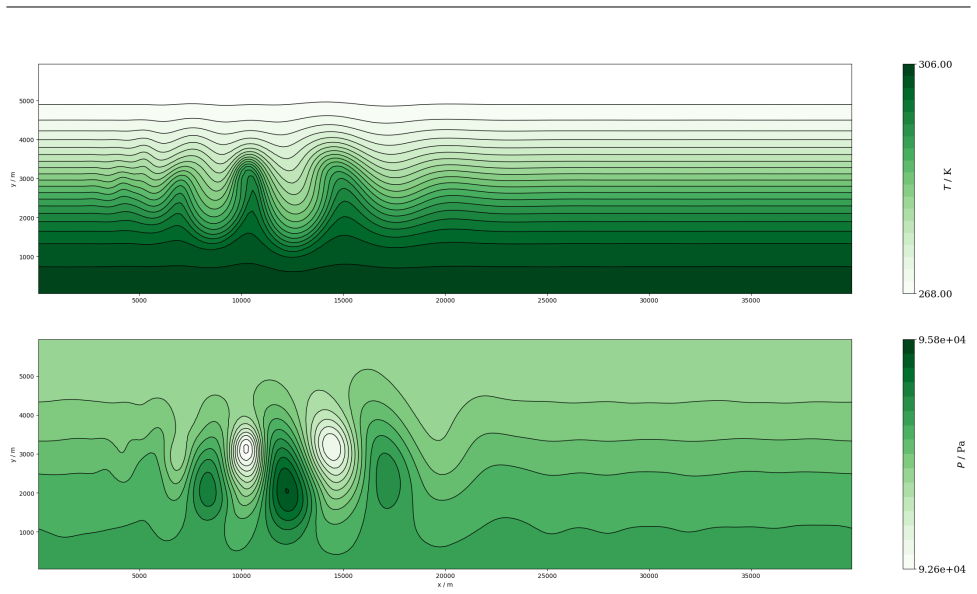
The paper demonstrates that FWSW-SDC, which splits the right-hand side into fast terms treated implicitly and slow transport terms treated explicitly, can be coupled to a compatible finite element spatial discretisation of the compressible Euler equations. A convergence test for advection on the sphere produces the expected fourth, sixth, and eighth order rates for SDC(2,3), SDC(3,5), and SDC(4,7). In the nonlinear gravity-wave test the measured convergence is second order, better than fourth order, and better than fifth order as spatial and temporal order increase together, and the rising-bubble and baroclinic-wave simulations reproduce reference fields. The paper concludes that SDC offers a viable alternative to IMEX Runge-Kutta and other semi-implicit temporal discretisations used in numerical weather prediction and climate modelling.
Load-bearing premise
The load-bearing premise is that the order and stability proven for FWSW-SDC on linear model problems carry over to the nonlinear moist compressible Euler equations even though each implicit fast-wave solve is stopped at a relative tolerance of $10^{-4}$.
Editorial extensions
If this is right
- The temporal order of a dynamical core can be raised without re-engineering the discretisation, because $M$ and $K$ are runtime parameters.
- A single unified model could use low-order time stepping for short forecasts and higher-order time stepping for climate integrations, where temporal error accumulates over many steps.
- Diagonal preconditioners for the implicit and explicit sweeps produce nearly identical rising-bubble results to standard LU and explicit-Euler preconditioners, which is a step toward parallelising SDC across collocation nodes.
- On the gravity-wave benchmark, the combined space-time convergence improves from about second order at $p=1$ with SDC(2,3) to better than fifth order at $p=5$ with SDC(4,7), showing that both orders can be increased together.
- The method remains stable for the benchmark time steps used in the literature, matching reference baroclinic-wave structures at 12 days with a 1800-second time step.
Reading between the lines
- Beyond the paper: the measured order for the highest-order schemes on nonlinear tests could be limited by the $10^{-4}$ solver tolerance, so a tolerance study would separate algebraic error from space-time discretisation error.
- Beyond the paper: the demonstrated stability of diagonal preconditioners suggests a concrete parallel-in-time implementation with one thread per collocation node, though the paper only lists time-parallel SDC as future work.
- Beyond the paper: if arbitrary-order temporal accuracy persists over climate-length integrations, the accumulated temporal error could be reduced without changing the dynamical core's time-stepping scheme, but the benchmarks here cover days, not decades.
- Beyond the paper: the moisture extension covers vapour and cloud water with a simple two-phase scheme, so adding rain and testing a cold-pool or precipitating case would test the splitting's behaviour under stronger source terms.
Signed reviews
Editorial analysis
A structured set of objections, weighed in public.
Referee Report
Summary. The paper applies fast-wave slow-wave spectral deferred correction (FWSW-SDC) time stepping to the moist compressible Euler equations discretised with compatible finite elements in the Gusto/Firedrake framework. The method is formulated as a preconditioned Richardson iteration on a collocation problem, with an implicit treatment of fast-wave terms and explicit treatment of slow-wave terms. The authors demonstrate the scheme on four benchmarks: tracer advection on the sphere (temporal convergence up to order 8), a non-hydrostatic gravity wave (combined space-time convergence), a moist rising bubble, and a dry baroclinic wave in a channel. The central claim is that FWSW-SDC provides runtime-selectable, arbitrarily high temporal order for a modern dynamical-core equation set, and that it is a promising alternative to existing semi-implicit and IMEX methods for NWP and climate modelling.
Significance. If fully substantiated, the paper would provide a useful demonstration that SDC-type time integrators can be coupled to a compatible finite element compressible Euler model, with the practical advantage of choosing temporal order at runtime and the potential for parallel-in-time variants. The work has clear strengths: the benchmarks are standard and are compared against external reference solutions (Williamson, Skamarock and Klemp, Bryan and Fritsch, Ullrich), the code and run scripts are publicly available, and the comparison between classical LU-trick preconditioning and the newer diagonal MIN-SR preconditioners addresses an actively developing part of the SDC literature. The main gap is that the evidence for the headline 'arbitrary temporal order' claim on the target equations is indirect: the only clean temporal self-convergence test is a linear explicit advection problem, while the compressible Euler convergence study refines space and time together and therefore cannot distinguish temporal from spatial order.
major comments (3)
- [§3.2, Table 2] The gravity-wave convergence study refines Δx and Δt simultaneously at fixed CFL = 0.06, so the observed slopes cannot isolate the temporal order of the SDC scheme. The p=1, p=3, and p=5 spatial discretisations have nominal spatial orders 2, 4, and 6, respectively, and the observed slopes of approximately 2, better than 4, and better than 5 are exactly what one would expect from spatial error alone when temporal errors are of higher order. The statement in §3.2 that the combination 'can provide methods with variable and arbitrarily high order of accuracy' therefore needs support from a temporal self-convergence experiment on the compressible Euler equations, i.e. fixed fine spatial resolution with Δt varying alone, ideally over several Δt values at the same Δx.
- [§2.4] The nonlinear and linear solver tolerances are set to 10^-4, a level comparable to the error magnitudes needed to verify 5th- to 7th-order convergence on the reported meshes. Since SDC order statements assume exact solution of the implicit sweeps, it is load-bearing to demonstrate that the inexact Newton solves with Eisenstat-Walker forcing do not cap the observed order or produce the kind of error plateau that could be mistaken for superconvergence. A concrete test would be to repeat the proposed temporal convergence study with tolerances 10^-4 and 10^-8 and report both the measured slopes and the absolute error levels.
- [§3.1 vs §3.2] The only clean high-order temporal convergence test in the paper is linear tracer advection on the sphere with a prescribed wind and an explicit scheme; it does not exercise the fast-wave implicit solve, the FWSW splitting, or the nonlinear pressure and gravity dynamics that define the compressible Euler target. Consequently, the evidence for 'arbitrary order accuracy' on the target application currently rests on extrapolation from a linear test to the nonlinear benchmarks. The authors should either add a temporal convergence test for the actual FWSW-SDC Euler scheme (for example, the gravity wave at fixed spatial resolution, or a small-amplitude acoustic/gravity-wave problem with a known reference) or substantially soften the arbitrary-order wording in the abstract and conclusion.
minor comments (6)
- [Abstract] The sentence 'Finally, a baroclinic wave in simulated in a Cartesian domain' contains a grammatical typo ('in simulated' should be 'is simulated').
- [§2.3] Internal cross-references are broken: 'Section 22.2' and 'Section 22.3' appear instead of Sections 2.2 and 2.3; the same issue occurs with 'Section 33.2', '33.3', and '33.4' in the results and conclusion.
- [Eq. (32a)] The perturbation radius is defined as r = sqrt((x-x_c)^2 - (y-y_x)^2), which contains a minus sign and an undefined y_x; this should presumably be sqrt((x-x_c)^2 + (y-y_c)^2) as in Ullrich et al. (2015).
- [Eq. (29b)] The Coriolis parameter appears as 'f0 = 2.0 −6 Km−1', which seems to be missing the factor 10^-6; please correct the typesetting.
- [§2.3] The state vector x is first defined as [u, ρ, θ_vd, m_v]^T but the governing equations and Algorithm 1 also include m_c; the definition should be [u, ρ, θ_vd, m_v, m_c]^T for consistency.
- [Figure 1] The caption says 'SDC(2,3) and SDC(3,5) achieve the expected order of convergence of 4, 6 and 8 respectively' but three schemes are listed in the text; please clarify which scheme corresponds to which order and correct the apparent omission of SDC(4,7).
Circularity Check
No significant circularity: the SDC convergence orders are verified independently and the benchmark predictions are external, so the paper's self-citations are not load-bearing.
full rationale
The derivation chain is self-contained and none of the claimed predictions reduce to fitted constants or self-defined quantities. The temporal-order claim is checked in Section 3.1 with an external Williamson et al. advection problem, where SDC(2,3), SDC(3,5) and SDC(4,7) are measured against an SSPRK3 reference and observe orders 4, 6, and 8; the predicted orders come from independent SDC theory (Xia et al. 2007; Ruprecht and Speck 2016) rather than from a parameter fitted here. The nonlinear tests are compared with external benchmarks (Skamarock and Klemp 1994; Bryan and Fritsch 2002; Ullrich et al. 2015) and previous Gusto results, with no calibration of tolerances or coefficients to the presented outputs. The self-citations to Bendall et al. (2020), Melvin et al. (2010), Cotter and Shipton (2012), and Ruprecht and Speck (2016) supply prior, peer-reviewed components of the base discretisation and method; they are not invoked as a uniqueness theorem and they do not substitute for the paper's own numerical evidence. One experimental-design caveat is visible in Section 3.2, where the gravity-wave convergence study refines Δx and Δt together at fixed CFL 0.06, so the observed slopes of 2, approximately 4, and approximately 5 track the spatial discretisation rather than isolating the temporal SDC order; this weakens that particular demonstration but is a support and interpretation limitation, not a circular derivation.
Assumptions & free parameters
free parameters (2)
- SUPG stabilization parameter tau =
1/sqrt(15)
- nonlinear/linear solver tolerances =
10^-4 (absolute and relative)
assumptions (4)
- standard math Each SDC sweep increases order by one up to collocation order (Xia et al. 2007).
- domain assumption Compatible finite element spaces satisfying the discrete de Rham complex provide good dispersion and no spurious modes.
- ad hoc to paper The chosen fast/slow splitting of the compressible Euler equations remains stable and high-order for nonlinear, non-rectangular problems.
- domain assumption The microphysics source terms from Bendall et al. 2020 are correct for the two-moisture model.
Cite this review
Pith. "Pith review of Fast-wave slow-wave spectral deferred correction methods applied to the compressible Euler equations." pith.science (2026). https://pith.science/paper/RPIRF4DF
@misc{pith2026250515985,
  author       = {Pith},
  title        = {Pith review of: Fast-wave slow-wave spectral deferred correction methods applied to the compressible Euler equations},
  year         = {2026},
  howpublished = {\url{https://pith.science/paper/RPIRF4DF}},
  note         = {Machine review of arXiv:2505.15985}
}
read the original abstract
This paper investigates the application of a fast-wave slow-wave spectral deferred correction time-stepping method (FWSW-SDC) to the compressible Euler equations. The resulting model achieves arbitrary order accuracy in time, demonstrating robust performance in standard benchmark idealised test cases for dynamical cores used for numerical weather prediction. The model uses a compatible finite element spatial discretisation, achieving good linear wave dispersion properties without spurious computational modes. A convergence test confirms the model's high temporal accuracy. Arbitrarily high spatial-temporal convergence is demonstrated using a gravity wave test case. The model is further extended to include the parametrisation of a simple physics process by adding two phases of moisture and its validity is demonstrated for a rising thermal problem. Finally, a baroclinic wave in simulated in a Cartesian domain.
Figures


Figures from the paper (1 more)
Reference graph
Works this paper leans on
-
[1]
Balay, S., W. D. Gropp, L. C. McInnes, and B. F. Smith, 1997: Efficient M anagement of P arallelism in O bject O riented N umerical S oftware L ibraries. Modern Software Tools in Scientific Computing, E. Arge, A. M. Bruaset, and H. P. Langtangen, Eds., Birkh \" a user Press, 163--202
work page 1997
-
[2]
Balay, S., and Coauthors, 2024: PETSc/TAO U sers M anual. Tech. Rep. ANL-21/39 - Revision 3.21, Argonne National Laboratory. doi:10.2172/2205494
doi:10.2172/2205494 2024
-
[3]
Bendall, T. M., T. H. Gibson, J. Shipton, C. J. Cotter, and B. Shipway, 2020: A compatible finite-element discretisation for the moist compressible E uler equations. Quarterly Journal of the Royal Meteorological Society, 146 (732), 3187--3205
work page 2020
-
[4]
Bercea, G., A. T. T. McRae, D. A. Ham, L. Mitchell, F. Rathgeber, L. Nardi, F. Luporini, and P. H. J. Kelly, 2016: A structure-exploiting numbering algorithm for finite elements on extruded meshes, and its performance evaluation in F iredrake. Geoscientific Model Development, 9 (10), 3803--3815, doi:10.5194/gmd-9-3803-2016, 1604.05937
work page Pith review arXiv 2016
- [5]
- [6]
- [7]
- [8]
Show all 57 references
-
[9]
Dalcin, L. D., R. R. Paz, P. A. Kler, and A. Cosimo, 2011: Parallel distributed computing using P ython. Advances in Water Resources, 34 (9), 1124--1139, doi:https://doi.org/10.1016/j.advwatres.2011.04.013
2011 doi
-
[10]
R., and P
Durran, D. R., and P. N. Blossey, 2012: Implicit– E xplicit M ultistep M ethods for F ast- W ave– S low- W ave P roblems. Monthly Weather Review, 140 (4), 1307–1325, doi:10.1175/MWR-D-11-00088.1
2012 doi
-
[11]
Greengard, and V
Dutt, A., L. Greengard, and V. Rokhlin, 2000: Spectral deferred correction methods for ordinary differential equations. BIT Numerical Mathematics, 40 (2), 241--266
2000
-
[12]
C., and H
Eisenstat, S. C., and H. F. Walker, 1996: Choosing the forcing terms in an inexact N ewton method. SIAM Journal on Scientific Computing, 17 (1), 16--32
1996
-
[13]
Minion, 2012: Toward an efficient parallel in time method for partial differential equations
Emmett, M., and M. Minion, 2012: Toward an efficient parallel in time method for partial differential equations. Communications in Applied Mathematics and Computational Science, 7 (1), 105--132
2012
-
[14]
Falgout, R. D., S. Friedhoff, T. V. Kolev, S. P. MacLachlan, and J. B. Schroder, 2014: Parallel time integration with multigrid . SIAM Journal on Scientific Computing, 36, C635--C661, doi:10.1137/130944230
2014 doi
-
[15]
Tang, and J
Feng, X., T. Tang, and J. Yang, 2015: Long time numerical simulations for phase-field problems using p-adaptive spectral deferred correction methods. SIAM Journal on Scientific Computing, 37 (1), A271--A294
2015
-
[16]
Götschel, T
Freese, P., S. Götschel, T. Lunet, D. Ruprecht, and M. Schreiber, 2024: Parallel performance of shared memory parallel spectral deferred corrections. ://arxiv.org/abs/2403.20135, 2403.20135
2024
-
[17]
W., 1988: Parallel methods for ordinary differential equations
Gear, C. W., 1988: Parallel methods for ordinary differential equations . CALCOLO, 25 (1-2), 1--20, doi:10.1007/BF02575744
1988 doi
-
[18]
Xu, 2019: Semi-implicit spectral deferred correction method based on the invariant energy quadratization approach for phase field problems
Guo, R., and Y. Xu, 2019: Semi-implicit spectral deferred correction method based on the invariant energy quadratization approach for phase field problems. Comput. Phys, 26 (1), 87--113
2019
-
[19]
A., and Coauthors, 2023: Firedrake U ser M anual
Ham, D. A., and Coauthors, 2023: Firedrake U ser M anual . Imperial College London and University of Oxford and Baylor University and University of Washington, first edition ed., doi:10.25561/104839
2023 doi
-
[20]
Hartney, N., T. M. Bendall, and J. Shipton, 2024: A compatible finite element discretisation for moist shallow water equations. arXiv preprint arXiv:2409.07182
2024 arXiv
-
[21]
Jia, and M
Huang, J., J. Jia, and M. Minion, 2006: Accelerating the convergence of spectral deferred correction methods. Journal of Computational Physics, 214 (2), 633--656
2006
-
[22]
Reich, 2007: A regularization approach for a vertical-slice model and semi- L agrangian S t \"o rmer-- V erlet time stepping
Hundertmark, T., and S. Reich, 2007: A regularization approach for a vertical-slice model and semi- L agrangian S t \"o rmer-- V erlet time stepping. Quarterly Journal of the Royal Meteorological Society, 133 (627), 1575--1587
2007
-
[23]
Jia, J., J. C. Hill, K. J. Evans, G. I. Fann, and M. A. Taylor, 2013: A spectral deferred correction method applied to the shallow water equations on a sphere. Monthly Weather Review, 141 (10), 3435--3449
2013
-
[24]
Mitchell, M
Lange, M., L. Mitchell, M. G. Knepley, and G. J. Gorman, 2016: Efficient mesh management in Firedrake using PETSc-DMPlex . SIAM Journal on Scientific Computing, 38 (5), S143--S155, doi:10.1137/15M1026092, http://arxiv.org/abs/1506.07749
2016 arXiv
-
[25]
Maday, and G
Lions, J.-L., Y. Maday, and G. Turinici, 2001: A ``parareal" in time discretization of PDE s . Comptes Rendus de l'Académie des Sciences - Series I - Mathematics, 332, 661--668, doi:10.1016/S0764-4442(00)01793-6
2001 doi
-
[26]
Shen, 2015: Stabilized semi-implicit spectral deferred correction methods for A llen-- C ahn and C ahn-- H illiard equations
Liu, F., and J. Shen, 2015: Stabilized semi-implicit spectral deferred correction methods for A llen-- C ahn and C ahn-- H illiard equations. Mathematical Methods in the Applied Sciences, 38 (18), 4564--4575
2015
-
[27]
Baumann, and R
Lunet, T., T. Baumann, and R. Speck, 2024: P arallel-in- T ime/qmat. ://github.com/Parallel-in-Time/qmat, doi:10.5281/zenodo.11956479
2024 doi
-
[28]
T., G.-T
McRae, A. T., G.-T. Bercea, L. Mitchell, D. A. Ham, and C. J. Cotter, 2016: Automated generation and symbolic manipulation of tensor product finite elements. SIAM Journal on Scientific Computing, 38 (5), S25--S47
2016
-
[29]
Benacchio, B
Melvin, T., T. Benacchio, B. Shipway, N. Wood, J. Thuburn, and C. Cotter, 2019: A mixed finite-element, finite-volume, semi-implicit discretization for atmospheric dynamics: C artesian geometry. Quarterly Journal of the Royal Meteorological Society, 145 (724), 2835--2853
2019
-
[30]
Benacchio, J
Melvin, T., T. Benacchio, J. Thuburn, and C. Cotter, 2018: Choice of function spaces for thermodynamic variables in mixed finite-element methods. Quarterly Journal of the Royal Meteorological Society, 144 (712), 900--916
2018
-
[31]
Dubal, N
Melvin, T., M. Dubal, N. Wood, A. Staniforth, and M. Zerroukat, 2010: An inherently mass-conserving iterative semi-implicit semi- L agrangian discretization of the non-hydrostatic vertical-slice equations. Quarterly Journal of the Royal Meteorological Society, 136 (648), 799--814
2010
-
[32]
Quarterly Journal of the Royal Meteorological Society
Melvin, T., and Coauthors, 2024: A mixed finite-element, finite-volume, semi-implicit discretisation for atmospheric dynamics: S pherical geometry. Quarterly Journal of the Royal Meteorological Society
2024
-
[33]
L., 2003: Semi-implicit spectral deferred correction methods for ordinary differential equations
Minion, M. L., 2003: Semi-implicit spectral deferred correction methods for ordinary differential equations. Communications in Mathematical Sciences, 1 (3), 471--500
2003
-
[34]
L., 2004: Semi-implicit projection methods for incompressible flow based on spectral deferred corrections
Minion, M. L., 2004: Semi-implicit projection methods for incompressible flow based on spectral deferred corrections. Applied numerical mathematics, 48 (3-4), 369--387
2004
-
[35]
Shipton, and C
Natale, A., J. Shipton, and C. J. Cotter, 2016: Compatible finite element spaces for geophysical fluid dynamics. Dynamics and Statistics of the Climate System, 1 (1), dzw005
2016
-
[36]
Nixon-Hill, R. W., D. Shapero, C. J. Cotter, and D. A. Ham, 2024: Consistent point data assimilation in F iredrake and I cepack. Geoscientific Model Development, 17 (13), 5369--5386
2024
-
[37]
Norsett, E. H. S., and G. Wanner, 1987: Solving O rdinary D ifferential E quations I : N onsti P roblems. Springer-Verlag
1987
-
[38]
Ong, B. W., R. D. Haynes, and K. Ladd, 2016: Algorithm 965: RIDC methods: A family of parallel time integrators. ACM Transactions on Mathematical Software (TOMS), 43 (1), 1--13
2016
-
[39]
W., and R
Ong, B. W., and R. J. Spiteri, 2020: D eferred C orrection M ethods for O rdinary D ifferential E quations. Journal of Scientific Computing, 83 (3), 60, doi:10.1007/s10915-020-01235-8
2020 doi
-
[40]
Atmosphere-Ocean, 19 (1), 35--46
Robert, A., 1981: A stable numerical integration scheme for the primitive meteorological equations. Atmosphere-Ocean, 19 (1), 35--46
1981
-
[41]
Speck, 2016: Spectral deferred corrections with fast-wave slow-wave splitting
Ruprecht, D., and R. Speck, 2016: Spectral deferred corrections with fast-wave slow-wave splitting. SIAM Journal on Scientific Computing, 38 (4), A2535--A2557
2016
-
[42]
C., and J
Skamarock, W. C., and J. B. Klemp, 1994: Efficiency and accuracy of the K lemp- W ilhelmson time-splitting technique. Monthly Weather Review, 122 (11), 2623--2630
1994
-
[43]
Skamarock, W. C., J. B. Klemp, M. G. Duda, L. D. Fowler, S.-H. Park, and T. D. Ringler, 2012: A multiscale nonhydrostatic atmospheric model using centroidal voronoi tesselations and c-grid staggering. Monthly Weather Review, 140 (9), 3090--3105
2012
-
[44]
C., and Coauthors, 2008: A description of the advanced research wrf version 3
Skamarock, W. C., and Coauthors, 2008: A description of the advanced research wrf version 3. NCAR technical note, 475 (125), 10--5065
2008
-
[45]
ACM Transactions on Mathematical Software (TOMS), 45 (3), 1--23
Speck, R., 2019: Algorithm 997: py SDC —prototyping spectral deferred corrections. ACM Transactions on Mathematical Software (TOMS), 45 (3), 1--23
2019
-
[46]
Thuburn, 2012: Horizontal grids for global weather and climate prediction models: a review
Staniforth, A., and J. Thuburn, 2012: Horizontal grids for global weather and climate prediction models: a review. Quarterly Journal of the Royal Meteorological Society, 138 (662), 1--26
2012
-
[47]
Computer methods in applied mechanics and engineering, 73 (3), 331--339
Tezduyar, T., 1989: Finite element formulation for the vorticity-stream function form of the incompressible E uler equations on multiply-connected domains. Computer methods in applied mechanics and engineering, 73 (3), 331--339
1989
-
[48]
Tezduyar, T. E., R. Glowinski, and J. Liou, 1988: Petrov- G alerkin methods on multiply connected domains for the vorticity-stream function formulation of the incompressible N avier- S tokes equations. International journal for numerical methods in fluids, 8 (10), 1269--1290
1988
-
[49]
Reed, and C
Ullrich, P., K. Reed, and C. Jablonowski, 2015: Analytical initial conditions and an analysis of baroclinic instability waves in f-and -plane 3 D channel models. Quarterly Journal of the Royal Meteorological Society, 141 (693), 2972--2988
2015
-
[50]
Geoscientific Model Development, 7 (1), 361--386
Walters, D., and Coauthors, 2014: The M et O ffice U nified M odel global atmosphere 4.0 and JULES global land 4.0 configurations. Geoscientific Model Development, 7 (1), 361--386
2014
-
[51]
BIT Numerical Mathematics, 55 (4), 1219 -- 1241, doi:10.1007/s10543-014-0540-y
Weiser, M., 2015: Faster SDC convergence on non-equidistant grids by DIRK sweeps. BIT Numerical Mathematics, 55 (4), 1219 -- 1241, doi:10.1007/s10543-014-0540-y
2015 doi
-
[52]
Ghosh, 2018: Theoretically optimal inexact spectral deferred correction methods
Weiser, M., and S. Ghosh, 2018: Theoretically optimal inexact spectral deferred correction methods. Communications in Applied Mathematics and Computational Science, 13 (1), 53--86
2018
-
[53]
Williamson, D. L., J. B. Drake, J. J. Hack, R. Jakob, and P. N. Swarztrauber, 1992: A standard test set for numerical approximations to the shallow water equations in spherical geometry. Journal of computational physics, 102 (1), 211--224
1992
-
[54]
Speck, and D
Winkel, M., R. Speck, and D. Ruprecht, 2015: A high-order B oris integrator. Journal of computational physics, 295, 456--474
2015
-
[55]
Xu, and C
Xia, Y., Y. Xu, and C. Shu, 2007: Efficient time discretization for local discontinuous G alerkin methods. Discrete and Continuous Dynamical Systems Series B, 8 (3), 677
2007
-
[56]
Reinert, P
Z \"a ngl, G., D. Reinert, P. R \' podas, and M. Baldauf, 2015: The ICON ( ICO sahedral N on-hydrostatic) modelling framework of DWD and MPI-M : D escription of the non-hydrostatic dynamical core. Quarterly Journal of the Royal Meteorological Society, 141 (687), 563--579
2015
-
[57]
Lunet, S
Čaklović, G., T. Lunet, S. Götschel, and D. Ruprecht, 2025: Improving E fficiency of P arallel A cross the M ethod S pectral D eferred C orrections. ://doi.org/10.1137/24M1649800, A430–A453 pp., doi:10.1137/24M1649800
2025 doi
Reviewed August 7, 2026 · model on record in the stance chip above.
Discussion (0). Continue with ORCID to comment.