REVIEW 4 major objections 5 minor 81 references
SONIC: Cost-Effective Web Access for Developing Countries
T0 review · 4 major / 5 minor · reviewed 2026-08-07 · deepseek-v4-flash
Pith's one-line read SONIC claims that existing FM broadcast infrastructure plus SMS can deliver useful web content and LLM chat answers to ordinary Android phones, and backs this with a six-week, 30-user deployment in Cameroon sustaining 10 kbps downlink and…
desk verdict A real deployment of FM-broadcast web delivery, honestly reported; the abstract overstates some numbers and the novelty claim needs toning down. read the letter →
The pith
A machine-rendered reading of the paper's core claim, the machinery that carries it, and where it could break.
The reading
What carries the argument
The system's load-bearing piece is an audio-over-FM chain built on OFDM, a multi-carrier modulation that splits the channel into narrow orthogonal sub-carriers: 92 sub-carriers centered around 9.2 kHz carry 10 kbps of coded data, modulated by an open-source audio modem library. On the send side, webpages are rendered headlessly, captured as 320-pixel-wide WebP screenshots, wrapped in a structured file format whose headers mark metadata, link maps, and payload frames, and then pushed through the station's audio path. On the phone, a modified open-source Android build opens the built-in FM tuner to apps, the app decodes frames with CRC32 checksums plus inner and outer forward-error correction, and lost pixels are filled by nearest-neighbor interpolation, exploiting the left-to-right structure of text. Requests travel by SMS; interactive hyperlinks are stored as click coordinates, and a scored push mechanism prefetches the three most likely next links during idle time.
What would settle it
Run the same nightly broadcast for one week at a second FM station, measuring per-frame loss against signal strength; if the majority of receptions above -90 dBm exceed 20% loss, or if any single day's transmission fails because station staff did not flip the switch, the paper's reliability claim does not generalize.
Extended reading notes
Core claim
The paper claims that pre-rendered webpage screenshots and LLM responses can be encoded as OFDM audio, broadcast over an FM station's off-peak hours, and decoded on unrooted Android phones using their built-in FM tuners, with SMS providing the request channel. In its Cameroon deployment, transmissions sustained 10 kbps; a majority of receptions with signal strength above -90 dBm lost less than 20% of frames, and mean decoding accuracy was 71%. Users made 1,737 URL requests and 2,936 query requests over six weeks, and the broadcast nature meant every tuned-in phone received every transmission, feeding a shared knowledge hub even for users who never sent a request. The paper further claims one FM frequency can serve roughly 30 active users in a seven-hour nightly window, and 300 users with ten frequencies.
Load-bearing premise
The system assumes the radio station's audio chain, including the mixer, transmitter audio input, and the phone's FM receiver, carries the OFDM-modulated audio with little distortion, and that station staff reliably switch to the data broadcast at 10 PM; the paper reports days were lost when the switch was missed or the transmitter volume drifted from 100%.
Editorial extensions
If this is right
- If the deployment numbers hold, a single seven-hour overnight window on one FM frequency can clear the backlog of about 30 active users, and scaling to 300 users requires roughly ten frequencies, suggesting capacity can grow by adding channels rather than redesigning the system.
- Because FM is broadcast, content requested by one user reaches every tuned-in phone; the knowledge hub turns this into a free discovery channel and preserves downlink anonymity, since the server cannot know who is listening.
- LLM responses arrive faster than full webpages because they are smaller, but a single lost 500-byte frame can break an entire response, whereas webpage images tolerate partial loss; completion rates therefore depend on content type and signal strength.
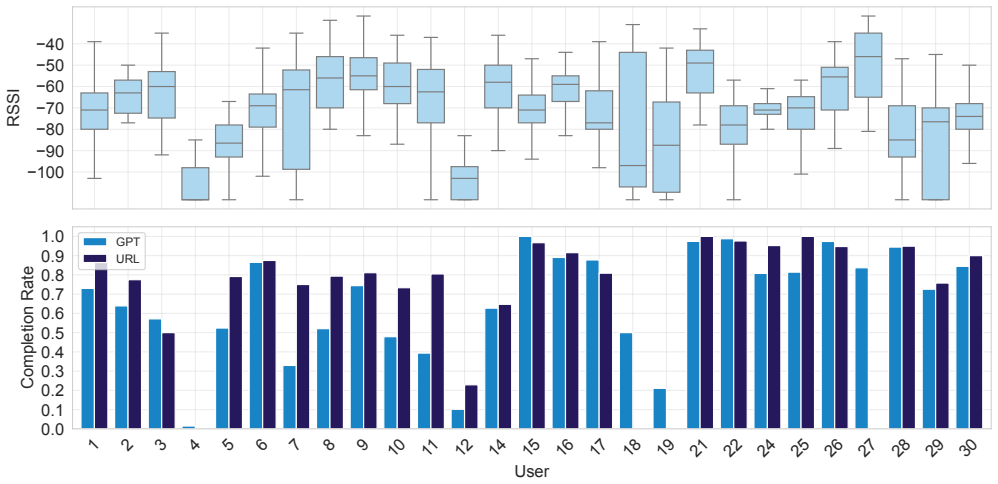
- Users with median signal strength above -70 dBm consistently exceeded 80% request completion, while users below -90 dBm often fell below 30%, so receiver placement and antenna conditions determine whether the service is usable.
- Once the station and SMS gateway exist, serving additional listeners adds almost no marginal cost, making advertising-supported or SMS-premium business models plausible.
Reading between the lines
- Editorial inference: the same off-peak broadcast channel could prefetch popular pages and LLM answers into phone caches, reducing later cellular usage to interactive or personalized requests only.
- Editorial inference: since LLM responses lose value with a single lost frame while webpage images tolerate partial loss, rebroadcasting short LLM responses with added redundancy would likely lift completion rates more than increasing the overall bitrate.
- Editorial inference: moving from the analog audio path to an FM subcarrier or a dedicated digital channel could raise throughput well beyond 10 kbps without changing the client's request-by-SMS model.
- Editorial inference: the push priority score was fit on click data from one online study population, so its coefficients may shift for other regions; logging clicks on pushed links during deployment would let the metric adapt to local browsing habits.
Editorial analysis
A structured set of objections, weighed in public.
Referee Report
Summary. The paper presents SONIC, a system that delivers simplified web content and LLM-generated responses to low-end smartphones using FM radio as a broadcast downlink and SMS as an uplink. The authors describe the server and client architecture, a modified LineageOS build that exposes FM tuner audio to applications, image-based webpage compression with pixel interpolation, and a hyperlink-pushing heuristic. They report a six-week deployment at an FM radio station in Cameroon with 30 users, and claim a sustained downlink throughput of 10 kbps, less than 20% transmission loss for a majority of transmissions above -90 dBm, and strong user engagement across web browsing and ChatGPT interactions.
Significance. If the headline claims are supported, SONIC would be a genuinely useful contribution to low-cost connectivity in low-income regions: it repurposes near-ubiquitous FM radio and SMS infrastructure, and the six-week deployment with 30 real users is a substantial step beyond lab-only evaluations. The paper also makes a credible case that FM-capable phones are widely available and affordable in the target regions. The main concerns are not about the overall concept but about whether the abstract's quantitative claims are backed by the reported measurements.
major comments (4)
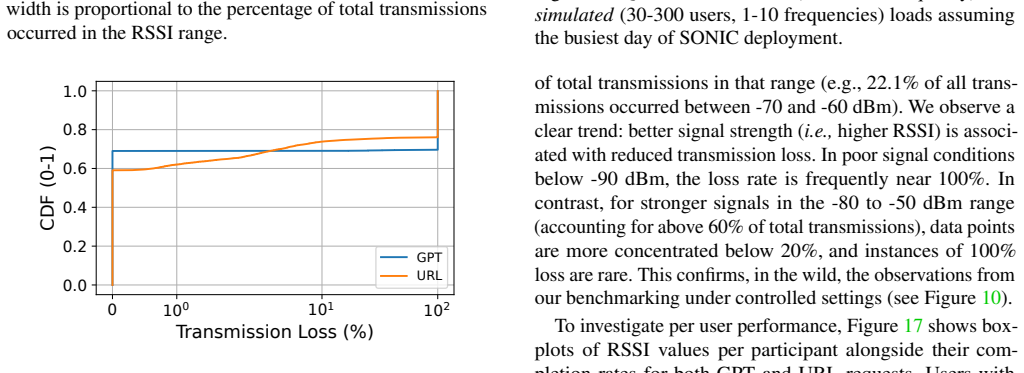
- [§6, Figure 14, and abstract] The abstract claims 'less than 20% loss for a majority of transmissions with signal strength above -90 dBm,' but the paper does not report the statistic that directly supports this claim. Figure 14 shows violin plots with bin widths labeled as percentages of total transmissions, but it does not state the median loss per bin or the fraction of transmissions with loss below 20% for the RSSI > -90 dBm subset. The text in §6 says data points are 'more concentrated below 20%' for the -80 to -50 dBm range, which is not a quantitative majority statement. Relatedly, 'loss' is not defined: it could mean lost frames, lost bytes, or failed transmissions, and the denominator is unclear. Please report the exact fraction of transmissions with loss below 20% among those with RSSI above -90 dBm, and define the loss metric precisely.
- [§3.1.1 and §6] The abstract and Section 1 describe 'a sustained downlink throughput of 10 kbps' as a demonstrated result, but Section 3.1.1 defines 10 kbps as the modulation rate of the Quiet OFDM profile (92 sub-carriers, 9.2 kHz center frequency). Section 6 contains no measured throughput or goodput data, such as bytes successfully delivered per hour or per transmission window. As written, the headline number is a configuration parameter, not a measured result. Please either remove 'sustained' and rephrase as the configured modulation bitrate, or add measured throughput/goodput from the deployment.
- [§1 and §6] Section 1 states that 'Mean decoding accuracy remained at 71% under real-world conditions,' but this metric is never defined and does not appear anywhere in Section 6. The evaluation instead reports transmission loss percentages and request completion rates. If 'decoding accuracy' refers to the fraction of successfully decoded frames, bytes, or transmissions, that definition and the supporting measurement must be provided; otherwise, the sentence should be removed from the introduction.
- [§6, Figure 16] The scalability analysis is based on 'FCFS queue simulations' whose methodology is not described. The paper does not state how the baseline traffic was scaled, how cache behavior was modeled, what service time was assumed per request, whether the simulated players experience transmission loss, or how the number of frequencies changes the service rate. Since the abstract and conclusion describe SONIC as 'scalable,' these simulation assumptions need to be specified, or the figure should be explicitly labeled as an illustrative back-of-the-envelope extrapolation rather than a simulation result.
minor comments (5)
- [Abstract and §1] The unit is written as '-90 dbM' and 'dBM'; it should be '-90 dBm' throughout.
- [§2] The sentence 'These results sheds light on the affordability of web access' should be 'These results shed light...'.
- [§6, Figure 14] The percentages printed beneath the RSSI bins are the proportions of transmissions, but the violin plot itself is not accompanied by a legend describing what the median, quartiles, or whiskers represent; please add a legend or a short caption explaining the plot elements.
- [§6, Figure 17] The term 'completion rate' is used but not defined; it should state whether a request counts as complete only when all frames are decoded, or whether partial content counts.
- [§4, Figure 10] The line 'over 95% of transmissions experienced loss rates below 10%' refers to ideal lab conditions, but this is easy to misread as a field result because Figure 14 is discussed later; consider adding an explicit qualifier such as 'under controlled lab conditions' in the sentence.
Circularity Check
No significant circularity; deployment results are empirical and self-contained, with only minor non-load-bearing self-citations.
full rationale
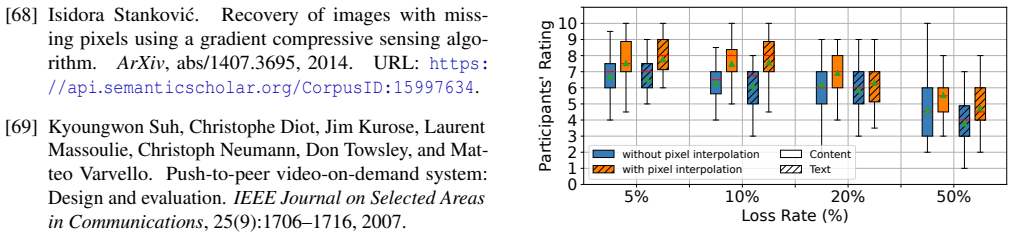
The paper's central results are measured deployment outcomes: sustained 10 kbps throughput, loss rates versus RSSI, completion rates, and user engagement from a six-week live FM station deployment in Cameroon. These are empirical observations, not quantities derived by fitting parameters and then re-reporting them as predictions. The pushing heuristic (score=0.68*w*h - 0.32*y) is transparently described as a logistic-regression fit from a Prolific user study and is used only as a prioritization heuristic for idle-time link pushing; it is not presented as a validated scientific prediction and it does not feed back into the throughput, loss, or engagement claims. The only substantive self-citation is reference [57], the authors' own prior CoNEXT work, which is used for the initial SONIC framework and for the pixel-interpolation benchmark: the paper states 'we adopt a lightweight approach proposed and benchmarked by [57] that provides consistently high content readability scores even at a 20% pixel loss rate.' That benchmark is an external prior user study from published work, not a fitted value of this paper, and it is not load-bearing for the deployment measurements. The paper also candidly discloses operational failures (inconsistent station switch-over, transmitter volume requirements, power outages, SIM blocking) that act as independent constraints rather than circular supports. No equation in the paper is defined in terms of its own output, and no 'uniqueness theorem' or ansatz is imported from the authors' prior work to force a conclusion. Any concern about whether the abstract's 'less than 20% loss for a majority of transmissions' is fully supported by the violin-plot medians in Figure 14 is a data-reporting or correctness question, not a circularity question. Overall, the derivation chain is self-contained against real-world external measurements, so the circularity score is 0.
Assumptions & free parameters
free parameters (4)
- Link-pushing regression coefficients =
area weight = 0.68, y-position weight = -0.32
- Screenshot width =
320 pixels
- WebP quality =
10%
- Frame size =
500 bytes
assumptions (5)
- domain assumption The FM radio station's audio chain (mixer, transmitter, and receiver audio path) faithfully transports the OFDM-modulated audio signal.
- domain assumption The modified LineageOS build can expose FM radio audio to third-party apps without root on a range of Android devices.
- domain assumption The SONIC server has stable internet access to fetch webpages and call LLM APIs.
- domain assumption Users have access to SMS service for the uplink.
- domain assumption Pixel interpolation recovers lost frames well enough for reading left-to-right text pages.
Cite this review
Pith. "Pith review of SONIC: Cost-Effective Web Access for Developing Countries." pith.science (2026). https://pith.science/paper/ZPDBIGLZ
@misc{pith2026250516519,
  author       = {Pith},
  title        = {Pith review of: SONIC: Cost-Effective Web Access for Developing Countries},
  year         = {2026},
  howpublished = {\url{https://pith.science/paper/ZPDBIGLZ}},
  note         = {Machine review of arXiv:2505.16519}
}
read the original abstract
Over 2.6 billion people remain without access to the Internet in 2025. This phenomenon is especially pronounced in developing regions, where cost and infrastructure limitations are major barriers to connectivity. In response, we design SONIC, a low-cost, scalable data delivery system that builds on existing infrastructures: FM radio for downlink broadcasting, and SMS for personalized uplink. SONIC is motivated by the widespread availability of FM radio and SMS infrastructure in developing regions, along with embedded FM radio tuners in affordable mobile phones. SONIC offers several innovations to effectively transmit Web content over sound over FM radio, in a reliable and compressed form. For example, we transmit pre-rendered webpages and leverage pixel interpolation to recover errors at the receiver. We further modify Android to offer a simpler deployment pipeline, supporting a wide range of devices. We deployed SONIC at an FM radio station in Cameroon for six weeks with 30 participants. Our results demonstrate a sustained downlink throughput of 10 kbps, less than 20% loss for a majority of transmissions with signal strength above -90 dbM, and a strong user engagement across both Web browsing and ChatGPT interactions.
Figures


Figures from the paper (13 more)



Reference graph
Works this paper leans on
-
[1]
https://developer.chrome.com/docs/ lighthouse
Lighthouse. https://developer.chrome.com/docs/ lighthouse. 12
-
[2]
Prolific | quickly find research participants you can trust. https://www.prolific.com/. Accessed: 2025-04-12
work page 2025
-
[3]
URL: http: //www.seleniumhq.org/about/
Seleniumhq browser automation, 2017. URL: http: //www.seleniumhq.org/about/
work page 2017
-
[4]
Citi program - collaborative institutional training initia- tive. www.citiprogram.org, 2019. Accessed: 2022-05- 18
work page 2019
-
[5]
https:// developers.google.com/speed/webp
An image format for the Web., 2023. https:// developers.google.com/speed/webp
work page 2023
-
[6]
https://github.com/quiet/ org.quietmodem.Quiet
Android app built with Quiet which allows o pass data through the speakers of an Android device., 2023. https://github.com/quiet/ org.quietmodem.Quiet
work page 2023
-
[7]
https://github.com/ jamesonrader/AudioQR
AudioQR, 2023. https://github.com/ jamesonrader/AudioQR
work page 2023
-
[8]
Expanding internet connectivity with stratospheric bal- loons, 2023.https://x.company/projects/loon/
work page 2023
Show all 81 references
-
[9]
https://github.com/ggerganov/ ggwave
GGwave, 2023. https://github.com/ggerganov/ ggwave
2023
-
[10]
High altitude connectivity: The next chapter,
-
[11]
https://support.google.com/websearch/answer/ 9836344?hl=en
Load mobile pages faster with Web Light, 2023. https://support.google.com/websearch/answer/ 9836344?hl=en
2023
-
[12]
https://en.wikipedia.org/ wiki/MSN_Direct
MSN Direct, 2023. https://en.wikipedia.org/ wiki/MSN_Direct
2023
-
[13]
https://github.com/ quiet/quiet
Quiet modem project., 2023. https://github.com/ quiet/quiet
2023
-
[14]
https:// support.apple.com/guide/safari/hide-ads- when-reading-sfri32632/mac
Safari Reader Mode, 2023. https:// support.apple.com/guide/safari/hide-ads- when-reading-sfri32632/mac
2023
-
[15]
Starlink, 2023.https://starlink.com/
2023
-
[16]
https:// almanac.httparchive.org/en/2022/
Web Almanac, 2023. https:// almanac.httparchive.org/en/2022/
2023
-
[17]
Accessed: 2025-03-
Taara: A google x moonshot, 2025. Accessed: 2025-03-
2025
-
[18]
Africa’s shifting media landscapes: Digital media use grows, but so do demographic divides,
Afrobarometer. Africa’s shifting media landscapes: Digital media use grows, but so do demographic divides,
-
[19]
URL:https://x.company/projects/taara/
-
[20]
Audience listenership of fm radio: A case study of rural development in northern ghana.Cogent Arts & Humanities, 10(1):2184750, 2023
Osman Antwi-Boateng, Muhammed Danladi Musa, and Mu-Azu Iddirisu Andani and. Audience listenership of fm radio: A case study of rural development in northern ghana.Cogent Arts & Humanities, 10(1):2184750, 2023. arXiv:https: //doi.org/10.1080/23311983.2023.2184750, doi:10.1080/2...
2023
-
[21]
Ashigwuike, Ale Felix, and Farouq E
Evans C. Ashigwuike, Ale Felix, and Farouq E. Shaibu. The impact of soil texture on path loss modelling of an fm signal using diffraction technique: A case study of prime fm radio nigeria.Euro- pean Journal of Engineering Research and Science, 4(4):56–63, April 2019. URL: http...
2019 doi
-
[22]
Broadcastreceiver,
Android Developers. Broadcastreceiver,
-
[23]
Signal coverage mapping of local radios
Tina Baidar. Signal coverage mapping of local radios. Journal on Geoinformatics, Nepal, 2017. Accessed via Nepal Journals Online
2017
-
[24]
Driveshaft: Improving perceived mobile web performance.arXiv preprint arXiv:1809.09292, 2018
Ketan Bhardwaj, Ada Gavrilovska, Moritz Steiner, Mar- tin Flack, and Stephen Ludin. Driveshaft: Improving perceived mobile web performance.arXiv preprint arXiv:1809.09292, 2018
2018 arXiv
-
[25]
Drivers’ warning application through personalized dsss-cdma data transmission by using the fm radio broadcasting infrastructure.IEEE Access, 11:11711–11731, 2023
Radu Gabriel Bozomitu and Florin Doru Hutu. Drivers’ warning application through personalized dsss-cdma data transmission by using the fm radio broadcasting infrastructure.IEEE Access, 11:11711–11731, 2023
2023
-
[26]
Batcomm: enabling inaudible acoustic communication with high-throughput for mobile de- vices
Yang Bai, Jian Liu, Li Lu, Yilin Yang, Yingying Chen, and Jiadi Yu. Batcomm: enabling inaudible acoustic communication with high-throughput for mobile de- vices. InProceedings of the 18th Conference on Embed- ded Networked Sensor Systems, pages 205–217, 2020
2020
-
[27]
Madhyastha, and Vyas Sekar
Michael Butkiewicz, Daimeng Wang, Zhe Wu, Harsha V . Madhyastha, and Vyas Sekar. Klot- ski: Reprioritizing web content to improve user experience on mobile devices. In12th USENIX Symposium on Networked Systems Design and Implementation (NSDI ’15), Oakland, CA, USA,
-
[28]
Deep learning for irregularly and regularly missing data reconstruction.Scientific Reports, 10(1):3302, Feb 2020
Xintao Chai, Hanming Gu, Feng Li, Hongyou Duan, Xiaobo Hu, and Kai Lin. Deep learning for irregularly and regularly missing data reconstruction.Scientific Reports, 10(1):3302, Feb 2020. doi:10.1038/s41598- 020-59801-x
2020 doi
-
[29]
Jsanalyzer: A web developer tool for simpli- fying mobile web pages through non-critical javascript elimination.ACM Transactions on the Web, 16(4):1–31, 2022
Moumena Chaqfeh, Russell Coke, Jacinta Hu, Waleed Hashmi, Lakshmi Subramanian, Talal Rahwan, and Yasir Zaki. Jsanalyzer: A web developer tool for simpli- fying mobile web pages through non-critical javascript elimination.ACM Transactions on the Web, 16(4):1–31, 2022
2022
-
[30]
A robust radiocommunication system for fm transmission based on software defined radio technology
Radu Gabriel Bozomitu and ¸ Stefan Corneliu Stoica. A robust radiocommunication system for fm transmission based on software defined radio technology. In2022 IEEE 28th International Symposium for Design and Technology in Electronic Packaging (SIITME), pages 78–81. IEEE, 2022
2022
-
[31]
Jscleaner: De-cluttering mobile webpages through javascript cleanup
Moumena Chaqfeh, Yasir Zaki, Jacinta Hu, and Lakshmi Subramanian. Jscleaner: De-cluttering mobile webpages through javascript cleanup. InProceedings of The Web Conference 2020, pages 763–773, 2020
2020
-
[32]
Accessed: 2025-03-22
Cloudflare, Inc.Threat Intelligence APIs - Secu- rity Center, 2025. Accessed: 2025-03-22. URL: https://developers.cloudflare.com/security- center/intel-apis/
2025
-
[33]
Global smartphone market share: Quarterly
Counterpoint Research. Global smartphone market share: Quarterly. 2025. URL: https://www.counterpointresearch.com/ insights/global-smartphone-share/
2025
-
[34]
Digital 2025: Cameroon, 2025
DataReportal. Digital 2025: Cameroon, 2025. Accessed: 2025-03-26. URL: https://datareportal.com/ reports/digital-2025-cameroon
2025
-
[35]
To block or not to block: Accelerating mobile web pages on-the-fly through javascript classification
Moumena Chaqfeh, Muhammad Haseeb, Waleed Hashmi, Patrick Inshuti, Manesha Ramesh, Matteo Varvello, Lakshmi Subramanian, Fareed Zaffar, and Yasir Zaki. To block or not to block: Accelerating mobile web pages on-the-fly through javascript classification. InProceedings of the 12t...
2022
-
[36]
Bufferbloat: dark buffers in the internet.Communications of the ACM, 55(1):57–65, 2012
Jim Gettys and Kathleen Nichols. Bufferbloat: dark buffers in the internet.Communications of the ACM, 55(1):57–65, 2012
2012
-
[37]
Speedreader: Reader mode made fast and private
Mohammad Ghasemisharif, Peter Snyder, Andrius Auci- nas, and Benjamin Livshits. Speedreader: Reader mode made fast and private. InThe World Wide Web Confer- ence, pages 526–537, 2019
2019
-
[38]
Amp is a web component framework to easily create user-first web experiences - amp.dev
Google. Amp is a web component framework to easily create user-first web experiences - amp.dev. https: //amp.dev, 2019. Accessed: 2019-05-05
2019
-
[39]
The llama 3 herd of models, 2024
Aaron Grattafiori, Laurens Van Der Maaten, et al. The llama 3 herd of models, 2024. https://arxiv.org/ abs/2407.21783.arXiv:2407.21783
2024 arXiv
-
[40]
Inc. Docker. Docker: Open platform for developing, shipping, and running applications, 2024. URL: https: //www.docker.com/
2024
-
[41]
GSMArena - Mobile Phone Specifications, News, Reviews, 2025
GSMArena. GSMArena - Mobile Phone Specifications, News, Reviews, 2025. Accessed: 21 Mar. 2025. URL: https://www.gsmarena.com/
2025
-
[42]
A framework for im- proving web affordability and inclusiveness
Rumaisa Habib, Sarah Tanveer, Aimen Inam, Haseeb Ahmed, Ayesha Ali, Zartash Afzal Uzmi, Zafar Ayyub Qazi, and Ihsan Ayyub Qazi. A framework for im- proving web affordability and inclusiveness. InPro- ceedings of the ACM SIGCOMM 2023 Conference, ACM SIGCOMM ’23, page 592–607, N...
2023
-
[43]
Mobile wifi 4g router huawei e8372h-517 wifi modem
Huawei Technologies Co., Ltd. Mobile wifi 4g router huawei e8372h-517 wifi modem. Online. Accessed: 25 March 2025. URL: https://sincereonetech.com/products/4g- router-huawei-e8372h-517-wifi-modem/
2025
-
[44]
Near-ultrasound communication for tv’s 2nd screen services
Soonwon Ka, Tae Hyun Kim, Jae Yeol Ha, Sun Hong Lim, Su Cheol Shin, Jun Won Choi, Chulyoung Kwak, and Sunghyun Choi. Near-ultrasound communication for tv’s 2nd screen services. InProceedings of the 22nd Annual International Conference on Mobile Computing and Networking, pages ...
2016
-
[45]
The state of mobile internet connectivity report 2024, 2024
GSMA. The state of mobile internet connectivity report 2024, 2024. Accessed: 2025-02-05. URL: https://www.gsma.com/r/wp-content/uploads/ 2024/10/The-State-of-Mobile-Internet- Connectivity-Report-2024.pdf
2024
-
[46]
Muzeel: assessing the impact of javascript dead code elimination on mobile web per- formance
Jesutofunmi Kupoluyi, Moumena Chaqfeh, Matteo Varvello, Russell Coke, Waleed Hashmi, Lakshmi Sub- ramanian, and Yasir Zaki. Muzeel: assessing the impact of javascript dead code elimination on mobile web per- formance. InProceedings of the 22nd ACM Internet Measurement Conferen...
2022
-
[47]
Muzeel: A dynamic javascript analyzer for dead code elimination in today’s web.arXiv preprint arXiv:2106.08948, 2021
Tofunmi Kupoluyi, Moumena Chaqfeh, Matteo Varvello, Waleed Hashmi, Lakshmi Subramanian, and Yasir Zaki. Muzeel: A dynamic javascript analyzer for dead code elimination in today’s web.arXiv preprint arXiv:2106.08948, 2021
2021 arXiv
-
[48]
Tranco: A research-oriented top sites ranking hardened 14 against manipulation
Victor Le Pochat, Tom Van Goethem, Samaneh Tajal- izadehkhoob, Maciej Korczy´nski, and Wouter Joosen. Tranco: A research-oriented top sites ranking hardened 14 against manipulation. InProceedings of the 26th An- nual Network and Distributed System Security Sym- posium, NDSS 20...
2019
-
[49]
Chirp signal-based aerial acoustic com- munication for smart devices
Hyewon Lee, Tae Hyun Kim, Jun Won Choi, and Sunghyun Choi. Chirp signal-based aerial acoustic com- munication for smart devices. In2015 IEEE Confer- ence on Computer Communications (INFOCOM), pages 2407–2415. IEEE, 2015
2015
-
[50]
My traceroute (MTR)
Matt Kimball. My traceroute (MTR). https:// www.bitwizard.nl/mtr/
-
[51]
Javascript dead code identi- fication, elimination, and empirical assessment.IEEE Transactions on Software Engineering, 2023
Ivano Malavolta, Kishan Nirghin, Gian Luca Scoccia, Simone Romano, Salvatore Lombardi, Giuseppe Scan- niello, and Patricia Lago. Javascript dead code identi- fication, elimination, and empirical assessment.IEEE Transactions on Software Engineering, 2023
2023
-
[52]
How the core web vitals metrics thresholds were defined, 2020
Bryan McQuade and Barry Pollard. How the core web vitals metrics thresholds were defined, 2020. Accessed: 2025-04-16. URL: https://web.dev/articles/ defining-core-web-vitals-thresholds
2020
-
[53]
Mtn cameroon official website, 2025
MTN Cameroon. Mtn cameroon official website, 2025. Accessed: 2025-03-20. URL:https://mtn.cm/
2025
-
[54]
Polaris: Faster page loads using fine-grained dependency tracking
Ravi Netravali, Ameesh Goyal, James Mickens, and Hari Balakrishnan. Polaris: Faster page loads using fine-grained dependency tracking. In13th USENIX Symposium on Networked Sys- tems Design and Implementation (NSDI 16), Santa Clara, CA, 2016. USENIX Association. URL: https://ww...
2016
-
[55]
Lineageos android distribution, 2024
LineageOS. Lineageos android distribution, 2024. A free and open-source operating system for various de- vices, based on the Android mobile platform. URL: https://lineageos.org/
2024
-
[56]
Openai api reference, 2024
OpenAI. Openai api reference, 2024. Accessed: 2025- 03-24. URL: https://platform.openai.com/docs/ api-reference/chat
2024
-
[57]
Sonic: Connect the uncon- nected via fm radio & sms
Ayush Pandey, Rohail Asim, Khalid Mengal, Matteo Varvello, and Yasir Zaki. Sonic: Connect the uncon- nected via fm radio & sms. InProceedings of the 20th International Conference on Emerging Networking EX- periments and Technologies, CoNEXT ’24, page 41–47, New York, NY , USA,...
2024
-
[58]
Maml: Towards a faster web in developing regions
Ayush Pandey, Matteo Varvello, Syed Ishtiaque Ahmed, Shurui Zhou, Lakshmi Subramanian, and Yasir Zaki. Maml: Towards a faster web in developing regions. InProceedings of the ACM on Web Conference 2025, WWW ’25, page 727–739, New York, NY , USA, 2025. Association for Computing ...
2025
-
[59]
Image inpainting based on deep learning: A review.Displays, 69:102028,
Zhen Qin, Qingliang Zeng, Yixin Zong, and Fan Xu. Image inpainting based on deep learning: A review.Displays, 69:102028,
-
[60]
Speedtest® CLI, Internet connection measure- ment for developers
OOKLA. Speedtest® CLI, Internet connection measure- ment for developers. https://www.speedtest.net/apps/cli
-
[61]
Backdoor: Making microphones hear inaudible sounds
Nirupam Roy, Haitham Hassanieh, and Romit Roy Choudhury. Backdoor: Making microphones hear inaudible sounds. InProceedings of the 15th Annual International Conference on Mobile Systems, Applications, and Services, pages 2–14, 2017
2017
-
[62]
Nearest neighbor value interpolation.International Journal of Advanced Computer Science and Applications, 3(4), 2012
Olivier Rukundo and Hanqiang Cao. Nearest neighbor value interpolation.International Journal of Advanced Computer Science and Applications, 3(4), 2012. URL: http://dx.doi.org/10.14569/IJACSA.2012.030405, doi:10.14569/IJACSA.2012.030405
2012 arXiv
-
[63]
A world wide view of browsing the world wide web
Kimberly Ruth, Aurore Fass, Jonathan Azose, Mark Pearson, Emma Thomas, Caitlin Sadowski, and Zakir Durumeric. A world wide view of browsing the world wide web. InProceedings of the 22nd ACM Internet Measurement Conference, IMC ’22, page 317–336, New York, NY , USA, 2022. Assoc...
2022
-
[64]
Huawei lte api
Salamek. Huawei lte api. GitHub repository, 2025. Ac- cessed: 25 March 2025. URL: https://github.com/ Salamek/huawei-lte-api
2025
-
[65]
A software- defined ultrasonic networking framework for wearable devices.IEEE/ACM Transactions on Networking, 25(2):960–973, 2016
G Enrico Santagati and Tommaso Melodia. A software- defined ultrasonic networking framework for wearable devices.IEEE/ACM Transactions on Networking, 25(2):960–973, 2016
2016
-
[66]
Dimension c-137, 2025
Rick and Morty Wiki Contributors. Dimension c-137, 2025. Accessed: 24 Mar. 2025. URL: https://rickandmorty.fandom.com/wiki/ Dimension_C-137
2025
-
[67]
Digital 2025 global overview report, 2025
We Are Social and Meltwater. Digital 2025 global overview report, 2025. Retrieved on 18 March
2025
-
[68]
Recovery of images with miss- ing pixels using a gradient compressive sensing algo- rithm.ArXiv, abs/1407.3695, 2014
Isidora Stankovi ´c. Recovery of images with miss- ing pixels using a gradient compressive sensing algo- rithm.ArXiv, abs/1407.3695, 2014. URL: https: //api.semanticscholar.org/CorpusID:15997634
2014 arXiv
-
[69]
Push-to-peer video-on-demand system: Design and evaluation.IEEE Journal on Selected Areas in Communications, 25(9):1706–1716, 2007
Kyoungwon Suh, Christophe Diot, Jim Kurose, Laurent Massoulie, Christoph Neumann, Don Towsley, and Mat- teo Varvello. Push-to-peer video-on-demand system: Design and evaluation.IEEE Journal on Selected Areas in Communications, 25(9):1706–1716, 2007
2007
-
[70]
Per- formance characterization of videoconferencing in the wild
Matteo Varvello, Hyunseok Chang, and Yasir Zaki. Per- formance characterization of videoconferencing in the wild. InProceedings of the 22nd ACM Internet Mea- surement Conference, pages 261–273, 2022
2022
-
[71]
A worldwide look into mobile access networks through the eyes of ami- gos
Matteo Varvello and Yasir Zaki. A worldwide look into mobile access networks through the eyes of ami- gos. InTMA 2023 - Proceedings of the 7th Net- work Traffic Measurement and Analysis Conference. Institute of Electrical and Electronics Engineers Inc. doi:10.23919/TMA58422.20...
2023
-
[72]
Revcast: Fast, private certificate revocation over fm radio
Aaron Schulman, Dave Levin, and Neil Spring. Revcast: Fast, private certificate revocation over fm radio. In Proceedings of the 2014 ACM SIGSAC Conference on Computer and Communications Security, pages 799– 810, 2014
2014
-
[73]
Speeding up web page loads with shandian
Xiao Sophia Wang, Arvind Krishnamurthy, and David Wetherall. Speeding up web page loads with shandian. In13th USENIX Symposium on Networked Systems Design and Implementation (NSDI 16), pages 109–122, Santa Clara, CA, 2016. USENIX Association. URL: https://www.usenix.org/confer...
2016
-
[74]
URL: https://datareportal.com/reports/ digital-2025-global-overview-report. 15
2025
-
[79]
Springer Berlin Heidelberg, Berlin, Heidelberg, 1995
Hans Wackernagel.Ordinary Kriging, pages 74–81. Springer Berlin Heidelberg, Berlin, Heidelberg, 1995. doi:10.1007/978-3-662-03098-1_11
1995 doi
-
[81]
Worlddata.info: The world in num- bers, 2025
WorldData.info. Worlddata.info: The world in num- bers, 2025. Accessed: 2025-04-08. URL: https: //www.worlddata.info/. A Pixel Interpolation Figure 20 contains the results from a user study conducted by [57] to benchmark the effectiveness of their pixel interpo- lation approac...
2025
-
[2015]
Open Access
USENIX Association. Open Access. URL: https://www.usenix.org/conference/nsdi15/ technical-sessions/presentation/butkiewicz. 13
-
[2021]
URL: https://www.sciencedirect.com/ science/article/pii/S0141938221000391, doi:10.1016/j.displa.2021.102028
2021
-
[2023]
https://engineering.fb.com/2018/06/ 27/connectivity/high-altitude-connectivity- the-next-chapter/
2018
-
[2024]
URL: https://www.afrobarometer.org/ wp-content/uploads/2024/04/AD800-PAP14- Digital-media-use-grows-across-Africa% 5ELJ-but-so-do-demographic-divides- Afrobarometer-29april24.pdf
2024
-
[2025]
URL: https: //developer.android.com/develop/background- work/background-tasks/broadcasts
Accessed: 2025-04-10. URL: https: //developer.android.com/develop/background- work/background-tasks/broadcasts
2025
Reviewed August 7, 2026 · model on record in the stance chip above.
Discussion (0). Continue with ORCID to comment.