REVIEW 4 major objections 6 minor 83 references
Causal-Invariant Cross-Domain Out-of-Distribution Recommendation
T0 review · 4 major / 6 minor · reviewed 2026-08-07 · deepseek-v4-flash
Pith's one-line read A recommender learns dual-level causal-invariant preferences and removes review-derived confounders, beating the strongest baseline by 6.28% in HR@10 and 9.42% in NDCG@10.
desk verdict A competent empirical framework with an untested causal-invariance claim; worth refereeing but only as conditional. read the letter →
The pith
A machine-rendered reading of the paper's core claim, the machinery that carries it, and where it could break.
The reading
What carries the argument
The load-bearing mechanism is the dual-level DAG, a directed acyclic graph whose nodes are dimensions of user attributes and disentangled user preferences and whose edges are the weighted, invariant mechanism by which attributes generate preferences. At each level the graph is fit to the linear structural equation $B = A^{\top} B + \epsilon$ with a trace-based acyclicity penalty and structural constraints, and the same equation is reused at inference to generate causal-invariant preferences from attributes. The second mechanism is the iterative confounder-discovery loop: an LLM proposes variables from reviews, annotates them, a conditional-independence filter and a constraint-based causal discovery algorithm refine them, the Markov blanket of the interaction variable selects the relevant set, and the LLM extracts observed confounders with chain-of-thought reasoning; backdoor adjustment with a learned confounder-selection function then removes their effect. Attention fuses the domain-specific and domain-shared causal-invariant preferences before the final predictor.
What would settle it
Re-estimate the two adjacency matrices on training subsets drawn from different regions or user-degree groups and compare the sets of nonzero edges; if the nonzero structure differs materially across environments, the inferred preferences are not invariant, and the causal explanation of the gains fails.
Extended reading notes
Core claim
The central claim is that causal-invariant user preferences can be learned at two complementary levels and that doing so resolves the combined CDDS and SDDS problem. At the domain-specific level the model learns a DAG encoded by a weighted adjacency matrix $A_{\mathrm{spe}}$ such that the linear structural equation $B_{\mathrm{spe}} = A_{\mathrm{spe}}^{\top} B_{\mathrm{spe}} + \epsilon$ holds, where $B_{\mathrm{spe}}$ concatenates user attributes with target-domain-specific preferences; a parallel DAG is learned over domain-shared preferences. Both graphs are constrained so that influence flows only from attributes to preferences and preferences are never root nodes, and they are trained jointly with the recommendation objective. The LLM-guided confounder discovery module then iteratively proposes candidate causal variables from reviews, annotates them into structured values, refines them through conditional-independence filtering and a constraint-based causal discovery algorithm, extracts observed confounders via chain-of-thought prompting, and deconfounds through backdoor adjustment with a confounder-selection weighting. The paper reports that on the Douban and Amazon datasets, across user-degree-shift and region-shift settings, the framework outperforms the best baseline, DT3OR, by averages of 6.28% in HR@10 and 9.42% in NDCG@10.
Load-bearing premise
The load-bearing premise is that the linear structural equation learned for each DAG describes a genuinely invariant causal mechanism that stays the same across both cross-domain and single-domain shifts; if that equation is not invariant, the preferences called causal-invariant are just linear transformations of user attributes, and the reported gains could come from added model capacity rather than from causal transfer.
Editorial extensions
If this is right
- A recommender can handle CDDS and SDDS in one training objective rather than chaining separate transfer or debiasing steps, avoiding error accumulation.
- Learning the target domain's own causal graph matters as much as learning the shared graph: removing either level costs roughly 9–10% in ranking metrics on average.
- The observed-confounder module is doing real work: removing it drops average performance by 8.53%, and replacing it with direct single-step LLM extraction drops 4.36%.
- As the degree of distribution shift increases, the framework keeps the largest margin over the strongest baselines and degrades the most gradually.
- Averaged over the studied OOD settings, the proposed model surpasses the best baseline DT3OR by 6.28% in HR@10 and 9.42% in NDCG@10.
Reading between the lines
- Beyond the paper: if the invariance claim holds, the same dual-level design could be tested on unseen target domains, where the domain-shared DAG would serve as a portable prior for user preference formation; the paper lists this as future work, not evidence.
- Beyond the paper: because the method depends on review text, its gains may not transfer to domains with sparse, short, or noisy reviews; a review-free ablation would separate the deconfounding mechanism from the language model's content signal.
- Beyond the paper: the paper's own stated limitation is that only observed confounders extracted from reviews are modeled; a hybrid that also learns environment-based invariant representations for unobserved confounders could close that gap.
- Beyond the paper: the source domain's domain-specific causal structure is deliberately not learned, so the transfer signal flows only through the shared graph; learning a source-specific graph as well could reveal how much of the benefit rests on shared versus domain-specific causal mechanisms.
Editorial analysis
A structured set of objections, weighed in public.
Referee Report
Summary. The paper proposes CICDOR, a framework for a newly formulated cross-domain out-of-distribution recommendation setting that simultaneously addresses cross-domain distribution shift (CDDS) and single-domain distribution shift (SDDS). The method disentangles user preferences into domain-shared and domain-specific components, learns dual-level DAG-based causal structures over user attributes and preferences using a linear structural causal model with NOTEARS-style acyclicity, and uses an LLM-guided iterative pipeline (variable proposal, review annotation, FCI-based refinement, Markov blanket extraction, confounder extraction, and causal feedback) to identify observed confounders from user reviews. Confounders are then used in a backdoor-adjustment prediction module. Experiments on three source-target pairs from Douban and Amazon under user-degree and region shift settings report that CICDOR outperforms twelve baselines, including a 6.28% average HR@10 improvement and a 9.42% NDCG@10 improvement over the best baseline DT3OR, with ablations and parameter sensitivity analyses. The paper also reports a two-phase training strategy, time-complexity analysis, and a stated limitation regarding unobserved confounders.
Significance. If the causal-invariance claim were established, CICDOR would be a valuable unified treatment of a genuinely new setting: cross-domain OOD recommendation with coexisting CDDS and SDDS. The manuscript has concrete strengths: a clear problem formulation, a detailed algorithm with modular pipeline and complexity analysis, comparison against twelve representative baselines with five-run averages and paired t-tests, and ablations that separately assess the dual-level causal learning and the confounder-discovery module. However, the central explanatory claim—that the learned DAGs encode invariant causal mechanisms—is asserted rather than demonstrated. Nothing in the training objective enforces invariance across the OOD environments used in evaluation, and the deconfounding step assumes properties of the LLM-extracted confounders that are not validated. The reported accuracy gains may therefore come from added model capacity, regularization, or auxiliary review-derived features rather than from causal invariance. The empirical result remains interesting if reframed as a regularized cross-domain OOD method, but the causal interpretation is currently unsubstantiated.
major comments (4)
- [Section 4.3 and Eq. (20)] The paper's central claim is that A_spe and A_sha encode invariant causal mechanisms, but no invariance constraint, environment partition, or invariance test appears in the optimization. The total loss in Eq. (20) is a weighted sum of recommendation, causal, disentanglement, and regularization losses; none of these terms uses the OOD environment splits defined in Section 5.1.1 (high-degree vs. low-degree users, Beijing vs. non-Beijing users). The domain-specific DAG is learned on pooled target training data only, so the statement in Section 4.3 that preferences inferred through A_spe are "inherently causal-invariant" is an assertion rather than a demonstrated property. Please add an explicit invariance test, such as comparing A_spe estimated separately on each environment or evaluating environment-wise accuracy, and include a capacity-matched control (for example, a randomly or adversarially regularized graph with the same parameter count) to distinguish true invariance from regularization or added capacity.
- [Equations (3)-(5)] The linear SCM B_spe = A_spe^T B_spe + eps in Eq. (3) is assumed, but the paper does not provide an identifiability argument for recovering A_spe from the learned embeddings via the reconstruction loss in Eq. (4) plus the DAG and structural constraints. Because B_spe is itself a learned, non-identifiable representation, minimizing Eq. (4) may simply discover one of many linear transformations consistent with the constraints; nothing guarantees it corresponds to the stable preference-formation mechanism invoked in the title and abstract. Please either provide a formal identifiability or invariance argument under an explicit data-generating model, or substantially weaken the causal interpretation and validate the graph on held-out environments.
- [Section 4.4.4 and Eq. (15)] The backdoor adjustment in Eq. (15) assumes that the extracted confounders C satisfy the backdoor criterion relative to treatment E and outcome Y. The LLM prompt in Figure 4 checks whether each variable has a direct effect and an indirect effect on Y, but it does not establish that C blocks all backdoor paths or that the identified variables are genuine common causes of E and Y in the observed data. The ablation improvement of the full model over w/o confounder in Table 3 is therefore also consistent with C acting as auxiliary predictive features extracted from reviews. Please demonstrate confounder validity, for instance through an experiment with known ground-truth confounders, or present the module as a review-informed feature regularizer rather than causal deconfounding.
- [Table 3 and Section 5.1.4] The headline empirical comparison rests on five-run averages with a paired t-test, but no standard deviations or per-run results are reported for any entry, and all results are shown only for embedding dimension k=64 despite the claim that CICDOR consistently outperforms baselines at other dimensions. Without standard deviations or an additional embedding dimension, the stability and statistical strength of the reported 5-10% improvements are difficult to assess. Please report standard deviations or confidence intervals for all entries, show results for at least one other k, and release code to enable reproduction.
minor comments (6)
- [Section 4.2.1] There is a typo in the phrase "to obtrain the combined user embeddings"; it should read "to obtain."
- [Section 4.6] The text says the module "learns casual structure"; this should be "causal structure."
- [Section 5.1.2] The paragraph states that Optuna with 50 trials was used to find optimal hyperparameters, but the immediately following sentences fix several hyperparameters as defaults. Please clarify which hyperparameters were tuned by Optuna and for which models, and whether the listed defaults are the results of that tuning.
- [Equation (13)] The conditional entropy notation H_{hat R}(Y|Z) is not formally defined. Please define the empirical conditional entropy used here, including how the distribution over Y is estimated from the review subset.
- [Algorithm 1] In line 27 of Algorithm 1, the text "J_s cluster centroids" uses a superscript s that is inconsistent with the scalar notation J defined in Table 1. Please align the notation.
- [Title page and references] The ACM reference format header lists the publication year as 2018 with a J. ACM article number; this appears to be a template artifact and should be updated to the current submission year and venue.
Circularity Check
Causal-invariance label is attached by definition to a DAG fitted on pooled target data, while the headline accuracy comparisons are externally benchmarked.
-
fitted input called prediction
[Section 4.3, Eqs. (3)-(9), inference paragraph after Eq. (9); total loss Eq. (20)]
"Since A_spe captures the invariant causal mechanism of how users' attributes generate their preferences, the inferred preferences through A_spe are inherently causal-invariant and thus more reliable for OOD recommendation."
A_spe is learned by minimizing the reconstruction loss L_rec_spe = (1/N) Σ ||B_i − A_spe^T B_i||^2 (Eq. 4) plus NOTEARS acyclicity and structural constraints on pooled target training data. The total objective in Eq. (20) contains no term that uses the OOD environment partitions (high-degree vs. Beijing users) defined in Section 5.1.1, so 'invariance' is neither enforced nor tested across the environments used for evaluation. The inferred 'causal-invariant preference' is then obtained by feeding B_spe = E_att || 0 through Eq. (3) and taking the posterior block, i.e., a linear transformation of user attributes through a matrix fitted to reconstruct the original domain-specific preference embedding.
full rationale
The central accuracy claim is not circular: CICDOR is compared against twelve external baselines on two real-world datasets, and the reported HR@10/NDCG@10 gains are standard held-out benchmark numbers whose validity does not depend on the causal-invariance narrative. The circularity is confined to the explanatory claim: the dual-level DAGs are fitted on the same pooled target training data used for recommendation, with no environment-split objective or invariance test, so the assertion that preferences inferred through A_spe are 'inherently causal-invariant' is a self-definitional/fitted-input relabeling rather than a demonstrated property. The self-citations to the authors' own prior work, e.g., the backdoor-adjustment deconfounding module in Section 4.5, are component-level reuse of published methods rather than uniqueness arguments, and they are not the load-bearing source of the benchmark improvements. Overall score 4: the empirical result has independent content, but a key explanatory construct reduces by construction.
Assumptions & free parameters
free parameters (8)
- J (number of confounder cluster centroids) =
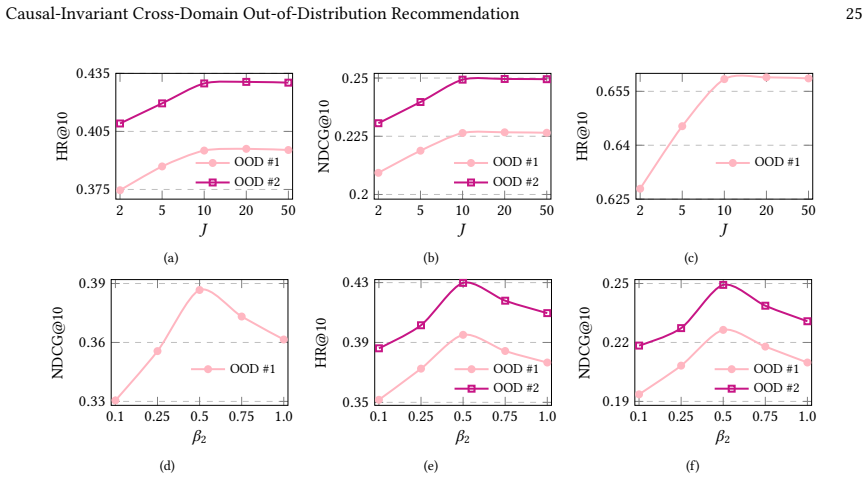
10
- beta_2 (dual-level causal loss weight) =
0.5
- gamma (domain disentanglement balance) =
0.5
- beta_1, beta_3, beta_4 (loss weights) =
1.0, 1.0, 0.00001
- Embedding dimension k =
64
- MLP hidden and output dimensions (k_in, k_out) =
128, 8
- Training epochs per phase =
60 then 40
- Causal loss weights alpha_1..alpha_4 =
Adopted from CDCOR [30]
assumptions (7)
- standard math NOTEARS continuous acyclicity constraint Tr(e^{A∘A}) - k = 0 correctly enforces DAG-ness
- domain assumption Causal Markov condition and faithfulness hold for the FCI algorithm applied to LLM-annotated review variables
- ad hoc to paper Concatenated attribute and preference embedding dimensions form a linear acyclic SCM with B = A^T B + eps
- ad hoc to paper Causal influences flow only from user attribute nodes to preference nodes, and preference nodes cannot be roots
- ad hoc to paper The learned DAG A remains invariant under both CDDS and SDDS without any invariance constraint or environment partition
- ad hoc to paper LLM-identified variables satisfying direct and indirect effect criteria are genuine confounders satisfying the backdoor criterion
- domain assumption Common user overlap across domains is sufficient for disentangling domain-shared preferences
invented entities (2)
-
Causal-invariant user preference representations (E_inv_sp, E_inv_sha)
-
Observed confounder subspace C^s/C^t
Cite this review
Pith. "Pith review of Causal-Invariant Cross-Domain Out-of-Distribution Recommendation." pith.science (2026). https://pith.science/paper/ANDA3PSD
@misc{pith2026250516532,
  author       = {Pith},
  title        = {Pith review of: Causal-Invariant Cross-Domain Out-of-Distribution Recommendation},
  year         = {2026},
  howpublished = {\url{https://pith.science/paper/ANDA3PSD}},
  note         = {Machine review of arXiv:2505.16532}
}
read the original abstract
Cross-Domain Recommendation (CDR) aims to leverage knowledge from a relatively data-richer source domain to address the data sparsity problem in a relatively data-sparser target domain. While CDR methods need to address the distribution shifts between different domains, i.e., cross-domain distribution shifts (CDDS), they typically assume independent and identical distribution (IID) between training and testing data within the target domain. However, this IID assumption rarely holds in real-world scenarios due to single-domain distribution shift (SDDS). The above two co-existing distribution shifts lead to out-of-distribution (OOD) environments that hinder effective knowledge transfer and generalization, ultimately degrading recommendation performance in CDR. To address these co-existing distribution shifts, we propose a novel Causal-Invariant Cross-Domain Out-of-distribution Recommendation framework, called CICDOR. In CICDOR, we first learn dual-level causal structures to infer domain-specific and domain-shared causal-invariant user preferences for tackling both CDDS and SDDS under OOD environments in CDR. Then, we propose an LLM-guided confounder discovery module that seamlessly integrates LLMs with a conventional causal discovery method to extract observed confounders for effective deconfounding, thereby enabling accurate causal-invariant preference inference. Extensive experiments on two real-world datasets demonstrate the superior recommendation accuracy of CICDOR over state-of-the-art methods across various OOD scenarios.
Figures


Figures from the paper (3 more)


Reference graph
Works this paper leans on
-
[1]
Sara Abdali, Anjali Parikh, Steve Lim, and Emre Kiciman. 2023. Extracting Self-Consistent Causal Insights from Users Feedback with LLMs and In-context Learning.arXiv preprint arXiv:2312.06820(2023)
arXiv 2023
-
[2]
Taiyu Ban, Lyuzhou Chen, Derui Lyu, Xiangyu Wang, and Huanhuan Chen. 2023. Causal Structure Learning Supervised by Large Language Model. arXiv preprint arXiv:2311.11689(2023)
arXiv 2023
-
[3]
Gilles Blanchard, Aniket Anand Deshmukh, Urun Dogan, Gyemin Lee, and Clayton Scott. 2021. Domain Generalization by Marginal Transfer Learning.JMLR22, 2 (2021), 1–55
2021
-
[4]
Daniel Borkan, Lucas Dixon, Jeffrey Sorensen, Nithum Thain, and Lucy Vasserman. 2019. Nuanced Metrics for Measuring Unintended Bias with Real Data for Text Classification. InTheWebConf. 491–500
2019
-
[5]
Peter Bühlmann. 2020. Invariance, Causality and Robustness.Statist. Sci.35, 3 (2020), 404–426
2020
-
[6]
Jiangxia Cao, Shaoshuai Li, Bowen Yu, Xiaobo Guo, Tingwen Liu, and Bin Wang. 2023. Towards Universal Cross-Domain Recommendation. In WSDM. 78–86
work page 2023
-
[7]
Jiangxia Cao, Xixun Lin, Xin Cong, Jing Ya, Tingwen Liu, and Bin Wang. 2022. DisenCDR: Learning Disentangled Representations for Cross-Domain Recommendation. InSIGIR. 267–277
work page 2022
-
[8]
Tao Chen, Siqi Zuo, Cheng Li, Mingyang Zhang, Qiaozhu Mei, and Michael Bendersky. 2024. Unlocking the ‘Why’ of Buying: Introducing a New Dataset and Benchmark for Purchase Reason and Post-Purchase Experience.arXiv preprint arXiv:2402.13417(2024)
work page Pith review arXiv 2024
Show all 83 references
-
[9]
Yoonhyuk Choi, Jiho Choi, Taewook Ko, Hyungho Byun, and Chong-Kwon Kim. 2022. Review-Based Domain Disentanglement without Duplicate Users or Contexts for Cross-Domain Recommendation. InCIKM. 293–303
2022
-
[10]
Pengfei Ding, Yan Wang, Guanfeng Liu, Nan Wang, and Xiaofang Zhou. 2025. Few-Shot Causal Representation Learning for Out-of-Distribution Generalization on Heterogeneous Graphs.IEEE TKDE37, 4 (2025), 1804–1818
2025
-
[11]
Wenjing Fu, Zhaohui Peng, Senzhang Wang, Yang Xu, and Jin Li. 2019. Deeply Fusing Reviews and Contents for Cold Start Users in Cross-Domain Recommendation Systems. InAAAI. 94–101
2019
-
[12]
Yaroslav Ganin and Victor Lempitsky. 2015. Unsupervised Domain Adaptation by Backpropagation. InICML. 1180–1189
2015
-
[13]
Yaroslav Ganin, Evgeniya Ustinova, Hana Ajakan, Pascal Germain, Hugo Larochelle, François Laviolette, Mario March, and Victor Lempitsky. 2016. Domain-Adversarial Training of Neural Networks.JMLR17, 59 (2016), 1–35
2016
-
[14]
Chen Gao, Yu Zheng, Wenjie Wang, Fuli Feng, Xiangnan He, and Yong Li. 2022. Causal Inference in Recommender Systems: A Survey and Future Directions.ACM TOIS42, 4 (2022), 1–32. Manuscript submitted to ACM Causal-Invariant Cross-Domain Out-of-Distribution Recommendation 27
2022
-
[15]
Lei Guo, Hao Liu, Lei Zhu, Weili Guan, and Zhiyong Cheng. 2023. DA-DAN: A Dual Adversarial Domain Adaption Network for Unsupervised Non-overlapping Cross-domain Recommendation.ACM TOIS42, 2 (2023), 1–27
2023
-
[16]
Osman Gani
Uzma Hasan, Emam Hossain, and Md. Osman Gani. 2023. A Survey on Causal Discovery Methods for I.I.D. and Time Series Data.TMLR2023 (2023)
2023
-
[17]
Xiangnan He, Lizi Liao, Hanwang Zhang, Liqiang Nie, Xia Hu, and Tat-Seng Chua. 2017. Neural Collaborative Filtering. InWWW. 173–182
2017
-
[18]
Yue He, Zimu Wang, Peng Cui, Hao Zou, Yafeng Zhang, Qiang Cui, and Yong Jiang. 2022. CausPref: Causal Preference Learning for Out-of-Distribution Recommendation. InTheWebConf. 410–421
2022
-
[19]
Guangneng Hu, Yu Zhang, and Qiang Yang. 2018. CoNet: Collaborative Cross Networks for Cross-Domain Recommendation. InCIKM. 667–676
2018
-
[20]
Guangneng Hu, Yu Zhang, and Qiang Yang. 2019. Transfer Meets Hybrid: A Synthetic Approach for Cross-Domain Collaborative Filtering with Text. InTheWebConf. 2822–2829
2019
-
[21]
Diab, and Bernhard Schölkopf
Zhijing Jin, Jiarui Liu, Zhiheng LYU, Spencer Poff, Mrinmaya Sachan, Rada Mihalcea, Mona T. Diab, and Bernhard Schölkopf. 2024. Can Large Language Models Infer Causation from Correlation?. InICLR
2024
-
[22]
Heishiro Kanagawa, Hayato Kobayashi, Nobuyuki Shimizu, Yukihiro Tagami, and Taiji Suzuki. 2019. Cross-domain Recommendation via Deep Domain Adaptation. InECIR. 20–29
2019
-
[23]
Elahe Khatibi, Mahyar Abbasian, Zhongqi Yang, Iman Azimi, and Amir M Rahmani. 2024. ALCM: Autonomous LLM-Augmented Causal Discovery Framework.arXiv preprint arXiv:2405.01744(2024)
2024 arXiv
-
[24]
Emre Kiciman, Robert Ness, Amit Sharma, and Chenhao Tan. 2023. Causal Reasoning and Large Language Models: Opening a New Frontier for Causality.TMLR(2023)
2023
-
[25]
Diederik P Kingma and Jimmy Ba. 2015. Adam: A Method for Stochastic Optimization. InICLR
2015
-
[26]
Kipf and Max Welling
Thomas N. Kipf and Max Welling. 2017. Semi-Supervised Classification with Graph Convolutional Networks. InICLR
2017
-
[27]
Hao Duong Le, Xin Xia, and Zhang Chen. 2024. Multi-Agent Causal Discovery Using Large Language Models.arXiv preprint arXiv:2407.15073 (2024)
2024 arXiv
-
[28]
Hanyu Li, Weizhi Ma, Peijie Sun, Jiayu Li, Cunxiang Yin, Yancheng He, Guoqiang Xu, Min Zhang, and Shaoping Ma. 2024. Aiming at the Target: Filter Collaborative Information for Cross-Domain Recommendation. InSIGIR. 2081–2090
2024
-
[29]
Siqing Li, Liuyi Yao, Shanlei Mu, Wayne Xin Zhao, Yaliang Li, Tonglei Guo, Bolin Ding, and Ji-Rong Wen. 2021. Debiasing Learning based Cross-domain Recommendation. InKDD. 3190–3199
2021
-
[30]
Zhuhang Li and Ning Yang. 2024. Cross-Domain Causal Preference Learning for Out-of-Distribution Recommendation. InDASFAA. 245–260
2024
-
[31]
Chenxi Liu, Yongqiang Chen, Tongliang Liu, Mingming Gong, James Cheng, Bo Han, and Kun Zhang. 2024. Discovery of the Hidden World with Large Language Models. InNeurIPS
2024
-
[32]
Meng Liu, Jianjun Li, Guohui Li, and Peng Pan. 2020. Cross Domain Recommendation via Bi-directional Transfer Graph Collaborative Filtering Networks. InCIKM. 885–894
2020
-
[33]
Weiming Liu, Jiajie Su, Chaochao Chen, and Xiaolin Zheng. 2021. Leveraging Distribution Alignment via Stein Path for Cross-Domain Cold-Start Recommendation.NeurIPS34 (2021), 19223–19234
2021
-
[34]
Michael Oberst, Nikolaj Thams, Jonas Peters, and David Sontag. 2021. Regularizing towards Causal Invariance: Linear Models with Proxies. InICML. 8260–8270
2021
-
[35]
2014.Probabilistic Reasoning in Intelligent Systems: Networks of Plausible Inference
Judea Pearl. 2014.Probabilistic Reasoning in Intelligent Systems: Networks of Plausible Inference. Elsevier
2014
-
[36]
2018.The Book of Why: The New Science of Cause and Effect
Judea Pearl and Dana Mackenzie. 2018.The Book of Why: The New Science of Cause and Effect. Basic books
2018
-
[37]
Shuofei Qiao, Yixin Ou, Ningyu Zhang, Xiang Chen, Yunzhi Yao, Shumin Deng, Chuanqi Tan, Fei Huang, and Huajun Chen. 2023. Reasoning with Language Model Prompting: A Survey. InACL. 5368–5393
2023
-
[38]
Masahiro Sato, Sho Takemori, Janmajay Singh, and Tomoko Ohkuma. 2020. Unbiased Learning for the Causal Effect of Recommendation. InRecSys. 378–387
2020
-
[39]
Shohei Shimizu, Patrik O Hoyer, Aapo Hyvärinen, Antti Kerminen, and Michael Jordan. 2006. A Linear Non-Gaussian Acyclic Model for Causal Discovery.JMLR7, 10 (2006)
2006
-
[40]
2001.Causation, Prediction, and Search
Peter Spirtes, Clark Glymour, and Richard Scheines. 2001.Causation, Prediction, and Search. MIT press
2001
-
[41]
Hongzu Su, Jingjing Li, Zhekai Du, Lei Zhu, Ke Lu, and Heng Tao Shen. 2024. Cross-domain Recommendation via Dual Adversarial Adaptation. ACM TOIS42, 3 (2024), 1–26
2024
-
[42]
Hongzu Su, Yifei Zhang, Xuejiao Yang, Hua Hua, Shuangyang Wang, and Jingjing Li. 2022. Cross-domain Recommendation via Adversarial Adaptation. InCIKM. 1808–1817
2022
-
[43]
Zhu Sun, Kaidong Feng, Jie Yang, Xinghua Qu, Hui Fang, Yew-Soon Ong, and Wenyuan Liu. 2024. Adaptive In-Context Learning with Large Language Models for Bundle Generation. InSIGIR. 966–976
2024
-
[44]
Masayuki Takayama, Tadahisa Okuda, Thong Pham, Tatsuyoshi Ikenoue, Shingo Fukuma, Shohei Shimizu, and Akiyoshi Sannai. 2024. Integrating Large Language Models in Causal Discovery: A Statistical Causal Approach.arXiv preprint arXiv:2402.01454(2024)
2024 arXiv
-
[45]
Balasubramanian, and Amit Sharma
Aniket Vashishtha, Abbavaram Gowtham Reddy, Abhinav Kumar, Saketh Bachu, Vineeth N. Balasubramanian, and Amit Sharma. 2023. Causal Inference using LLM-Guided Discovery. InAAAI 2024 Workshop on ”Are Large Language Models Simply Causal Parrots?”
2023
-
[46]
Bohao Wang, Jiawei Chen, Changdong Li, Sheng Zhou, Qihao Shi, Yang Gao, Yan Feng, Chun Chen, and Can Wang. 2024. Distributionally Robust Graph-based Recommendation System. InTheWebConf. 3777–3788. Manuscript submitted to ACM 28 Zhu et al
2024
-
[47]
Cheng Wang, Mathias Niepert, and Hui Li. 2019. RecSys-DAN: Discriminative Adversarial Networks for Cross-Domain Recommender Systems. IEEE TNNLS31, 8 (2019), 2731–2740
2019
-
[48]
Wenjie Wang, Fuli Feng, Xiangnan He, Xiang Wang, and Tat-Seng Chua. 2021. Deconfounded Recommendation for Alleviating Bias Amplification. InKDD. 1717–1725
2021
-
[49]
Wenjie Wang, Xinyu Lin, Fuli Feng, Xiangnan He, Min Lin, and Tat-Seng Chua. 2022. Causal Representation Learning for Out-of-Distribution Recommendation. InTheWebConf. 3562–3571
2022
-
[50]
Wenjie Wang, Xinyu Lin, Liuhui Wang, Fuli Feng, Yinwei Wei, and Tat-Seng Chua. 2023. Equivariant Learning for Out-of-Distribution Cold-start Recommendation. InMM. 903–914
2023
-
[51]
Zimu Wang, Yue He, Jiashuo Liu, Wenchao Zou, Philip S Yu, and Peng Cui. 2022. Invariant Preference Learning for General Debiasing in Recommendation. InKDD. 1969–1978
2022
-
[52]
Jason Wei, Xuezhi Wang, Dale Schuurmans, Maarten Bosma, Fei Xia, Ed Chi, Quoc V Le, Denny Zhou, et al. 2022. Chain-of-Thought Prompting Elicits Reasoning in Large Language Models. InNeurIPS. 24824–24837
2022
-
[53]
Ruobing Xie, Qi Liu, Liangdong Wang, Shukai Liu, Bo Zhang, and Leyu Lin. 2022. Contrastive Cross-Domain Recommendation in Matching. In KDD. 4226–4236
2022
-
[54]
Yuanzhen Xie, Chenyun Yu, Xinzhou Jin, Lei Cheng, Bo Hu, and Zang Li. 2024. Heterogeneous Graph Contrastive Learning for Cold Start Cross-Domain Recommendation.Knowledge-Based Systems299 (2024), 112054
2024
-
[55]
Wujiang Xu, Qitian Wu, Runzhong Wang, Mingming Ha, Qiongxu Ma, Linxun Chen, Bing Han, and Junchi Yan. 2024. Rethinking Cross-Domain Sequential Recommendation under Open-World Assumptions. InTheWebConf. 3173–3184
2024
-
[56]
Xihong Yang, Yiqi Wang, Jin Chen, Wenqi Fan, Xiangyu Zhao, En Zhu, Xinwang Liu, and Defu Lian. 2025. Dual Test-Time Training for Out-of- Distribution Recommender System.IEEE TKDE(2025)
2025
-
[57]
Feng Yuan, Lina Yao, and Boualem Benatallah. 2019. DARec: Deep Domain Adaptation for Cross-Domain Recommendation via Transferring Rating Patterns. InIJCAI. 4227–4233
2019
-
[58]
Tianzi Zang, Yanmin Zhu, Haobing Liu, Ruohan Zhang, and Jiadi Yu. 2022. A Survey on Cross-domain Recommendation: Taxonomies, Methods, and Future Directions.ACM TOIS41, 2 (2022), 1–39
2022
-
[59]
Matej Zečević, Moritz Willig, Devendra Singh Dhami, and Kristian Kersting. 2023. Causal Parrots: Large Language Models May Talk Causality But Are Not Causal.arXiv preprint arXiv:2308.13067(2023)
2023 arXiv
-
[60]
An Zhang, Wenchang Ma, Jingnan Zheng, Xiang Wang, and Tat-Seng Chua. 2024. Robust Collaborative Filtering to Popularity Distribution Shift. ACM TOIS42, 3 (2024), 1–25
2024
-
[61]
An Zhang, Jingnan Zheng, Xiang Wang, Yancheng Yuan, and Tat-Seng Chua. 2023. Invariant Collaborative Filtering to Popularity Distribution Shift. InTheWebConf. 1240–1251
2023
-
[62]
Shengyu Zhang, Xusheng Feng, Wenyan Fan, Wenjing Fang, Fuli Feng, Wei Ji, Shuo Li, Li Wang, Shanshan Zhao, Zhou Zhao, et al. 2023. Video-Audio Domain Generalization via Confounder Disentanglement. InAAAI. 15322–15330
2023
-
[63]
Shengyu Zhang, Qiaowei Miao, Ping Nie, Mengze Li, Zhengyu Chen, Fuli Feng, Kun Kuang, and Fei Wu. 2024. Transferring Causal Mechanism over Meta-representations for Target-Unknown Cross-domain Recommendation.ACM TOIS42, 4 (2024), 1–27
2024
-
[64]
Weizhi Zhang, Yuanchen Bei, Liangwei Yang, Henry Peng Zou, Peilin Zhou, Aiwei Liu, Yinghui Li, Hao Chen, Jianling Wang, Yu Wang, et al
-
[65]
Yang Zhang, Yue Shen, Dong Wang, Jinjie Gu, and Guannan Zhang. 2023. Connecting Unseen Domains: Cross-Domain Invariant Learning in Recommendation. InSIGIR. 1894–1898
2023
-
[66]
Zeyang Zhang, Xin Wang, Haibo Chen, Haoyang Li, and Wenwu Zhu. 2024. Disentangled Dynamic Graph Attention Network for Out-of-Distribution Sequential Recommendation.ACM TOIS43, 1 (2024), 1–42
2024
-
[67]
Chu Zhao, Enneng Yang, Yuliang Liang, Pengxiang Lan, Yuting Liu, Jianzhe Zhao, Guibing Guo, and Xingwei Wang. 2025. Graph Representation Learning via Causal Diffusion for Out-of-Distribution Recommendation. InTheWebConf. 334–346
2025
-
[68]
Chu Zhao, Enneng Yang, Yuliang Liang, Jianzhe Zhao, Guibing Guo, and Xingwei Wang. 2025. Distributionally Robust Graph Out-of-Distribution Recommendation via Diffusion Model. InTheWebConf. 2018–2031
2025
-
[69]
Chuang Zhao, Hongke Zhao, Ming He, Jian Zhang, and Jianping Fan. 2023. Cross-domain Recommendation via User Interest Alignment. In TheWebConf. 887–896
2023
-
[70]
Weiqi Zhao, Dian Tang, Xin Chen, Dawei Lv, Daoli Ou, Biao Li, Peng Jiang, and Kun Gai. 2023. Disentangled Causal Embedding with Contrastive Learning for Recommender System. InTheWebConf. 406–410
2023
-
[71]
Xiaoyun Zhao, Ning Yang, and Philip S Yu. 2022. Multi-Sparse-Domain Collaborative Recommendation via Enhanced Comprehensive Aspect Preference Learning. InWSDM. 1452–1460
2022
-
[72]
Xun Zheng, Bryon Aragam, Pradeep K Ravikumar, and Eric P Xing. 2018. DAGs with NO TEARS: Continuous Optimization for Structure Learning. NeurIPS31 (2018)
2018
-
[73]
Yu Zheng, Chen Gao, Xiang Li, Xiangnan He, Yong Li, and Depeng Jin. 2021. Disentangling User Interest and Conformity for Recommendation with Causal Embedding. InTheWebConf. 2980–2991. Manuscript submitted to ACM Causal-Invariant Cross-Domain Out-of-Distribution Recommendation 29
2021
-
[74]
Feng Zhu, Chaochao Chen, Yan Wang, Guanfeng Liu, and Xiaolin Zheng. 2019. DTCDR: A Framework for Dual-Target Cross-Domain Recommenda- tion. InCIKM. 1533–1542
2019
-
[75]
Feng Zhu, Yan Wang, Chaochao Chen, Guanfeng Liu, Mehmet Orgun, and Jia Wu. 2018. A Deep Framework for Cross-Domain and Cross-System Recommendations. InIJCAI. 3711–3717
2018
-
[76]
Feng Zhu, Yan Wang, Chaochao Chen, Guanfeng Liu, and Xiaolin Zheng. 2020. A Graphical and Attentional Framework for Dual-Target Cross-Domain Recommendation. InIJCAI. 3001–3008
2020
-
[77]
Feng Zhu, Yan Wang, Chaochao Chen, Jun Zhou, Longfei Li, and Guanfeng Liu. 2021. Cross-Domain Recommendation: Challenges, Progress, and Prospects. InIJCAI. 4721–4728
2021
-
[78]
Jiajie Zhu, Yan Wang, Feng Zhu, and Zhu Sun. 2023. Domain Disentanglement with Interpolative Data Augmentation for Dual-Target Cross-Domain Recommendation. InRecSys. 515–527
2023
-
[79]
Jiajie Zhu, Yan Wang, Feng Zhu, and Zhu Sun. 2025. Causal Deconfounding via Confounder Disentanglement for Dual-Target Cross-Domain Recommendation.ACM TOIS(2025). Accepted for publication
2025
-
[80]
Yaochen Zhu, Jing Ma, and Jundong Li. 2023. Causal Inference in Recommender Systems: A Survey of Strategies for Bias Mitigation, Explanation, and Generalization.arXiv preprint arXiv:2301.00910(2023)
2023 arXiv
-
[81]
Yaochen Zhu, Xubin Ren, Jing Yi, and Zhenzhong Chen. 2022. Deep Deconfounded Content-based Tag Recommendation for UGC with Causal Intervention.arXiv preprint arXiv:2205.14380(2022)
2022 arXiv
-
[82]
Yongchun Zhu, Zhenwei Tang, Yudan Liu, Fuzhen Zhuang, Ruobing Xie, Xu Zhang, Leyu Lin, and Qing He. 2022. Personalized Transfer of User Preferences for Cross-domain Recommendation. InWSDM. 1507–1515. Manuscript submitted to ACM
2022
-
[2025]
Cold-Start Recommendation towards the Era of Large Language Models (LLMs): A Comprehensive Survey and Roadmap.arXiv preprint arXiv:2501.01945(2025)
2025 arXiv
Reviewed August 7, 2026 · model on record in the stance chip above.
Discussion (0). Sign in to comment.