REVIEW 4 major objections 6 minor 151 references
Exploring magneto-electric coupling through lattice distortions: insights from a pantograph model
T0 review · 4 major / 6 minor · reviewed 2026-08-07 · deepseek-v4-flash
Pith's one-line read The paper claims that lattice distortions alone can drive the defining behaviors of collinear type II multiferroics, including a complete magnetic-field switch-off of electric polarization.
desk verdict A competent self-review of the pantograph mechanism, with a clean topological-soliton picture and one unproven load-bearing assumption: fixed Ising dipoles above the critical field. read the letter →
The pith
A machine-rendered reading of the paper's core claim, the machinery that carries it, and where it could break.
The reading
What carries the argument
The load-bearing object is the pantograph relation $p_i(\sigma_i,\delta_i)=p_0(1-\beta\delta_i)\,2\sigma_i$, which ties each electric dipole's magnitude to the local bond-length change $\delta_i$, together with the spin-Peierls modulation $J_1(\delta_i)=J_1(1-\alpha\delta_i)$ of the magnetic exchange. These feed self-consistent distortion equations, for example $K\delta_i = \alpha J_1\langle S_i\cdot S_{i+1}\rangle - \beta\varepsilon\sigma_i + J_e(\beta+\tfrac{3}{2a})(\sigma_{i-1}\sigma_i+\sigma_i\sigma_{i+1})$ in the minimal model, so that distortions minimize the total energy while spins and dipoles adjust to the distorted lattice. The same distortions act as the communication channel between magnetic and electric order, and the topological solitons that carry the first magnetic excitations separate domains of opposite local polarization, which is what makes the total polarization vanish above $h_{c1}$.
What would settle it
Measure the electric polarization across the magnetization onset in a quasi-one-dimensional collinear type II multiferroic such as LiCuVO4: a smooth or partial polarization drop instead of a sharp switch-off to zero would refute the model's central claim. Alternatively, treat the dipoles as dynamical quantum variables in the self-consistent calculation and check whether $P^{\rm z}_{\rm total}(h>h_{c1})$ remains exactly zero.
Extended reading notes
Core claim
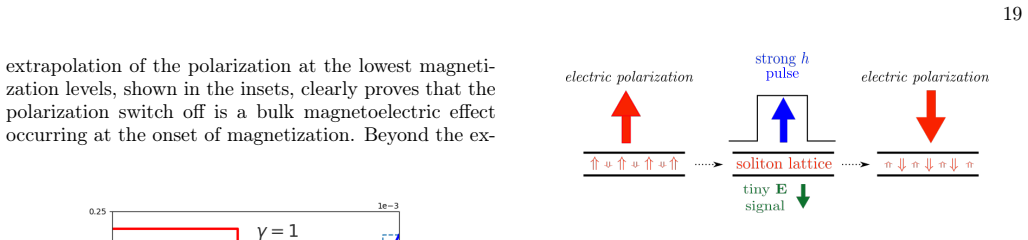
The paper's central claim is that a pantograph mechanism—where lattice distortions simultaneously modulate magnetic exchange couplings and the magnitudes of electric dipoles—provides a successful microscopic description of ubiquitous phenomena in type II improper multiferroics. In the model, the zero-field magnetic order is a gapped state accompanied by alternating (dimerized) lattice distortions; because each dipole's strength is $p_i=p_0(1-\beta\delta_i)2\sigma_i$, the alternating distortions turn an antiferroelectric dipole pattern into a ferrielectric one with a spontaneous bulk polarization. The first magnetic excitations are not single magnons but pairs of topological solitons that separate domains with opposite local polarization; as solitons proliferate above the critical field $h_{c1}$, the domain polarizations cancel and the total polarization drops identically to zero. The same shared-distortion coupling lets an electric field, by reorganizing dipoles and distortions, open or close magnetization plateaus and thereby produce electrically driven magnetization jumps. The paper reports that these features persist in extended models with next-nearest-neighbor frustration and easy-axis anisotropy, where the experimentally common $\uparrow\uparrow\downarrow\downarrow$ order emerges, and in higher-spin and two-dimensional versions.
Load-bearing premise
The load-bearing premise is that the electric dipoles stay locked in their antiferroelectric up-down pattern while the spins and lattice relax; if those dipoles can flip or fluctuate in a real material, the predicted complete switch-off of polarization could be weakened or lost.
Editorial extensions
If this is right
- A magnetic field above the spin gap $h_{c1}$ produces a complete switch-off of the spontaneous electric polarization, $P^{\rm z}_{\rm total}(h>h_{c1})=0$, in both the minimal and the extended one-dimensional models.
- An electric field that drives the dipoles into a period-four quadrumerized phase opens a magnetization plateau at $M=1/2$, so crossing the electro-elastic transition at fixed magnetic field yields an electrically driven magnetization jump.
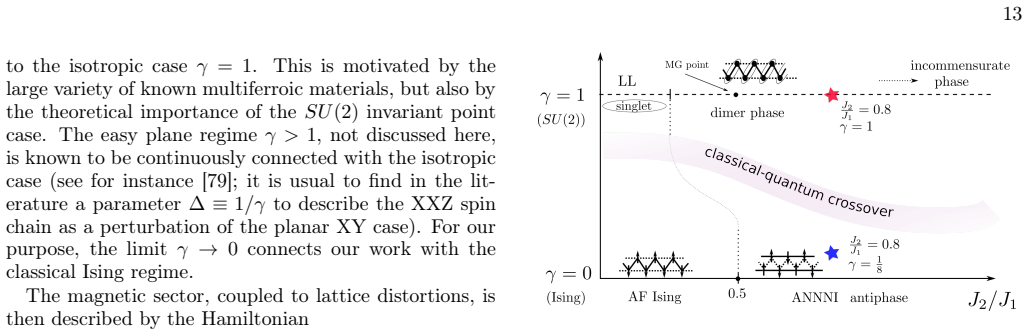
- With next-nearest-neighbor frustration and easy-axis anisotropy, the model stabilizes the experimentally common $\uparrow\uparrow\downarrow\downarrow$ spin order while keeping the polarization switch-off, connecting the mechanism to materials such as AgCrS2 and related chain compounds.
- Long-range dipole-dipole interactions create a period-three $\Uparrow\Uparrow\Downarrow$ dipolar phase; at simultaneous polarization and magnetization equal to one third of saturation, the distortions favor a quantum dimer plateau in some parameter ranges and a classical $\uparrow\uparrow\downarrow$ plateau in others.
- For $S=3/2$ magneto-elastic chains, a first-order structural transition opens a spin gap and magnetization plateaus; coupling those distortions to dipoles would again produce a zero-field ferrielectric polarization that switches off under field.
Reading between the lines
- Beyond the paper: the sharpness of the predicted polarization switch-off depends on soliton pairs being equally spaced; quenched disorder or inter-chain couplings that pin domain walls would leave a residual polarization, so the cleanest test should be in highly uniform quasi-one-dimensional compounds.
- Beyond the paper: the Z2-degenerate polarization together with magnetic erasure and poling-field rewrite suggests a concrete memory cycle; strain-engineered heterostructures, where lattice mismatch controls the effective electro-elastic coupling, offer a way to tune the switch-off field experimentally.
- Beyond the paper: because the S=3/2 transition is first order in the spin-phonon coupling, applying hydrostatic pressure should produce a steeply varying magnetization and polarization, a testable prediction that goes beyond the fields the paper considers.
- Beyond the paper: in two dimensions the model selects zig-zag stripe order when dipolar coupling is strong, implying a material trend—compounds with larger dipole-dipole interactions should favor E-type $\uparrow\uparrow\downarrow\downarrow$ order over checkerboard order—that could be checked across manganite families.
Editorial analysis
A structured set of objections, weighed in public.
Referee Report
Summary. The manuscript is a review of a series of the authors' own prior works (Refs. [20,22,24,29,30]) on a 'pantograph' model of magneto-electric coupling mediated by lattice distortions in low-dimensional multiferroics. The model couples spin-1/2 (and higher-spin) magnetic moments, classical Ising electric dipoles, and elastic bond distortions, with both spin-exchange and dipole strengths depending on the distortions. The central claims are that (i) at zero magnetic field the magneto-elastic instability produces alternating lattice distortions that turn an antiferroelectric dipole configuration into a ferrielectric state with spontaneous polarization, and (ii) above a critical magnetic field the lowest magnetic excitations are pairs of topological solitons separating domains of opposite ferrielectric polarization, leading to 'a complete switch-off of electrical polarization, P_total(h > hc1) = 0' (Section IIIC). The review also discusses magnetization plateaus at M = 1/2 and M = 1/3, electric-field-driven magnetization jumps, extensions to S > 1/2 chains with a first-order spin-phonon transition, and a two-dimensional Ising version with zig-zag stripe order.
Significance. If the claims are correct, the pantograph mechanism provides a concrete and falsifiable microscopic route to collinear type II multiferroic behavior, with a solitonic domain-wall mechanism that explains (and predicts) the polarization switch-off at the magnetization onset. The manuscript collects a substantial body of numerical results (DMRG with truncation errors below 10^-12, Monte Carlo for the 2D case) and makes specific predictions: equidistant repelling solitons, ferrielectric domains of equal length, and a first-order spin-phonon transition for S = 3/2 at lambda_c ~ 0.1355. These are strengths. However, the paper is essentially a self-review: the evidence for the central claims comes from the authors' own previous computations, with no independent replication and no quantitative comparison to experimental measurements. The exact zero-polarization statement rests on a frozen-dipole assumption whose stability is not demonstrated in the magnetized regime, and the text wavers between 'vanishes identically' and 'drops nearly to zero'.
major comments (4)
- [Section IIIB3 and Section IIIC] The exact statement 'P_total(h > hc1) = 0' (Section IIIC) rests on the assumption that the electric dipoles remain fixed in the antiferroelectric Ising configuration throughout the self-consistent iteration. Section IIIB3 justifies this with the sentence 'Proving different dipolar configurations we have concluded that no dipole flips are energetically convenient,' but no proof or numerical check is presented, and this justification is only framed for the zero-field, zero-magnetization state. In the magnetized regime, the self-consistent distortions develop soliton domain walls (Figs. 9, 18, 19), and the dipole energy in Eq. (15) contains couplings to the local distortion pattern; a dipole-flip pattern following the short/long bond domains could break the exact cancellation between opposite ferrielectric domains. The authors should either provide a quantitative test of dipole-flip stability for the Sz_total = 1 and higher excited states, or explicitly state that the exact zero is a property of the frozen-dipole approximation and that the physically expected value is near-zero but not identically zero.
- [Abstract, Section IIIC, Section IVC1, Section VII] The manuscript is internally inconsistent about the sharpness of the polarization switch-off. The abstract and Section IIIC claim a 'complete switch-off' with 'P_total(h > hc1) = 0' and 'vanishes identically,' while Section IVC1 states that the polarization 'drops nearly to zero,' and Section VII acknowledges that with a poling electric field 'the polarization of the magnetized states [is] not to be completely turned off.' These are materially different claims. Since the exact zero is central to the abstract's technological narrative (erase/rewrite polarization), the authors must reconcile these statements and make clear under which conditions (poling field, frozen dipoles) the polarization is exactly zero versus merely small.
- [Abstract and Section VII] The claim that the model 'successfully describes ubiquitous phenomena in type II improper multiferroics' is not substantiated in this manuscript by any quantitative comparison to experimental data for a specific material. The evidence consists of the authors' prior numerical studies (Refs. [20,22,24,29,30]); the many experimental materials mentioned (AgCrS2, Ca3CoMnO6, HoMnO3, etc.) are discussed only qualitatively. For a review that makes a success claim, a table comparing computed polarization, magnetization-plateau fields, and distortion amplitudes with measured values for at least one material would be needed. Without that, the 'successful description' claim is stronger than the evidence presented.
- [Section VIA2] The first-order spin-phonon transition for S = 3/2, with critical coupling lambda_c ~ 0.1355, is presented as a robust finding ('the value of lambda_c is not sensitive to the chain length'), but the manuscript gives no finite-size scaling analysis, chain-length dependence plot, or error estimate to support this claim. Because this transition is a new feature presented in this review (not in the earlier spin-1/2 works), the numerical evidence should be shown rather than only stated.
minor comments (6)
- [Section I] There are several typographical errors, for example 'an that the low temperature magnetic order is still protected by a spin gap an that' should read 'and that,' and 'to to higher dimensional lattices' in the outline should read 'to higher dimensional lattices.'
- [Section IVB2b] The text contains an unresolved cross-reference 'cf. Fig.??' which should be replaced with the actual figure number.
- [Section VIA1] The placeholder '[REFERENCES]' appears in the sentence about single ion anisotropy and should be replaced with actual citations.
- [Section IVA1] The parenthetical instruction '(revise units in fig and text)' is left in the main text and should be removed.
- [Figure 6 caption] The caption contains a typo: 'doble arrows' should be 'double arrows.'
- [Section IVC1] There is a bracket mismatch in 'as it also occurs in the magneto-elastic case,47]' where the bracket should be closed as '47].'
Circularity Check
Central validation rests on the authors' own prior papers, but the equation-level derivation is self-contained and not circular.
-
self citation load bearing
[Abstract; Section IIIC (Fig. 8 caption); Section IVC1]
"The model successfully describes ubiquitous phenomena in type II improper multiferroics. ... The numerical results shown in Fig. 8 express the polarization switch-off mechanism ... Original data in Ref. [20]. ... the spontaneous electric polarization observed at zero magnetization is switched off by means of the applied magnetic field.20"
The abstract's central claim that the pantograph model 'successfully describes ubiquitous phenomena' is supported in this manuscript only by the authors' own prior numerical studies (Refs. [20,22,24,29,30]), all co-authored by the present authors or their immediate collaborators. The key quantitative outputs — the polarization switch-off, the magnetization plateaus, and the soliton-domain cancellation — are explicitly labeled as 'Original data in Ref. [20]' or 'reprinted from Ref. [22]' rather than independently recomputed or tested against external quantitative benchmarks. The paper itself only says the results 'could help in fitting actual parameters,' acknowledging that no quantitative experimental fit is provided.
full rationale
The internal derivation chain in the manuscript is not circular: Eq. (12) defines the minimal pantograph Hamiltonian; Eq. (15) is obtained by minimizing that Hamiltonian with respect to the elastic distortions; and the polarization switch-off P_total(h>hc1)=0 follows from the soliton-domain distortion pattern combined with the fixed antiferroelectric dipole background. That is a model computation, not an identity smuggled in as a prediction. The h=0 ferrielectric polarization also follows directly from Eq. (4)-(5) once the spin-Peierls dimerization is solved. The main caveat is the fixed-dipole assumption in Section IIIB3 ('In practice they are kept fixed during the iterations'); this is a genuine modeling constraint and a correctness risk for the magnetized regime, but it is an unvalidated assumption rather than a circular reduction, so it does not by itself raise the circularity score. The reason the score is not zero is that the manuscript is essentially a self-review: the abstract's 'successfully describes ubiquitous phenomena' claim and the specific numerical predictions are imported from the authors' own earlier papers without independent verification. That is a load-bearing self-citation chain, giving a moderate circularity score of 4 rather than a fully independent derivation.
Assumptions & free parameters
free parameters (7)
- J1 (exchange energy) =
0.5 (energy scale)
- J2/J1 frustration ratio =
0.8 (also 0.2, 0.5)
- gamma (XXZ anisotropy) =
1 to 1/8 (also 1/4)
- alpha (magneto-elastic coupling) =
0.2 (minimal model also uses 1.0)
- beta (dipole-elastic or pantograph coupling) =
0.2
- Je (effective dipolar exchange) =
0.2 or 0.5
- lambda_c (critical spin-phonon coupling for S=3/2) =
0.1355 (S=1: 0.192)
assumptions (5)
- domain assumption The lattice can be treated adiabatically and as a mean-field order parameter; phonon frequencies are much smaller than magnetic energy scales.
- ad hoc to paper Dipolar variables are classical Ising degrees of freedom and remain in the antiferroelectric configuration; dipole flips are not energetically favorable.
- domain assumption Only the nearest-neighbor exchange J1 depends on distortions; J2 is distortion independent.
- domain assumption Dipolar interactions can be truncated at second neighbors with linear expansion in distortions.
- domain assumption The global constraint sum_i delta_i = 0 fixes the lattice constant.
Cite this review
Pith. "Pith review of Exploring magneto-electric coupling through lattice distortions: insights from a pantograph model." pith.science (2026). https://pith.science/paper/KEUBHGGE
@misc{pith2026250516611,
  author       = {Pith},
  title        = {Pith review of: Exploring magneto-electric coupling through lattice distortions: insights from a pantograph model},
  year         = {2026},
  howpublished = {\url{https://pith.science/paper/KEUBHGGE}},
  note         = {Machine review of arXiv:2505.16611}
}
read the original abstract
Multiferroic materials exhibit the coexistence of magnetic and electric order. They are at the forefront of modern condensed matter physics due to their potential applications in next-generation technologies such as data storage, sensors, and actuators. Despite significant progress, understanding and optimizing the coupling mechanisms between electric polarization and magnetism remain active areas of research. We review here a series of papers presenting a comprehensive numerical and theoretical exploration of a pantograph mechanism modeling magneto-electric coupling through lattice distortions in low dimensional multiferroic systems. These works introduce and elaborate a microscopic model where elastic lattice distortions mediate interactions between spin 1/2 magnetic moments and electric dipoles, uncovering novel physics and functionalities. The model successfully describes ubiquitous phenomena in type II improper multiferroics, particularly when dominant Ising spin components are introduced through XXZ-type rotational symmetry breaking spin interactions. We also study more realistic extensions relevant for materials with higher spin magnetic ions and to materials where magnetic couplings draw higher dimensional lattices.
Figures


Figures from the paper (22 more)






Reference graph
Works this paper leans on
-
[1]
Curie, J
P. Curie, J. Phys. 3 , 393 (1894)
-
[2]
Dzyaloshinskii, Sov
I.E. Dzyaloshinskii, Sov. Phys. JETP 10(3) , 628 (1960)
1960
-
[3]
Landau, E
L. Landau, E. Lifshitz, Electrodynamics of continuous media , Pergamon Press, 1960
1960
-
[4]
Astrov, Sov
D.N. Astrov, Sov. Phys. JETP 11(3) , 708 (1960)
1960
-
[5]
J. Wang, B. Neaton, H. Zheng, V. Nagarajan, S.B. Ogale, B. Liu, D. Viehland, V. Vaithyanathan, D.G. Schlom, U.V. Waghmare, N.A. Spaldin, K.M. Rabe, M. Wuttig, R. Ramesh, Science 299 , 1719 (2003)
2003
-
[6]
Kimura, T
T. Kimura, T. Goto, H. Shintani, K. Ishizaka, T. Arima and Y. Tokura, Nature 426 , 55 (2003); T. Kimura, S. Ishihara, H. Shintani, T. Arima, K.T. Takahashi, K. Ishizaka, and Y. Tokura, Phys. Rev. 68 , 060403(R) (2003)
2003
-
[7]
Fiebig, J
M. Fiebig, J. Phys. D: Appl. Phys. 38 , R123 (2005)
2005
-
[8]
Cheong, M
S.-W. Cheong, M. Mostovoy, Nature Materials 6 , 13 (2007)
2007
Show all 151 references
-
[9]
Ramesh and N
R. Ramesh and N. A. Spaldin, Nat. Mater. 6 , 21 (2007)
2007
-
[10]
van den Brink, D.I
J. van den Brink, D.I. Khomskii, J. Phys.: Condens. Matter 20 , 434217 (2008)
2008
-
[11]
Tokura, S
Y. Tokura, S. Seki and N. Nagaosa, Rep. Prog. Phys. 77 , 076501 (2014)
2014
-
[12]
Dong, J.-M
S. Dong, J.-M. Liu, S.-W. Cheong, and Z. Ren, Adv. Phys. 64 , 519 (2015)
2015
-
[13]
Khomskii in Multiferroic Materials: Properties, Techniques, and Applications , edited by J
D.I. Khomskii in Multiferroic Materials: Properties, Techniques, and Applications , edited by J. Wang (CRC Press, New York, 2017)
2017
-
[14]
S. Dong, H. Xiang and E. Dagotto, Natl. Sci. Rev. 6 , 1 (2019)
2019
-
[15]
Giovannetti et al , Phys
G. Giovannetti et al , Phys. Rev. B 83 , 060402(R) (2011)
2011
-
[16]
Streltsov, A.I
S.V. Streltsov, A.I. Poteryaev, and A.N. Rubtsov, J. Phys.: Condens. Matter 27 , 165601 (2015)
2015
-
[17]
Medarde, J
M.L. Medarde, J. Phys.: Condens. Matter 9 , 1679 (1997)
1997
-
[19]
Sergienko, C
I.A. Sergienko, C. S en and E. Dagotto, Phys. Rev. Lett. 97 , 227204 (2006)
2006
-
[20]
Cabra, A.O
D.C. Cabra, A.O. Dobry, C.J. Gazza, and G.L. Rossini, Phys. Rev. 100, 161111(R) (2019)
2019
-
[21]
Spalding and R
N.A. Spalding and R. Ramesh, Nature Materials 18 , 203 (2019)
2019
-
[22]
D. C. Cabra, A. O. Dobry, C. J. Gazza, and G. L. Rossini, Phys. Rev. B 103, 144421 (2021)
2021
-
[23]
R. Chen, J. F. Wang, Z. W. Ouyang, Z. Z. He, S. M. Wang, L. Lin, J. M. Liu, C. L. Lu, Y. Liu, C. Dong, C. B. Liu, Z. C. Xia, A. Matsuo, Y. Kohama, and K. Kindo, Phys. Rev. B 98, 184404 (2018)
2018
-
[24]
D. C. Cabra, A. O. Dobry, C. J. Gazza, and G. L. Rossini, Phys. Rev. B 105, 115103 (2022)
2022
-
[25]
Weingart, N
C. Weingart, N. Spaldin, and E. Bousquet, Phys. Rev. B 86, 094413 (2012)
2012
-
[26]
Yosida, J
K. Yosida, J. Appl. Phys. 39, 511–518 (1968)
1968
-
[27]
F.D.M.\ Haldane, Phys.\ Rev.\ Lett.\ 45 , 1358 (1980)
1980
-
[28]
Affleck and F.D.M
I. Affleck and F.D.M. Haldane, Phys. Rev. B 36 , 5291 (1987)
1987
-
[29]
C. J. Gazza, A. A. Aligia, A. O. Dobry, G. L. Rossini, and D. C. Cabra, Phys. Rev. B 111, 014443 (2025)
2025
-
[30]
L. Pili, R. A. Borzi, D. C. Cabra, and S. A. Grigera, Phys. Rev. B 105, 094428 (2022)
2022
-
[31]
Tagantsev, K
A.K. Tagantsev, K. Vaideeswaran, S.B. Vakhrushev, A.V. Filimonov, R.G. Burkovsky, A. Shaganov, D. Andronikova, A.I. Rudskoy, A.Q.R. Baron, H. Uchiyama, D. Chernyshov, A. Bosak, Z. Ujma, K. Roleder, A. Majchrowski, J.-H. Ko and N. Setter, Nat. Commun. 4, 2229 (2013)
2013
-
[32]
Resta, Europhys
R. Resta, Europhys. Lett. 22, 133 (1993)
1993
-
[33]
Radtke, A
G. Radtke, A. Saúl, H. A. Dabkowska, M. B.Salamon, and M. Jaime, Proc. Natl. Acad. Sci. USA 112, 1971 (2015)
2015
-
[34]
Yao and V.C
X. Yao and V.C. Lo, Journal of Applied Physics 104, 083919 (2008)
2008
-
[35]
Spalding, in Physics of Ferroelectrics: a Modern Perspective, edited by K
N. Spalding, in Physics of Ferroelectrics: a Modern Perspective, edited by K. Rabe, Ch.H. Ahn and J.-M. Triscone (Springer-Verlag, Heidelberg, 2007)
2007
-
[36]
Naka and S
M. Naka and S. Ishihara, Sci. Rep 6, 20781 (2016)
2016
-
[37]
K. A. M\"uller and H. Burkard, Phys. Rev. B 19, 3593 (1979); P. Chandra, G.G. Lonzarich, S.E. Rowley, and J.F. Scott, Rep. Prog. Phys. 80 112502 (2017); C. Enderlein, J. Ferreira de Oliveira1, D A. Tompsett, E. Baggio Saitovitch, S.S. Saxena, G.G. Lonzarich, and S.E. Rowley, N...
1979
-
[38]
Uchinokura, J
K. Uchinokura, J. Phys.: Condens. Matter 14 , R195 (2002)
2002
-
[39]
Essler, A.M
F.H.L. Essler, A.M. Tsvelik, and G. Delfino, Phys. Rev. B, 56, 11001 (1997)
1997
-
[40]
Dobry, D.C
A.O. Dobry, D.C. Cabra, and G.L. Rossini, Phys. Rev. B, 75, 045122 (2007)
2007
-
[41]
Naka and S
M. Naka and S. Ishihara, Sci. Rep 6 :20781 (2016)
2016
-
[42]
Cross and D.S
M.C. Cross and D.S. Fisher, Phys. Rev. B 19, 402 (1979)
1979
-
[43]
Feiguin, J.A
A.E. Feiguin, J.A. Riera, A.O. Dobry, and H.A. Ceccatto, Phys. Rev. B 56, 14607 (1997)
1997
-
[44]
White, Phys
S.R. White, Phys. Rev. Lett. 69, 2863 (1992)
1992
-
[45]
Kimura, T
T. Kimura, T. Goto, H. Shintani, K. Ishizaka, T. Arima, and Y. Tokura, Nature 426, 55 (2003)
2003
-
[46]
N. Hur, S. Park, P.A. Sharma, J.S. Ahn, S. Guha, and S-W. Cheong, Nature 429, 392 (2004)
2004
-
[47]
uchner, P.H.M. van Loosdrecht, F. Sch\
T. Lorenz, B. B\"uchner, P.H.M. van Loosdrecht, F. Sch\"onfeld, G. Chouteau, A. Revcolevschi and G. Dhalenne, Phys. Rev. Lett. 81 , 148 (1998)
1998
-
[48]
Hou, J.H
Y.S. Hou, J.H. Yang, X.G. Gong, and H.J. Xiang, Phys. Rev. B 88, 060406(R) (2013)
2013
-
[49]
Shimamoto, S
K. Shimamoto, S. Mukherjee, S. Manz, J.S. White, M.Trassin, M. Kenzelmann, L. Chapon, T. Lippert, M. Fiebig, C.W. Schneider, and Christof Niedermayer, Scientific Reports 7, 44753 (2017)
2017
-
[50]
Flint, H.-T
R. Flint, H.-T. Yi, P. Chandra, S.-W. Cheong and V. Kiryukhin, Phys. Rev. B 81, 092402 (2010); M. Nishida, F. Ishii, and M. Saito, J. Phys. Soc. Jpn. 83, 124711 (2014); V.S. Zapf , B.G. Ueland, M. Laver, M. Lonsky, M. Pohlit, J. Müller, T. Lancaster, J.S. Möller, S.J. Blundell...
2010 arXiv
-
[51]
Damay, C
F. Damay, C. Martin, V. Hardy, G. Andr\'e, S. Petit, and A. Maignan, Phys. Rev. B 83, 184413 (2011)
2011
-
[52]
Dong , R
S. Dong , R. Yu, S. Yunoki, J.-M. Liu, and E. Dagotto, Eur. Phys. J. B 71, 339 (2009)
2009
-
[53]
Tokunaga, N
Y. Tokunaga, N. Furukawa, H. Sakai, Y. Taguchi, T. Arima,and Y. Tokura, Nature Mater. 8, 558 (2009)
2009
-
[54]
Giovannetti, A
G. Giovannetti, A. Stroppa, S. Picozzi, D. Baldomir, V. Pardo, S. Blanco-Canosa, F. Rivadulla, S. Jodlauk, D. Niermann, J. Rohrkamp, T. Lorenz, S. Streltsov, D.I. Khomskii, and J. Hemberger, Phys. Rev. B 83, 060402(R) (2011)
2011
-
[55]
Catalano, M
S. Catalano, M. Gibert, J. Fowlie, J. Íñiguez, J-M. Triscone, and J. Kreisel, Rep. Prog. Phys. 81 (2018) 046501
2018
-
[56]
Blasco, J.L
J. Blasco, J.L. Garc\' a-Muñoz, J. Garc\' a, G. Sub\' as, J. Stankiewicz, J.A. Rodr\' guez-Velamazán, and C. Ritter, Phys. Rev. B 96, 024409 (2017)
2017
-
[57]
Y\'a\ nez-Vilar, E.D
S. Y\'a\ nez-Vilar, E.D. Mun, V.S. Zapf, B.G. Ueland, J.S. Gardner, J.D. Thompson, J. Singleton, M. S\'anchez-And\'ujar, J. Mira, N. Biskup, M.A. Se\ nar\' s-Rodr\' guez, and C.D. Batista, Phys. Rev. B 84, 134427 (2011)
2011
-
[58]
Chikara, J
S. Chikara, J. Singleton, J. Bowlan, D.A. Yarotski, N. Lee, H.Y. Choi, Y.J. Choi, and V.S. Zapf, Phys. Rev. B 93, 180405(R) (2016)
2016
-
[59]
Kim, J.Y
M.K. Kim, J.Y. Moon, S.H. Oh, D.G. Oh, Y.J. Choi, and N. Lee, Scientific Reports 9, 5456 (2019)
2019
-
[60]
Zhou, H.J
H.Y. Zhou, H.J. Zhao, W.Q. Zhang, and X.M. Chen, Appl. Phys. Lett. 106, 152901 (2015)
2015
-
[61]
B. J. Gibson, R. K. Kremer, A. V. Prokofiev, W. Assmus, and G. J. McIntyre, Physica B 350, E253 (2004)
2004
-
[62]
Yasui, Y
Y. Yasui, Y. Naito, K. Sato, T. Moyoshi, M. Sato, and K. Kakurai, J. Phys. Soc. Jpn. 77, 023712 (2008)
2008
-
[63]
S. Park, Y. J. Choi, C. L. Zhang, and S.-W. Cheong, Phys. Rev. Lett. 98, 057601 (2007)
2007
-
[64]
S. Seki, Y. Yamasaki, M. Soda, M. Matsuura, K. Hirota, and Y. Tokura, Phys. Rev. Lett. 100, 127201 (2008)
2008
-
[65]
Yasui, K
Y. Yasui, K. Sato, Y. Kobayashi, and M. Sato, J. Phys. Soc. Jpn. 78, 084720 (2009
2009
-
[66]
S. Seki, T. Kurumaji, S. Ishiwata, H. Matsui, H. Murakawa, Y. Tokunaga, Y. Kaneko, T. Hasegawa, and Y. Tokura, Phys. Rev. B 82, 064424 (2010)
2010
-
[67]
Zhao, T.-L
L. Zhao, T.-L. Hung, C.-C. Li, Y.-Y. Chen, M.-K. Wu, R. K. Kremer, M. G. Banks, A. Simon, M.-H. Whangbo, C. Lee, J. S. Kim, I. Kim, and K.H. Kim, Adv. Mater. 24, 2469 (2012)
2012
-
[68]
apers, K. C. Rule, S. S\
B. Willenberg, M. Sch\"apers, K. C. Rule, S. S\"ullow, M. Reehuis, H. Ryll, B. Klemke, K. Kiefer, W. Schottenhamel, B. B\"uchner, B. Ouladdiaf, M. Uhlarz, R. Beyer, J. Wosnitza, and A. U. B. Wolter, Phys. Rev. Lett. 108, 117202 (2012)
2012
-
[69]
Yasui, M
Y. Yasui, M. Sato, and I. Terasaki, J. Phys. Soc. Jpn. 80, 033707 (2011);Y. Yasui, Y. Yanagisawa, M. Sato, and I. Terasaki, J. Phys.: Conf. Ser. 320, 012087 (2011)
2011
-
[70]
J. M. Law, P. Reuvekamp, R. Glaum, C. Lee, J. Kang, M.-H. Whangbo, and R. K. Kremer, Phys. Rev. B 84, 014426 (2011)
2011
-
[71]
Koteswararao, K
B. Koteswararao, K. Yoo, F.C. Cho, and K.H. Kim, APL Materials 4, 036101 (2016)
2016
-
[72]
Bramwell and M.J.P
S.T. Bramwell and M.J.P. Gingras, Science 294, 1495 (2001)
2001
-
[73]
Gingras and P.A
M.J.P. Gingras and P.A. McClarty, Rep. Prog. Phys. 77 056501 (2014)
2014
-
[74]
Rau and M.J.P
J.G. Rau and M.J.P. Gingras, Annu. Rev. Condens. Matter Phys. 10, 357 (2019)
2019
-
[75]
Slobinsky, L
D. Slobinsky, L. Pili, G. Baglietto, S.A. Grigera, and R.A. Borzi, arXiv:2011.15017
2011 arXiv
-
[76]
Y. Shi, Y. Guo, X. Wang, A.J. Princep, D. Khalyavin, P. Manuel, Y. Michiue, A. Sato, K. Tsuda, S. Yu, M. Arai, Y. Shirako, M. Akaogi, N. Wang, K. Yamaura, and A.T. Boothroyd, Nature Mater. 12, 1024 (2013); H.M. Liu, Y.P. Du, Y.L. Xie, J.-M. Liu, C.-G. Duan, and X. Wan, Phys. R...
2013
-
[77]
Devonshire, Adv
F. Devonshire, Adv. Phys. 3, 85 (1954)
1954
-
[78]
A. O. Gogolin, A. A. Nersesyan, and A. Tsvelik,Bosonization and Strongly Correlated Systems, (Cambridge University Press, 1998)
1998
-
[79]
Giamarchi, Quantum Physics in One Dimension, (Oxford University Press, 2004)
T. Giamarchi, Quantum Physics in One Dimension, (Oxford University Press, 2004)
2004
-
[80]
Auerbach, Interacting electrons and quantum magnetism, (Springer-Verlag, Heidelberg, 1994)
See for instance A. Auerbach, Interacting electrons and quantum magnetism, (Springer-Verlag, Heidelberg, 1994)
1994
-
[81]
Seno and J
F. Seno and J. M. Yeomans, Phys. Rev. B 50,10385 (1994)
1994
-
[82]
Dyson, Phys
F.J. Dyson, Phys. Rev. 102, 1217 (1956); S.V. Maleev, Sov. Phys. JETP 6, 776 (1958)
1956
-
[83]
Blanco, Msc
F. Blanco, Msc. Thesis, Universidad Nacional de La Plata, Argentina (unpublished)
-
[84]
Haldane, Phys
F.D.M. Haldane, Phys. Rev. B 25, 4925 (1982)
1982
-
[85]
Okamoto and K
K. Okamoto and K. Nomura, Phys. Lett. A 169, 433 (1992)
1992
-
[86]
Eggert, Phys
S. Eggert, Phys. Rev. B 54, R9612(R) (1996)
1996
-
[87]
Majumdar and D
C.K. Majumdar and D. Ghosh, J. Math. Phys. 10, 1388 (1969)
1969
-
[88]
White and I
S.R. White and I. Affleck, Phys. Rev. B 54, 9862 (1996)
1996
-
[89]
Allen and D
D. Allen and D. Senechal, Phys. Rev. B 55, 299 (1997)
1997
-
[90]
Nersesyan, A.O
A.A. Nersesyan, A.O. Gogolin, and F.H.L. Essler, Phys. Rev. Lett. 81, 910 (1998)
1998
-
[91]
Selke, Phys
W. Selke, Phys. Rep. 170, 213 (1988)
1988
-
[92]
Bray, L.V
J.W. Bray, L.V. Interrante, I.S. Jacobs, and J.C. Bonner, in Extended Linear Chain Compounds, edited by J.C. Miller (Plenum, New York, 1982)
1982
-
[93]
D. C. Cabra, M. Moliner, and F. Stauffer, Phys. Rev. B 74, 014428 (2006)
2006
-
[94]
Vekua, D.C
T. Vekua, D.C. Cabra, A.O. Dobry, C.J. Gazza, and D. Poilblanc, Phys. Rev. Lett. 96, 117205 (2006)
2006
-
[95]
C.J.\ Gazza, A.O.\ Dobry, D.C.\ Cabra, and T.\ Vekua, Phys.\ Rev.\ B 75 , 165104 (2007)
2007
-
[96]
Inagaki and H
S. Inagaki and H. Fukuyama, J. Phys. Soc. Jpn. 52, 2504 (1983)
1983
-
[97]
Li and Y
P. Li and Y. Chen, Physics Letters A 374, 453 (2010)
2010
-
[98]
M. Arai, M. Fujita, M. Motokawa, J. Akimitsu, and S.M. Bennington, Phys. Rev. Lett. 77, 3649 (1996)
1996
-
[99]
Nakano and H
T. Nakano and H. Fukuyama, J. Phys. Soc. Jpn. 49, 1679 (1980)
1980
-
[100]
Manton and P
N. Manton and P. Sutcliffe, Topological solitons (Cambridge University Press, Cambridge, 2004)
2004
-
[101]
Mastrogiuseppe, C
D. Mastrogiuseppe, C. Gazza, and A. Dobry, J. Phys.: Condens. Matter 20, 135223 (2008)
2008
-
[102]
Hida and I
K. Hida and I. Affleck, J. Phys. Soc. Japan 74, 1849 (2005)
2005
-
[103]
Lorenz, B
T. Lorenz, B. Büchner, P. H. M. van Loosdrecht, F. Schönfeld, G. Chouteau, A. Revcolevschi, and G. Dhalenne Phys. Rev. Lett. 81, 148 (1998)
1998
-
[104]
H. D. Rosales and G. L. Rossini, Phys. Rev. B 76, 224404 (2007)
2007
-
[105]
Okunishi and T
K. Okunishi and T. Tonegawa, Journal of the Physical Society of Japan 3, 479 (2003)
2003
-
[106]
Okunishi and T
K. Okunishi and T. Tonegawa, J. Phys. Soc. Jpn. 3, 479 (2003)
2003
-
[107]
Okunishi and T
K. Okunishi and T. Tonegawa, Phys. Rev. B 68, 224422 (2003)
2003
-
[108]
Fadeev and L
L.D. Fadeev and L. Takhtajan, Phys. Lett. A 85, 375 (1981)
1981
-
[109]
Kiryukhin, B
V. Kiryukhin, B. Keimer, J. P. Hill, and A. Vigliante, Phys. Rev. Lett. 76, 4608 (1996)
1996
-
[110]
A. E. Feiguin, J. A. Riera, A. O. Dobry, and H. A. Ceccatto, Phys. Rev. B 56, 14607 (1997)
1997
-
[111]
Dobry and D
A. Dobry and D. Ibaceta Phys. Rev. B 63, 144404 (2001)
2001
-
[112]
Horvati\' c , Y
M. Horvati\' c , Y. Fagot-Revurat, C. Berthier, G. Dhalenne, and A. Revcolevschi, Phys. Rev. Lett. 83, 420 (1999)
1999
-
[113]
Bergman, R
D.L. Bergman, R. Shindou, G.A. Fiete, and L. Balents, Models of degeneracy breaking in pyrochlore antiferromagnets Phys. Rev. B 74 , 134409 (2006)
2006
-
[114]
Haldane, Nonlinear Field Theory of Large-Spin Heisenberg Antiferromagnets: Semiclassically Quantized Solitons of the One-Dimensional Easy-Axis Néel State , Phys
F.D.M. Haldane, Nonlinear Field Theory of Large-Spin Heisenberg Antiferromagnets: Semiclassically Quantized Solitons of the One-Dimensional Easy-Axis Néel State , Phys. Rev. Lett. 50 1153 (1983)
1983
-
[115]
H. J. Schulz, Phys. Rev. B 34 , 6372 (1986)
1986
-
[116]
Affleck, D
I. Affleck, D. Gepner, H. J. Schulz and T. Ziman, Critical behaviour of spin-s Heisenberg antiferromagnetic chains: analytic and numerical results , Journal of Physics A: Mathematical and General, 22 (5), 511 (1989)
1989
-
[117]
D. C. Cabra, P. Pujol, and C. von Reichenbach, Non-Abelian bosonization and Haldane’s conjecture , Phys. Rev. B 58 , 65 (1998)
1998
-
[118]
Onishi and S
H. Onishi and S. Miyashita, Phys. Rev. B 64 , 014405 (2001); Prog. Theor. Phys. Supp. 145 , 182 (2002)
2001
-
[119]
Taniyama, J
T. Taniyama, J. Phys.: Condens. Matter 27, 504001 (2015)
2015
-
[120]
Poddar, P
S. Poddar, P. de Sa, R. Cai, L. Delannay, B. Nysten, L. Piraux, and A.M. Jonas, ACS Nano 12, 576 (2018)
2018
-
[121]
Mijatovic and S
M. Mijatovic and S. Milosevic, Phys. Lett
-
[122]
Y. J. Choi, H.-T. Yi, S. Lee, Q. Huang, V. Kiryukhin,
-
[123]
Damay, C
F. Damay, C. Martin, V. Hardy, G. André, S. Petit,
-
[124]
Tokunaga, N
Y. Tokunaga, N. Furukawa, H. Sakai, Y. Taguchi, T
-
[125]
Blasco, J
J. Blasco, J. L. Garc\' a-Mu\ noz, J. Garc\' a, G. Sub\' as,
-
[126]
Y\'a\ nez-Vilar, E
S. Y\'a\ nez-Vilar, E. D. Mun, V. S. Zapf, B. G. Ueland,
-
[127]
M. K. Kim, J. Y. Moon, S. H. Oh, D. G. Oh, Y. J
-
[128]
We use double arrows ,
-
[129]
S. R. White, Phys. Rev. Lett. 69, 2863
-
[130]
Eerenstein, N
W. Eerenstein, N. Mathur, and J. F. Scott, nature 442,
-
[131]
N. Hur, I. Jeong, M. Hundley, S. Kim, and S.-W
-
[132]
S. Lee, A. Pirogov, M. Kang, K.-H. Jang, M. Yone-
-
[133]
Dong, J.-M
S. Dong, J.-M. Liu, S.-W. Cheong, and Z. Ren, Advances
-
[134]
Fiebig, T
M. Fiebig, T. Lottermoser, D. Meier, and M. Trassin,
-
[135]
M. M. Vopson, Critical Reviews in Solid State and Materials Sciences 40, 223 (2015)
2015
-
[136]
Wang, Multiferroic Materials: Properties, Techniques,
J. Wang, Multiferroic Materials: Properties, Techniques,
-
[137]
Hu and E
T. Hu and E. Kan, Wiley Interdisciplinary Reviews:
-
[138]
Lilienblum, T
M. Lilienblum, T. Lottermoser, S. Manz, S. M. Selbach,
-
[139]
J. K. Murthy, K. D. Chandrasekhar, H. Wu, H. Yang, J.-
-
[140]
Chikara, J
S. Chikara, J. Singleton, J. Bowlan, D. A. Yarotski,
-
[141]
Zhang, X
J. Zhang, X. Lu, X. Yang, J. Wang, and J. Zhu, Physical
-
[142]
M. Kim, J. Moon, S. Oh, D. Oh, Y. Choi, and N. Lee,
-
[143]
H. Y. Zhou, H. J. Zhao, W. Q. Zhang, and X. M. Chen,
-
[144]
G. S. Jeon, J.-H. Park, K. H. Kim, and J. H. Han, Physical Review B 79, 104437 (2009)
2009
-
[145]
Pili and S
L. Pili and S. A. Grigera, Physical Review B 99, 144421
-
[146]
Sirker, A
J. Sirker, A. Klumper, and K. Hamacher, Physical Re-
-
[147]
Yáñez-Vilar, E
S. Yáñez-Vilar, E. Mun, V. Zapf, B. Ueland, J. S. Gard-
-
[148]
R. Chen, J. Wang, Z. Ouyang, Z. He, S. Wang, L. Lin,
-
[149]
Kimura, T
T. Kimura, T. Goto, H. Shintani, K. Ishizaka, T. hisa
-
[150]
Shimamoto, S
K. Shimamoto, S. Mukherjee, S. Manz, J. S. White,
-
[151]
Wang and A
F. Wang and A. Vishwanath, Phys. Rev. Lett. 100,
-
[152]
G. S. Uhrig et al., Phys. Rev. B 60, 9468 (1999)
1999
Reviewed August 7, 2026 · model on record in the stance chip above.
Discussion (0). Continue with ORCID to comment.