REVIEW 4 major objections 5 minor 15 references
Chirp Delay-Doppler Domain Modulation: A New Paradigm of Integrated Sensing and Communication for Autonomous Vehicles
T0 review · 4 major / 5 minor · reviewed 2026-08-07 · deepseek-v4-flash
Pith's one-line read This paper proposes Chirp-DMA, a chirp-division multiple access scheme that lets mmWave radar pairs simultaneously sense targets and exchange low-rate control data, using only standard radar processing.
desk verdict A practical low-rate ISAC concept for chirp radar, but the decision-directed tracking loop that makes it work is never validated. read the letter →
The pith
A machine-rendered reading of the paper's core claim, the machinery that carries it, and where it could break.
The reading
What carries the argument
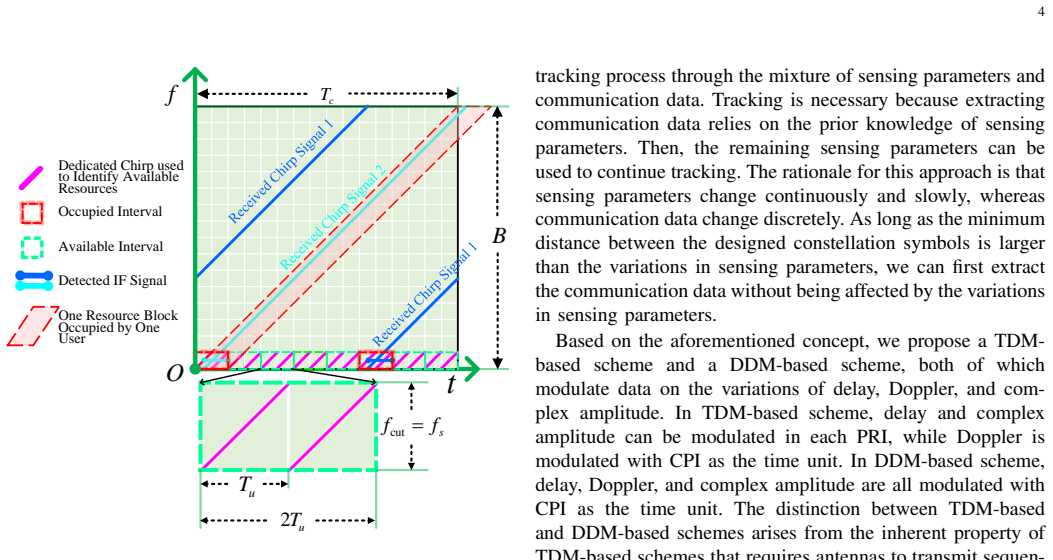
The load-bearing object is the dedicated chirp, a locally generated chirp with the same chirp rate as the transmitted signal but shorter duration $T_u = T_c f_{cut}/B$, used to identify idle time-frequency resources by mixing incoming signals and detecting IF tones. The associated Chirp-DMA allocates tilted-bar resource blocks with a guard time $T_u$, so that $T_c/(2T_u)$ transceiver pairs can operate concurrently. Inside each block, the modulation mechanism is to displace the detected peak in the range-Doppler map relative to the position predicted by tracking: a quantized delay shift encodes data in range, a quantized Doppler shift encodes data in velocity, and a QAM or PSK symbol encodes data in complex amplitude. The receiver separates communication data from sensing parameters by relying on the fact that sensing parameters change continuously while data symbols are discrete, provided the minimum constellation spacing exceeds the sensing variation.
What would settle it
Run the DDM scheme in simulation with a tracked target whose true delay jitter is made comparable to the minimum constellation spacing, for example by adding a second reflection path whose strength is within a few dB of the direct path, and measure BER and tracking divergence across many frames. If the decision-directed demodulation loop cannot keep the error below the constellation spacing under this condition, the paper's central assumption fails.
Extended reading notes
Core claim
The central claim is that the chirp itself can carry data: by shifting the position of a detected target peak in the range-Doppler map by a small, quantized amount in delay or Doppler, or by changing the complex amplitude of the chirp, a transmitter can embed a few bits per frame without changing the waveform's radar-friendly properties. Because sensing parameters evolve slowly and predictably, the paper argues that the receiver can first subtract the predicted delay and Doppler from the measured peak position, decode the residue as communication data, and then use the remaining parameters to continue tracking. Two modulation variants are given: a TDM-MIMO version that modulates delay and amplitude every pulse repetition interval and Doppler once per coherent processing interval, reaching hundreds of kilobits per second, and a DDM-MIMO version that modulates all three dimensions once per CPI, reaching only kilobits per second but working at lower SNR because all antennas transmit simultaneously. The proposed Chirp-DMA uses a dedicated chirp shorter than the regular chirp to probe which tilted time-frequency bars are occupied, and the authors state that interference-free ISAC is achievable as long as there is a certain delay among different chirps, with up to $T_c/(2T_u)$ transceiver pairs accommodated. The paper validates the DDM version by simulation, showing that data demodulation, target detection, and delay, velocity, and angle estimation all succeed at low SNR under the chosen parameter settings.
Load-bearing premise
The whole method rests on the receiver's ability to tell a data-induced shift from a motion-induced shift by trusting predictions from the tracking filter, with the paper assuming that the minimum distance between constellation symbols is larger than the variation in sensing parameters; no analysis is given for what happens when tracking errors, multipath, or a missed detection violate that inequality.
Editorial extensions
If this is right
- With Chirp-DMA, multiple mmWave radar transceiver pairs can share the same time-frequency resources, and the number of simultaneously supported pairs is set by the ratio of the chirp duration to the dedicated-chirp duration.
- The DDM-based scheme gives kbps-level rates, enough for vehicular control messages, while the TDM-based scheme raises the rate by roughly the number of chirps per frame, at a 6 dB SNR penalty.
- The whole receiver chain is built from FFT, CFAR, and MUSIC, so the added communication function does not require new hardware or a separate radio.
- Because bandwidth, PRI, and SNR are interchangeable, doubling bandwidth or PRI buys 3 dB of equivalent SNR, allowing a vehicle to trade range resolution or update rate for link margin.
- The scheme operates at SNR values near -35 dB, suggesting lower transmit power and less interference to other spectrum users.
Reading between the lines
- Beyond the paper, the low rates mean the chirp link is limited to control-plane messaging; high-volume sensor sharing would need a separate channel.
- Beyond the paper, a realistic stress test is multipath with strong secondary reflections, because the tracking loop could misread a delay jump as data; the paper does not simulate this.
- Beyond the paper, constellation spacing could be adapted to tracking confidence to trade rate for robustness, an option the paper leaves open.
Signed reviews
Editorial analysis
A structured set of objections, weighed in public.
Referee Report
Summary. The paper proposes a chirp-based integrated sensing and communication (ISAC) framework for autonomous vehicles. It introduces Chirp-DMA, a cognitive-resource-allocation scheme that identifies idle time-frequency resources using dedicated short-duration chirps and claims interference-free operation for multiple transceiver pairs as long as the chirps are separated by a certain delay. Within each allocated resource block, the paper proposes two delay-Doppler domain modulation schemes: a TDM-based scheme with per-PRI delay and amplitude modulation plus per-CPI Doppler modulation, and a DDM-based scheme with CPI-level modulation of delay, Doppler, and complex amplitude. Both schemes embed data in the same delay-Doppler parameters used for sensing, to be extracted during tracking with FFT, CFAR, MUSIC, and EKF. The DDM scheme is evaluated by simulation through BER, hitrate, and estimation-error CDFs at SNR values down to -35 dB, with data rates of a few kbps. The paper also discusses open problems including synchronization, malicious interference, multi-vehicle networking, and extension to embodied agents, and provides a GitHub link for simulation code.
Significance. If the central claims were substantiated, the paper would offer a practically attractive ISAC design: a low-complexity extension of existing FMCW radar signal processing that simultaneously provides sensing and low-rate V2V communication without dedicated communication hardware or spectrum. The use of familiar radar algorithms (FFT, CFAR, MUSIC, EKF) and the provision of simulation code are strengths, and the paper is honest about the low data rates and about several idealizing assumptions. However, the key claims are not supported by the evidence presented. The interference-free property of Chirp-DMA is asserted rather than derived or simulated; the tracking-based demodulation principle is a decision-directed loop whose stability is neither analyzed nor simulated; and the data-rate formulas assume a full delay modulation range that is not reconciled with the physical target position. The simulation section omits essential setup details and does not demonstrate the multi-frame closed-loop operation that the demodulation concept requires.
major comments (4)
- [Section III-A] The claim that 'interference-free ISAC can be achieved as long as there is a certain delay among different chirps' is not substantiated. No signal model for the multiple-access scenario is given, no analysis of the cross-correlation between a victim receiver's locally generated chirp and an interfering chirp with a different start time or chirp rate is provided, and no simulation of multiple transmitter-receiver pairs is shown. The derived capacity T_c/(2T_u) relies on an idealized timing grid (Fig. 3) whose robustness to non-ideal synchronization, range-dependent path loss, and near-far effects is asserted rather than demonstrated. Because Chirp-DMA is the stated mechanism behind the abstract's 'without interference' claim, this is a load-bearing gap.
- [Section III-B] The demodulation principle is a decision-directed tracking loop: data bits are read from the received delay-Doppler mixture using sensing predictions, and the data-removed measurement is then used to update the track. The paper states that 'Communication data is first extracted during the tracking process through the mixture of sensing parameters and communication data' and that this works 'as long as the minimum distance between the designed constellation symbols is larger than the variations in sensing parameters.' No error-propagation analysis is given, no quantitative threshold for 'variations in sensing parameters' is derived, and no closed-loop multi-frame simulation of the tracking-demodulation loop is presented. Section IV-B explicitly concedes that 'larger errors in parameter estimation result in larger tracking errors, which in turn adversely affect the demodulation performance.' Without a stability or error-propagation analysis and without end-to-end simulation of this loop, the claimed simultaneous sensing and communication at SNR down to -35 dB is unsupported.
- [Section III-B] The data-rate formulas assume that the full N_s/2 delay range is available for modulation, independent of the target's true position. In Fig. 4, the target has both an 'actual detected position' and a 'should-be' position, which implies that some range bins are occupied by the physical target and cannot be used for data symbols without ambiguity or false-target risk. The paper does not specify how the transmitter avoids the target's true range bin, how the receiver knows which bins are allowable, or how the modulation range is renegotiated when the target delay changes between frames. The claimed data rates therefore overstate the achievable delay-domain capacity.
- [Section III-C] The simulation section reports BER, hitrate, and CDF curves but omits essential setup details: the number and parameters of targets, radar cross-section, multipath and channel model, noise and SNR reference point, the number of Monte Carlo runs, and whether the reference position used for demodulation is genie-aided or obtained from the tracking loop. Fig. 5(a) is described in the caption as 'data demodulation performance' but the text refers to BER; the curves are not distinguished by marker style. Without these details, and without a signal model or equation for the DDM waveform, the provided code link cannot be independently checked, and the central claim of reliable operation down to -35 dB cannot be assessed.
minor comments (5)
- [Abstract and Section I] There are typos: 'enabe' in the abstract and 'estimiation' and 'cumulative distributive function' in Section III-C should be 'estimation' and 'cumulative distribution function', respectively.
- [Section III-B] The notation N_s, f_s, and N_c is used in the data-rate formulas but N_s is not explicitly defined before its first use; a formal list of symbols would improve readability.
- [Section III-C] The statement that the TDM BER curve will shift 6 dB to the right compared with the DDM scheme is not supported by any simulation or derivation shown in the paper.
- [Fig. 5] The figure caption does not identify line styles or symbols for the different configurations, making it hard to map the curves to the legend entries; a table of configurations and data rates would help.
- [Section III-C] The comment that the worst-case BER is 1 rather than 0.5 because 'if the detection fails, no demodulation takes place' is not fully explained in a conventional BER framework and should be clarified or justified.
Circularity Check
No significant circularity: the derivations are self-contained counting and geometry arguments, and the decision-directed demodulation loop is an acknowledged algorithmic gap rather than a circular reduction.
full rationale
The paper's central derivations are parameter-counting and time-frequency geometry arguments rather than fitted predictions renamed as results. The Chirp-DMA interference-free condition in Section III-A is a direct consequence of the low-pass filter after dechirping: a same-slope chirp delayed by more than T_c f_cut/B produces an IF beat frequency above f_cut and is filtered out, so the 'certain delay' condition follows from the receiver architecture rather than being assumed as an input. The data-rate formulas in Section III-B are closed-form counts of resolvable delay cells, QAM/PM orders, and Doppler cells per PRI or CPI, with no fitted parameters; the TDM and DDM rate expressions are algebraic consequences of the chosen modulation time units. The tracking-based demodulation described in Section III-B is a decision-directed receiver architecture: data are extracted from the residual relative to predicted sensing parameters, and the data-removed measurements update the track. While the paper provides no error-propagation analysis and indeed admits in Section IV-B that 'larger errors in parameter estimation result in larger tracking errors, which in turn adversely affect the demodulation performance,' this is a missing closed-loop robustness analysis, not a case where a claimed prediction reduces by construction to its own inputs. The one-to-one correspondence between hitrate and BER noted in Section III-C is an explicit acknowledgement that the sensing and communication metrics are linked by the resolution-based constellation spacing; it limits the independence of the two simulation curves but does not make the derivation circular. Self-citations to [5], [6], and [15] point to standard algorithms or alternative processing directions and are not load-bearing. No fitted parameter is presented as a prediction, no uniqueness theorem is imported from the authors' prior work, and no known result is merely renamed. Overall circularity score is 0.
Assumptions & free parameters
free parameters (3)
- Maximum round-trip delay allocation (N_s/2 range bins) =
N_s/2
- Chirps per CPI (N_c) =
128 in simulations
- Modulation order N_Q =
4 (QPSK) in simulations
assumptions (5)
- domain assumption Mixing with a local chirp and low-pass filtering removes any received chirp whose time separation exceeds T_u, so time-separated chirps do not interfere.
- domain assumption The receiver can track the unmodulated delay and Doppler of the link accurately enough to separate data-induced shifts from physical motion.
- domain assumption Ideal synchronization between active and passive transceivers.
- domain assumption One target per range-velocity bin in the simulation, so MUSIC reduces to matched filtering.
- standard math Standard FFT, CA-CFAR, and MUSIC algorithms behave as assumed.
Cite this review
Pith. "Pith review of Chirp Delay-Doppler Domain Modulation: A New Paradigm of Integrated Sensing and Communication for Autonomous Vehicles." pith.science (2026). https://pith.science/paper/FRXPHEFM
@misc{pith2026250516807,
  author       = {Pith},
  title        = {Pith review of: Chirp Delay-Doppler Domain Modulation: A New Paradigm of Integrated Sensing and Communication for Autonomous Vehicles},
  year         = {2026},
  howpublished = {\url{https://pith.science/paper/FRXPHEFM}},
  note         = {Machine review of arXiv:2505.16807}
}
read the original abstract
Autonomous driving is reshaping the way humans travel, with millimeter wave (mmWave) radar playing a crucial role in this transformation to enabe vehicle-to-everything (V2X). Although chirp is widely used in mmWave radar systems for its strong sensing capabilities, the lack of integrated communication functions in existing systems may limit further advancement of autonomous driving. In light of this, we first design ``dedicated chirps" tailored for sensing chirp signals in the environment, facilitating the identification of idle time-frequency resources. Based on these dedicated chirps, we propose a chirp-division multiple access (Chirp-DMA) scheme, enabling multiple pairs of mmWave radar transceivers to perform integrated sensing and communication (ISAC) without interference. Subsequently, we propose two chirp-based delay-Doppler domain modulation schemes that enable each pair of mmWave radar transceivers to simultaneously sense and communicate within their respective time-frequency resource blocks. The modulation schemes are based on different multiple-input multiple-output (MIMO) radar schemes: the time division multiplexing (TDM)-based scheme offers higher communication rates, while the Doppler division multiplexing (DDM)-based scheme is suitable for working in a lower signal-to-noise ratio range. We then validate the effectiveness of the proposed DDM-based scheme through simulations. Finally, we present some challenges and issues that need to be addressed to advance ISAC in V2X for better autonomous driving. Simulation codes are provided to reproduce the results in this paper: \href{https://github.com/LiZhuoRan0/2025-IEEE-Network-ChirpDelayDopplerModulationISAC}{https://github.com/LiZhuoRan0}.
Figures


Figures from the paper (3 more)


Reference graph
Works this paper leans on
-
[1]
Automotive radars: A review of signal processing techniques,
S. M. Patole, M. Torlak, D. Wang, and M. Ali, “Automotive radars: A review of signal processing techniques,”IEEE Signal Process. Mag., vol. 34, no. 2, pp. 22–35, Mar. 2017
2017
-
[2]
Automotive radar signal processing: Research directions and practical challenges,
F. Engels, P. Heidenreich, M. Wintermantel, L. St ¨acker, M. Al Kadi, and A. M. Zoubir, “Automotive radar signal processing: Research directions and practical challenges,”IEEE J. Sel. Top. Signal. Process., vol. 15, no. 4, pp. 865–878, Jun. 2021
work page 2021
-
[3]
S. Sun, A. P. Petropulu, and H. V . Poor, “MIMO radar for advanced driver- assistance systems and autonomous driving: Advantages and challenges,” IEEE Signal Process. Mag., vol. 37, no. 4, pp. 98–117, Jul. 2020
work page 2020
-
[4]
Cross-domain dual-functional ofdm waveform design for accurate sensing/positioning,
F. Zhang, T. Mao, R. Liu, Z. Han, S. Chen, and Z. Wang, “Cross-domain dual-functional ofdm waveform design for accurate sensing/positioning,” IEEE J. Sel. Areas Commun., vol. 42, no. 9, pp. 2259–2274, Sept. 2024
work page 2024
-
[5]
Integrated sensing and communication with mmWave massive MIMO: A compressed sampling perspective,
Z. Gao, Z. Wan, D. Zheng, S. Tan, C. Masouros, D. W. K. Ng, and S. Chen, “Integrated sensing and communication with mmWave massive MIMO: A compressed sampling perspective,”IEEE Trans. on Wireless Commun., vol. 22, no. 3, pp. 1745–1762, Mar. 2023
work page 2023
-
[6]
AI empowered channel semantic acquisition for 6G integrated sensing and communication networks,
Y . Zhang, Z. Gao, J. Zhao, Z. He, Y . Zhang, C. Lu, and P. Xiao, “AI empowered channel semantic acquisition for 6G integrated sensing and communication networks,”IEEE Netw., vol. 38, no. 2, pp. 45–53, Mar. 2024
work page 2024
-
[7]
An overview of OTFS for internet of things: Concepts, benefits, and challenges,
L. Xiao, S. Li, Y . Qian, D. Chen, and T. Jiang, “An overview of OTFS for internet of things: Concepts, benefits, and challenges,”IEEE Internet Things J., vol. 9, no. 10, pp. 7596–7618, May 2022
work page 2022
-
[8]
AFDM: A full diversity next generation waveform for high mobility communications,
A. Bemani, N. Ksairi, and M. Kountouris, “AFDM: A full diversity next generation waveform for high mobility communications,” inProc. IEEE Int. Conf. Commun. Workshops (ICC Workshops), Jun. 2021, pp. 1–6
work page 2021
Show all 15 references
-
[9]
Joint wireless communication and radar sensing systems–state of the art and future prospects,
L. Han and K. Wu, “Joint wireless communication and radar sensing systems–state of the art and future prospects,”IET Microw., Antennas & Propag., vol. 7, no. 11, pp. 876–885, Aug. 2013
2013
-
[10]
mmWave enabled connected autonomous vehicles: A use case with V2V cooperative perception,
M. B. Mollah, H. Wang, M. A. Karim, and H. Fang, “mmWave enabled connected autonomous vehicles: A use case with V2V cooperative perception,”IEEE Netw., vol. 38, no. 6, pp. 485–492, 2024
2024
-
[11]
Radar interference mitigation for automated driving: Exploring proactive strategies,
C. Aydogdu, M. F. Keskin, G. K. Carvajal, O. Eriksson, H. Hellsten, H. Herbertsson, E. Nilsson, M. Rydstrom, K. Vanas, and H. Wymeersch, “Radar interference mitigation for automated driving: Exploring proactive strategies,”IEEE Signal Process. Mag., vol. 37, no. 4, pp. 72–84, ...
2020
-
[12]
Experimental study of LoRa modulation immunity to doppler effect in CubeSat radio communications,
A. A. Doroshkin, A. M. Zadorozhny, O. N. Kus, V . Y . Prokopyev, and Y . M. Prokopyev, “Experimental study of LoRa modulation immunity to doppler effect in CubeSat radio communications,”IEEE Access, vol. 7, pp. 75 721–75 731, May 2019
2019
-
[13]
LoRadar: Enabling concurrent radar sensing and LoRa communication,
Q. Huang, Z. Luo, J. Zhang, W. Wang, and Q. Zhang, “LoRadar: Enabling concurrent radar sensing and LoRa communication,”IEEE Trans. Mob. Comput., vol. 21, no. 6, pp. 2045–2057, Jun. 2022
2022
-
[14]
FRaC: FMCW- based joint radar-communications system via index modulation,
D. Ma, N. Shlezinger, T. Huang, Y . Liu, and Y . C. Eldar, “FRaC: FMCW- based joint radar-communications system via index modulation,”IEEE J. Sel. Top. Signal. Process., vol. 15, no. 6, pp. 1348–1364, Nov. 2021
2021
-
[15]
Sensing user’s channel and location with terahertz extra-large reconfigurable intelligent surface under hybrid-field beam squint effect,
Z. Li, Z. Gao, and T. Li, “Sensing user’s channel and location with terahertz extra-large reconfigurable intelligent surface under hybrid-field beam squint effect,”IEEE J. Sel. Top. Signal. Process., vol. 17, no. 4, pp. 893–911, Jul. 2023
2023
Reviewed August 7, 2026 · model on record in the stance chip above.
Discussion (0). Continue with ORCID to comment.