REVIEW 5 major objections 5 minor 69 references
DeepRec: Towards a Deep Dive Into the Item Space with Large Language Model Based Recommendation
T0 review · 5 major / 5 minor · reviewed 2026-08-07 · deepseek-v4-flash
Pith's one-line read DeepRec claims that letting a language model and a preference-aware retriever alternate over multiple turns improves next-item recommendation beyond one-shot methods.
desk verdict DeepRec is a genuinely new multi-turn LLM-TRM agent for sequential recommendation with solid engineering, but the difficulty-filtered training data leaves a real generalization gap that the paper never closes. read the letter →
The pith
A machine-rendered reading of the paper's core claim, the machinery that carries it, and where it could break.
The reading
What carries the argument
The load-bearing object is the preference-aware TRM: a traditional recommendation model that accepts a textual user preference in addition to the interaction history. Its user representation is $\mathbf{h}=\frac{1}{2}\left[f_{\text{TRM}}(X)+f_{\text{Text}}(p_i)\right]$, the average of the sequential model's embedding of history and a text encoder's embedding of the LLM's generated preference, and item scores come from cosine similarity or dot product with item embeddings. This identity is what turns free-form LLM text into an executable retrieval query, and it lets the same TRM serve both as the tool the LLM queries and as the source of collaborative embeddings in the point-wise reward. The rest of the machinery—hierarchical rewards and a two-stage Reinforce++ training loop—exists to make the LLM use that tool productively.
What would settle it
On the leave-one-out test split, compute how many ground-truth next items the preference-aware TRM ranks at position 100 or worse; then retrain DeepRec with the filtering threshold set to 50 and 200. If a large share of test labels would be filtered out, or if Recall and NDCG swing with the threshold, the reported advantage reflects the difficulty filter rather than the multi-turn interaction.
Extended reading notes
Core claim
The central claim is that a language model and a traditional recommendation model improve each other when they are allowed to alternate over multiple turns. DeepRec's loop is formalized as a product over turns of $\Pr_{\text{LLM}}(t_i,p_i|X,\{t_j,p_j,I_j\}_{j<i})\Pr_{\text{TRM}}(I_i|X,p_i)$, followed by a final ranking term $\Pr_{\text{LLM}}(y|X,\{t_i,p_i,I_i\})$, so the LLM supplies thoughts and preferences while the TRM supplies candidate items. The preference-aware TRM is what makes the loop concrete: it averages the sequence model's user representation with a text encoder's representation of the generated preference, $\mathbf{h}=\frac{1}{2}[f_{\text{TRM}}(X)+f_{\text{Text}}(p_i)]$, making the retrieval respond to what the LLM wrote. Rewards for format, invocation count, and preference diversity supervise the process, while point-wise similarity, hit, and a linear rank reward supervise the outcome, trained in two stages. The paper's experimental claim is that this pipeline beats the compared traditional and LLM-based recommenders on all reported Recall and NDCG metrics and carries over to an unseen domain.
Load-bearing premise
The load-bearing premise is that examples where the preference-aware retriever ranks the true next item at position 100 or worse can be thrown away from training without harming test performance; the paper reports no measurement of how many test examples would be excluded by that rule.
Editorial extensions
If this is right
- Item-catalog updates no longer require re-tuning the LLM; the language model only writes preferences and ranks titles, so only the retrieval model's embeddings need refreshing.
- Recommendation can be trained from process and outcome rewards without hand-labeled reasoning-retrieval traces, which are expensive to produce.
- Encouraging diverse preference statements prevents multi-turn retrievals from collapsing into one repeated candidate list, so exploration is an explicit part of the objective.
- A policy trained on one product domain transfers to another domain, which implies the learned skill is general preference exploration rather than memorized items.
- The same autonomous loop can be extended by adding more tool recommenders, such as CTR models, as the paper proposes for future work.
Reading between the lines
- A reader cannot yet separate the contribution of multi-turn reasoning from the contribution of a larger candidate pool; DeepRec retrieves 20 items per turn, so comparing it with one retrieval of the same total number of candidates and the same final ranking would isolate the reasoning effect.
- The rank-100 data filter is a natural place to probe robustness: sweeping the threshold and measuring test-side filtering rates would show whether the gains survive on cases the retriever itself finds hard.
- If the recipe generalizes, the two-stage pattern—first reward the interaction format, then reward the outcome—becomes a template for teaching LLMs to use any external retrieval tool, not just recommenders, which could be tested on search or database agents.
Editorial analysis
A structured set of objections, weighed in public.
Referee Report
Summary. DeepRec proposes a reinforcement-learning-trained LLM that interacts with a traditional recommendation model (TRM) over multiple turns: at each turn the LLM reasons over the user history and previously retrieved items, emits a textual preference description, and the TRM retrieves items based on that description; after several turns the LLM ranks all retrieved items into a final recommendation list. The method is trained with a two-stage RL procedure (a cold-start stage using process-level rewards and a recommendation-oriented stage using outcome-level rewards), and a difficulty-based data-selection step discards training samples where the TRM ranks the true next item below position 100. Experiments on MovieLens-1M and an Amazon Video Games subset report that DeepRec outperforms traditional and LLM-based baselines on Recall@5/10 and NDCG@5/10, and an additional experiment reports promising generalization to an unseen domain (Musical Instruments). The paper includes the source code link and provides a formal description of the interaction paradigm.
Significance. If the reported results are reliable, DeepRec represents a genuinely new architectural pattern for combining LLM reasoning with TRM retrieval: rather than using TRMs only for candidate generation or LLMs only for re-ranking, it lets the LLM drive an iterative, preference-conditioned retrieval process, and it applies RL to learn this behavior. The formalism in Eq. (5) and the hierarchical reward design are clearly presented, and the code is promised to be public, which would aid reproducibility. However, the empirical evidence is substantially weakened by the unquantified difficulty-based data selection, an under-specified cross-domain experiment, a likely typo in a baseline result, and the absence of error bars or significance tests. These gaps currently prevent the reader from assessing whether the claimed superiority is robust or is instead concentrated in an easy subset of test cases defined by the same TRM used for training.
major comments (5)
- [Section 2.3] Difficulty-Based Data Selection: the paper discards all training samples where the preference-aware TRM ranks the true next item below position 100, but it never reports how many training samples are removed, how many test samples would be removed by the same criterion, or how performance varies with the threshold. Because the TRM is fit on the training split, its ranks on held-out test items will generally be worse than on training items, so the filter is likely more aggressive at test time than the training statistics suggest. The w/o Data Selection ablation in Table 3 only shows that removing the filter lowers full-test-set performance; it does not establish that the filtered policy generalizes to hard test cases. Please report the fraction of filtered training and test samples, a sensitivity analysis over the threshold (e.g., 50, 100, 200, no filter), and test metrics stratified by TRM rank of the ground-truth item.
- [Section 3.4.3] Generalization to unseen domain is not sufficiently described. The preference-aware TRM is a TedRec model with item embeddings; if it is trained only on the Game dataset, it cannot retrieve items from Musical Instruments because the item vocabularies differ. The paper does not state whether the TRM is retrained on the new domain, whether item embeddings are shared, or how the LLM policy is applied. It also does not give the dataset statistics or the evaluation protocol for the unseen domain. Without this information, the claim that DeepRec 'still exhibits impressive performance' cannot be verified. Please specify how the TRM is obtained for the new domain and what knowledge (if any) transfers from the Game-trained RL policy.
- [Tables 2 and 3] All results are reported as point estimates without error bars, confidence intervals, significance tests, or multiple seeds. Given that the improvements over the strongest traditional baseline are modest (e.g., on ML-1M, Recall@10 0.2423 vs 0.2312; on Game, Recall@10 0.1016 vs 0.0929), the reader cannot tell whether these differences are reliable or are artifacts of a single run. Please report means and standard deviations over at least three random seeds and, where feasible, a paired significance test (e.g., paired bootstrap or Wilcoxon signed-rank) for the main comparisons in Tables 2 and 3.
- [Table 2, ML-1M, SASRec row] The reported NDCG@5 of 0.0100 is implausible relative to the same row's NDCG@10 of 0.1252 and Recall@5 of 0.1501. A value of 0.0100 would imply that the ground-truth item is almost never ranked at position 1-5, which is inconsistent with Recall@5 of 0.1501 and with the other methods in the table. This is likely a typo (0.1000 is a plausible value), but as published it distorts the baseline comparison. Please correct the value or provide an explanation.
- [Section 2.4.2, Eq. (10)] The point-wise reward uses collaborative embeddings from the same preference-aware TRM that serves as the retrieval tool. This means the RL policy is rewarded for retrieving items the TRM already scores highly, which could bias the learned behavior toward TRM-favored items and reduce the incentive for the deep exploration that the paper identifies as its main contribution. The final evaluation on held-out ground-truth labels mitigates the circularity, but the reward still shapes the training distribution. Please add an ablation that removes the collaborative term (or uses an independently trained TRM for reward computation) to quantify the effect on final performance.
minor comments (5)
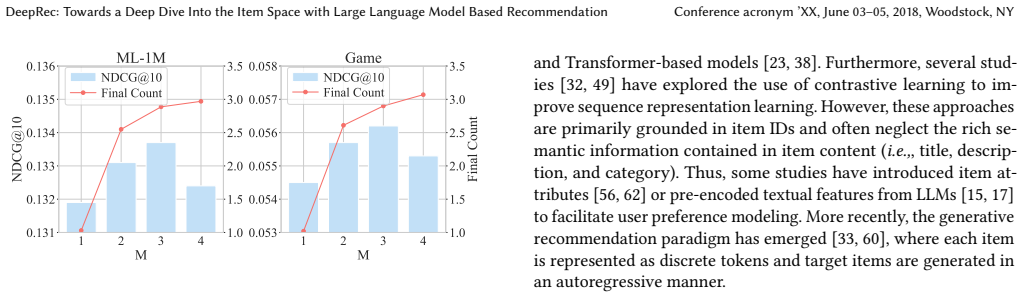
- [Figure 4] The two curves are not clearly distinguished in the caption or legend; the right y-axis is labeled 'Final Count' and the left y-axis is 'NDCG@10', but the figure does not state which curve corresponds to which axis. Please add explicit labels and a legend.
- [Section 3.4.3, Table 4] The table reports only four metrics for the unseen domain; it would be helpful to include the number of users, items, and interactions for Musical Instruments so that the reader can gauge the difficulty of the setting.
- [Section 2.3, Eq. (8)] The invocation count reward gives a flat reward of 1 for any m > M, which means that exceeding the upper bound yields the same reward as exactly reaching M. If this is intentional to avoid encouraging excessive invocation, please state it explicitly in the text.
- [Section 2.4.2, Eq. (10)] The position weight w_k = (K - k + 1)^2 is a design choice that is not justified. A brief explanation or reference to a common ranking loss would improve readability.
- [Section 3.1.4] The text states 'we set the KL coefficient to 0'; with KL=0 there is no constraint on the policy update, which could lead to reward hacking. Please discuss this choice or provide a sensitivity analysis over the KL coefficient.
Circularity Check
No circularity: held-out label evaluation and external baselines keep the derivation self-contained.
full rationale
The paper's central claim is an empirical system result: DeepRec uses RL-trained LLM–TRM interaction for next-item recommendation and is evaluated on held-out labels under leave-one-out. No equation defines the final prediction in terms of the fitted inputs. Equation (5) factorizes the generative process as PrLLM(thought/preference) * PrTRM(retrieval) * PrLLM(rank); the final rank is optimized with hit/rank rewards against the true label (Eqs. 11–12, 14), so the reported Recall/NDCG numbers are not forced by construction. The point-wise reward (Eq. 10) does reuse collaborative embeddings from the same preference-aware TRM (Eq. 6) that performs retrieval; this is a legitimate reward-design risk (it may bias the policy toward items the TRM already favors), but it is not a circular reduction because the outcome-level rewards and the final evaluation both use ground-truth labels rather than TRM scores. The difficulty-based data selection (Section 2.3) discards training prompts where the TRM ranks the label above position 100; this changes the training distribution and is a real generalization concern, but the test set is not filtered by the same rule, so the headline comparison is still an external benchmark. The self-citations (TedRec [51] as the base TRM, LC-Rec [60] as a baseline) are used as components and comparators, not as justifications of the method's validity, and the core interaction/reward design is tested against several external baselines. Consequently, no step in the derivation reduces to its own input, and the paper is not circular.
Assumptions & free parameters
free parameters (7)
- Difficulty threshold for data selection =
100
- Invocation count upper bound M =
3
- Retrieved items per invocation =
20
- Rank reward scale =
0.2
- Position weight exponent =
w_k=(K-k+1)^2
- Preference embedding mixture weight =
1/2
- Maximum history length =
20
assumptions (5)
- domain assumption The preference-aware TRM defined in Eq. 6 effectively retrieves items relevant to the user's current preference when given an averaged representation.
- domain assumption Text embeddings from BGE-large capture semantic similarity that correlates with user preferences for the target items.
- domain assumption Reinforce++ with KL coefficient 0 will not diverge or reward-hack on this task.
- domain assumption The trajectory rollouts produced by the LLM interacting with the TRM are representative of test-time behavior.
- standard math The probabilistic factorization in Eq. 5 correctly models the generative process of multi-turn retrieval.
Cite this review
Pith. "Pith review of DeepRec: Towards a Deep Dive Into the Item Space with Large Language Model Based Recommendation." pith.science (2026). https://pith.science/paper/PMYBTDYP
@misc{pith2026250516810,
  author       = {Pith},
  title        = {Pith review of: DeepRec: Towards a Deep Dive Into the Item Space with Large Language Model Based Recommendation},
  year         = {2026},
  howpublished = {\url{https://pith.science/paper/PMYBTDYP}},
  note         = {Machine review of arXiv:2505.16810}
}
read the original abstract
Recently, large language models (LLMs) have been introduced into recommender systems (RSs), either to enhance traditional recommendation models (TRMs) or serve as recommendation backbones. However, existing LLM-based RSs often do not fully exploit the complementary advantages of LLMs (e.g., world knowledge and reasoning) and TRMs (e.g., recommendation-specific knowledge and efficiency) to fully explore the item space. To address this, we propose DeepRec, a novel LLM-based RS that enables autonomous multi-turn interactions between LLMs and TRMs for deep exploration of the item space. In each interaction turn, LLMs reason over user preferences and interact with TRMs to retrieve candidate items. After multi-turn interactions, LLMs rank the retrieved items to generate the final recommendations. We adopt reinforcement learning(RL) based optimization and propose novel designs from three aspects: recommendation model based data rollout, recommendation-oriented hierarchical rewards, and a two-stage RL training strategy. For data rollout, we introduce a preference-aware TRM, with which LLMs interact to construct trajectory data. For rewards, we design a hierarchical reward function that involves both process-level and outcome-level rewards to optimize the interaction process and recommendation performance, respectively. For RL training, we develop a two-stage training strategy, where the first stage aims to guide LLMs to interact with TRMs and the second stage focuses on performance improvement. Experiments on public datasets demonstrate that DeepRec significantly outperforms both traditional and LLM-based baselines, offering a new paradigm for deep exploration in recommendation systems.
Figures


Figures from the paper (1 more)
Reference graph
Works this paper leans on
-
[1]
OpenAI (2025). 2025. Deep Research System Card . Technical Report. OpenAI. https://cdn.openai.com/deep-research-system-card.pdf
work page 2025
-
[2]
Keqin Bao, Jizhi Zhang, Yang Zhang, Wenjie Wang, Fuli Feng, and Xiangnan He. 2023. TALLRec: An Effective and Efficient Tuning Framework to Align Large Language Model with Recommendation. In Proceedings of the 17th ACM Conference on Recommender Systems, RecSys 2023, Singapore, Singapore, September 18-22, 2023, Jie Zhang, Li Chen, Shlomo Berkovsky, Min Zhan...
work page 2023
-
[3]
Qiguang Chen, Libo Qin, Jinhao Liu, Dengyun Peng, Jiannan Guan, Peng Wang, Mengkang Hu, Yuhang Zhou, Te Gao, and Wanxiang Che. 2025. Towards Reason- ing Era: A Survey of Long Chain-of-Thought for Reasoning Large Language Mod- els. CoRR abs/2503.09567 (2025). doi:10.48550/ARXIV.2503.09567 arXiv:2503.09567
-
[4]
Yuxin Chen, Junfei Tan, An Zhang, Zhengyi Yang, Leheng Sheng, Enzhi Zhang, Xiang Wang, and Tat-Seng Chua. 2024. On Softmax Direct Preference Optimiza- tion for Recommendation. In Advances in Neural Information Processing Systems 38: Annual Conference on Neural Information Processing Systems 2024, NeurIPS 2024, Vancouver, BC, Canada, December 10 - 15, 2024
work page 2024
-
[5]
Zhipeng Chen, Yingqian Min, Beichen Zhang, Jie Chen, Jinhao Jiang, Daixuan Cheng, Wayne Xin Zhao, Zheng Liu, Xu Miao, Yang Lu, Lei Fang, Zhongyuan Wang, and Ji-Rong Wen. 2025. An Empirical Study on Eliciting and Improving R1-like Reasoning Models. CoRR abs/2503.04548 (2025). doi:10.48550/ARXIV. 2503.04548 arXiv:2503.04548
-
[6]
Zheng Chu, Jingchang Chen, Qianglong Chen, Weijiang Yu, Tao He, Haotian Wang, Weihua Peng, Ming Liu, Bing Qin, and Ting Liu. 2023. A Survey of Chain of Thought Reasoning: Advances, Frontiers and Future. CoRR abs/2309.15402 (2023). doi:10.48550/ARXIV.2309.15402 arXiv:2309.15402
-
[7]
Yizhou Dang, Enneng Yang, Yuting Liu, Guibing Guo, Linying Jiang, Jianzhe Zhao, and Xingwei Wang. 2024. Data Augmentation for Sequential Recommen- dation: A Survey. CoRR abs/2409.13545 (2024). doi:10.48550/ARXIV.2409.13545 arXiv:2409.13545
-
[8]
DeepSeek-AI. 2025. DeepSeek-R1: Incentivizing Reasoning Capability in LLMs via Reinforcement Learning. CoRR abs/2501.12948 (2025). doi:10.48550/ARXIV. 2501.12948 arXiv:2501.12948
Show all 69 references
-
[9]
Xiaofei Dong, Xueqiang Zhang, Weixin Bu, Dan Zhang, and Feng Cao. 2024. A Survey of LLM-based Agents: Theories, Technologies, Applications and Sugges- tions. In 3rd International Conference on Artificial Intelligence, Internet of Things and Cloud Computing Technology, AIoTC 20...
2024
-
[10]
Shijie Geng, Shuchang Liu, Zuohui Fu, Yingqiang Ge, and Yongfeng Zhang. 2022. Recommendation as Language Processing (RLP): A Unified Pretrain, Personalized Prompt & Predict Paradigm (P5). In RecSys ’22: Sixteenth ACM Conference on Recommender Systems, Seattle, W A, USA, Septem...
2022
-
[11]
Maxwell Harper and Joseph A
F. Maxwell Harper and Joseph A. Konstan. 2016. The MovieLens Datasets: History and Context. ACM Trans. Interact. Intell. Syst. 5, 4 (2016), 19:1–19:19. doi:10.1145/2827872
2016 doi
-
[12]
Ruining He and Julian J. McAuley. 2016. Fusing Similarity Models with Markov Chains for Sparse Sequential Recommendation. In IEEE 16th International Con- ference on Data Mining, ICDM 2016, December 12-15, 2016, Barcelona, Spain . IEEE Computer Society, 191–200
2016
-
[13]
Balázs Hidasi, Alexandros Karatzoglou, Linas Baltrunas, and Domonkos Tikk
-
[14]
Minjie Hong, Yan Xia, Zehan Wang, Jieming Zhu, Ye Wang, Sihang Cai, Xi- aoda Yang, Quanyu Dai, Zhenhua Dong, Zhimeng Zhang, and Zhou Zhao. 2025. EAGER-LLM: Enhancing Large Language Models as Recommenders through Exogenous Behavior-Semantic Integration. In Proceedings of the AC...
2025
-
[15]
McAuley, and Wayne Xin Zhao
Yupeng Hou, Zhankui He, Julian J. McAuley, and Wayne Xin Zhao. 2023. Learn- ing Vector-Quantized Item Representation for Transferable Sequential Recom- menders. In Proceedings of the ACM Web Conference 2023, WWW 2023, Austin, TX, USA, 30 April 2023 - 4 May 2023 . ACM, 1162–1171
2023
-
[16]
Yupeng Hou, Jiacheng Li, Zhankui He, An Yan, Xiusi Chen, and Julian J. McAuley
-
[17]
Yupeng Hou, Shanlei Mu, Wayne Xin Zhao, Yaliang Li, Bolin Ding, and Ji-Rong Wen. 2022. Towards Universal Sequence Representation Learning for Recom- mender Systems. In KDD ’22: The 28th ACM SIGKDD Conference on Knowledge Discovery and Data Mining, Washington, DC, USA, August 1...
2022
-
[18]
McAuley, and Wayne Xin Zhao
Yupeng Hou, Junjie Zhang, Zihan Lin, Hongyu Lu, Ruobing Xie, Julian J. McAuley, and Wayne Xin Zhao. 2024. Large Language Models are Zero-Shot Rankers for Recommender Systems. In Advances in Information Retrieval - 46th European Conference on Information Retrieval, ECIR 2024, G...
2024
- [19]
- [20]
-
[21]
Wenyue Hua, Shuyuan Xu, Yingqiang Ge, and Yongfeng Zhang. 2023. How to Index Item IDs for Recommendation Foundation Models. In Annual International ACM SIGIR Conference on Research and Development in Information Retrieval in the Asia Pacific Region, SIGIR-AP 2023, Beijing, Chi...
2023
- [22]
-
[23]
Wang-Cheng Kang and Julian J. McAuley. 2018. Self-Attentive Sequential Rec- ommendation. In IEEE International Conference on Data Mining, ICDM 2018, Singapore, November 17-20, 2018 . IEEE Computer Society, 197–206
2018
-
[24]
Xiangyang Li, Bo Chen, Lu Hou, and Ruiming Tang. 2023. Ctrl: Connect collabo- rative and language model for ctr prediction. ACM Transactions on Recommender Systems (2023)
2023
- [25]
- [26]
-
[27]
Jiacheng Lin, Tian Wang, and Kun Qian. 2025. Rec-R1: Bridging Generative Large Language Models and User-Centric Recommendation Systems via Reinforce- ment Learning. CoRR abs/2503.24289 (2025). doi:10.48550/ARXIV.2503.24289 arXiv:2503.24289 DeepRec: Towards a Deep Dive Into the...
2025 doi
- [28]
- [29]
-
[30]
Sichun Luo, Yuxuan Yao, Bowei He, Yinya Huang, Aojun Zhou, Xinyi Zhang, Yuanzhang Xiao, Mingjie Zhan, and Linqi Song. 2024. Integrating Large Lan- guage Models into Recommendation via Mutual Augmentation and Adaptive Aggregation. CoRR abs/2401.13870 (2024). doi:10.48550/ARXIV....
2024 doi
- [31]
-
[32]
Ruihong Qiu, Zi Huang, Hongzhi Yin, and Zijian Wang. 2022. Contrastive Learn- ing for Representation Degeneration Problem in Sequential Recommendation. In WSDM ’22: The Fifteenth ACM International Conference on Web Search and Data Mining, Virtual Event / Tempe, AZ, USA, Februa...
2022
-
[33]
Tran, Jonah Samost, Maciej Kula, Ed H
Shashank Rajput, Nikhil Mehta, Anima Singh, Raghunandan Hulikal Keshavan, Trung Vu, Lukasz Heldt, Lichan Hong, Yi Tay, Vinh Q. Tran, Jonah Samost, Maciej Kula, Ed H. Chi, and Mahesh Sathiamoorthy. 2023. Recommender Systems with Generative Retrieval. In Advances in Neural Infor...
2023
- [34]
-
[35]
Robertson and Hugo Zaragoza
Stephen E. Robertson and Hugo Zaragoza. 2009. The Probabilistic Relevance Framework: BM25 and Beyond. Found. Trends Inf. Retr. 3, 4 (2009), 333–389
2009
- [36]
-
[37]
Steffen Rendle, Christoph Freudenthaler, and Lars Schmidt-Thieme. 2010. Factor- izing personalized Markov chains for next-basket recommendation. InProceedings of the 19th International Conference on World Wide Web, WWW 2010, Raleigh, North Carolina, USA, April 26-30, 2010 . AC...
2010
-
[38]
Fei Sun, Jun Liu, Jian Wu, Changhua Pei, Xiao Lin, Wenwu Ou, and Peng Jiang
-
[39]
Yong Kiam Tan, Xinxing Xu, and Yong Liu. 2016. Improved Recurrent Neural Networks for Session-based Recommendations. InProceedings of the 1st Workshop on Deep Learning for Recommender Systems, DLRS@RecSys 2016, Boston, MA, USA, September 15, 2016. ACM, 17–22
2016
- [40]
-
[41]
Jiaxi Tang and Ke Wang. 2018. Personalized Top-N Sequential Recommendation via Convolutional Sequence Embedding. In Proceedings of the Eleventh ACM International Conference on Web Search and Data Mining, WSDM 2018, Marina Del Rey, CA, USA, February 5-9, 2018 . ACM, 565–573
2018
- [42]
-
[43]
Qwen Team. 2025. QwQ-32B: Embracing the Power of Reinforcement Learning. https://qwenlm.github.io/blog/qwq-32b/
2025
- [44]
-
[45]
Likang Wu, Zhi Zheng, Zhaopeng Qiu, Hao Wang, Hongchao Gu, Tingjia Shen, Chuan Qin, Chen Zhu, Hengshu Zhu, Qi Liu, Hui Xiong, and Enhong Chen
-
[46]
Shu Wu, Yuyuan Tang, Yanqiao Zhu, Liang Wang, Xing Xie, and Tieniu Tan
-
[47]
Yunjia Xi, Weiwen Liu, Jianghao Lin, Xiaoling Cai, Hong Zhu, Jieming Zhu, Bo Chen, Ruiming Tang, Weinan Zhang, and Yong Yu. 2024. Towards Open-World Recommendation with Knowledge Augmentation from Large Language Models. In Proceedings of the 18th ACM Conference on Recommender ...
2024
-
[48]
Wenjie Wang, Honghui Bao, Xinyu Lin, Jizhi Zhang, Yongqi Li, Fuli Feng, See- Kiong Ng, and Tat-Seng Chua. 2024. Learnable Item Tokenization for Generative Recommendation. In International Conference on Information and Knowledge Management
2024
-
[49]
Xu Xie, Fei Sun, Zhaoyang Liu, Shiwen Wu, Jinyang Gao, Jiandong Zhang, Bolin Ding, and Bin Cui. 2022. Contrastive Learning for Sequential Recommendation. In 38th IEEE International Conference on Data Engineering, ICDE 2022, Kuala Lumpur, Malaysia, May 9-12, 2022 . IEEE, 1259–1273
2022
-
[50]
World Wide Web (WWW) 27, 5 (2024), 60
A survey on large language models for recommendation. World Wide Web (WWW) 27, 5 (2024), 60
2024
-
[51]
Lanling Xu, Zhen Tian, Bingqian Li, Junjie Zhang, Daoyuan Wang, Hongyu Wang, Jinpeng Wang, Sheng Chen, and Wayne Xin Zhao. 2024. Sequence-level Semantic Representation Fusion for Recommender Systems. In Proceedings of the 33rd ACM International Conference on Information and Kn...
2024
-
[52]
Session-Based Recommendation with Graph Neural Networks. In The Thirty-Third AAAI Conference on Artificial Intelligence, AAAI 2019, The Thirty- First Innovative Applications of Artificial Intelligence Conference, IAAI 2019, The Ninth AAAI Symposium on Educational Advances in A...
2019
- [53]
-
[54]
Shitao Xiao, Zheng Liu, Peitian Zhang, Niklas Muennighoff, Defu Lian, and Jian-Yun Nie. 2024. C-Pack: Packed Resources For General Chinese Embeddings. In Proceedings of the 47th International ACM SIGIR Conference on Research and Development in Information Retrieval, SIGIR 2024...
2024
- [55]
-
[56]
Sheng, Jiajie Xu, Fuzhen Zhuang, Junhua Fang, and Xiaofang Zhou
Chengfeng Xu, Pengpeng Zhao, Yanchi Liu, Victor S. Sheng, Jiajie Xu, Fuzhen Zhuang, Junhua Fang, and Xiaofang Zhou. 2019. Graph Contextualized Self- Attention Network for Session-based Recommendation. In Proceedings of the Twenty-Eighth International Joint Conference on Artifi...
2019
- [57]
- [58]
- [59]
- [60]
- [61]
-
[62]
Sheng, Jiajie Xu, De- qing Wang, Guanfeng Liu, and Xiaofang Zhou
Tingting Zhang, Pengpeng Zhao, Yanchi Liu, Victor S. Sheng, Jiajie Xu, De- qing Wang, Guanfeng Liu, and Xiaofang Zhou. 2019. Feature-level Deeper Self-Attention Network for Sequential Recommendation. In Proceedings of the Twenty-Eighth International Joint Conference on Artific...
2019
-
[63]
Kun Zhou, Hui Yu, Wayne Xin Zhao, and Ji-Rong Wen. 2022. Filter-enhanced MLP is All You Need for Sequential Recommendation. In WWW ’22: The ACM Web Conference 2022, Virtual Event, Lyon, France, April 25 - 29, 2022 . ACM, 2388–2399
2022
-
[64]
Wayne Xin Zhao, Shanlei Mu, Yupeng Hou, Zihan Lin, Yushuo Chen, Xingyu Pan, Kaiyuan Li, Yujie Lu, Hui Wang, Changxin Tian, Yingqian Min, Zhichao Feng, Xinyan Fan, Xu Chen, Pengfei Wang, Wendi Ji, Yaliang Li, Xiaoling Wang, and Ji-Rong Wen. 2021. RecBole: Towards a Unified, Com...
2021
-
[66]
Bowen Zheng, Yupeng Hou, Hongyu Lu, Yu Chen, Wayne Xin Zhao, Ming Chen, and Ji-Rong Wen. 2024. Adapting Large Language Models by Integrating Col- laborative Semantics for Recommendation. In 40th IEEE International Conference on Data Engineering, ICDE 2024, Utrecht, The Netherl...
2024
-
[68]
Kun Zhou, Hui Wang, Wayne Xin Zhao, Yutao Zhu, Sirui Wang, Fuzheng Zhang, Zhongyuan Wang, and Ji-Rong Wen. 2020. S3-Rec: Self-Supervised Learning for Sequential Recommendation with Mutual Information Maximization. In CIKM Conference acronym ’XX, June 03–05, 2018, Woodstock, NY...
2020
-
[2016]
In 4th International Conference on Learning Representations, ICLR 2016, San Juan, Puerto Rico, May 2-4, 2016, Conference Track Proceedings, Yoshua Bengio and Yann LeCun (Eds.)
Session-based Recommendations with Recurrent Neural Networks. In 4th International Conference on Learning Representations, ICLR 2016, San Juan, Puerto Rico, May 2-4, 2016, Conference Track Proceedings, Yoshua Bengio and Yann LeCun (Eds.)
2016
-
[2019]
In Proceedings of the 28th ACM International Con- ference on Information and Knowledge Management, CIKM 2019, Beijing, China, November 3-7, 2019
BERT4Rec: Sequential Recommendation with Bidirectional Encoder Repre- sentations from Transformer. In Proceedings of the 28th ACM International Con- ference on Information and Knowledge Management, CIKM 2019, Beijing, China, November 3-7, 2019. ACM, 1441–1450
2019
-
[2024]
doi:10.1109/AIOTC63215.2024.10748304
IEEE, 407–413. doi:10.1109/AIOTC63215.2024.10748304
2024
Reviewed August 7, 2026 · model on record in the stance chip above.
Discussion (0). Sign in to comment.