REVIEW 4 major objections 5 minor 124 references
RetroChat: Designing for the Preservation of Past Digital Experiences
T0 review · 4 major / 5 minor · reviewed 2026-08-07 · deepseek-v4-flash
Pith's one-line read A GPT-driven chat agent prompted with archived 2000–2010 Chinese BBS dialogue and embedded in a restored MSN Messenger environment can make people who lived through that era re-adopt its language and relive associated memories.
desk verdict A worthwhile design experiment that overclaims its central evidence: the corpus-to-agent link is asserted, not shown, and the paper needs a baseline before the preservation claim lands. read the letter →
The pith
A machine-rendered reading of the paper's core claim, the machinery that carries it, and where it could break.
The reading
What carries the argument
The carrying mechanism is RetroChat itself: a GPT-4 agent whose persona, conversational style, and response format are conditioned by three corpora (archived Tianya Club BBS dialogue, a year-annotated Chinese internet slang index, and a 2000–2010 nickname collection), running inside a restored MSN Messenger 8.1 client on period hardware. The prompts instruct the agent to act as a 2010 Chinese netizen, make slang use peak around 2010 and decline toward 2000, and avoid modern terminology, while the vintage interface and physical setup supply the visual and tactile context for nostalgic immersion.
What would settle it
Collect the logged conversations from a new sample and compare the agent's slang tokens against the year-annotated slang index: if the model's usage does not peak near 2010 and decline toward 2000, or if post-2010 expressions appear frequently, the claim of time-faithful emulation fails. A complementary test: recruit people with no prior exposure to 2000–2010 Chinese social media and observe whether they nonetheless show the nostalgia and language adaptation the paper attributes to the design; if they do, those reactions cannot be evidence of preserving a lived past.
Extended reading notes
Core claim
The paper's central claim is that an interactive, LLM-driven reconstruction of a defunct Chinese chat-era environment can function as experiential digital heritage. Concretely: RetroChat, a GPT-4 agent prompted to be a 2010 Chinese netizen and to distribute slang according to historical frequency (peaking around 2010 and fading toward 2000), produced conversations in which participants, especially those familiar with the era, mirrored the agent's dated vocabulary and styles. The authors interpret this as evidence that the design captures the past chatting experience and evokes memory flashbacks and nostalgia through conversation. The same effect carried beyond language: shared topics such as online farming games, personal-page footprints, and P2P resource hunting surfaced unprompted, and some participants moved from online reminiscence to autobiographical memories like childhood snacks or being stood up for a chat. As a methodology, the study claims that chat-based systems let researchers observe real-time engagement with legacy digital contexts rather than only analyzing static text.
Load-bearing premise
The whole result depends on the archived forum conversations and slang lists standing in for how people actually talked online in 2000–2010; if that sample is skewed, the nostalgia participants feel is a response to a constructed retro blend, not to the real past the design claims to preserve.
Editorial extensions
If this is right
- If the effect is real, digital heritage preservation gains a new mode: instead of freezing content, archives can be reanimated as conversational agents that let later visitors experience an era's expressive style from the inside.
- Era-faithful conversational agents can serve as research instruments for observing how contemporary users negotiate historical digital personas and linguistic conventions in real time.
- The observed spontaneous adoption of past slang by seven of eighteen participants suggests the agent's style can shape user language in measurable ways, consistent with language-style matching effects known from human conversation.
- The 'tree hole' confiding behavior indicates that period-faithful agents may also function as low-stakes emotional outlets, which would need careful study before being treated as a support application.
- The Y2K aesthetic responses reported by participants suggest experiential preservation carries artistic and cultural value beyond historical fidelity, opening design space for expressive rather than strictly accurate reconstructions.
Reading between the lines
- A controlled comparison between the full RetroChat setup and the same agent in a modern chat interface would likely show how much nostalgia is carried by the language versus the hardware and interface; the paper does not isolate these factors.
- The same pipeline could be applied to other lost or partially lost digital cultures, such as pre-2016 MySpace, but its success would depend on the availability and representativeness of archived dialogue, which the paper's own corpus limitations show is not guaranteed.
- The 'tree hole' finding hints that historical personas may encourage self-disclosure because users project an era-specific, anonymous netizen identity onto the agent; a testable extension would measure disclosure depth against a contemporary persona.
- The method of embodying an era in an agent's name, slang, and conversational timing could generalize to non-textual nostalgia channels such as sound, image, and interface behavior, but that extension is not tested here.
Editorial analysis
A structured set of objections, weighed in public.
Referee Report
Summary. The paper presents RetroChat, an interactive archival system that combines GPT-4 with archived 2000–2010 Tianya BBS dialogue and an MSN Messenger 8.1 environment running on a CRT monitor. The authors conducted a formative interview study with five participants, built a corpus of 156,852 characters, engineered prompts, and ran a qualitative study with 18 participants, collecting chat logs and 232 minutes of retrospective interviews. The main claim is that the design captures the past chatting experience, evokes memory flashbacks and nostalgia, and prompts familiar users to adapt their language to the period style.
Significance. If the central claim holds, the paper contributes a novel experiential approach to digital heritage preservation and a method for studying real-time interaction with historical online cultures. The design process is described in unusual detail, including full prompt text, the design strategies, and the physical setup; this level of detail supports replication. The paper also openly discusses several limitations, including sample composition and generalizability. However, as argued below, the construct-validity and control issues are currently unresolved, so the significance is conditional.
major comments (4)
- [§4.2.2–4.3 and §6.1] The observed nostalgia and language adaptation cannot be attributed to the archived Tianya corpus because the paper gives no sampling details for the 156,852-character corpus (e.g., thread selection, dates, inclusion criteria) and no agent-side output examples. The prompt itself instructs GPT-4 to 'simulate the online communication style of Chinese netizens representing the 2000 to 2010 era' and to integrate the slang index, which may be sufficient to produce the effect independently of the preserved corpus. Without a baseline or ablation (e.g., the same prompt without the corpus, or a modern chatbot) and without a validity check of the generated dialogue against period sources, the claimed causal link between the preserved data and user experience is unsupported. This is a construct-validity and reproducibility gap that directly affects the central claim.
- [§5.2/Table 2 and §6.1] The sample is almost entirely composed of participants who began using SNS before 2005 and self-report familiarity with the era; the only two 'Unknowledgeable' participants are not analyzed separately. Since the conclusion that 'participants, particularly those familiar with the era, adapted their language' is drawn from a sample selected for familiarity, demand characteristics and shared memory cannot be ruled out. A comparison group of unfamiliar participants or a separate analysis of the unknowledgeable subgroup is needed to support the claim that the design evokes nostalgia and language adaptation rather than merely that participants already primed with that era responded to a retro-themed chatbot.
- [§5.4 and §6] The thematic analysis reports no inter-rater reliability or coding agreement metric, so the numeric claim that '7 of 18 participants incorporated past internet slang' and the categorization in Table 3 rest on an unquantified coding process. The paper should report coding reliability (e.g., Cohen's kappa) or a detailed audit trail, and should show examples of the agent-side outputs for each of the quoted participant uses. Without this, the key quantitative-sounding results cannot be independently verified.
- [§6.3 and §6.4] Negative cases directly challenge the central claim but are only mentioned in passing: P9 described the interaction as 'contrived and warm' with a response speed that 'disrupts the natural flow,' and P13 called the expressions 'over the top.' The analysis does not explain how these responses are reconciled with the claim that the design 'captures the past chatting experience,' nor does it report how many participants expressed such reservations. A systematic treatment of disconfirming evidence is required for the qualitative claim to be convincing.
minor comments (5)
- [§5.3] The placeholder 'Figure ??' should be corrected to the actual figure reference for the experimental procedure.
- [§4.3.2] The prompt instruction says slang should 'peak around 2010 and progressively decline from 2009 to 2000,' implying a monotonic increase from 2000 to 2010; this is in tension with DS3 and the KF5 finding that slang emerges at specific times and then fades. The exact intended frequency curve should be clarified.
- [§4.2.2] The prose comparison of archived page counts (MOP 2,047, Tianya 1,564, Sina BBS 1,301) would be easier to interpret as a table or figure, and the text should report how many of Tianya's 1,564 snapshots actually contributed to the final 156,852-character corpus.
- [§4.4] The justification for choosing MSN 8.1 as 'the most popular version of MSN in China during that time based on time-based speculation' is vague; either provide a citation or state explicitly that the choice was a design assumption.
- [Throughout] The manuscript contains several typographical and consistency issues: 'Retrochat' vs. 'RetroChat', 'chronogical' (§4.3), 'phenemenon' (§7), 'actualizing researcher to observing' (§7.2), 'formate' (§4.3), and 'Familarity' in Table 3. A careful proofreading pass is recommended.
Circularity Check
No significant circularity: the central claim is an empirical qualitative result, not a derivation from the paper's own definitions; self-citations appear in related work and future directions but are not load-bearing premises.
full rationale
The paper's derivation chain is: formative interviews, design strategies, corpus construction from Tianya/Wayback/Baidu Wenku, prompt engineering, deployment in a retro MSN environment, and a qualitative study with thematic analysis. No equation-level derivation or fitted parameter exists, so the main circularity failure modes do not apply. The nearest concern is that the same team selected the corpus, wrote the prompt, and interpreted participants' nostalgic reactions as evidence of successful preservation, and that no baseline or ablation isolates whether the corpus itself produced the era-specific language. That is a construct-validity and reproducibility gap, not a reduction by construction: the observed language adaptation and nostalgia are empirical responses to the whole artifact, and the paper does not claim to have derived those responses from a fitted value or from its own definitions. Self-citations ([30], [37], [52-54], [101], [108], [109], [115-117]) are used as related-work support for GenAI's potential in heritage and for prior methods; none is invoked as an authority that forces the central result, and no uniqueness theorem or ansatz is imported from prior same-author work. The paper also acknowledges its sample limitations and the need for future testing on contemporary setups, further indicating that its claims are presented as interpretive findings rather than as a closed formal derivation. Under the hard rules requiring a quotable reduction of a claim to its inputs, no circular step can be exhibited.
Assumptions & free parameters
assumptions (5)
- domain assumption Archived Tianya Club BBS threads from 1999-2011 are a faithful sample of 2000-2010 Chinese online expression, sufficient to build the agent's style.
- domain assumption GPT-4, given the continuous prompts and the corpus metadata, can accurately emulate the era's persona, slang frequency, and conversational style.
- ad hoc to paper Slang usage in the prompt should peak around 2010 and decline toward 2000, as instructed in §4.3.2.
- domain assumption A restored MSN 8.1 client on Escargot plus a CRT monitor, mechanical keyboard, and ball mouse is a valid representation of the 2007-era Chinese chat environment.
- domain assumption Participants' self-reports of nostalgia, memory flashbacks, and language adaptation are valid evidence that the experience preserves past digital experience.
Cite this review
Pith. "Pith review of RetroChat: Designing for the Preservation of Past Digital Experiences." pith.science (2026). https://pith.science/paper/UP77R36B
@misc{pith2026250517208,
  author       = {Pith},
  title        = {Pith review of: RetroChat: Designing for the Preservation of Past Digital Experiences},
  year         = {2026},
  howpublished = {\url{https://pith.science/paper/UP77R36B}},
  note         = {Machine review of arXiv:2505.17208}
}
read the original abstract
Rapid changes in social networks have transformed the way people express themselves, turning past neologisms, values, and mindsets embedded in these expressions into online heritage. How can we preserve these expressions as cultural heritage? Instead of traditional archiving methods for static material, we designed an interactive and experiential form of archiving for Chinese social networks. Using dialogue data from 2000-2010 on early Chinese social media, we developed a GPT-driven agent within a retro chat interface, emulating the language and expression style of the period for interaction. Results from a qualitative study with 18 participants show that the design captures the past chatting experience and evokes memory flashbacks and nostalgia feeling through conversation. Participants, particularly those familiar with the era, adapted their language to match the agent's chatting style. This study explores how the design of preservation methods for digital experiences can be informed by experiential representations supported by generative tools.
Figures

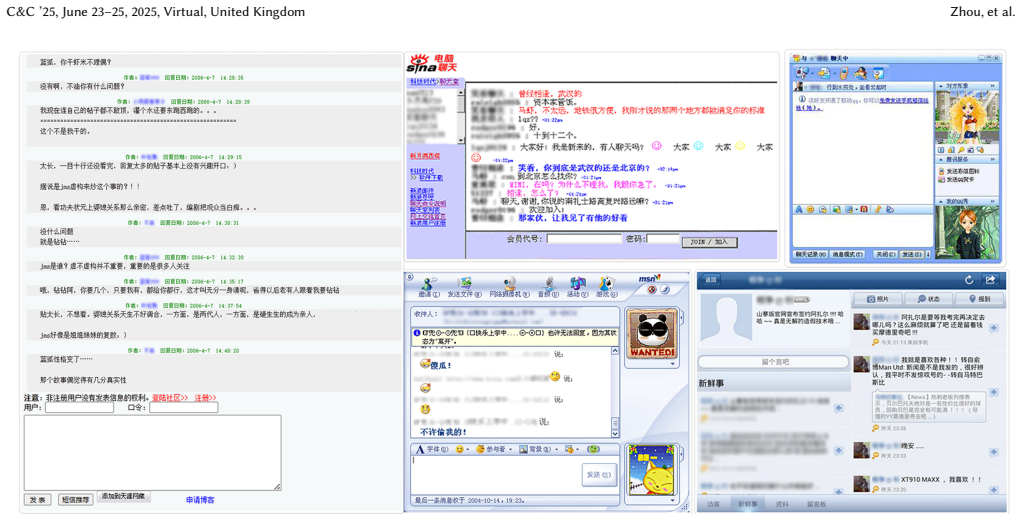

Figures from the paper (5 more)


Reference graph
Works this paper leans on
-
[1]
Amelia Acker and Jed R Brubaker. 2014. Death, memorialization, and social media: A platform perspective for personal archives. Archivaria (2014), 1–23
2014
-
[2]
Amelia Acker and Adam Kreisberg. 2020. Social media data archives in an API-driven world. Archival Science 20, 2 (2020), 105–123
2020
-
[3]
Martin Adam, Michael Wessel, and Alexander Benlian. 2021. AI-based chatbots in customer service and their effects on user compliance. Electronic Markets 31, 2 (2021), 427–445
2021
-
[4]
Syifa Adiba, Nur Sanny Rahmawati, et al . 2025. Exploring GenAI’s Role in Digital Cultural Memory at Museums and Art Galleries in Indonesia: AR and VR Perspectives. In International Conference on Asian Digital Libraries . Springer, 198–211
2025
-
[5]
Way back then
Vibhor Agarwal and Nishanth Sastry. 2022. “Way back then”: A Data-driven View of 25+ years of Web Evolution. In Proceedings of the ACM Web Conference
2022
-
[6]
Tarek Ait Baha, Mohamed El Hajji, Youssef Es-Saady, and Hammou Fadili. 2023. The power of personalization: A systematic review of personality-adaptive chatbots. SN Computer Science 4, 5 (2023), 661
2023
-
[7]
Sanjay K Arora, Yin Li, Jan Youtie, and Philip Shapira. 2016. Using the wayback machine to mine websites in the social sciences: A methodological resource. Journal of the Association for Information Science and Technology 67, 8 (2016), 1904–1915
2016
-
[8]
All Tech Asia. 2015. Top 3 reasons behind the failure of MSN Messenger in China and the rise of QQ. https://medium.com/act-news/top-3-reasons-behind-the- failure-of-msn-messenger-in-china-and-the-rise-of-qq-8573b186ebc1
2015
Show all 124 references
-
[9]
DA Balakin, AR Alikberova, and SA Nazarova. 2019. Internet-memes in Chinese mediasphere as a reflection of modern reality. Journal of Sociology and Social Anthropology 10, 4 (2019), 309–314
2019
-
[10]
Adam Balcerzak, Marcin Łączyński, Aline Hufschmitt, and Tomasz Gackowski
-
[11]
Janet B Bavelas, Linda Coates, and Trudy Johnson. 2000. Listeners as co- narrators. Journal of personality and social psychology 79, 6 (2000), 941
2000
-
[12]
Mohammed Bennis et al. 2024. Cyberculture/Cyberspace as a Mode of Trans- mission of Cultures, Identities and Power Relations: A Theoretical Perspective. Journal of Humanities and Social Sciences Studies 6, 6 (2024), 36–42
2024
-
[13]
Xiao Bi, Deli Chen, Guanting Chen, Shanhuang Chen, Damai Dai, Chengqi Deng, Honghui Ding, Kai Dong, Qiushi Du, Zhe Fu, et al . 2024. Deepseek llm: Scaling open-source language models with longtermism. arXiv preprint arXiv:2401.02954 (2024)
2024 arXiv
-
[14]
Richard E Boyatzis. 1998. Transforming qualitative information: Thematic analy- sis and code development . Sage
1998
-
[15]
Niels Brügger. 2011. Web archiving–between past, present, and future. The handbook of Internet studies (2011), 24–42
2011
-
[16]
Alex Calderwood, Noah Wardrip-Fruin, and Michael Mateas. 2022. Spinning coherent interactive fiction through foundation model prompts. ICCC
2022
-
[17]
Beatrice Cannelli and Marta Musso. 2022. Social media as part of personal digital archives: exploring users’ practices and service providers’ policies regarding the preservation of digital memories. Archival Science 22, 2 (2022), 259–283
2022
-
[18]
Lina Cao and Xijin Tang. 2014. Topics and trends of the on-line public concerns based on Tianya forum. Journal of Systems Science and Systems Engineering 23, 2 (2014), 212–230
2014
-
[19]
Giovanni Carta. 2017. Metadata and video games emulation: an effective bond to achieve authentic preservation? Records Management Journal 27, 2 (2017), 192–204
2017
-
[20]
Jindong Chen, Lina Cao, and Xijin Tang. 2014. How to Become a More Popular Thread on Tianya Club. In Proceedings of the 2014 International Conference on Retrochat C&C ’25, June 23–25, 2025, Virtual, United Kingdom Social Computing. 1–4
2014
-
[21]
Minzhe Chen, Shuqing Liu, and Shuyu Zhang. 2022. Internet Language Study in China. In The Palgrave Handbook of Chinese Language Studies . Springer, 275–296
2022
-
[22]
Be Suicided
Rong Chen and Xiaoxia Hu. 2020. “Be Suicided”: A Construction Grammar Analysis of the Innovative bèi Construction in Chinese. Cognitive Semantics 6, 1 (2020), 83–106
2020
-
[23]
HH Clark. 1991. Grounding in communication. Perspectives on socially shared cognition/American Psychological Association (1991)
1991
-
[24]
Victoria Clarke and Virginia Braun. 2017. Thematic analysis. The journal of positive psychology 12, 3 (2017), 297–298
2017
-
[25]
Luigi Colucci Cante, Beniamino Di Martino, Mariangela Graziano, Dario Branco, and Gennaro Junior Pezzullo. 2024. Automated storytelling technologies for cultural heritage. In International Conference on Emerging Internet, Data & Web Technologies. Springer, 597–606
2024
-
[26]
David Craig, Jian Lin, and Stuart Cunningham. 2021. Wanghong as social media entertainment in China. Springer
2021
-
[27]
Roberto Di Cosmo and Stefano Zacchiroli. 2017. Software heritage: Why and how to preserve software source code. In iPRES 2017-14th International Conference on Digital Preservation. 1–10
2017
-
[28]
Nicholas Epley, Adam Waytz, and John T Cacioppo. 2007. On seeing human: a three-factor theory of anthropomorphism. Psychological review 114, 4 (2007), 864
2007
-
[29]
Niels Ole Finnemann. 2019. Web archive. KO KNOWLEDGE ORGANIZATION 46, 1 (2019), 47–70
2019
-
[30]
Being Eroded, Piece by Piece
Kexue Fu, Ruishan Wu, Yuying Tang, Yixin Chen, Bowen Liu, and RAY LC. 2024. " Being Eroded, Piece by Piece": Enhancing Engagement and Storytelling in Cultural Heritage Dissemination by Exhibiting GenAI Co-Creation Artifacts. In Proceedings of the 2024 ACM Designing Interactive...
2024
-
[31]
Svetlana Yu Glushkova and Militsa K Voronina. 2018. Trends In The Devel- opment Of Chinese Internet Language. Modern Journal of Language Teaching Methods 8, 9 (2018), 37–43
2018
-
[32]
Rahul Goel, Sandeep Soni, Naman Goyal, John Paparrizos, Hanna Wallach, Fernando Diaz, and Jacob Eisenstein. 2016. The social dynamics of language change in online networks. In Social Informatics: 8th International Conference, SocInfo 2016, Bellevue, W A, USA, November 11-14, 2...
2016
-
[33]
Mengjun Guo. 2018. Playfulness, parody, and carnival: Catchphrases and mood on the Chinese Internet from 2003 to 2015. Communication and the Public 3, 2 (2018), 134–150
2018
-
[34]
Luke Haliburton, Matthias Hoppe, Albrecht Schmidt, and Thomas Kosch. 2021. Quick, Print This Page! The Value of Analogue Media in a Digital World. In Extended Abstracts of the 2021 CHI Conference on Human Factors in Computing Systems. 1–7
2021
-
[35]
Yuanning Han, Ziyi Qiu, Jiale Cheng, and RAY LC. 2024. When Teams Embrace AI: Human Collaboration Strategies in Generative Prompting in a Creative Design Task. InProceedings of the CHI Conference on Human Factors in Computing Systems. 1–14
2024
-
[36]
Ziran He. 2008. On memes and memetics in language. In Proceedings of the 10th international conference, Pragmatics Society of Japan . 71–82
2008
-
[37]
I Recall the Past
Zhiting He, Jiayi Su, Li Chen, Tianqi Wang, and Ray LC. 2024. " I Recall the Past": Exploring How People Collaborate with Generative AI to Create Cultural Heritage Narratives. arXiv preprint arXiv:2501.00359 (2024)
2024 arXiv
-
[38]
James D Herbsleb, David L Atkins, David G Boyer, Mark Handel, and Thomas A Finholt. 2002. Introducing instant messaging and chat in the workplace. In Proceedings of the SIGCHI conference on Human factors in computing systems . 171–178
2002
-
[39]
Susan C Herring, Dieter Stein, and Tuija Virtanen. 2013. Introduction to the pragmatics of computer-mediated communication. Pragmatics of computer- mediated communication (2013), 3–32
2013
-
[40]
My agent understands me better
Yuki Hou, Haruki Tamoto, and Homei Miyashita. 2024. " My agent understands me better": Integrating Dynamic Human-like Memory Recall and Consolidation in LLM-Based Agents. In Extended Abstracts of the CHI Conference on Human Factors in Computing Systems . 1–7
2024
-
[41]
James C-T Huang and Na Liu. 2014. A new passive form in Mandarin: Its syntax and implications. International Journal of Chinese Linguistics 1, 1 (2014), 1–34
2014
-
[42]
Qunying Huang and Chen Xu. 2014. A data-driven framework for archiving and exploring social media data. Annals of GIS 20, 4 (2014), 265–277
2014
-
[43]
Markus Huber, Martin Mulazzani, Manuel Leithner, Sebastian Schrittwieser, Gilbert Wondracek, and Edgar Weippl. 2011. Social snapshots: Digital forensics for online social networks. In Proceedings of the 27th annual computer security applications conference. 113–122
2011
-
[44]
James Hutson. 2024. Combining Large Language Models and Immersive Tech- nologies to Represent Cultural Heritage in the Metaverse Context. InAugmented and Virtual Reality in the Metaverse . Springer, 265–281
2024
-
[45]
Stuart Jeffrey. 2012. A new digital dark age? Collaborative web tools, social media and long-term preservation. World Archaeology 44, 4 (2012), 553–570
2012
-
[46]
Lianrui Jia. 2022. Forgotten passwords and Long-Gone exes: the life and death of Renren. Internet Histories 6, 1-2 (2022), 133–153
2022
-
[47]
Camilla Johansson. 2023. Video Game Preservation and Emulation from Three Perspectives: Developers, Archivists and Gamers
2023
-
[48]
Björn Kindenberg. 2025. The Role of AI in Historical Simulation Design: A TPACK Perspective on a French Revolution Simulation Design Experience. Education Sciences 15, 2 (2025), 192
2025
-
[49]
Ana Knežević. 2023. Internet memes as heritage in becoming and its problems: The methodology of heritization and the formation of cultural memory in cyberspace. Glasnik Etnografskog instituta SANU 71, 2 (2023), 275–298
2023
-
[50]
Attila Kovari. 2024. ChatGPT the Omniscient? A Guide to Effective Prompting. In 2024 IEEE 7th International Conference and Workshop Óbuda on Electrical and Power Engineering (CANDO-EPE). IEEE, 000047–000052
2024
-
[51]
Yong Ming Kow, Jing Wen, and Yunan Chen. 2012. Designing online games for real-life relationships: examining QQ farm in intergenerational play. In Proceedings of the ACM 2012 conference on computer supported cooperative work . 613–616
2012
-
[52]
RAY LC. 2023. HUMAN ENOUGH: A Space for Reconstructions of AI visions in Speculative Climate Futures. In Proceedings of the 15th Conference on Creativity and Cognition (Virtual Event) (C&C ’23). Association for Computing Machinery, New York, NY, USA, 217–222
2023
-
[53]
RAY LC. 2023. TOGETHER ENOUGH: Collaborative Constructions of Adapta- tions to Climate Futures. In Companion Publication of the 2023 ACM Designing Interactive Systems Conference (Pittsburgh, PA, USA) (DIS ’23 Companion). Asso- ciation for Computing Machinery, New York, NY, USA, 55–59
2023
-
[54]
RAY LC, Sijia Liu, Latisha Besariani Hendra, and Kexue Fu. 2024. TIME ENOUGH: Generative AI Visions of Climate Change as Cave Paintings of the Future. In Proceedings of the 16th Conference on Creativity & Cognition (C&C ’24) . Association for Computing Machinery, New York,...
2024
-
[55]
Qinyuan Lei and Ran Tang. 2024. Playful, coded, and emotional language: Discursive strategies of online criticism on Chinese social media. Discourse & Communication (2024), 17504813241281711
2024
-
[56]
Zihao Li. 2023. From DV to DMs: Chinese Independent Documentaries in the Age of Social Media. Ph. D. Dissertation. Concordia University
2023
-
[57]
Zhenzhen Li. 2024. The impact of artificial intelligence technology innovation on economic development–from the perspective of generative AI products. Journal of Education, Humanities and Social Sciences 27 (2024), 565–574
2024
-
[58]
Jue Liu. 2014. Shamate Alecks. The World of Chinese 4, 2 (2014), 72–74
2014
-
[59]
Jin Liu and Hongyin Tao. 2012. Negotiating linguistic identities under global- ization: Language use in contemporary China. In Chinese under globalization: Emerging trends in language use in China . World Scientific, 203–212
2012
-
[60]
Xingyu Bruce Liu, Shitao Fang, Weiyan Shi, Chien-Sheng Wu, Takeo Igarashi, and XiangAnthony’ Chen. 2024. Proactive Conversational Agents with Inner Thoughts. arXiv preprint arXiv:2501.00383 (2024)
2024 arXiv
-
[61]
Stine Lomborg. 2012. Researching communicative practice: Web archiving in qualitative social media research. Journal of Technology in Human Services 30, 3-4 (2012), 219–231
2012
-
[62]
Keming Lu, Bowen Yu, Chang Zhou, and Jingren Zhou. 2024. Large language models are superpositions of all characters: Attaining arbitrary role-play via self-alignment. arXiv preprint arXiv:2401.12474 (2024)
2024 arXiv
-
[63]
Deepak Kumar Mahto and Lisha Singh. 2016. A dive into Web Scraper world. In 2016 3rd International Conference on Computing for Sustainable Global Devel- opment (INDIACom). IEEE, 689–693
2016
-
[64]
Ekaterina Namiceva and Petar Namicev. 2018. AI and its role in preserving cultural heritage-transforming the citys urban memory. IDEA, International Journal of Science and Arts 2, 3 (2018), 171–176
2018
-
[65]
Kate G Niederhoffer and James W Pennebaker. 2002. Linguistic style matching in social interaction. Journal of Language and Social Psychology 21, 4 (2002), 337–360
2002
-
[66]
Mikkel Nørtoft. 2024. Gamifying the past–archaeogaming by archaeologists. (2024)
2024
-
[67]
Babu Noushad, Pascal WM Van Gerven, and Anique BH De Bruin. 2024. Twelve tips for applying the think-aloud method to capture cognitive processes.Medical Teacher 46, 7 (2024), 892–897
2024
-
[68]
Everything on the internet can be saved
Jessica Ogden. 2022. “Everything on the internet can be saved”: Archive Team, Tumblr and the cultural significance of web archiving. Internet Histories 6, 1-2 (2022), 113–132
2022
-
[69]
Jessica Ogden, Edward Summers, and Shawn Walker. 2024. Know (ing) Infras- tructure: The Wayback Machine as object and instrument of digital research. Convergence 30, 1 (2024), 167–189
2024
-
[70]
Joon Sung Park, Joseph O’Brien, Carrie Jun Cai, Meredith Ringel Morris, Percy Liang, and Michael S Bernstein. 2023. Generative agents: Interactive simulacra of human behavior. In Proceedings of the 36th annual acm symposium on user interface software and technology . 1–22
2023
-
[71]
Pat Pataranutaporn, Valdemar Danry, Lancelot Blanchard, Lavanay Thakral, Naoki Ohsugi, Pattie Maes, and Misha Sra. 2023. Living memories: AI-generated C&C ’25, June 23–25, 2025, Virtual, United Kingdom Zhou, et al. characters as digital mementos. In Proceedings of the 28th Int...
2023
-
[72]
Michael Quinn Patton. 2014. Qualitative research & evaluation methods: Inte- grating theory and practice . Sage publications
2014
-
[73]
Zeynep Pehlivan, Jérôme Thièvre, and Thomas Drugeon. 2021. Archiving social media: the case of Twitter. In The Past Web: Exploring Web Archives. Springer, 43–56
2021
-
[74]
Dan Pinchbeck, David Anderson, Janet Delve, Antonio Ciuffreda, Getaneh Otemu, and Andreas Lange. [n. d.]. Emulation as a strategy for the preservation of games: the KEEP project. In Proceedings of DiGRA 2009 Conference: Breaking New Ground: Innovation in Games, Play, Practice ...
2009
-
[75]
Remi Poivet, Mélanie Lopez Malet, Catherine Pelachaud, and Malika Auvray
-
[76]
Jack Linchuan Qiu. 2009. Working-Class Network Society: Communication Tech- nology and the Information Have-Less in Urban China . The MIT Press
2009
-
[77]
Frontiers in Psychology 14 (2023), 1266186
The influence of conversational agents’ role and communication style on user experience. Frontiers in Psychology 14 (2023), 1266186
2023
-
[78]
Mathura Shanmugasundaram and Arunkumar Tamilarasu. 2023. The impact of digital technology, social media, and artificial intelligence on cognitive functions: a review. Frontiers in Cognition 2 (2023), 1203077
2023
-
[79]
Selim Sametoğlu, DHM Pelt, Johannes C Eichstaedt, Lyle H Ungar, and Meike Bartels. 2024. The value of social media language for the assessment of wellbeing: A systematic review and meta-analysis. The Journal of Positive Psychology 19, 3 (2024), 471–489
2024
-
[80]
Michael Shumanov and Lester Johnson. 2021. Making conversations with chatbots more personalized. Computers in Human Behavior 117 (2021), 106627
2021
-
[81]
Yuya Shibuya, Andrea Hamm, and Teresa Cerratto Pargman. 2022. Mapping HCI research methods for studying social media interaction: A systematic literature review. Computers in Human Behavior 129 (2022), 107131
2022
-
[82]
Dimitris Spiliotopoulos, Efstratios Tzoannos, Pepi Stavropoulou, Georgios Kouroupetroglou, and Alexandros Pino. 2012. Designing user interfaces for social media driven digital preservation and information retrieval. In Computers Helping People with Special Needs: 13th Internat...
2012
-
[83]
Marita Skjuve, Asbjørn Følstad, Knut Inge Fostervold, and Petter Bae Brandtzaeg
-
[84]
Ping Sun, Guoning Zhao, Zhen Liu, Xiaoting Li, and Yunze Zhao. 2022. Toward discourse involution within China’s Internet: Class, voice, and social media. New Media & Society 24, 5 (2022), 1033–1052
2022
-
[85]
Ekaterina Svikhnushina and Pearl Pu. 2022. PEACE: a model of key social and emotional qualities of conversational chatbots. ACM Transactions on Interactive Intelligent Systems 12, 4 (2022), 1–29
2022
-
[86]
Chi Sun, Xipeng Qiu, Yige Xu, and Xuanjing Huang. 2019. How to fine-tune bert for text classification?. In Chinese computational linguistics: 18th China national conference, CCL 2019, Kunming, China, October 18–20, 2019, proceedings
2019
-
[87]
Varinder Taprial and Priya Kanwar. 2012. Understanding social media . Book- boon
2012
-
[88]
Henry Tari, M Danial Khan, Justus Rutten, Darian Othman, Thales Bertaglia, Rishabh Kaushal, and Adriana Iamnitchi. 2024. Leveraging GPT for the Genera- tion of Multi-Platform Social Media Datasets for Research. In Proceedings of the 35th ACM Conference on Hypertext and Social ...
2024
-
[89]
Huawei Tan and Yating Yu. 2024. A study on identification of youth identity through a gender lens in network buzzwords: A critical discourse analysis. Humanities and Social Sciences Communications 11, 1 (2024), 1–12
2024
-
[90]
Xiaoli Tian. 2019. The allure of being modern: Personal quality as status symbol among migrant families in Shanghai. Chinese Sociological Review 51, 3 (2019), 311–335
2019
-
[91]
Xinyue Tian and Wei Ren. 2024. Ironic criticisms and responses on Chinese social media. Pragmatics & Cognition 31, 1 (2024), 97–124
2024
-
[92]
Sara Day Thomson. 2017. Preserving social media: Applying principles of digital preservation to social media archiving. (2017)
2017
-
[93]
Stefano Valtolina and Mattia Marchionna. 2021. Design of a chatbot to assist the elderly. InInternational Symposium on End User Development. Springer, 153–168
2021
-
[94]
Piia Varis and Tom Van Nuenen. 2017. The internet, language, and virtual interactions. The Oxford handbook of language and society (2017), 473–488
2017
-
[95]
Mojtaba Torkjazi, Reza Rejaie, and Walter Willinger. 2009. Hot today, gone tomorrow: On the migration of myspace users. In Proceedings of the 2nd ACM workshop on Online social networks . 43–48
2009
-
[96]
Joseph Weizenbaum. 1966. ELIZA—a computer program for the study of natural language communication between man and machine.Commun. ACM 9, 1 (1966), 36–45
1966
-
[97]
Athena Kin-kam Wong and Dickson KW Chiu. 2024. Digital curation prac- tices on web and social media archiving in libraries and archives. Journal of Librarianship and Information Science (2024), 09610006241252661
2024
-
[98]
Xue Wang and Renqing Hu. 2021. English Translation of Hot Words in the Internet plus Era. In 2021 4th International Conference on Information Systems and Computer Aided Education . 223–226
2021
-
[99]
Zhou Yan. 2021. Chinese internet buzzwords: research on network languages in internet group communication. Routledge
2021
-
[100]
Pinar Yanardag, Manuel Cebrian, and Iyad Rahwan. 2021. Shelley: A crowd- sourced collaborative horror writer. In Proceedings of the 13th Conference on Creativity and Cognition. 1–8
2021
-
[101]
Jinghong Xiao, Dingjia Chen, Qiao Tang, Luo Suo, Xingjie Zhou, Wenjing Wang, Wei Zheng, and Man Zhou. 2022. 2020 Report on the development of Chinese Internet literature. New Techno Humanities 2, 1 (2022), 1–12
2022
-
[102]
Guobin Yang. 2003. The Internet and civil society in China: A preliminary assessment. Journal of Contemporary China 12, 36 (2003), 453–475
2003
-
[103]
Xi Yang, Marco Aurisicchio, and Weston Baxter. 2019. Understanding affective experiences with conversational agents. Inproceedings of the 2019 CHI conference on human factors in computing systems . 1–12
2019
-
[104]
Daijin Yang, Yanpeng Zhou, Zhiyuan Zhang, Toby Jia-Jun Li, and RAY LC. 2022. AI as an Active Writer: Interaction strategies with generated text in human-AI collaborative fiction writing. In Joint Proceedings of the IUI 2022 Workshops: HAI-GEN, HEALTHI, HUMANIZE, TExSS, SOCIALI...
2022
-
[105]
What is computer-mediated communica- tion?
Mike Z Yao and Rich Ling. 2020. “What is computer-mediated communica- tion?”—An introduction to the special issue. Journal of Computer-Mediated Communication 25, 1 (2020), 4–8
2020
-
[106]
Elaine Jingyan Yuan. 2021. The web of meaning: The internet in a changing Chinese society. University of Toronto Press
2021
-
[107]
Jun Yao, Jie Song, and Michael Singh. 2013. The ironical Chinese bei-construction and its accessibility to English speakers. Journal of Pragmatics 55 (2013), 195– 209
2013
-
[108]
Ronaldo’s a poser!
Yuhan Zeng, Yingxuan Shi, Xuehan Huang, Fiona Nah, and RAY LC. 2025. "Ronaldo’s a poser!": How the Use of Generative AI Shapes Debates in Online Forums. In Proceedings of the CHI Conference on Human Factors in Computing Systems (CHI ’25) . Association for Computing Machinery, ...
2025
-
[109]
Qinshi Zhang, Ruoyu Wen, Latisha Besariani Hendra, Zijian Ding, and RAY LC. 2025. Can AI Prompt Humans? Multimodal Agents Prompt Players’ Game Actions and Show Consequences to Raise Sustainability Awareness. In Proceedings of the CHI Conference on Human Factors in Computing Sy...
2025
-
[110]
FM Zanzotto, Marco Pennacchiotti, et al. 2012. Language evolution in social media: a preliminary study. Linguistica Zero (2012)
2012
-
[111]
Yi Zhang and Wei Ren. 2024. From hˇao to hˇou–stylising online communication with Chinese dialects. International Journal of Multilingualism 21, 1 (2024), 149–168
2024
-
[112]
https://doi.org/10.1145/3706598.3713829
-
[113]
Wayne Xin Zhao, Kun Zhou, Junyi Li, Tianyi Tang, Xiaolei Wang, Yupeng Hou, Yingqian Min, Beichen Zhang, Junjie Zhang, Zican Dong, et al. 2023. A survey of large language models. arXiv preprint arXiv:2303.18223 (2023)
2023 arXiv
-
[114]
https://doi.org/10.1145/3706598.3713661
-
[115]
Western Wall
Xiaoyu Zhang. 2020. Placing Notes in the Virtual “Western Wall”: Online Memorial Culture in Chinese Social Media. (2020)
2020
-
[116]
Suifang Zhou, Latisha Besariani Hendra, Qinshi Zhang, Jussi Holopainen, and RAY LC. 2024. Eternagram: Probing Player Attitudes Towards Climate Change Using a ChatGPT-driven Text-based Adventure. InProceedings of the CHI Con- ference on Human Factors in Computing Systems . 1–23
2024
-
[117]
Zheng Zhang, Ying Xu, Yanhao Wang, Bingsheng Yao, Daniel Ritchie, Tong- shuang Wu, Mo Yu, Dakuo Wang, and Toby Jia-Jun Li. 2022. Storybuddy: A human-ai collaborative chatbot for parent-child interactive storytelling with flexible parental involvement. In Proceedings of the 202...
2022
-
[118]
Yftah Ziser, Bonnie Webber, and Shay B Cohen. 2023. Rant or rave: variation over time in the language of online reviews. Language Resources and Evaluation 57, 3 (2023), 1329–1359
2023
-
[119]
NON-MAINSTREAM
Pianzhou Zhou. 2009. BEING “NON-MAINSTREAM” IN CHINESE CY- BERSPACE: FZL SUBCULTURE ON THE INTERNET. (2009)
2009
-
[120]
Suifang Zhou, Latisha Hendra, and Ray Lc. 2024. Eternagram: Post-Climate Devastation Text Adventure. In Proceedings of the 17th International Symposium on Visual Information Communication and Interaction (VINCI ’24) . Association for Computing Machinery, New York, NY, USA, 1–2...
2024
-
[122]
Suifang Zhou, Latisha Besariani Hendra, Qinshi Zhang, Jussi Holopainen, and RAY LC. 2024. Eternagram: Probing Player Attitudes Towards Climate Change Using a ChatGPT-driven Text-based Adventure. In Proceedings of the CHI Con- ference on Human Factors in Computing Systems (CHI ...
2024
-
[124]
Qiu Zitong. 2013. Cuteness as a subtle strategy: Urban female youth and the online feizhuliu culture in contemporary China. Cultural Studies 27, 2 (2013), 225–241
2013
-
[2021]
Interna- tional Journal of Human-Computer Studies 149 (2021), 102601
My chatbot companion-a study of human-chatbot relationships. Interna- tional Journal of Human-Computer Studies 149 (2021), 102601
2021
-
[2023]
In Machine Intelligence and Digital Interaction Conference
Real-Time Gameplay Data and Biometric Measurement Integration as a Data Source for Game User Research. In Machine Intelligence and Digital Interaction Conference. Springer, 144–156
Reviewed August 7, 2026 · model on record in the stance chip above.
Discussion (0). Sign in to comment.