REVIEW 5 major objections 8 minor 1 cited by
A Joint Analysis of Strong Lensing and Type Ia Supernovae to Determine the Hubble Constant
T0 review · 5 major / 8 minor · reviewed 2026-08-07 · deepseek-v4-flash
Pith's one-line read Combining seven time-delay lens distances, 99 Einstein-radius systems, and Pantheon+ supernovae through the cosmic distance duality relation yields a model-independent $H_0 = 70.55 \pm 7.44$ km/s/Mpc.
desk verdict A clean CDDR-based H0 combination with an honest error budget, but the GP step over D_Als/D_As ignores source-redshift and mass-profile dependence, so I read the central value as a consistency check rather than a determination. read the letter →
The pith
A machine-rendered reading of the paper's core claim, the machinery that carries it, and where it could break.
The reading
What carries the argument
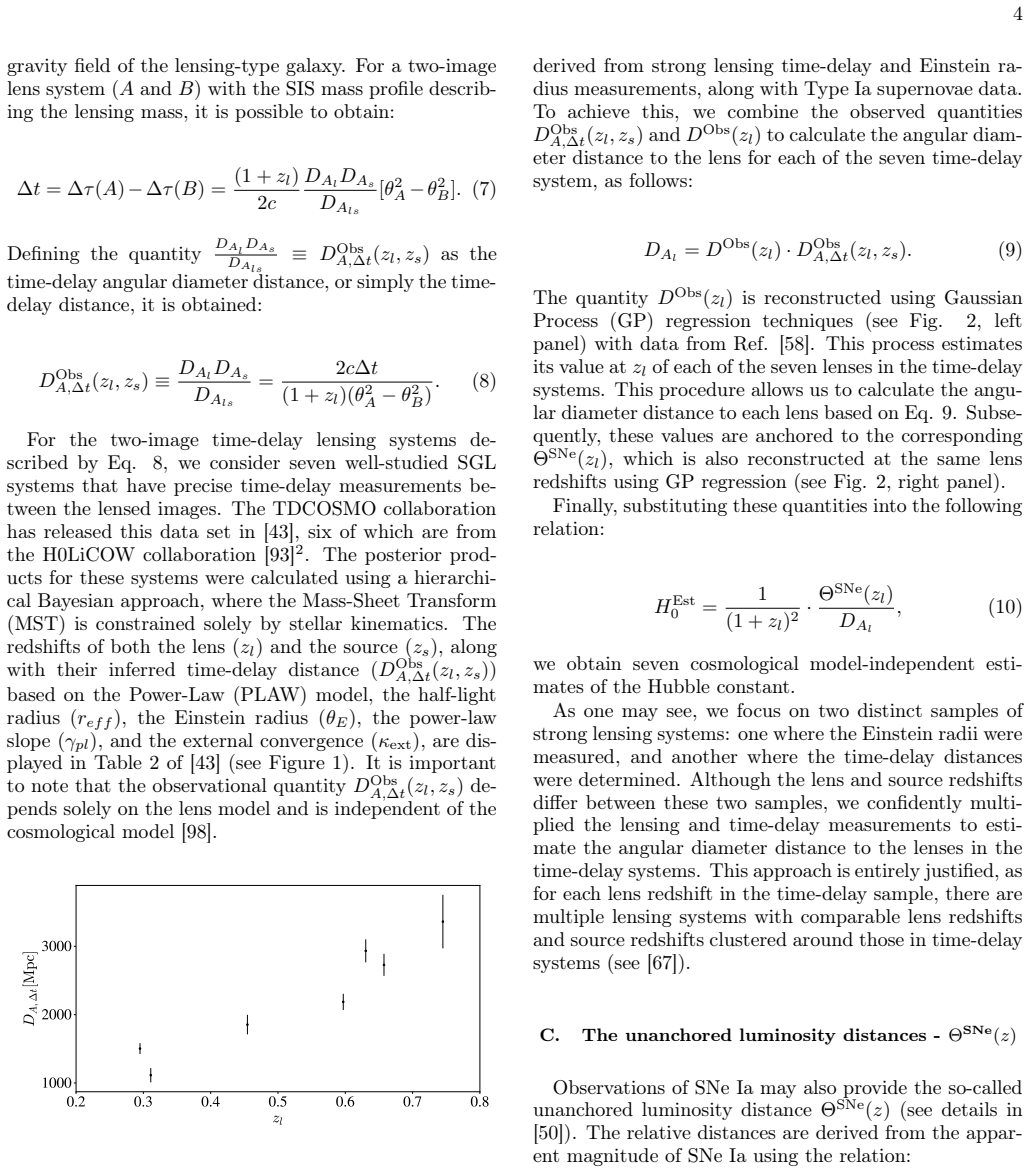
The load-bearing identity is the product in Eq. (9): the observed time-delay angular diameter distance $D^{\mathrm{Obs}}_{A,\Delta t}(z_l,z_s)$, which is cosmology-independent, is multiplied by $D^{\mathrm{Obs}}(z_l) \equiv D_{Als}/D_{As}$, the Einstein-radius distance ratio reconstructed from 99 systems by Gaussian Process regression as a smooth function of the lens redshift $z_l$. Evaluating that reconstruction at each of the seven time-delay lens redshifts produces $D_A^l$. The same regression machinery, applied to Pantheon+ apparent magnitudes and converted with a calibrated intercept $a_B$, gives the unanchored luminosity distance $\Theta_{\mathrm{SNe}}(z_l)$; Eq. (10) joins the two through the cosmic distance duality relation. The lens mass model is fixed to a power-law profile with $\gamma = 2.1$, and the GP covariance is a squared-exponential kernel.
What would settle it
Split the 99 Einstein-radius systems by source redshift or by image multiplicity, reconstruct $D^{\mathrm{Obs}}(z_l)$ in each subgroup, and compare the curves at the seven TDCOSMO lens redshifts; a shift between subgroups larger than the reported ~24% intrinsic scatter would show that evaluating a single smoothed curve at $z_l$ misses source-dependent information and biases $H_0$. A sharper test: for a lens with multiple measured images or a known source redshift, require the GP prediction to match the actual $D^{\mathrm{Obs}}$ value, not just the smoothed mean.
Extended reading notes
Core claim
The central claim is that the product $D_A^l = D^{\mathrm{Obs}}(z_l)\,D^{\mathrm{Obs}}_{A,\Delta t}(z_l,z_s)$ gives a cosmology-independent angular diameter distance to each time-delay lens, and that the cosmic distance duality relation $D_L = (1+z)^2 D_A$ then turns unanchored supernova distances into a per-lens $H_0$ through $H_0 = \Theta_{\mathrm{SNe}}(z_l)/[(1+z_l)^2 D_A^l]$. Applied to the seven TDCOSMO systems, the seven model-free estimates combine in a MCMC posterior, with an added intrinsic scatter of about 24%, to give $H_0 = 70.55 \pm 7.435$ km/s/Mpc at 68% confidence. The paper emphasizes that this value agrees within $1\sigma$ with both the early-universe Planck value and the local SH0ES value, so the method is a viable independent consistency probe even though it does not resolve the Hubble tension.
Load-bearing premise
The load-bearing premise is that the Gaussian-process curve built from 99 Einstein-radius ratios, treated as a smooth function of lens redshift, correctly predicts $D_{Als}/D_{As}$ for each of the seven time-delay lenses, even though that ratio also depends on each system's source redshift and mass profile.
Editorial extensions
If this is right
- If the central claim holds, every strong-lensing Einstein-radius system becomes a distance indicator: the GP-reconstructed $D^{\mathrm{Obs}}(z)$ curve, once validated, can supply angular diameter distances at arbitrary lens redshifts without fixing a cosmology.
- The same pipeline applied to larger lens samples, such as those expected from next-generation surveys, should sharpen the $H_0$ posterior directly, since the dominant uncertainty in the current result comes from only seven time-delay lenses.
- The result's $1\sigma$ agreement with both Planck and SH0ES means the inverse-distance-ladder route is currently a consistency check, not a tension discriminator; its real test will come from reducing the reported ~24% intrinsic scatter.
- Because the method avoids anchoring to the CMB sound horizon or the distance ladder, it offers a third, independent rung for cross-checking $H_0$ determinations.
Reading between the lines
- Beyond the paper, the Gaussian-process assumption can be tested directly by splitting the 99 Einstein-radius systems by source redshift and comparing the reconstructed curves; a systematic offset at the seven TDCOSMO lens redshifts would propagate straight into $H_0$.
- Beyond the paper, the same product identity could be crossed with absolute distance anchors other than supernovae, such as gravitational-wave standard sirens, to see whether the CDDR consistency holds across distance indicators.
- Beyond the paper, the seven individual $H_0$ estimates should be published separately; if they show a redshift trend, that is an early warning of CDDR violation or residual lens-model systematics that the combined value hides.
Editorial analysis
A structured set of objections, weighed in public.
Referee Report
Summary. This paper proposes a cosmological-model-independent estimate of the Hubble constant by combining three datasets at the lens redshifts of seven TDCOSMO time-delay systems: (i) the Einstein-radius observable D^Obs = D_Als/D_As, reconstructed as a function of lens redshift by a Gaussian process trained on 99 strong-lensing systems from Cao et al. (2015); (ii) the time-delay angular diameter distance D^Obs_{A,Δt} of each of the seven TDCOSMO systems; and (iii) the unanchored luminosity distance Θ = H0 D_L from the Pantheon+ supernova sample, also reconstructed by a Gaussian process. Using the cosmic distance duality relation, the authors form seven estimates H0,i = Θ(z_l)/[(1+z_l)^2 D^Obs(z_l) D^Obs_{A,Δt}] and combine them with an MCMC likelihood that includes a fitted intrinsic scatter, obtaining H0 = 70.55 ± 7.44 km/s/Mpc (68% CL). The paper frames the result as a model-independent consistency check that lies between the Planck and SH0ES values without resolving the Hubble tension.
Significance. The core algebraic identity is sound and genuinely cosmology-independent: D^Obs is constructed to be independent of H0, and the product D^Obs · D^Obs_{A,Δt} cancels the source angular diameter distance to leave D_Al; the CDDR then converts the SNe unanchored luminosity distance into H0 per lens. This is a clever and nontrivial way to build an inverse distance ladder from strong lensing alone, and the use of the full Pantheon+ covariance matrix, including the a_B intercept uncertainty through Eq. (13), is careful. The paper is also commendably explicit about its limitations (mass-sheet degeneracy, anisotropy, no marginalization over mass-profile details) and does not overclaim about resolving the Hubble tension. The main value, if the concerns below are addressed, is a novel cross-check that is independent of any FLRW metric assumption. The current constraining power is modest (about 10.5% precision), and the unbiasedness of the central value depends on assumptions about the Gaussian-process reconstruction and the lens mass profiles that are not yet demonstrated.
major comments (5)
- [II.D and Eq. (9)] The Gaussian process reconstructs D^Obs ≡ D_Als/D_As as a one-dimensional function of the lens redshift z_l, but this distance ratio also depends on the source redshift z_s and on the mass-profile slope γ. Equation (9) evaluates the population-mean curve at the z_l of each of the seven TDCOSMO lenses and multiplies it by the per-system time-delay distance; the product equals D_Al only if each TDCOSMO system is representative of the 99-system sample in both z_s and γ at that z_l. The justification given at the end of Section II.B — that the source redshifts of the Einstein-radius sample are 'clustered around those in time-delay systems' — is supported only by a citation to ref. [67], with no explicit comparison of the z_s distributions at matched lens redshifts. If, for example, the TDCOSMO systems have systematically higher (or lower) source redshifts than the average of the 99 systems at the same z_l, all seven D_Al values shift in the same direction and H0 is biased by a common-mode offset that the fitted σ_int cannot remove. I request an explicit (z_l, z_s, γ) comparison between the seven TDCOSMO systems and the 99-system sample, or alternatively a two-dimensional GP in (z_l, z_s) with a marginalization over γ.
- [II.A, Eq. (4)] The Einstein-radius observable is computed with the power-law slope fixed at γ = 2.1 for all 99 systems, while the TDCOSMO time-delay distances used in Eq. (9) are individually derived under power-law lens models with system-specific slopes γ_pl (Table 2 of ref. [43]). Since Eq. (4) depends on γ through f(γ) and the factor (θ_ap/θ_E)^{2−γ}, a TDCOSMO system whose γ_pl differs from 2.1 yields a D^Obs estimate that is inconsistent with the mass model used for its time-delay distance; the product in Eq. (9) is then not D_Al for that system. The paper does not quote the γ_pl values or test their consistency with 2.1. The analysis should marginalize over γ (for instance with the prior from the lens-sample measurements) and report the sensitivity of H0 to this choice.
- [III, σ_int] The final uncertainty is dominated by a fitted intrinsic scatter σ_int ≈ 24% that is added to the covariance matrix specifically 'to obtain a χ_red ≈ 1'. This large scatter means that the seven H0 estimates from Eq. (10) are mutually inconsistent at the level of their propagated uncertainties; the quoted 68% interval H0 = 70.55 ± 7.44 km/s/Mpc is therefore determined by an ad hoc parameter rather than by the data, and a common-mode systematic would survive the enlarged error bars. The authors should report the seven individual estimates H0_i and the χ² obtained before adding σ_int, and should justify the 24% level as a physical scatter (for example, arising from the γ and environment distributions) rather than as a normalization fudge.
- [III, Eq. (17)] As written, the covariance C_{H0} = C_{Θ_SNe} + C_{D^Obs} + C_{D^Obs_{A,Δt}} adds matrices for quantities of different physical dimensions (Θ has units of km/s, D^Obs is dimensionless, and D^Obs_{A,Δt} has units of Mpc), and it treats the multiplicative relation of Eq. (10) as if it were additive. The correct linearized propagation of H0 ∝ Θ/(D^Obs D^Obs_{A,Δt}) requires Jacobian-weighted covariance matrices, or equivalently the computation should be done in log-space. Please correct Eq. (17), or clarify that the code propagates the covariance of the product in Eqs. (9)-(10) and present the correct expression.
- [II.D] The Einstein-radius training set is selected by excluding the dataset of ref. [77] after inspecting its Gaussian-process reconstruction, which the authors report as showing 'bigger uncertainties... due to an unknown trend with redshift'. Because ref. [77] is stated to contain all systems of ref. [58], choosing the training sample on the basis of the reconstructed output is a post-hoc selection that can bias the GP mean function; the authors should either adopt a pre-defined selection criterion or demonstrate that the inferred H0 and its uncertainty are stable when the [77] data are included.
minor comments (8)
- [II.D] Typo: 'Einstien Radius dataset' should read 'Einstein radius dataset'.
- [Fig. 2] The right-panel axis label 'Θ(z)[km/s/Mpc]' has unclear units and normalization; since Θ = H0 D_L has units of km/s, please verify the units and explain the 10^6 axis scaling.
- [III] Typo: 'C −1_H Est 0 is is the inverse' should read 'is the inverse'.
- [II.B / ref. [43]] The seven TDCOSMO systems' values of (z_l, z_s, D^Obs_{A,Δt}, γ_pl) are not reproduced; given their central role in Eqs. (9)-(10), a table of these inputs would improve reproducibility and would allow readers to assess the z_s and γ comparisons requested above.
- [Eq. (13)] The second term in Eq. (13) should be identified as (5σ_aB)^2 J, where J is the all-ones matrix, reflecting the common shift induced by the intercept uncertainty a_B.
- [II.A] The statement 'the observed quantity 4 is independent of the Hubble constant value' is awkward; it should cite Eq. (4) explicitly. Also, the aperture conversion to σ0 is described in one line; a brief equation or a pointer to Table 1 of ref. [58] would help.
- [II.D] Please state whether any of the seven TDCOSMO lenses are also members of the 99 Einstein-radius systems; if so, their Einstein-radius data enter both the GP training and the time-delay product, and this partial dependence should be discussed.
- [Form] The 'Keywords' and 'PACS numbers' fields are empty and should be completed.
Circularity Check
No circularity: the H0 estimate is an algebraic combination of independent datasets through the CDDR, with no fitted parameter relabeled as a prediction.
full rationale
Walking the derivation chain: DObs is constructed from 99 Einstein-radius systems via Eq. 4, DObs_A,Delta_t comes from the seven TDCOSMO time-delay lenses via Eq. 8, and Eq. 9 is the algebraic identity (DAls/DAs)*(DAl*DAs/DAls)=DAl. No cosmological model enters, and no H0 value is used to build either factor. The unanchored luminosity distance Theta_SNe is obtained from Pantheon+ with the externally calibrated intercept aB, and Eq. 10 is simply the CDDR relation DL=(1+z)^2 DA rewritten for H0. The Gaussian-process hyperparameters are fitted separately to the Einstein-radius and supernova datasets, but H0 is not an input to those fits, and the additional sigma_int only inflates the error budget rather than shifting the central value. The most fragile step is evaluating the one-dimensional GP reconstruction of DObs(zl) at the seven TDCOSMO redshifts despite differences in source redshift and mass-profile slope; this is a possible systematic bias and is acknowledged in the paper's limitation statement, but it is not a circular reduction of the result to its own inputs. Self-citations such as refs. [52,56,67,79] appear as methodological references and prior applications of the same CDDR technique; none of them supplies the target H0 value or forces the final estimate by construction. The paper therefore contains no significant circularity.
Assumptions & free parameters
free parameters (5)
- sigma_int (intrinsic scatter) =
about 24% (relative)
- gamma (power-law slope) =
2.1 (fixed, not fitted)
- P (environment systematic) =
20%
- a_B (SNe intercept) =
0.71273 ± 0.00176
- GP kernel hyperparameters (sigma_f, l) =
optimized via marginal likelihood, not quoted
assumptions (5)
- domain assumption The cosmic distance duality relation DL = (1+z)^2 DA holds exactly.
- ad hoc to paper The lens mass distribution is a spherically symmetric power law with the same index gamma = 2.1 for all 99 Einstein-radius systems and for the TDCOSMO time-delay lenses.
- domain assumption The reconstructed D^Obs(z_l) from the 99-system sample is representative of the distance ratio for the seven TDCOSMO lenses.
- domain assumption The TDCOSMO time-delay distances D^Obs_{A,Δt} based on the power-law mass model are correct, i.e., mass-sheet degeneracy and stellar anisotropy are not fully marginalized.
- domain assumption Type Ia supernovae are standardizable candles with a known intercept a_B.
Cite this review
Pith. "Pith review of A Joint Analysis of Strong Lensing and Type Ia Supernovae to Determine the Hubble Constant." pith.science (2026). https://pith.science/paper/RLMKT4L6
@misc{pith2026250517262,
  author       = {Pith},
  title        = {Pith review of: A Joint Analysis of Strong Lensing and Type Ia Supernovae to Determine the Hubble Constant},
  year         = {2026},
  howpublished = {\url{https://pith.science/paper/RLMKT4L6}},
  note         = {Machine review of arXiv:2505.17262}
}
abstract
We present a cosmological model-independent determination of the Hubble constant, $H_0$, by combining time-delay measurements from seven TDCOSMO systems, Einstein radius measurements, and Type Ia Supernovae data sourced from the Pantheon+ sample. For each lens of time-delay system, we calculate the angular diameter distance $D_{A_l}$ using the product $D^{\textrm{Obs}}(z_l) \cdot D_{A,\Delta t}^{\textrm{Obs}}(z_l, z_s)$, where $D^{\textrm{Obs}}(z_l)$ is reconstructed via Gaussian Processes from 99 Einstein radius measurements, and $D_{A,\Delta t}^{\textrm{Obs}}(z_l,z_s)$ is the time-delay angular distance. We also reconstruct the unanchored luminosity distance $H_0 D_L(z_l)$ from supernova data. By using the cosmic distance duality relation validity, we anchor $D_{A_l}$ and $H_0 D_L(z_l)$ to infer $H_0 = 70.55 \pm 7.44$ km/s/Mpc (68\% CL). Our result, though not resolving the Hubble tension, offers a cosmological model-independent consistency check and highlights the potential of using strong lensing and supernovae data via the cosmic distance duality relation to constrain $H_0$.
Figures


Forward citations
Cited by 1 Pith paper
-
Investigating a Possible Variation of the Gravitational Constant Through Gas Mass Fraction Measurements and Type Ia Supernovae Observations
Non-parametric reconstruction of G(z) from cluster f_gas and Pantheon+ under L∝G^1.46 finds constant G consistent, with only mild low-z departures allowed.
Reference graph
Works this paper leans on
-
[58]
L. R. Colaço, Universe11, 89 (2025), arXiv:2503.06189 [astro-ph.CO]
work page Pith review arXiv 2025
-
[77]
Y. Chen, R. Li, Y. Shu, and X. Cao, MNRAS 488, 3745 (2019), arXiv:1809.09845 [astro-ph.CO]
arXiv 2019
-
[67]
A. Rana, D. Jain, S. Mahajan, A. Mukherjee, and R. F. L. Holanda, JCAP 07, 010 (2017), arXiv:1705.04549 [astro-ph.CO]
arXiv 2017
-
[43]
S. Birrer et al., Astron. Astrophys. 643, A165 (2020), arXiv:2007.02941 [astro-ph.CO]
arXiv 2020
-
[1]
A. G. Riess et al., The Astronomical Journal 116, 1009–1038 (1998)
1998
-
[2]
Perlmutter, G
S. Perlmutter, G. Aldering, G. Goldhaber, R. A. Knop, P. Nugent, P. G. Castro, S. Deustua, S. Fabbro, Goo- bar, and et at.,TheAstrophysicalJournal 517,565–586 (1999)
1999
-
[3]
D. H. Weinberg, M. J. Mortonson, D. J. Eisenstein, C. Hirata, A. G. Riess, and E. Rozo, Physics Reports 530, 87–255 (2013)
2013
-
[4]
Özer and M
M. Özer and M. Taha, Physics Letters B171, 363–365 (1986)
1986
Show all 118 references
-
[5]
5 dark matter and dark energy,
V. Sahni, “5 dark matter and dark energy,” in The Physics of the Early Universe (Springer Berlin Heidel- berg, 2004) p. 141–179
2004
-
[6]
Caldera-Cabral, R
G. Caldera-Cabral, R. Maartens, and B. M. Schaefer, JCAP 2009, 027–027 (2009)
2009
-
[7]
P. A. R. Adeet al. (Planck), Astron. Astrophys. 594, A13 (2016), arXiv:1502.01589 [astro-ph.CO]
2016 arXiv
-
[8]
Kamionkowski and A
M. Kamionkowski and A. G. Riess, Annual Review of Nuclear and Particle Science73, 153–180 (2023)
2023
-
[9]
Di Valentino, O
E. Di Valentino, O. Mena, S. Pan, L. Visinelli, W. Yang, A. Melchiorri, D. F. Mota, A. G. Riess, and J. Silk, Class. Quant. Grav. 38, 153001 (2021), arXiv:2103.01183 [astro-ph.CO]
2021 arXiv
-
[10]
Weinberg, Reviews of Modern Physics 61, 1–23 (1989)
S. Weinberg, Reviews of Modern Physics 61, 1–23 (1989)
1989
-
[11]
Padmanabhan, Physics Reports 380, 235–320 (2003)
T. Padmanabhan, Physics Reports 380, 235–320 (2003)
2003
-
[12]
This paper employs the 2.7 Python Machine Learning GaPP4 code to conduct the Gaussian Process (GP) re- gression [102] on Type Ia supernovae and on SGL sys- tems
As mentioned earlier, we reconstruct these two ob- servables independently at the same lens redshifts as the DObs A,∆t(zl, zs) data from SGL. This paper employs the 2.7 Python Machine Learning GaPP4 code to conduct the Gaussian Process (GP) re- gression [102] on Type Ia supern...
2024
-
[13]
Zlatev, L
I. Zlatev, L. Wang, and P. J. Steinhardt, Physical Re- view Letters 82, 896–899 (1999)
1999
-
[14]
Lombriser, Classical and Quantum Gravity 40, 155005 (2023)
L. Lombriser, Classical and Quantum Gravity 40, 155005 (2023)
2023
-
[15]
Aghanimet al
N. Aghanimet al. (Planck), Astron. Astrophys.641, A6 (2020), [Erratum: Astron.Astrophys. 652, C4 (2021)], arXiv:1807.06209 [astro-ph.CO]
2020 arXiv
-
[16]
A. G. Riesset al., Astrophys. J. Lett.934, L7 (2022), arXiv:2112.04510 [astro-ph.CO]
2022 arXiv
-
[17]
R. A. Battye, T. Charnock, and A. Moss, Physical Re- view D 91 (2015), 10.1103/physrevd.91.103508
2015 doi
-
[18]
W. L. Freedman, Nature Astronomy 1 (2017), 10.1038/s41550-017-0121
2017 doi
-
[19]
J. S. Alcaniz, J. P. Neto, F. S. Queiroz, D. R. da Silva, and R. Silva, Scientific Reports 12 (2022), 10.1038/s41598-022-24608-5
2022 doi
-
[20]
Pogosian, M
L. Pogosian, M. Raveri, K. Koyama, M. Martinelli, A.Silvestri, G.-B.Zhao, J.Li, S.Peirone, andA.Zucca, Nature Astronomy 6, 1484–1490 (2022)
2022
-
[21]
W. J. C. da Silva and R. Silva, The European Physical Journal C81 (2021), 10.1140/epjc/s10052-021-09177-7
2021 doi
-
[22]
D’Eramo, R
F. D’Eramo, R. Z. Ferreira, A. Notari, and J. L. Bernal, JCAP 2018, 014–014 (2018)
2018
-
[23]
Refsdal, MNRAS128, 307 (1964)
S. Refsdal, MNRAS128, 307 (1964)
1964
-
[24]
K. C. Wong et al., MNRAS498, 1420–1439 (2019)
2019
-
[25]
P. Saha, D. Sluse, J. Wagner, and L. L. R. Williams, Space Sci. Rev.220, 12 (2024), arXiv:2401.04165 [astro- ph.CO]
2024 arXiv
-
[26]
Birrer et al., Space Sci
S. Birrer et al., Space Sci. Rev. 220, 48 (2024), arXiv:2210.10833 [astro-ph.CO]
2024 arXiv
-
[27]
Moresco et al
M. Moresco et al. , Living Rev. Rel. 25, 6 (2022), arXiv:2201.07241 [astro-ph.CO]
2022 arXiv
-
[28]
A. J. Shajib et al., ssr220, 87 (2024), arXiv:2210.10790 [astro-ph.GA]
2024 arXiv
-
[29]
Lemon et al., MNRAS 520, 3305 (2023), arXiv:2206.07714 [astro-ph.GA]
C. Lemon et al., MNRAS 520, 3305 (2023), arXiv:2206.07714 [astro-ph.GA] . 9
2023 arXiv
-
[30]
Treu et al., MNRAS 481, 1041 (2018), arXiv:1808.04838 [astro-ph.CO]
T. Treu et al., MNRAS 481, 1041 (2018), arXiv:1808.04838 [astro-ph.CO]
2018 arXiv
-
[31]
S. A. Rodney, G. B. Brammer, J. D. R. Pierel, J. Richard, S. Toft, K. F. O’Connor, M. Akhshik, and K. E. Whitaker, Nature Astron. 5, 1118 (2021), arXiv:2106.08935 [astro-ph.CO]
2021 arXiv
-
[32]
P. L. Kelly et al. , Science 347, 1123 (2015), arXiv:1411.6009 [astro-ph.CO]
2015 arXiv
-
[33]
Courbin et al., arXiv e-prints , arXiv:1706.09424 (2017), arXiv:1706.09424 [astro-ph.IM]
F. Courbin et al., arXiv e-prints , arXiv:1706.09424 (2017), arXiv:1706.09424 [astro-ph.IM]
2017 arXiv
-
[34]
Millon et al., Astron
M. Millon et al., Astron. Astrophys.642, A193 (2020), arXiv:2006.10066 [astro-ph.CO]
2020 arXiv
-
[35]
S. H. Suyuet al., Astrophys. J. Lett.788, L35 (2014), arXiv:1306.4732 [astro-ph.CO]
2014 arXiv
-
[36]
S. Suyu, P. Marshall, M. Auger, S. Hilbert, R. Bland- ford, L. Koopmans, C. Fassnacht, and T. Treu, The Astrophysical Journal 711 (2009), 10.1088/0004- 637X/711/1/201
2009 doi
-
[37]
Birrer et al., MNRAS 484, 4726 (2019), arXiv:1809.01274 [astro-ph.CO]
S. Birrer et al., MNRAS 484, 4726 (2019), arXiv:1809.01274 [astro-ph.CO]
2019 arXiv
-
[38]
K. C. Wong et al., MNRAS465, 4895 (2016)
2016
-
[39]
G. C.-F. Chen et al., MNRAS490, 1743 (2019)
2019
-
[40]
C. E. Rusu et al., MNRAS498, 1440 (2019)
2019
-
[41]
S. H. Suyu et al., MNRAS468, 2590 (2017)
2017
-
[42]
A. J. Shajib et al., MNRAS 494, 6072 (2020), https://academic.oup.com/MNRAS/article- pdf/494/4/6072/33212512/staa828.pdf
2020
-
[44]
Millon et al., Astron
M. Millon et al., Astron. Astrophys.639, A101 (2020), arXiv:1912.08027 [astro-ph.CO]
2020 arXiv
-
[45]
Du, J.-J
S.-S. Du, J.-J. Wei, Z.-Q. You, Z.-C. Chen, Z.-H. Zhu, and E.-W. Liang, MNRAS 521, 4963 (2023), arXiv:2302.13887 [astro-ph.CO]
2023 arXiv
-
[46]
Collett, F
T. Collett, F. Montanari, and S. Rasanen, Phys. Rev. Lett.123, 231101 (2019), arXiv:1905.09781 [astro- ph.CO]
2019 arXiv
-
[47]
Qi, J.-W
J.-Z. Qi, J.-W. Zhao, S. Cao, M. Biesiada, and Y. Liu, MNRAS 503, 2179 (2021), arXiv:2011.00713 [astro- ph.CO]
2021 arXiv
- [48]
-
[49]
X. Gong, T. Liu, and J. Wang, Eur. Phys. J. C84, 873 (2024)
2024
- [50]
-
[51]
X. Li, R. E. Keeley, A. Shafieloo, and K. Liao, As- trophys. J. 960, 103 (2024), arXiv:2308.06951 [astro- ph.CO]
2024 arXiv
-
[52]
Renzi and A
F. Renzi and A. Silvestri, Phys. Rev. D107, 023520 (2023), arXiv:2011.10559 [astro-ph.CO]
2023 arXiv
-
[53]
J. E. Gonzalez, M. Ferreira, L. R. Colaço, R. F. L. Holanda, and R. C. Nunes, Phys. Lett. B857, 138982 (2024), arXiv:2405.13665 [astro-ph.CO]
2024 arXiv
-
[54]
L. R. Colaço, M. Ferreira, R. F. L. Holanda, J. E. Gonzalez, and R. C. Nunes, JCAP 05, 098 (2024), arXiv:2310.18711 [astro-ph.CO]
2024 arXiv
-
[55]
Perivolaropoulos, Phys
L. Perivolaropoulos, Phys. Rev. D110, 123518 (2024), arXiv:2408.11031 [astro-ph.CO]
2024 arXiv
-
[56]
K. Liao, A. Shafieloo, R. E. Keeley, and E. V. Linder, Astrophys. J. Lett. 895, L29 (2020), arXiv:2002.10605 [astro-ph.CO]
2020 arXiv
-
[57]
Scolnic et al
D. Scolnic et al. , Astrophys. J. 938, 113 (2022), arXiv:2112.03863 [astro-ph.CO]
2022 arXiv
-
[59]
M. Wang, X. Fu, B. Xu, Y. Huang, Y. Yang, and Z. Lu, Eur. Phys. J. C84, 702 (2024), arXiv:2407.12250 [astro- ph.CO]
2024 arXiv
-
[60]
S. Cao, M. Biesiada, R. Gavazzi, A. Piórkowska, and Z.-H. Zhu, Astrophys. J. 806, 185 (2015), arXiv:1509.07649 [astro-ph.CO]
2015 arXiv
-
[61]
Kumar, A
D. Kumar, A. Rana, D. Jain, S. Mahajan, A. Mukher- jee, and R. F. L. Holanda, JCAP 01, 053 (2022), arXiv:2107.04784 [astro-ph.CO]
2022 arXiv
-
[62]
A.Favale, A.Gómez-Valent, andM.Migliaccio, (2024), arXiv:2405.12142 [astro-ph.CO]
2024 arXiv
-
[63]
R. F. L. Holanda, F. S. Lima, A. Rana, and D. Jain, Eur. Phys. J. C82, 115 (2022), arXiv:2104.01614 [astro- ph.CO]
2022 arXiv
-
[64]
F. S. Lima, R. F. L. Holanda, S. H. Pereira, and W. J. C. da Silva, JCAP 08, 035 (2021), arXiv:2104.06202 [astro-ph.CO]
2021 arXiv
-
[65]
R. F. L. Holanda, L. R. Colaço, S. H. Pereira, and R. Silva, JCAP06, 008 (2019), arXiv:1904.01342 [astro- ph.CO]
2019 arXiv
-
[66]
R. S. Gonçalves, S. Landau, J. S. Alcaniz, and R. F. L. Holanda, JCAP 06, 036 (2020), arXiv:1907.02118 [astro-ph.CO]
2020 arXiv
-
[68]
T. Yang, R. F. L. Holanda, and B. Hu, Astropart. Phys. 108, 57 (2019), arXiv:1710.10929 [astro-ph.CO]
2019 arXiv
-
[69]
I. M. H. Etherington, General Relativity and Gravita- tion 39 (2007)
2007
-
[70]
G. F. R. Ellis, General Relativity and Gravitation39 (2007)
2007
-
[71]
K. U. Ratnatunga, R. E. Griffiths, and E. J. Ostrander, aj 117, 2010 (1999), arXiv:astro-ph/9902100 [astro-ph]
1999 arXiv
-
[72]
B. A. Bassett and M. Kunz, Phys. Rev. D69, 101305 (2004), arXiv:astro-ph/0312443
2004 arXiv
-
[73]
M. W. Auger, T. Treu, A. S. Bolton, R. Gavazzi, L. V. E. Koopmans, P. J. Marshall, L. A. Moustakas, and S. Burles, apj 724, 511 (2010), arXiv:1007.2880 [astro-ph.CO]
2010 arXiv
-
[74]
L. V. E. Koopmans, A. Bolton, T. Treu, O. Czoske, M. W. Auger, M. Barnabè, S. Vegetti, R. Gavazzi, L. A. Moustakas, and S. Burles, apjl703, L51 (2009), arXiv:0906.1349 [astro-ph.CO]
2009 arXiv
-
[75]
Sonnenfeld, T
A. Sonnenfeld, T. Treu, R. Gavazzi, S. H. Suyu, P. J. Marshall, M. W. Auger, and C. Nipoti, Astrophys. J. 777, 98 (2013), arXiv:1307.4759 [astro-ph.CO]
2013 arXiv
-
[76]
Barnabè, O
M. Barnabè, O. Czoske, L. V. E. Koopmans, T. Treu, and A. S. Bolton, MNRAS415, 2215 (2011), arXiv:1102.2261 [astro-ph.CO]
2011 arXiv
-
[78]
S. Cao, M. Biesiada, M. Yao, and Z.-H. Zhu, MNRAS 461, 2192 (2016), arXiv:1604.05625 [astro-ph.CO]
2016 arXiv
-
[79]
L. R. Colaço, J. E. Gonzalez, and R. F. L. Holanda, Eur. Phys. J. C81, 533 (2021), arXiv:2010.04021 [astro- ph.CO]
2021 arXiv
-
[80]
E. O. Ofek, H.-W. Rix, and D. Maoz, Mon. Not. Roy. Astron. Soc. 343, 639 (2003), arXiv:astro-ph/0305201
2003 arXiv
-
[81]
L. R. Colaço, R. F. L. Holanda, and R. Silva, Eur. Phys. J. C 81, 822 (2021), arXiv:2004.08484 [astro-ph.CO] . 10
2021 arXiv
-
[82]
Jorgensen, M
I. Jorgensen, M. Franx, and P. Kjaergaard, MNRAS 276, 1341 (1995)
1995
-
[83]
S. Cao, J. Qi, M. Biesiada, X. Zheng, T. Xu, and Z.- H. Zhu, Astrophys. J.867, 50 (2018), arXiv:1810.01287 [astro-ph.CO]
2018 arXiv
-
[84]
L. R. Colaço, R. F. L. Holanda, R. C. Nunes, and J. E. Gonzalez, (2022), arXiv:2201.04073 [astro-ph.CO]
2022 arXiv
-
[85]
R. F. L. Holanda, K. Bora, and S. Desai, Eur. Phys. J. C 82, 526 (2022), arXiv:2105.10988 [astro-ph.CO]
2022 arXiv
-
[86]
M. H. Amante, J. Magaña, V. Motta, M. A. García- Aspeitia, and T. Verdugo, MNRAS 498, 6013 (2020), arXiv:1906.04107 [astro-ph.CO]
2020 arXiv
-
[87]
Martel, P
H. Martel, P. Premadi, and R. Matzner, Astrophys. J. 570, 17 (2002), arXiv:astro-ph/0201198
2002 arXiv
-
[88]
L. R. Colaço, S. J. Landau, J. E. Gonzalez, J. Spinelly, and G. L. F. Santos, JCAP08, 062 (2022), arXiv:2204.06459 [astro-ph.CO]
2022 arXiv
-
[89]
C. R. Keeton, D. Christlein, and A. I. Zabludoff, As- trophys. J. 545, 129 (2000), arXiv:astro-ph/0007288
2000 arXiv
-
[90]
Christlein, apj 545, 145 (2000), arXiv:astro- ph/0006450 [astro-ph]
D. Christlein, apj 545, 145 (2000), arXiv:astro- ph/0006450 [astro-ph]
2000
-
[91]
Grillo, M
C. Grillo, M. Lombardi, and G. Bertin, Astron. Astro- phys. 477, 397 (2008), arXiv:0711.0882 [astro-ph]
2008 arXiv
-
[92]
S. Cao, Y. Pan, M. Biesiada, W. Godlowski, and Z.-H. Zhu, JCAP 2012, 016 (2012), arXiv:1105.6226 [astro- ph.CO]
2012 arXiv
-
[93]
K. C. Wong et al., MNRAS 498, 1420 (2020), arXiv:1907.04869 [astro-ph.CO]
2020 arXiv
-
[94]
Melia, J.-J
F. Melia, J.-J. Wei, and X.-F. Wu, aj149, 2 (2015), arXiv:1410.0875 [astro-ph.CO]
2015 arXiv
-
[95]
Pandey, M
S. Pandey, M. Raveri, and B. Jain, Phys. Rev. D102, 023505 (2020), arXiv:1912.04325 [astro-ph.CO]
2020 arXiv
-
[96]
C. S. Kochanek, MNRAS 493, 1725 (2020), arXiv:1911.05083 [astro-ph.CO]
2020 arXiv
-
[97]
Treu, araa 48, 87 (2010), arXiv:1003.5567 [astro- ph.CO]
T. Treu, araa 48, 87 (2010), arXiv:1003.5567 [astro- ph.CO]
2010 arXiv
-
[98]
I. I. Shapiro, Phys. Rev. Lett.13, 789 (1964)
1964
-
[99]
A. G. Riess et al. , Astrophys. J. 826, 56 (2016), arXiv:1604.01424 [astro-ph.CO]
2016 arXiv
-
[100]
P. L. Kelly et al. , Science 380, abh1322 (2023), arXiv:2305.06367 [astro-ph.CO]
2023 arXiv
-
[101]
C. E. Rasmussen and C. K. I. Williams,Gaussian pro- cesses for machine learning., Adaptive computation and machine learning (MIT Press, 2006) pp. I–XVIII, 1–248
2006
-
[102]
R.NarayanandM.Bartelmann,in 13th Jerusalem Win- ter School in Theoretical Physics: Formation of Struc- ture in the Universe (1996) arXiv:astro-ph/9606001
1996 arXiv
- [103]
-
[104]
Seikel, C
M. Seikel, C. Clarkson, and M. Smith, JCAP 2012, 036 (2012), arXiv:1204.2832 [astro-ph.CO]
2012 arXiv
-
[105]
J. F. Jesus, R. Valentim, A. A. Escobal, and S. H. Pereira, JCAP04, 053 (2020), arXiv:1909.00090 [astro- ph.CO]
2020 arXiv
-
[106]
Balmès and P
I. Balmès and P. S. Corasaniti, MNRAS 431, 1528 (2013), arXiv:1206.5801 [astro-ph.CO]
2013 arXiv
-
[107]
X. Li, R. E. Keeley, A. Shafieloo, X. Zheng, S. Cao, M. Biesiada, and Z.-H. Zhu, Mon. Not. Roy. Astron. Soc. 507, 919 (2021), arXiv:2103.16032 [astro-ph.CO]
2021 arXiv
-
[108]
Yang, Z.-K
T. Yang, Z.-K. Guo, and R.-G. Cai, Phys. Rev. D91, 123533 (2015), arXiv:1505.04443 [astro-ph.CO]
2015 arXiv
-
[109]
Foreman-Mackey, D
D. Foreman-Mackey, D. W. Hogg, D. Lang, and J. Goodman, pasp 125, 306 (2013), arXiv:1202.3665 [astro-ph.IM]
2013 arXiv
-
[110]
Theχ2 function can be writ- ten as χ2 = (H0 − H Est 0,i )C −1 H Est 0 (H0 − H Est 0,i )T , (17) where H Est 0,i are the estimates of the Hubble rate sup- ported by Eq
to perform the plots. Theχ2 function can be writ- ten as χ2 = (H0 − H Est 0,i )C −1 H Est 0 (H0 − H Est 0,i )T , (17) where H Est 0,i are the estimates of the Hubble rate sup- ported by Eq. 10, and H0 is a free parameter. The quantity C −1 H Est 0 is is the inverse of the cova...
2018
-
[111]
J. F. Jesus, R. Valentim, A. A. Escobal, S. H. Pereira, and D. Benndorf, JCAP 11, 037 (2022), arXiv:2112.09722 [astro-ph.CO]
2022 arXiv
-
[112]
Lewis, (2019), arXiv:1910.13970 [astro-ph.IM]
A. Lewis, (2019), arXiv:1910.13970 [astro-ph.IM]
2019 arXiv
-
[113]
T. Liu, X. Yang, Z. Zhang, J. Wang, and M. Biesiada, Phys. Lett. B 845, 138166 (2023), arXiv:2308.15731 [astro-ph.CO]
2023 arXiv
-
[114]
Renzi, N
F. Renzi, N. B. Hogg, and W. Giarè, MNRAS 513, 4004 (2022), arXiv:2112.05701 [astro-ph.CO]
2022 arXiv
-
[115]
Meylan, P
G. Meylan, P. Jetzer, P. North, P. Schneider, C. S. Kochanek, and J. Wambsganss, eds., Saas-Fee Ad- vanced Course 33: Gravitational Lensing: Strong, Weak and Micro (2006) arXiv:astro-ph/0407232 [astro-ph]
2006 arXiv
-
[116]
Khadka, S
N. Khadka, S. Birrer, A. Leauthaud, and H. Nix, mnras 533, 795 (2024), arXiv:2404.01513 [astro-ph.CO]
2024 arXiv
-
[117]
Birrer, A
S. Birrer, A. Amara, and A. Refregier, JCAP 2016, 020 (2016), arXiv:1511.03662 [astro-ph.CO]
2016 arXiv
-
[118]
T. Treu, S. H. Suyu, and P. J. Marshall, Astron. Astro- phys.Rev. 30,8(2022),arXiv:2210.15794[astro-ph.CO]
2022 arXiv
Reviewed August 7, 2026 · model on record in the stance chip above.
Discussion (0). Sign in to comment.