REVIEW 3 major objections 5 minor 1 cited by
Bayesian and non-Bayesian multi-fidelity surrogate models for multi-objective aerodynamic optimization under extreme cost imbalance
T0 review · 3 major / 5 minor · reviewed 2026-08-07 · deepseek-v4-flash
Pith's one-line read With only twenty high-fidelity CFD runs, simple AR1 co-kriging with Bayesian infill beats a multi-fidelity neural network with genetic-algorithm infill; POD reduction of the design space helps every strategy.
desk verdict AR1 co-kriging with Bayesian infill beats MFDNN on a realistic OGV problem under a tight high-fidelity budget, but the 'extreme cost imbalance' framing overstates what the experiment actually tests. read the letter →
The pith
A machine-rendered reading of the paper's core claim, the machinery that carries it, and where it could break.
The reading
What carries the argument
The load-bearing pieces are the two surrogate families and their infill policies. AR1 co-kriging uses the linear autoregressive relation $f_{hf}(x) = \rho f_{lf}(x) + \delta(x)$, with a Gaussian-process bias term $\delta$ trained per objective; its recursive formulation gives closed-form predictive variance, which is what the Bayesian acquisition function needs, and the infill point maximizes the minimal probability of improvement, optionally regularized as $\alpha_{WB2S} = \gamma \alpha_f - \psi(\mu_f)$, while additional low-fidelity samples come from lower-confidence-bound and max-min-distance criteria under a nested-design constraint. The multi-fidelity deep neural network combines a linear and a non-linear sub-network, $f_{hf}(x) = \beta F_l(x, y_L) + (1-\beta)F_{nl}(x, y_L)$, is deterministic, and is therefore paired with an NSGA-II run whose best candidates are recomputed by the solvers as high- and low-fidelity infills. Both surrogates are trained on coarse-mesh RANS with the Spalart-Allmaras model (low fidelity) versus feature-based anisotropic-mesh-adapted RANS with a transition model, SA-BCM (high fidelity), and both run in the original eight-variable space or a four-variable POD latent space built from a Latin-hypercube sample of deformed blades.
What would settle it
Measure the real wall-clock cost of one design evaluation at each fidelity level (three operating points per design) and rerun the six configurations with the budget expressed in total solver cost rather than a fixed count of high-fidelity calls: if the cost ratio turns out far below $10^3$, or if the AR1 advantage over the multi-fidelity neural network shrinks or reverses under cost-matched budgets, then the ranking is not established for the extreme-imbalance regime claimed. A second check is to report variances, not just means, over many more than five repetitions: if the AR1-versus-neural-network gaps in IGD, IGD+, and hypervolume fall within run-to-run noise, the comparison does not support the ranking.
Extended reading notes
Core claim
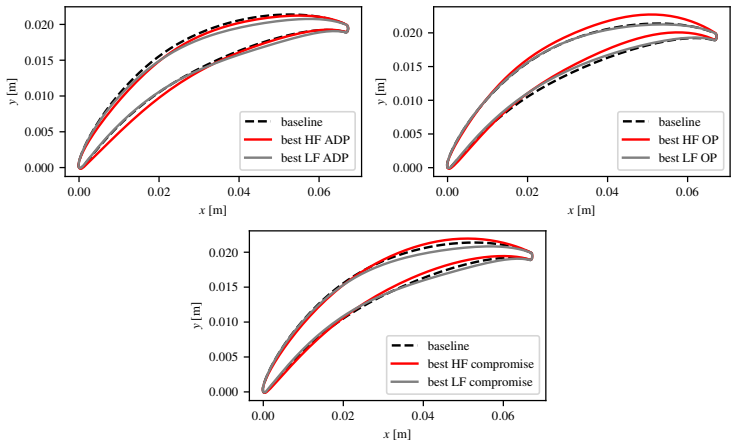
The central claim is that in the very few high-fidelity samples regime, the AR1 co-kriging model, which fuses the low- and high-fidelity responses through the linear autoregressive relation $f_{hf}(x) = \rho f_{lf}(x) + \delta(x)$, combined with a Bayesian infill based on the minimal probability of improvement, outperforms the multi-fidelity deep neural network combined with an NSGA-II genetic-algorithm infill. After ten infill steps on the LRN-OGV cascade, the AR1 configurations achieved the best inverted generational distance, Pareto-compliant IGD+, and hypervolume scores, and the POD-reduced AR1 variants (E2, E6) posted the largest gains. The paper further claims that POD-based dimension reduction of the free-form-deformation parametrization, from eight to four variables, was highly successful for all approaches, improving both the dataset Pareto quality and the optimized loss coefficients, with trade-off candidates improving $w_{ADP}$ by up to 10% and $w_{OP}$ by up to 22%. A caveat the authors state directly is that the final surrogate-assisted NSGA-II post-processing gives a denser but unreliable Pareto front wherever high-fidelity samples are not nearby, so any candidate taken from the predicted Pareto should be recomputed at high fidelity.
Load-bearing premise
The study assumes, but never measures, that its cheap and expensive flow solvers really differ in cost by the extreme factors, thousands to tens of thousands, that motivate calling the regime one of 'extreme cost imbalance'.
Editorial extensions
If this is right
- Design teams who can afford only about twenty high-fidelity CFD evaluations should choose AR1 co-kriging with a Bayesian infill over a multi-fidelity deep neural network with genetic-algorithm infill.
- Halving the design dimension with POD improves Pareto quality and optimized performance for every strategy, so the reduction can be adopted independently of the surrogate choice.
- Pareto fronts produced by the final surrogate-assisted genetic run are only reliable near actual high-fidelity samples; any extracted candidate must be recomputed with the high-fidelity solver.
- The regularized Bayesian infill criterion that gave order-of-magnitude gains on the analytical ZDT problems did not transfer to the real cascade problem, so gains on toy problems need confirmation on the actual cost model.
- Because AR1 requires nested designs, the winning strategy forces paired high- and low-fidelity evaluations at the same design points, constraining how low-fidelity data are gathered.
Reading between the lines
- If the ranking transfers to truly extreme cost gaps, such as LES or unsteady RANS as the high-fidelity source, the argument for the simple Bayesian route strengthens, because Bayesian infill spends each very expensive call where uncertainty is highest while the genetic algorithm spends its calls on the surrogate's extrapolated best guesses.
- A testable extension the paper does not run: fold the true solver cost ratio into the budget, treating one high-fidelity call as thousands of low-fidelity calls, and check whether the AR1 advantage grows with the imbalance; the fixed twenty-call budget leaves the cost ratio implicit.
- The disappointing transfer of the regularized infill criterion hints that its theoretical advantage, validated on smooth ZDT test functions, depends on objective geometry that the real cascade problem does not have; a batch or multi-point infill that treats the three operating points per design as one sample could be more productive than regularization.
Editorial analysis
A structured set of objections, weighed in public.
Referee Report
Summary. The paper compares two multi-fidelity surrogate-based strategies for multi-objective aerodynamic shape optimization of a low-Reynolds number linear outlet guide vane cascade: Bayesian AR1 co-kriging with adaptive infill, and a non-Bayesian multi-fidelity deep neural network (MFDNN) with a genetic-algorithm infill, each with and without POD-based dimension reduction. The central claim is that under "extreme computational cost imbalance" with very few high-fidelity evaluations, AR1 co-kriging with Bayesian infill outperforms MFDNN, and that POD reduction improves all configurations. The study includes preliminary tests on 1D analytical functions and ZDT problems, followed by a CFD-based optimization using coarse-mesh RANS SA as the low-fidelity model and adapted-mesh RANS SA-BCM as the high-fidelity model, with a brute-force NSGA-II reference Pareto front.
Significance. The question is practically relevant: if a simpler autoregressive co-kriging model with Bayesian infill outperforms a more flexible neural-network multi-fidelity model in a very small high-fidelity budget, that is an actionable result for industrial optimization. The study is carefully designed in several respects: it uses a realistic turbomachinery configuration with a brute-force reference solution; it employs feature-based anisotropic mesh adaptation to control high-fidelity discretization error; the initial DOEs are controlled across configurations; and the predicted Pareto fronts are honestly checked by recomputation with the high-fidelity solver. The 1D and ZDT preliminary experiments are useful for model selection. The dataset Pareto metrics are computed from actual CFD evaluations, not from the surrogate's own predictions, so the comparison is not circular. However, the significance is limited by the mismatch between the stated extreme cost-imbalance regime and the actual wall-clock cost ratio in the experiment, and by the lack of statistical uncertainty assessment on the five-run means.
major comments (3)
- [§5.3, §1 and Abstract] The paper motivates the study with cost ratios of 10^3–10^4 between high- and low-fidelity models, but the high-fidelity model used in the experiment is RANS SA-BCM on an adapted mesh and the low-fidelity is RANS SA on a coarse mesh. The wall-clock times reported in §5.3 (2 days vs 3 hours) give a per-evaluation cost ratio of roughly 16. Since the optimization loops use identical populations and generations, this ratio directly reflects the per-evaluation cost. The experiment therefore tests a moderate cost-imbalance regime, and the abstract's claim that AR1 with Bayesian infill is preferable "under extreme cost imbalance" is not supported by evidence from the targeted regime.
- [Tables 7 and 8] The central comparison rests on mean IGD, IGD+, and HV values averaged over five runs, but no standard deviations, confidence intervals, or significance tests are reported. Several gaps between the leading AR1 configurations are small (e.g., final IGD 5.2e-3 for E1 vs 4.9e-3 for E2; final IGD+ 4.0e-3 for E1 vs 4.4e-3 for E2), and without dispersion measures the ranking "AR1-based configurations perform better" is not statistically grounded.
- [Section 6 and Table 7] The claim that "for all approaches, dimension reduction with POD proved to be highly successful" is overstated. For the non-regularized AR1 pair, E1 and E2 give mixed results: E2 has better final IGD (4.9e-3 vs 5.2e-3) and HV (8.4e-5 vs 5.6e-5), but worse IGD+ (4.4e-3 vs 4.0e-3). Moreover, the regularized AR1 with POD (E6) shows no improvement at the five-infill checkpoint (IGD ratio 1.0). The conclusion should be qualified to specific configurations and metrics.
minor comments (5)
- [Title page] The PACS and MSC entries ("0000, 1111") appear to be placeholders and should be replaced with proper classification codes.
- [Equation (3)] The notation α_WB2S is used without defining "WB2S"; the acronym should be expanded at first use.
- [Table 7] The "Reference" row (IGD=0, IGD+=0, HV=1.7e-4) may confuse readers because the reference front is both the target and the metric anchor; a footnote clarifying that the metrics are computed with respect to this reference would help.
- [Section 5.4] The paper states that five runs are performed but does not report the seeds or describe how the runs differ (e.g., LHS draws, network initialization); stating seed details would improve reproducibility.
- [Section 3.1] The term "nested DOEs" is used several times before it is defined; a brief definition in Section 3.1 would improve readability.
Circularity Check
No significant circularity: the multi-fidelity comparison is an empirical benchmark whose Pareto metrics are computed from actual high-fidelity CFD evaluations, not from quantities defined by the fitted surrogate parameters.
full rationale
The central comparison is self-contained. The AR1 scaling factor rho and the MFDNN correlation parameter beta are learned from the low- and high-fidelity data, but the reported IGD, IGD+, and hypervolume values (Table 7) and the trade-off improvements (Table 8) are evaluated on the dataset Pareto formed by actual high-fidelity RANS SA-BCM evaluations, and the predicted Pareto is explicitly checked by recomputation with the high-fidelity solver (Section 5.4). The POD claim is likewise empirical: the POD-based configurations E2, E4, and E6 start from the same reconstructed initial DOEs and are compared against the non-reduced configurations E1, E3, and E5 on actual solver outputs. The self-citations to Matar [22,23] and Leusink [21] provide motivational context for the extreme cost-imbalance framing rather than a definitional step that determines the outcome; the same-group origin of those references does not by itself make the benchmark circular. A scope concern does exist: the paper's own wall-clock data imply a roughly 16x cost ratio between the high- and low-fidelity optimizations, not the 10^3-10^4 ratio cited from [22,23], so the 'extreme imbalance' label is not demonstrated by the experiment. The paper itself acknowledges this in the conclusion by proposing future RANS/LES work. This is an external-validity or correctness issue, not a circularity: no equation defines a predicted quantity in terms of the metric used to validate it, and no fitted parameter is renamed as a prediction.
Assumptions & free parameters
free parameters (4)
- gamma (regularization parameter in alpha_WB2S) =
not reported
- POD retained modes d* =
4
- high-fidelity mesh complexity Nc =
16000
- number of high-fidelity samples (initial plus infills) =
10 + 10
assumptions (6)
- domain assumption AR1 decomposition f_hf(x) = rho f_lf(x) + delta(x) with constant rho and Gaussian process delta
- domain assumption Nested design of experiments, with high-fidelity samples at a subset of the low-fidelity locations
- domain assumption High-fidelity RANS SA-BCM on adapted meshes is a sufficiently accurate proxy for true aerodynamic losses
- domain assumption Feature-based mesh adaptation with a Mach-number sensor yields error-free high-fidelity solutions for all deformed geometries
- domain assumption The single NSGA-II reference Pareto front, with 50 generations and 20 candidates, is a good proxy for the true Pareto front
- domain assumption Extreme cost imbalance of 10^3 to 10^4 is assumed to hold for the RANS pair used here
Cite this review
Pith. "Pith review of Bayesian and non-Bayesian multi-fidelity surrogate models for multi-objective aerodynamic optimization under extreme cost imbalance." pith.science (2026). https://pith.science/paper/AVAILPB4
@misc{pith2026250517279,
  author       = {Pith},
  title        = {Pith review of: Bayesian and non-Bayesian multi-fidelity surrogate models for multi-objective aerodynamic optimization under extreme cost imbalance},
  year         = {2026},
  howpublished = {\url{https://pith.science/paper/AVAILPB4}},
  note         = {Machine review of arXiv:2505.17279}
}
read the original abstract
Aerodynamic shape optimization in industry still faces challenges related to robustness and scalability. This aspect becomes crucial for advanced optimizations that rely on expensive high-fidelity flow solvers, where computational budget constraints only allow a very limited number of simulations within the optimization loop. To address these challenges, we investigate strategies based on multi-fidelity surrogate models. In particular, we focus on the case of extreme computational cost imbalance between the high- and low-fidelity models, which severely limits the maximum allowable number of high-fidelity function calls. To maximize the information extracted from the high-fidelity samples, we generate a reduced representation of the design space and use an adaptive infill strategy to smartly place the high-fidelity samples where they can best guide the optimization. Bayesian co-kriging and non-Bayesian multi-fidelity neural networks are trained by combining low- and high-fidelity models for a use-case consisting of a low Reynolds linear outlet guide vane at subsonic and transitional flow conditions. Coarse-mesh RANS simulations are used as low-fidelity model while RANS simulations with a transition model and automatically (feature-based) adapted meshes are chosen as the high-fidelity one. Each surrogate model is then associated to an infill strategy of its kind and a proper orthogonal decomposition of the shape parametrization is used to reduce by half the dimension of the problem. Based on inverted distance and hypervolume metrics, we find that the simpler co-kriging representation in conjunction with Bayesian infill yields better performance than the multi-fidelity neural network and the considered non-Bayesian method.
Figures


Figures from the paper (13 more)




Forward citations
Cited by 1 Pith paper
-
Optimization-Embedded Active Multi-Fidelity Surrogate Learning for Multi-Condition Airfoil Shape Optimization
Uncertainty-triggered multi-fidelity GPs inside a hybrid GA redesign a 12-parameter CST airfoil for two flight conditions with only ~10–15% RANS calls and large reported gains over generation 1.
Reference graph
Works this paper leans on
-
[1]
S. Le Clainche, E. Ferrer, S. Gibson, E. Cross, A. Parente, R. Vinuesa, Improving aircraft performance using machine learning: A review, Aerospace Science and Technology 138 (2023) 108354. doi:10.1016/j.ast.2023.108354. URL https://linkinghub.elsevier.com/retrieve/pii/S1270963823002511
-
[2]
F. Afonso, M. Sohst, C. M. Diogo, S. S. Rodrigues, A. Ferreira, I. Ribeiro, R. Marques, F. F. Rego, A. Sohouli, J. Portugal-Pereira, H. Poli- carpo, B. Soares, B. Ferreira, E. C. Fernandes, F. Lau, A. Suleman, Strategies towards a more sustainable aviation: A systematic review, Progress in Aerospace Sciences 137 (2023) 100878. doi:10.1016/j.paerosci.2022....
arXiv 2023
-
[3]
S. Skinner, H. Zare-Behtash, State-of-the-art in aerodynamic shape optimisation methods, Applied Soft Computing 62 (2018) 933–962. doi:10.1016/j.asoc.2017.09.030. URL https://linkinghub.elsevier.com/retrieve/pii/S1568494617305690
-
[4]
Z. Li, X. Zheng, Review of design optimization methods for turbomachinery aerodynamics, Progress in Aerospace Sciences 93 (2017) 1–23. doi:10.1016/j.paerosci.2017.05.003. URL https://linkinghub.elsevier.com/retrieve/pii/S037604211730088X
-
[5]
S. K. Nadarajah, A. Jameson, Optimum shape design for unsteady flows with time-accurate continuous and discrete adjoint method, AIAA journal 45 (7) (2007) 1478–1491
work page 2007
-
[6]
E. Ampellio, F. Bertini, A. Ferrero, F. Larocca, L. Vassio, Turbomachinery design by a swarm-based optimization method coupled with a cfd solver, Advances in aircraft and spacecraft science 3 (2) (2016) 149
work page 2016
-
[7]
H. R. Karbasian, B. C. Vermeire, Gradient-free aerodynamic shape optimization using large eddy simulation, Computers & Fluids 232 (2022) 105185
work page 2022
- [8]
Show all 73 references
-
[9]
J. R. Martins, Aerodynamic design optimization: Challenges and perspectives, Computers & Fluids 239 (2022) 105391. doi:10.1016/j. compfluid.2022.105391. URL https://linkinghub.elsevier.com/retrieve/pii/S0045793022000615
2022
-
[10]
Forrester, A
A. Forrester, A. Sobester, A. Keane, Engineering design via surrogate modelling: a practical guide, John Wiley & Sons, 2008
2008
-
[11]
A. I. Forrester, A. J. Keane, Recent advances in surrogate-based optimization, Progress in aerospace sciences 45 (1-3) (2009) 50–79
2009
-
[12]
Le Gratiet, J
L. Le Gratiet, J. Garnier, RECURSIVE CO-KRIGING MODEL FOR DESIGN OF COMPUTER EXPERIMENTS WITH MULTI- PLE LEVELS OF FIDELITY, International Journal for Uncertainty Quantification 4 (5) (2014) 365–386. doi:10.1615/Int.J. UncertaintyQuantification.2014006914. URL http://www.dl.be...
2014 doi
-
[13]
Brevault, M
L. Brevault, M. Balesdent, A. Hebbal, Overview of Gaussian process based multi-fidelity techniques with variable relationship between fidelities, application to aerospace systems, Aerospace Science and Technology 107 (2020) 106339. doi:10.1016/j.ast.2020.106339. URL https://li...
2020
-
[14]
M. G. Fern ´andez-Godino, Review of multi-fidelity models, Advances in Computational Science and Engineering 1 (4) (2023) 351–400
2023
-
[15]
A. J. Keane, Statistical Improvement Criteria for Use in Multiobjective Design Optimization, AIAA journal 44 (4) (Apr. 2012). doi:https: //doi.org/10.2514/1.16875. URL https://arc.aiaa.org/doi/abs/10.2514/1.16875?journalCode=aiaaj
2012 doi
-
[16]
J. N. Fuhg, A. Fau, U. Nackenhorst, State-of-the-art and comparative review of adaptive sampling methods for kriging, Archives of Compu- tational Methods in Engineering 28 (2021) 2689–2747
2021
-
[17]
Zhang, F
X. Zhang, F. Xie, T. Ji, Z. Zhu, Y . Zheng, Multi-fidelity deep neural network surrogate model for aerodynamic shape optimization, Computer Methods in Applied Mechanics and Engineering 373 (2021) 113485. doi:10.1016/j.cma.2020.113485. URL https://linkinghub.elsevier.com/retrie...
2021
-
[18]
X. Wu, Z. Zuo, L. Ma, W. Zhang, Multi-fidelity neural network-based aerodynamic optimization framework for propeller design in electric aircraft, Aerospace Science and Technology 146 (2024) 108963. doi:10.1016/j.ast.2024.108963. URL https://linkinghub.elsevier.com/retrieve/pii...
2024
-
[19]
Charayron, T
R. Charayron, T. Lefebvre, N. Bartoli, J. Morlier, Towards a multi-fidelity & multi-objective Bayesian optimization e fficient algorithm, Aerospace Science and Technology 142 (2023) 108673. doi:10.1016/j.ast.2023.108673. URL https://linkinghub.elsevier.com/retrieve/pii/S127096...
2023
-
[20]
Mourousias, B
N. Mourousias, B. G. Marinus, M. C. Runacres, A novel multi-fidelity optimization framework for high-altitude propellers, Aerospace Science and Technology 153 (2024) 109407. doi:10.1016/j.ast.2024.109407. URL https://linkinghub.elsevier.com/retrieve/pii/S1270963824005388
2024
-
[21]
Leusink, D
D. Leusink, D. Alfano, P. Cinnella, Multi-fidelity optimization strategy for the industrial aerodynamic design of helicopter rotor blades, Aerospace Science and Technology 42 (2015) 136–147
2015
-
[22]
Matar, Analysis of loss mechanisms inside Organic Rankine Cycle turbines and multi-fidelity optimization with LES and RANS coupling, Ph.D
C. Matar, Analysis of loss mechanisms inside Organic Rankine Cycle turbines and multi-fidelity optimization with LES and RANS coupling, Ph.D. thesis, Sorbonne Universit´e (Oct. 2024)
2024
-
[23]
Matar, P
C. Matar, P. Cinnella, X. Gloerfelt, Cost-e ffective multi-fidelity strategy for the optimization of high-reynolds number turbine flows guided by les, arXiv preprint arXiv:2503.17977 (2025)
2025 arXiv
-
[24]
Cinnella, P
P. Cinnella, P. M. Congedo, Convergence behaviours of genetic algorithms for aerodynamic optimisation problems, International Journal of Engineering Systems Modelling and Simulation 5 (4) (2013) 197. doi:10.1504/IJESMS.2013.056782. URL http://www.inderscience.com/link.php?id=56782
2013
-
[25]
Alauzet, A
F. Alauzet, A. Loseille, A decade of progress on anisotropic mesh adaptation for computational fluid dynamics, Computer-Aided Design 72 26 (2016) 13–39. doi:10.1016/j.cad.2015.09.005. URL https://linkinghub.elsevier.com/retrieve/pii/S0010448515001517
2016 doi
-
[26]
G. Chen, K. Fidkowski, Output-Based Mesh Adaptation for Variable-Fidelity Multipoint Aerodynamic Optimization, in: AIAA Aviation 2019 Forum, American Institute of Aeronautics and Astronautics, Dallas, Texas, 2019. doi:10.2514/6.2019-3057. URL https://arc.aiaa.org/doi/10.2514/6...
2019 doi
-
[27]
G. Chen, K. J. Fidkowski, Variable-fidelity multipoint aerodynamic shape optimization with output-based adapted meshes, Aerospace Science and Technology 105 (2020) 106004. doi:10.1016/j.ast.2020.106004. URL https://linkinghub.elsevier.com/retrieve/pii/S1270963820306866
2020
-
[28]
A. John, G. Vivarelli, N. Qin, S. Shahpar, Using Feature-Based Mesh Adaptation to Improve the Adjoint Optimisation of Transonic Com- pressor Blades, in: V olume 2C: Turbomachinery, American Society of Mechanical Engineers, Virtual, Online, 2020, p. V02CT35A036. doi:10.1115/GT2...
2020
-
[29]
Alauzet, L
F. Alauzet, L. Frazza, Feature-based and goal-oriented anisotropic mesh adaptation for RANS applications in aeronautics and aerospace, Journal of Computational Physics 439 (2021) 110340. doi:10.1016/j.jcp.2021.110340. URL https://linkinghub.elsevier.com/retrieve/pii/S0021999121002357
2021
-
[30]
K. Li, F. Li, Multi-Fidelity Methods for Optimization: A Survey, arXiv:2402.09638 [cs] (Feb. 2024). URL http://arxiv.org/abs/2402.09638
2024 arXiv
-
[31]
Kennedy, Predicting the output from a complex computer code when fast approximations are available, Biometrika 87 (1) (2000) 1–13
M. Kennedy, Predicting the output from a complex computer code when fast approximations are available, Biometrika 87 (1) (2000) 1–13. doi:10.1093/biomet/87.1.1. URL https://academic.oup.com/biomet/article-lookup/doi/10.1093/biomet/87.1.1
2000 doi
-
[32]
Perdikaris, M
P. Perdikaris, M. Raissi, A. Damianou, N. D. Lawrence, G. E. Karniadakis, Nonlinear information fusion algorithms for data-e fficient multi- fidelity modelling, Proceedings of the Royal Society A: Mathematical, Physical and Engineering Sciences 473 (2198) (2017) 20160751. doi:...
2017
-
[33]
X. Meng, G. E. Karniadakis, A composite neural network that learns from multi-fidelity data: Application to function approximation and inverse PDE problems, Journal of Computational Physics 401 (2020) 109020. doi:10.1016/j.jcp.2019.109020. URL https://linkinghub.elsevier.com/r...
2020
-
[34]
X. Meng, H. Babaee, G. E. Karniadakis, Multi-fidelity Bayesian neural networks: Algorithms and applications, Journal of Computational Physics 438 (2021) 110361. doi:10.1016/j.jcp.2021.110361. URL https://linkinghub.elsevier.com/retrieve/pii/S0021999121002564
2021
-
[35]
Cutajar, M
K. Cutajar, M. Pullin, A. Damianou, N. Lawrence, J. Gonz ´alez, Deep Gaussian Processes for Multi-fidelity Modeling, arXiv:1903.07320 [cs, stat] (Mar. 2019). URL http://arxiv.org/abs/1903.07320
1903 arXiv
-
[36]
A. A. Howard, M. Perego, G. E. Karniadakis, P. Stinis, Multifidelity deep operator networks for data-driven and physics-informed problems, Journal of Computational Physics 493 (2023) 112462. doi:10.1016/j.jcp.2023.112462. URL https://linkinghub.elsevier.com/retrieve/pii/S00219...
2023
-
[37]
Bhola, S
S. Bhola, S. Pawar, P. Balaprakash, R. Maulik, Multi-fidelity reinforcement learning framework for shape optimization, Journal of Computa- tional Physics 482 (2023) 112018. doi:10.1016/j.jcp.2023.112018. URL https://linkinghub.elsevier.com/retrieve/pii/S0021999123001134
2023
-
[38]
Y . He, Q. Gui, J. Luo, An e fficient parallel multi-fidelity multi-objective Bayesian optimization method and application to 3-stage axial compressor with 144 variables, Aerospace Science and Technology 150 (2024) 109235. doi:10.1016/j.ast.2024.109235. URL https://linkinghub....
2024
-
[39]
D. Zhan, Y . Cheng, J. Liu, Expected Improvement Matrix-Based Infill Criteria for Expensive Multiobjective Optimization, IEEE Transactions on Evolutionary Computation 21 (6) (2017) 956–975. doi:10.1109/TEVC.2017.2697503. URL https://ieeexplore.ieee.org/document/7908974/
2017
-
[40]
Y . He, J. Sun, P. Song, X. Wang, Variable-fidelity hypervolume-based expected improvement criteria for multi-objective e fficient global optimization of expensive functions, Engineering with Computers 38 (4) (2022) 3663–3689. doi:10.1007/s00366-021-01404-9 . URL https://link....
2022 doi
-
[41]
A. A. M. Rahat, R. M. Everson, J. E. Fieldsend, Alternative infill strategies for expensive multi-objective optimisation, in: Proceedings of the Genetic and Evolutionary Computation Conference, ACM, Berlin Germany, 2017, pp. 873–880. doi:10.1145/3071178.3071276. URL https://dl...
2017
-
[42]
R. Rao, V . Savsani, D. Vakharia, Teaching–Learning-Based Optimization: An optimization method for continuous non-linear large scale problems, Information Sciences 183 (1) (2012) 1–15. doi:10.1016/j.ins.2011.08.006. URL https://linkinghub.elsevier.com/retrieve/pii/S0020025511004191
2012 doi
-
[43]
T. W. Sederberg, Free-Form Deformation of Solid Geometric Models, SIGGRAPH Comput. Graph. 20 (4) (1986) 151–160. URL https://doi.org/10.1145/15886.15903
1986
-
[44]
B. M. Kulfan, Universal Parametric Geometry Representation Method, Journal of Aircraft 45 (1) (2008) 142–158, publisher: American Institute of Aeronautics and Astronautics. doi:10.2514/1.29958. URL https://arc.aiaa.org/doi/10.2514/1.29958
2008 doi
-
[45]
R. M. Hicks, P. A. Henne, Wing Design by Numerical Optimization, Journal of Aircraft (May 2012). doi:10.2514/3.58379. URL https://arc.aiaa.org/doi/10.2514/3.58379
2012 doi
-
[46]
P. G. Constantine, E. Dow, Q. Wang, Active subspace methods in theory and practice: applications to kriging surfaces, SIAM Journal on Scientific Computing 36 (4) (2014) A1500–A1524, arXiv:1304.2070 [math]. doi:10.1137/130916138. URL http://arxiv.org/abs/1304.2070
2014 arXiv
-
[47]
Cinquegrana, E
D. Cinquegrana, E. Iuliano, E fficient Global Optimization of a Transonic Wing with Geometric Data Reduction, in: 35th AIAA Applied 27 Aerodynamics Conference, American Institute of Aeronautics and Astronautics, Denver, Colorado, 2017. doi:10.2514/6.2017-3057. URL https://arc....
2017 doi
-
[48]
X. Wu, W. Zhang, X. Peng, Z. Wang, Benchmark aerodynamic shape optimization with the POD-based CST airfoil parametric method, Aerospace Science and Technology 84 (2019) 632–640. doi:10.1016/j.ast.2018.08.005. URL https://linkinghub.elsevier.com/retrieve/pii/S1270963817323532
2019 doi
-
[49]
Ullah, D
S. Ullah, D. A. Nguyen, H. Wang, S. Menzel, B. Sendho ff, T. Back, Exploring Dimensionality Reduction Techniques for Efficient Surrogate- Assisted optimization, in: 2020 IEEE Symposium Series on Computational Intelligence (SSCI), IEEE, Canberra, ACT, Australia, 2020, pp. 2965–...
2020
-
[50]
C. K. J. Hou, K. Behdinan, Dimensionality Reduction in Surrogate Modeling: A Review of Combined Methods, Data Science and Engineering 7 (4) (2022) 402–427. doi:10.1007/s41019-022-00193-5 . URL https://link.springer.com/10.1007/s41019-022-00193-5
2022 doi
-
[51]
Van Langenhove, D
J. Van Langenhove, D. Lucor, F. Alauzet, A. Belme, Goal-oriented error control of stochastic system approximations using metric-based anisotropic adaptations, Journal of Computational Physics 374 (2018) 384–412
2018
-
[52]
Belme, F
A. Belme, F. Alauzet, A. Dervieux, An a priori anisotropic goal-oriented error estimate for viscous compressible flow and application to mesh adaptation, Journal of Computational Physics 376 (2019) 1051–1088
2019
-
[53]
Alauzet, L
F. Alauzet, L. Frazza, D. Papadogiannis, Periodic adjoints and anisotropic mesh adaptation in rotating frame for high-fidelity RANS turbo- machinery applications, Journal of Computational Physics 450 (2022) 110814. doi:10.1016/j.jcp.2021.110814. URL https://linkinghub.elsevier...
2022
-
[54]
G. Chen, K. J. Fidkowski, Discretization error control for constrained aerodynamic shape optimization, Journal of Computational Physics 387 (2019) 163–185. doi:10.1016/j.jcp.2019.02.038. URL https://linkinghub.elsevier.com/retrieve/pii/S002199911930155X
2019 doi
-
[55]
Wackers, M
J. Wackers, M. Visonneau, A. Serani, R. Pellegrini, R. Broglia, M. Diez, Multi-Fidelity Machine Learning from Adaptive-and Multi-Grid RANS Simulations, Osaka, Japan, 2020
2020
-
[56]
Wackers, R
J. Wackers, R. Pellegrini, M. Diez, A. Serani, M. Visonneau, Improving active learning in multi-fidelity hydrodynamic optimization, Wash- ington DC, USA, 2022
2022
-
[57]
Ishibuchi, H
H. Ishibuchi, H. Masuda, Y . Tanigaki, Y . Nojima, Modified Distance Calculation in Generational Distance and Inverted Generational Distance, in: A. Gaspar-Cunha, C. Henggeler Antunes, C. C. Coello (Eds.), Evolutionary Multi-Criterion Optimization, V ol. 9019, Springer Interna...
2015 doi
-
[58]
Saves, R
P. Saves, R. Lafage, N. Bartoli, Y . Diouane, J. Bussemaker, T. Lefebvre, J. T. Hwang, J. Morlier, J. R. Martins, SMT 2.0: A Surrogate Modeling Toolbox with a focus on hierarchical and mixed variables Gaussian processes, Advances in Engineering Software 188 (2024) 103571. doi:...
2024
-
[59]
Grapin, Y
R. Grapin, Y . Diouane, J. Morlier, N. Bartoli, T. Lefebvre, P. Saves, J. H. Bussemaker, Constrained Multi-Objective Bayesian Optimization with Application to Aircraft Design, in: AIAA A VIATION 2022 Forum, American Institute of Aeronautics and Astronautics, Chicago, IL & Virt...
2022 doi
-
[60]
K. Deb, A. Pratap, S. Agarwal, T. Meyarivan, A fast and elitist multiobjective genetic algorithm: Nsga-ii, IEEE Transactions on Evolutionary Computation 6 (2) (2002) 182–197. doi:10.1109/4235.996017
2002
-
[61]
J. G. Falc ´on-Cardona, M. T. M. Emmerich, C. A. C. Coello, On the Construction of Pareto-Compliant Combined Indicators, Evolutionary Computation 30 (3) (2022) 381–408. doi:10.1162/evco_a_00307. URL https://direct.mit.edu/evco/article/30/3/381/109569/On-the-Construction-of-Par...
2022 doi
-
[62]
C. V oß, M. Siggel, J. Backhaus, G. Goinis, A. Pahs, A di fferentiated geometry blade parameterization methodology for gas turbines, Com- puters & Fluids (2025) 106588
2025
-
[63]
E. A. Bufi, P. Cinnella, Robust optimization of supersonic orc nozzle guide vanes, in: Journal of Physics: Conference Series, V ol. 821, IOP Publishing, 2017, p. 012014
2017
-
[64]
Serafino, B
A. Serafino, B. Obert, P. Cinnella, Multi-fidelity robust design optimization of an orc turbine for high temperature waste heat recovery, Energy 269 (2023) 126538
2023
-
[65]
Alauzet, P
F. Alauzet, P. Spalart, A new rotation correction for the Spalart-Allmaras model to improve o ff-body vortex prediction and vortex-vortex interaction effects, in: AIAA SCITECH 2024 Forum, American Institute of Aeronautics and Astronautics, Orlando, FL, 2024. doi:10. 2514/6.202...
2024 doi
-
[66]
S. R. Allmaras, F. T. Johnson, P. R. Spalart, Modi cations and Clari cations for the Implementation of the Spalart-Allmaras Turbulence Model, Computational Fluid Dynamics (2012)
2012
-
[67]
S. C. Cakmakcioglu, O. Bas, R. Mura, U. Kaynak, A Revised One-Equation Transitional Model for External Aerodynamics, in: AIAA A VIATION 2020 FORUM, American Institute of Aeronautics and Astronautics, VIRTUAL EVENT, 2020.doi:10.2514/6.2020-2706. URL https://arc.aiaa.org/doi/10....
2020 doi
-
[68]
R. Mura, S. C. Cakmakcioglu, A Revised One-Equation Transitional Model for External Aerodynamics - Part I: Theory, Validation and Base Cases, in: AIAA A VIATION 2020 FORUM, American Institute of Aeronautics and Astronautics, VIRTUAL EVENT, 2020. doi: 10.2514/6.2020-2714. URL h...
2020 doi
-
[69]
D. P. Kingma, Adam: A method for stochastic optimization, arXiv preprint arXiv:1412.6980 (2014)
2014 arXiv
-
[70]
Glorot, Y
X. Glorot, Y . Bengio, Understanding the di fficulty of training deep feedforward neural networks, in: Y . W. Teh, M. Titterington (Eds.), Proceedings of the Thirteenth International Conference on Artificial Intelligence and Statistics, V ol. 9 of Proceedings of Machine Learni...
2010
-
[71]
Zitzler, K
E. Zitzler, K. Deb, L. Thiele, Comparison of multiobjective evolutionary algorithms: Empirical results, Evolutionary computation 8 (2) (2000) 173–195
2000
-
[72]
Hergt, W
A. Hergt, W. Hage, S. Grund, W. Steinert, M. Terhorst, F. Schongen, Y . Wilke, Riblet Application in Compressors: Toward E fficient Blade Design, Journal of Turbomachinery 137 (11) (2015) 111006. doi:10.1115/1.4031090. URL https://asmedigitalcollection.asme.org/turbomachinery/...
2015 doi
-
[73]
Hergt, M
A. Hergt, M. Pesch, S. Grund, J. Flamm, Low reynolds number e ffects in compressor blade design, International Journal of Gas Turbine, Propulsion and Power Systems 15 (4) (2024) v15n4tp08. doi:10.38036/jgpp.15.4_v15n4tp08. 29
2024 doi
Reviewed August 7, 2026 · model on record in the stance chip above.
Discussion (0). Sign in to comment.