REVIEW 3 major objections 6 minor 89 references
The phase-space of tailed radio galaxies in massive clusters
T0 review · 3 major / 6 minor · reviewed 2026-08-07 · deepseek-v4-flash
Pith's one-line read Narrow-angle tailed radio galaxies sit closer to the cluster centre than ordinary cluster galaxies, at similar velocities, with bending strongest near the core.
desk verdict Useful cluster-selected catalogue and a solid radial trend, but the phase-space excess claims are undermined by a likely radial mismatch in the reference sample and an over-claimed abstract. read the letter →
The pith
A machine-rendered reading of the paper's core claim, the machinery that carries it, and where it could break.
The reading
What carries the argument
The machinery is the four-quadrant cluster phase-space diagram, divided by projected radius $r/r_{500}=1$ and line-of-sight velocity offset $c|\Delta z|/\sigma_{\mathrm{cluster}}=1.5$, the same construction previously applied to jellyfish galaxies. The paper's excess statistic $\eta$ compares the fraction of tailed radio galaxies in each quadrant with the fraction of the reference galaxy catalogue in that quadrant, so $\eta>1$ marks a quadrant where tails are over-represented relative to the cluster population. The physical mechanism under test is ram pressure, $P_{\mathrm{ram}}\propto\rho_{\mathrm{gas}}v^2$, and the observable carrying the argument is the bending angle, measured from the bright spots in the two radio lobes relative to the host galaxy's optical position. The negative correlation between bending angle and impact radius, together with the phase-space excess near the core, identifies the intracluster gas density as the dominant driver of the bending.
What would settle it
Rerun the excess analysis with full three-dimensional galaxy velocities (complete spectroscopy plus independent distance estimates) instead of projected radii and line-of-sight offsets: if the narrow-angle-tailed excess in the low-velocity, low-radius quadrant does not persist after deprojection, the central phase-space claim is falsified.
Extended reading notes
Core claim
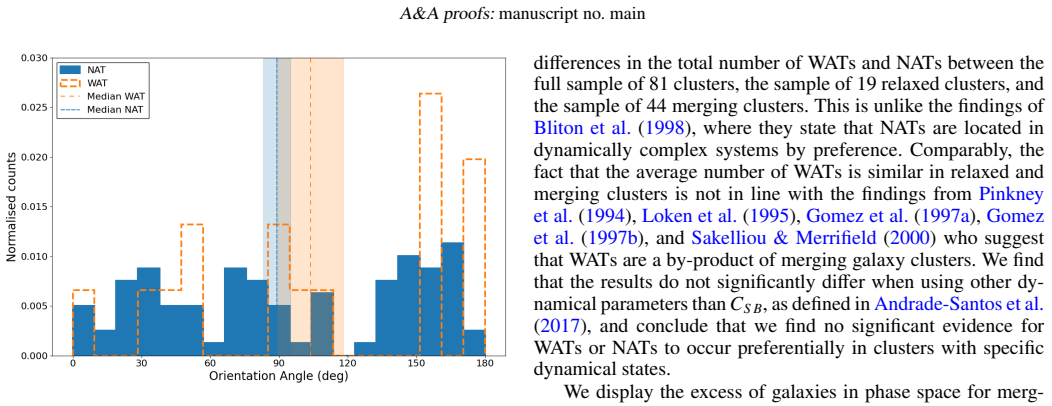
The paper's central discovery is that narrow-angle tailed radio galaxies occupy a distinct region of the cluster phase-space diagram, and that the phase-space placement, not the cluster's merger state, is what governs how strongly the radio jets are bent. From 81 Planck SZ-selected clusters at $z>0.1$ with L-band radio imaging, the authors classify 84 NATs, 16 WATs, and 9 unbent sources, and place the 27 NATs with spectroscopic velocities on a phase-space diagram referenced to a spectroscopic catalogue of cluster galaxies. NATs have a significant excess in the low-velocity, low-radius quadrant ($\eta_{\mathrm{NAT},3} = 1.53^{+0.16}_{-0.22}$), a marginal excess in the high-velocity, low-radius quadrant ($\eta_{\mathrm{NAT},2} = 1.63^{+0.85}_{-0.47}$), a strong deficit in the low-velocity, high-radius quadrant ($\eta_{\mathrm{NAT},4} = 0.30^{+0.24}_{-0.09}$), and no members in the high-velocity, high-radius quadrant. Their velocity offset does not differ from the average cluster galaxy ($c|\Delta z|/\sigma_{\mathrm{cluster}} = 0.71\pm0.11$ versus $0.79\pm0.01$), so the distinguishing property is proximity to the cluster centre. Bending angle is negatively correlated with impact radius (Pearson $r=-0.41$, $p=0.006$; Spearman $r=-0.36$, $p=0.02$), and while NATs and WATs occur in equal numbers in merging and relaxed clusters, their phase-space distribution shifts with dynamical state: merging clusters show the NAT excess in the high-velocity, low-radius region ($\eta_{\mathrm{NAT,merging},2} = 2.19^{+1.17}_{-0.69}$) whereas relaxed clusters show it in the low-velocity, low-radius region ($\eta_{\mathrm{NAT,relaxed},3} = 2.22^{+0.08}_{-0.35}$).
Load-bearing premise
The argument assumes that the projected distance and the line-of-sight velocity offset, both explicit lower limits, faithfully stand in for the real three-dimensional position and speed of each galaxy, and that the spectroscopic reference catalogue fairly represents the general cluster population.
Editorial extensions
If this is right
- The bending angle of a tailed radio galaxy can serve as a rough radial gauge inside a cluster: the more bent sources sit closer to the core, where the intracluster medium is densest.
- NATs provide a sharper tracer of the core's ram-pressure environment than the general galaxy population, since they are preferentially found near the centre rather than spread across the cluster.
- The shared high-velocity, low-radius excess with jellyfish galaxies points to one common physical driver, ram pressure, but NATs persist in the low-velocity core while jellyfish do not, implying that radio tails survive longer after infall than stripped star-forming gas.
- Because the number of NATs and WATs does not depend on cluster dynamical state while their phase-space location does, cluster censuses that ignore position within the cluster will miss the dynamical information these sources carry.
Reading between the lines
- If the bending-radius correlation is purely ram-pressure driven, the same analysis in lower-mass clusters should produce weaker bending at the same normalized radius, and measuring this would separate ram pressure from magnetic-field bending.
- The empty high-velocity, high-radius quadrant may be partly an observational bias, since radio lobes fade in lower-density gas; deeper radio imaging of those regions would test whether NATs are truly absent there or merely too faint to classify.
- The shift of the NAT excess between merging and relaxed clusters, combined with the lack of a preferred tail orientation, suggests bent radio sources could record the last merger; a larger sample spanning cluster redshift would show whether stirred-up NATs re-settle into the core as clusters relax.
Editorial analysis
A structured set of objections, weighed in public.
Referee Report
Summary. The paper presents 127 extended radio sources found in VLA 1-2 GHz observations of 81 Planck-ESZ clusters at z > 0.1, classifies 109 of them by bending angle into 84 NATs, 16 WATs, and 9 non-bent sources, and compares their projected cluster-centric distances and phase-space positions with galaxies from the HeCS-SZ survey. The central claims are that NATs are more centrally concentrated than the general cluster population and than WATs, that bending angle anticorrelates with cluster-centric radius, that NATs show a significant excess in the low-velocity/low-impact-radius phase-space region (eta_3 = 1.53) and a marginal excess in the high-velocity/low-impact-radius region (eta_2 = 1.63), and that this phase-space behaviour resembles that of jellyfish galaxies. The paper also reports no difference in the occurrence of NATs/WATs between merging and relaxed clusters but a dynamical-state-dependent phase-space distribution.
Significance. If the phase-space claims survive the corrections requested below, this is a valuable observational contribution. The cluster-selected approach avoids the reverse selection of many earlier tailed-radio-galaxy studies, the catalogue is made available, and the comparison with jellyfish galaxies gives a concrete physical interpretation in terms of ram pressure. The radial-concentration and bending-radius correlation results appear reasonably supported. The main significance is moderated by the small number of NATs with velocities (27 in 24 clusters) and by the need to match the reference-sample selection to the radio-source selection before the phase-space excess can be accepted as established.
major comments (3)
- [§2.1, §3.2, Eq. (2), Fig. 2, Table 2] Section 2.1 restricts the radio-source catalogue to r/r500 < 2, but neither Fig. 2 nor Table 2/Fig. 4/Eq. (2) states that the HeCS-SZ reference is restricted to the same radial range. Because eta is a ratio of fractions (Eq. 2), the reference denominator and quadrant counts must be computed over exactly the same radial support as the NAT sample; otherwise the reported eta_3 and eta_4 values are biased by construction. If HeCS-SZ extends beyond 2 r500, the large-radius galaxy counts inflate the reference denominator and the outer-quadrant counts, mechanically boosting eta_3 and suppressing eta_4; if HeCS-SZ is truncated at R200 < 2 r500, the bias enters in the opposite direction. The sentence in §3.2 that the Roberts et al. (2021a) cut at r180 'simply lowers the sample size but does not bias the excess calculation' is not correct unless the reference sample is cut at the same radius. Please recompute all eta values and the Fig. 2 comparison with a common, explicitly stated radial cut for both samples, and report the sensitivity of the phase-space excesses to the chosen aperture.
- [§3.2, Table 2] The phase-space analysis uses only 27 NATs with velocities, drawn from 24 of the 81 clusters, while Table 2 reports 3238 HeCS-SZ galaxies. The paper does not state whether those 3238 reference galaxies come from exactly the same 24 clusters and the same radial aperture as the NATs, or from the full HeCS-SZ survey. If the reference includes clusters or radial bins not represented in the NAT sample, the comparison is not a matched test. Please state the overlap explicitly, compare the mass, redshift, and dynamical-state distributions of the 24 clusters with the parent 81-cluster sample, and show that the phase-space excess persists when the reference is restricted to the same clusters and to r/r500 < 2. Given the small number of NATs in the phase-space quadrants, the paper should also specify how many of those 27 have blended tails and whether the region-3 excess survives for the resolved-tail subset.
- [§2.3, Table 1, §3.2] Section 2.3 states that sources with blended tails are assigned a bending angle of 180 degrees and classified as NATs, and the text indicates that 65 of the 84 NATs fall in this category. For these sources the bending angle is not measured, so the NAT class is partly defined by an assumption about unresolved morphology rather than by the quantitative threshold used for WATs. The robustness test in §2.3 varies the 80/100-degree thresholds but does not test the 180-degree assignment rule itself. Please recompute the distance and phase-space statistics for the 19 resolved NATs only, or at least flag the blended sources separately, to demonstrate that the main conclusions are not driven by this classification rule.
minor comments (6)
- [§2.2, Eq. (1)] Equation (1) is typeset in a way that is not mathematically interpretable as written; please rewrite the membership criterion explicitly, for example as |z_gal - z_cluster|/(1 + z_gal) < Delta z with the uncertainty sigma handled in a clearly stated way.
- [§3.4] The final sentence of §3.4 contradicts the preceding two sentences and the abstract/conclusions: it says merging clusters show the strongest excess in region 3 and relaxed clusters in region 2, while the tabulated values and the rest of the text say merging clusters have eta = 2.19 in region 2 and relaxed clusters have eta = 2.22 in region 3. Please correct this sentence.
- [Table 1 note] The note below Table 1 says '6 out of 18 WATs' but Table 1 lists 16 WATs in total; please correct the denominator and clarify what the 18 counts refer to.
- [§4.1] The sentence 'Combined with the negative correlation we find for bending angle and distance (Figure 4)' appears in the context of the bending-angle-versus-distance relation and should cite Figure 3 rather than Figure 4.
- [Fig. 3 caption] The stated uncertainty on the running median, |M - [p16, p84]|/sqrt(N), is not a standard formula and should be justified or replaced with a bootstrap or percentile interval.
- [General statistics] Please specify the prescription used for the reported eta uncertainties (e.g., Poisson or Bayesian intervals as in Roberts et al. 2021a) and state whether any multiple-comparison correction was applied across the four phase-space quadrants.
Circularity Check
No significant circularity; the NAT phase-space excess is an independent measurement against the external HeCS-SZ reference.
full rationale
The central claim (Sect. 3.2, Table 2) is that NATs are overrepresented in phase-space regions 2 and 3 relative to the HeCS-SZ cluster population, with eta_NAT,2 = 1.63 and eta_NAT,3 = 1.53. Equation 2 defines eta as the ratio of the NAT quadrant fraction to the HeCS-SZ quadrant fraction. No parameter is fitted to the NAT data to produce this excess; the HeCS-SZ counts come from an external catalogue (Rines et al. 2016), and the 27 NATs with velocities are a subset of that catalogue whose positions are independently measured. The classification into NAT/WAT is based on radio bending angle (Sect. 2.3), not on radius or velocity, so the radial/phase-space result is not definitional. The paper does adopt the four-quadrant phase-space grid from Roberts et al. (2021a), a prior same-group paper, but that grid is a methodological template, not a premise from which the NAT excess is derived. The skeptical concern about an unmatched radial selection is a real potential bias: Sect. 2.1 restricts radio sources to r/r500 < 2 ('to make sure we have an unbiased sampling as a function of radius, we only used clusters at z>0.1 and sources at radii r < 2r500'), while the HeCS-SZ reference radial footprint is not stated in the eta calculation; if the reference includes galaxies outside that radius, the eta values would shift. That is a selection-effect risk, not a circular reduction, because Eq. 2 compares two observed samples and would be reportable either way. Likewise, the paper's assertion in Sect. 3.2 that the Roberts et al. r180 cut 'simply lowers the sample size but does not bias the excess calculation' is questionable, but it is a statistical assumption rather than a circularity. The stated caveat that velocities and distances are lower limits (Sect. 3.2) is an honest limitation that does not make the result equivalent to its inputs. Overall, the derivation chain is self-contained against external data; no fitted parameter is relabeled as a prediction and no load-bearing claim rests on an unverified self-citation.
Assumptions & free parameters
free parameters (4)
- Phase-space quadrant boundary r/r500 =
1.0
- Phase-space quadrant boundary c|Δz|/sigma_cluster =
1.5
- Bending angle classification thresholds =
15 degrees and 90 degrees
- r180 to r500 conversion factor =
1.57
assumptions (5)
- ad hoc to paper Bending angle of sources with blended tails is set to 180 degrees and they are classified as NATs.
- domain assumption Projected radius and line-of-sight velocity are lower limits of the true 3D phase-space position.
- domain assumption The HeCS-SZ galaxy sample is a representative reference for the phase-space distribution of all cluster galaxies in the sample.
- domain assumption Bending of radio jets is caused by ram pressure Pram proportional to rho_gas v^2.
- domain assumption The Chandra concentration parameter CSB with break value 0.4 separates relaxed and merging clusters.
Cite this review
Pith. "Pith review of The phase-space of tailed radio galaxies in massive clusters." pith.science (2026). https://pith.science/paper/IOFXAIKO
@misc{pith2026250517334,
  author       = {Pith},
  title        = {Pith review of: The phase-space of tailed radio galaxies in massive clusters},
  year         = {2026},
  howpublished = {\url{https://pith.science/paper/IOFXAIKO}},
  note         = {Machine review of arXiv:2505.17334}
}
read the original abstract
The radio jets of radio galaxies in galaxy clusters are often bent due to the ram pressure of the intracluster medium. In this paper we start with a well-defined sample of galaxy clusters and subsequently identifying tailed radio sources in these known environments. Our sample consists of 81 galaxy clusters from the Planck ESZ cluster sample. We present a catalogue of 127 extended cluster radio sources, including brightest cluster galaxies, obtained by visually inspecting Karl G. Jansky Very Large Array (1-2 GHz) observations. We have determined the bending angle of 109 well-structured sources, and classified them accordingly: 84 narrow-angle tailed sources (NATs), 16 wide-angle tailed sources (WATs), and 9 non-bent radio sources. We find a negative correlation between the bending angle and the distance to the cluster centre (impact radius), and we observe that NATs generally have smaller impact radii than the regular galaxy population and WATs. We present a phase-space diagram of tailed radio galaxy velocities and impact radii and find that NATs have a significant excess in the high-velocity and low-impact radius region of phase space, indicating they undergo the largest amount of ram pressure bending. We compared the results from our sample with those for jellyfish galaxies, and suggest that the mechanism responsible for bending the radio tails is similar to the stripping of gas in jellyfish galaxies, although tailed radio galaxies are more concentrated in the centre of the phase space. Finally, we find that NATs and WATs have the same occurrence ratio in merging and relaxed clusters. However, their distribution in the phase-space is significantly different. We report an excess of NATs in the high-velocity and low-impact-radius phase-space region in merging clusters, and an excess of relaxed clusters in the low-velocity and low-impact-radius region.
Figures


Figures from the paper (1 more)
Reference graph
Works this paper leans on
-
[1]
, " * write output.state after.block = add.period write newline
ENTRY address archiveprefix author booktitle chapter edition editor howpublished institution eprint journal key month note number organization pages publisher school series title type volume year label extra.label sort.label short.list INTEGERS output.state before.all mid.sentence after.sentence after.block FUNCTION init.state.consts #0 'before.all := #1 ...
-
[2]
write newline
" write newline "" before.all 'output.state := FUNCTION n.dashify 't := "" t empty not t #1 #1 substring "-" = t #1 #2 substring "--" = not "--" * t #2 global.max substring 't := t #1 #1 substring "-" = "-" * t #2 global.max substring 't := while if t #1 #1 substring * t #2 global.max substring 't := if while FUNCTION word.in bbl.in " " * FUNCTION format....
-
[3]
R., et al
Andrade-Santos , F., Jones , C., Forman , W. R., et al. 2017, , 843, 76
2017
-
[4]
W., Melin, J.-B., et al
Andrade-Santos, F., Pratt, G. W., Melin, J.-B., et al. 2021, The Astrophysical Journal, 914, 58
2021
-
[5]
L., Navarro , J
Balogh , M. L., Navarro , J. F., & Morris , S. L. 2000, , 540, 113
2000
-
[6]
S., & Csabai , I
Beck , R., Dobos , L., Budav \'a ri , T., Szalay , A. S., & Csabai , I. 2016, , 460, 1371
2016
-
[7]
C., Rees , M
Begelman , M. C., Rees , M. J., & Blandford , R. D. 1979, , 279, 770
1979
-
[8]
K., & Pal , S
Bhukta , N., Mondal , S. K., & Pal , S. 2022, , 516, 372
2022
Show all 89 references
-
[9]
M., Jaff \'e , Y., et al
Biviano , A., Poggianti , B. M., Jaff \'e , Y., et al. 2024, , 965, 117
2024
-
[10]
O., Owen, F
Bliton, M., Rizza, E., Burns, J. O., Owen, F. N., & Ledlow, M. J. 1998, Mon. Not. Roy. Astron. Soc., 301, 609
1998
-
[11]
2022, , 30, 3
Boselli , A., Fossati , M., & Sun , M. 2022, , 30, 3
2022
-
[12]
2024, arXiv e-prints, arXiv:2402.08452
Bulbul , E., Liu , A., Kluge , M., et al. 2024, arXiv e-prints, arXiv:2402.08452
2024 arXiv
-
[13]
C., Magnier , E
Chambers , K. C., Magnier , E. A., Metcalfe , N., et al. 2016, arXiv e-prints, arXiv:1612.05560
2016 arXiv
-
[14]
2020, , 496, 4654
Chen , H., Sun , M., Yagi , M., et al. 2020, , 496, 4654
2020
-
[15]
O., Sakemi , H., Ohmura , T., et al
Chibueze , J. O., Sakemi , H., Ohmura , T., et al. 2021, , 593, 47
2021
-
[16]
A., Merrifield , M
de Vos , K., Hatch , N. A., Merrifield , M. R., & Mingo , B. 2021, , 506, L55
2021
-
[17]
J., Lang , D., et al
Dey , A., Schlegel , D. J., Lang , D., et al. 2019, , 157, 168
2019
-
[18]
Duncan , K. J. 2022, [ [arXiv] 2203.01949 ]
2022 arXiv
-
[19]
2011, , 526, A79
Eckert , D., Molendi , S., & Paltani , S. 2011, , 526, A79
2011
-
[20]
Fumagalli , M., Fossati , M., Hau , G. K. T., et al. 2014, , 445, 4335
2014
-
[21]
2017, , 839, 14
Gan , Z., Li , H., Li , S., & Yuan , F. 2017, , 839, 14
2017
-
[22]
F., Rudnick , L., Wong , O
Garon , A. F., Rudnick , L., Wong , O. I., et al. 2019, , 157, 126
2019
-
[23]
J., et al
Gendron-Marsolais , M., Hlavacek-Larrondo , J., van Weeren , R. J., et al. 2020, , 499, 5791
2020
-
[24]
L., Ledlow , M
Gomez , P. L., Ledlow , M. J., Burns , J. O., Pinkey , J., & Hill , J. M. 1997 a , , 114, 1711
1997
-
[25]
L., Pinkney , J., Burns , J
Gomez , P. L., Pinkney , J., Burns , J. O., et al. 1997 b , , 474, 580
1997
-
[26]
Gunn , J. E. & Gott , J. Richard, I. 1972, , 176, 1
1972
-
[27]
Hardcastle , M. J. & Krause , M. G. H. 2013, , 430, 174
2013
-
[28]
2023, , 675, A118
Ignesti , A., Vulcani , B., Botteon , A., et al. 2023, , 675, A118
2023
-
[29]
M., et al
Ignesti, A., Vulcani, B., Poggianti, B. M., et al. 2022, The Astrophysical Journal, 937, 58
2022
-
[30]
W., Nolting , C., O'Neill , B
Jones , T. W., Nolting , C., O'Neill , B. J., & Mendygral , P. J. 2017, Physics of Plasmas, 24, 041402
2017
-
[31]
Jones , T. W. & Owen , F. N. 1979, , 234, 818
1979
-
[32]
2024, arXiv e-prints, arXiv:2401.05747
Koulouridis , E., Gkini , A., & Drigga , E. 2024, arXiv e-prints, arXiv:2401.05747
2024 arXiv
-
[33]
A., Chandler, C
Lacy, M., Baum, S. A., Chandler, C. J., et al. 2020, Publications of the Astronomical Society of the Pacific, 132, 035001
2020
-
[34]
S., et al
Lamee , M., Rudnick , L., Farnes , J. S., et al. 2016, , 829, 5
2016
-
[35]
2025, , 276, 46
Lao , B., Andernach , H., Yang , X., et al. 2025, , 276, 46
2025
-
[36]
O., & Norman , M
Loken , C., Roettiger , K., Burns , J. O., & Norman , M. 1995, , 445, 80
1995
-
[37]
Louren c o , A. C. C., Jaff \'e , Y. L., Vulcani , B., et al. 2023, , 526, 4831
2023
-
[38]
H., Kenderdine , S., & Neville , A
MacDonald , G. H., Kenderdine , S., & Neville , A. C. 1968, , 138, 259
1968
-
[39]
2022, , 659, A139
Massaglia , S., Bodo , G., Rossi , P., Capetti , A., & Mignone , A. 2022, , 659, A139
2022
-
[40]
2019, , 621, A132
Massaglia , S., Bodo , G., Rossi , P., Capetti , S., & Mignone , A. 2019, , 621, A132
2019
-
[41]
1980, , 18, 165
Miley , G. 1980, , 18, 165
1980
-
[42]
K., Perola , G
Miley , G. K., Perola , G. C., van der Kruit , P. C., & van der Laan , H. 1972, , 237, 269
1972
-
[43]
H., Hardcastle , M
Mingo , B., Croston , J. H., Hardcastle , M. J., et al. 2019, , 488, 2701
2019
-
[44]
Mishra , H. D. & Dai , X. 2020, , 159, 69
2020
-
[45]
2017, Nature Astronomy, 1, 596
Morganti , R. 2017, Nature Astronomy, 1, 596
2017
-
[46]
E., Wilcots, E., Hooper, E., & Heinz, S
Morris, M. E., Wilcots, E., Hooper, E., & Heinz, S. 2022, The Astronomical Journal, 163, 280
2022
-
[47]
2021, , 508, 5326
M \"u ller , A., Pfrommer , C., Ignesti , A., et al. 2021, , 508, 5326
2021
-
[48]
P., Hopkins , A
Norris , R. P., Hopkins , A. M., Afonso , J., et al. 2011, , 28, 215
2011
-
[49]
P., Marvil , J., Collier , J
Norris , R. P., Marvil , J., Collier , J. D., et al. 2021, , 38, e046
2021
-
[50]
P., Tothill, N
O'Brien, A., Norris, R. P., Tothill, N. F. H., & Filipovic, M. D. 2016, PoS, EXTRA-RADSUR2015, 045
2016
-
[51]
O'Dea , C. P. & Owen , F. N. 1985, , 90, 954
1985
-
[52]
K., van Weeren , R
Osinga , E., Miley , G. K., van Weeren , R. J., et al. 2020, , 642, A70
2020
-
[53]
J., Andrade-Santos , F., et al
Osinga , E., van Weeren , R. J., Andrade-Santos , F., et al. 2022, , 665, A71
2022
-
[54]
J., Rudnick , L., et al
Osinga , E., van Weeren , R. J., Rudnick , L., et al. 2024, arXiv e-prints, arXiv:2408.07178
2024 arXiv
-
[55]
Owen , F. N. & Rudnick , L. 1976, , 205, L1
1976
-
[56]
L., Brodwin, M., et al
Paterno-Mahler, R., Blanton, E. L., Brodwin, M., et al. 2017, The Astrophysical Journal, 844, 78
2017
-
[57]
E., Fabian , A
Pesce , J. E., Fabian , A. C., Edge , A. C., & Johnstone , R. M. 1990, in Astrophysics and Space Science Library, Vol. 160, Windows on Galaxies, ed. G. Fabbiano , J. S. Gallagher , & A. Renzini , 372
1990
-
[58]
2003, , 342, 163
Pierpaoli , E., Borgani , S., Scott , D., & White , M. 2003, , 342, 163
2003
-
[59]
A., Shabala , S
Pimbblet , K. A., Shabala , S. S., Haines , C. P., Fraser-McKelvie , A., & Floyd , D. J. E. 2013, , 429, 1827
2013
-
[60]
O., & Hill , J
Pinkney , J., Burns , J. O., & Hill , J. M. 1994, , 108, 2031
1994
-
[61]
Planck Collaboration , Ade , P. A. R., Aghanim , N., et al. 2014, , 571, A29
2014
-
[62]
Planck Collaboration , Ade , P. A. R., Aghanim , N., et al. 2011, , 536, A8
2011
-
[63]
Planck Collaboration , Ade , P. A. R., Aghanim , N., et al. 2016, , 594, A27
2016
-
[64]
M., Fasano , G., Omizzolo , A., et al
Poggianti , B. M., Fasano , G., Omizzolo , A., et al. 2016, , 151, 78
2016
-
[65]
M., Gullieuszik , M., Tonnesen , S., et al
Poggianti , B. M., Gullieuszik , M., Tonnesen , S., et al. 2019, , 482, 4466
2019
-
[66]
2013, , 432, 243
Pratley , L., Johnston-Hollitt , M., Dehghan , S., & Sun , M. 2013, , 432, 243
2013
-
[67]
2017, , 843, 128
Rhee , J., Smith , R., Choi , H., et al. 2017, , 843, 128
2017
-
[68]
J., Geller , M
Rines , K. J., Geller , M. J., Diaferio , A., & Hwang , H. S. 2016, , 819, 63
2016
-
[69]
D., van Weeren , R
Roberts , I. D., van Weeren , R. J., McGee , S. L., et al. 2021 a , , 650, A111
2021
-
[70]
D., van Weeren , R
Roberts , I. D., van Weeren , R. J., McGee , S. L., et al. 2021 b , , 652, A153
2021
-
[71]
2017, , 468, 1917
Rossetti , M., Gastaldello , F., Eckert , D., et al. 2017, , 468, 1917
2017
-
[72]
2021, Galaxies, 9, 85
Rudnick , L. 2021, Galaxies, 9, 85
2021
-
[73]
& Owen , F
Rudnick , L. & Owen , F. N. 1976, , 203, L107
1976
-
[74]
& Windram , M
Ryle , M. & Windram , M. D. 1968, , 138, 1
1968
-
[75]
& Merrifield , M
Sakelliou , I. & Merrifield , M. R. 1999, , 305, 417
1999
-
[76]
& Merrifield , M
Sakelliou , I. & Merrifield , M. R. 2000, , 311, 649
2000
-
[77]
W., Hardcastle , M
Shimwell , T. W., Hardcastle , M. J., Tasse , C., et al. 2022, , 659, A1
2022
-
[78]
W., R \"o ttgering , H
Shimwell , T. W., R \"o ttgering , H. J. A., Best , P. N., et al. 2017, , 598, A104
2017
-
[79]
W., Tasse , C., Hardcastle , M
Shimwell , T. W., Tasse , C., Hardcastle , M. J., et al. 2019, , 622, A1
2019
-
[80]
2022, , 934, 86
Smith , R., Shinn , J.-H., Tonnesen , S., et al. 2022, , 934, 86
2022
-
[81]
& Singal , A
Srivastava , S. & Singal , A. K. 2020, , 493, 3811
2020
-
[82]
& Zarattini , S
Tarr \' o , P. & Zarattini , S. 2020, , 642, A102
2020
-
[83]
2017, , 608, A58
Terni de Gregory , B., Feretti , L., Giovannini , G., et al. 2017, , 608, A58
2017
-
[84]
Ulrich , M. H. 1978, , 221, 422
1978
-
[85]
Vollmer, B., Beck, R., Kenney, J. D. P., & van Gorkom, J. H. 2004, The Astronomical Journal, 127, 3375
2004
-
[86]
Wen , Z. L. & Han , J. L. 2015, , 807, 178
2015
-
[87]
2019, , 622, A25
Wilber , A., Br \"u ggen , M., Bonafede , A., et al. 2019, , 622, A25
2019
-
[88]
Willson , M. A. G. 1970, , 151, 1
1970
-
[89]
G., Adelman , J., Anderson , John E., J., et al
York , D. G., Adelman , J., Anderson , John E., J., et al. 2000, , 120, 1579
2000
Reviewed August 7, 2026 · model on record in the stance chip above.
Discussion (0). Continue with ORCID to comment.