REVIEW 4 major objections 4 minor 1 cited by
Condensate Fraction Scaling and Berezinskii-Kosterlitz-Thouless Transition of Superconductivity and Superfluidity
T0 review · 4 major / 4 minor · reviewed 2026-08-07 · deepseek-v4-flash
Pith's one-line read Condensate fraction finds the BKT transition from small lattices
desk verdict Solid AFQMC study showing condensate fraction is a far better finite-size probe of the BKT transition than the on-site pairing correlator; central claim holds up, though the L≥20 shortcut needs an explicit L_min robustness test. read the letter →
The pith
A machine-rendered reading of the paper's core claim, the machinery that carries it, and where it could break.
The reading
What carries the argument
The load-bearing object is the condensate fraction $n_c = \lambda_\mathrm{max}/(N/2)$, the largest eigenvalue of the momentum-space pairing matrix $M_{kk'} = \langle \hat{\Delta}_k^\dagger \hat{\Delta}_{k'} \rangle - \langle c^\dagger_{k\uparrow}c_{k\uparrow}\rangle\langle c^\dagger_{-k\downarrow}c_{-k\downarrow}\rangle$ divided by the number of pairs. Its eigenvector encodes the full pair wave function, including nonlocal Cooper pairs. The argument runs on the algebraic-to-exponential crossover of $n_c$ with linear system size $L$: $n_c \propto L^{-\eta}$ below the BKT temperature with $\eta$ reaching $1/4$ at the transition, and $n_c \propto e^{-\alpha L}$ above it. That crossover, rather than the noisy pairing correlator, is what locates the transition.
What would settle it
Compute the condensate fraction for a model with an exactly known BKT transition, such as the 2D XY model or the 2D Bose–Hubbard model at a known filling, and test whether the inflection-point scheme with $b=1$ reproduces the accepted $T_\mathrm{BKT}$ from lattices of size $L=20$ to $64$; a systematic offset would indicate the heuristic mapping is biased.
Extended reading notes
Core claim
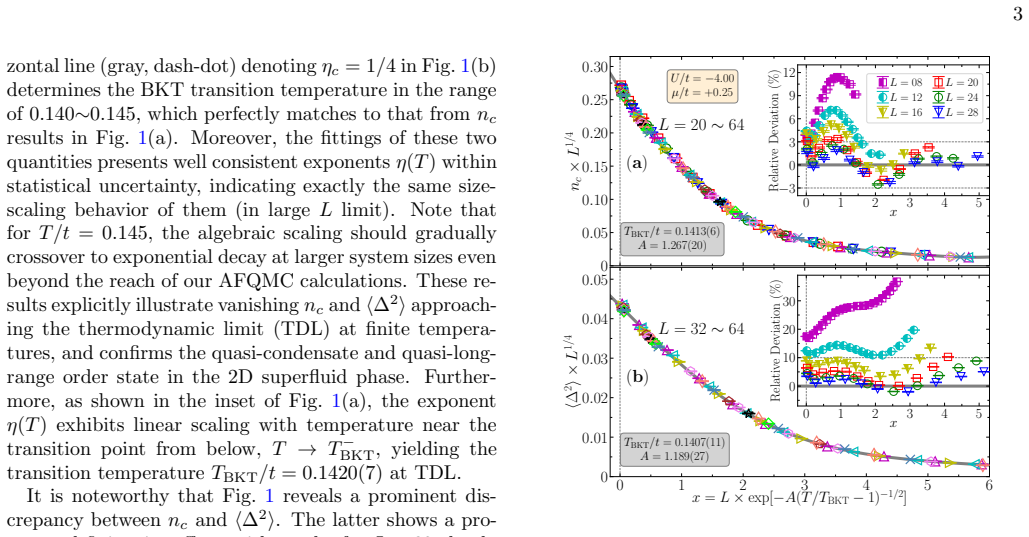
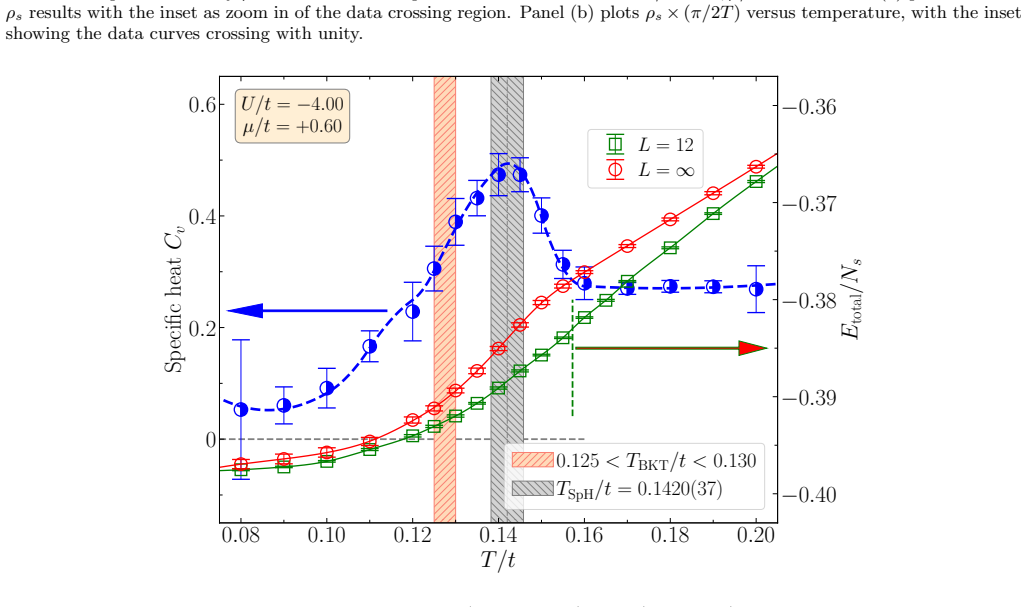
The central discovery is that the condensate fraction $n_c$, defined from the largest eigenvalue of the momentum-space pairing matrix, obeys the same algebraic size scaling as the pairing correlator in the quasi-ordered phase, $n_c \propto L^{-\eta}$ with $\eta \to 1/4$ at the transition, but with much smaller subleading corrections. Formally, the on-site pairing correlator carries a subleading $L^{-2}$ correction that dominates at the moderate sizes accessible to simulation, whereas $n_c$ includes Cooper pairs of all sizes and therefore scales cleanly from $L \approx 20$ upward. The crossover between algebraic and exponential scaling brackets the transition, and extrapolating the extracted exponent $\eta(T)$ to $\eta_c=1/4$ yields the transition temperature; the same $T_\mathrm{BKT}$ is obtained from data collapse and from the logarithmic finite-size scaling of $T_\mathrm{BKT}(L)$. The specific heat shows a peak slightly above the transition, at about $1.10\,T_\mathrm{BKT}$.
Load-bearing premise
The paper identifies the inflection point of the condensate-fraction temperature curve as the finite-size BKT transition temperature and extrapolates it using $T_\mathrm{BKT}(L) = T_\mathrm{BKT}(\infty) + a/(\ln bL)^2$ with $b$ fixed to 1; this mapping and fitting choice are heuristic and, if inappropriate, would shift the reported $T_\mathrm{BKT}$.
Editorial extensions
If this is right
- Accurate BKT temperatures can be extracted from lattices as small as $L=20$, roughly an order of magnitude cheaper than the sizes needed for the on-site pairing correlator.
- The scheme transfers directly to other 2D fermionic systems, including spin-orbit-coupled models and dilute Fermi gases, where the pairing correlator and superfluid density become vanishingly small.
- For 2D bosonic systems, the condensate fraction from the single-particle density matrix provides a competitive alternative to superfluid-density-based methods.
- The specific-heat anomaly at about $1.1\,T_\mathrm{BKT}$ gives experimentalists a precursor signature for locating the BKT transition in optical lattices.
- The logarithmic correction $T_\mathrm{BKT}(L) = T_\mathrm{BKT}(\infty) + a/(\ln bL)^2$ is confirmed for a correlated fermion system, supporting the BKT finite-size scenario.
Reading between the lines
- Because $n_c$ collects pairing weight at all momenta, the small finite-size corrections observed here may be generic for order parameters defined from the leading eigenvalue of a reduced density matrix, not special to the Hubbard model; testing this on the 2D XY model would separate the two possibilities.
- In dilute 2D Fermi gases, where both the pairing correlator and superfluid density vanish in finite systems, $n_c$ may be the only practical observable; a two-step extrapolation in $L$ and particle number, as outlined in the paper, could give the first unbiased $T_\mathrm{BKT}$ in the continuum limit.
- The inflection-point method, if validated against exactly solvable BKT models, could be automated as a black-box estimator for transition temperatures in future tensor-network and Monte Carlo studies of 2D superconducting and superfluid models.
Signed reviews
Editorial analysis
A structured set of objections, weighed in public.
Referee Report
Summary. The paper studies the 2D attractive Fermi-Hubbard model with finite-temperature auxiliary-field quantum Monte Carlo, reaching system sizes up to 64x64 (4096 sites). It defines the condensate fraction n_c from the largest eigenvalue of the momentum-space pairing matrix and shows numerically that n_c scales algebraically with L below the BKT transition and exponentially above it, with markedly smaller finite-size effects than the on-site pairing correlator. From the n_c scaling the paper extracts the BKT transition temperature for U/t=-4, mu/t=0.25 by three methods: linear extrapolation of the exponent eta(T) to eta_c=1/4, data collapse of n_c L^{1/4}, and extrapolation of finite-size transition temperatures T_BKT(L), yielding consistent values around T_BKT/t=0.142. A specific-heat anomaly with a peak near 1.10 T_BKT is also reported, and the methods are argued to be applicable to other 2D fermionic and bosonic superfluids.
Significance. If the central scaling claim holds, the condensate fraction provides a practical and accurate observable for determining BKT transitions in 2D correlated systems, with substantially smaller finite-size corrections than the widely used on-site pairing correlator. The paper's strengths include numerically exact simulations at unprecedented lattice sizes for this model, small statistical errors, extensive supplementary results for multiple fillings and interaction strengths, and a consistent cross-check of T_BKT across three independent fitting schemes. The claimed general applicability to other fermionic and bosonic systems is plausible but remains an extrapolation from the Hubbard-model evidence presented.
major comments (4)
- [Fig. 1(a); SM Sec. IIIE] The central claim that L>=20 is sufficient to determine T_BKT accurately is not quantitatively tested. The supplemental material explicitly states that for U/t=-4, mu/t=1.25 the condensate fraction shows finite-size effects for L<=28 (SM Sec. IIIE), yet for the main parameter set no stability analysis with respect to the minimum system size L_min is shown. All three T_BKT estimates use the scaling assumption with a chosen L_min (L>=20 for n_c in Fig. 1(a), L=20-64 for the data collapse in Fig. 2(a), and the n_c(T) inflection points in Fig. 3), so a systematic bias from residual finite-size corrections would shift all three estimates together. The paper should report how eta and T_BKT vary as L_min is changed (for example L_min=16, 20, 24, 28) and include this spread in the final uncertainty of T_BKT=0.1420(7).
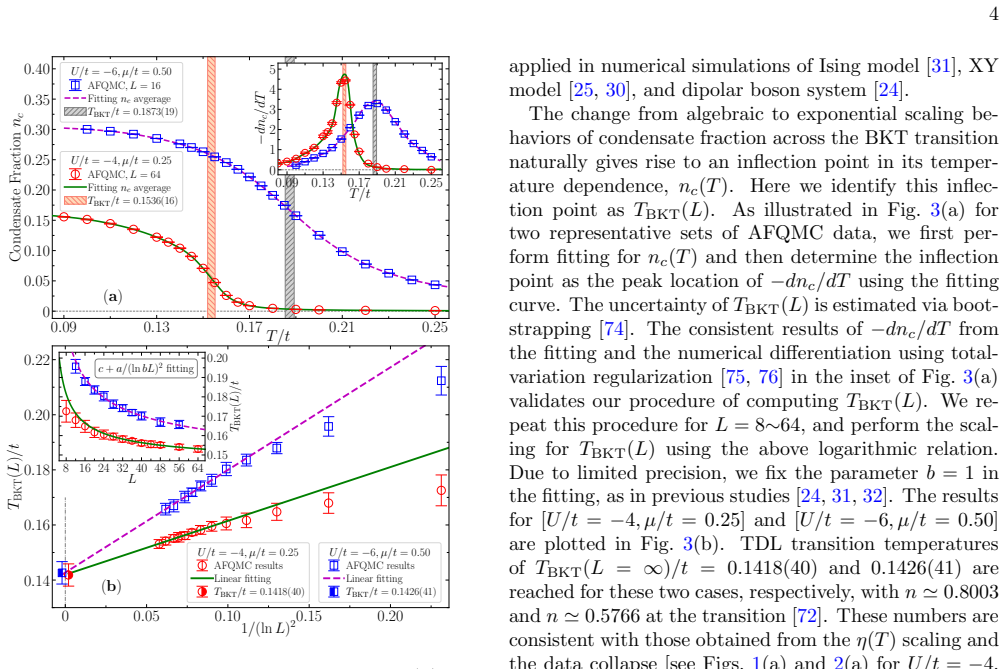
- [Fig. 3(a) and (b)] The identification of the inflection point of n_c(T) as the finite-size BKT transition temperature T_BKT(L) is heuristic and is not derived or independently justified. The agreement with the eta(T) scaling and data-collapse results is encouraging, but the logarithmic-correction extrapolation T_BKT(L)=T_BKT(infinity)+a/(ln bL)^2 and the associated claim that the logarithmic correction is 'confirmed' rest entirely on this mapping. The paper should either provide a derivation or a systematic comparison with alternative finite-size definitions of T_BKT(L), such as the crossing point of n_c L^{1/4} curves at eta=1/4. In addition, the reported error bars for T_BKT(infinity) from Fig. 3(b) exclude the fitting choice of fixing b=1; the inset with b free is mentioned as consistent, but the sensitivity should be quantified.
- [SM Eq. (13) and main text around Fig. 1] The paper derives the subleading L^{-2} correction for the on-site pairing correlator (SM Eq. 13), but no analogous derivation is given for the condensate fraction n_c. The main-text argument that n_c includes Cooper pairs of all sizes explains physically why local-pair fluctuations are reduced, but it does not rule out subleading corrections from momentum-space discretization or from the normalization lambda_max/(N/2). Because the central advantage of n_c over the pairing correlator is precisely its small finite-size corrections, this assumption is load-bearing for all three T_BKT estimates. The authors should either supply a derivation of the leading and subleading finite-size behavior of n_c or perform a direct multi-term fit (for example n_c = A L^{-eta} (1 + c L^{-2} + ...) with varying L_min) to demonstrate the absence of significant subleading terms for L>=20.
- [Inset of Fig. 1(a)] The linear extrapolation of eta(T) to eta_c=1/4 is described as a limit approached 'from below', but the text reports eta=0.304(2) at T/t=0.145, which is above the stated transition interval 0.140<T_BKT/t<0.145. If T/t=0.145 is included in the linear fit, the result would be biased by data that the paper itself says should be in the crossover regime to exponential decay. The manuscript should state exactly which temperatures enter the linear fit and justify the exclusion or inclusion of T/t=0.145.
minor comments (4)
- [Throughout] There are numerous typographical errors and misspellings, including 'attracive', 'diffrent', 'the the', 'inlcuding', 'questiones', 'capabilty', 'seperated', and 'tunning'. A careful proofreading pass is needed.
- [Fig. 3(b) and inset] The main text fixes b=1 in the formula T_BKT(L)=T_BKT(infinity)+a/(ln bL)^2, while the inset shows a fit using c+a/(ln bL)^2. The relationship between these parametrizations and why b=1 is the preferred choice should be stated more clearly.
- [Sec. IV (SM)] In the fixed-filling results, some statements such as 'the result of T_BKT/t ~ 0.10 should be obtained' for L=20 are not tied to a specific figure or table; giving the actual fitted value and its uncertainty would make the comparison quantitative.
- [Abstract and introduction] The phrase 'condensate fractionscaling' is broken across a line in the abstract and appears without a space in several places; this is a formatting issue, not a substantive one.
Circularity Check
No significant circularity: BKT scaling forms are external templates, TBKT values are fits to directly measured condensate-fraction data, and the central scaling/finite-size claims are empirical observations with independent cross-checks.
full rationale
The paper does not claim to derive BKT theory from the condensate fraction; it imports standard BKT scaling forms as external inputs — ηc = 1/4, the correlation-length scaling variable x = L exp[−A(T/TBKT − 1)^−1/2], and the logarithmic finite-size correction TBKT(L) = TBKT(∞) + a/(ln bL)^2 — and applies them to a directly measured observable, nc = λmax/(N/2), defined via the leading eigenvalue of the pairing matrix. The algebraic-versus-exponential scaling of nc is read directly from log-log plots, and the exponent η(T) is extracted without using TBKT as an input. The three TBKT estimates are outputs of fits within BKT theory, not renamed fit parameters: the η(T) linear extrapolation uses measured η values and the external critical value ηc = 1/4; the data collapse uses fixed ηc = 1/4 and a fitted TBKT that must make the data collapse onto a single curve; and the TBKT(L) extrapolation uses the inflection point of the measured nc(T) and the standard logarithmic form. These procedures are consistency checks against BKT theory, not self-referential reductions. The claim of reduced finite-size effects is also empirical: the paper compares power-law fits for L ≥ 20 (nc) versus L ≥ 32 (⟨Δ2⟩), with relative deviations of about 3% versus 10% at L = 20, and this is not a fitted-input-called-prediction. Self-citations (e.g., Refs. [42, 43, 60]) supply methodology and prior applications, not the load-bearing justification for the current scaling result; the subleading L^−2 correction for ⟨Δ2⟩ is derived within the Supplemental Material (SM Eq. 13), not merely cited. Heuristic choices such as identifying the inflection point of nc(T) as TBKT(L) and fixing b = 1 are systematic-uncertainty/correctness risks rather than circularity, because the paper provides independent cross-checks with ⟨Δ2⟩ scaling, superfluid density, and the bounded range 0.140 < TBKT/t < 0.145. Overall, the central derivation chain is self-contained and externally benchmarked; no step reduces to its own input by construction.
Assumptions & free parameters
free parameters (4)
- Amplitude A in BKT scaling variable =
1.267(20) for U/t=-4, μ/t=0.25 (Fig. 2a); other values in supplemental
- Coefficient a in TBKT(L) log-correction =
Not quoted explicitly (fitted in Fig. 3b)
- Constant b in TBKT(L) log-correction =
1 (fixed by hand)
- Polynomial coefficients for f(x) in data collapse =
Not reported
assumptions (6)
- domain assumption BKT theory: algebraic decay with exponent η ≤ 1/4 below the transition, η = 1/4 at TBKT
- domain assumption Nelson-Kosterlitz universal jump: ρs(T→TBKT-) = 2TBKT/π
- domain assumption BKT finite-size scaling form: ⟨Δ²⟩L^{1/4} = f(L exp[-A(T/TBKT-1)^{-1/2}])
- domain assumption Logarithmic finite-size correction: TBKT(L) = TBKT(∞) + a/(ln bL)^2
- ad hoc to paper Condensate fraction has the same leading scaling exponent as the on-site pairing correlator
- standard math Trotter error is eliminated by Δτ→0 extrapolation
Cite this review
Pith. "Pith review of Condensate Fraction Scaling and Berezinskii-Kosterlitz-Thouless Transition of Superconductivity and Superfluidity." pith.science (2026). https://pith.science/paper/B7I5YFN2
@misc{pith2026250517411,
  author       = {Pith},
  title        = {Pith review of: Condensate Fraction Scaling and Berezinskii-Kosterlitz-Thouless Transition of Superconductivity and Superfluidity},
  year         = {2026},
  howpublished = {\url{https://pith.science/paper/B7I5YFN2}},
  note         = {Machine review of arXiv:2505.17411}
}
abstract
Characterizing the superconducting and superfluid transitions in two-dimensional (2D) many-body systems is of broad interest and remains a fundamental issue. In this study, we establish the {\it condensate fraction} scaling as a highly efficient tool to achieve that and accordingly propose efficient schemes to accurately determine the associated Berezinskii-Kosterlitz-Thouless (BKT) transitions. Using the 2D attractive Fermi-Hubbard model as a testbed and applying numerically exact auxiliary-field quantum Monte Carlo simulations, we access unprecedented system sizes (up to $64\times 64 = 4096$ lattice sites) and perform a comprehensive analysis for the temperature dependence and finite-size scaling of {\it condensate fraction} across the BKT transition. We demonstrate that this quantity exhibits algebraic scaling below the transition and exponential scaling above it, with significantly reduced finite-size effects comparing to the extensively studied on-site pairing correlator. This greatly improves the determination of BKT transition using moderate system sizes. We also extract finite-size BKT transition temperature from condensate fraction, and confirm its logarithmic correction on system size. Based on the accurately determined transition, we reveal that the specific heat displays an anomaly, showing a peak at a temperature slightly above BKT transition. Our findings should be generally applicable to 2D fermionic and bosonic systems hosting superconductivity or superfluidity.
Figures

Figures from the paper (19 more)




Forward citations
Cited by 1 Pith paper
-
In search of exotic pairing in the Hubbard model: many-body computation and quantum gas microscopy
Low-temperature signatures of finite-momentum (FFLO) pairing are predicted to appear at T/t = 1/3 in the spin-imbalanced attractive 2D Hubbard model, within reach of current cold-atom experiments, with an in-plane spi...
Reference graph
Works this paper leans on
-
[1]
V. L. Berezinsky, Destruction of Long-range Order in One-dimensional and Two-dimensional Systems Possess- ing a Continuous Symmetry Group. II. Quantum Sys- tems., Sov. Phys. JETP 34, 610 (1972)
1972
-
[2]
J. M. Kosterlitz and D. J. Thouless, Ordering, metasta- bility and phase transitions in two-dimensional systems, Journal of Physics C: Solid State Physics 6, 1181 (1973). 6
work page 1973
-
[3]
J. M. Kosterlitz, The critical properties of the two- dimensional xy model, Journal of Physics C: Solid State Physics 7, 1046 (1974)
1974
-
[4]
V. N. Ryzhov, E. E. Tareyeva, Y. D. Fomin, and E. N. Tsiok, Berezinskii-Kosterlitz-Thouless transition and two-dimensional melting, Physics Uspekhi 60, 857 (2017)
work page 2017
-
[5]
D. R. Nelson and J. M. Kosterlitz, Universal jump in the superfluid density of two-dimensional superfluids, Phys. Rev. Lett. 39, 1201 (1977)
1977
-
[6]
D. J. Bishop and J. D. Reppy, Study of the superfluid transition in two-dimensional 4He films, Phys. Rev. Lett. 40, 1727 (1978)
work page 1978
-
[7]
D. M. Ceperley and E. L. Pollock, Path-integral simula- tion of the superfluid transition in two-dimensional 4He, Phys. Rev. B 39, 2084 (1989)
work page 1989
-
[8]
M. R. Beasley, J. E. Mooij, and T. P. Orlando, Possibility of vortex-antivortex pair dissociation in two-dimensional superconductors, Phys. Rev. Lett. 42, 1165 (1979)
work page 1979
Show all 81 references
-
[9]
A. F. Hebard and A. T. Fiory, Evidence for the kosterlitz- thouless transition in thin superconducting aluminum films, Phys. Rev. Lett. 44, 291 (1980)
1980
-
[10]
S. A. Wolf, D. U. Gubser, W. W. Fuller, J. C. Garland, and R. S. Newrock, Two-dimensional phase transition in granular nbn films, Phys. Rev. Lett. 47, 1071 (1981)
1981
-
[11]
Hadzibabic, P
Z. Hadzibabic, P. Kr¨ uger, M. Cheneau, B. Battelier, and J. Dalibard, Berezinskii–kosterlitz–thouless crossover in a trapped atomic gas, Nature 441, 1118 (2006)
2006
-
[12]
Clad´ e, C
P. Clad´ e, C. Ryu, A. Ramanathan, K. Helmerson, and W. D. Phillips, Observation of a 2d bose gas: From ther- mal to quasicondensate to superfluid, Phys. Rev. Lett. 102, 170401 (2009)
2009
-
[13]
J.-y. Choi, S. W. Seo, and Y.-i. Shin, Observation of ther- mally activated vortex pairs in a quasi-2d bose gas, Phys. Rev. Lett. 110, 175302 (2013)
2013
-
[14]
M. G. Ries, A. N. Wenz, G. Z¨ urn, L. Bayha, I. Boettcher, D. Kedar, P. A. Murthy, M. Neidig, T. Lompe, and S. Jochim, Observation of pair condensation in the quasi- 2d bec-bcs crossover, Phys. Rev. Lett. 114, 230401 (2015)
2015
-
[15]
P. A. Murthy, I. Boettcher, L. Bayha, M. Holzmann, D. Kedar, M. Neidig, M. G. Ries, A. N. Wenz, G. Z¨ urn, and S. Jochim, Observation of the berezinskii-kosterlitz- thouless phase transition in an ultracold fermi gas, Phys. Rev. Lett. 115, 010401 (2015)
2015
-
[16]
Sunami, V
S. Sunami, V. P. Singh, D. Garrick, A. Beregi, A. J. Barker, K. Luksch, E. Bentine, L. Mathey, and C. J. Foot, Observation of the berezinskii-kosterlitz-thouless transi- tion in a two-dimensional bose gas via matter-wave in- terferometry, Phys. Rev. Lett. 128, 250402 (2022)
2022
-
[17]
Bohlen, L
M. Bohlen, L. Sobirey, N. Luick, H. Biss, T. Enss, T. Lompe, and H. Moritz, Sound propagation and quantum-limited damping in a two-dimensional fermi gas, Phys. Rev. Lett. 124, 240403 (2020)
2020
-
[18]
Sobirey, N
L. Sobirey, N. Luick, M. Bohlen, H. Biss, H. Moritz, and T. Lompe, Observation of superfluidity in a strongly correlated two-dimensional fermi gas, Science 372, 844 (2021)
2021
-
[19]
Christodoulou, M
P. Christodoulou, M. Ga lka, N. Dogra, R. Lopes, J. Schmitt, and Z. Hadzibabic, Observation of first and second sound in a bkt superfluid, Nature594, 191 (2021)
2021
-
[20]
Sobirey, H
L. Sobirey, H. Biss, N. Luick, M. Bohlen, H. Moritz, and T. Lompe, Observing the influence of reduced dimen- sionality on fermionic superfluids, Phys. Rev. Lett. 129, 083601 (2022)
2022
-
[21]
Arisue, High-temperature expansion of the magnetic susceptibility and higher moments of the correlation function for the two-dimensional xy model, Phys
H. Arisue, High-temperature expansion of the magnetic susceptibility and higher moments of the correlation function for the two-dimensional xy model, Phys. Rev. E 79, 011107 (2009)
2009
-
[22]
C. Chatelain, Dmrg study of the berezin- skii–kosterlitz–thouless transitions of the 2d five-state clock model, Journal of Statistical Mechanics: Theory and Experiment 2014, P11022 (2014)
2014
-
[23]
Ueda and M
A. Ueda and M. Oshikawa, Resolving the berezinskii- kosterlitz-thouless transition in the two-dimensional xy model with tensor-network-based level spectroscopy, Phys. Rev. B 104, 165132 (2021)
2021
-
[24]
Filinov, N
A. Filinov, N. V. Prokof’ev, and M. Bonitz, Berezinskii- kosterlitz-thouless transition in two-dimensional dipole systems, Phys. Rev. Lett. 105, 070401 (2010)
2010
-
[25]
Tomita and Y
Y. Tomita and Y. Okabe, Probability-changing cluster al- gorithm for two-dimensional XY and clock models, Phys. Rev. B 65, 184405 (2002)
2002
-
[26]
Tobochnik and G
J. Tobochnik and G. V. Chester, Monte carlo study of the planar spin model, Phys. Rev. B 20, 3761 (1979)
1979
-
[27]
S. Ota, S. B. Ota, and M. Fahnle, Microcanonical monte carlo simulations for the two-dimensional xy model, Jour- nal of Physics: Condensed Matter 4, 5411 (1992)
1992
-
[28]
Ota and S
S. Ota and S. Ota, Vortices in the 2d classical xy-model: a microcanonical monte carlo simulation study, Physics Letters A 206, 133 (1995)
1995
-
[29]
Gupta and C
R. Gupta and C. F. Baillie, Critical behavior of the two- dimensional xy model, Phys. Rev. B 45, 2883 (1992)
1992
-
[30]
P. H. Nguyen and M. Boninsegni, Superfluid transition and specific heat of the 2d x-y model: Monte carlo simulation, Applied Sciences 11, 10.3390/app11114931 (2021)
2021 doi
-
[31]
W.-Y. Su, F. Hu, C. Cheng, and N. Ma, Berezinskii- kosterlitz-thouless phase transitions in a kagome spin ice by a quantifying monte carlo process: Distribution of hamming distances, Phys. Rev. B 108, 134422 (2023)
2023
-
[32]
A. W. Sandvik, Computational Studies of Quantum Spin Systems, AIP Conference Proceedings 1297, 135 (2010)
2010
-
[33]
R. T. Scalettar, E. Y. Loh, J. E. Gubernatis, A. Moreo, S. R. White, D. J. Scalapino, R. L. Sugar, and E. Dagotto, Phase diagram of the two-dimensional negative-u hubbard model, Phys. Rev. Lett. 62, 1407 (1989)
1989
-
[34]
Moreo and D
A. Moreo and D. J. Scalapino, Two-dimensional negative- u hubbard model, Phys. Rev. Lett. 66, 946 (1991)
1991
-
[35]
J. M. Singer, M. H. Pedersen, T. Schneider, H. Beck, and H.-G. Matuttis, From bcs-like superconductivity to condensation of local pairs: A numerical study of the attractive hubbard model, Phys. Rev. B 54, 1286 (1996)
1996
-
[36]
Paiva, R
T. Paiva, R. R. dos Santos, R. T. Scalettar, and P. J. H. Denteneer, Critical temperature for the two-dimensional attractive hubbard model, Phys. Rev. B 69, 184501 (2004)
2004
-
[37]
Nakano and K
T. Nakano and K. Kuroki, Quantum monte carlo study of the superconducting kosterlitz-thouless transition of the attractive hubbard model on a triangular lattice, Phys. Rev. B 74, 174502 (2006)
2006
-
[38]
Paiva, R
T. Paiva, R. Scalettar, M. Randeria, and N. Trivedi, Fermions in 2d optical lattices: Temperature and entropy scales for observing antiferromagnetism and superfluid- ity, Phys. Rev. Lett. 104, 066406 (2010)
2010
-
[39]
R. A. Fontenele, N. C. Costa, R. R. dos Santos, and T. Paiva, Two-dimensional attractive hubbard model and 7 the bcs-bec crossover, Phys. Rev. B 105, 184502 (2022)
2022
-
[40]
X. Zhu, W. Han, S. Feng, and H. Guo, Quantum monte carlo study of the attractive kagome-lattice hubbard model, Phys. Rev. Res. 5, 023037 (2023)
2023
-
[41]
Wang and Y
X.-C. Wang and Y. Qi, Phase fluctuations in two-dimensional superconductors and pseudogap phe- nomenon, Phys. Rev. B 107, 224502 (2023)
2023
-
[42]
Y.-Y. He, H. Shi, and S. Zhang, Reaching the continuum limit in finite-temperature ab initio field-theory compu- tations in many-fermion systems, Phys. Rev. Lett. 123, 136402 (2019)
2019
-
[43]
Y.-Y. He, H. Shi, and S. Zhang, Precision many- body study of the berezinskii-kosterlitz-thouless transi- tion and temperature-dependent properties in the two- dimensional fermi gas, Phys. Rev. Lett. 129, 076403 (2022)
2022
-
[44]
D. J. Scalapino, S. R. White, and S. C. Zhang, Super- fluid density and the drude weight of the hubbard model, Phys. Rev. Lett. 68, 2830 (1992); D. J. Scalapino, S. R. White, and S. Zhang, Insulator, metal, or superconduc- tor: The criteria, Phys. Rev. B 47, 7995 (1993)
1992
-
[45]
C. N. Yang, Concept of off-diagonal long-range order and the quantum phases of liquid he and of superconductors, Rev. Mod. Phys. 34, 694 (1962)
1962
-
[46]
G. E. Astrakharchik, J. Boronat, J. Casulleras, and S. Giorgini, Momentum distribution and condensate frac- tion of a fermion gas in the bcs-bec crossover, Phys. Rev. Lett. 95, 230405 (2005)
2005
-
[47]
Fukushima, Y
N. Fukushima, Y. Ohashi, E. Taylor, and A. Griffin, Su- perfluid density and condensate fraction in the bcs-bec crossover regime at finite temperatures, Phys. Rev. A75, 033609 (2007)
2007
-
[48]
V. F. Sears and E. C. Svensson, Pair correlations and the condensate fraction in superfluid 4He, Phys. Rev. Lett. 43, 2009 (1979)
1979
-
[49]
M. W. Zwierlein, C. A. Stan, C. H. Schunck, S. M. F. Raupach, A. J. Kerman, and W. Ketterle, Condensation of pairs of fermionic atoms near a feshbach resonance, Phys. Rev. Lett. 92, 120403 (2004)
2004
-
[50]
Inada, M
Y. Inada, M. Horikoshi, S. Nakajima, M. Kuwata- Gonokami, M. Ueda, and T. Mukaiyama, Critical tem- perature and condensate fraction of a fermion pair con- densate, Phys. Rev. Lett. 101, 180406 (2008)
2008
-
[51]
M. J. H. Ku, A. T. Sommer, L. W. Cheuk, and M. W. Zwierlein, Revealing the superfluid lambda transition in the universal thermodynamics of a unitary fermi gas, Sci- ence 335, 563 (2012)
2012
-
[52]
Giorgini, L
S. Giorgini, L. P. Pitaevskii, and S. Stringari, Condensate fraction and critical temperature of a trapped interacting bose gas, Phys. Rev. A 54, R4633 (1996)
1996
-
[53]
Salasnich, N
L. Salasnich, N. Manini, and A. Parola, Condensate frac- tion of a fermi gas in the bcs-bec crossover, Phys. Rev. A 72, 023621 (2005)
2005
-
[54]
Dell’Anna, G
L. Dell’Anna, G. Mazzarella, and L. Salasnich, Conden- sate fraction of a resonant fermi gas with spin-orbit cou- pling in three and two dimensions, Phys. Rev. A 84, 033633 (2011)
2011
-
[55]
R. He, N. Li, B.-N. Lu, and D. Lee, Superfluid condensate fraction and pairing wave function of the unitary fermi gas, Phys. Rev. A 101, 063615 (2020)
2020
-
[56]
Jensen, C
S. Jensen, C. N. Gilbreth, and Y. Alhassid, Pairing corre- lations across the superfluid phase transition in the uni- tary fermi gas, Phys. Rev. Lett. 124, 090604 (2020)
2020
-
[57]
Richie-Halford, J
A. Richie-Halford, J. E. Drut, and A. Bulgac, Emergence of a pseudogap in the bcs-bec crossover, Phys. Rev. Lett. 125, 060403 (2020)
2020
-
[58]
de Koning, W
M. de Koning, W. Cai, C. Cazorla, and J. Boronat, Ab- sence of off-diagonal long-range order in hcp 4He dislo- cation cores, Phys. Rev. Lett. 130, 016001 (2023)
2023
-
[59]
Salasnich, Condensate fraction of a two-dimensional attractive fermi gas, Phys
L. Salasnich, Condensate fraction of a two-dimensional attractive fermi gas, Phys. Rev. A 76, 015601 (2007)
2007
-
[60]
H. Shi, S. Chiesa, and S. Zhang, Ground-state proper- ties of strongly interacting fermi gases in two dimensions, Phys. Rev. A 92, 033603 (2015)
2015
-
[61]
H. Shi, P. Rosenberg, S. Chiesa, and S. Zhang, Rashba spin-orbit coupling, strong interactions, and the bcs-bec crossover in the ground state of the two-dimensional fermi gas, Phys. Rev. Lett. 117, 040401 (2016)
2016
-
[62]
C. N. Yang, η pairing and off-diagonal long-range order in a hubbard model, Phys. Rev. Lett. 63, 2144 (1989)
1989
-
[63]
D. K. Mark and O. I. Motrunich, η-pairing states as true scars in an extended hubbard model, Phys. Rev. B 102, 075132 (2020)
2020
-
[64]
Hille, F
C. Hille, F. B. Kugler, C. J. Eckhardt, Y.-Y. He, A. Kauch, C. Honerkamp, A. Toschi, and S. Andergassen, Quantitative functional renormalization group descrip- tion of the two-dimensional hubbard model, Phys. Rev. Res. 2, 033372 (2020)
2020
-
[65]
Blankenbecler, D
R. Blankenbecler, D. J. Scalapino, and R. L. Sugar, Monte carlo calculations of coupled boson-fermion sys- tems. i, Phys. Rev. D 24, 2278 (1981)
1981
-
[66]
J. E. Hirsch, Discrete hubbard-stratonovich transforma- tion for fermion lattice models, Phys. Rev. B 28, 4059 (1983)
1983
-
[67]
S. R. White, D. J. Scalapino, R. L. Sugar, E. Y. Loh, J. E. Gubernatis, and R. T. Scalettar, Numerical study of the two-dimensional hubbard model, Phys. Rev. B 40, 506 (1989)
1989
-
[68]
R. T. Scalettar, R. M. Noack, and R. R. P. Singh, Er- godicity at large couplings with the determinant monte carlo algorithm, Phys. Rev. B 44, 10502 (1991)
1991
-
[69]
McDaniel, E
T. McDaniel, E. F. D’Azevedo, Y. W. Li, K. Wong, and P. R. C. Kent, Delayed Slater determinant update al- gorithms for high efficiency quantum Monte Carlo, The Journal of Chemical Physics 147, 174107 (2017)
2017
-
[70]
Y.-Y. He, M. Qin, H. Shi, Z.-Y. Lu, and S. Zhang, Finite-temperature auxiliary-field quantum monte carlo: Self-consistent constraint and systematic approach to low temperatures, Phys. Rev. B 99, 045108 (2019)
2019
-
[71]
Y.-F. Song, Y. Deng, and Y.-Y. He, Magnetic, ther- modynamic, and dynamical properties of the three- dimensional fermionic hubbard model: A comprehensive monte carlo study, Phys. Rev. B 111, 035123 (2025)
2025
-
[72]
See Supplemental Material at http://link.aps.org/supplemental/xxx for further discussions on AFQMC algorithm, other numerical re- sults of condensate fraction, on-site pairing correlation, superfluid density, and fermion filling as well as double occupancy
-
[73]
Hartke, B
T. Hartke, B. Oreg, C. Turnbaugh, N. Jia, and M. Zwier- lein, Direct observation of nonlocal fermion pairing in an attractive fermi-hubbard gas, Science 381, 82 (2023)
2023
-
[74]
Y.-F. Song, Y. Deng, and Y.-Y. He, Nature of the mixed- parity pairing of attractive fermions with spin-orbit cou- pling in an optical lattice, Phys. Rev. B 109, 094504 (2024)
2024
-
[75]
Chartrand, Numerical differentiation of noisy, nons- mooth data, ISRN Applied Mathematics 2011, 164564 8 (2011)
R. Chartrand, Numerical differentiation of noisy, nons- mooth data, ISRN Applied Mathematics 2011, 164564 8 (2011)
2011
-
[76]
Wietek, Y.-Y
A. Wietek, Y.-Y. He, S. R. White, A. Georges, and E. M. Stoudenmire, Stripes, antiferromagnetism, and the pseu- dogap in the doped hubbard model at finite temperature, Phys. Rev. X 11, 031007 (2021)
2021
-
[77]
Rosenberg, H
P. Rosenberg, H. Shi, and S. Zhang, Ultracold atoms in a square lattice with spin-orbit coupling: Charge order, superfluidity, and topological signatures, Phys. Rev. Lett. 119, 265301 (2017)
2017
-
[78]
[61, 74]
The seperated condensate fractions of singlet and triplet channels can be also extracted, and they can further elu- cidate their respective contributions to the overall mix- parity pairing, see Ref. [61, 74]
-
[79]
Ohgoe, T
T. Ohgoe, T. Suzuki, and N. Kawashima, Ground-state phase diagram of the two-dimensional extended bose- hubbard model, Phys. Rev. B 86, 054520 (2012)
2012
-
[80]
Boninsegni, N
M. Boninsegni, N. Prokof’ev, and B. Svistunov, Worm algorithm for continuous-space path integral monte carlo simulations, Phys. Rev. Lett. 96, 070601 (2006)
2006
-
[81]
Condensate Fraction Scaling and Specific Heat Anomaly around Berezinskii-Kosterlitz-Thouless Transition of Superconductivity and Superfluidity
D. M. Ceperley, Path integrals in the theory of condensed helium, Rev. Mod. Phys. 67, 279 (1995). 9 Supplementary Material for “Condensate Fraction Scaling and Specific Heat Anomaly around Berezinskii-Kosterlitz-Thouless Transition of Superconductivity and Superfluidity” I. OV...
1995
Reviewed August 7, 2026 · model on record in the stance chip above.
Discussion (0). Continue with ORCID to comment.