REVIEW 3 major objections 4 minor 47 references
Latent Imputation before Prediction: A New Computational Paradigm for De Novo Peptide Sequencing
T0 review · 3 major / 4 minor · reviewed 2026-08-07 · deepseek-v4-flash
Pith's one-line read LIPNovo demonstrates that imputing the latent representations of missing b/y fragment peaks before peptide prediction improves de novo sequencing across three benchmarks, reaching 0.797 amino acid precision on the Nine-species dataset.
desk verdict LIPNovo gets real gains on de novo sequencing benchmarks, but the paper hasn't shown the imputation content is what causes them — the ablations tangle the imputation module with extra decoder tokens. read the letter →
The pith
A machine-rendered reading of the paper's core claim, the machinery that carries it, and where it could break.
The reading
What carries the argument
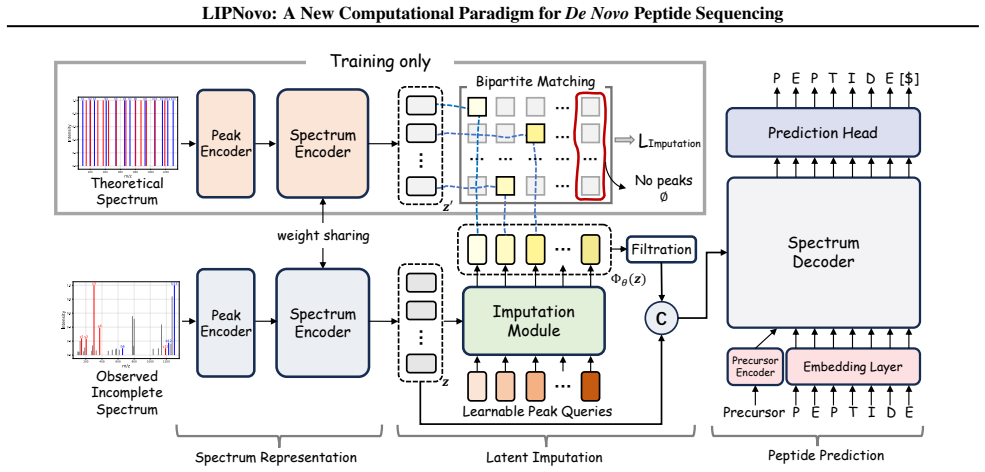
The central object is the latent imputation module $\Phi_\theta$: a transformer decoder with $M=100$ learnable peak queries that takes the observed spectrum representations $z$ as encoded memory and outputs candidate latent vectors plus confidence scores. Training uses a theoretical spectrum $z'$ built from the ground-truth peptide, assuming every b- and y-ion has charge $+1$ and constant intensity equal to the maximum observed intensity; optimal bipartite matching assigns each predicted vector to a theoretical peak or to $\varnothing$, and the imputation loss combines MSE on matched pairs with a cross-entropy term over assignments. This machinery makes missing-fragment recovery an explicit, end-to-end trainable objective before peptide decoding.
What would settle it
Train LIPNovo on spectra whose fragmentation is dominated by multiply charged ions or c/z ions, such as ETD data, and compare against the same baseline: if the imputation stage stops providing gains, or if the imputed latent vectors no longer match actual missing fragment identities when scored against true peak labels, the central claim is refuted. A cheaper check on existing data is to replace the constant-intensity, +1-charge theoretical spectrum with an empirically calibrated fragmentation model and see whether imputation quality and peptide accuracy improve or degrade.
Extended reading notes
Core claim
LIPNovo's central claim is that compensating for missing fragmentation before prediction, in latent space, is a better computational paradigm than asking an encoder-decoder model to work directly with incomplete spectra. The paper frames imputation as a set-prediction problem: a transformer decoder with a fixed set of learnable peak queries reads the observed spectrum representation and outputs candidate latent vectors, which are matched to the latent representations of theoretical b/y ions by optimal bipartite matching using the Hungarian algorithm. The imputation loss combines mean squared error on matched latent vectors with a classification term for predictions assigned to the empty set. During inference, the theoretical spectrum is discarded; the filtered imputed representations are concatenated with the observed spectrum representation and fed to the autoregressive peptide decoder. The result is consistent gains across all three benchmarks, with ablations showing that the imputation module contributes most of the improvement.
Load-bearing premise
The load-bearing assumption is that an idealized theoretical spectrum—every b/y ion present, singly charged, with a single uniform intensity—is a good training target for what real fragmentation should look like; if real instruments deviate systematically from that ideal, the imputation module is trained to fill in the wrong picture and the gains may not transfer.
Editorial extensions
If this is right
- Adding an explicit latent imputation stage before decoding becomes a viable design for de novo sequencing; the reported gains are +5.6%, +20.0%, and +11.2% amino acid precision over the retrained baseline on Nine-species, Seven-species, and HC-PT.
- Because the upper bound from using ground-truth theoretical representations is 0.939 amino acid precision, continued improvement of imputation quality is a concrete path to further sequencing gains.
- The imputation targets are derived from the same ground-truth peptides used for the sequence loss, so the paradigm can be dropped into existing encoder-decoder training pipelines without new annotations.
- The ablation and parameter-matched comparison imply that the gain comes from the imputation objective itself, not from added parameters, so comparable gains should require an explicit imputation mechanism rather than simply larger models.
Reading between the lines
- The same latent-imputation-before-prediction idea could extend to other sequencing tasks where a theoretical fragmentation target can be enumerated, such as oligonucleotide or glycan mass spectrometry.
- The idealized +1 b/y target is the main transfer risk; adapting the theoretical spectrum to instrument-specific fragmentation, for example including c/z ions or neutral losses, is a natural testable extension that would show whether the gains survive outside HCD-style data.
- High missing-fragmentation ratios above 0.8 show sharply reduced gains in the paper's own analysis, suggesting that this paradigm will need external priors or cross-sample information in the most degraded spectra.
- One could probe whether the imputed latents genuinely encode fragment identity by decoding them into peak-level m/z predictions or classifying them against true fragment types, a check the paper does not perform.
Editorial analysis
A structured set of objections, weighed in public.
Referee Report
Summary. LIPNovo introduces a latent-space imputation step for de novo peptide sequencing: after encoding the observed MS/MS spectrum, a transformer-decoder imputation module with learned peak queries predicts latent representations of an idealized theoretical b/y-ion spectrum; filtered imputed vectors are concatenated with the observed spectrum tokens and passed to an autoregressive peptide decoder. Training uses bipartite matching plus an imputation loss, and also supervises the decoder on the theoretical-spectrum context. Experiments on the Nine-species, Seven-species, and HC-PT datasets report state-of-the-art amino acid-, peptide-, and PTM-level results, together with leave-one-out cross-validation, hyperparameter sensitivity, missing-fragmentation-ratio analyses, and a parameter-matched baseline.
Significance. If the performance gains are attributable to the content of the imputed theoretical-peak representations, this is a meaningful advance: it offers a simple plug-in module for existing encoder-decoder architectures, with released code and consistent gains across three benchmark datasets. The paper also provides useful auxiliary evidence, including leave-one-out species generalization, a hyperparameter sensitivity study, and an oracle upper-bound analysis. However, the causal attribution to theoretical-peak imputation is not yet established, because none of the ablation or oracle conditions controls for the increased number of tokens presented to the peptide decoder. The central mechanistic claim therefore needs additional control experiments before the paper can support its strongest conclusion.
major comments (3)
- [Section 4.4, Table 5; Section 3.2.5, Eq. (7)] The ablations do not control for the number of tokens fed to the peptide decoder. Row 2 of Table 5 (baseline + complementary spectrum) passes only observed tokens, while rows 3-5 additionally concatenate up to M=100 imputation-module outputs filtered by the threshold in Eq. (7). The improvement from row 2 to row 3 (+1.1% amino acid precision) and from row 4 to row 5 (+1.5%) is therefore compatible with a model that benefits simply from additional context vectors, regardless of whether those vectors encode theoretical peaks. The oracle experiment in Figure 5 has the same confound, because substituting ground-truth theoretical representations also increases the token count. Please add control conditions that feed the same number of non-informative tokens (for example, random latent vectors, duplicated observed peaks, or additional complementary-spectrum embeddings) to the decoder; only if the imputed vectors content matters beyond token count can the paper claim that latent imputation drives the gain.
- [Section 4.4, Table 5] The claim that 'using the imputation mechanism alone leads to significant improvements' is based on row 4 versus row 1, but row 4 simultaneously adds the imputation module and the auxiliary cross-entropy loss LCE(z') from Eq. (9). Row 4 therefore does not isolate the imputation mechanism. The comparison that removes LCE(z') (row 3 versus row 2) shows only a +1.1% amino acid precision gain, and even that comparison is still subject to the token-count confound described above. Please report an ablation that adds LCE(z') to the baseline without imputation tokens, or otherwise orthogonalizes the auxiliary loss from the token-count increase.
- [Section 3.2.2, Eq. (3); Section 3.2.3, Eq. (4)] The imputation targets are generated under the assumptions that every theoretical fragment is singly charged and that its intensity equals the maximum observed intensity (I'_j = max{I_1, ..., I_N}). Real tandem mass spectra contain multiply charged ions, neutral losses, and internal ions, so this is an idealized target that may deviate systematically from the instrument's actual fragmentation behavior. The paper does not quantify how often singly charged b/y ions dominate in the three datasets, nor does it test transfer to data with different collision energies or instrument types. Please add a diagnostic (for example, the proportion of observed peaks attributable to singly charged b/y ions, or an evaluation on a dataset with substantial multi-charge fragmentation) to justify the target's validity for the claimed general paradigm.
minor comments (4)
- [Throughout] There are several typos and wording issues: 'w.r.tthe' in Section 1, 'tailed imputation training objective' in Figure 2 and Equation (9) should be 'tailored', and 'the fist M peaks' in Section 4.4 should be 'the first M peaks'.
- [Equation (5)] The indicator notation in Equation (5) is malformed as typeset; please use standard notation such as 1{z'_j not in empty-set} and 1{z'_j in empty-set} for clarity.
- [Figure 3] The peptide label in Figure 3 is hard to read (for example, 'PETIDP' in the inset); please enlarge and align the fragment labels with the sequence positions so that the b-ion and y-ion derivation is unambiguous.
- [Tables 1-3, 5, 6] All reported numbers are from single runs without variance estimates. Given that some improvements are small (for example, Table 6 shows differences of around 0.005, and Table 3 shows a PTM recall decrease on some species), please provide repeated-seed means and standard deviations for at least the main comparisons and core ablations.
Circularity Check
No significant circularity: imputation targets are training-only and test-time predictions use only observed spectra.
full rationale
The central derivation is not circular. The imputation targets z' are constructed from the ground-truth peptide sequence (Section 3.2.2, Eq. 3) and are used only during training; at inference 'the upper part is discarded, eliminating the need for the theoretical spectrum during testing' (Figure 2 caption and Remark 3.1). The peptide decoder is trained with LCE([z~; z]) + LCE(z') + L_Imputation (Eq. 9), but at test time the prediction uses only the observed-spectrum representations z and the imputed representations z~ produced by Phi_theta, with no ground-truth label reused. The upper-bound experiment in Figure 5 is explicitly labeled as an upper bound obtained by directly using ground-truth representations, so it is an oracle diagnostic rather than a claimed prediction. No fitted parameter is renamed as a prediction, no load-bearing argument rests on a self-citation, and no uniqueness theorem is imported from the authors' prior work. The ablations in Table 5 do alter decoder token count when the imputation module is added, which is a potential experimental confound, but that is a validity concern rather than a circularity: the reported gains are measured on held-out test spectra and are not forced by construction.
Assumptions & free parameters
free parameters (4)
- number of peak queries M =
100
- imputation filter threshold tau =
0.8
- imputation decoder layer count =
3
- theoretical peak intensity I'_j =
max observed intensity
assumptions (5)
- domain assumption Peptide fragmentation primarily produces b- and y-ions at charge +1.
- domain assumption A theoretical spectrum computed from the ground-truth peptide is a reasonable supervision target for imputation.
- domain assumption The same spectrum encoder can represent both observed and theoretical spectra in a shared latent space.
- domain assumption Missing fragmentation patterns are learnable across the training distribution.
- standard math Standard transformer self-attention and cross-attention are sufficient to model peak interactions.
Cite this review
Pith. "Pith review of Latent Imputation before Prediction: A New Computational Paradigm for De Novo Peptide Sequencing." pith.science (2026). https://pith.science/paper/L3F6IDSA
@misc{pith2026250517524,
  author       = {Pith},
  title        = {Pith review of: Latent Imputation before Prediction: A New Computational Paradigm for De Novo Peptide Sequencing},
  year         = {2026},
  howpublished = {\url{https://pith.science/paper/L3F6IDSA}},
  note         = {Machine review of arXiv:2505.17524}
}
read the original abstract
De novo peptide sequencing is a fundamental computational technique for ascertaining amino acid sequences of peptides directly from tandem mass spectrometry data, eliminating the need for reference databases. Cutting-edge models usually encode the observed mass spectra into latent representations from which peptides are predicted autoregressively. However, the issue of missing fragmentation, attributable to factors such as suboptimal fragmentation efficiency and instrumental constraints, presents a formidable challenge in practical applications. To tackle this obstacle, we propose a novel computational paradigm called \underline{\textbf{L}}atent \underline{\textbf{I}}mputation before \underline{\textbf{P}}rediction (LIPNovo). LIPNovo is devised to compensate for missing fragmentation information within observed spectra before executing the final peptide prediction. Rather than generating raw missing data, LIPNovo performs imputation in the latent space, guided by the theoretical peak profile of the target peptide sequence. The imputation process is conceptualized as a set-prediction problem, utilizing a set of learnable peak queries to reason about the relationships among observed peaks and directly generate the latent representations of theoretical peaks through optimal bipartite matching. In this way, LIPNovo manages to supplement missing information during inference and thus boosts performance. Despite its simplicity, experiments on three benchmark datasets demonstrate that LIPNovo outperforms state-of-the-art methods by large margins. Code is available at \href{https://github.com/usr922/LIPNovo}{https://github.com/usr922/LIPNovo}.
Figures


Figures from the paper (3 more)


Reference graph
Works this paper leans on
-
[1]
Aebersold, R. and Mann, M. Mass spectrometry-based proteomics. Nature, 422 0 (6928): 0 198--207, 2003
work page 2003
-
[2]
Bandeira, N., Pham, V., Pevzner, P., Arnott, D., and Lill, J. R. Automated de novo protein sequencing of monoclonal antibodies. Nature biotechnology, 26 0 (12): 0 1336--1338, 2008
work page 2008
-
[3]
Blackstock, W. P. and Weir, M. P. Proteomics: quantitative and physical mapping of cellular proteins. Trends in biotechnology, 17 0 (3): 0 121--127, 1999
work page 1999
-
[4]
End-to-end object detection with transformers
Carion, N., Massa, F., Synnaeve, G., Usunier, N., Kirillov, A., and Zagoruyko, S. End-to-end object detection with transformers. In European conference on computer vision, pp.\ 213--229. Springer, 2020
2020
-
[5]
B., Williams, W., van Beljouw, S
Eloff, K., Kalogeropoulos, K., Morell, O., Mabona, A., Jespersen, J. B., Williams, W., van Beljouw, S. P., Skwark, M., Laustsen, A. H., Brouns, S. J., et al. De novo peptide sequencing with instanovo: Accurate, database-free peptide identification for large scale proteomics experiments. bioRxiv, pp.\ 2023--08, 2023
work page 2023
-
[6]
Freitag, M. and Al-Onaizan, Y. Beam search strategies for neural machine translation. arXiv preprint arXiv:1702.01806, 2017
arXiv 2017
-
[7]
Generative adversarial networks
Goodfellow, I., Pouget-Abadie, J., Mirza, M., Xu, B., Warde-Farley, D., Ozair, S., Courville, A., and Bengio, Y. Generative adversarial networks. Communications of the ACM, 63 0 (11): 0 139--144, 2020
2020
-
[8]
Hayat, A. and Hasan, M. R. Claim your data: Enhancing imputation accuracy with contextual large language models. arXiv preprint arXiv:2405.17712, 2024
arXiv 2024
Show all 47 references
-
[9]
Contranovo: A contrastive learning approach to enhance de novo peptide sequencing
Jin, Z., Xu, S., Zhang, X., Ling, T., Dong, N., Ouyang, W., Gao, Z., Chang, C., and Sun, S. Contranovo: A contrastive learning approach to enhance de novo peptide sequencing. In Proceedings of the AAAI Conference on Artificial Intelligence, volume 38, pp.\ 144--152, 2024
2024
-
[10]
Kingma, D. P. Auto-encoding variational bayes. arXiv preprint arXiv:1312.6114, 2013
2013 arXiv
-
[11]
Kuhn, H. W. The hungarian method for the assignment problem. Naval research logistics quarterly, 2 0 (1-2): 0 83--97, 1955
1955
-
[12]
Deep learning
LeCun, Y., Bengio, Y., and Hinton, G. Deep learning. nature, 521 0 (7553): 0 436--444, 2015
2015
-
[13]
Predicting protein function from sequence and structure
Lee, D., Redfern, O., and Orengo, C. Predicting protein function from sequence and structure. Nature reviews molecular cell biology, 8 0 (12): 0 995--1005, 2007
2007
-
[14]
Comparison of the effects of imputation methods for missing data in predictive modelling of cohort study datasets
Li, J., Guo, S., Ma, R., He, J., Zhang, X., Rui, D., Ding, Y., Li, Y., Jian, L., Cheng, J., et al. Comparison of the effects of imputation methods for missing data in predictive modelling of cohort study datasets. BMC Medical Research Methodology, 24 0 (1): 0 41, 2024 a
2024
-
[15]
Method for incomplete and imbalanced data based on multivariate imputation by chained equations and ensemble learning
Li, J., Wang, Z., Wu, L., Qiu, S., Zhao, H., Lin, F., and Zhang, K. Method for incomplete and imbalanced data based on multivariate imputation by chained equations and ensemble learning. IEEE Journal of Biomedical and Health Informatics, 2024 b
2024
-
[16]
Relevant applications of generative adversarial networks in drug design and discovery: molecular de novo design, dimensionality reduction, and de novo peptide and protein design
Lin, E., Lin, C.-H., and Lane, H.-Y. Relevant applications of generative adversarial networks in drug design and discovery: molecular de novo design, dimensionality reduction, and de novo peptide and protein design. Molecules, 25 0 (14): 0 3250, 2020
2020
-
[17]
and Tsai, C.-F
Lin, W.-C. and Tsai, C.-F. Missing value imputation: a review and analysis of the literature (2006--2017). Artificial Intelligence Review, 53: 0 1487--1509, 2020
2006
-
[18]
Accurate de novo peptide sequencing using fully convolutional neural networks
Liu, K., Ye, Y., Li, S., and Tang, H. Accurate de novo peptide sequencing using fully convolutional neural networks. Nature Communications, 14 0 (1): 0 7974, 2023
2023
-
[19]
Peaks: powerful software for peptide de novo sequencing by tandem mass spectrometry
Ma, B., Zhang, K., Hendrie, C., Liang, C., Li, M., Doherty-Kirby, A., and Lajoie, G. Peaks: powerful software for peptide de novo sequencing by tandem mass spectrometry. Rapid communications in mass spectrometry, 17 0 (20): 0 2337--2342, 2003
2003
-
[20]
Recent advances in mass spectrometry based clinical proteomics: applications to cancer research
Macklin, A., Khan, S., and Kislinger, T. Recent advances in mass spectrometry based clinical proteomics: applications to cancer research. Clinical proteomics, 17 0 (1): 0 17, 2020
2020
-
[21]
Mitigating the missing-fragmentation problem in de novo peptide sequencing with a two-stage graph-based deep learning model
Mao, Z., Zhang, R., Xin, L., and Li, M. Mitigating the missing-fragmentation problem in de novo peptide sequencing with a two-stage graph-based deep learning model. Nature Machine Intelligence, 5 0 (11): 0 1250--1260, 2023
2023
-
[22]
McDonald, W. H. and Yates Iii, J. R. Shotgun proteomics and biomarker discovery. Disease markers, 18 0 (2): 0 99--105, 2002
2002
-
[23]
The impact of noise and missing fragmentation cleavages on de novo peptide identification algorithms
McDonnell, K., Howley, E., and Abram, F. The impact of noise and missing fragmentation cleavages on de novo peptide identification algorithms. Computational and Structural Biotechnology Journal, 20: 0 1402--1412, 2022
2022
-
[24]
I., Vitek, O., and Aebersold, R
Nesvizhskii, A. I., Vitek, O., and Aebersold, R. Analysis and validation of proteomic data generated by tandem mass spectrometry. Nature methods, 4 0 (10): 0 787--797, 2007
2007
-
[25]
B., Baker, M
Noor, Z., Ahn, S. B., Baker, M. S., Ranganathan, S., and Mohamedali, A. Mass spectrometry--based protein identification in proteomics—a review. Briefings in bioinformatics, 22 0 (2): 0 1620--1638, 2021
2021
-
[26]
K., Sun, F., White, A
Nowinski, A. K., Sun, F., White, A. D., Keefe, A. J., and Jiang, S. Sequence, structure, and function of peptide self-assembled monolayers. Journal of the American Chemical Society, 134 0 (13): 0 6000--6005, 2012
2012
-
[27]
Olsen, J. V. and Mann, M. Improved peptide identification in proteomics by two consecutive stages of mass spectrometric fragmentation. Proceedings of the National Academy of Sciences, 101 0 (37): 0 13417--13422, 2004
2004
-
[28]
H., Xin, L., Chen, X., Li, M., Shan, B., and Ghodsi, A
Qiao, R., Tran, N. H., Xin, L., Chen, X., Li, M., Shan, B., and Ghodsi, A. Computationally instrument-resolution-independent de novo peptide sequencing for high-resolution devices. Nature Machine Intelligence, 3 0 (5): 0 420--425, 2021
2021
-
[29]
Stekhoven, D. J. and B \"u hlmann, P. Missforest—non-parametric missing value imputation for mixed-type data. Bioinformatics, 28 0 (1): 0 112--118, 2012
2012
-
[30]
T., Bludau, I., Zeng, W.-F., Voytik, E., Ammar, C., Schessner, J
Strauss, M. T., Bludau, I., Zeng, W.-F., Voytik, E., Ammar, C., Schessner, J. P., Ilango, R., Gill, M., Meier, F., Willems, S., et al. Alphapept: a modern and open framework for ms-based proteomics. Nature Communications, 15 0 (1): 0 2168, 2024
2024
-
[31]
Deep learning versus conventional methods for missing data imputation: A review and comparative study
Sun, Y., Li, J., Xu, Y., Zhang, T., and Wang, X. Deep learning versus conventional methods for missing data imputation: A review and comparative study. Expert Systems with Applications, 227: 0 120201, 2023
2023
-
[32]
L., Smith, L
Tabb, D. L., Smith, L. L., Breci, L. A., Wysocki, V. H., Lin, D., and Yates, J. R. Statistical characterization of ion trap tandem mass spectra from doubly charged tryptic peptides. Analytical chemistry, 75 0 (5): 0 1155--1163, 2003
2003
-
[33]
H., Zhang, X., Xin, L., Shan, B., and Li, M
Tran, N. H., Zhang, X., Xin, L., Shan, B., and Li, M. De novo peptide sequencing by deep learning. Proceedings of the National Academy of Sciences, 114 0 (31): 0 8247--8252, 2017
2017
-
[34]
Uzozie, A. C. and Aebersold, R. Advancing translational research and precision medicine with targeted proteomics. Journal of proteomics, 189: 0 1--10, 2018
2018
-
[35]
Attention is all you need
Vaswani, A. Attention is all you need. Advances in Neural Information Processing Systems, 2017
2017
-
[36]
Recent developments in mass-spectrometry-based targeted proteomics of clinical cancer biomarkers
Wenk, D., Zuo, C., Kislinger, T., and Sepiashvili, L. Recent developments in mass-spectrometry-based targeted proteomics of clinical cancer biomarkers. Clinical Proteomics, 21 0 (1): 0 6, 2024
2024
-
[37]
R., Royston, P., and Wood, A
White, I. R., Royston, P., and Wood, A. M. Multiple imputation using chained equations: issues and guidance for practice. Statistics in medicine, 30 0 (4): 0 377--399, 2011
2011
-
[38]
A., Washburn, M
Wolters, D. A., Washburn, M. P., and Yates, J. R. An automated multidimensional protein identification technology for shotgun proteomics. Analytical chemistry, 73 0 (23): 0 5683--5690, 2001
2001
-
[39]
Xia, J., Chen, S., Zhou, J., Shan, X., Du, W., Gao, Z., Tan, C., Hu, B., Zheng, J., and Li, S. Z. Adanovo: Towards robust emph \ De Novo \ peptide sequencing in proteomics against data biases. In The Thirty-eighth Annual Conference on Neural Information Processing Systems, 2024
2024
-
[40]
Introducing -helixnovo for practical large-scale de novo peptide sequencing
Yang, T., Ling, T., Sun, B., Liang, Z., Xu, F., Huang, X., Xie, L., He, Y., Li, L., He, F., et al. Introducing -helixnovo for practical large-scale de novo peptide sequencing. Briefings in Bioinformatics, 25 0 (2): 0 bbae021, 2024
2024
-
[41]
R., Eng, J
Yates, J. R., Eng, J. K., and McCormack, A. L. Mining genomes: correlating tandem mass spectra of modified and unmodified peptides to sequences in nucleotide databases. Analytical chemistry, 67 0 (18): 0 3202--3210, 1995
1995
-
[42]
Yilmaz, M., Fondrie, W., Bittremieux, W., Oh, S., and Noble, W. S. De novo mass spectrometry peptide sequencing with a transformer model. In International Conference on Machine Learning, pp.\ 25514--25522. PMLR, 2022
2022
-
[43]
E., Bittremieux, W., Melendez, C
Yilmaz, M., Fondrie, W. E., Bittremieux, W., Melendez, C. F., Nelson, R., Ananth, V., Oh, S., and Noble, W. S. Sequence-to-sequence translation from mass spectra to peptides with a transformer model. Nature communications, 15 0 (1): 0 6427, 2024
2024
-
[44]
Nearest neighbor selection for iteratively knn imputation
Zhang, S. Nearest neighbor selection for iteratively knn imputation. Journal of Systems and Software, 85 0 (11): 0 2541--2552, 2012
2012
-
[45]
and Charoenphakdee, N
Zheng, S. and Charoenphakdee, N. Diffusion models for missing value imputation in tabular data. arXiv preprint arXiv:2210.17128, 2022
2022 arXiv
-
[46]
Zhou, J., Chen, S., Xia, J., Liu, S., Ling, T., Du, W., Liu, Y., Yin, J., and Li, S. Z. Novobench: Benchmarking deep learning-based emph \ De Novo \ sequencing methods in proteomics. In The Thirty-eight Conference on Neural Information Processing Systems Datasets and Benchmark...
2024
-
[47]
write newline
" write newline "" before.all 'output.state := FUNCTION n.dashify 't := "" t empty not t #1 #1 substring "-" = t #1 #2 substring "--" = not "--" * t #2 global.max substring 't := t #1 #1 substring "-" = "-" * t #2 global.max substring 't := while if t #1 #1 substring * t #2 gl...
Reviewed August 7, 2026 · model on record in the stance chip above.
Discussion (0). Sign in to comment.