REVIEW 2 major objections 3 minor 36 references
Equilibrium boundary conditions for vectorial multi-dimensional lattice Boltzmann schemes
T0 review · 2 major / 3 minor · reviewed 2026-08-07 · deepseek-v4-flash
Pith's one-line read This paper proves that filling ghost cells with equilibrium states makes monotone lattice Boltzmann schemes converge to the weak entropy solution of scalar hyperbolic conservation laws on bounded multi-dimensional domains.
desk verdict Real first convergence proof for LB with boundaries, but the bounded-domain version is asserted, not proved, and the entropy proof has a κ-range gap. read the letter →
The pith
A machine-rendered reading of the paper's core claim, the machinery that carries it, and where it could break.
The reading
What carries the argument
The machinery is the equilibrium bridge f_i^eq(u) between macroscopic data and mesoscopic distribution functions, together with the two-relaxation-times collision operator and the monotonicity condition (17). The consistency of the equilibria with the fluxes, expressed in (9), is what allows boundary data to be injected through f_i^eq without breaking conservation. The proof combines a maximum principle, ℓ1-contractivity of relaxation, L1 and total variation estimates, equicontinuity, and a geometric relaxation estimate showing the solution stays within O(Δx) of equilibrium; the entropy argument then uses Krushkov-type entropies defined as |f_i - f_i^eq(κ)| and a boundary trace inequality that follows from the monotonicity and consistency of the equilibria.
What would settle it
Run the monotone D2Q5 scheme on (0,1)^2 with zero initial data and incompatible boundary data on the west and south walls, such as a constant value 1 on the west and a constant value -1 on the south, and check whether the total variation of the reconstructed distribution functions at a fixed time remains bounded independently of the grid size as Δx → 0; if it grows without bound, or if the limiting solution violates the boundary entropy inequality near the corner, the bounded-domain form of the theorem fails.
Extended reading notes
Core claim
The central claim is that equilibrium boundary conditions, in which each incoming distribution just outside the domain is set to the equilibrium evaluated at the prescribed boundary trace, make monotone two-relaxation-times D2Q5 lattice Boltzmann schemes convergent for scalar hyperbolic conservation laws on multi-dimensional domains. Under condition (17), the scheme satisfies a maximum principle, is ℓ1-contractive in relaxation, admits L1 and total variation bounds controlled by the data, is equicontinuous in time, and its distribution functions stay within O(Δx) of equilibrium. These ingredients yield a subsequence converging in L∞-in-time and L1-in-space to a limit u that is at equilibrium and satisfies the weak entropy inequality with boundary trace terms. The convergence holds regardless of whether the boundary is an inflow or an outflow, and simpler stencils and relaxation models are included as limiting cases.
Load-bearing premise
The theorem is proved on an unbounded quarter-plane with only two boundary walls, while the finite square with four walls and corners is handled by an unproved assertion in Section 2.6 that the same estimates carry over.
Editorial extensions
If this is right
- Lattice Boltzmann schemes with equilibrium ghost-cell boundary conditions are convergent solvers for scalar hyperbolic conservation laws on bounded domains, so this classical 'wet-node' approach gains a rigorous theoretical foundation.
- The boundary treatment does not need to detect inflow versus outflow: stability and convergence hold for both, matching the fact that the macroscopic PDE only requires data along incoming characteristics.
- The monotonicity conditions derived here give explicit parameter constraints on relaxation rates and lattice coefficients that guarantee safe boundary behavior; violating them is linked to boundary layers or oscillations.
- The proof covers D1Q2, D1Q3, D2Q4, and BGK variants as limiting cases, so the result transfers to a family of practical schemes by reducing the stencil or setting relaxation parameters equal.
- The O(Δx) closeness to equilibrium supports using equilibria for initialization as well as for boundary data, and the entropy dissipation near boundaries is inherited from the bulk relaxation property.
Reading between the lines
- If the asserted extension to the finite square with corners is completed, the same compactness framework should yield convergence with all four walls active, provided a corner-aware trace inequality controls the two incoming directions simultaneously.
- The linear boundary-layer analysis for wrong outflow traces suggests that, in smooth-data regimes, the Lp boundary-layer error scales as O(Δx^{1/p}), which would dominate for p > 1; this sharp rate could be tested experimentally for nonlinear scalar problems.
- The numerical success for the Euler system hints that equilibrium boundary conditions may also be convergent for systems under analogous spectral or entropy-stability conditions, but the proof in the vectorial case remains open.
- Because the equilibrium bridge depends only on macroscopic data, the same ghost-cell closure could be applied to other kinetic or relaxation schemes, with monotonicity-like constraints playing the role of the sub-characteristic condition.
Editorial analysis
A structured set of objections, weighed in public.
Referee Report
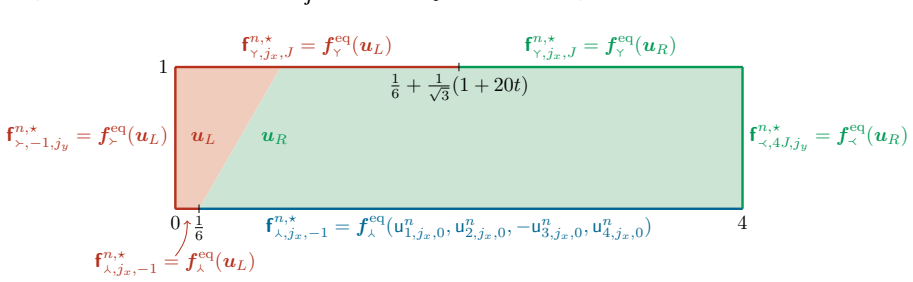
Summary. The paper proposes equilibrium-based boundary conditions for vectorial multi-dimensional lattice Boltzmann schemes and studies their behavior. In the scalar case, for monotone two-relaxation-times D2Q5 schemes satisfying condition (17), the authors prove on the quarter plane (R_+*)^2 that the numerical solution is L1-stable, equicontinuous in time, uniformly bounded in total variation, and within O(Delta x) of the equilibrium manifold. Combining these estimates in the Crandall-Majda framework, they obtain convergence up to subsequence in L∞_t L1_x to a limit u that is at equilibrium, and they claim in Theorem 4 that this limit satisfies the Bardos-Leroux-Nédelec weak entropy inequality stated in Definition 1 on the bounded square (0,1)^2. The paper also contains numerical experiments for scalar problems and for the Euler equations, including a double Mach-10 reflection.
Significance. If the proof were complete, the paper would provide the first convergence result for lattice Boltzmann schemes with non-periodic boundary conditions for weak solutions of hyperbolic conservation laws. The quarter-plane estimates are written out in detail, the '♭-procedure' is a clean device for bounding sums of equilibrium differences, and the numerical section demonstrates that the proposed boundary conditions work on demanding test cases. However, the advertised central claim is the bounded-domain statement of Theorem 4, and that statement is not actually proved: the paper proves its estimates only on the quarter plane with two boundaries, and the entropy proof applies Proposition 8 to equilibrium states that may lie outside the allowed box K. These gaps are load-bearing and must be fixed before the main result can be accepted.
major comments (2)
- [Section 2.6 and Theorems 3-4] The convergence and entropy theorems are proved on the quarter plane (R_+*)^2 with only western and southern boundary conditions, while the paper's central claim is convergence to the Bardos-Leroux-Nédelec weak entropy solution of Definition 1 on the bounded square (0,1)^2 with four boundary segments. Section 2.6 merely asserts that 'analogous properties and estimates hold for the numerical scheme on (0,1)^2' without any proof. Passing to the square requires additional L1, equicontinuity, and total-variation estimates with data on all four walls, trace inequalities on the eastern and northern walls where the entropy boundary terms carry opposite signs, and control of the four corner cells in the entropy proof (for instance, the north-east analogue of Eq. (35), where two boundary equilibria stream into the same cell). None of these estimates are written out, so Theorem 4 as stated is unsupported.
- [Section 2.11, proof of Theorem 4] The entropy inequality is claimed for all κ ∈ R, but the proof applies Proposition 8 to the tuple f_eq(κ). Proposition 8 is stated only for arguments in K = ∏_p [f_eq_p(-u∞), f_eq_p(u∞)], and by the monotonicity of the equilibria (Proposition 6), f_eq(κ) is not in K when |κ| > u∞. The proof does not justify the ℓ1-contractivity inequality for such κ, nor does it explain how the full BLN inequality for all κ follows from the range κ ∈ [-u∞,u∞]. The entropy proof is therefore incomplete even on the quarter plane.
minor comments (3)
- [Eq. (28)] In the display after Eq. (28), the term |f^{n,*}_{6,1,j_y} - f^{eq}_i(tilde u^n_{,j_y})| should read |f^{n,*}_{6,1,j_y} - f^{eq}_6(tilde u^n_{,j_y})|; the subscript i is undefined in that term.
- [Theorem 3 and Definition 1] Definition 1 requires the limit u to belong to BV((0,T) × (0,1)^2), but Theorem 3 only states L∞_t L1_x convergence and pointwise boundedness. The paper should explicitly state how the uniform BV_x bounds and L1-time continuity imply the space-time BV regularity needed to apply Definition 1.
- [Section 2.6] The phrase 'analogous properties and estimates hold' is too cursory for a statement that underpins the main theorem. Even if a full proof is deferred, the authors should outline the necessary changes for the four-wall problem, particularly the signs of the boundary terms and the handling of corners.
Circularity Check
No circular reduction found; the main caveat is an unproved bounded-domain extension, which is a completeness gap rather than circularity.
full rationale
The derivation chain is not circular. The equilibrium boundary conditions in (11)-(12) are constructed from the given macroscopic boundary data via the equilibrium functions; they contain no fitted parameter that is later renamed as a predicted quantity. The convergence proof imports monotonicity of the relaxation and its l1-contractivity as Propositions 6 and 8 from the authors' prior work [Aregba-Driollet and Bellotti, 2025], and the overall strategy follows [Aregba-Driollet, 2024, Aregba-Driollet and Bellotti, 2025]. These are separate, parameter-free results with stated assumptions, condition (17), that do not include the present boundary-convergence claim, so under the review rules they count as independent support rather than as circularity. Similarly, the entropy argument imports Lemma 1 from [Aregba-Driollet and Milisic, 2004] and a discrete-entropy treatment from the same authors' earlier work; these lemmas are not defined in terms of the target entropy inequality and are applied with their own proofs elsewhere. No equation in the paper is shown to reduce to itself by construction, and no fitted input is relabeled as a prediction. The significant caveat is Section 2.6: the proof is performed on the quarter plane, and the passage to the bounded square with four boundary segments and corners is asserted with 'analogous properties and estimates hold' without proof. That missing corner and east/north wall analysis is a correctness risk for the bounded-domain version of Theorems 3 and 4, but it is an incompleteness of the argument, not a circular step. The numerical experiments are benchmarked against independent Godunov and Woodward-Colella references. Therefore the circularity score is 0.
Assumptions & free parameters
free parameters (5)
- Lx
- Ly
- omega_s
- omega_a
- lambda (grid ratio)
assumptions (7)
- domain assumption Fluxes are C^1 with phi_x(0)=phi_y(0)=0 (Assumption 1).
- domain assumption Initial and boundary data lie in L∞ ∩ BV ∩ L1 (Assumption 2).
- domain assumption Equilibria have the linear-plus-flux form of Assumption 3 with free Lx, Ly.
- domain assumption Monotonicity constraints (17) imply the relaxation operator is monotone and ℓ1-contractive on the rectangle K.
- standard math Lemma 1, the boundary entropy inequality from Aregba-Driollet and Milisic 2004, Lemma 4.4, is valid under (17).
- ad hoc to paper The quarter-plane estimates transfer to the bounded square (0,1)^2 with four boundaries and corners.
- standard math Existence and uniqueness of the BLN weak entropy solution under the stated regularity assumptions.
Cite this review
Pith. "Pith review of Equilibrium boundary conditions for vectorial multi-dimensional lattice Boltzmann schemes." pith.science (2026). https://pith.science/paper/DCC7VAZC
@misc{pith2026250517535,
  author       = {Pith},
  title        = {Pith review of: Equilibrium boundary conditions for vectorial multi-dimensional lattice Boltzmann schemes},
  year         = {2026},
  howpublished = {\url{https://pith.science/paper/DCC7VAZC}},
  note         = {Machine review of arXiv:2505.17535}
}
read the original abstract
The concept of equilibrium is a general tool to fill the gap between macroscopic and mesoscopic information, both within kinetic systems and kinetic schemes. This work explores the use of equilibria to devise numerical boundary conditions for multi-dimensional vectorial lattice Boltzmann schemes tackling systems of hyperbolic conservation laws. In the scalar case, we prove convergence for schemes with monotone relaxation to the weak entropy solution by Bardos, Leroux, and N{\'e}delec [Commun. Partial Differ. Equ., 4 (9), 1979], following the path by Crandall and Majda [Math. Comput., 34, 149 (1980)]. Numerical experiments are conducted both for scalar and vectorial problems, and demonstrate the effectiveness of equilibrium boundary conditions in capturing significant physical phenomena.
Figures


Figures from the paper (5 more)




Reference graph
Works this paper leans on
-
[1]
Ambrosio, L., Fusco, N., and Pallara, D. (2000). Functions of bounded variation and free discontinuity problems . Oxford University Press
work page 2000
-
[2]
Antoine, X., Arnold, A., Besse, C., Ehrhardt, M., and Sch \"a dle, A. (2008). A Review of Transparent and Artificial Boundary Conditions Techniques for Linear and Nonlinear Schr \"o dinger Equations . Communications in Computational Physics , 4(4):729--796
work page 2008
-
[3]
Aregba-Driollet, D. (2024). Convergence of Lattice Boltzmann methods with overrelaxation for a nonlinear conservation law . ESAIM: Mathematical Modelling and Numerical Analysis , 58(5):1935--1958
work page 2024
-
[4]
Aregba-Driollet, D. and Bellotti, T. (2025). Monotonicity and convergence of two-relaxation-times lattice Boltzmann schemes for a non-linear conservation law . arXiv preprint arXiv:2501.07934
work page Pith review arXiv 2025
-
[5]
Aregba-Driollet, D. and Mili s i \'c , V. (2004). Kinetic approximation of a boundary value problem for conservation laws. Numerische Mathematik , 97:595--633
work page 2004
-
[6]
Bardos, C., LeRoux, A.-Y., and N \'e d \'e lec, J.-C. (1979). First order quasilinear equations with boundary conditions. Communications in Partial Differential Equations , 4(9):1017--1034
work page 1979
-
[7]
Bellotti, T. (2024a). Consistency and stability of boundary conditions for a two-velocities lattice Boltzmann scheme . Accepted in IMA Journal of Numerical Analysis
work page 2024
-
[8]
Bellotti, T. (2024b). Initialisation from lattice Boltzmann to multi-step Finite Difference methods: modified equations and discrete observability . Journal of Computational Physics , 504:112871
work page 2024
Show all 36 references
-
[9]
Bellotti, T., Gouarin, L., Graille, B., and Massot, M. (2022). Multidimensional fully adaptive lattice Boltzmann methods with error control based on multiresolution analysis . Journal of Computational Physics , 471:111670
2022
-
[10]
Bellotti, T., Helluy, P., and Navoret, L. (2025). Fourth-order entropy-stable lattice Boltzmann schemes for hyperbolic systems . SIAM Journal on Scientific Computing , 47(1):A586--A611
2025
-
[11]
and Serre, D
Benabdallah, A. and Serre, D. (1987). Probl \`e mes aux limites pour des syst \`e mes hyperboliques non lin \'e aires de deux \'e quations \`a une dimension d'espace. Comptes rendus de l'Acad \'e mie des sciences. S \'e rie 1, Math \'e matique , 305(15):677--680
1987
-
[12]
and Coulombel, J.-F
Boutin, B. and Coulombel, J.-F. (2017). Stability of finite difference schemes for hyperbolic initial boundary value problems: numerical boundary layers. Numerical Mathematics: Theory, Methods and Applications , 10(3):489--519
2017
-
[13]
Brenner, P., Thom \'e e, V., and Wahlbin, L. B. (2006). Besov spaces and applications to difference methods for initial value problems , volume 434. Springer
2006
-
[14]
Chambolle, A., Caselles, V., Cremers, D., Novaga, M., Pock, T., et al. (2010). An introduction to total variation for image analysis. Theoretical foundations and numerical methods for sparse recovery , 9(263-340):227
2010
-
[15]
Coulombel, J.-F. (2013). Stability of finite difference schemes for hyperbolic initial boundary value problems . HCDTE Lecture Notes. Part I. Nonlinear Hyperbolic PDEs, Dispersive and Transport Equations
2013
-
[16]
and Gloria, A
Coulombel, J.-F. and Gloria, A. (2011). Semigroup stability of finite difference schemes for multidimensional hyperbolic initial-boundary value problems. Mathematics of Computation , 80(273):165--203
2011
-
[17]
Crandall, M. G. and Majda, A. (1980). Monotone difference approximations for scalar conservation laws. Mathematics of Computation , 34(149):1--21
1980
-
[18]
and Petronilho, J
da Fonseca , C. and Petronilho, J. (2001). Explicit inverses of some tridiagonal matrices. Linear Algebra and its Applications , 325(1):7--21
2001
-
[19]
Dubois, F. (2014). Simulation of strong nonlinear waves with vectorial lattice Boltzmann schemes . International Journal of Modern Physics C , 25(12):1441014
2014
-
[20]
and Le Floch, P
Dubois, F. and Le Floch, P. (1988). Boundary conditions for nonlinear hyperbolic systems of conservation laws. Journal of Differential Equations , 71(1):93--122
1988
-
[21]
Gohberg, I., Lancaster, P., and Rodman, L. (2005). Matrix polynomials . Springer
2005
-
[22]
and Tadmor, E
Goldberg, M. and Tadmor, E. (1981). Scheme-independent stability criteria for difference approximations of hyperbolic initial-boundary value problems. II . Mathematics of Computation , 36(154):603--626
1981
-
[23]
Graille, B. (2014). Approximation of mono-dimensional hyperbolic systems: A lattice Boltzmann scheme as a relaxation method . Journal of Computational Physics , 266:74--88
2014
-
[24]
Guti \'e rrez-Guti \'e rrez, J. (2008). Powers of tridiagonal matrices with constant diagonals. Applied Mathematics and Computation , 206(2):885--891
2008
-
[25]
Inamuro, T., Yoshino, M., and Ogino, F. (1995). A non-slip boundary condition for lattice Boltzmann simulations . Physics of fluids , 7(12):2928--2930
1995
-
[26]
and Yang, Z
Junk, M. and Yang, Z. (2008). Convergence of lattice Boltzmann methods for Stokes flows in periodic and bounded domains . Computers & Mathematics with Applications , 55(7):1481--1491
2008
-
[27]
and Yang, Z
Junk, M. and Yang, Z. (2009). Convergence of lattice Boltzmann methods for Navier--Stokes flows in periodic and bounded domains . Numerische Mathematik , 112:65--87
2009
-
[28]
Kr \"u ger, T., Kusumaatmaja, H., Kuzmin, A., Shardt, O., Silva, G., and Viggen, E. (2016). The lattice Boltzmann method: principles and practice . Cham, Switzerland: Springer International Publishing AG
2016
-
[29]
and Tadmor, E
Kurganov, A. and Tadmor, E. (2000). New high-resolution central schemes for nonlinear conservation laws and convection--diffusion equations. Journal of Computational Physics , 160(1):241--282
2000
-
[30]
and Succi, S
Mohamad, A. and Succi, S. (2009). A note on equilibrium boundary conditions in lattice Boltzmann fluid dynamic simulations . The European Physical Journal Special Topics , 171(1):213--221
2009
-
[31]
Otto, F. (1996). Initial-boundary value problem for a scalar conservation law. Comptes rendus de l'Acad \'e mie des sciences. S \'e rie 1, Math \'e matique , 322(8):729--734
1996
-
[32]
Serre, D. (1999). Systems of Conservation Laws 2: Geometric Structures, Oscillations, and Initial-Boundary Value Problems , volume 2. Cambridge University Press
1999
-
[33]
Van Leemput, P., Rheinl \"a nder, M., and Junk, M. (2009). Smooth initialization of lattice Boltzmann schemes . Computers & Mathematics with Applications , 58(5):867--882
2009
-
[34]
Vovelle, J. (2002). Convergence of finite volume monotone schemes for scalar conservation laws on bounded domains. Numerische Mathematik , 90(3):563--596
2002
-
[35]
Wissocq, G., Liu, Y., and Abgrall, R. (2024). A positive-and bound-preserving vectorial lattice Boltzmann method in two dimensions . arXiv preprint arXiv:2411.15001 (under revision)
2024 arXiv
-
[36]
and Colella, P
Woodward, P. and Colella, P. (1984). The numerical simulation of two-dimensional fluid flow with strong shocks. Journal of Computational Physics , 54(1):115--173
1984
Reviewed August 7, 2026 · model on record in the stance chip above.
Discussion (0). Continue with ORCID to comment.