Asynchronous Global Protocols, Precisely: Full Proofs
Pith reviewed 2026-05-19 14:00 UTC · model grok-4.3
The pith
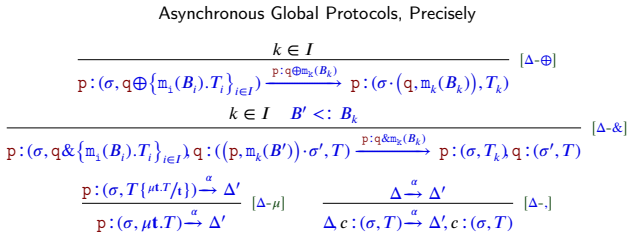
Global protocols can be projected to optimised asynchronous local types while preserving soundness and liveness through a proven operational correspondence.
A machine-rendered reading of the paper's core claim, the machinery that carries it, and where it could break.
Core claim
The paper shows that the coinductive full merging projection is correct for the first time, and that the asynchronous association between a global protocol and its optimised local types is both sound and complete. These two results together make the association an invariant that carries type soundness, session-fidelity, deadlock-freedom and liveness from the unoptimised system to any system obtained by independent local optimisations.
What carries the argument
The asynchronous association, a relation that connects a global protocol to a set of refined local types while maintaining operational correspondence under asynchronous message passing.
If this is right
- Each participant can refine its local type by reordering actions without consulting the others, yet the whole system remains compatible.
- Type soundness, session fidelity, deadlock freedom and liveness hold for any collection of optimised endpoints that satisfy the asynchronous association.
- The same invariant can be reused to transfer future bottom-up theorems to the top-down optimised setting without repeating the proofs.
Where Pith is reading between the lines
- The same style of association could be applied to other global description languages that admit asynchronous optimisations.
- Because local refinements are independent, the approach supports incremental verification of large distributed systems where only some participants change their behaviour.
- If the operational semantics can be shown to match a concrete network model such as TCP with out-of-order delivery, the liveness guarantees would apply directly to deployed code.
Load-bearing premise
The new operational semantics for global protocols must correctly capture exactly the reorderings that are safe in real asynchronous networks.
What would settle it
A concrete global protocol, its projected local types, and a permitted local optimisation such that the optimised endpoints produce a message sequence forbidden by the original global protocol or that deadlocks while the global protocol does not.
Figures




read the original abstract
Asynchronous multiparty session types are a type-based framework which ensure the compatibility of components in a distributed system by checking compliance against a specified global protocol. We propose a top-down approach, starting with the global protocol which is then projected into a set of local specifications. Next, we use an asynchronous refinement relation, precise asynchronous multiparty subtyping, to enable local specifications to be optimised by permuting actions within individual asynchronous components. This supports local reasoning, as each component can be independently developed and refined in isolation, before being integrated into a larger system. We show that this methodology guarantees both type soundness and liveness of the collection of optimised components. In this article, we first propose new operational semantics of global protocols which capture sound optimisations in the context of asynchronous message-passing. Next we define an asynchronous association between global protocols and a set of optimised local types. Thirdly, we prove, for the first time, the correctness of the most expressive endpoint projection in the literature, coinductive full merging projection. We then show the main theorems of this article: soundness and completeness of the operational correspondence of the asynchronous association. As a consequence, the association acts as an invariant that can be used to transfer key theorems from the bottom-up system to the top-down system. In particular, we used this to prove type soundness, session-fidelity, deadlock-freedom and liveness of the collection of optimised endpoints.
Editorial analysis
A structured set of objections, weighed in public.
Referee Report
Summary. The manuscript proposes a top-down methodology for asynchronous multiparty session types. It begins with global protocols, introduces new operational semantics to capture sound optimizations under asynchrony, projects them via coinductive full merging projection to optimized local types using precise asynchronous multiparty subtyping, and defines an asynchronous association. The paper proves the correctness of this projection for the first time and establishes soundness and completeness of the operational correspondence, which serves as an invariant to transfer type soundness, session-fidelity, deadlock-freedom, and liveness from the bottom-up system to the optimized top-down endpoints.
Significance. If the central results hold, the work delivers the first full proofs of correctness for the most expressive endpoint projection in the literature (coinductive full merging projection) in an asynchronous setting. The operational correspondence theorems provide a reusable invariant for transferring key safety and liveness properties, supporting independent local optimization of components while preserving global protocol guarantees. This strengthens formal methods for verifying asynchronous distributed systems.
major comments (1)
- [§3] §3 (New operational semantics of global protocols): The claim that these semantics capture sound optimizations under asynchronous message-passing is load-bearing for all subsequent results. The presentation does not explicitly demonstrate that the permitted reorderings match exactly those realizable under standard models (per-channel FIFO queues with no implicit cross-channel buffering). A concrete example or lemma showing that a reordering allowed here is realizable in a realistic network (and conversely that unrealizable ones are forbidden) is needed to confirm the correspondence theorems apply to actual implementations.
minor comments (2)
- The abstract and introduction could include a brief illustrative example of an optimization permitted by the new semantics and the corresponding local types to aid reader intuition.
- Notation for the asynchronous association (e.g., the relation symbol and its coinductive definition) should be introduced with a small running example before the main theorems.
Simulated Author's Rebuttal
We thank the referee for their careful reading and constructive comments on the manuscript. We address the major comment below and will revise the paper to incorporate the requested clarification.
read point-by-point responses
-
Referee: [§3] §3 (New operational semantics of global protocols): The claim that these semantics capture sound optimizations under asynchronous message-passing is load-bearing for all subsequent results. The presentation does not explicitly demonstrate that the permitted reorderings match exactly those realizable under standard models (per-channel FIFO queues with no implicit cross-channel buffering). A concrete example or lemma showing that a reordering allowed here is realizable in a realistic network (and conversely that unrealizable ones are forbidden) is needed to confirm the correspondence theorems apply to actual implementations.
Authors: We agree that the presentation in §3 would benefit from an explicit demonstration that the permitted reorderings align precisely with those realizable under standard asynchronous models using per-channel FIFO queues and no cross-channel buffering. The semantics were designed to model exactly such behavior by allowing independent actions across channels while preserving FIFO order within each. In the revised manuscript we will add a new lemma in §3 establishing a correspondence (via simulation or bisimulation) between our reduction rules and executions in a network model consisting of independent FIFO queues per channel. We will also include a concrete example of a permitted reordering (e.g., swapping sends on distinct channels) that is realizable in a realistic asynchronous network, together with an explanation of why reorderings requiring cross-channel buffering or violating per-channel FIFO are forbidden by the rules. This addition will directly support the subsequent correctness results. revision: yes
Circularity Check
No circularity: definitions followed by independent formal proofs
full rationale
The paper defines new operational semantics for global protocols under asynchrony, an asynchronous association to optimised local types, and coinductive full merging projection. It then proves correctness of the projection and soundness/completeness of the operational correspondence, using the association as an invariant to transfer properties like type soundness, session-fidelity, deadlock-freedom and liveness. These are standard definitional steps followed by theorem proofs with no reduction of results to inputs by construction, no fitted parameters renamed as predictions, and no load-bearing self-citations that would render the claims tautological. The derivation chain is self-contained against the stated semantics and proofs.
Axiom & Free-Parameter Ledger
axioms (2)
- standard math Coinductive definitions suffice for precise asynchronous multiparty subtyping and full merging projection
- domain assumption New operational semantics for global protocols correctly model asynchronous message-passing optimisations
Lean theorems connected to this paper
-
IndisputableMonolith/Foundation/RealityFromDistinction.leanreality_from_one_distinction unclear?
unclearRelation between the paper passage and the cited Recognition theorem.
We prove, for the first time, the correctness of the most expressive endpoint projection in the literature, coinductive full merging projection... soundness and completeness of the operational correspondence of the asynchronous association
-
IndisputableMonolith/Cost/FunctionalEquation.leanwashburn_uniqueness_aczel unclear?
unclearRelation between the paper passage and the cited Recognition theorem.
precise asynchronous multiparty subtyping... reordering of actions within individual asynchronous components
What do these tags mean?
- matches
- The paper's claim is directly supported by a theorem in the formal canon.
- supports
- The theorem supports part of the paper's argument, but the paper may add assumptions or extra steps.
- extends
- The paper goes beyond the formal theorem; the theorem is a base layer rather than the whole result.
- uses
- The paper appears to rely on the theorem as machinery.
- contradicts
- The paper's claim conflicts with a theorem or certificate in the canon.
- unclear
- Pith found a possible connection, but the passage is too broad, indirect, or ambiguous to say the theorem truly supports the claim.
Reference graph
Works this paper leans on
-
[1]
Recommendation Z.120, International Telecommunication Union (ITU-T), Geneva, October 1996
Message sequence chart (msc). Recommendation Z.120, International Telecommunication Union (ITU-T), Geneva, October 1996. (10/96). Revised and approved by WTSC (Geneva, 9–18 Oct 1996)
work page 1996
-
[2]
Generalised Multiparty Session Types with Crash-Stop Failures (Technical Report, 2022-07-08)
Adam D Barwell, Alceste Scalas, Nobuko Yoshida, and Fangyi Zhou. Generalised Multiparty Session Types with Crash-Stop Failures (Technical Report, 2022-07-08)
work page 2022
-
[3]
Asynchronous subtyping by trace relaxation
Laura Bocchi, Andy King, and Maurizio Murgia. Asynchronous subtyping by trace relaxation. In Bernd FinkbeinerandLauraKovács, editors,ToolsandAlgorithmsfortheConstruction andAnalysisofSystems-30th InternationalConference,TACAS2024,HeldasPartoftheEuropeanJointConferencesonTheoryandPractice of Software, ETAPS 2024, Luxembourg City, Luxembourg, April 6-11, 20...
work page 2024
-
[4]
Abstract Subtyping for Asynchronous Multiparty Sessions
Laura Bocchi, Andy King, Maurizio Murgia, and Simon Thompson. Abstract Subtyping for Asynchronous Multiparty Sessions. In Patricia Bouyer and Jaco van de Pol, editors,36th International Conference on ConcurrencyTheory(CONCUR2025),volume348ofLeibnizInternationalProceedingsinInformatics(LIPIcs), pages 10:1–10:19, Dagstuhl, Germany, 2025. Schloss Dagstuhl – ...
work page 2025
-
[5]
On Communicating Finite-State Machines.Journal of the ACM, 30(2):323– 342, April 1983
Daniel Brand and Pitro Zafiropulo. On Communicating Finite-State Machines.Journal of the ACM, 30(2):323– 342, April 1983
work page 1983
-
[6]
Mario Bravetti, Marco Carbone, Julien Lange, Nobuko Yoshida, and Gianluigi Zavattaro. A Sound Algorithm for Asynchronous Session Subtyping and its Implementation.Logical Methods in Computer Science, Volume 17, Issue 1, March 2021
work page 2021
-
[7]
Undecidabilityofasynchronoussessionsubtyping.Inf
MarioBravetti,MarcoCarbone,andGianluigiZavattaro. Undecidabilityofasynchronoussessionsubtyping.Inf. Comput., 256:300–320, 2017
work page 2017
-
[8]
A Sound and Complete Characterization of Fair AsynchronousSessionSubtyping
Mario Bravetti, Luca Padovani, and Gianluigi Zavattaro. A Sound and Complete Characterization of Fair AsynchronousSessionSubtyping. InPatriciaBouyerandJacovandePol,editors,36thInternationalConference on Concurrency Theory (CONCUR 2025), volume 348 ofLeibniz International Proceedings in Informatics (LIPIcs), pages 11:1–11:17, Dagstuhl, Germany, 2025. Schlo...
work page 2025
-
[9]
Structuredcommunication-centeredprogrammingforweb services.ACM Trans
MarcoCarbone,KoheiHonda,andNobukoYoshida. Structuredcommunication-centeredprogrammingforweb services.ACM Trans. Program. Lang. Syst., 34(2):8:1–8:78, 2012
work page 2012
-
[10]
David Castro-Perez, Francisco Ferreira, Lorenzo Gheri, and Nobuko Yoshida. Zooid: a DSL for certified multiparty computation: from mechanised metatheory to certified multiparty processes. In Stephen N. Freund and Eran Yahav, editors,PLDI ’21: 42nd ACM SIGPLAN International Conference on Programming Language Design and Implementation, Virtual Event, Canada...
work page 2021
-
[11]
CAMP:cost-awaremultipartysessionprotocols.Proc.ACMProgram
DavidCastro-PerezandNobukoYoshida. CAMP:cost-awaremultipartysessionprotocols.Proc.ACMProgram. Lang., 4(OOPSLA):155:1–155:30, 2020
work page 2020
-
[12]
Tzu Chun Chen, Mariangiola Dezani-Ciancaglini, Alceste Scalas, and Nobuko Yoshida. On the preciseness of subtyping in session types.Logical Methods in Computer Science, 13(2), June 2017
work page 2017
-
[13]
On the preciseness of subtyping in session types: 10 years later
Tzu-Chun Chen, Mariangiola Dezani-Ciancaglini, and Nobuko Yoshida. On the preciseness of subtyping in session types: 10 years later. InProceedings of the 26th International Symposium on Principles and Practice of Declarative Programming, PPDP ’24, New York, NY, USA, 2024. Association for Computing Machinery. K. Pischke et al.:Preprint submitted to Elsevie...
work page 2024
-
[14]
A Gentle Introduction to Multiparty Asynchronous Session Types
Mario Coppo, Mariangiola Dezani-Ciancaglini, Luca Padovani, and Nobuko Yoshida. A Gentle Introduction to Multiparty Asynchronous Session Types. In15th International School on Formal Methods for the Design of Computer, Communication and Software Systems: Multicore Programming, volume 9104 ofLNCS, pages 146–178. Springer, 2015
work page 2015
-
[15]
Global Progress for Dynamically Interleaved Multiparty Sessions.MSCS, 26:238–302, 2015
Mario Coppo, Mariangiola Dezani-Ciancaglini, Nobuko Yoshida, and Luca Padovani. Global Progress for Dynamically Interleaved Multiparty Sessions.MSCS, 26:238–302, 2015
work page 2015
-
[16]
Safesession-basedasynchronouscoordinationinrust
ZakCutnerandNobukoYoshida. Safesession-basedasynchronouscoordinationinrust. InCoordinationModels and Languages: 23rd IFIP WG 6.1 International Conference, COORDINATION 2021, Held as Part of the 16th InternationalFederatedConferenceonDistributedComputingTechniques,DisCoTec2021,Valletta,Malta,June 14–18, 2021, Proceedings, page 80–89, Berlin, Heidelberg, 20...
work page 2021
-
[17]
Deadlock-Free Asynchronous Message Reordering in Rust with Multiparty Session Types
Zak Cutner, Nobuko Yoshida, and Martin Vassor. Deadlock-Free Asynchronous Message Reordering in Rust with Multiparty Session Types. In27th ACM SIGPLAN Symposium on Principles and Practice of Parallel Programming, volume abs/2112.12693 ofPPoPP ’22, pages 246–261. ACM, 2022
-
[18]
Full abstraction in a subtyped pi-calculus with linear types
Romain Demangeon and Kohei Honda. Full abstraction in a subtyped pi-calculus with linear types. In Proceedings of CONCUR 2011, volume 6901 ofLNCS, pages 280–296. Springer, 2011
work page 2011
-
[19]
Multiparty session types meet communicating automata
Pierre-Malo Deniélou and Nobuko Yoshida. Multiparty session types meet communicating automata. InESOP, volume 7211 ofLNCS, pages 194–213. Springer, 2012
work page 2012
-
[20]
Pierre-Malo Deniélou and Nobuko Yoshida. Multiparty compatibility in communicating automata: Characteri- sation and synthesis of global session types. InICALP 2013, pages 174–186, 2013
work page 2013
-
[21]
Parameterisedmultipartysessiontypes
Pierre-MaloDeniélou,NobukoYoshida,AndiBejleri,andRaymondHu. Parameterisedmultipartysessiontypes. Logical Methods in Computer Science, 8(4), 2012
work page 2012
-
[22]
Realisability and complementability of multiparty session types
Cinzia Di Giusto, Etienne Lozes, and Pascal Urso. Realisability and complementability of multiparty session types. InProceedings of the 27th International Symposium on Principles and Practice of Declarative Programming, PPDP ’25, New York, NY, USA, 2025. Association for Computing Machinery
work page 2025
-
[23]
Burak Ekici, Tadayoshi Kamegai, and Nobuko Yoshida. Formalising Subject Reduction and Progress for MultipartySessionProcesses.In16thInternationalConferenceonInteractiveTheoremProving,2025,Reykjavik, Iceland, volume 352 ofLIPIcs, pages 19:1–19:23. Schloss Dagstuhl - Leibniz-Zentrum f"ur Informatik, 2025
work page 2025
-
[24]
Completeness of Asynchronous Session Tree Subtyping in Coq
Burak Ekici and Nobuko Yoshida. Completeness of Asynchronous Session Tree Subtyping in Coq. In15th International Conference on Interactive Theorem Proving, 2024, Tbilisi, Georgia, volume 309, pages 6:1–6:20. Schloss Dagstuhl - Leibniz-Zentrum f"ur Informatik, 2024
work page 2024
-
[25]
SimonGayandMalcolmHole.Subtypingforsessiontypesinthepicalculus.ActaInformatica,42(2-3):191–225, November 2005
work page 2005
-
[26]
Silvia Ghilezan, Svetlana Jakšić, Jovanka Pantović, Alceste Scalas, and Nobuko Yoshida. Precise subtyping for synchronous multiparty sessions.Journal of Logical and Algebraic Methods in Programming, 104:127–173, April 2019
work page 2019
-
[27]
Precise subtyping for asynchronous multiparty sessions.ACM Trans
Silvia Ghilezan, Jovanka Pantović, Ivan Prokić, Alceste Scalas, and Nobuko Yoshida. Precise subtyping for asynchronous multiparty sessions.ACM Trans. Comput. Logic, 24(2), nov 2023
work page 2023
-
[28]
The standardization of message sequence charts
Peter Graubmann, Ekkart Rudolph, and Jens Grabowski. The standardization of message sequence charts. In ProceedingsoftheIEEESoftwareEngineeringStandardsSymposium(SESS’93),pages48–63,Brighton,United Kingdom, September 1993. IEEE Computer Society
work page 1993
-
[29]
JonasKastbergHinrichsen,JesperBengtson,andRobbertKrebbers.Actris2.0:Asynchronoussession-typebased reasoning in separation logic.Logical Methods in Computer Science, Volume 18, Issue 2, Jun 2022. K. Pischke et al.:Preprint submitted to ElsevierPage 40 of 47 Asynchronous Global Protocols, Precisely
work page 2022
-
[30]
Languageprimitivesandtypedisciplinesforstructured communication-based programming
KoheiHonda,VascoT.Vasconcelos,andMakotoKubo. Languageprimitivesandtypedisciplinesforstructured communication-based programming. InProceedings of ESOP 1998, volume 1381 ofLNCS, pages 22–138. Springer, 1998
work page 1998
-
[31]
Type-Directed Compilation for Multicore Programming.ENTCS, 241:101–111, 2009
Kohei Honda, Vasco Thudichum Vasconcelos, and Nobuko Yoshida. Type-Directed Compilation for Multicore Programming.ENTCS, 241:101–111, 2009
work page 2009
-
[32]
Multiparty Asynchronous Session Types
Kohei Honda, Nobuko Yoshida, and Marco Carbone. Multiparty Asynchronous Session Types. InProceedings of POPL 2008, pages 273–284. ACM, 2008
work page 2008
-
[33]
Multiparty asynchronous session types.Journal of the ACM, 63(1):9:1–9:67, 2016
Kohei Honda, Nobuko Yoshida, and Marco Carbone. Multiparty asynchronous session types.Journal of the ACM, 63(1):9:1–9:67, 2016
work page 2016
-
[34]
On the Undecidability of Asynchronous Session Subtyping
Julien Lange and Nobuko Yoshida. On the Undecidability of Asynchronous Session Subtyping. InProceedings of FOSSACS 2017, volume 10203 ofLNCS, pages 441–457. Springer, 2017
work page 2017
-
[35]
Deciding subtyping for asynchronous multiparty sessions
Elaine Li, Felix Stutz, and Thomas Wies. Deciding subtyping for asynchronous multiparty sessions. InLecture Notes in Computer Science, Lecture notes in computer science, pages 176–205. Springer Nature Switzerland, Cham, 2024
work page 2024
-
[36]
Complete multiparty session type projection with automata
Elaine Li, Felix Stutz, Thomas Wies, and Damien Zufferey. Complete multiparty session type projection with automata. InLecture Notes in Computer Science, Lecture notes in computer science, pages 350–373. Springer Nature Switzerland, Cham, 2023
work page 2023
-
[37]
Characterizingimplementabilityofglobalprotocols with infinite states and data.Proc
ElaineLi,FelixStutz,ThomasWies,andDamienZufferey. Characterizingimplementabilityofglobalprotocols with infinite states and data.Proc. ACM Program. Lang., 9(OOPSLA1), April 2025
work page 2025
-
[38]
Certified Implementability of Global Multiparty Protocols
Elaine Li and Thomas Wies. Certified Implementability of Global Multiparty Protocols. In Yannick Forster and Chantal Keller, editors,16th International Conference on Interactive Theorem Proving (ITP 2025), volume 352 ofLeibniz International Proceedings in Informatics (LIPIcs), pages 15:1–15:20, Dagstuhl, Germany, 2025. Schloss Dagstuhl – Leibniz-Zentrum f...
work page 2025
-
[39]
On subtyping-relation completeness, with an application to iso-recursive types.ACM Trans
Jay Ligatti, Jeremy Blackburn, and Michael Nachtigal. On subtyping-relation completeness, with an application to iso-recursive types.ACM Trans. Program. Lang. Syst., 39(1), March 2017
work page 2017
-
[40]
A behavioral notion of subtyping.ACM Trans
Barbara H Liskov and Jeannette M Wing. A behavioral notion of subtyping.ACM Trans. Program. Lang. Syst., 16(6):1811–1841, November 1994
work page 1994
-
[41]
Generalising projection in asyn- chronousmultipartysessiontypes
Rupak Majumdar, Madhavan Mukund, Felix Stutz, and Damien Zufferey. Generalising projection in asyn- chronousmultipartysessiontypes. InSergeHaddadandDanieleVaracca,editors,32ndInternationalConference on Concurrency Theory, CONCUR 2021, August 24-27, 2021, Virtual Conference, volume 203 ofLIPIcs, pages 35:1–35:24. Schloss Dagstuhl - Leibniz-Zentrum für Info...
work page 2021
-
[42]
Session-based communication optimisation for higher-order mobile processes
Dimitris Mostrous and Nobuko Yoshida. Session-based communication optimisation for higher-order mobile processes. InPierre-LouisCurien,editor,TypedLambdaCalculiandApplications,9thInternationalConference, TLCA 2009, Brasilia, Brazil, July 1-3, 2009. Proceedings, volume 5608 ofLecture Notes in Computer Science, pages 203–218. Springer, 2009
work page 2009
-
[43]
Nicholas Ng, Jose G.F. Coutinho, and Nobuko Yoshida. Protocols by Default: Safe MPI Code Generation based on Session Types. In24th International Conference on Compiler Construction, volume 9031 ofLNCS, pages 212–232. Springer, 2015
work page 2015
-
[44]
Multiparty Session C: Safe Parallel Programming with Message Optimisation
Nicholas Ng, Nobuko Yoshida, and Kohei Honda. Multiparty Session C: Safe Parallel Programming with Message Optimisation. In50th International Conference on Objects, Models, Components, Patterns, volume 7304 ofLNCS, pages 202–218. Springer, 2012
work page 2012
-
[45]
Benjamin Pierce.Types and Programming Languages. MIT Press, 2002. K. Pischke et al.:Preprint submitted to ElsevierPage 41 of 47 Asynchronous Global Protocols, Precisely
work page 2002
-
[46]
Asynchronous Global Protocols, Precisely
Kai Pischke and Nobuko Yoshida. Asynchronous Global Protocols, Precisely. InComponents Operationally: Reversibility and System Engineering, volume 16065 ofLNCS, pages 116–133. Springer Nature, 2025
work page 2025
-
[47]
Alceste Scalas and Nobuko Yoshida. Less is more: Multiparty session types revisited.Proceedings of the ACM on Programming Languages, 3(POPL):1–29, January 2019
work page 2019
-
[48]
Felix Stutz. Asynchronous Multiparty Session Type Implementability is Decidable - Lessons Learned from Message Sequence Charts. In Karim Ali and Guido Salvaneschi, editors,37th European Conference on Object-OrientedProgramming(ECOOP2023),volume263ofLeibnizInternationalProceedingsinInformatics (LIPIcs), pages 32:1–32:31, Dagstuhl, Germany, 2023. Schloss Da...
work page 2023
-
[49]
An automata-theoretic basis for specification and type checking of multiparty protocols
Felix Stutz and Emanuele D’Osualdo. An automata-theoretic basis for specification and type checking of multiparty protocols. InProgramming Languages and Systems: 34th European Symposium on Programming, ESOP 2025, Held as Part of the International Joint Conferences on Theory and Practice of Software, ETAPS 2025, Hamilton, ON, Canada, May 3–8, 2025, Proceed...
work page 2025
-
[50]
An Interaction-based Language and its Typing System
Kaku Takeuchi, Kohei Honda, and Makoto Kubo. An Interaction-based Language and its Typing System. In Constantine Halatsis, Dimitris G. Maritsas, George Philokyprou, and Sergios Theodoridis, editors,PARLE ’94: Parallel Architectures and Languages Europe, 6th International PARLE Conference, Athens, Greece, July 4-8, 1994, Proceedings, volume 817 ofLecture N...
work page 1994
-
[51]
Top-down or bottom-up? complexity analyses of synchronous multiparty session types.Proc
Thien Udomsrirungruang and Nobuko Yoshida. Top-down or bottom-up? complexity analyses of synchronous multiparty session types.Proc. ACM Program. Lang., 9(POPL):1040–1071, 2025
work page 2025
-
[52]
Adecentralizedanalysisofmultipartyprotocols.Sci.Comput.Program., 222(102840):102840, October 2022
BasvandenHeuvelandJorgeAPérez. Adecentralizedanalysisofmultipartyprotocols.Sci.Comput.Program., 222(102840):102840, October 2022
work page 2022
-
[53]
Programming language implementations with multiparty session types
Nobuko Yoshida. Programming language implementations with multiparty session types. In Frank S. deBoer,FerruccioDamiani,ReinerHähnle,EinarBrochJohnsen,andEduardKamburjan,editors,ActiveObject Languages: Current Research Trends, volume 14360 ofLecture Notes in Computer Science, pages 147–165. Springer, 2024
work page 2024
-
[54]
Less is More Revisited: Association with Global Multiparty Session Types
Nobuko Yoshida and Ping Hou. Less is More Revisited: Association with Global Multiparty Session Types. In The Practice of Formal Methods: Essays in Honour of Cliff Jones, Part II, pages –. LNCS, 2024
work page 2024
-
[55]
The Scribble Protocol Language
Nobuko Yoshida, Raymond Hu, Rumyana Neykova, and Nicholas Ng. The Scribble Protocol Language. In 8th International Symposium on Trustworthy Global Computing, volume 8358 ofLNCS, pages 22–41. Springer, 2013
work page 2013
-
[56]
Session-based compilation framework for multicore programming
Nobuko Yoshida, Vasco Thudichum Vasconcelos, Hervé Paulino, and Kohei Honda. Session-based compilation framework for multicore programming. InFMCO 2008, pages 226–246, 2008
work page 2008
-
[57]
CommunicatingFiniteStateMachinesandanExtensible Toolchain for Multiparty Session Types
NobukoYoshida,FangyiZhou,andFranciscoFerreira. CommunicatingFiniteStateMachinesandanExtensible Toolchain for Multiparty Session Types. In23rd International Symposium on Fundamentals of Computation Theory, volume 12867 ofLNCS, pages 18–35. Springer, 2021. K. Pischke et al.:Preprint submitted to ElsevierPage 42 of 47 Asynchronous Global Protocols, Precisely...
work page 2021
discussion (0)
Sign in with ORCID, Apple, or X to comment. Anyone can read and Pith papers without signing in.