REVIEW 3 major objections 5 minor 45 references
Inference of Substructured Reduced-Order Models for Dynamic Contact from Contact-free Simulations
T0 review · 3 major / 5 minor · reviewed 2026-08-07 · deepseek-v4-flash
Pith's one-line read A reduced-order contact model can be learned without ever simulating contact.
desk verdict A promising non-intrusive route to contact ROMs that needs a careful repair pass before it is reproducible. read the letter →
The pith
A machine-rendered reading of the paper's core claim, the machinery that carries it, and where it could break.
The reading
What carries the argument
The central object is the Craig-Bampton-like reduction ansatz $q \approx V\,(q_B^T,\hat q_I^T)^T$ with $q_I \approx \Phi_{IB} q_B + V_I \hat q_I$, where $q_B$ are the boundary (potential contact) degrees of freedom kept in full dimension and $V_I$ is a POD basis for the interior. The coupling matrix $\Phi_{IB}$ carries the argument: it maps boundary displacements to interior displacements and, when identified exactly through static unit-displacement simulations, it is what makes the dual-system Lagrange multipliers (contact pressures) accurate. The dual system is a linear complementarity problem (LCP), written as $B + A\lambda \ge 0$, $\lambda \ge 0$, $\lambda^T(B+A\lambda)=0$, with matrix $\hat A = h^2 C_B(\hat M + h^2\hat K)^{-1} C_B^T$. Because the inferred $\hat M$, $\hat K$ are symmetric positive definite, so is $\hat A$, and the LCP has a unique solution for every right-hand side.
What would settle it
Take a test structure with strong inertial boundary–interior coupling (for example a stiff, heavy interior attached to a light boundary), train the reduced model on contact-free snapshots using all three coupling strategies, then solve a contact scenario and compare the Lagrange multipliers against the full-order contact solution. If the static-simulation coupling matrix also produces contact-force errors far above 1%, or if the least-squares variants cannot be improved by enriching the training data, the claim that contact-free data are sufficient for accurate contact pressures would be refuted.
Extended reading notes
Core claim
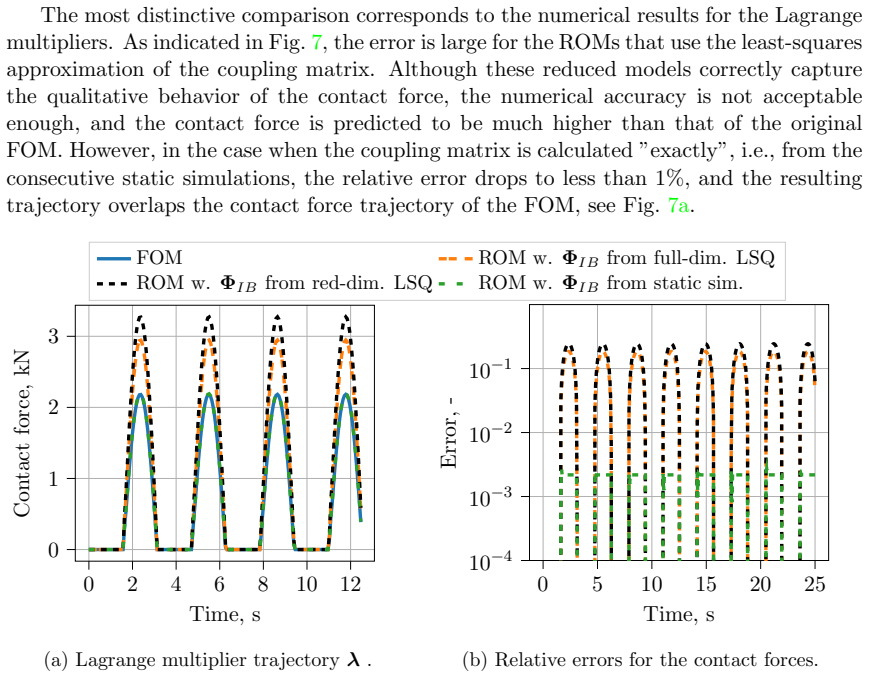
The paper's central claim is that a substructured reduced-order model inferred from contact-free snapshots can reproduce the contact response of the full-order model, provided the boundary–interior coupling matrix is recovered well. On the beam example, the variant that computes the coupling matrix from successive static unit-displacement simulations reaches less than 1% relative error in the contact forces, while the two least-squares estimates of the coupling matrix produce much larger contact-force errors even though displacements remain accurate. The authors interpret this as evidence that the coupling matrix, not the interior reduction basis, is the critical ingredient for contact pressure accuracy. The inferred reduced matrices are forced to be symmetric positive definite, which makes the reduced linear complementarity problem well posed and uniquely solvable by Lemke's method.
Load-bearing premise
The load-bearing assumption is that the interior response is the sum of a static coupling response to boundary motion plus the response of the fixed-boundary interior system to the external load, with the inertial coupling between boundary and interior neglected; the least-squares coupling estimates rest directly on this split, and they are the ones that give poor contact-force accuracy.
Editorial extensions
If this is right
- Contact simulations become unnecessary for ROM training: only contact-free response data and static unit-displacement solves are needed.
- Contact pressures can be recovered in near-real time because the LCP size equals the number of contact nodes, which is small compared with the full displacement dimension.
- The substructured ROM preserves the contact interface exactly, so the reduced model can be used for contact detection and search at low cost even when the coupling estimate is only approximate.
- The SPD constraints on the inferred matrices guarantee a well-posed reduced contact problem, not just a stable reduced dynamics.
- The method transfers to 3D finite-element models and to loading frequencies different from the training frequency, as the two test cases show.
Reading between the lines
- The large gap in contact-force accuracy between the static-simulation coupling and the least-squares couplings suggests that the inertial term neglected in the approximation of the coupling matrix is precisely what controls the dual variable; a testable extension would add an inertial correction term to the least-squares fit and see whether contact-force errors drop.
- For structures with large possible contact regions, the exact static-mode strategy becomes expensive; a hybrid that uses least-squares coupling for a first pass and then refines only the active contact nodes with static modes could keep the cost down while preserving accuracy.
- The same substructured inference idea could be applied to node-to-segment contact or frictional contact, but the LCP would have to be replaced by a more general complementarity or nonsmooth system, so the uniqueness argument based on an SPD LCP matrix would no longer apply directly.
Editorial analysis
A structured set of objections, weighed in public.
Referee Report
Summary. The paper proposes a non-intrusive model-order-reduction method for dynamic node-to-node contact in linear elasticity. The method infers a Craig-Bampton-like substructured ROM from contact-free simulation snapshots, using operator inference with symmetry and positive-definiteness constraints, and then enforces contact by solving a dual linear complementarity problem with Lemke's algorithm. Three ways of identifying the boundary--interior coupling matrix are proposed: a full-dimensional least-squares fit, a reduced-dimensional least-squares fit, and a static unit-displacement simulation approach. The method is demonstrated on two three-dimensional finite-element examples, a console beam and a piston rod, with the static-simulation coupling giving the most accurate contact forces.
Significance. If the central claim holds, the paper offers a practical route to building contact-capable reduced models from data that contain no active contact, which is valuable for digital-twin applications in structural mechanics. The combination of Craig-Bampton substructuring with operator inference is a sensible and useful extension, and the static-coupling variant achieves a genuine out-of-sample prediction, with below 1% relative contact-force error in the beam example. The paper also provides code and data availability, which is a strength for reproducibility. The main limitations are the unquantified superposition assumption behind Eq. (41) and the fact that, in the reported experiments, only the static-simulation coupling variant attains acceptable contact-force accuracy, while the two least-squares variants do not.
major comments (3)
- [§4.2.3, Eq. (45) and Algorithm 1] The reduced force snapshot matrix is defined inconsistently with the stated transformation. Section 4.1 states that bf = V^T f, and with V in Eq. (30) this gives bF_B = F_B + Φ_IB^T F_I. However, Eq. (45) and Algorithm 1, line 4, write bF_B = F_B + Φ_IB F_I^(1). Besides the missing transpose, the printed expression is dimensionally incompatible because Φ_IB is n_I × n_B while F_I is n_I × k. This is load-bearing for reproducibility, since the training data for the operator-inference problem depend on this definition; please correct the formula and ensure the algorithm listing matches the code used to produce the numerical results.
- [§4.2.2, Eq. (41)] The load-bearing modeling assumption Q_I ≈ Φ_IB Q_B + Q_I^(1) is introduced without a quantitative validity check. In an exact Craig-Bampton decomposition, the dynamic interior coordinates satisfy an equation forced by -(M_II Φ_IB + M_IB) q¨_B, so the fixed-boundary response Q_I^(1) does not equal the dynamic part of the full interior response when boundary accelerations are significant. Since Eq. (41) is used both to fit Φ_IB in Eqs. (42)-(43) and to define the interior training data bQ_I^(1) in Eq. (45) and Algorithm 1, the inferred reduced model can be systematically biased even when Φ_IB itself is exact. The paper should report a residual or error measure for Eq. (41) on the training data, such as ||Q_I - Φ_IB Q_B - Q_I^(1)||_F / ||Q_I||_F, and state a condition under which the approximation is valid.
- [§5.1, Fig. 7] The numerical evidence narrows the general claim made in the abstract and conclusions: the two least-squares coupling estimates produce contact-force errors that the text itself calls 'not acceptable' (Fig. 7b), while only the static-simulation coupling reaches below 1% relative error. Because accurate contact forces are the advertised advantage of the adjoint/LCP formulation, the paper should present the static-simulation variant as the main validated method and the least-squares variants as auxiliary tools, or provide a criterion for when the latter can be trusted.
minor comments (5)
- [§4.1, Eq. (34)] Immediately after Eq. (34), the text says q_B, f_B ∈ R^{n_I}; this should be R^{n_B}.
- [§4.2.2, Eq. (42)] The least-squares objective in Eq. (42) should be ||Q_I - Q_I^(1) - Φ_IB Q_B||_F^2; as printed, the plus sign before Q_I^(1) changes the problem. The same sign issue appears in Eq. (43).
- [§4.2.2, Eq. (43)] The snapshot matrices Q_I^(2) and Q_B^(2) in Eq. (43) are not defined; presumably they are the interior and boundary blocks of a data set used for the reduced-space least-squares fit, but this should be stated explicitly.
- [§5.1] The load frequency is written as '0 , 32 Hz' with a comma as decimal separator, which is inconsistent with the rest of the text.
- [Fig. 4 caption] The phrase 'interior subsystem snapshot set of the full-order system simulation with fixed boundary nodes' is redundant and confusing; it should simply say the snapshot set from the fixed-boundary simulation (38).
Circularity Check
No significant circularity: contact forces are out-of-sample outputs of an LCP solved with reduced operators fitted to contact-free snapshots; cited prior work is re-derived rather than load-bearing.
full rationale
The paper's inference chain is: contact-free snapshots are used to build a Craig-Bampton-style basis and coupling matrix, reduced operators are fitted by constrained least squares, and contact pressures are then obtained by solving a linear complementarity problem in the dual variables. The displacements and Lagrange multipliers reported in Section 5 are not among the fitted quantities: the LCP matrix and right-hand side are assembled from the fitted reduced operators and the current external load, and Lemke's method computes lambda from complementarity conditions that were never used as training data. Thus the central contact-force prediction is a genuine out-of-sample output, not a renamed fit. The use of the authors' prior work [34] for primal-dual decoupling is not load-bearing because Section 2.2 re-derives the LCP from the KKT conditions, and the uniqueness claim is supported by the standard reference [12] together with the enforced SPD constraints. Equation (41), QI ≈ ΦIB QB + QI^(1), is a physical approximation that neglects inertial coupling between boundary and interior degrees of freedom; the paper's own Fig. 7 shows that contact-force accuracy is sensitive to how ΦIB is obtained, so this is a correctness and robustness limitation rather than a circular definition. The 'exact' coupling matrix from static simulations is the standard constraint-mode definition from Craig-Bampton substructuring, not a fitted parameter that is later reported as a prediction. Overall, no step of the derivation reduces by construction to its own inputs, and the self-citations are contextual rather than load-bearing.
Assumptions & free parameters
free parameters (5)
- Interior reduced dimension r =
2 (both examples)
- Training load (harmonic force parameters) =
beam: 0.16 Hz, 3 kN; piston rod: not fully specified
- Boundary/contact node set =
6 nodes for beam; not stated for piston rod
- Implicit Euler time step h =
not reported in text
- Snapshot count k =
not reported in text
assumptions (6)
- domain assumption Linear elasticity, small deformations, frictionless adhesion-free node-to-node contact.
- domain assumption The semi-discretized system is M q_ddot + K q = f with M and K symmetric positive definite.
- domain assumption The maximum possible set of contact nodes is known a priori.
- ad hoc to paper The interior response decomposes as QI ≈ Φ_IB QB + Q_I^(1), where Q_I^(1) is a fixed-boundary simulation with the same external force.
- ad hoc to paper The reduced operators can be inferred by the constrained least squares in Eq. (46), with cM, cK SPD and interior blocks fixed to those of the fixed-boundary subsystem.
- standard math Standard LCP theory: an LCP with an SPD matrix has a unique solution for every right-hand side.
Cite this review
Pith. "Pith review of Inference of Substructured Reduced-Order Models for Dynamic Contact from Contact-free Simulations." pith.science (2026). https://pith.science/paper/5C2FIGKN
@misc{pith2026250518050,
  author       = {Pith},
  title        = {Pith review of: Inference of Substructured Reduced-Order Models for Dynamic Contact from Contact-free Simulations},
  year         = {2026},
  howpublished = {\url{https://pith.science/paper/5C2FIGKN}},
  note         = {Machine review of arXiv:2505.18050}
}
read the original abstract
In this paper, we propose an operator-inference-based reduction approach for contact problems, leveraging snapshots from simulations without active contact. Contact problems are solved using adjoint methods, by switching to the dual system, where the corresponding Lagrange multipliers represent the contact pressure. The Craig-Bampton-like substructuring method is incorporated into the inference process to provide the reduced system matrices and the coupling of the contact and interior nodes. The maximum possible set of contact nodes must be known a priori. Characteristic properties of the inferred matrices, such as symmetry and positive definiteness, are enforced by appending additional constraints to the underlying least-squares problem. The resulting dual system, which forms a linear complementarity problem, is well-defined and can be effectively solved using methods such as Lemke's algorithm. The performance of the proposed method is validated on three-dimensional finite element models.
Figures


Figures from the paper (8 more)




Reference graph
Works this paper leans on
-
[1]
M. S. Allen, D. Rixen, M. van der Seijs, P. Tiso, T. Abrahamsson, and R. L. Mayes. Substructuring in Engineering Dynamics . Springer Cham, 2020
work page 2020
-
[2]
M. Balajewiec, D. Amsallem, and C. Farhat. Projection-based model reduction for contact problems. Int. J. Numer. Meth. Engng , 106:pp. 644–663, 2015
work page 2015
-
[3]
U. Baur, P. Benner, and L. Feng. Model order reduction for linear and nonlinear systems: a system-theoretic perspective. Arch. Comput. Methods Eng., 21(4):pp. 331– 358, 2014
work page 2014
-
[4]
T. Belytschko and T.-J. R. Hughes. Computational methods for transient analysis. Vol. 1 in Computational Methods in Mechanics. Amsterdam-New York, North-Holland Publ. Co., 1983
work page 1983
-
[5]
P. Benner and L. Feng. Recycling Krylov subspaces for solving linear systems with successively changing right-hand sides arising in model reduction. In Model Reduction for Circuit Simulation . Springer, 2011
work page 2011
- [6]
- [7]
- [8]
Show all 45 references
-
[9]
Besselink, N
B. Besselink, N. van de Wouw, J. M. Scherpen, and H. Nijmeijer. Model reduction for nonlinear systems by incremental balanced truncation. IEEE Trans. Autom. Control, 59(10):pp. 2739–2753, 2014
2014
-
[10]
S. Boyd, L. El Ghaoui, E. Feron, and V. Balakrishnan. Linear Matrix Inequalities in System and Control Theory . SIAM, 1994
1994
-
[11]
Breiten and T
T. Breiten and T. Damm. Krylov subspace methods for model order reduction of bilinear control systems. Syst. Control Lett. , 59(8):pp. 443–450, 2010
2010
-
[12]
R. W. Cottle, J.-S. Pang, and R. E. Stone. The Linear Complementarity Problem . SIAM, 2009
2009
-
[13]
Craig and M
R. Craig and M. Bampton. Coupling of substructures for dynamic analyses. AIAA J., pp. 1313–1319, 1968
1968
-
[14]
Delhez, F
E. Delhez, F. Nyssen, J.-C. Golinval, and A. Batailly. Reduced order modeling of blades with geometric nonlinearities and contact interactions. J. Sound Vib. , 500:116037, 2021
2021
-
[15]
Diamond and S
S. Diamond and S. Boyd. CVXPY: A Python-embedded modeling language for convex optimization. J. Mach. Learn. Res. , 17(83):pp. 1–5, 2016
2016
-
[16]
Farhat, P
C. Farhat, P. Avery, T. Chapman, and J. Cortial. Dimensional reduction of nonlinear finite element dynamic models with finite rotations and energy-based mesh sampling and weighting for computational efficiency. Int. J. Numer. Methods Eng. , 98(9):pp. 625–662, 2014
2014
-
[17]
Fauque, I
J. Fauque, I. Rami` ere, and D. Ryckelynck. Hybrid hyper-reduced modeling for contact mechanics problems. Int. J. Numer. Methods Eng. , 115(1):pp. 117–139, 2018
2018
-
[18]
Filanova, I
Y. Filanova, I. Pontes Duff, P. Goyal, and P. Benner. An operator inference oriented approach for linear mechanical systems. Mech. Syst. Signal Process., 200:110620, 2023
2023
-
[19]
Francavilla and O
A. Francavilla and O. Zienkiewicz. A note on numerical computation of elastic contact problems. Int. J. Numer. Methods Eng. , 9:pp. 913–924, 1975
1975
-
[20]
Geradin and D
M. Geradin and D. J. Rixen. Mechanical Vibrations: Theory and Application to Structural Dynamics. Wiley, 2015
2015
-
[21]
P. Gill, W. Murry, and M. Wright. Practical Optimization . Academic Press, 4th edition, 1981. 28
1981
- [22]
-
[23]
Hartmann, M
D. Hartmann, M. Herz, M. Paffrath, J. Rommes, T. Tamarozzi, H. Van der Auweraer, and U. Wever. Model order reduction and digital twins , pp. 379–430. De Gruyter, Berlin, Boston, 2021
2021
-
[24]
Heinrich, M
C. Heinrich, M. Khalil, K. Martynov, and U. Wever. Online remaining lifetime esti- mation for structures. Mech. Syst. Signal Process. , 119:pp. 312–327, 2019
2019
-
[25]
W. C. Hurty. Vibrations of structural systems by component mode synthesis. J. Eng. Mech. Div., 86(4):51–69, 1960
1960
-
[26]
Ilyas Ahmad, P
M. Ilyas Ahmad, P. Benner, and I. Jaimoukha. Krylov subspace methods for model reduction of quadratic-bilinear systems. IET Control Theory Appl. , 10(16):pp. 2010– 2018, 2016
2010
-
[27]
Kikuchi and J
N. Kikuchi and J. T. Oden. Contact Problems in Elasticity . SIAM, 1988
1988
-
[28]
Kramer, B
B. Kramer, B. Peherstorfer, and K. E. Willcox. Learning nonlinear reduced models from data with operator inference. Annual Review of Fluid Mechanics, 56:pp. 521–548, 2024
2024
-
[29]
K¨ urschner
P. K¨ urschner. Balanced truncation model order reduction in limited time intervals for large systems. Adv. Comput. Math. , 44(6):pp. 1821–1844, 2018
2018
-
[30]
Lamperski
A. Lamperski. Python: Lemkelcp 0.1. https://pypi.org/project/lemkelcp/
-
[31]
Le Berre, I
S. Le Berre, I. Rami` ere, J. Fauque, and D. Ryckelynck. Condition number and clustering-based efficiency improvement of reduced-order solvers for contact problems using lagrange multipliers. Mathematics, 10(9):1495, 2022
2022
-
[32]
Li and S.-L
C.-X. Li and S.-L. Wu. A note on the unique solution of linear complementarity problem. Cogent Math., 3(1):1271268, 2016
2016
-
[33]
Lohmann and B
B. Lohmann and B. Salimbahrami. Ordnungsreduktion mittels Krylov- Unterraummethoden (Order Reduction using Krylov Subspace Methods). at- Automatisierungstechnik, 52(1):30–38, 2004
2004
-
[34]
Manvelyan, B
D. Manvelyan, B. Simeon, and U. Wever. An efficient model order reduction scheme for dynamic contact in linear elasticity. Comput. Mech., 10.1007/s00466-021-02068-4, 2021
2021 doi
-
[35]
Manvelyan, B
D. Manvelyan, B. Simeon, and U. Wever. A physics-based model reduction approach for node-to-segment contact problems in linear elasticity. Int. J. Numer. Methods Eng., 2022. 29
2022
-
[36]
Martynov and U
K. Martynov and U. Wever. On polynomial hyperreduction for nonlinear structural mechanics. Int. J. Numer. Methods Eng. , 118(12):pp. 701–717, 2019
2019
-
[38]
Peherstorfer and K
B. Peherstorfer and K. Willcox. Data-driven operator inference for nonintrusive projection-based model reduction. Comput. Methods Appl. Mech. Eng. , 306:pp. 196– 215, 2016
2016
-
[39]
Radermacher and S
A. Radermacher and S. Reese. Pod-based model reduction with empirical interpolation applied to nonlinear elasticity. Int. J. Numer. Methods Eng., 107(6):pp. 477–495, 2016
2016
-
[40]
D. J. Rixen. A dual Craig–Bampton method for dynamic substructuring. J. Comput. Appl. Math. , 168(1-2):pp. 383–391, 2004
2004
-
[41]
J. Saak, D. Siebelts, and S. W. R. Werner. A comparison of second-order model order reduction methods for an artificial fishtail. at-Automatisierungstechnik, 67(8):pp. 648– 667, 2019
2019
-
[42]
Salimbahrami, R
B. Salimbahrami, R. Eid, and B. Lohmann. Model reduction by second order Krylov subspaces: Extensions, stability and proportional damping. In Proc. IEEE Conf. Comput. Aided Control Syst. Design, Munich, Germany , pp. 2997–3002. IEEE, 2006
2006
-
[43]
Sharma, D
H. Sharma, D. A. Najera-Flores, M. D. Todd, and B. Kramer. Lagrangian operator inference enhanced with structure-preserving machine learning for nonintrusive model reduction of mechanical systems. Comput. Methods Appl. Mech. Eng. , 423:116865, 2024
2024
-
[44]
Swischuk, L
R. Swischuk, L. Mainini, B. Peherstorfer, and K. Willcox. Projection-based model reduction: Formulations for physics-based machine learning. Comput. Fluids, 179:pp. 704–717, 2019
2019
-
[45]
Van der Auweraer and D
H. Van der Auweraer and D. Hartmann. The executable digital twin: merging the digital and the physics worlds. e-print 2210.17402v2, arXiv, 2023. cs.OH
2023 arXiv
-
[46]
Wriggers
P. Wriggers. Computational Contact Mechanics . Springer Berlin, Heidelberg, 2006. 30
2006
Reviewed August 7, 2026 · model on record in the stance chip above.
Discussion (0). Continue with ORCID to comment.