REVIEW 4 major objections 5 minor 61 references
Unveiling compact planetary nebulae: Broad-band survey analysis and LAMOST confirmation
T0 review · 4 major / 5 minor · reviewed 2026-08-07 · deepseek-v4-flash
Pith's one-line read Two broad-band color-color diagrams built from Gaia and Pan-STARRS photometry can isolate compact planetary nebulae with strong emission lines, and the criteria have already produced one spectroscopically confirmed new PN.
desk verdict A credible new PN candidate and genuinely new color-color diagrams, but the selection method still rests on hand-drawn boundaries and a single out-of-sample hit. read the letter →
The pith
A machine-rendered reading of the paper's core claim, the machinery that carries it, and where it could break.
The reading
What carries the argument
The machinery is a two-zone color selection built from the excess that strong nebular emission lines imprint on broad-band photometry. In the $g$ band, H$\beta$, [O III], He II, and other lines act; in the $r$ band, H$\alpha$, [N II], and [S II] act; a compact PN is unresolved in these surveys, so those lines make $G-g$ and $G-r$ unusually large relative to the $(G_{\rm BP}-G_{\rm RP})$ stellar color. The paper draws compact PN zones by straight lines on both diagrams (Figure 1) and requires that a candidate satisfy both criteria. The zones were defined on 882 true PNe from the Chornay and Walton (2021) central-star catalogue, after excluding saturated sources with $r < 13.5$. The second stage is LAMOST spectroscopy, which confirms a PN by its emission-line pattern, and the third is Cloudy modeling of the line ratios to infer the ionizing source parameters.
What would settle it
Take a large, spectroscopically labeled sample of point sources that includes stars, CVs, symbiotic stars, YSOs, and SNRs mixed with known compact PNe, and count how many non-PNe land inside the two hand-drawn zones: if the contamination fraction is comparable to the PN fraction, the zones are not selective. Alternatively, apply both criteria to every object in a large emission-line catalog, obtain LAMOST spectra for every object that passes, and measure the confirmation rate; a rate near zero would falsify the method's predictive power.
Extended reading notes
Core claim
The central claim is that the color combinations $(G-g)$ versus $(G_{\rm BP}-G_{\rm RP})$ and $(G-r)$ versus $(G_{\rm BP}-G_{\rm RP})$ separate compact planetary nebulae from stars, cataclysmic variables, symbiotic stars, young stellar objects, supernova remnants, and normal stars. Compact PNe with strong emission lines and a weak continuum sit in a region of both diagrams that other objects mostly avoid, because nebular lines boost the Gaia $G$ band and the Pan-STARRS $g$ and $r$ bands. On the strength of this separation, the paper selects candidates from the emission-line catalog of Skoda et al. (2020) that fall in both zones, retrieves their LAMOST spectra, and identifies J020808.63+491401.0 as a previously unknown high-ionization planetary nebula. The LAMOST spectrum shows classical Balmer lines, He II, [Ar V], [Ar III], and [Ne III] and no low-excitation lines, and the best-fitting Cloudy model places a 180,000 K central star with about 3,400 solar luminosities, which corresponds to a roughly 2-solar-mass progenitor on post-AGB tracks.
Load-bearing premise
The zones that define a compact PN in both color-color diagrams were traced by eye on a training sample of 882 PNe, and the method assumes these hand-drawn boundaries separate compact PNe from all other objects in any new catalog with no measured completeness or contamination.
Editorial extensions
If this is right
- A large fraction of Galactic PNe (estimated to number in the thousands) remain undiscovered; if the color criteria hold, they can be hunted in the existing Gaia and Pan-STARRS archives without new narrowband surveys.
- Candidates passing both color zones are worth spectroscopic follow-up, since in the short LAMOST test the two zones together selected emission-line-dominated objects and one of the two was a clear high-ionization PN.
- The method is conservative and not exhaustive: many PNe fall outside the compact zones, and the paper explicitly notes that objects meeting both criteria are more likely to be genuine PNe.
- The new object J020808.63+491401.0 is a very hot (180,000 K), relatively luminous (3,400 L$\odot$) PN whose central star is consistent with a 2-solar-mass progenitor, younger and hotter than the majority of cataloged central stars.
- The same color criteria identify a separate region for very extended PNe, whose spectra are dominated by weak emission on a stellar continuum, thereby also flagging extended PNe.
Reading between the lines
- The hand-drawn zone boundaries in Figure 1 are the step most in need of quantitative testing; without a completeness and contamination measurement, the method's yield on unseen catalogs is uncertain despite the one confirmed example.
- If the zones are made rigorous (for example by training an automated classifier on the same colors), the approach could be applied to the entire Gaia–Pan-STARRS overlap rather than just a pre-filtered emission-line list, and the discovered PN fraction could be measured directly.
- The strong-line selection bias means the method will preferentially find young, hot, high-ionization PNe like J020808.63+491401.0 rather than the evolved, faint, extended majority, so surveys built on it will be skewed toward a specific evolutionary stage.
- Since broad-band line excess works wherever strong nebular lines fall inside broad filters, the same logic could extend to other photometric systems such as SDSS/ugriz or LSST and potentially to extragalactic samples.
Editorial analysis
A structured set of objections, weighed in public.
Referee Report
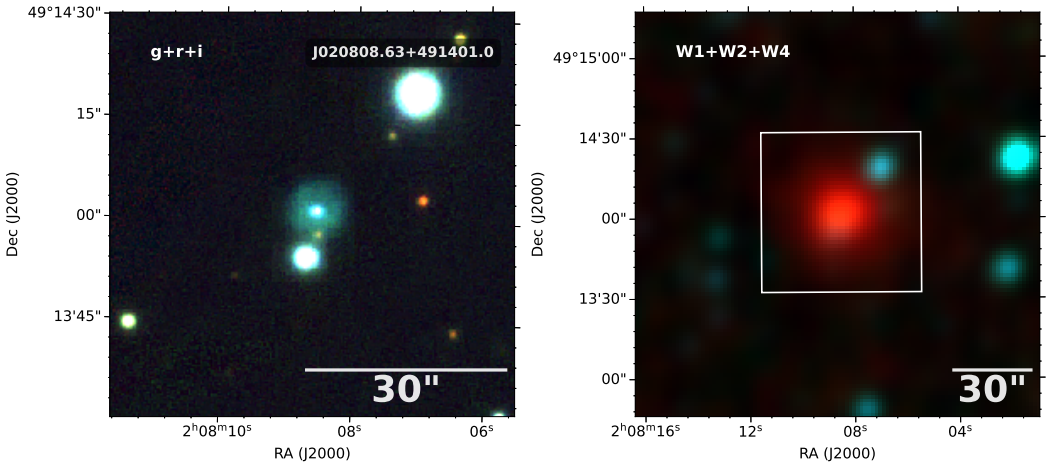
Summary. The paper proposes new photometric selection criteria for identifying compact planetary nebulae (PNe) using Gaia DR3 and Pan-STARRS1 broad-band colors, specifically the (G−g) versus (GBP−GRP) and (G−r) versus (GBP−GRP) diagrams. The selection zones are defined by eye on 882 PNe from the Chornay and Walton (2021) catalog, with contaminant contours for CVs, YSOs, SySt, and SNRs. The criteria are validated on 20 confirmed PNe with LAMOST spectra and then applied to the third list of the Škoda et al. (2020) emission-line catalog, yielding two candidates of which one, J020808.63+491401.0, is argued to be a genuine PN based on LAMOST spectroscopy showing Balmer, He II, [Ar V], [Ar III], [Ne III], and [O III] lines, plus optical and WISE imagery. A Cloudy photoionization model is fitted to eight blue-arm line ratios, giving an ionizing source effective temperature of 180,000 K, luminosity about 3,400 L⊙, and a progenitor mass near 2 M⊙.
Significance. The discovery of J020808.63+491401.0 is a valuable result: the spectroscopic evidence (high-ionization nebular lines, absence of low-ionization lines) and the round morphology with a bright central star together provide a reasonable case for a new Galactic planetary nebula. The paper also makes a useful methodological contribution by demonstrating that broad-band Gaia/Pan-STARRS colors can highlight compact, strong-emission-line PNe, and it provides public access to the best-fit Cloudy model on GitHub. However, the paper's central claim of a 'novel photometric selection method' is not yet quantitatively established: the selection zones are hand-drawn, no contamination or completeness rates are measured, and the out-of-sample validation rests on a single confirmed candidate. If the method is properly calibrated in future work, it could provide a practical tool for finding compact PNe in existing all-sky surveys, but the present analysis is best read as a proof-of-concept combined with a single-object discovery.
major comments (4)
- [Section 2.1, Figure 1] The compact PN zones in Figure 1 are demarcated by eye with straight lines, and the paper gives no analytic definition of the boundaries, no quantitative measurement of how many contaminant objects (CVs, SySt, YSOs, SNRs) fall inside the zones, and no completeness estimate for the recovery of known compact PNe. The only out-of-sample application, to the Škoda et al. (2020) third list in Section 2.3, produced two candidates of which one was spectroscopically confirmed, which is too small a sample to establish the false-positive rate of the criteria. The authors should compute and report the contamination and completeness of the zones on a labeled test sample, or alternatively reframe the paper's claims from a general selection method to a single-object proof-of-concept.
- [Section 2.2, Table A.3] The validation using 20 true PNe with LAMOST spectra is not independent, because these objects come from the same HASH/Chornay–Walton parent catalogs used to define the color zones, so the recovery of 9 out of 20 in the compact (G−g) zone is partly expected. Furthermore, the text states that 'almost all' of these 9 objects have diameters smaller than 10 arcseconds, but Table A.3 shows that Abell 30, with a diameter of 127 arcseconds, is included in the (G−g) compact zone; two other objects have no diameter listed. This overstatement weakens the morphological argument and should be corrected, and the validation should be repeated on a truly independent sample.
- [Section 3, Eq. (1), Table 1] The Cloudy fitting procedure is strongly over-parameterized: approximately 14 free parameters (T, L, nH, Rin, Rout, E(B−V), and eight abundances, with He and Ar adjusted) are constrained by only 8 observed line fluxes, i.e., 7 independent ratios after normalizing to Hβ. The χ² statistic in Eq. (1) is computed without accounting for the number of fitted parameters, and the paper gives no uncertainty estimates or degeneracy analysis for the derived quantities. Consequently, the reported values of Teff = 180,000 K, L ≈ 3,400 L⊙, the elemental abundances, and the derived progenitor mass of 2 M⊙ from Figure 9 are not uniquely determined and should be presented as tentative rather than as robust physical parameters.
- [Section 3] The grid of Cloudy models is incompletely specified, which prevents reproduction of the fitting procedure. The paper gives ranges for T, L, nH, and E(B−V), but it does not state the grid or steps used for the inner and outer radii (Rin and Rout) nor for the He and Ar abundances that were explicitly adjusted. The claim of having generated 'more than 40,000 models' and selecting the best fit based on χ² minimization is therefore not auditable. Please document the full parameter ranges and steps for all adjusted quantities, or provide the model-generation script in the GitHub repository.
minor comments (5)
- [Introduction] There is a typo in the first paragraph: 'braod-band' should be 'broad-band'.
- [Section 2.3] The sentence 'The absence of red-shifted emission lines in its optical spectrum eliminates the possibility of its extragalactic nature' is confusing, because the measured heliocentric radial velocity is −40 km/s (blueshifted). The reasoning would be clearer if stated in terms of the small absolute velocity or the lack of a systemic redshift, and a reference for the argument would be helpful.
- [Figure 7 caption] The caption says 'Optical (right) and IR (left) images', but the main text and the layout of the figure panels indicate that the optical (g+r+i) images are on the left and the WISE (W1+W2+W4) images are on the right. Please check and correct the caption.
- [Table A.3] For K 3-67 and K 3-69, the PN diameter column is left blank; the text implies these values are unknown, but this should be stated explicitly (e.g., with a dash) so the reader does not mistake them for missing data.
- [Section 2.1] The description of the extended PN zone boundary as 'bounded by the black dashed line and the red dashed and pointed line' is vague; providing the equations of the boundary lines or a zoomed-in inset with axis ranges would make the criteria reproducible.
Circularity Check
No significant circularity: the color-color selection is fitted to known PNe, but the paper's central discovery is an out-of-sample application to unlabeled Skoda objects, and the Cloudy parameters are presented as model fits rather than independent predictions.
full rationale
The derivation chain is self-contained and the central claim rests on an out-of-sample result. Section 2.1 defines the compact-PN zones by eye using 882 known PNe from Chornay and Walton (2021) together with overplotted contaminant populations; recovering known compact PNe in such a training sample is not a prediction, but the paper does not use those recoveries as the decisive test of the method. The actual predictive step is in Section 2.3, where the criteria are applied to the third, previously unreported list of about 1000 emission-line objects from Skoda et al. (2020); only two objects pass both criteria, and one of them, J020808.63+491401.0, is then independently confirmed as a PN by its LAMOST spectrum (Balmer, He II, [Ar V], [Ar III], [Ne III]) and by Pan-STARRS/WISE morphology. This out-of-sample confirmation is not forced by construction: the color zones were not defined using this object or the Skoda list. The Cloudy modeling in Section 3 is a best fit to the same LAMOST spectrum, so the quoted Teff = 180,000 K and L = 3,400 Lsun are fitted parameters, not independent predictions; the paper explicitly calls them the best-fit model and does not rename them as predictions. The comparison with Miller Bertolami (2016) tracks is an inference from those fitted parameters, not a circular step. The self-citations (Weidmann et al. 2020; Gutierrez-Soto et al. 2020) are used for comparison objects and earlier methodology, but they are not load-bearing for the new object's confirmation, which rests on the LAMOST spectrum and images. The validation set of HASH PNe with LAMOST spectra may partially overlap the parent catalogs used to define the zones and is therefore a limited completeness check, but this is a methodological robustness concern, not circularity.
Assumptions & free parameters
free parameters (15)
- Compact PN zone boundaries =
Dashed lines in Figure 1
- Effective temperature of ionizing source =
180,000 K (log 5.26)
- Luminosity of ionizing source =
log 37.12 erg/s (~3,400 Lsun)
- Hydrogen density =
log 3.78 (~6,000 cm^-3)
- Inner radius =
log 16.60 cm
- Outer radius =
log 17.05 cm
- Color excess E(B-V) =
0.03
- He/H abundance =
10^-0.92
- C/H abundance =
10^-4.15
- N/H abundance =
10^-4.72
- O/H abundance =
10^-3.83
- Ne/H abundance =
10^-4.58
- Si/H abundance =
10^-5.00
- S/H abundance =
10^-6.00
- Ar/H abundance =
10^-6.24
assumptions (7)
- domain assumption Central ionizing source radiates as a black body.
- domain assumption The nebula is a homogeneous sphere with unity filling factor.
- domain assumption LAMOST relative flux calibration is accurate enough for the blue-arm line ratios used in modeling.
- domain assumption The Bailer-Jones geometric distance of 2.31 kpc is correct.
- domain assumption The Galactic extinction law with R(V) = 3.1 applies.
- domain assumption Miller Bertolami (2016) post-AGB evolutionary tracks are applicable for the progenitor mass estimate.
- domain assumption HASH catalog classifications are reliable enough to serve as training labels.
Cite this review
Pith. "Pith review of Unveiling compact planetary nebulae: Broad-band survey analysis and LAMOST confirmation." pith.science (2026). https://pith.science/paper/GMVBIULR
@misc{pith2026250518308,
  author       = {Pith},
  title        = {Pith review of: Unveiling compact planetary nebulae: Broad-band survey analysis and LAMOST confirmation},
  year         = {2026},
  howpublished = {\url{https://pith.science/paper/GMVBIULR}},
  note         = {Machine review of arXiv:2505.18308}
}
read the original abstract
Planetary nebulae (PNe) are pivotal for advancing our knowledge of stellar evolution and galactic chemical enrichment. Recent progress in surveys and data analysis has revolutionized PN research, leading to the discovery of new objects and deeper insights into their properties. We have devised a novel photometric selection method, integrating GAIA and Pan-STARRS photometry, to identify compact PN candidates. This approach utilizes color-color diagrams, specifically (G-g) versus (GBP-GRP) and (G-r) versus (GBP-GRP), as primary criteria for candidate selection. The subsequent verification step involves confirming these candidates through LAMOST spectroscopic data. By cross-referencing a comprehensive dataset of PNe, GAIA, Pan-STARRS, and LAMOST DR7 spectra, we explore the potential of our approach and the crucial role played by these surveys in PN research. The LAMOST spectra provide compelling evidence supporting our selection criteria, especially for compact PNe characterized by strong emission lines and low continuum. Applying these criteria to a catalog of emission line objects, we have selected a PN candidate. Detailed analysis of its LAMOST spectrum unveiled classical Balmer emission lines and high-ionization lines (He II, [Ar V], [Ar III], [Ne III]), characteristic of high-ionization PNe, without low-excitation lines. Using the photoionization code Cloudy, our modeling revealed parameters including an ionizing source temperature of 180x10^3 K, luminosity around 3400 Lsun, and gas abundances encompassing various elements. Comparing the PNe evolution track, the progenitor star was estimated to have a mass of 2 Msun. Our findings show strong promise for separating compact PNe from other objects and provide a robust framework for further exploration of these surveys in the context of planetary nebulae.
Figures


Figures from the paper (6 more)



Reference graph
Works this paper leans on
-
[1]
write newline
" write newline "" before.all 'output.state := FUNCTION n.dashify 't := "" t empty not t #1 #1 substring "-" = t #1 #2 substring "--" = not "--" * t #2 global.max substring 't := t #1 #1 substring "-" = "-" * t #2 global.max substring 't := while if t #1 #1 substring * t #2 global.max substring 't := if while FUNCTION word.in bbl.in ":" * " " * FUNCTION f...
-
[2]
Compact planetary nebulae: Improved IR diagnostic criteria based on classification tree modelling
author Akras , S. , author Guzman-Ramirez , L. , author Gon c alves , D.R. , year 2019 a. title Compact planetary nebulae: improved IR diagnostic criteria based on classification tree modelling . journal volume 488 , pages 3238--3250 . :10.1093/mnras/stz1911, http://arxiv.org/abs/1907.10026 arXiv:1907.10026
work page Pith review arXiv 2019
-
[3]
author Akras , S. , author Guzman-Ramirez , L. , author Leal-Ferreira , M.L. , author Ramos-Larios , G. , year 2019 b. title A Census of Symbiotic Stars in the 2MASS, WISE, and Gaia Surveys . journal volume 240 , pages 21 . :10.3847/1538-4365/aaf88c, http://arxiv.org/abs/1902.01451 arXiv:1902.01451
arXiv 2019
-
[4]
The Progenitors and Lifetimes of Planetary Nebula
author Badenes , C. , author Maoz , D. , author Ciardullo , R. , year 2015 . title The Progenitors and Lifetimes of Planetary Nebulae . journal volume 804 , pages L25 . :10.1088/2041-8205/804/1/L25, http://arxiv.org/abs/1502.01015 arXiv:1502.01015
work page Pith review arXiv 2015
-
[5]
author Bailer-Jones , C.A.L. , author Rybizki , J. , author Fouesneau , M. , author Demleitner , M. , author Andrae , R. , year 2021 . title Estimating Distances from Parallaxes. V. Geometric and Photogeometric Distances to 1.47 Billion Stars in Gaia Early Data Release 3 . journal volume 161 , pages 147 . :10.3847/1538-3881/abd806, http://arxiv.org/abs/20...
arXiv 2021
-
[6]
author Cenarro , A.J. , author Moles , M. , author Crist \'o bal-Hornillos , D. , author Mar \'i n-Franch , A. , author Ederoclite , A. , author Varela , J. , author L \'o pez-Sanjuan , C. , author Hern \'a ndez-Monteagudo , C. , author Angulo , R.E. , author V \'a zquez Rami \'o , H. , author Viironen , K. , author Bonoli , S. , author Orsi , A.A. , auth...
-
[7]
author Chen , B. , author Liu , X. , author Xiang , M. , author Yuan , H. , author Huang , Y. , author Shi , J. , author Fan , Z. , author Huo , Z. , author Wang , C. , author Ren , J. , author Tian , Z. , author Zhang , H. , author Liu , G. , author Cao , Z. , author Zhang , Y. , author Hou , Y. , author Wang , Y. , year 2016 . title The LAMOST Spectrosc...
arXiv 2016
-
[8]
author Chornay , N. , author Walton , N.A. , year 2021 . title One star, two star, red star, blue star: an updated planetary nebula central star distance catalogue from Gaia EDR3 . journal volume 656 , pages A110 . :10.1051/0004-6361/202142008, http://arxiv.org/abs/2102.13654 arXiv:2102.13654
work page Pith review arXiv 2021
Show all 61 references
-
[9]
, author Zhao , Y.H
author Cui , X.Q. , author Zhao , Y.H. , author Chu , Y.Q. , author Li , G.P. , author Li , Q. , author Zhang , L.P. , author Su , H.J. , author Yao , Z.Q. , author Wang , Y.N. , author Xing , X.Z. , author Li , X.N. , author Zhu , Y.T. , author Wang , G. , author Gu , B.Z. , ...
2012
-
[10]
, author Moe , M
author De Marco , O. , author Moe , M. , year 2005 . title Common Envelope Evolution through Planetary Nebula Eyes , in: editor Szczerba , R. , editor Stasi \'n ska , G. , editor Gorny , S.K. (Eds.), booktitle Planetary Nebulae as Astronomical Tools , pp. pages 169--172 . :10....
2005 arXiv
-
[11]
, author Meatheringham , S.J
author Dopita , M.A. , author Meatheringham , S.J. , year 1990 . title The Evolutionary Sequence of Planetary Nebulae . journal volume 357 , pages 140 . :10.1086/168900
1990 doi
-
[12]
, author Webbink , R.F
author Downes , R.A. , author Webbink , R.F. , author Shara , M.M. , author Ritter , H. , author Kolb , U. , author Duerbeck , H.W. , year 2006 . title VizieR Online Data Catalog: Catalog of Cataclysmic Variables (Downes+ 2001-2006) . journal VizieR Online Data Catalog , pages V/123A
2006
-
[13]
u pc \"u Yoldas , A. , author Lewis , J. , author Barentsen , G. , author Eisl \
author Drew , J.E. , author Gonzalez-Solares , E. , author Greimel , R. , author Irwin , M.J. , author K \"u pc \"u Yoldas , A. , author Lewis , J. , author Barentsen , G. , author Eisl \"o ffel , J. , author Farnhill , H.J. , author Martin , W.E. , author Walsh , J.R. , autho...
2014 arXiv
-
[15]
, author Chatzikos , M
author Ferland , G.J. , author Chatzikos , M. , author Guzm \'a n , F. , author Lykins , M.L. , author van Hoof , P.A.M. , author Williams , R.J.R. , author Abel , N.P. , author Badnell , N.R. , author Keenan , F.P. , author Porter , R.L. , author Stancil , P.C. , year 2017 . ...
2017 arXiv
-
[16]
, author Blair , W.P
author Fesen , R.A. , author Blair , W.P. , author Kirshner , R.P. , year 1985 . title Optical emission-line properties of evolved galactic supernova remnants. journal volume 292 , pages 29--48 . :10.1086/163130
1985 doi
-
[17]
, author Parker , Q.A
author Fragkou , V. , author Parker , Q.A. , author Zijlstra , A.A. , author V \'a zquez , R. , author Sabin , L. , author Rechy-Garcia , J.S. , year 2022 . title The Planetary Nebula in the 500 Myr Old Open Cluster M37 . journal volume 935 , pages L35 . :10.3847/2041-8213/ac8...
2022 arXiv
-
[18]
, year 2008
author Frew , D.J. , year 2008 . title Planetary Nebulae in the Solar Neighbourhood: Statistics, Distance Scale and Luminosity Function . Ph.D. thesis. Department of Physics, Macquarie University, NSW 2109, Australia
2008
-
[19]
, year 2017
author Frew , D.J. , year 2017 . title Challenges faced by current Galactic planetary nebula surveys , in: editor Liu , X. , editor Stanghellini , L. , editor Karakas , A. (Eds.), booktitle Planetary Nebulae: Multi-Wavelength Probes of Stellar and Galactic Evolution , pp. page...
2017 arXiv
-
[20]
, author Parker , Q.A
author Frew , D.J. , author Parker , Q.A. , year 2010 . title Planetary Nebulae: Observational Properties, Mimics and Diagnostics . journal volume 27 , pages 129--148 . :10.1071/AS09040, http://arxiv.org/abs/1002.1525 arXiv:1002.1525
2010 arXiv
-
[21]
u ller , H. , author Stephenson , C.A. , author S \
author Gaia Collaboration , author Smart , R.L. , author Sarro , L.M. , author Rybizki , J. , author Reyl \'e , C. , author Robin , A.C. , author Hambly , N.C. , author Abbas , U. , author Barstow , M.A. , author de Bruijne , J.H.J. , author Bucciarelli , B. , author Carrasco ...
2021 arXiv
-
[22]
u ller , H. , author Stephenson , C.A. , author S \
author Gaia Collaboration , author Vallenari , A. , author Brown , A.G.A. , author Prusti , T. , author de Bruijne , J.H.J. , author Arenou , F. , author Babusiaux , C. , author Biermann , M. , author Creevey , O.L. , author Ducourant , C. , author Evans , D.W. , author Eyer ,...
2023 arXiv
-
[23]
, year 2019
author Green , D.A. , year 2019 . title A revised catalogue of 294 Galactic supernova remnants . journal Journal of Astrophysics and Astronomy volume 40 , pages 36 . :10.1007/s12036-019-9601-6, http://arxiv.org/abs/1907.02638 arXiv:1907.02638
2019 arXiv
-
[24]
, author Gon c alves , D.R
author Guti \'e rrez-Soto , L.A. , author Gon c alves , D.R. , author Akras , S. , author Cortesi , A. , author L \'o pez-Sanjuan , C. , author Guerrero , M.A. , author Daflon , S. , author Borges Fernandes , M. , author Mendes de Oliveira , C. , author Ederoclite , A. , autho...
2020 arXiv
-
[25]
, author Woodward , C.E
author Helton , L.A. , author Woodward , C.E. , author Walter , F.M. , author Vanlandingham , K. , author Schwarz , G.J. , author Evans , A. , author Ness , J.U. , author Geballe , T.R. , author Gehrz , R.D. , author Greenhouse , M. , author Krautter , J. , author Liller , W. ...
2010
-
[26]
, author Luo , A.L
author Hou , W. , author Luo , A.L. , author Hu , J.Y. , author Yang , H.F. , author Du , C.D. , author Liu , C. , author Lee , C.D. , author Lin , C.C. , author Wang , Y.F. , author Zhang , Y. , author Cao , Z.H. , author Hou , Y.H. , year 2016 . title A catalog of early-type...
2016 arXiv
-
[27]
, author Kronberger , M
author Jacoby , G.H. , author Kronberger , M. , author Patchick , D. , author Teutsch , P. , author Saloranta , J. , author Howell , M. , author Crisp , R. , author Riddle , D. , author Acker , A. , author Frew , D.J. , author Parker , Q.A. , year 2010 . title Searching for Fa...
2010 arXiv
-
[28]
, author Burgett , W
author Kaiser , N. , author Burgett , W. , author Chambers , K. , author Denneau , L. , author Heasley , J. , author Jedicke , R. , author Magnier , E. , author Morgan , J. , author Onaka , P. , author Tonry , J. , year 2010 . title The Pan-STARRS wide-field optical/NIR imagin...
2010 doi
-
[29]
, author Grebel , E.K
author Kniazev , A.Y. , author Grebel , E.K. , author Zucker , D.B. , author Rix , H.W. , author Mart \' nez-Delgado , D. , author Snedden , S.A. , year 2014 . title A Search for Planetary Nebulae with the Sloan Digital Sky Survey: The Outer Regions of M31 . journal volume 147...
2014 arXiv
-
[30]
, author Henry , R.B.C
author Kwitter , K.B. , author Henry , R.B.C. , year 2022 . title Planetary Nebulae: Sources of Enlightenment . journal volume 134 , pages 022001 . :10.1088/1538-3873/ac32b1, http://arxiv.org/abs/2110.13993 arXiv:2110.13993
2022 arXiv
-
[31]
, author Plat , A
author Mayya , Y.D. , author Plat , A. , author G \'o mez-Gonz \'a lez , V.M.A. , author Zaragoza-Cardiel , J. , author Charlot , S. , author Bruzual , G. , year 2023 . title Detection of He ^ ++ ion in the star-forming ring of the Cartwheel using MUSE data and ionizing mechan...
2023
-
[32]
u ller , A. , author Sesto , L.A. , author Silva , R. , author Smith Castelli , A.V. , author Teixeira , R. , author Telles , E. , author Thom de Souza , R.C. , author Th \
author Mendes de Oliveira , C. , author Ribeiro , T. , author Schoenell , W. , author Kanaan , A. , author Overzier , R.A. , author Molino , A. , author Sampedro , L. , author Coelho , P. , author Barbosa , C.E. , author Cortesi , A. , author Costa-Duarte , M.V. , author Herpi...
2019 arXiv
-
[33]
, year 2016
author Miller Bertolami , M.M. , year 2016 . title New models for the evolution of post-asymptotic giant branch stars and central stars of planetary nebulae . journal volume 588 , pages A25 . :10.1051/0004-6361/201526577, http://arxiv.org/abs/1410.1679 arXiv:1410.1679
2016 arXiv
-
[34]
, author De Marco , O
author Moe , M. , author De Marco , O. , year 2006 . title Do Most Planetary Nebulae Derive from Binaries? I. Population Synthesis Model of the Galactic Planetary Nebula Population Produced by Single Stars and Binaries . journal volume 650 , pages 916--932 . :10.1086/506900, h...
2006 arXiv
-
[35]
, author Anupama , G.C
author Mondal , A. , author Anupama , G.C. , author Kamath , U.S. , author Das , R. , author Selvakumar , G. , author Mondal , S. , year 2018 . title Optical spectroscopy of the recurrent nova RS Ophiuchi - from the outburst of 2006 to quiescence . journal volume 474 , pages 4...
2018 arXiv
-
[36]
, author Das , R
author Mondal , A. , author Das , R. , author Anupama , G.C. , author Mondal , S. , year 2020 . title Photoionization modelling of quiescence-phase spectra of novae and a symbiotic star . journal volume 492 , pages 2326--2334 . :10.1093/mnras/stz3570, http://arxiv.org/abs/2007...
2020 arXiv
-
[37]
, year 2013
author Morisset , C. , year 2013 . title pyCloudy: Tools to manage astronomical Cloudy photoionization code . howpublished Astrophysics Source Code Library, record ascl:1304.020 . http://arxiv.org/abs/1304.020 arXiv:1304.020
2013
-
[38]
, author Das , R
author Pandey , R. , author Das , R. , author Shaw , G. , author Mondal , S. , year 2022 a. title Photoionization Modeling of the Dusty Nova V1280 Scorpii . journal volume 925 , pages 187 . :10.3847/1538-4357/ac36dc, http://arxiv.org/abs/2111.02380 arXiv:2111.02380
2022 arXiv
-
[39]
, author Habtie , G.R
author Pandey , R. , author Habtie , G.R. , author Bandyopadhyay , R. , author Das , R. , author Teyssier , F. , author Guarro Fl \'o , J. , year 2022 b. title Study of 2021 outburst of the recurrent nova RS Ophiuchi: Photoionization and morphokinematic modelling . journal vol...
2022 arXiv
-
[40]
, year 2022
author Parker , Q.A. , year 2022 . title Planetary nebulae and how to find them: A concise review . journal Frontiers in Astronomy and Space Sciences volume 9 , pages 895287 . :10.3389/fspas.2022.895287
2022
-
[41]
, author Boji c i \'c , I.S
author Parker , Q.A. , author Boji c i \'c , I.S. , author Frew , D.J. , year 2016 . title HASH: the Hong Kong/AAO/Strasbourg H planetary nebula database , in: booktitle Journal of Physics Conference Series , p. pages 032008 . :10.1088/1742-6596/728/3/032008, http://arxiv.org/...
2016 arXiv
-
[42]
, author Phillipps , S
author Parker , Q.A. , author Phillipps , S. , author Pierce , M.J. , author Hartley , M. , author Hambly , N.C. , author Read , M.A. , author MacGillivray , H.T. , author Tritton , S.B. , author Cass , C.P. , author Cannon , R.D. , author Cohen , M. , author Drew , J.E. , aut...
2005
-
[43]
, author Xiang , Z
author Parker , Q.A. , author Xiang , Z. , author Ritter , A. , year 2022 . title A Preliminary Investigation of CSPN in the HASH Database . journal Galaxies volume 10 , pages 32 . :10.3390/galaxies10010032
2022 doi
-
[44]
, author Anche , R.M
author Pavana , M. , author Anche , R.M. , author Anupama , G.C. , author Ramaprakash , A.N. , author Selvakumar , G. , year 2019 . title Optical spectroscopic and polarization properties of 2011 outburst of the recurrent nova T Pyxidis . journal volume 622 , pages A126 . :10....
2019 arXiv
- [45]
-
[46]
, author Natta , A
author Rigliaco , E. , author Natta , A. , author Testi , L. , author Randich , S. , author Alcal \`a , J.M. , author Covino , E. , author Stelzer , B. , year 2012 . title X-shooter spectroscopy of young stellar objects. I. Mass accretion rates of low-mass T Tauri stars in Ori...
2012 arXiv
-
[47]
, year 2019
author Robitaille, T. , year 2019 . title APLpy v2.0: The Astronomical Plotting Library in Python . https://doi.org/10.5281/zenodo.2567476, :10.5281/zenodo.2567476
2019 doi
-
[48]
, author Bianchini , A
author Sabbadin , F. , author Bianchini , A. , author Hamzaoglu , E. , year 1984 . title Internal motions of fourteen planetary nebulae. journal volume 136 , pages 200--205
1984
-
[49]
, author Minello , S
author Sabbadin , F. , author Minello , S. , author Bianchini , A. , year 1977 . title Sharpless 176: a large, nearby planetary nebula. journal volume 60 , pages 147--149
1977
-
[50]
, author Luo , A.L
author Song , Y.H. , author Luo , A.L. , author Comte , G. , author Bai , Z.R. , author Zhang , J.N. , author Du , W. , author Zhang , H.T. , author Chen , J.J. , author Zuo , F. , author Zhao , Y.H. , year 2012 . title Relative flux calibration for the Guoshoujing Telescope (...
2012 doi
-
[51]
, year 2005
author Taylor , M.B. , year 2005 . title TOPCAT & STIL: Starlink Table/VOTable Processing Software , in: editor Shopbell , P. , editor Britton , M. , editor Ebert , R. (Eds.), booktitle Astronomical Data Analysis Software and Systems XIV , p. pages 29
2005
-
[52]
, author Maddox , S
author Tresse , L. , author Maddox , S. , author Loveday , J. , author Singleton , C. , year 1999 . title Spectral analysis of the Stromlo-APM Survey - I. Spectral properties of galaxies . journal volume 310 , pages 262--280 . :10.1046/j.1365-8711.1999.02977.x, http://arxiv.or...
1999
-
[53]
, author Montez , Rodolfo, J
author Vejar , G. , author Montez , Rodolfo, J. , author Morris , M. , author Stassun , K.G. , year 2019 . title Planetary Nebulae and How to Find Them: Color Identification in Big Broadband Surveys . journal volume 879 , pages 38 . :10.3847/1538-4357/ab21ba, http://arxiv.org/...
2019 arXiv
-
[54]
, author Greimel , R
author Viironen , K. , author Greimel , R. , author Corradi , R.L.M. , author Mampaso , A. , author Rodr \' guez , M. , author Sabin , L. , author Delgado-Inglada , G. , author Drew , J.E. , author Giammanco , C. , author Gonz \'a lez-Solares , E.A. , author Irwin , M.J. , aut...
2009 arXiv
-
[55]
, author Mampaso , A
author Viironen , K. , author Mampaso , A. , author Corradi , R.L.M. , author Rodr \' guez , M. , author Greimel , R. , author Sabin , L. , author Sale , S.E. , author Unruh , Y. , author Delgado-Inglada , G. , author Drew , J.E. , author Giammanco , C. , author Groot , P. , a...
2009 arXiv
-
[56]
, author Podsztavek , O
author S koda , P. , author Podsztavek , O. , author Tvrd \'i k , P. , year 2020 . title Active deep learning method for the discovery of objects of interest in large spectroscopic surveys . journal volume 643 , pages A122 . :10.1051/0004-6361/201936090, http://arxiv.org/abs/2...
2020 arXiv
-
[57]
, author Gamen , R
author Weidmann , W.A. , author Gamen , R. , author van Hoof , P.A.M. , author Zijlstra , A. , author Minniti , D. , author Volpe , M.G. , year 2013 . title Near-infrared photometry of Galactic planetary nebulae with the VVV Survey . journal volume 552 , pages A74 . :10.1051/0...
2013 arXiv
-
[58]
, author Mari , M.B
author Weidmann , W.A. , author Mari , M.B. , author Schmidt , E.O. , author Gaspar , G. , author Miller Bertolami , M.M. , author Oio , G.A. , author Guti \'e rrez-Soto , L.A. , author Volpe , M.G. , author Gamen , R. , author Mast , D. , year 2020 . title Catalogue of the ce...
2020 arXiv
-
[59]
, author Liu , X.W
author Xiang , M.S. , author Liu , X.W. , author Yuan , H.B. , author Huang , Y. , author Huo , Z.Y. , author Zhang , H.W. , author Chen , B.Q. , author Zhang , H.H. , author Sun , N.C. , author Wang , C. , author Zhao , Y.H. , author Shi , J.R. , author Luo , A.L. , author Li...
2015 arXiv
-
[60]
, author Adelman , J
author York , D.G. , author Adelman , J. , author Anderson , John E., J. , author Anderson , S.F. , author Annis , J. , author Bahcall , N.A. , author Bakken , J.A. , author Barkhouser , R. , author Bastian , S. , author Berman , E. , author Boroski , W.N. , author Bracker , S...
-
[61]
, author Zhao , Y.H
author Zhao , G. , author Zhao , Y.H. , author Chu , Y.Q. , author Jing , Y.P. , author Deng , L.C. , year 2012 . title LAMOST spectral survey An overview . journal Research in Astronomy and Astrophysics volume 12 , pages 723--734 . :10.1088/1674-4527/12/7/002
2012 doi
-
[62]
2015, , 579, A101
Aladro, R., Martín, S., Riquelme, D., et al. 2015, , 579, A101
2015
Reviewed August 7, 2026 · model on record in the stance chip above.
Discussion (0). Sign in to comment.