REVIEW 5 major objections 6 minor 1 cited by
Efficient Differentiable Hardware Rasterization for 3D Gaussian Splatting
T0 review · 5 major / 6 minor · reviewed 2026-08-07 · deepseek-v4-flash
Pith's one-line read This paper claims that the backward pass of 3D Gaussian Splatting can be moved from tile-based software rasterization into the hardware graphics pipeline without approximating the gradients.
desk verdict A promising new backward pass for hardware-rasterized 3DGS with a real gap: the paper never verifies that its gradients match the tile-based baseline, so the speedups might be for a slightly different gradient. read the letter →
The pith
A machine-rendered reading of the paper's core claim, the machinery that carries it, and where it could break.
The reading
What carries the argument
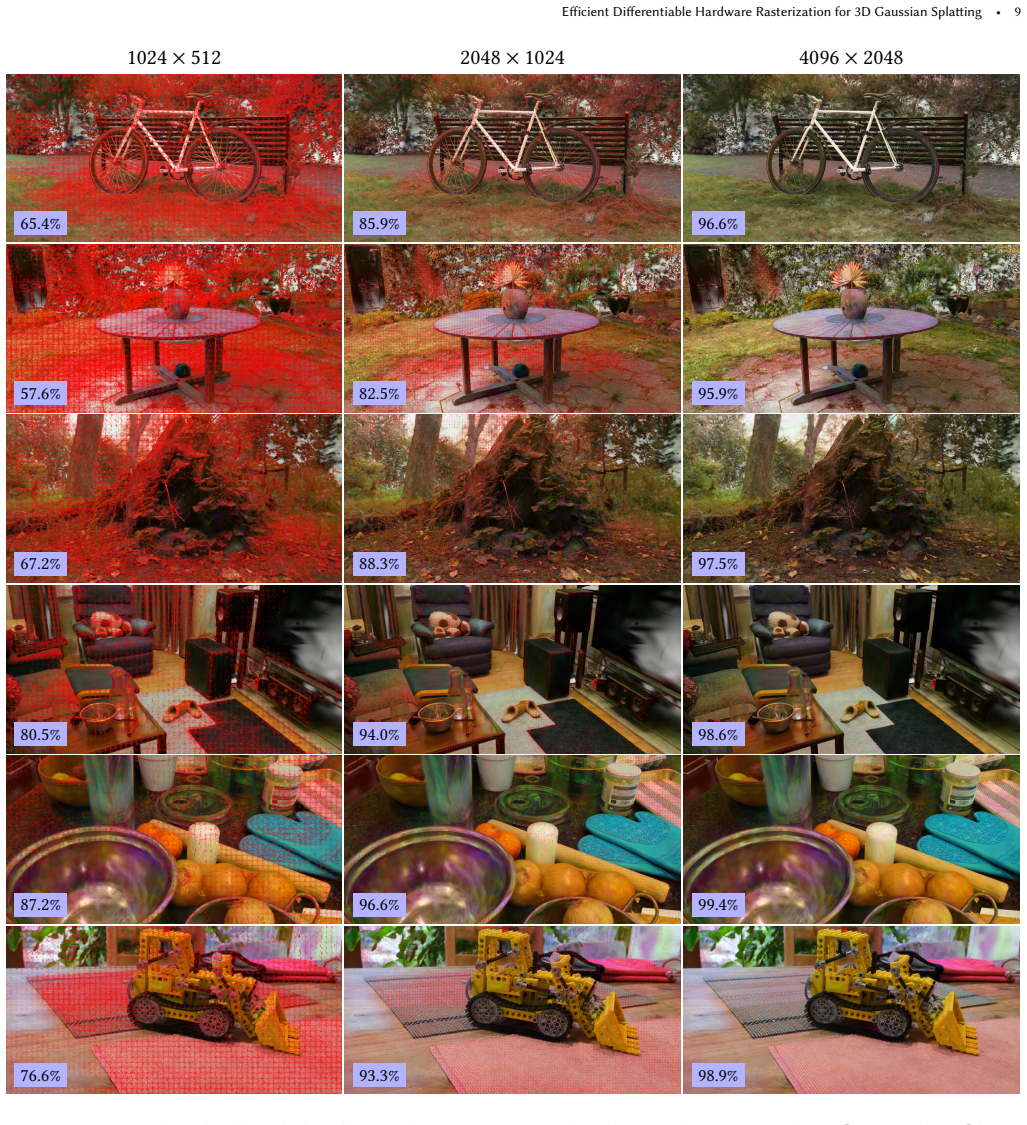
The load-bearing mechanism is the hybrid gradient-reduction pipeline inside the fragment shader, supported by the Splat-Subgroup Cohesion Hypothesis. Programmable blending -- implemented via $VK\_EXT\_fragment\_shader\_interlock$ on desktop GPUs -- gives fragment shaders race-free, rasterization-ordered read-modify-write access to a per-pixel texture holding $(C'_i, T_i)$, so the backward recurrence of Equations 3--7 can run exactly in front-to-back order. The hybrid reduction aggregates per-pixel parameter gradients first across a $2\times 2$ quad (qadAdd in Procedure 2) and, when all active lanes in a 32-thread subgroup carry the same splat ID and the active count exceeds a balancing threshold $X$, across the whole subgroup via subgroupAdd; one atomicAdd then writes the reduced result to the global gradient buffer. The Splat-Subgroup Cohesion Hypothesis is the empirical premise that fragments of a single splat mostly land in one subgroup, which the paper validates only on one RTX 4080 and compensates for with a quad-level fallback when cohesion fails. The mixed-precision render-target choice (float16 or unorm16) carries the forward-pass half of the speedup, because full float32 render targets run the forward pass slower than the backward pass on this GPU.
What would settle it
Run the same forward/backward benchmark on a GPU with different fragment-scheduling rules (for example an AMD RDNA or an NVIDIA Turing/Ampere card) using the MipNeRF360 scenes, and measure the splat-subgroup cohesion rate and end-to-end speedup; if cohesion falls well below the reported 70--90% range at 2048$\times$1024 or the speedup drops toward the quad-reduction-only 3.05x level, the architecture-specific premise would be shown false or narrow. Alternatively, construct a synthetic scene of many tiny splats at low resolution where the cohesion rate is near zero and check whether the backward pass degrades toward the naive-atomic baseline.
Extended reading notes
Core claim
The paper's central claim is that a differentiable hardware rasterizer for 3D Gaussian Splatting can compute exact per-pixel gradients and still beat the tile-based software rasterizer in both speed and memory. The backward pass keeps per-pixel recurrence state -- the front-to-back transmittance $T_i$ and the auxiliary color sum $C'_i$ -- in a render-target texture updated inside a fragment-shader critical section made safe by programmable blending (fragment interlock on desktop GPUs). This allows each fragment to compute the exact gradients $\partial L/\partial c_i$ and $\partial L/\partial \alpha_i$ in front-to-back order, including a T-Culling skip when $T_i<0.0001$, and then reduce them per splat with quad-level and subgroup-level operations. On the RTX 4080 with the MipNeRF360 dataset, the paper reports over 10x faster backward rasterization than naive atomicAdd, about 3x faster than the canonical tile-based backward rasterizer, and 3.07x end-to-end speedup with float16 render targets, while fixed-capacity buffers reduce sorting memory to 2.67% of the tile-based amount. A second claim is that 16-bit render targets (float16, unorm16) are the best accuracy-efficiency point, since float32 render targets suffer severe forward-pass slowdown on this hardware.
Load-bearing premise
The speedups rest on the Splat-Subgroup Cohesion Hypothesis -- that fragments from a single Gaussian splat are usually scheduled into the same 32-thread subgroup -- which the paper validates only on one RTX 4080 and which the quad fallback can only partially recover if it fails on other GPUs or scenes.
Editorial extensions
If this is right
- 3DGS training can adopt fixed-capacity buffers: sorting memory drops from 3.93 GB to 105 MB on the MipNeRF360 dataset, a 37x reduction that removes dynamic memory allocation as a scalability bottleneck.
- The backward pass becomes exact rather than approximate: unlike depth-peeling or stochastic-transparency hardware rasterizers, no gradient is dropped because of a layer limit or Monte Carlo noise.
- Mixed-precision training is safe at 16 bits: float16 and unorm16 keep gradient errors small (RMSE below 0.6, MRE below 0.04 for large gradients) while restoring near-peak forward throughput.
- End-to-end training on hardware rasterization can beat tile-based software rasterization by over 3x when 16-bit render targets are used, and the margin grows further with unorm8 if accuracy can be tolerated.
- The method turns 3DGS training into a fixed-memory, hardware-accelerated pipeline that is suitable for resource-constrained devices.
- The forward pass cannot use T-Culling under fixed-function blending, so the paper applies T-Culling only in the backward pass; this still yields the reported 3.07x end-to-end speedup.
Reading between the lines
- If the Splat-Subgroup Cohesion Hypothesis generalizes, the same backward-pass design should port to tile-based mobile GPUs, whose native programmable blending already guarantees rasterization-ordered fragment execution and may remove the interlock overhead this paper measures on desktop; the paper lists mobile deployment as future work but does not test it.
- The cohesion rate grows with splat size and resolution, so scenes with many small splats (grass, foliage, distant detail) are exactly where the quad fallback engages; a scene-adaptive balancing threshold $X$ or a resolution-dependent dispatch policy could recover part of the lost speedup.
- The finding that float32 render targets are slower than 16-bit targets on this GPU suggests that other differentiable renderers built on hardware blending, not just 3DGS, may benefit from the same mixed-precision render-target choice independently of the gradient-reduction strategy.
- Since the forward pass cannot apply T-Culling under fixed-function blending, combining a depth-peeling-like early-termination scheme with this reduction pipeline is a plausible next step to push the end-to-end speedup further; this is not evaluated in the paper.
Editorial analysis
A structured set of objections, weighed in public.
Referee Report
Summary. The paper presents a differentiable hardware rasterizer for 3D Gaussian Splatting that uses programmable blending (fragment shader interlock) to perform per-pixel gradient computation in a front-to-back recurrence, combined with a hybrid quad/subgroup gradient reduction strategy. The authors report over 10x faster backward rasterization than naive atomics, roughly 3x over the tile-based 3DGS baseline, a 3.07x end-to-end speedup on an RTX 4080 with the MipNeRF 360 dataset, and a 37x reduction in sorting memory. They also analyze the accuracy/performance trade-off of float16, unorm16, and unorm8 render targets, concluding that 16-bit formats provide a favorable balance. The core claims are that the hardware pipeline is mathematically equivalent to tile-based backward gradients and that it enables fixed-memory, hardware-accelerated 3DGS training.
Significance. If the claims hold, the paper would be a substantial contribution: it would be the first method to extend hardware rasterization to the 3DGS backward pass without approximations, while also demonstrating a large memory reduction. The analytical recurrence in Eq. (7) and Procedure 1 is correct (apart from a typo in Eq. (4)), and the hybrid reduction idea is a sensible and reusable optimization. The reported speedups and memory figures would be practically valuable for resource-constrained training. However, the significance is tempered by the lack of a direct gradient-equivalence test against the tile-based reference and the absence of training convergence results, which leave the central 'exact differentiable rasterizer' claim unverified. The paper does ship machine-readable pseudocode and reports detailed performance tables, but the absence of reproducibility artifacts further limits verification.
major comments (5)
- [Section 4.6 and Procedure 1] The paper never directly compares the gradients produced by the hardware pipeline to those of the tile-based 3DGS rasterizer (Kerbl et al.) on the same scenes and viewpoints. Table 4 only measures float16/unorm16/unorm8 errors relative to the authors' own float32 configuration, and Table 2 compares only runtimes. The 'exact differentiable rasterizer' claim in Section 3.1 therefore rests entirely on the analytical derivation, while implementation choices—interlock execution order, T-culling threshold, cullingFlag handling, and low-precision per-pixel state texture tex_C',T—could introduce systematic deviations. I request a direct numerical comparison of gradient outputs (e.g., max/mean absolute error, relative error, and cosine similarity) between the hardware float32 pipeline and the tile-based baseline for a representative set of images, including the float16 configuration used for the headline speedup.
- [Section 4, first paragraph] No training or convergence experiments are reported. Gradient errors are measured on pretrained models using stochastic image gradients uniformly distributed in [-1, 1], not on actual optimization trajectories, and the paper's motivation is 'resource-constrained 3DGS training' (abstract and conclusion). Without at least a short training comparison (e.g., PSNR/SSIM over iterations against the tile-based baseline for float16 and unorm16), the practical claim that this method 'makes 3DGS training a fixed-memory, hardware-accelerated pipeline' is unsupported. The authors should add a training experiment to demonstrate that the approximate gradients from low-precision render targets still yield convergent optimization.
- [Section 3.1.2, Eqs. (4) and (7)] Equation (4) as written is incorrect: the correct gradient of the alpha-compositing loss has numerator c_i T_i (1 - alpha_i) - sum_{k=i+1}^N T_k alpha_k c_k over (1 - alpha_i), not c_i T_i - sum_{k=i+1}^N T_k alpha_k c_k. Substituting Eq. (6) into the incorrect Eq. (4) cannot yield Eq. (7). The final Procedure 1 formula and Eq. (7) are in fact correct (they match the true derivative), which suggests a typographical error in Eq. (4), but the 'mathematically rigorous' derivation in the text is internally inconsistent and must be corrected. Please also verify that all intermediate steps in Section 3.1.2 are consistent after the fix.
- [Table 2] The DISTWAR row is internally inconsistent with the table format and with the baseline numbers. The row reports '35.83 ms 3.94x 38.34 ms 3.75x 74.40 ms 2.42x', but the 3DGS baseline forward rasterization is 16.74 ms, so a value of 35.83 ms cannot be 3.94x faster. Either the columns are misaligned, the speedups are computed against a different baseline, or the values are misreported. Since DISTWAR is a key comparison for the backward-pass speedup claim, this inconsistency must be resolved before the benchmark results can be considered reliable.
- [Section 3.2.3 and Table 1] The reported 10x backward speedup relies on the Splat-Subgroup Cohesion Hypothesis, which is validated only on a single RTX 4080. When cohesion fails and the quad fallback is used, the speedup drops from 10.44x to 3.05x (Table 1), i.e., roughly a factor of three. The paper acknowledges the architecture-specificity, but the abstract and introduction do not state this limitation. The authors should report, for their benchmark scenes, the fraction of fragments that actually take the subgroup reduction path in the timed runs, and they should rephrase the headline claims to make clear that the speedups are conditional on a GPU scheduling property that is not guaranteed on other hardware.
minor comments (6)
- [Title page / ACM Reference Format] The ACM Reference Format line and the copyright footer still use 2018; update all instances to the actual submission year.
- [Section 2.2] Typos in the text: 'inherit scalability issues' should read 'inherent scalability issues', and 'In constrast' should read 'In contrast'.
- [Procedure 2] The function name 'qadAdd' in Procedure 2 is a typo; it should be 'quadAdd'. The same typo occurs in the procedure body.
- [Section 4, first paragraph] The choice of stochastic image gradients uniformly distributed in [-1, 1] for numerical precision and performance measurements is unusual; please justify why this distribution, rather than gradients from a real training loss, is appropriate for evaluating gradient accuracy and backward-pass performance.
- [Table 3] The 'Ours (unorm8)' row omits the sorting memory column; for completeness, include the sorting memory allocation or explicitly state that it is the same as for the other 'Ours' configurations.
- [Figure 2] The cohesion rates in Figure 2 are reported as single percentages; please specify how many frames or viewpoints were averaged for each value, and whether the variance across views is significant.
Circularity Check
No significant circularity: the gradient derivation is self-contained and the speedups are empirical measurements against an external baseline.
full rationale
The derivation chain is self-contained. Section 3.1 starts from the standard alpha-blending equations (2)-(4) and algebraically re-arranges them via the recurrences (5)-(6) into Equation 7; Procedure 1 implements exactly these recurrences. No term in Equations 3-7 is defined in terms of the output it is used to predict. The backward speedups in Table 1 are measured runtimes of alternative reduction strategies, and the balancing threshold X is an explicit profiling knob, not a fitted parameter disguised as a prediction. The Splat-Subgroup Cohesion Hypothesis is presented as an empirical regularity and validated directly by the cohesion-rate measurements in Figure 2, and the paper explicitly limits it to RTX 4080 and calls for cross-platform validation; using it to choose a reduction strategy is a design assumption, not a circular derivation. There are no load-bearing self-citations: the substantial references are external baselines (Kerbl et al., gsplat, DISTWAR, prior hardware rasterizers). The reported 3.07x speedup and 2.67% memory figures are direct measurements or arithmetic against the external tile-based baseline, not consequences of assuming the result. The skeptic's point that gradient equivalence to the tile-based baseline is not directly measured is a validation gap, not a circularity: an untested claim can be unsupported without being definitionally forced.
Assumptions & free parameters
free parameters (1)
- Balancing threshold X =
X=4 (subgroup), X=8 (hybrid)
assumptions (3)
- standard math Chain-rule gradients of alpha compositing (Eqs. 3, 4, 7)
- domain assumption Fragment shader interlock gives race-free per-pixel state in rasterization order
- ad hoc to paper Splat-Subgroup Cohesion Hypothesis
Cite this review
Pith. "Pith review of Efficient Differentiable Hardware Rasterization for 3D Gaussian Splatting." pith.science (2026). https://pith.science/paper/SMKQB5RW
@misc{pith2026250518764,
  author       = {Pith},
  title        = {Pith review of: Efficient Differentiable Hardware Rasterization for 3D Gaussian Splatting},
  year         = {2026},
  howpublished = {\url{https://pith.science/paper/SMKQB5RW}},
  note         = {Machine review of arXiv:2505.18764}
}
read the original abstract
Recent works demonstrate the advantages of hardware rasterization for 3D Gaussian Splatting (3DGS) in forward-pass rendering through fast GPU-optimized graphics and fixed memory footprint. However, extending these benefits to backward-pass gradient computation remains challenging due to graphics pipeline constraints. We present a differentiable hardware rasterizer for 3DGS that overcomes the memory and performance limitations of tile-based software rasterization. Our solution employs programmable blending for per-pixel gradient computation combined with a hybrid gradient reduction strategy (quad-level + subgroup) in fragment shaders, achieving over 10x faster backward rasterization versus naive atomic operations and 3x speedup over the canonical tile-based rasterizer. Systematic evaluation reveals 16-bit render targets (float16 and unorm16) as the optimal accuracy-efficiency trade-off, achieving higher gradient accuracy among mixed-precision rendering formats with execution speeds second only to unorm8, while float32 texture incurs severe forward pass performance degradation due to suboptimal hardware optimizations. Our method with float16 formats demonstrates 3.07x acceleration in full pipeline execution (forward + backward passes) on RTX4080 GPUs with the MipNeRF 360 dataset, outperforming the baseline tile-based renderer while preserving hardware rasterization's memory efficiency advantages -- incurring merely 2.67% of the memory overhead required for splat sorting operations. This work presents a unified differentiable hardware rasterization method that simultaneously optimizes runtime and memory usage for 3DGS, making it particularly suitable for resource-constrained devices with limited memory capacity.
Figures

Forward citations
Cited by 1 Pith paper
-
Does it matter which Gaussians you pick in 4D Gaussian streaming?
A reinforcement-learned plug-in sampler can match or beat IGS@8192 quality on N3DV and MeetingRoom using as few as 256 anchors while reducing per-frame time.
Reference graph
Works this paper leans on
-
[2002]
IEEE Transactions on Visualization and Computer Graphics 8, 3 (2002), 223–238
EWA splatting. IEEE Transactions on Visualization and Computer Graphics 8, 3 (2002), 223–238. Andy Adinets and Duane Merrill. 2022. Onesweep: A faster least significant digit radix sort for gpus. arXiv preprint arXiv:2206.01784 (2022). Apple Inc. 2024. Metal feature set tables . Apple Inc. https://developer.apple.com/metal/ Metal-Feature-Set-Tables.pdf Ac...
arXiv 2002
-
[2022]
Hardware-Rasterized Ray-Based Gaussian Splatting
Mip-nerf 360: Unbounded anti-aliased neural radiance fields. In Proceedings of the IEEE/CVF conference on computer vision and pattern recognition . 5470–5479. Samuel Rota Bulo, Nemanja Bartolovic, Lorenzo Porzi, and Peter Kontschieder. 2025. Hardware-Rasterized Ray-Based Gaussian Splatting. arXiv preprint arXiv:2503.18682 (2025). Sankeerth Durvasula, Adri...
work page Pith review arXiv 2025
-
[2024]
Advances in neural information processing systems 37 (2024), 140138– 140158
Lightgaussian: Unbounded 3d gaussian compression with 15x reduction and 200+ fps. Advances in neural information processing systems 37 (2024), 140138– 140158. Guangchi Fang and Bing Wang. 2024. Mini-splatting: Representing scenes with a con- strained number of gaussians. In European Conference on Computer Vision . Springer, 165–181. Guofeng Feng, Siyan Ch...
arXiv 2024
Reviewed August 7, 2026 · model on record in the stance chip above.
Discussion (0). Sign in to comment.