REVIEW 3 major objections 4 minor 65 references
Dissociative positronium attachment in halogen gases
T0 review · 3 major / 4 minor · reviewed 2026-08-07 · deepseek-v4-flash
Pith's one-line read Dissociative positronium attachment explains the anomalously large annihilation rates of positronium in halogen gases.
desk verdict First DPsA calculation for F2 gives a plausible mechanism and an honest benchmark, but the leap to Br2/I2 rests on an unestablished exothermicity that could flip the conclusion. read the letter →
The pith
A machine-rendered reading of the paper's core claim, the machinery that carries it, and where it could break.
The reading
What carries the argument
The load-bearing machinery is the combination of the free-electron-gas (FEG) model for Ps-molecule scattering and the quasiclassical (WKB) local theory of dissociative attachment. The FEG model yields the Σu resonance position and adiabatic width as functions of internuclear separation; the quasiclassical formula σ = 4π2/k2 Γ(RF) Fv(E) s then converts those into capture cross sections, with the survival factor s controlling the probability that the temporary PsF2 complex dissociates rather than autodetaches. The exponential sensitivity of s to the crossing point ρcr is what makes the rate large but uncertain.
What would settle it
Measure the ortho-positronium annihilation rate in pure F2 gas at 300 K: the mechanism predicts 1Zeff of order 600 or more, whereas ordinary pickoff would give a value near unity. A measured 1Zeff well below, say, 100 would disprove the claim. Alternatively, an accurate ab initio calculation of the PsF2 potential energy curve that placed ρcr far from −0.250 a.u. would show the FEG prediction is an artifact.
Extended reading notes
Core claim
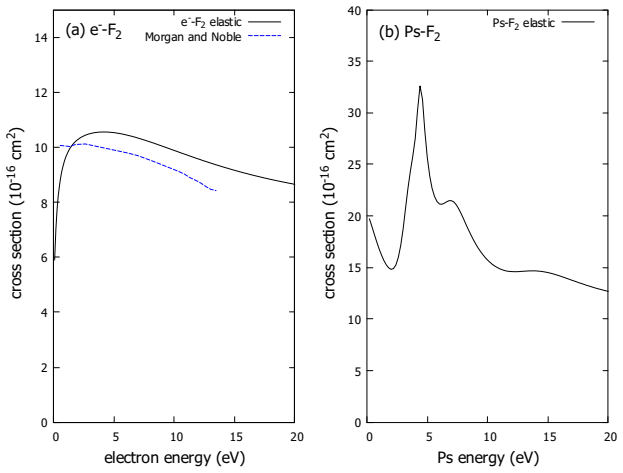
The central claim is that dissociative positronium attachment, not generic chemical quenching, is the mechanism behind the large 1Zeff values in halogen gases. Using free-electron-gas scattering potentials, the paper finds a Σu resonance in Ps-F2 scattering whose potential energy curve crosses the neutral curve at ρcr = −0.250 a.u., inside the classically forbidden region. Feeding the resonance position and width into a quasiclassical local theory of dissociative attachment gives a thermal rate constant 0.178 × 10⁻¹⁰ cm3/s and 1Zeff = 629 at 300 K, regarded by the authors as a lower bound because the resonance width is likely underestimated. The same calculation reproduces the shape of dissociative electron attachment in F2 and underestimates the best DEA cross section by a factor of four, which sets the expected accuracy.
Load-bearing premise
The calculated rate grows exponentially with the placement of the curve crossing ρcr = −0.250 a.u., where the PsF2 resonance curve meets the neutral F2 curve; if the free-electron-gas model puts this crossing even 0.02 a.u. in the wrong direction, 1Zeff rises from 629 to over 1500, so the whole numerical prediction rests on that one crossing position.
Editorial extensions
If this is right
- If DPsA is the operative mechanism, the high 1Zeff values in Br2 and I2 find a microscopic explanation: Ps attaches to a molecule, the molecule dissociates, and the PsX complex annihilates quickly.
- The predicted 1Zeff for F2 at room temperature is large enough to be measurable, so F2 gas could serve as the cleanest experimental test of the mechanism.
- The same mechanism may apply to NO2, whose extremely high 1Zeff = 5.7 × 10⁵ could be explained if its DPsA cross section exceeds its dissociative electron attachment cross section at thermal energies.
- Thermal averaging over vibrational states matters: even though kBT is four times smaller than the vibrational quantum, excited vibrational levels contribute significantly, raising 1Zeff from 596 to 629.
- Resonant Ps scattering and electron scattering can differ qualitatively at low energies even when they agree at higher velocities, so resonance-driven Ps chemistry cannot be read off electron-molecule data.
Reading between the lines
- If the crossing point is as sensitive as Table III suggests, 1Zeff in F2 should be strongly temperature-dependent, a signature distinct from ordinary pickoff and testable by varying gas temperature.
- The same quasiclassical machinery could be reversed: a measured 1Zeff in F2 would pin down the PsF2 curve crossing and give experimental constraints on positronium-molecule interaction potentials.
- Because DPsA produces a bound Ps-halide complex whose positron annihilates with high-momentum atomic electrons, angular-correlation measurements in F2 should show a high-momentum component analogous to the NO2 data cited by the paper.
- The mechanism suggests that Ps chemistry could drive molecular dissociation at thermal energies without free electrons, which may be relevant to positronium-based diagnostics in gases and soft matter.
Signed reviews
Editorial analysis
A structured set of objections, weighed in public.
Referee Report
Summary. The paper proposes dissociative positronium attachment (DPsA), Ps + X2 -> PsX + X, as the mechanism behind the anomalously large ortho-positronium annihilation rates measured in Br2 and I2. It presents fixed-nuclei scattering calculations for Ps on F2 within a free-electron-gas model, identifies a Sigma_u resonance, and extracts the resonance width and PsF2 potential energy curve as functions of internuclear separation. These are then used as input to a local quasiclassical (WKB) dissociative-attachment formula, Eq. (7), to compute the DPsA cross section and thermally averaged rate for F2. The calculation yields 1Zeff = 596 for the ground vibrational state and 629 after vibrational averaging at 300 K, rising to 1507 and 4281 if the PsF2 curve is shifted by 0.02 and 0.05 a.u. The authors benchmark their method by reproducing the F2 dissociative electron attachment cross section to within a factor of four of previous nonlocal calculations and argue that their DPsA result is a lower bound.
Significance. If the proposal is correct, it would provide a quantitative mechanism for the long-standing 'chemical quenching' of ortho-positronium in halogen gases and would connect positronium-molecule scattering to the well-developed theory of dissociative electron attachment. The manuscript has several genuine strengths: the quasiclassical derivation in Appendix A is transparent; the electron-F2 benchmark gives a factor-of-four agreement with established nonlocal calculations; and the authors explicitly show the sensitivity of their result to the curve-crossing position in Table III rather than hiding it. The main significance, however, is conditional on the extrapolation from F2 to Br2 and I2, which is not demonstrated by the calculations in the paper and is sensitive to the sign of the threshold energy for those molecules. As a prediction for F2, the work is interesting and testable if Ps-F2 annihilation experiments become available; as an explanation of the Br2/I2 data, it currently rests on an unverified threshold assumption.
major comments (3)
- [Sec. IV, Table III] The paper's central claim that DPsA explains the Br2 and I2 quenching is not backed by a quantitative threshold check for these molecules. Using Table I, Eth = D0 - PsA for Br2 is -0.091 eV with the Ps affinity of Ref. [24] but +0.097 eV with Ref. [25], and for I2 it is -0.174 eV with Ref. [24] but +0.147 eV with Ref. [25]. If the positive values are correct, the 300-K Maxwellian Boltzmann factor exp(-Eth/kBT) is only about 0.02, so DPsA could not plausibly reach the measured 1Zeff ~ 10^4 without an unreasonably large prefactor. Because F2 is exothermic by more than 1 eV, the F2 calculation cannot certify the mechanism for the heavier halogens. The authors should either perform a scattering calculation for Br2 and I2 with the same method, or at minimum bracket the threshold using both Ps-affinity data and state explicitly how the central conclusion depends on the sign of Eth.
- [Sec. IV, Table III] The predicted rate is exponentially sensitive to the crossing point rho_cr, whose location is a model output of the free-electron-gas calculation. Shifting the PsF2 potential curve horizontally by only 0.02 and 0.05 a.u. raises the Boltzmann-averaged 1Zeff from 629 to 1507 and 4281 (Table III). Since rho_cr = -0.250 a.u. lies in the classically forbidden region and the FEG model is approximate, the paper should provide an error estimate for rho_cr or an independent check, for example against a more accurate PsF2 curve, rather than presenting 629 as a lower bound. Without such an estimate, the central quantitative claim is not yet robust.
- [Secs. II and III] The benchmark of the DEA calculation is encouraging but leaves a sizable uncertainty that is not propagated into the DPsA rate. The present WKB result underestimates the best nonlocal DEA cross section by a factor of four (Sec. III), and the adiabatic widths in Table II are acknowledged to be underestimates for F2- and vanish for PsF2 beyond R = 2.4 a.u. Because the DPsA cross section is proportional to the width at the Franck-Condon point and to the survival factor, a comparable or larger error in the Ps width directly translates into 1Zeff ~ 10^3. The paper should give an explicit uncertainty budget and discuss whether a nonlocal treatment of the PsF2 resonance would alter the crossing-point argument that suppresses the F2 rate relative to DEA.
minor comments (4)
- [Sec. I, Eq. (2)] The notation 1Zeff is confusing: the leading '1' appears to be a relic of a superscript for the singlet state and is never defined. Please introduce the notation explicitly and use a consistent subscript/superscript format.
- [Sec. IV and Table III] The text states that the ground vibrational state gives <sigma V> = 0.178 x 10^-10 cm^3/s and that further vibrational averaging at room temperature gives 1Zeff = 629, while Table III lists a rate of 0.1882 x 10^-10 cm^3/s for the same unshifted case. Please reconcile these numbers.
- [Sec. II, Fig. 2] The text says the lowest two resonances are Delta_g at about 3.42 eV and Pi_u at about 4.38 eV, while the figure caption lists all symmetries without marking which curve is which. It would help the reader if the caption indicated the colour/symbol correspondence explicitly, especially because only the Sigma_u resonance is used later for DPsA.
- [Sec. II, Fig. 5] The comparison of the F2- curve in Fig. 5 is attributed to Ref. [31] in the text but to Ref. [19] in one place; Ref. [19] is a review of positron and positronium binding to atoms. Please check the citation and make the attribution consistent.
Circularity Check
No significant circularity: the F2 DPsA rate and 1Zeff are computed from scattering-derived resonance parameters and the quasiclassical DEA formula, not fitted to the target annihilation rates.
full rationale
The central derivation is self-contained. The paper computes Ps-F2 scattering in the free-electron-gas model, extracts the Sigma_u resonance position and width as functions of internuclear separation, and feeds these into the quasiclassical local dissociative-attachment formula, Eq. (7) and Appendix A. The resulting cross section is thermally averaged to obtain 1Zeff = <sigma V> / (4 pi r0^2 c). No parameter is fitted to the measured Br2 or I2 annihilation rates, and the F2 value is not adjusted to reproduce any target 1Zeff. The hand-applied horizontal shifts in Table III are an explicit sensitivity test, not a fit: the paper states the unshifted result (629) as its central value and presents the shifted values only to estimate how strongly the crossing position affects the outcome. The self-citations to the authors' prior work are method transfers, not unverified assumptions: the FEG model is benchmarked against independent e--F2 R-matrix scattering and against DEA calculations and experimental attachment rates, and prior FEG applications to Ps scattering are compared with measured cross sections. The use of Ps affinities from the authors' many-body work [25] is accompanied by the independent MRCI values [24], and the paper explicitly flags bromine and iodine as only 'possibly' exothermic, acknowledging the uncertainty. Any concern about whether the mechanism truly explains Br2 and I2 is a correctness or extrapolation risk, not a circularity, because the quantitative prediction for F2 does not reduce to the measured rates it is compared with.
Assumptions & free parameters
free parameters (1)
- Horizontal shift Delta_rho of the PsF2 potential energy curve =
0, 0.02, and 0.05 a.u. (chosen by hand)
assumptions (5)
- domain assumption The free-electron-gas model gives reliable low-energy Ps-molecule scattering potentials, including the Sigma_u resonance position and width for Ps-F2.
- domain assumption The local quasiclassical theory of dissociative attachment, Eq. (7) and Appendix A, applies to positronium projectiles with the substitution of Ps momentum for electron momentum.
- domain assumption The Sigma_u resonance is the only channel contributing to DPsA at thermal energies; the other resonances' potential energy curves do not cross the neutral curve.
- domain assumption The PsF2 potential curve and adiabatic width Gamma(R) can be extrapolated into the crossing region, including the asymptotic value U(infinity) derived from D0, hbar omega, and the EA of F.
- domain assumption Ps-atom complexes formed by DPsA annihilate rapidly, with a lifetime of about 0.5 ns, so every DPsA event contributes to o-Ps quenching with nearly unit efficiency.
Cite this review
Pith. "Pith review of Dissociative positronium attachment in halogen gases." pith.science (2026). https://pith.science/paper/YHMNSEDK
@misc{pith2026250518776,
  author       = {Pith},
  title        = {Pith review of: Dissociative positronium attachment in halogen gases},
  year         = {2026},
  howpublished = {\url{https://pith.science/paper/YHMNSEDK}},
  note         = {Machine review of arXiv:2505.18776}
}
abstract
We suggest that the observed large annihilation rates of ortho-positronium ($o$-Ps) in halogen gases are due to the process of dissociative Ps attachment, ${\rm Ps} + X_2 \to {\rm Ps}X + X$, where $X$ stands for a halogen atom. This process is similar to dissociative electron attachment which leads to formation of negative ions. We calculate the cross section and rate of this process for the F$_2$ molecule, for which it is exothermic, and therefore, can occur at room temperature. We start with the Ps-F$_2$ scattering calculations which take into account electron exchange and correlations within the framework of the free-electron-gas model. The calculations reveal several resonances. Similar to the process of dissociative electron attachment, a $\Sigma_u$ resonance contributes to the dissociative Ps attachment at thermal energies. We determine the resonance position and width as functions of the internuclear separation, and use them as inputs for the local version of the quasiclassical theory of dissociative attachment. Our calculations yield an anomalously large rate constant for the $o$-Ps annihilation process which is only one order of magnitude lower than those observed for Br$_2$ and I$_2$.
Figures


Figures from the paper (4 more)


Reference graph
Works this paper leans on
-
[24]
S. L. Saito, Multireference configuration interaction calculations for positronium halides, J. Chem. Phys.122, 054302 (2005)
work page 2005
-
[25]
Many-body theory calculations of positron binding to negative ions
A. Ludlow and G. F. Gribakin, Many-body theory calculations of positron binding to negative 22 ions, Int. Rev. At. Mol. Phys.1, 73 (2010); arXiv:1002.3125v1 [physics.atom-ph] 16 Feb 2010
work page Pith review arXiv 2010
-
[1]
E. Churazov, R. Sunyaev, S. Sazonov, M. Revnivtsev, and D. Varshalovich, Positron annihi- lation spectrum from the Galactic Centre region observed by SPI/INTEGRAL, Mon. Not. R. Astron. Soc.357, 1377 (2005)
work page 2005
-
[2]
P. Jean, J. Kn¨ odlseder, W. Gillard, N. Guessoum, K. Ferri` ere, A. Marcowith, V. Lonjou, and J. P. Roques, Spectral analysis of the Galactice +e? annihilation emission, Astron. Astrophys. 445, 579 (2006)
work page 2006
-
[3]
Charlton, Experimental studies of positrons scattering in gases, Rep
M. Charlton, Experimental studies of positrons scattering in gases, Rep. Prog. Phys.48, 737 (1985)
work page 1985
-
[4]
P. J. Schultz and K. G. Lynn, Interaction of positron beams with surfaces, thin films, and interfaces, Rev. Mod. Phys.60, 701 (1988)
work page 1988
-
[5]
S. G. Karshenboim, Precision physics of simple atoms: QED tests, nuclear structure and fundamental constants, Phys. Rep.4221 (2005)
work page 2005
-
[6]
D. B. Cassidy, Experimental progress in positronium laser physics, Eur. Phys. J. D72, 53 (2018)
work page 2018
Show all 65 references
-
[7]
Charlton, A
M. Charlton, A. P. Mills Jr, and Y. Yamazaki, Special issue on antihydrogen and positronium, J. Phys. B50, 140201 (2017)
2017
-
[8]
Wada and T
K. Wada and T. Hyodo, A simple shape-free model for pore-size estimation with positron annihilation lifetime spectroscopy, J. Phys. Conf. Ser.443012003 (2013)
2013
-
[9]
P. A. Fraser and M. Kraidy, The pick-off quenching of orthopositronium in helium, Proc. Phys. Soc. London89, 533 (1966)
1966
-
[10]
D. G. Green, A. R. Swann, and G. F. Gribakin, Many-body theory for positronium-atom interactions, Phys. Rev. Lett.120, 183402 (2018)
2018
-
[11]
A. R. Swann, D. G. Green, and G. F. Gribakin, Many-body theory of positronium scattering and pickoff annihilation in noble-gas atoms, Phys. Rev. A 107, 042802 (2023). 21
2023
-
[12]
Mitroy and S
J. Mitroy and S. A. Novikov, Spin-Orbit Quenching of Positronium during Atomic Collisions, Phys. Rev. Lett.90, 183202 (2003)
2003
-
[13]
Saito and T
H. Saito and T. Hyodo, Experimental Evidence for Spin-Orbit Interactions in Positronium-Xe Collisions, Phys. Rev. Lett.97, 253402 (2006)
2006
-
[14]
Shibuya, T
K. Shibuya, T. Nakayama, H. Saito, and T. Hyodo, Spin conversion and pick-off annihilation of ortho-positronium in gaseous xenon at elevated temperatures, Phys. Rev. A88, 012511 (2013)
2013
-
[15]
Hyodo, T
T. Hyodo, T. Nakayama, H. Saito, F. Saito, and K. Wada, The quenching of ortho-positronium, Phys. Status Solidi C6, 2497 (2009)
2009
-
[16]
K. Wada, F. Saito, N. Shinohara, and T. Hyodo, Pick-off quenching probability of ortho- positronium per collision with atoms and molecules, Eur. Phys. J. D66, 108 (2012)
2012
-
[17]
S. Y. Chuang and S. J. Tao, Quenching of positronium in nitrogen dioxide, Phys. Rev. A9, 989 (1974)
1974
-
[18]
Shinohara, N
N. Shinohara, N. Suzuki, T. Chang, and T. Hyodo, Pickoff and spin conversion of orthopositro- nium in oxygen, Phys. Rev. A64, 042702 (2001)
2001
-
[19]
Mitroy, M
J. Mitroy, M. W. J. Bromley and G. G. Ryzhikh, Positron and positronium binding to atoms, J. Phys. B35R81 (2002)
2002
-
[20]
Bressanini, M
D. Bressanini, M. Mella, and G. Morosi, Positron and positronium chemistry by quantum Monte Carlo. III. Ground state of [OH,Ps], [CH,Ps] and [NH 2,Ps] complexes, J. Chem. Phys. 109, 5931 (1998)
1998
-
[21]
This is in stark contrast to positron-molecule binding which supports very high positron- molecule annihilation rates due to vibrational Feshbach resonances [27]
-
[22]
Matth ´ ıasson, A
K. Matth ´ ıasson, A. Kvaran, G. A. Garcia, P. Weidner and B. Szt´ aray, Resolving the F2 bond energy discrepancy using coincidence ion pair production (cipp) spectroscopy, PCCP23, 8292 (2021)
2021
-
[23]
Lide, ed.,CRC Handbook of Chemistry and Physics(CRC Press, Boca Raton, FL, 2016)
David R. Lide, ed.,CRC Handbook of Chemistry and Physics(CRC Press, Boca Raton, FL, 2016)
2016
-
[26]
I. I. Fabrikant, S. Eden, N. J. Mason, and J. Fedor, Chapter Nine - Recent Progress in Dissociative Electron Attachment: From Diatomics to Biomolecules, Adv. At. Mol. Opt. Phys. 66, 545 (2017)
2017
-
[27]
G. F. Gribakin, J. A. Young, and C. M. Surko, Positron-molecule interactions: Resonant attachment, annihilation, and bound states, Rev. Mod. Phys.82, 2557 (2010)
2010
-
[28]
Charlton, T
M. Charlton, T. Giles, H. Lewis and D. P. van der Werf, Positron annihilation in small molecules, J. Phys. B46, 195001 (2013)
2013
-
[29]
Iwata, R
K. Iwata, R. G. Greaves, T. J. Murphy, M. D. Tinkle, and C. M. Surko, Measurements of positron-annihilation rates on molecules, Phys. Rev. A51, 473 (1995)
1995
-
[30]
Uzer, Theories of intramolecular vibrational energy transfer, Phys
T. Uzer, Theories of intramolecular vibrational energy transfer, Phys. Rep.199, 73 (1991)
1991
-
[31]
I. I. Fabrikant, Dissociative electron attachment to halogen molecules: Angular distributions and nonlocal effects, Phys. Rev. A94, 052707 (2016)
2016
-
[32]
I. I. Fabrikant and R. S. Wilde, Exchange and correlation in positronium-molecule scattering, Phys. Rev. A97, 052707 (2018)
2018
-
[33]
T. N. Rescigno and C. F. Bender, The stability of the F2 − ion: a model for dissociative attachment, J. Phys. B: At. Mol. Phys.9, L329 (1976)
1976
-
[34]
R. J. Hall, Dissociative attachment and vibrational excitation of F2 by slow electrons, J. Chem. Phys.68, 1803 (1978)
1978
-
[35]
A. U. Hazi, A. E. Orel, and T. N. Rescigno, Ab Initio Study of Dissociative Attachment of Low-Energy Electrons to F 2, Phys. Rev. Lett.46, 918 (1981)
1981
-
[36]
J. N. Bardsley and J. M. Wadehra, Dissociative attachment in HCl, DCl, and F 2, J. Chem. Phys.78, 7227 (1983)
1983
-
[37]
S. A. Kalin and A. K. Kazansky, The semiclassical version of the non-local resonance theory of electron-molecule collisions, J. Phys. B: At. Mol. Opt. Phys.23, 4377 (1990)
1990
-
[38]
M. Ingr, H. D. Meyer, and L. S. Cederbaum, Potential energy curve of the X2 u+ resonance state of F − 2 computed by CAP/CI, J. Phys. B: At. Mol. Opt. Phys.32, L547 (1999)
1999
-
[39]
Brems, T
V. Brems, T. Beyer, B. M. Nestmann, H. D. Meyer, and L. S. Cederbaum, Rotationalvibra- tional resonance states, J. Chem. Phys.117, 10635 (2002)
2002
-
[40]
Honigmann, R
M. Honigmann, R. J. Buenker, and H. P. Liebermann, Complex configuration interaction 23 calculations of the cross section for the dissociative electron attachment process e − + F2 F + F− using the complex basis function method, J. Comput. Chem.33, 355 (2012)
2012
-
[41]
F − 2 (2016)
showed that the best theoretical DEA cross sections were generated by Haziet al.[35] using the Stiltjes momentum imaging technique for calculation of the resonance width. In a more recent study [31], we used the resonance position and width fromR-matrix calculations. The corre...
2016
-
[42]
N. S. Shuman, T. M. Miller, A. A. Viggiano, and I. I. Fabrikant, Thermal electron attachment to F2, Phys. Rev. A88, 062708 (2013)
2013
-
[43]
Hara, The Scattering of Slow Electrons by Hydrogen Molecules, J
S. Hara, The Scattering of Slow Electrons by Hydrogen Molecules, J. Phys. Soc. Jpn.22, 710 (1967)
1967
-
[44]
Q. Sun, X. Zhang, S. Banerjee, P. Bao, M. Barbry, N. S. Blunt, N. A. Bogdanov, G. H. Booth, J. Chen, Z.-H. Cui, J. J. Eriksen, Y. Gao, S. Guo, J. Hermann, M. R. Hermes, K. Koh, P. Koval, S. Lehtola, Z. Li, J. Liu, N. Mardirossian, J. D. McClain, M. Motta, B. Mussard, H. Q. Pha...
2020
-
[45]
Q. Sun, T. C. Berkelbach, N. S. Blunt, G. H. Booth, S. Guo, Z. Li, J. Liu, J. McClain, S. Sharma, S. Wouters, and G. K.-L. Chan, PySCF: the Python-based simulations of chemistry framework, WIREs Comput. Mol. Sci.8, e1340 (2018)
2018
-
[46]
Sun, Libcint: An efficient general integral library for Gaussian basis functions, J
Q. Sun, Libcint: An efficient general integral library for Gaussian basis functions, J. Comp. Chem.36, 1664 (2015)
2015
-
[47]
R. S. Wilde and I. I. Fabrikant, Positronium collisions with rare-gas atoms: Free-electron gas plus orthogonalizing pseudopotential model, Phys. Rev. A98, 042703 (2018)
2018
-
[48]
R. S. Wilde and I. I. Fabrikant, Positronium collisions with molecular nitrogen, Phys. Rev A 97, 052708 (2018)
2018
-
[49]
R. S. Wilde and I. I. Fabrikant, Resonance scattering of positronium atoms by nitrogen molecules, J. Phys. B: At. Mol. Opt. Phys.53, 185202 (2020)
2020
-
[50]
R. S. Wilde, H. B. Ambalampitiya and I. I. Fabrikant, Positronium collisions with O 2 and CO2, Phys. Rev. A104, 012810 (2021)
2021
-
[51]
D. M. Newson, R. Kadokura, H. Allen, S. E. Fayer, S. J. Brawley, M. Shipman G. Laricchia, R. S. Wilde and I. I. Fabrikant, Low-energy positronium scattering from O 2, Phys. Rev, A. 107, 022809 (2023). 24
2023
-
[52]
R. S. Wilde, M. K. Selvage and I. I. Fabrikant, Positronium collisions with polar molecules, Phys. Rev. A106, 032810 (2022)
2022
-
[53]
S. J. Brawley, S. Armitage, J. Beale, D. E. Leslie, A. I. Williams, and G. Laricchia, Electron- Like Scattering of Positronium, Science330, 789 (2010)
2010
-
[54]
S. J. Brawley, A. I. Williams, M. Shipman, and G. Laricchia, Resonant Scattering of Positro- nium in Collision with CO 2, Phys. Rev. Lett.105, 263401 (2010)
2010
-
[55]
Shipman, S
M. Shipman, S. J. Brawley, L. Sarkadi, and G. Laricchia, Resonant scattering of positronium as a quasifree electron, Phys. Rev. A95, 032704 (2017)
2017
-
[56]
An analysis of the experimental values, J
M Gussoni, R Rui, G Zerbi, Electronic and relaxation contribution to linear molecular polar- izability. An analysis of the experimental values, J. Mol. Struct.447, 163 (1998)
1998
-
[57]
London, The general theory of molecular forces, Trans
F. London, The general theory of molecular forces, Trans. Faraday Soc.338 (1937)
1937
-
[58]
I. I. Fabrikant and G. F. Gribakin, Positronium-atom scattering at low energies, Phys. Rev. A90, 052717 (2014)
2014
-
[59]
L. A. Morgan and C. J. Noble, Elastic scattering of electrons by fluorine molecules, J. Phys. B: At. Mol. Phys.17L369 (1984)
1984
-
[60]
A. K. Kazansky and I. S. Yelets, The semiclassical approximation in the local theory of res- onance inelastic interaction of slow electrons with molecules, J. Phys. B: At. Mol. Phys.17, 4767 (1984)
1984
-
[61]
S. A. Rangwala, E. Krishnakumar, and S. V. K. Kumar, Dissociative-electron-attachment cross sections: A comparative study of NO 2 and O3, Phys. Rev. A68, 052710 (2003)
2003
-
[62]
H. Liu, X. Jiang, Ch.-H. Yuen, V. Kokoouline, and M. Ayouz, Formation of negative-ion resonance and dissociative attachment in collisions of NO2 with electrons, J. Phys. B: At. Mol. Opt. Phys.54, 185201 (2021)
2021
-
[63]
J. N. Bardsley, Configuration interaction in the continuum states of molecules, J. Phys. B1, 349 (1968)
1968
-
[64]
L. D. Landau and E. M. Lifshitz,Quantum Mechanics, 3rd ed. (Pergamon Press, Oxford, 1977)
1977
-
[65]
T. F. O’Malley, Theory of dissociative attachment, Phys. Rev.150, 14 (1966). 25
1966
Reviewed August 7, 2026 · model on record in the stance chip above.
Discussion (0). Continue with ORCID to comment.