REVIEW 4 major objections 6 minor 2 cited by
Formation of Supersonic Turbulence in the Primordial Star-forming Cloud
T0 review · 4 major / 6 minor · reviewed 2026-08-07 · deepseek-v4-flash
Pith's one-line read This paper claims that strong supersonic turbulence, with a characteristic Mach number of roughly 5.2, arises naturally during the assembly of a massive primordial minihalo, before any stars exist to drive it.
desk verdict Plausible new result undercut by a checkable box-size inconsistency and a missing resolution study; worth a referee but not ready to be taken as established. read the letter →
The pith
A machine-rendered reading of the paper's core claim, the machinery that carries it, and where it could break.
The reading
What carries the argument
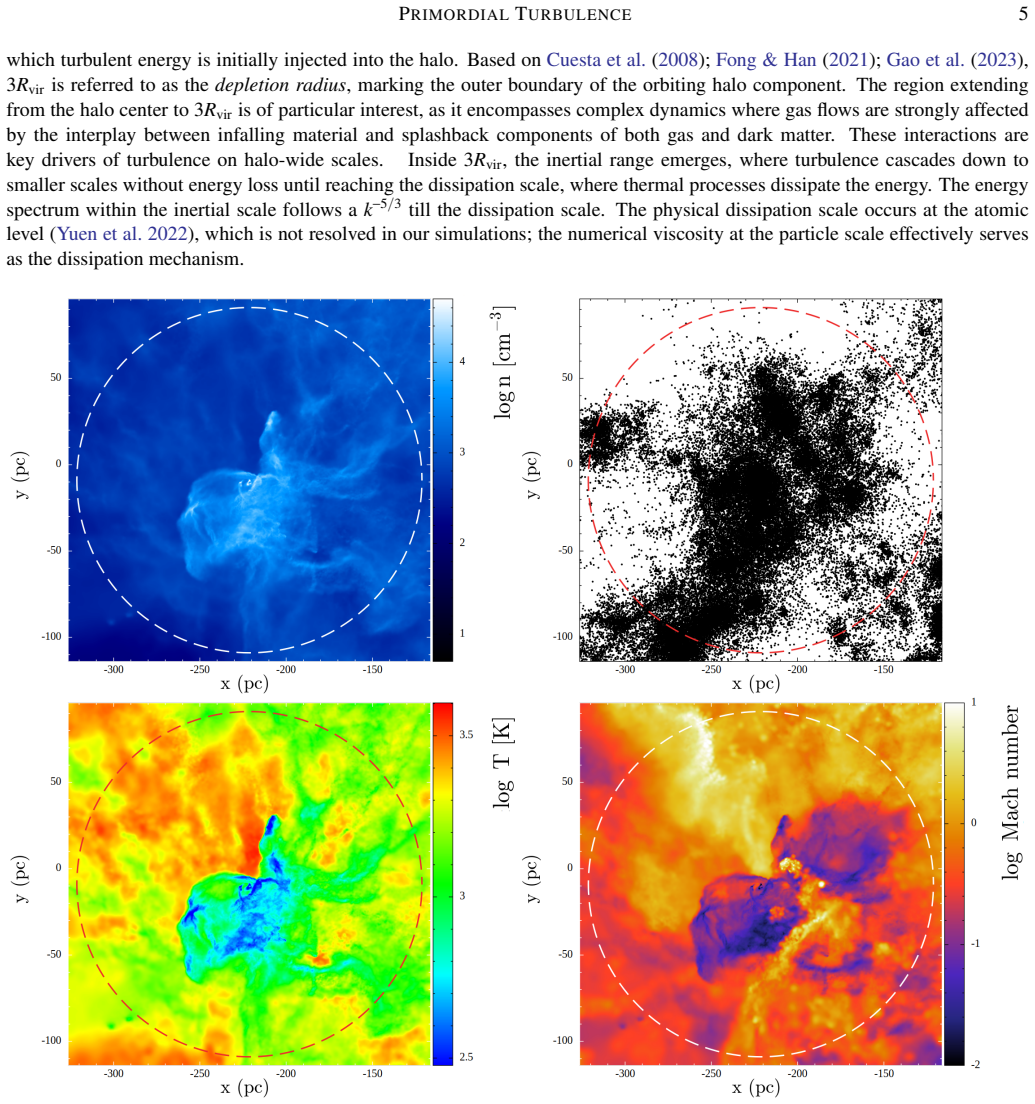
The central object is the super-Lagrangian particle-splitting refinement: every gas and dark matter particle is progressively split during the first five million years of the simulation, raising the mass resolution by a factor of about $10^5$ to target masses of $0.19\,M_\odot$ for gas and $80.88\,M_\odot$ for dark matter. This lets the simulation resolve the entire minihalo rather than only its central core, which is what allows the large-scale accretion flow and its turbulence to appear. The load-bearing diagnostics are the gas Mach number distribution, peaking near 5.2, and the kinetic-energy power spectrum, whose turnover at $k \sim 1$ kpc$^{-1}$ marks the driving scale near $3 R_{\rm vir}$ and whose $k^{-5/3}$ slope marks the inertial cascade.
What would settle it
Re-run the same halo with a distinctly different particle-splitting schedule, for example halving or doubling the target gas mass resolution of $0.19\,M_\odot$, or splitting particles over a longer or shorter interval, and compare the Mach number distribution, the kinetic-energy spectrum, and the mass of the most massive bound clump. If the characteristic Mach number changes by more than the expected sampling uncertainty, or if the bound core disappears or changes mass substantially, then the reported supersonic turbulence would be a numerical artifact rather than a property of halo assembly.
Extended reading notes
Core claim
The paper's central claim is that gravitational collapse alone, during the assembly of a massive minihalo at $z \sim 19$, naturally produces supersonic turbulence with a characteristic Mach number of approximately 5.2. The kinetic-energy power spectrum of the gas follows a $k^{-5/3}$ power law from a driving scale of about three virial radii down to roughly 2 pc, indicating an inertial turbulent cascade. This turbulence stirs the gas and fragments the star-forming cloud into dense clumps, one of which is gravitationally bound with mass $8.07\,M_\odot$, size $0.03$ pc, density $3.9\times10^6$ cm$^{-3}$, and temperature 117 K, exceeding its local Jeans mass of $1.75\,M_\odot$ and beginning to collapse. The author's interpretation is that supersonic turbulence on halo scales, rather than stellar feedback, regulates the mass scale of Population III stars by setting an upper limit on stellar mass through the masses of the collapsing clumps.
Load-bearing premise
The measurement assumes that the $10^5$-fold particle-splitting refinement reproduces the real large-scale accretion flow without injecting spurious velocity perturbations, and the paper presents no resolution study or convergence test showing that the Mach number, the $k^{-5/3}$ spectrum, or the bound-core mass are independent of the splitting schedule and numerical viscosity.
Editorial extensions
If this is right
- Supersonic turbulence with Mach number near 5.2 forms naturally in a collapsing $10^7\,M_\odot$ minihalo without any stellar feedback.
- The kinetic-energy spectrum follows $k^{-5/3}$ from the halo scale down to parsec scales, so the turbulence stirs the entire star-forming cloud, not just the central region.
- The turbulence fragments the primordial cloud into multiple clumps rather than allowing monolithic collapse, lowering the characteristic mass of Population III stars.
- The identified bound core of $8.07\,M_\odot$ exceeds its Jeans mass and is collapsing, giving an upper bound on the mass of the star that will form from it.
- Cloud-scale fragmentation, driven by supersonic turbulence, complements disk-scale fragmentation and pushes the characteristic Population III mass down to the roughly 1 to 40 $M_\odot$ range.
Reading between the lines
- Editorial extension: if the turbulent cascade with a driving scale near $3 R_{\rm vir}$ is generic, then zoom-in simulations that start inside the halo may miss the energy injection that sets the clump mass spectrum, implying some reported Population III initial mass functions are biased by their initial conditions.
- Editorial extension: a clean numerical test would be to run the same halo with and without the early-Universe streaming velocity between baryons and dark matter; since that effect is deliberately omitted here, its inclusion would bracket the turbulence amplitude in realistic patches of the early universe.
- Editorial extension: if cloud-scale clump masses cap the final stellar masses, then the abundance patterns of extremely metal-poor stars should be dominated by core-collapse and hypernova yields rather than pair-instability supernovae, a prediction that can be compared with stellar archaeology surveys.
Editorial analysis
A structured set of objections, weighed in public.
Referee Report
Summary. The paper presents a GIZMO zoom-in simulation of a 1.05e7 solar-mass minihalo at z~20-18.78, using initial conditions from the TNG50 simulation and a super-Lagrangian particle-splitting technique that increases resolution by ~1e5, with GRACKLE primordial chemistry and cooling. The authors report that supersonic turbulence with a characteristic Mach number of ~5.2 develops during halo assembly, that the gas kinetic-energy power spectrum follows a Kolmogorov k^-5/3 scaling, and that a gravitationally bound core of 8.07 solar masses and 0.03 pc size forms. They conclude that accretion-driven supersonic turbulence fragments primordial star-forming clouds and may lower the characteristic mass of Population III stars.
Significance. If the result is robust, it would challenge the traditional picture of quasi-spherical, quiescent collapse in minihalos and would strengthen the emerging view that the first stars can form with relatively low masses. The paper has clear strengths: it uses external large-scale cosmological initial conditions rather than idealized boxes, it couples the simulation to a detailed primordial chemistry network, and it does not fit free parameters to the target claims; the Mach number, spectral slope, and bound-core mass are all simulation outputs. These are falsifiable predictions. However, the central claim currently rests on a single simulation run with internal unit inconsistencies and no convergence testing, so the significance is conditional.
major comments (4)
- [§1.2, §2.2, Fig. 4] The claimed driving scale is inconsistent with the simulation volume. Section 1.2 states that the initial conditions are a cubic volume of ~14.7 ckpc per side, which at z~19-20 corresponds to a physical side of ~0.7 kpc and a half-side of ~0.35 kpc, just enough to contain Rvir~0.34 kpc. Section 2.2 and Fig. 4 identify the turbulence driving scale as ~1064 pc ~ 3Rvir ~ 1.0 kpc, which is larger than the whole box and therefore cannot be a resolved physical mode. Moreover, the two wavelength conversions in §2.2 are mutually inconsistent: if k=1 kpc^-1 maps to 1064 pc through lambda=1/k, then k=50 kpc^-1 maps to 20 pc, not the quoted 2 pc; if instead lambda=2*pi/k, then k=1 kpc^-1 corresponds to 6.3 kpc, not 1064 pc. The authors need to define the k convention, correct the unit conversions, and demonstrate that the low-k turnover is not the fundamental box mode; without this, the inertial-range and 3Rvir driving-scale interpretation is unsupported.
- [§1.2, §2.2] There is no resolution or convergence study. The resolution is increased by a factor of ~1e5 through super-Lagrangian particle splitting over the first 5 Myr, but the paper does not test whether the splitting schedule, splitting duration, or final mass resolution (0.19 solar masses for gas and 80.9 solar masses for dark matter) affect the measured Mach number, the k^-5/3 spectral slope, or the 8.07 solar-mass bound-core mass. Because particle splitting modifies the particle distribution and can in principle inject spurious velocity perturbations, a convergence test with a different splitting rate or final resolution is necessary before the turbulence can be claimed to 'naturally develop' rather than be a numerical artifact.
- [§2.3, Fig. 5] The characteristic Mach number of ~5.2 is computed from the total gas velocity, which includes coherent gravitational infall and accretion streams; indeed Fig. 3 shows supersonic accretion flows around r~5-100 pc. To support the claim of supersonic turbulence rather than supersonic accretion, the authors should separate the turbulent velocity component from the mean flow, for example by subtracting a filtered large-scale velocity field or by using scale-dependent velocity structure functions. As presented, the peak in the Mach-number distribution is not uniquely attributable to turbulence.
- [Abstract, §2.3, §3] The generalization that supersonic turbulence 'may be common in primordial halos' is based on a single minihalo and a single bound core. There is no variation of halo mass, spin, assembly history, or environment, and no statistical sample. The conclusion that supersonic turbulence lowers the characteristic mass of Population III stars is therefore an extrapolation; the paper should either add more halo realizations or explicitly restrict the claim to the simulated halo.
minor comments (6)
- [§1.2] The phrase 'spacial resolution' should be 'spatial resolution'.
- [Abstract, Introduction] The abstract says previous simulations used cosmological box sizes of ~1-2 Mpc, while the Introduction says ~0.3-2 Mpc; these numbers should be made consistent.
- [References] The reference 'Turk, Abel, & O'Shea 2009' appears twice in the reference list.
- [Fig. 4] Figure 4 lacks axis labels and units, and the text does not state whether E(k) is the three-dimensional spectrum or an angle-averaged one-dimensional spectrum; please specify the normalization and the definition of k.
- [Fig. 5] The paper shows a gas mass fraction versus Mach number distribution but does not specify whether the histogram is mass-weighted or volume-weighted, nor over which radial region or density threshold it is computed; please clarify.
- [§2.2] The term 'depletion radius' is used for 3Rvir with references to Cuesta et al. (2008), Fong & Han (2021), and Gao et al. (2023); since this is not a standard term, either define it explicitly or replace it with a more common term such as 'splashback radius'.
Circularity Check
No circularity: the central results are simulation outputs, and self-citations are used only for external comparison or method description, not to derive the target claims.
full rationale
The paper's central claims—supersonic turbulence with Mach number ~5.2, a Kolmogorov-like k^-5/3 spectrum, and a gravitationally bound 8.07 Msun core—are direct outputs of the GIZMO simulation, not parameters fitted to those claims. The kinetic-energy power spectrum is computed from the simulated gas velocities, and the bound core is identified by a clump-finding algorithm with its mass, size, density, and Jeans mass reported from the simulation. No equation is defined in terms of the result it is supposed to predict, and no fitted parameter is renamed as a prediction. The citations to Tang & Chen (2024) and Tung & Chen (2024), both involving the authors, are not load-bearing in the derivation: Tang & Chen is used as an external interpretation of what Mach > 4 turbulence does to fragmentation, and Tung & Chen is cited alongside other works as an example of particle-splitting methodology. The comparison to Kolmogorov scaling is an external benchmark rather than an input. The absence of a convergence study and the possible inconsistency between the quoted driving scale (~1064 pc) and the simulation volume are numerical and physical concerns, not circularity. Accordingly, no specific circular step can be quoted, and the appropriate score is 0.
Assumptions & free parameters
free parameters (3)
- Gas particle mass resolution after splitting =
0.19 Msun
- Dark matter particle mass resolution after splitting =
80.88 Msun
- Particle splitting duration and rate =
first ~5 Myr
assumptions (6)
- domain assumption Primordial gas chemistry and cooling are fully described by the GRACKLE twelve-species network with no metals or dust.
- domain assumption Initial conditions extracted from TNG50 at z=20, including the FOF group and surrounding volume, provide a valid cosmological environment for a Pop III minihalo.
- ad hoc to paper Super-Lagrangian particle splitting increases resolution by ~1e5 without spuriously modifying the turbulent velocity field.
- domain assumption Uniform particle refinement is preferable to AMR for capturing volume-filling turbulence.
- domain assumption Baryon-dark matter streaming velocity is negligible relative to gravitational accretion in this halo.
- domain assumption The kinetic-energy spectrum is interpreted with Kolmogorov's incompressible k^-5/3 scaling even though the flow is highly compressible and supersonic.
Cite this review
Pith. "Pith review of Formation of Supersonic Turbulence in the Primordial Star-forming Cloud." pith.science (2026). https://pith.science/paper/HQEOZAKG
@misc{pith2026250518964,
  author       = {Pith},
  title        = {Pith review of: Formation of Supersonic Turbulence in the Primordial Star-forming Cloud},
  year         = {2026},
  howpublished = {\url{https://pith.science/paper/HQEOZAKG}},
  note         = {Machine review of arXiv:2505.18964}
}
abstract
We present new simulations of the formation and evolution of the first star-forming cloud within a massive minihalo of mass of $1.05 \times 10^7\, M_{\odot}$, carried out using the GIZMO code with detailed modeling of primordial gas cooling and chemistry. Unlike previous studies that simulated the formation of the first stars within a smaller cosmological boxsize of $\sim 1-2$ Mpc, our work adopts initial conditions from the large-scale cosmological simulations, IllustrisTNG spanning $\sim 50$ Mpc to study the formation of primordial clouds that give birth to the first stars. We increase the original resolution of IllustrisTNG by a factor of $\sim10^5$ using a particle-splitting technique, achieving an extremely high resolution that allows us to resolve turbulence driven by gravitational collapse during early structure formation. We find that strong supersonic turbulence with a characteristic Mach number of $\sim 5.2$ naturally develops within the collapsing halo. This turbulence efficiently stirs the gas, promoting fragmentation of the star-forming cloud into multiple dense clumps. Among them, we identify a gravitationally bound core with a mass of $8.07\,M_{\odot}$ and a size of $0.03$ pc, which exceeds its local Jeans mass and is on the verge of collapsing into a star. Our results indicate that supersonic turbulence may be common in primordial halos and can play a crucial role in cloud-scale fragmentation, potentially lowering the characteristic mass scale of the first stars.
Figures


Figures from the paper (4 more)


Forward citations
Cited by 2 Pith papers
-
Supersonic Turbulence in Primordial Halos: A Comparison With and Without The Stream Velocity
Stream velocity boosts turbulence in primordial halos below roughly one million solar masses and suppresses it above, with the crossover near the filtering mass.
-
Turbulence in Primordial Dark Matter Halos and Its Impact on the First Star Formation
Supersonic turbulence, with Mach numbers 1.8 to 4.2 scaling with halo mass, is common in 15 simulated minihalos and fragments their central gas into Jeans-unstable clumps.
Reference graph
Works this paper leans on
-
[1]
2021, MNRAS, 508, 3226
Abe, M., Yajima, H., Khochfar, S., Dalla Vecchia, C., & Omukai, K. 2021, MNRAS, 508, 3226
2021
-
[2]
Abel, T., Bryan, G. L., & Norman, M. L. 1998, The Formation and Fragmentation of Primordial Molecular Clouds, arXiv:astro-ph/9810215 [astro-ph]
arXiv 1998
-
[3]
L., & Norman, M
Abel, T., Bryan, G. L., & Norman, M. L. 2002, Science, 295, 93 Anglés-Alcázar, D., Quataert, E., Hopkins, P. F., et al. 2021, ApJ, 917, 53
2002
-
[4]
C., Honda, S., & Lee, Y
Aoki, W., Tominaga, N., Beers, T. C., Honda, S., & Lee, Y . S. 2014, Science, 345, 912
2014
-
[5]
2020, A&A, 641, A70
Bacchini, C., Fraternali, F., Iorio, G., et al. 2020, A&A, 641, A70
2020
-
[6]
1967, Physical Review Letters, 18, 379
Barkat, Z., Rakavy, G., & Sack, N. 1967, Physical Review Letters, 18, 379
1967
-
[7]
C., & Christlieb, N
Beers, T. C., & Christlieb, N. 2005, ARA&A, 43, 531
2005
-
[8]
2013, Reports on Progress in Physics, 76, 112901
Bromm, V . 2013, Reports on Progress in Physics, 76, 112901
2013
Show all 99 references
-
[9]
Bromm, V ., & Larson, R. B. 2004, ARA&A, 42, 79
2004
-
[10]
2015, ApJ, 802, 13
Chen, K.-J., Bromm, V ., Heger, A., Jeon, M., & Woosley, S. 2015, ApJ, 802, 13
2015
-
[11]
J., et al
Chen, K.-J., Heger, A., Whalen, D. J., et al. 2017, MNRAS, 467, 4731
2017
-
[12]
J., et al
Chen, K.-J., Tang, C.-Y ., Whalen, D. J., et al. 2024, ApJ, 964, 91
2024
-
[13]
2018, MNRAS, 475, 4378
Chiaki, G., Susa, H., & Hirano, S. 2018, MNRAS, 475, 4378
2018
-
[14]
2020, MNRAS, 498, 2676
Chiaki, G., & Tominaga, N. 2020, MNRAS, 498, 2676
2020
-
[15]
2022, MNRAS, 510, 5199
Chiaki, G., & Yoshida, N. 2022, MNRAS, 510, 5199
2022
-
[16]
S., Naoz, S., Burkhart, B., Marinacci, F., & V ogelsberger, M
Chiou, Y . S., Naoz, S., Burkhart, B., Marinacci, F., & V ogelsberger, M. 2021, ApJ, 906, 25
2021
-
[17]
2021, MNRAS, 508, 4175
Chon, S., Omukai, K., & Schneider, R. 2021, MNRAS, 508, 4175
2021
-
[18]
C., Glover, S
Clark, P. C., Glover, S. C. O., Smith, R. J., et al. 2011, Science, 331, 1040 10 CHEN, HO,ANDTUNG
2011
-
[19]
J., Prada, F., Klypin, A., & Moles, M
Cuesta, A. J., Prada, F., Klypin, A., & Moles, M. 2008, MNRAS, 389, 385
2008
-
[20]
G., & Scalo, J
Elmegreen, B. G., & Scalo, J. 2004, ARA&A, 42, 211 Falceta-Gonçalves, D., Kowal, G., Falgarone, E., & Chian, A. C. L. 2014, Nonlinear Processes in Geophysics, 21, 587
2004
-
[21]
2011, PhRvL, 107, 114504
Federrath, C., Chabrier, G., Schober, J., et al. 2011, PhRvL, 107, 114504
2011
-
[22]
S., Iapichino, L., & Beattie, J
Federrath, C., Klessen, R. S., Iapichino, L., & Beattie, J. R. 2021, Nature Astronomy, 5, 365
2021
-
[23]
2023, A&A, 672, A193 Ferrière, K
Fensch, J., Bournaud, F., Brucy, N., et al. 2023, A&A, 672, A193 Ferrière, K. M. 2001, Reviews of Modern Physics, 73, 1031
2023
-
[24]
2021, MNRAS, 503, 4250
Fong, M., & Han, J. 2021, MNRAS, 503, 4250
2021
-
[25]
2010, Astronomische Nachrichten, 331, 474
Frebel, A. 2010, Astronomische Nachrichten, 331, 474
2010
-
[26]
L., Woosley, S
Fryer, C. L., Woosley, S. E., & Heger, A. 2001, ApJ, 550, 372
2001
-
[27]
P., & Li, Z
Gao, H., Han, J., Fong, M., Jing, Y . P., & Li, Z. 2023, ApJ, 953, 37
2023
-
[28]
Y ., Semenov, V
Gnedin, N. Y ., Semenov, V . A., & Kravtsov, A. V . 2018, Journal of Computational Physics, 359, 93
2018
-
[29]
Greif, T. H. 2015, Computational Astrophysics and Cosmology, 2, 3
2015
-
[30]
H., Springel, V ., White, S
Greif, T. H., Springel, V ., White, S. D. M., et al. 2011, ApJ, 737, 75
2011
-
[31]
Heger, A., & Woosley, S. E. 2002, ApJ, 567, 532 —. 2010, ApJ, 724, 341
2002
-
[32]
2021, A&A, 655, A3
Hennebelle, P. 2021, A&A, 655, A3
2021
-
[33]
2021, ApJ, 915, 107 —
Higashi, S., Susa, H., & Chiaki, G. 2021, ApJ, 915, 107 —. 2022, ApJ, 940, 38
2021
-
[34]
2024, ApJ, 962, 158
Higashi, S., Susa, H., Federrath, C., & Chiaki, G. 2024, ApJ, 962, 158
2024
-
[35]
2017, Science, 357, 1375
Hirano, S., Hosokawa, T., Yoshida, N., & Kuiper, R. 2017, Science, 357, 1375
2017
-
[36]
Hirano, S., Hosokawa, T., Yoshida, N., Omukai, K., & Yorke, H. W. 2015, MNRAS, 448, 568
2015
-
[37]
2014, ApJ, 781, 60
Hirano, S., Hosokawa, T., Yoshida, N., et al. 2014, ApJ, 781, 60
2014
-
[38]
2014, The Astrophysical Journal, 781, 60
Hirano, S., Hosokawa, T., Yoshida, N., et al. 2014, The Astrophysical Journal, 781, 60
2014
-
[39]
Hopkins, P. F. 2015, Monthly Notices of the Royal Astronomical Society, 450, 53–110
2015
-
[40]
F., Wetzel, A., Kereš, D., et al
Hopkins, P. F., Wetzel, A., Kereš, D., et al. 2018, Monthly Notices of the Royal Astronomical Society, 480, 800–863
2018
-
[41]
2022, ApJL, 929, L30
Hu, H., Qiu, Y ., Gendron-Marsolais, M.-L., et al. 2022, ApJL, 929, L30
2022
-
[42]
N., Tominaga, N., Kobayashi, C., & Nomoto, K
Ishigaki, M. N., Tominaga, N., Kobayashi, C., & Nomoto, K. 2018, ApJ, 857, 46
2018
-
[43]
2012, Annual Review of Nuclear and Particle Science, 62, 407
Janka, H.-T. 2012, Annual Review of Nuclear and Particle Science, 62, 407
2012
-
[44]
C., Almgren, A., Bell, J., et al
Joggerst, C. C., Almgren, A., Bell, J., et al. 2010, ApJ, 709, 11
2010
-
[45]
E., & Heger, A
Kasen, D., Woosley, S. E., & Heger, A. 2011, ApJ, 734, 102
2011
-
[46]
C., Bessell, M
Keller, S. C., Bessell, M. S., Frebel, A., et al. 2014, Nature, 506, 463
2014
-
[47]
Kim, C.-G., & Ostriker, E. C. 2017, ApJ, 846, 133
2017
-
[48]
S., & Glover, S
Klessen, R. S., & Glover, S. C. O. 2023, ARA&A, 61, 65
2023
-
[49]
S., Heitsch, F., & Mac Low, M.-M
Klessen, R. S., Heitsch, F., & Mac Low, M.-M. 2000, ApJ, 535, 887
2000
-
[50]
Kolmogorov, A. N. 1991, Proceedings: Mathematical and Physical Sciences, 434, 9
1991
-
[51]
Koo, B.-C., Kim, C.-G., Park, S., & Ostriker, E. C. 2020, ApJ, 905, 35
2020
-
[52]
R., & Burkhart, B
Krumholz, M. R., & Burkhart, B. 2016, MNRAS, 458, 1671
2016
-
[53]
Larson, R. B. 1979, MNRAS, 186, 479
1979
-
[54]
A., Whalen, D., & Khochfar, S
Latif, M. A., Whalen, D., & Khochfar, S. 2022, ApJ, 925, 28
2022
-
[55]
2024, MNRAS, 534, 290 Mac Low, M.-M., & Klessen, R
Liu, B., Gurian, J., Inayoshi, K., et al. 2024, MNRAS, 534, 290 Mac Low, M.-M., & Klessen, R. S. 2004, Reviews of Modern Physics, 76, 125
2024
-
[56]
I., & Woosley, S
MacFadyen, A. I., & Woosley, S. E. 1999, ApJ, 524, 262
1999
-
[57]
2003, ApJ, 598, 1163
Maeda, K., & Nomoto, K. 2003, ApJ, 598, 1163
2003
-
[58]
Magg, M., Nordlander, T., Glover, S. C. O., et al. 2020, MNRAS, 498, 3703
2020
-
[59]
2018, MNRAS, 480, 5113
Marinacci, F., V ogelsberger, M., Pakmor, R., et al. 2018, MNRAS, 480, 5113
2018
-
[60]
F., Stacy, A., & Li, P
McKee, C. F., Stacy, A., & Li, P. S. 2020, MNRAS, 496, 5528
2020
-
[61]
P., Pillepich, A., Springel, V ., et al
Naiman, J. P., Pillepich, A., Springel, V ., et al. 2018, MNRAS, 477, 1206
2018
-
[62]
2022, ApJL, 927, L12
Nakazato, Y ., Chiaki, G., Yoshida, N., et al. 2022, ApJL, 927, L12
2022
-
[63]
2018, MNRAS, 475, 624 —
Nelson, D., Pillepich, A., Springel, V ., et al. 2018, MNRAS, 475, 624 —. 2019, MNRAS, 490, 3234
2018
-
[64]
2006, Nuclear Physics A, 777, 424
Nomoto, K., Tominaga, N., Umeda, H., Kobayashi, C., & Maeda, K. 2006, Nuclear Physics A, 777, 424
2006
-
[65]
2001, ApJL, 561, L55
Omukai, K., & Palla, F. 2001, ApJL, 561, L55
2001
-
[66]
J., Quataert, E., & Sharma, P
Parrish, I. J., Quataert, E., & Sharma, P. 2010, ApJL, 712, L194
2010
-
[67]
2018, MNRAS, 475, 648
Pillepich, A., Nelson, D., Hernquist, L., et al. 2018, MNRAS, 475, 648
2018
-
[68]
2019, MNRAS, 490, 3196
Pillepich, A., Nelson, D., Springel, V ., et al. 2019, MNRAS, 490, 3196
2019
-
[69]
R., Clark, P
Prole, L. R., Clark, P. C., Klessen, R. S., & Glover, S. C. O. 2022, MNRAS, 510, 4019
2022
-
[70]
2024, MNRAS, 528, 3320
Ramesh, R., & Nelson, D. 2024, MNRAS, 528, 3320
2024
-
[71]
2024, A&A, 684, L16
Ramesh, R., Nelson, D., Fielding, D., & Brüggen, M. 2024, A&A, 684, L16
2024
-
[72]
Riaz, R., Bovino, S., Vanaverbeke, S., & Schleicher, D. R. G. 2018, MNRAS, 479, 667
2018
-
[73]
Ruszkowski, M., & Oh, S. P. 2011, MNRAS, 414, 1493
2011
-
[74]
Sharda, P., Federrath, C., & Krumholz, M. R. 2020, MNRAS, 497, 336
2020
-
[75]
Shore, S. N. 1992, An introduction to astrophysical hydrodynamics Skúladóttir, Á., Vanni, I., Salvadori, S., & Lucchesi, R. 2024, A&A, 681, A44
1992
-
[76]
Norman, M. L. 2009, The Astrophysical Journal, 691, 441
2009
-
[77]
D., Bryan, G
Smith, B. D., Bryan, G. L., Glover, S. C. O., et al. 2017, MNRAS, 466, 2217 PRIMORDIALTURBULENCE11
2017
-
[78]
2003, MNRAS, 339, 289
Springel, V ., & Hernquist, L. 2003, MNRAS, 339, 289
2003
-
[79]
Springel, V ., White, S. D. M., Tormen, G., & Kauffmann, G. 2001, MNRAS, 328, 726
2001
-
[80]
2018, MNRAS, 475, 676
Springel, V ., Pakmor, R., Pillepich, A., et al. 2018, MNRAS, 475, 676
2018
-
[81]
H., & Bromm, V
Stacy, A., Greif, T. H., & Bromm, V . 2010, MNRAS, 403, 45
2010
-
[82]
F., Lee, A
Stacy, A., McKee, C. F., Lee, A. T., Klein, R. I., & Li, P. S. 2022, MNRAS, 511, 5042
2022
-
[83]
2014, ApJ, 792, 32
Susa, H., Hasegawa, K., & Tominaga, N. 2014, ApJ, 792, 32
2014
-
[84]
2024, MNRAS, 529, 4248
Tang, C.-Y ., & Chen, K.-J. 2024, MNRAS, 529, 4248
2024
-
[85]
J., et al
Tegmark, M., Silk, J., Rees, M. J., et al. 1997, The Astrophysical Journal, 474, 1–12
1997
-
[86]
2009, ApJ, 690, 526
Tominaga, N. 2009, ApJ, 690, 526
2009
-
[87]
2007, ApJ, 660, 516
Tominaga, N., Umeda, H., & Nomoto, K. 2007, ApJ, 660, 516
2007
-
[88]
2010, Phys
Tseliakhovich, D., & Hirata, C. 2010, Phys. Rev. D, 82, 083520
2010
-
[89]
2024, arXiv e-prints, arXiv:2412.16440
Tung, P.-C., & Chen, K.-J. 2024, arXiv e-prints, arXiv:2412.16440
2024 arXiv
-
[91]
J., Abel, T., & O’Shea, B
Turk, M. J., Abel, T., & O’Shea, B. 2009, Science, 325, 601
2009
-
[92]
2002, ApJ, 565, 385
Umeda, H., & Nomoto, K. 2002, ApJ, 565, 385
2002
-
[93]
Wollenberg, K. M. J., Glover, S. C. O., Clark, P. C., & Klessen, R. S. 2020, MNRAS, 494, 1871
2020
-
[94]
Woosley, S. E. 1993, ApJ, 405, 273 —. 2017, ApJ, 836, 244
1993
-
[95]
E., Blinnikov, S., & Heger, A
Woosley, S. E., Blinnikov, S., & Heger, A. 2007, Nature, 450, 390
2007
-
[96]
E., Heger, A., & Weaver, T
Woosley, S. E., Heger, A., & Weaver, T. A. 2002, Reviews of Modern Physics, 74, 1015
2002
-
[97]
2023, Nature, 618, 712
Xing, Q.-F., Zhao, G., Liu, Z.-W., et al. 2023, Nature, 618, 712
2023
-
[98]
2008, Science, 321, 669
Yoshida, N., Omukai, K., & Hernquist, L. 2008, Science, 321, 669
2008
-
[99]
H., Ho, K
Yuen, K. H., Ho, K. W., Law, C. Y ., Chen, A., & Lazarian, A. 2022, Turbulent universal galactic Kolmogorov velocity cascade over 6 decades,arXiv:2204.13760 [astro-ph.GA]
2022 arXiv
-
[100]
E., & Heger, A
Zhang, W., Woosley, S. E., & Heger, A. 2008, ApJ, 679, 639
2008
Reviewed August 7, 2026 · model on record in the stance chip above.
Discussion (0). Continue with ORCID to comment.