On certain subclasses of analytic and harmonic mappings
Pith reviewed 2026-05-19 13:30 UTC · model grok-4.3
The pith
Harmonic mappings in the class D_H^0(α, M) satisfy coefficient bounds, growth estimates and starlikeness criteria while functions in P(M) have a sharp second Hankel determinant bound on inverse logarithmic coefficients.
A machine-rendered reading of the paper's core claim, the machinery that carries it, and where it could break.
Core claim
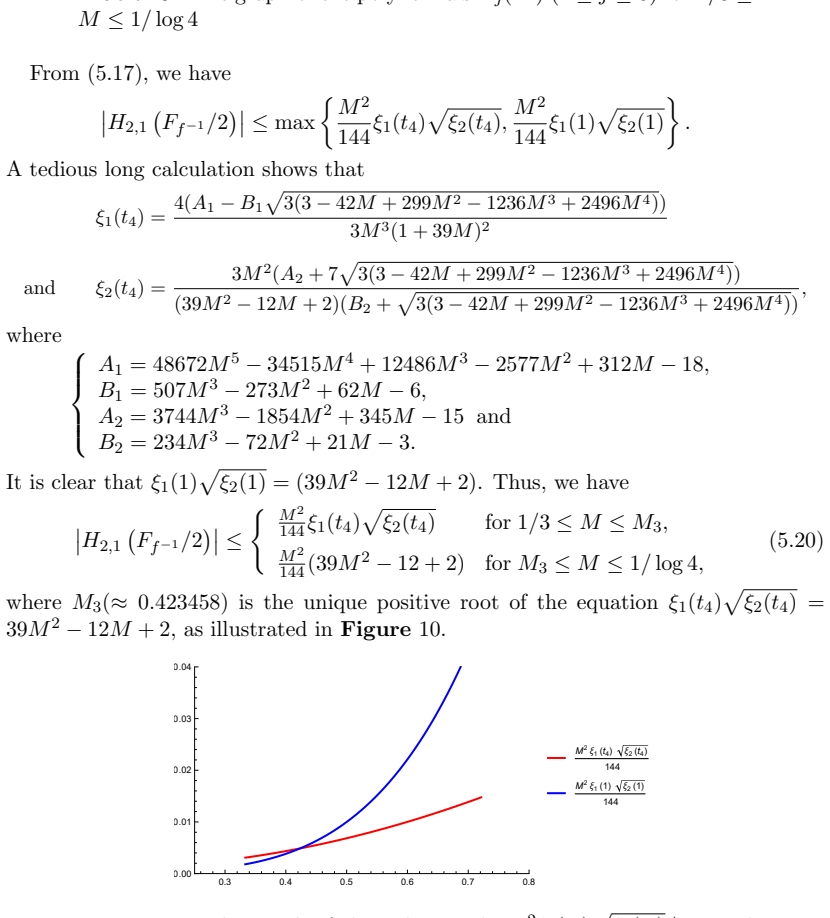
Functions belonging to the newly defined class D_H^0(α, M) satisfy coefficient bounds, growth estimates and starlikeness criteria; moreover the sharp bound of the second Hankel determinant of the inverse logarithmic coefficients is obtained for normalized analytic univalent functions f in P(M) satisfying Re(z f''(z)) > -M when 0 < M ≤ 1/log 4.
What carries the argument
The class D_H^0(α, M) of harmonic mappings defined by the inequality |(1-α)h'(z) + α z h''(z) -1 +α| ≤ M + |(1-α)g'(z) + α z g''(z)| with g'(0)=0 holding throughout the unit disk.
If this is right
- The coefficients of the analytic and co-analytic parts of functions in D_H^0(α, M) remain bounded by quantities depending only on α and M.
- Growth estimates limit the modulus |f(z)| for |z| < 1 in terms of α and M.
- Functions in D_H^0(α, M) satisfy explicit starlikeness criteria for suitable ranges of the parameters.
- The second Hankel determinant of inverse logarithmic coefficients for functions in P(M) attains a sharp upper bound when M lies in (0, 1/log 4].
Where Pith is reading between the lines
- Special choices of α and M recover earlier subclasses of harmonic mappings already studied in the literature.
- The restriction M ≤ 1/log 4 may be tied to the radius of univalence or convexity for the associated analytic functions.
- The same differential inequality could be combined with other operators such as convolution or integral transforms to generate further subclasses.
Load-bearing premise
The defining inequality is assumed to hold for every z inside the unit disk and the auxiliary class P(M) is restricted to the interval 0 < M ≤ 1/log 4.
What would settle it
A concrete harmonic function satisfying the defining inequality but whose coefficient magnitudes exceed the claimed bounds, or an analytic function in P(M) whose second Hankel determinant of inverse logarithmic coefficients exceeds the stated sharp value.
Figures



read the original abstract
Let $\mathcal{H}$ be the class of harmonic functions $f=h+\overline{g}$ in the unit disk $\mathbb{D}:=\{z\in\mathbb{C}:|z|<1\}$, where $h$ and $g$ are analytic in $\mathbb{D}$ with the normalization $h(0)=g(0)=h'(0)-1=0$. Let $\mathcal{D}_{\mathcal{H}}^0(\alpha, M)$ denote the class of functions $f=h+ \overline{g}\in\mathcal{H}$ satisfying the conditions $\left|(1-\alpha)h'(z)+\alpha zh''(z)-1+\alpha\right|\leq M+\left|(1-\alpha)g'(z)+\alpha zg''(z)\right|$ with $g'(0)=0$ for $z\in\mathbb{D}$, $M>0$ and $\alpha\in(0,1]$. In this paper, we investigate fundamental properties for functions in the class $\mathcal{D}_{\mathcal{H}}^0(\alpha, M)$, such as the coefficient bounds, growth estimates, starlikeness and some other properties. Furthermore, we obtain the sharp bound of the second Hankel determinant of inverse logarithmic coefficients for normalized analytic univalent functions $f\in\mathcal{P}(M)$ in $\mathbb{D}$ satisfying the condition $\text{Re}\left(zf''(z)\right)>-M$ for $0<M\leq 1/\log4$ and $z\in\mathbb{D}$.
Editorial analysis
A structured set of objections, weighed in public.
Referee Report
Summary. The paper introduces the class D_H^0(α, M) of normalized harmonic mappings f = h + conjugate(g) in the unit disk satisfying the inequality |(1-α)h'(z) + α z h''(z) - 1 + α| ≤ M + |(1-α)g'(z) + α z g''(z)| with g'(0) = 0. It derives coefficient bounds, growth estimates, and starlikeness criteria for functions in this class. Separately, for the class P(M) of normalized analytic univalent functions satisfying Re(z f''(z)) > -M, the paper obtains the sharp bound on the second Hankel determinant of the inverse logarithmic coefficients when 0 < M ≤ 1/log 4.
Significance. If the derivations hold, the results extend the literature on subclasses of harmonic mappings and univalent functions by supplying explicit estimates obtained via power-series manipulation and standard growth/subordination theorems. The sharp Hankel-determinant bound, obtained after verifying positivity of the auxiliary function for the extremal case under the stated restriction on M, is a concrete contribution that could serve as a reference point for related problems in geometric function theory.
minor comments (3)
- [Abstract] The abstract presents two distinct sets of results (one for the harmonic class D_H^0(α, M) and one for the analytic class P(M)); a brief sentence separating these threads would improve readability.
- [Section 2] In the statement of the defining inequality for D_H^0(α, M), the normalization g'(0) = 0 is given but its role in the subsequent coefficient extractions could be recalled explicitly when the first few coefficients are computed.
- [Section 4] The range 0 < M ≤ 1/log 4 for the Hankel-determinant result is justified by direct verification on the extremal function; a short remark on whether the bound remains valid (perhaps with a different constant) for M slightly larger than 1/log 4 would clarify the sharpness claim.
Simulated Author's Rebuttal
We thank the referee for the positive summary and significance assessment of our manuscript on the class D_H^0(α, M) of harmonic mappings and the sharp second Hankel determinant bound for inverse logarithmic coefficients in P(M). The recommendation for minor revision is noted. No specific major comments appear in the report, so we have no individual points to address.
Circularity Check
No significant circularity
full rationale
The central claims follow from direct manipulation of the defining inequality for class D_H^0(α, M) using power-series coefficients together with standard growth and subordination theorems for harmonic mappings. The separate Hankel-determinant bound for P(M) is obtained under the explicit restriction 0 < M ≤ 1/log 4, which is justified by verifying that an auxiliary function remains positive and subordinate via direct computation on the extremal function. No load-bearing step reduces by construction to a fitted parameter, self-definition, or self-citation chain; all derivations remain independent of the paper's own inputs and rest on externally verifiable analytic techniques.
Axiom & Free-Parameter Ledger
axioms (1)
- standard math Basic properties of analytic and harmonic functions in the unit disk (normalization, analyticity, conjugation)
Lean theorems connected to this paper
-
IndisputableMonolith/Foundation/AbsoluteFloorClosure.leanreality_from_one_distinction unclear?
unclearRelation between the paper passage and the cited Recognition theorem.
Let D0_H(α,M) denote the class of functions f=h+g∈H satisfying |(1−α)h′(z)+αzh″(z)−1+α|≤M+|(1−α)g′(z)+αzg″(z)| with g′(0)=0
-
IndisputableMonolith/Cost/FunctionalEquation.leanwashburn_uniqueness_aczel unclear?
unclearRelation between the paper passage and the cited Recognition theorem.
Theorem 5.1 … sharp bound of the second Hankel determinant of logarithmic inverse coefficients for f∈P(M)
What do these tags mean?
- matches
- The paper's claim is directly supported by a theorem in the formal canon.
- supports
- The theorem supports part of the paper's argument, but the paper may add assumptions or extra steps.
- extends
- The paper goes beyond the formal theorem; the theorem is a base layer rather than the whole result.
- uses
- The paper appears to rely on the theorem as machinery.
- contradicts
- The paper's claim conflicts with a theorem or certificate in the canon.
- unclear
- Pith found a possible connection, but the passage is too broad, indirect, or ambiguous to say the theorem truly supports the claim.
Reference graph
Works this paper leans on
-
[1]
A. Aleman and A. Constantin , Harmonic maps and ideal fluid flows, Arch. Rational Mech. Anal. 204 (2014), 479–513
work page 2014
-
[2]
R.M. Ali, S. Ponnusamy and V. Singh , Starlikeness of functions satisfying a differential in- equality, Ann. Polon. Math. 61 (1995), 135–140
work page 1995
-
[3]
V. Allu, V. Arora and A. Shaji, On the second Hankel determinant of logarithmic coefficients for certain univalent functions, Mediterr. J. Math. 20 (2023), 81
work page 2023
-
[4]
V. Allu and H. Halder , Bohr phenomenon for certain subclasses of harmonic mappings, Bull. Sci. Math. 173 (2021), 103053
work page 2021
-
[5]
V. Allu and V. Arora , Bohr-Rogosinski type inequalities for concave univalent functions, J. Math. Anal. Appl. 520 (2023), 126845
work page 2023
-
[6]
Y. A vci and E. Zlotkiewicz , On harmonic univalent mappings, Ann. Uni. Mariae Curie- Sklodowska Sect. A 44 (1990), 1–7
work page 1990
-
[7]
W. N. Bailey , W.N. Bailey. Generalized Hypergeometric Series, By W.N. Bailey, Cambridge Tracts in Mathematics and Mathematical Physics, No. 32, Cambridge University Press , 1964
work page 1964
-
[8]
Biswas, Second Hankel determinant of logarithmic coefficients for G(α) and P(M), J
R. Biswas, Second Hankel determinant of logarithmic coefficients for G(α) and P(M), J. Anal. 32 (2024), 3019–3037
work page 2024
-
[9]
R. Biswas and R. Mandal, The Bohr’s phenomenon for the class of K-quasiconformal harmonic mappings, Acta Math. Sci. (2025), To appear. ON CERTAIN SUBCLASSES 21
work page 2025
-
[10]
D. Bshouty, S. S. Joshi and S. B. Joshi , On close-to-convex harmonic mappings, Complex Var. Elliptic Equ. 58 (2013), 1195–1199
work page 2013
-
[11]
D. G. Cantor , Power series with integral coefficients,Bull. Amer. Math. Soc. 69 (1963), 362–366
work page 1963
-
[12]
J. H. Choi, Y. C. Kim and T. Sugawa, A general approach to the Fekete-Szeg¨ o problem, J. Math. Soc. Japan 59 (2007), 707–727
work page 2007
-
[13]
N. E. Cho, B. Kowalczyk and A. Lecko , Sharp bounds of some coefficient functionals over the class of functions convex in the direction of the imaginary axis, Bull. Aust. Math. Soc. 100 (2019), 86–96
work page 2019
-
[14]
M. Chuaqui, P. Duren and B. Osgood , Curvature properties of planar harmonic mappings, Comp. Methods Funct. Theory 4(1) (2004), 127–142
work page 2004
-
[15]
J. Clunie and T. Sheil-Small , Harmonic univalent functions, Ann. Acad. Sci. Fenn. Ser. A I 9 (1984), 3–25
work page 1984
-
[16]
Dienes , The Taylor series, New York, 1957
P. Dienes , The Taylor series, New York, 1957
work page 1957
-
[17]
P. L. Duren , Univalent Functions, Springer-Verlag, New York Inc, 1983
work page 1983
-
[18]
Duren , Harmonic mappings in the plane, Cambridge University Press , Cambridge, 2004
P. Duren , Harmonic mappings in the plane, Cambridge University Press , Cambridge, 2004
work page 2004
-
[19]
N. Ghosh and V. Allu, Some basic properties of certain subclass of harmonic univalent functions, Complex Var. Elliptic Equ. 63(12) (2017), 1687–1703
work page 2017
-
[20]
N. Ghosh and V. Allu, On some subclasses of harmonic mappings, Bull. Aust. Math. Soc. 101(1) (2020), 130–140
work page 2020
-
[21]
Heinz , ¨Uber die L¨ osungen der minimalfl¨ achengleichung,Nachr
E. Heinz , ¨Uber die L¨ osungen der minimalfl¨ achengleichung,Nachr. Akad. Wiss. G¨ ottingen Math. Phys. Kl , 1952, 51–56
work page 1952
-
[22]
A. W. Goodman , Univalent Functions, Vols. 1-2, Mariner Publishing Co. , Tampa, FL, 1983
work page 1983
- [23]
-
[24]
B. Kowalczyk and A. Lecko , Second Hankel determinant of logarithmic coefficients of convex and starlike functions, Bull. Aust. Math. Soc. 105(3) (2022), 458–467
work page 2022
-
[25]
B. Kowalczyk and A. Lecko , Second Hankel determinant of logarithmic coefficients of convex and starlike functions of order alpha, Bull. Malays. Math. Sci. Soc. 45(2) (2022), 727–740
work page 2022
-
[26]
Lewy, On the non-vanishing of the Jacobian in certain one-to-one mappings, Bull
H. Lewy, On the non-vanishing of the Jacobian in certain one-to-one mappings, Bull. Am. Math. Soc. 42 (1936), 689–692
work page 1936
-
[27]
R. J. Libera and E. J. Zlotkiewicz , Early coefficients of the inverse of a regular convex function, Proc. Amer. Math. Soc. 85 (1982), 225–230
work page 1982
-
[28]
R. J. Libera and E. J. Zlotkiewicz , Coefficient bounds for the inverse of a function with derivatives in P, Proc. Amer. Math. Soc. 87 (1983), 251–257
work page 1983
- [29]
- [30]
-
[31]
L ¨owner, Untersuchungenuber schlichte konforme Abbildungen des Einheitskreises, I
K. L ¨owner, Untersuchungenuber schlichte konforme Abbildungen des Einheitskreises, I. Math. Ann. 89 (1923), 103–121
work page 1923
-
[32]
T. H. MacGregor , Functions whose derivative has positive real part, Trans. Amer. Math. Soc. 104 (1962), 532–537
work page 1962
- [33]
-
[34]
P. T. Mocanu , Two simple sufficient conditions for starlikeness, Mathematica(Cluj) 34(57) (1992), 175–181
work page 1992
-
[35]
Pommerenke , Univalent Functions, Vandenhoeck & Ruprecht, G¨ ottingen, 1975
C. Pommerenke , Univalent Functions, Vandenhoeck & Ruprecht, G¨ ottingen, 1975
work page 1975
-
[36]
Pommerenke , On the coefficients and Hankel determinants of univalent functions, J
C. Pommerenke , On the coefficients and Hankel determinants of univalent functions, J. Lond. Math. Soc. 41 (1966), 111–122
work page 1966
-
[37]
Pommerenke , On the Hankel determinants of Univalent functions, Mathematika 14 (1967), 108–112
C. Pommerenke , On the Hankel determinants of Univalent functions, Mathematika 14 (1967), 108–112
work page 1967
-
[38]
S. Ponnusamy and S. Singh , Criteria for univalent, starlike and convex functions, Bull. Belg. Math. Soc. 9 (2002), 511–531
work page 2002
-
[39]
S. Ponnusamy, N. L. Sharma and K. J. Wirths , Logarithmic Coefficients of the Inverse of Univalent Functions, Results Math. 73 (2018), 160
work page 2018
-
[40]
S. Ponnusamy, H. Yamamoto and H. Yanagihara, Variability regions for certain families of harmonic univalent mappings, Complex Var. Elliptic Equ. 58(1) (2013), 23–34. 22 R. BISWAS
work page 2013
-
[41]
M. Raza, A. Riaz and D. K. Thomas , The third Hankel determinant for inverse coefficients of convex functions, Bull. Aust. Math. Soc. 109(1) (2024), 94–100
work page 2024
-
[42]
Y. J. Sim, A. Lecko and D. K. Thomas , The second Hankel determinant for strongly convex and Ozaki close-to-convex functions, Ann. Mat. Pura Appl. 200(6) (2021), 2515–2533
work page 2021
-
[43]
Singh , Radius of convexity of partial sums of a certain power series, J
R. Singh , Radius of convexity of partial sums of a certain power series, J. Aust. Math. Soc. 11 (1970), 407–410
work page 1970
-
[44]
D. K. Thomas, N. Tuneski and V. Allu , Univalent functions. A primer, De Gruyter Studies in Mathematics , 69, De Gruyter, Berlin, 2018
work page 2018
-
[45]
X. T. W angand X. Q. Liang , Precise coefficient estimates for close-to-convex harmonic univalent mappings, J. Math. Anal. Appl. 263 (2001), 501–509. Department of Mathematics, Raiganj University, Raiganj, West Bengal-733134, India. Email address : rajubiswasjanu02@gmail.com
work page 2001
discussion (0)
Sign in with ORCID, Apple, or X to comment. Anyone can read and Pith papers without signing in.