REVIEW 3 major objections 4 minor 33 references
Handle decompositions and stabilizations of open books
T0 review · 3 major / 4 minor · reviewed 2026-08-07 · deepseek-v4-flash
Pith's one-line read This paper establishes that exchange moves on an open book's handle decomposition change the page and monodromy in a controlled way while leaving the underlying manifold unchanged, recovering stabilizations and reducing trivial-monodromy…
desk verdict Genuinely new handle-exchange construction, but the main theorem is a sketch that needs to be filled in before the applications are fully load-bearing. read the letter →
The pith
A machine-rendered reading of the paper's core claim, the machinery that carries it, and where it could break.
The reading
What carries the argument
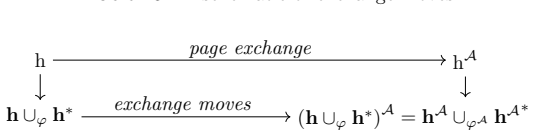
The central object is the exchange move, applied to the induced symmetric handle decomposition $h \cup_{\varphi} h^{*}$ of $\operatorname{Ob}(M, \varphi)$. A selection $A$ picks handles of index at least two whose monodromy restriction is isotopic to the identity; an exchangeable selection means no unselected handle is forced to intersect a selected handle's belt sphere. For each selected $k$-handle, the move slides the attaching sphere of its dual, an $(n-k)$-handle, into the $0$-handle and slides the selected handle itself into the $n$-handle, which replaces the handle by a boundary connected summand $S^{n-k} \times D^{k-1}$. The exchanged page $M^A$ is the page obtained by performing these replacements, and Theorem 4.7 gives the new monodromy $\varphi_A$ by patching the old monodromy on unselected handles with the new attaching data on the summands.
What would settle it
Take a page with one 1-handle and one 2-handle in canceling position, select the 2-handle, and carry out the exchange moves. The theorem predicts that the leftover handles form a handle decomposition of the half open book on the exchanged page, with the 2-handle replaced by $S^{n-2} \times D^1$; drawing the attaching spheres after the exchange and checking the handle count and attaching maps against Table 1 would settle whether Theorem 4.7 holds in the simplest nontrivial case.
Extended reading notes
Core claim
On the paper's own terms, the central discovery is that handle slides on the open book's handle decomposition are not merely moves that preserve the manifold: they are moves that change the page and monodromy in a controlled way. Given an open book $(M, \varphi)$ and a handle decomposition $h$ of $M$, choose a 'selection' $A$ of handles of index at least $2$ on which $\varphi$ is isotopic to the identity. The exchange move slides the dual of each selected handle into the $0$-handle and the selected handle into the $n$-handle; Theorem 4.7 asserts that the result is the handle decomposition of $\operatorname{Ob}(M^A, \varphi_A)$ induced by the exchanged page $M^A$, whose handle decomposition $h^A$ is obtained by replacing each selected $k$-handle with an $S^{n-k} \times D^{k-1}$ boundary summand. Hence $\operatorname{Ob}(M, \varphi)$ and $\operatorname{Ob}(M^A, \varphi_A)$ are diffeomorphic. From this, Theorems 1.1 and 1.2 recover $k$-stabilizations and middle-dimensional stabilizations, Theorem 1.3 gives explicit sphere open books with non-isotopic monodromies, and Theorem 1.4 reduces trivial-monodromy open books to boundary connected sums of disk bundles over spheres.
Load-bearing premise
The load-bearing premise is that, after the exchange moves, the remaining handles split into a handle decomposition of the half open book on the exchanged page and a relative handle decomposition on its boundary; the proof of Theorem 4.7 states this split rather than verifying it handle-by-handle, and the central claim collapses if this split fails for some page.
Editorial extensions
If this is right
- For every open book in dimension $n \geq 3$ and every $k \in [2, n-1]$, there is a $k$-stabilization whose page is $M \natural (S^{k-1} \times D^{n-k}) \natural (S^{n-k} \times D^{k-1})$, with the new monodromy restricting to the old one, and the resulting open book is not equivalent to the original.
- An odd-dimensional open book whose page has dimension $2\ell$ admits a middle-dimensional stabilization with page $M \natural (S^{\ell} \times D^{\ell})$, matching a standard contact stabilization.
- For each $n \geq 3$ and $k \in [2, n-1]$, the sphere $S^n$ admits explicit open books with page $(S^{k-1} \times D^{n-k}) \natural (S^{n-k} \times D^{k-1})$; for $k \leq \lfloor n/2 \rfloor$ the monodromies $\tau_k$ and $\tau_{n-k+1}$ are non-isotopic relative to the boundary.
- Any open book with trivial monodromy in dimension $n \geq 4$ can be stabilized to one whose page is $\natural_{i=1}^{n-2} \natural_{\mu_i} (S^i \times D^{n-1-i})$ for an explicit tuple $\mu$, with the original manifold unchanged.
- Two trivial-monodromy open books whose pages have equal Euler characteristic, or equal Euler characteristic modulo $2$ when the pages are even-dimensional, can be stabilized to open books with a common page.
Reading between the lines
- If Theorem 4.7 is correct, exchange moves give a purely smooth handle-calculus proof of stabilizations that contact geometry usually produces via Weinstein handles and Dehn–Seidel twists, which may help transfer Giroux-style stabilization questions to higher-dimensional smooth topology.
- The exchange construction suggests a duality on handle decompositions: selecting handles and then selecting the complementary dual handles may exchange the page again, potentially generating a graph of pairwise diffeomorphic open books; the paper does not explore this iteration.
- The trivial-monodromy theorem can be read as a normal form in which page complexity is traded for monodromy complexity, so explicitly computing $\sigma_\mu$ in low dimensions could yield new handle diagrams for high-dimensional open books.
- A testable extension would be to drop the exchangeability assumption and allow monodromy that is nontrivial on selected handles, asking whether a generalized move with compensating twists yields analogous stabilizations; Theorem 1.2 hints that such moves may exist.
Editorial analysis
A structured set of objections, weighed in public.
Referee Report
Summary. This paper develops a handle-calculus framework for open book decompositions in dimension at least three. It constructs a handle decomposition of the open book Ob(M, φ) from a handle decomposition h of the page M, defines a notion of 'exchangeable selection' of handles, and introduces 'exchange moves' consisting of handle slides that replace selected page handles by their dual handles. The main technical result (Theorem 4.7) asserts that these moves yield the induced handle decomposition of the open book whose page is the 'exchanged page' M^A and whose monodromy is a new map φ_A. Corollary 4.8 concludes that the underlying manifold is unchanged. From this the paper derives k-stabilizations and a middle-dimensional stabilization (Theorems 1.1 and 1.2), explicit open books on spheres with non-isotopic monodromies (Theorem 1.3), and a general stabilization result for trivial-monodromy open books to pages that are boundary connected sums of sphere times disks (Theorem 1.4 and Corollary 1.5).
Significance. The framework is potentially useful and original: it offers a uniform high-dimensional generalization of known stabilization operations and connects them to handle slides, recovering Quinn's almost-canonical pages and Harer's Hopf plumbing in special cases. The constructions are explicit and concrete, and the claimed applications are falsifiable and well stated. However, the central Theorem 4.7 is currently supported by a sketch argument, so the significance is conditional on a complete proof of the handle-by-handle identification of the two handle decompositions.
major comments (3)
- [Section 4, proof of Theorem 4.7] The sentence 'Consequently, the union of the 0-handle, all µ1 1-handles, the handles h^ℓ_i with (i,ℓ)∉A, and the dual handles h^{k*}_j with (j,k)∈A coincides with a handle decomposition on the half open book with the exchanged page M^A' is asserted without verifying that the attaching spheres, handle indices, and handle counts match the induced decomposition h^A constructed in Definition 4.3, nor that the dual handles' attaching maps after the slides are those prescribed by Lemma 3.5 for the exchanged page. Because every subsequent statement (Corollary 4.8, Theorems 1.1, 1.2, 1.3, 1.4) relies on this identification, the proof needs a handle-by-handle verification or a precise reference to a lemma that establishes the split.
- [Section 4, Definition 4.6] The exchange move (2) slides the attaching sphere of a selected page handle h^k_j into the n-handle, which is not a standard same-index handle slide; the paper appeals to [GS99] for preservation of diffeomorphism type, but for the slide to be an allowable handle move one must express it as a sequence of slides in the dual decomposition or verify that the resulting attaching data is obtained by legitimate handle slides. Without this justification, the diffeomorphism-type statement of Corollary 4.8 is not established for the two moves in combination.
- [Section 5, proof of Theorem 1.3] The proof of non-isotopy omits Claim 2 ('Since the proofs of Claims 1 and 2 are similar, we omit the latter'). The page (S^{k-1}×D^{n-k}) ♮ (S^{n-k}×D^{k-1}) is not symmetric under the map k ↦ n−k+1 when k ≤ n/2, so Claim 2 is not a formal consequence of Claim 1 and the homology computation for τ_{n-k+1} must be supplied for the theorem's conclusion.
minor comments (4)
- [Introduction] The phrase 'Hopf plumings' should be 'Hopf plumbings', and the spelling of 'stabilization' is inconsistent in a few places.
- [Definition 4.1] The selection condition depends on the chosen handle decomposition h; the paper should clarify whether M^A is intended to depend on h or to be independent up to diffeomorphism, and if the latter, provide a proof.
- [Figure 6] The schematic in Figure 6 would benefit from more detailed labeling of the handles before and after the exchange moves, so that the reader can follow which handle is slid along which path.
- [Definition 2.4] The convention for the orientation-reversing gluing map φ : ∂X → ∂X is terse; a sentence explaining the orientation convention in the double construction would improve readability.
Circularity Check
No circularity: the exchange-move construction is independent of its conclusion, and the self-cited half-open-book lemma is external evidence, not a circular input.
full rationale
I find no circular step. The central object of Theorem 4.7, the monodromy φ_A, is constructed after the exchange moves from the original monodromy on unselected handles and the attaching data of selected handles; it is not an input to the construction. The exchanged page M^A is defined independently (Definition 4.3) by replacing selected handles with boundary connected sums, and the proof then checks that the slid decomposition coincides with the induced decomposition on Ob(M^A, φ_A). The only self-citation, Lemma 2.8 ([Hsu24, Proposition 3.6]), is a published lemma about half open books with a proof outline; it does not assume Theorem 4.7, Corollary 4.8, or the stabilizations, so it is real support rather than a circular citation. The skeptical concern is genuine but not circular: the proof of Theorem 4.7 asserts, without a handle-by-handle verification, that the handles left after exchange moves split into a handle decomposition of hob(M^A) and a relative decomposition on (hob(M^A), DM^A); and in Theorem 1.3 the proof of Claim 2 is explicitly omitted ("Since the proofs of Claims 1 and 2 are similar, we omit the latter"). Those are rigor/correctness gaps that may affect the strength of the applications, but neither is a case in which a derived statement is identical to an input by construction or in which a fitted parameter is renamed as a prediction.
Assumptions & free parameters
assumptions (6)
- standard math Every compact smooth manifold with boundary admits a handle decomposition with exactly one 0-handle and no top-dimensional handle [GS99, Propositions 4.2.7 and 4.2.13].
- standard math Any handle decomposition has a dual relative handle decomposition obtained by reversing handle indices [GS99, Chapter 4].
- standard math Handle slides preserve the diffeomorphism type of the underlying manifold [GS99].
- standard math An attaching map of a handle in canceling position can be isotoped to the identity map, so attaching a canceling (k−1)- and k-handle pair to a 0-handle gives a boundary connected sum with a standard piece [GS99, Example 4.1.4(d)].
- standard math A handle decomposition on a page M induces a natural handle decomposition on the half open book hob(M) [Hsu24, Proposition 3.6].
- standard math Attaching ν1 1-handles to a single 0-handle produces a boundary connected sum of ν1 copies of S^1 × D^{n−2} [GS99, Example 4.1.4(b)].
Cite this review
Pith. "Pith review of Handle decompositions and stabilizations of open books." pith.science (2026). https://pith.science/paper/IF7K4AUJ
@misc{pith2026250519343,
  author       = {Pith},
  title        = {Pith review of: Handle decompositions and stabilizations of open books},
  year         = {2026},
  howpublished = {\url{https://pith.science/paper/IF7K4AUJ}},
  note         = {Machine review of arXiv:2505.19343}
}
abstract
We build handle decompositions of n-manifolds that encode given open book decompositions and describe handle slides that reveal new open book decompositions on the same underlying manifold, for $n \geq 3$. This recovers known stabilization operations for open books. As an application, we show that any open book with trivial monodromy can be stabilized to an open book whose page is a boundary connected sum of trivial disk bundles over spheres.
Figures


Figures from the paper (6 more)




Reference graph
Works this paper leans on
-
[1]
write newline
" write newline "" before.all 'output.state := FUNCTION output.nonempty.mrnumber duplicate missing pop "" 'skip if duplicate empty 'pop " " swap * " " * write if FUNCTION fin.entry add.period write mrnumber output.nonempty.mrnumber newline INTEGERS nameptr namesleft numnames FUNCTION format.language language empty "" " (" language * ")" * if FUNCTION form...
-
[2]
Alexander, A lemma on systems of knotted curves, Proc
J. Alexander, A lemma on systems of knotted curves, Proc. Natl. Acad. Sci. USA 9 (1923), 93--95
work page 1923
-
[3]
R. Budney and D. Gabai, Knotted 3 -balls in S ^4 , 2021, arXiv:1912.09029 http://arxiv.org/abs/1912.09029
arXiv 2021
-
[4]
, On the automorphism groups of hyperbolic manifolds, Int. Math. Res. Not. IMRN (2025), no. 7, Paper No. rnaf083, 28
work page 2025
- [5]
-
[6]
S. Baader and F. Misev, On the stabilization height of fiber surfaces in S^3 , J. Knot Theory Ramifications 27 (2018), no. 3, 1840001, 8
work page 2018
-
[7]
F. Bourgeois and O. van Koert, Contact homology of left-handed stabilizations and plumbing of open books, Commun. Contemp. Math. 12 (2010), no. 2, 223--263
work page 2010
- [8]
Show all 33 references
-
[9]
Etnyre and Y
J. Etnyre and Y. Li, The arc complex and contact geometry: nondestabilizable planar open book decompositions of the tight contact 3-sphere, Int. Math. Res. Not. (2015), no. 5, 1401--1420
2015
-
[10]
Etnyre, Lectures on open book decompositions and contact structures, Floer homology, gauge theory, and low-dimensional topology, Clay Math
J. Etnyre, Lectures on open book decompositions and contact structures, Floer homology, gauge theory, and low-dimensional topology, Clay Math. Proc., vol. 5, Amer. Math. Soc., Providence, RI, 2006, pp. 103--141
2006
-
[11]
Geiges, An introduction to contact topology, Cambridge Studies in Advanced Mathematics, vol
H. Geiges, An introduction to contact topology, Cambridge Studies in Advanced Mathematics, vol. 109, Cambridge University Press, Cambridge, 2008
2008
-
[12]
Giroux and N
E. Giroux and N. Goodman, On the stable equivalence of open books in three-manifolds, Geom. Topol. 10 (2006), 97--114
2006
-
[13]
Giroux, G\' e om\' e trie de contact: de la dimension trois vers les dimensions sup\' e rieures , Proceedings of the I nternational C ongress of M athematicians, V ol
E. Giroux, G\' e om\' e trie de contact: de la dimension trois vers les dimensions sup\' e rieures , Proceedings of the I nternational C ongress of M athematicians, V ol. II , Higher Ed. Press, Beijing, 2002, pp. 405--414
2002
-
[14]
Gompf and A
R. Gompf and A. Stipsicz, 4 -manifolds and K irby calculus , Graduate Studies in Mathematics, vol. 20, American Mathematical Society, Providence, RI, 1999
1999
-
[15]
Harer, How to construct all fibered knots and links, Topology 21 (1982), no
J. Harer, How to construct all fibered knots and links, Topology 21 (1982), no. 3, 263--280
1982
-
[16]
Hsueh, Kirby diagrams of 4-dimensional open books, Proc
C.-S. Hsueh, Kirby diagrams of 4-dimensional open books, Proc. Edinb. Math. Soc. (2) (2024), 1--29, to appear
2024
-
[17]
Kastenholz, Simplicial volume of open books in dimension 4, 2025, arXiv:2504.10975 http://arxiv.org/abs/2504.10975
T. Kastenholz, Simplicial volume of open books in dimension 4, 2025, arXiv:2504.10975 http://arxiv.org/abs/2504.10975
2025 arXiv
-
[18]
Kegel and F
M. Kegel and F. Schm\"aschke, Trisecting a 4-dimensional book into three chapters, Geom. Dedicata 218 (2024), no. 4, Paper No. 86
2024
-
[19]
Lawson, Open book decompositions for odd dimensional manifolds, Topology 17 (1978), 189--192
T. Lawson, Open book decompositions for odd dimensional manifolds, Topology 17 (1978), 189--192
1978
-
[20]
Licata and V
J. Licata and V. V\'ertesi, The G iroux correspondence in dimension 3 , 2024, arXiv:2408.01079 http://arxiv.org/abs/2408.01079
2024
-
[21]
Neumann and L
W. Neumann and L. Rudolph, Difference index of vectorfields and the enhanced M ilnor number , Topology 29 (1990), no. 1, 83--100
1990
-
[22]
Ozbagci and P
B. Ozbagci and P. Popescu-Pampu, Generalized plumbings and M urasugi sums , Arnold Math. J. 2 (2016), no. 1, 69--119
2016
-
[23]
Ozbagci, On open books for nonorientable 3-manifolds, Period
B. Ozbagci, On open books for nonorientable 3-manifolds, Period. Math. Hungar. 84 (2022), no. 1, 56--69
2022
-
[24]
Quinn, Open book decompositions, and the bordism of automorphisms, Topology 18 (1979), no
F. Quinn, Open book decompositions, and the bordism of automorphisms, Topology 18 (1979), no. 1, 55--73
1979
-
[25]
Saeki, On simple fibered knots in S^5 and the existence of decomposable algebraic 3 -knots , Comment
O. Saeki, On simple fibered knots in S^5 and the existence of decomposable algebraic 3 -knots , Comment. Math. Helv. 62 (1987), no. 4, 587--601
1987
-
[26]
, Knotted homology 3 -spheres in S^5 , J. Math. Soc. Japan 40 (1988), no. 1, 65--75
1988
-
[27]
, Open books on 5-dimensional manifolds, Hiroshima Math. J. 32 (2002), no. 2, 189--205
2002
-
[28]
Saha, On open book embedding of contact manifolds in the standard contact sphere, Canad
K. Saha, On open book embedding of contact manifolds in the standard contact sphere, Canad. Math. Bull. 63 (2020), no. 4, 755--770
2020
-
[29]
Seidel, Lectures on four-dimensional D ehn twists , Symplectic 4-manifolds and algebraic surfaces, Lecture Notes in Math., vol
P. Seidel, Lectures on four-dimensional D ehn twists , Symplectic 4-manifolds and algebraic surfaces, Lecture Notes in Math., vol. 1938, Springer, Berlin, 2008, pp. 231--267
1938
-
[30]
Thurston and H
W. Thurston and H. Winkelnkemper, On the existence of contact forms, Proc. Amer. Math. Soc. 52 (1975), 345--347
1975
-
[31]
van Koert, Lecture notes on stabilization of contact open books, M\"unster J
O. van Koert, Lecture notes on stabilization of contact open books, M\"unster J. Math. 10 (2017), no. 2, 425--455
2017
-
[32]
Weinstein, Contact surgery and symplectic handlebodies, Hokkaido Math
A. Weinstein, Contact surgery and symplectic handlebodies, Hokkaido Math. J. 20 (1991), no. 2, 241--251
1991
-
[33]
Winkelnkemper, Manifolds as open books, Bull
H. Winkelnkemper, Manifolds as open books, Bull. Amer. Math. Soc. 79 (1973), 45--51
1973
Reviewed August 7, 2026 · model on record in the stance chip above.
Discussion (0). Continue with ORCID to comment.