REVIEW 3 major objections 5 minor 69 references
Nonsymmorphic symmetry adapted finite element modeling of glide-symmetric photonic structures
T0 review · 3 major / 5 minor · reviewed 2026-08-07 · deepseek-v4-flash
Pith's one-line read This paper claims that the glide symmetry of photonic crystals lets one split the finite-element band-structure problem into smaller, decoupled, exactly equivalent subproblems, cutting the computational domain by a factor of two or four…
desk verdict Useful extension of symmetry-adapted FEM to glide-symmetric photonic structures, but the claimed exact decoupling of degenerate sub-tasks rests on an unproven vanishing of coupling blocks. read the letter →
The pith
A machine-rendered reading of the paper's core claim, the machinery that carries it, and where it could break.
The reading
What carries the argument
The load-bearing machinery is the character table of the nonsymmorphic group at each high-symmetry wave vector: irreducible representations of the little group at $k$, and full-group irreps induced from the star $k^*$ when time-reversal symmetry is needed. The Seitz-operator glide with its non-primitive translation determines, through those characters, the ratio between the field on one side of the minimal domain and the field on the other side (a scalar $\pm e^{i\pi a}$ for non-degenerate modes, a $2\times 2$ matrix for degenerate pairs), encoded in a transformation matrix $P$ that projects the full-cell system matrix onto the reduced degrees of freedom (Eqs. 10–11 and 14–15).
What would settle it
Run standard full-cell FEM and NSA-FEM on the same glide-symmetric structure over a dense set of wave vectors along an entire Brillouin-zone edge (or near a predicted accidental degeneracy) and check that the union of subtask eigenvalues matches the full-cell spectrum with no missing or spurious eigenvalues; a single mismatch would show the character-table boundary conditions do not suffice.
Extended reading notes
Core claim
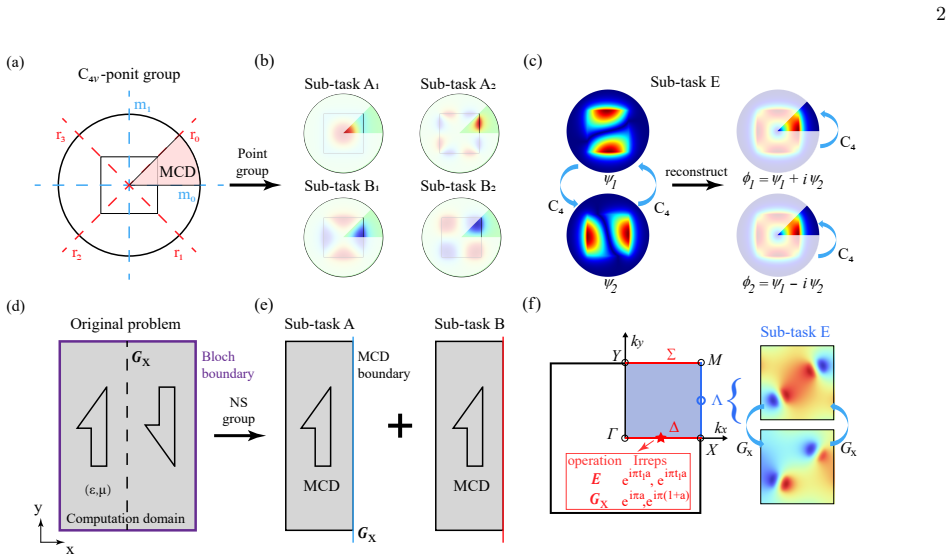
The paper introduces the nonsymmorphic symmetry-adapted finite element method (NSA-FEM) and demonstrates that for a photonic structure whose unit cell carries a glide operation $G_x = \{m_{01}|1/2,0\}$, the original matrix eigenproblem $Ax = \lambda Bx$ on the full cell can be reduced to independent subsystems on a minimal computational domain. For non-degenerate modes at a generic wave vector $\Delta$, the glide imposes a scalar character boundary condition $E_\Delta(r_R) = \pm e^{i\pi a}E_\Delta(r_L)$ (Eq. 5), which lets one solve only the left half and reconstruct the right half through the relation $x_{1,2} = D^k_j(\{R|\tau+R_n\})\{R|\tau+R_n\}^{-1} x_{1,1}$. For degenerate modes at $\Lambda$, where the glide has a two-dimensional representation and time-reversal symmetry couples the arms of the star $k^*$, the two modes form an inseparable pair whose coupled boundary conditions (Eq. 6) and transformation matrix $P$ (Eq. 15) yield the degenerate pair as a two-component subsystem. The band structures and modal fields obtained this way are reported to agree with standard full-cell FEM for a layer-group (rod group $pmcm$), a plane group ($P4g$), and a space group ($P4/mbm$) photonic crystal, while reducing degrees of freedom by one-half to one-quarter and wall-clock time in the examples shown.
Load-bearing premise
The load-bearing premise is that the symmetry-derived boundary conditions on the half- or quarter-cell domain yield exactly the same eigenvalues and eigenmodes as the full-cell problem, for both non-degenerate and degenerate modes; the paper shows visual agreement at selected wave vectors rather than a proof that the reduced spectrum coincides with the full spectrum.
Editorial extensions
If this is right
- Every band of a glide-symmetric photonic crystal can be computed on a half- or quarter-cell domain with full fields reconstructed by the glide relation, giving exact band-structure agreement at the wave vectors tested while using a fraction of the degrees of freedom.
- Bands are classified by irreducible representation from the outset, so band sticking, crossings, and degenerate points can be identified from the subtask decomposition rather than by post-processing the full spectrum.
- Time-reversal-induced degeneracies are treated as coupled two-mode subtasks built from full-group irreps of the star $k^*$, keeping phenomena such as hidden-symmetry nodal points within the reduced computation.
- The reduction procedure is systematic across group dimension: the same recipe is demonstrated for a layer group, a plane group, and a space group, and applies whenever a glide or screw operation is present.
- The decoupled subtasks can be solved independently and in parallel, so the reported sequential runtime reductions do not yet include the additional wall-clock gain from parallel execution.
Reading between the lines
- Editorial extension: Because the decomposition uses only group algebra and Bloch phases, the same boundary-constraint construction should carry over to other Hermitian eigenproblems on glide-symmetric lattices, including acoustics, elasticity, and Schrödinger-type equations.
- Editorial extension: A sharper validation than visual band agreement would be to compare the union of subtask eigenvalues with the full-cell spectrum over a dense set of wave vectors across the whole Brillouin zone; any missing or extra eigenvalue would pinpoint exactly where the character-table reduction breaks down.
- Editorial extension: The symmetry-resolved subtask spectra could be used as a projection basis for topological invariants, automatically assigning parity or glide eigenvalues to each band during large-scale computations.
- Editorial extension: The reported speedups are sequential; a direct benchmark of parallel subtask execution on a memory-bound problem would quantify the practical scaling advantage beyond the factor-of-domain reduction.
Signed reviews
Editorial analysis
A structured set of objections, weighed in public.
Referee Report
Summary. The paper proposes NSA-FEM, a symmetry-adapted finite element procedure for photonic band structures with nonsymmorphic space groups. It derives boundary conditions from the finite-dimensional irreducible representations of the little group at high-symmetry k, reduces the standard FEM eigenproblem Ax=λBx to subproblems on a minimal computational domain (MCD), and recovers full-cell fields via symmetry operations. The method is demonstrated on three structures: an AB-layer-stacked photonic crystal with rod group pmcm, a twisted quadrupole photonic crystal with a plane group, and a 3D metacrystal with space group P4/mbm. Comparisons to standard FEM are shown for band structures along high-symmetry paths, with DOF reductions by factors of 2–4 and reported speedups. The central claim is that the decomposition is exact rather than a heuristic domain reduction.
Significance. If exactness is established, this is a useful extension of symmetry-adapted FEM from symmorphic to nonsymmorphic groups. It offers a systematic route to exploit non-primitive translations and k-dependent irreps, provides symmetry labels for bands before solving, and enables parallel sub-task computations. The paper includes open-source MATLAB code on GitHub, which supports reproducibility, and benchmarks against standard FEM on three different structure types rather than a single toy model. However, the value of the contribution depends on proving that the reduced subproblems are exactly decoupled and spectrum-preserving; the manuscript currently leaves this at the level of assertion, so the significance is conditional.
major comments (3)
- [II.D, Eq. (13)] The central claim of exact decoupling is not established. In Eq. (13), the off-diagonal blocks O' are described as 'extremely sparse' and as representing 'weak coupling terms among the diagonal block matrices,' not as zero. No proof is given that these blocks vanish after the congruence transformation in Eq. (15), or that the spectrum of the reduced problem coincides with that of the original generalized eigenproblem in Eq. (7). If O' is nonzero, the sub-task eigenpairs are only an approximation, contradicting the abstract's claim of exact decomposition. Please provide a rigorous block-diagonalization argument (for example, equivariance of A and B under the symmetry representation and use of Schur's lemma), or, if the blocks are indeed nonzero, reframe the method as approximate and quantify the introduced error.
- [II.C, Eqs. (5)-(6)] The sufficiency of the proposed MCD boundary conditions for the two-dimensional representation at Λ is not demonstrated. Equations (6a)-(6b) impose two scalar relations between pairs of boundary degrees of freedom, but the full 2×2 representation matrix [[0,1],[-1,0]] in Table I couples the two degenerate components in a way that is not shown to be fully captured by these two relations. The paper should prove that the constrained reduced problem has the same eigenvalues with the same multiplicities as the original full-cell problem, including at the corners and intersections of the MCD boundary, rather than assuming this.
- [III.A-C] The numerical validation is visual rather than quantitative. In all three examples, agreement with standard FEM is claimed by overlaying band curves, but no eigenvalue residuals, eigenvalue counts, or tests of the degenerate sub-task at and around the star-k points are reported. Visual overlap of a few bands cannot certify that the reduced spectrum contains all eigenvalues with correct multiplicities, especially for the degenerate case where exactness is in question. Please add quantitative comparisons (for example, maximum relative frequency error, eigenvalue counts per sub-task) and a mesh-convergence test.
minor comments (5)
- [Table III] The text identifies the second example as plane group P4g (number 12), but the caption of Table III labels it P4bm; these are different group names and the inconsistency should be corrected.
- [Fig. 2] The caption of Fig. 2 labels subfigures (d) and (e), while the text refers to panels (a) and (b); the panel references and caption should be aligned.
- [II.D, Eq. (9)] Equation (9) is not well defined as written: the right-hand side multiplies a representation matrix, a symmetry operator, and a finite-element vector; the action of the space-group operator on discrete DOFs should be defined explicitly.
- [III.A-C] The timing comparisons do not report the number of eigenvalues requested, the eigensolver settings, or whether the sub-tasks were run serially; these details are needed to interpret the reported speedups.
- [Abstract and II.A] The abstract contains the sentence fragment 'our method fully accounting for non-primitive translations and nonstructural symmetries,' and Section II.A contains 'we can modal only half of the structure'; both should be rewritten.
Circularity Check
No significant circularity: the symmetry decomposition follows from externally tabulated space-group irreps and is validated against standard FEM; the only self-citation is a non-load-bearing background citation for the hidden-symmetry example.
full rationale
NSA-FEM's derivation chain is self-contained. The boundary constraints in Eq. (5) and Eq. (6) are obtained by applying Seitz operators and the character-table entries in Table I, which are sourced from the Bilbao Crystallographic Server and the standard normal-subgroup induction procedure in Appendix A. No quantity is fitted to the standard-FEM results and then renamed as a prediction; the comparison with standard FEM in Models A-C is a benchmark on the same mesh and solver, not a circular validation. The block decomposition in Eqs. (8)-(15) is a congruence transform P^T A P built from the symmetry operators and the character coefficients, with no fitted parameters. The only self-referential element of note is the citation to Ref. [38] (Xiong et al., including two present authors) for the 'hidden symmetry' of the AB-layer-stacked photonic crystal in Model A. That citation supplies physical context for the structure and its degeneracies, but the NSA-FEM domain reduction in Model A is justified by the rod-group irreps involving My and Gx, so the citation is not load-bearing for the claimed computational method. The manuscript's genuine weakness is not circularity but rigor: Eq. (13) describes the off-diagonal blocks O' as 'extremely sparse' and 'weak coupling terms' rather than proving that they vanish after the congruence transform, so the exactness of the degenerate Lambda reduction is under-justified. That is an omitted-proof or correctness concern, not a circularity, because the claim of exactness could fail without reducing to the method's inputs.
Assumptions & free parameters
assumptions (5)
- standard math The irreducible representations and character tables from the Bilbao Crystallographic Server [43,45] are correct for the groups p1g1, pmcm, P4g/P4bm, and P4/mbm.
- domain assumption Bloch's theorem and Eq. (1) are the correct governing equations for the photonic eigenproblem.
- standard math The Seitz-operator action in Eqs. (3)-(4) correctly represents space-group operations on vector electric fields.
- standard math The reality criteria for time-reversal symmetry in Appendix B are correctly applied to form TR-invariant irreps.
- domain assumption Model A possesses the hidden symmetry of Maxwell's equations described in [38].
Cite this review
Pith. "Pith review of Nonsymmorphic symmetry adapted finite element modeling of glide-symmetric photonic structures." pith.science (2026). https://pith.science/paper/7FQHEBOW
@misc{pith2026250519452,
  author       = {Pith},
  title        = {Pith review of: Nonsymmorphic symmetry adapted finite element modeling of glide-symmetric photonic structures},
  year         = {2026},
  howpublished = {\url{https://pith.science/paper/7FQHEBOW}},
  note         = {Machine review of arXiv:2505.19452}
}
read the original abstract
Space group theory is pivotal in the design of nanophotonics devices, enabling the characterization of periodic optical structures such as photonic crystals. The aim of this study is to extend the application of nonsymmorphic space groups in the field of numerical analysis for research and design of nanophotonics devices. In this work, we introduce the nonsymmorphic symmetry adapted finite element method, and provide a systematic approach for efficient band structure analysis of photonic structures with nonsymmorphic groups. We offer a formal and rigorous treatment by specifically deriving the boundary constraint conditions associated with the symmetry operations and their irreducible representations and decomposing the original problem into different subtasks. our method fully accounting for non-primitive translations and nonstructural symmetries like time-reversal symmetry and hidden symmetries. We demonstrate the effectiveness of our method via computing the band structure of photonic structures with a layer group, a plane group, and a space group. The results exhibit excellent agreement with those obtained using the standard finite element method, showcasing improved computational efficiency. Furthermore, the decomposition of the original problem facilitates band structure classification and analysis, enabling the identification of the different bands among the band structure in various subtasks. This advancement paves the way for innovative designs in nanophotonics.
Figures


Figures from the paper (3 more)


Reference graph
Works this paper leans on
-
[1]
Identify the nonsymmorphic symmetry of the cal- culated structure and determine the irreducible FBZ. 4 (a) Identify nonsymmorphic symmetry Irreps of the little-group with k Decompose probelm into sub-tasks Determine boundary constrains Adapted FEM method Full-group irreps induced with k* (b) RAM Time Size of computation domain Used RAM computaion time NSA...
-
[2]
Select the Irreps of the little group at k or the full- group Irreps induced at k∗ based on the symmetry properties and degeneracy
-
[3]
Decompose the original problem into sub-tasks based on the selected character table
-
[4]
Determine the symmetry constraints for each sub- task from the selected symmetry properties, and derive the boundary constraints that can be applied to FEM
-
[5]
For Steps 1 and 2, we can first determine the generators based on the structure
Apply the corresponding boundary constraints to the sub-tasks and solve them to obtain the band of different symmetry types. For Steps 1 and 2, we can first determine the generators based on the structure. The generators are a minimal set of symmetry operations that can be used to generate all other symmetry operations. Through the generators, we can look...
work page 2001
-
[6]
At ∆, the Seitz symbol {m010| 1 2 , 1 2 , 0} reduces the MCD to the left half of the unit cell. In the upper left quarter, the red boundaries constraints corre- spond inversely after the glide operation, with a similar effect in the lower left quarter. 10 θ (a) (c) Г X M Г 5 10 15 0 kx ky(b) M XГ α α standard-FEM NSA-FEM: ψ1 NSA-FEM: ψ2 FIG. 5. (a) Struct...
-
[7]
At Λ, the Seitz symbol {m100| 1 2 , 1 2 , 0} reduces the MCD to the upper half of the unit cell, with bound- ary constraints correspondence similar to ∆
-
[8]
At Σ, the MCD within the unit cell is not regu- lar; instead, it is reduced along the symmetry axes y = x + 1 2 and y = x + − 1 2 to half. By effec- tively translating the eighth triangle of the upper left along ∆ y = −a to the next cell, it is evident that the computational region is reduced to a tri- angle. In conclusion, the magenta region highlights t...
work page 2001
Show all 69 references
-
[9]
Identify the second kind subgroup of the space group, known as the little group Gk
-
[10]
Determine the kernel group Tk of Gk, which is the invariant subgroup with the character equal to 1
-
[11]
Calculate the characters of the Irreps of the quo- tient group Gk/Tk
-
[12]
Generate the Irreps of Gk from the Irreps of Gk/Tk
-
[13]
Identify the allowed representations of Gk
-
[14]
Induce the Irreps of the space group from the al- lowed representations. Take the example of solving the Irreps of the plane group pg at the Location X( k = π a i): Step 1: Identify the second kind subgroup: The second kind subgroup is given by Gk = {E|0}T + {σx|τ }T, (A1) whe...
-
[15]
The character table lists all the Irreps and the characters row-by-row, i.e., which essentially cor- responds to different symmetric type of modal in our paper
-
[16]
Each column represents a class of the group
-
[17]
Step 4 & 5: Generate and identify the allowed repre- sentations of Gk 13 TABLE VIII
As for a specific irreducible representation (row number fixed), the character indifferent column is to describe the conserved quantity of matrix rep- resentation for different class, and thus reflects the symmetric properties of that irreducible represen- tation under the sym...
-
[18]
If Irrep D is (a) single valued and real or (b) double valued and pseudo-real, it is TR invariant
-
[19]
The dimension of the TR-invariant Irrep doubles the dimension of D
If Irrep D is (a) single valued and pseudo-real or (b) double valued and real, the TR-invariant Irrep is the direct sum of D with itself. The dimension of the TR-invariant Irrep doubles the dimension of D. The label of the TR-invariant Irrep consists of two copies of the label of D
-
[20]
The label of the TR-invariant representation is the union of the labels of the two Irreps
If D1 and D2 form a pair of mutually conjugated Irreps, the direct sum of both Irreps is TR invari- ant. The label of the TR-invariant representation is the union of the labels of the two Irreps
-
[21]
Zhang, Q.-T
X. Zhang, Q.-T. Cao, Z. Wang, Y.-x. Liu, C.-W. Qiu, L. Yang, Q. Gong, and Y.-F. Xiao, Symmetry-breaking- induced nonlinear optics at a microcavity surface, Nat. Phys. 13, 21+ (2019)
2019
-
[22]
Y. Jing, Z. Xiong, Y. Chen, R.-y. Zhang, and C. T. Chan, Hidden symmetry-induced effective moving double-zero- index metamaterials, Opt. Lett. 49, 4018 (2024)
2024
-
[23]
Watanabe and L
H. Watanabe and L. Lu, Space group theory of photonic bands, Phys. Rev. Lett. 121 (2018)
2018
-
[24]
B. Q. Lv, Z.-L. Feng, Q. N. Xu, X. Gao, J. Z. Ma, L. Y. Kong, P. Richard, Y. B. Huang, V. N. Strocov, C. Fang, H. M. Weng, Y. G. Shi, T. Qian, and H. Ding, Obser- vation of three-component fermions in the topological semimetal molybdenum phosphide, NATURE 546, 627+ (2017)
2017
-
[25]
Z. Song, T. Zhang, Z. Fang, and C. Fang, Quantitative mappings between symmetry and topology in solids, Nat. Commun. 9 (2018)
2018
-
[26]
J. Gao, Q. Wu, C. Persson, and Z. Wang, Irvsp: To ob- tain irreducible representations of electronic states in the 14 vasp, Comput. Phys. Commun. 261 (2021)
2021
-
[27]
Z. Wang, J. Wang, L. Liu, and Y. Chen, Rotational bloch boundary conditions and the finite-element implementa- tion in photonic devices, Photonics 10 (2023)
2023
-
[28]
J. Wang, L. Liu, Z. Wang, Y. Jing, and Y. Chen, Gen- eralized bloch boundary conditions based on symmor- phic space group and the finite-element implementation in photonic crystal, J. Opt. Soc. Am. B (2024)
2024
-
[29]
J. Wang, L. Liu, and Y. Chen, Efficient finite element modeling of photonic structures with combined symme- try operations for waveguide modal analysis, in 2024 Light Conference, LCW(2024) pp. 1–5
2024
-
[30]
J. Wang, L. Liu, Y. Jing, Z. Xiong, and Y. Chen, Efficient finite element modeling of photonic modal analysis aug- mented by combined symmetry, Opt. Express 32, 39245 (2024)
2024
-
[31]
H. Li, H. Zhou, G. Wei, H. Xu, M. Qin, J. Liu, and F. Wu, Photonic spin-selective perfect absorptance on planar metasurfaces driven by chiral quasi-bound states in the continuum, Nanoscale 15, 6636 (2023)
2023
-
[32]
Zhang, M
J.-X. Zhang, M. C. Rechtsman, and C.-X. Liu, Invited article: Topological crystalline protection in a photonic system, APL Photonics 1 (2016)
2016
-
[33]
L. Lu, C. Fang, L. Fu, S. G. Johnson, J. D. Joannopoulos, and M. Solja?I?, Symmetry-protected topological pho- tonic crystal in three dimensions, Nat. Phys. (2016)
2016
-
[34]
Y. Wu, Y. Tang, Z. Hu, L. Feng, G. Guo, X. Ren, and G. Li, Optical spin-orbit interaction in spontaneous para- metric downconversion, Optica 10, 538 (2023)
2023
-
[35]
Wondratschek, The mathematical theory of symme- try in solids
H. Wondratschek, The mathematical theory of symme- try in solids. representation theory for point groups and space groups by c. j. bradley and a. p. cracknell, Acta Crystallogr., Sect. A 29, 581 (1973)
1973
-
[36]
C. Niu, H. Wang, N. Mao, B. Huang, and Y. Dai, Anti- ferromagnetic topological insulator with nonsymmorphic protection in two dimensions, Phys. Rev. Lett. (2020)
2020
-
[37]
Ikeda, M
A. Ikeda, M. Kawaguchi, S. Koibuchi, T. Hashimoto, T. Kawakami, S. Yonezawa, M. Sato, and Y. Maeno, Su- perconductivity in the nonsymmorphic line-nodal com- pound casb 2, Phys. Rev. Mater. (2020)
2020
-
[38]
Y. Xue, W. Xu, B. Zhao, and Z. Yang, Hidden higher- order topology in nonsymmorphic group iv and v tetrag- onal monolayers, Phys. Rev. B:Condens. Matter Mater. Phys. , 109 (2024)
2024
-
[39]
Y. Quan, V. Taufour, and W. E. Pickett, Nonsymmor- phic band sticking in a topological superconductor, Phys. Rev. B 105 (2022)
2022
-
[40]
J. Liu, Y. Wang, X. Dong, J. Yang, S. Zhang, M. Lyu, B. Wang, H. Wei, S. Wang, E. Liu, and B. Shen, Topo- logical nodal chains and transverse transport in the cen- trosymmetric ferromagnetic semimetal fein 2 s 4, Phys. Rev. B 109 (2024)
2024
-
[41]
Chakraborty, G
A. Chakraborty, G. Bian, and G. Vignale, Photon absorption of two-dimensional nonsymmorphic dirac semimetals, Phys. Rev. B 105 (2022)
2022
-
[42]
R.-Y. Liu, A. Huang, R. Sankar, J. A. Hlevyack, C.-C. Su, S.-C. Weng, M.-K. Lin, P. Chen, C.-M. Cheng, J. D. Denlinger, S.-K. Mo, A. V. Fedorov, C.-S. Chang, H.- T. Jeng, T.-M. Chuang, and T.-C. Chiang, Dirac nodal line in hourglass semimetal nb3site6, Nano Lett. 23, 380 (2023)
2023
-
[43]
Zhang and C.-X
R.-X. Zhang and C.-X. Liu, Nonsymmorphic symmetry protected dirac, m¨ obius, and hourglass fermions in topo- logical materials, in A Festschrift in Honor of the C N Yang Centenary, pp. 605–625
-
[44]
Y. Quan, V. Taufour, and W. E. Pickett, Nonsymmor- phic band sticking in a topological superconductor, Phys. Rev. B 105, 064517 (2022)
2022
-
[45]
H. Wu, A. M. Hallas, X. Cai, J. Huang, J. S. Oh, V. Lo- ganathan, A. Weiland, G. T. McCandless, J. Y. Chan, S.- K. Mo, D. Lu, M. Hashimoto, J. Denlinger, R. J. Birge- neau, A. H. Nevidomskyy, G. Li, E. Morosan, and M. Yi, Nonsymmorphic symmetry-protected band crossings in a sq...
2022
-
[46]
Kang-Hyok and K.-H
O. Kang-Hyok and K.-H. Kim, Multiband quadrupole topological photonic crystals with glide symmetries, Opt. Laser Technol. 168 (2024)
2024
-
[47]
Z. Liu, X. Zhou, G. Wei, L. Gao, B. Hou, and J.-J. Xiao, Topological corner modes by composite wannier states in glide-symmetric photonic crystal, Laser Photonics Rev. 18 (2024)
2024
-
[48]
D, and O’Brien, Spectral prop- erties of photonic crystal double heterostructure resonant cavities., Opt
Adam, Mock, Ling, Lu, J. D, and O’Brien, Spectral prop- erties of photonic crystal double heterostructure resonant cavities., Opt. Express (2008)
2008
-
[49]
Y. Liu, B. Lei, P. Yu, L. Zhong, K. Yu, and Y. Wu, Second-order topological corner states in two- dimensional elastic wave metamaterials with nonsym- morphic symmetries, Mech. Syst. Signal Process. 198 (2023)
2023
-
[50]
Z. Yue, Z. Zhang, H.-X. Wang, W. Xiong, Y. Cheng, and X. Liu, Glided acoustic higher-order topological insula- tors based on spoof surface acoustic waves, New J. Phys. 24 (2022)
2022
-
[51]
H.-X. Wang, Y. Chen, G.-Y. Guo, H.-Y. Kee, and J.-H. Jiang, Possible realization of optical dirac points in wood- pile photonic crystals, Opt. Express 30, 17204 (2022)
2022
-
[52]
Fischer, J
B. Fischer, J. Sarrazin, and G. Valerio, Glide-symmetric reconfigurable substrate-integrated holey waveguide, in 2024 18TH EUROPEAN CONFERENCE ON ANTEN- NAS AND PROPAGATION, EUCAP(2024)
2024
-
[53]
N. V. Hauff, H. Le Jeannic, P. Lodahl, S. Hughes, and N. Rotenberg, Chiral quantum optics in broken- symmetry and topological photonic crystal waveguides, Phys. Rev. Res. 4 (2022)
2022
-
[54]
N. V. Bazhan, B. A. Malomed, and A. I. Yaki- menko, Josephson oscillations of edge quasi-solitons in a photonic-topological coupler., Opt. Lett. 46 24, 6067 (2021)
2021
-
[55]
Bagheriasl, O
M. Bagheriasl, O. Quevedo-Teruel, and G. Valerio, Bloch analysis of artificial lines and surfaces exhibiting glide symmetry, IEEE Trans. Microwave Theory Tech. 67, 2618 (2019)
2019
-
[56]
Bagheriasl and G
M. Bagheriasl and G. Valerio, Bloch analysis of electro- magnetic waves in twist-symmetric lines, Symmetry 11 (2019)
2019
-
[57]
Zhang, Symmetry and degeneracy of phonon modes for periodic structures with glide symmetry, J
P. Zhang, Symmetry and degeneracy of phonon modes for periodic structures with glide symmetry, J. Mech. Phys. Solids 122, 244 (2019)
2019
-
[58]
Xiong, R
Z. Xiong, R. Y. Zhang, R. Yu, C. T. Chan, and Y. Chen, Hidden-symmetry-enforced nexus points of nodal lines in layer-stacked dielectric photonic crystals, Light:Sci. Appl. 9, 10 (2020)
2020
-
[59]
T. Inui, Y. Tanabe, and Y. Onodera, Group theory and its applications in physics(Berlin etc.: Springer-Verlag, 1990)
1990
-
[60]
Pelosi, R
G. Pelosi, R. Coccioli, and S. Selleri, Quick Finite El- ements for Electromagnetic Waves(Artech House, Inc., 1998). 15
1998
-
[61]
L. P. Bouckaert, R. Smoluchowski, and E. Wigner, The- ory of brillouin zones and symmetry properties of wave functions in crystals, in Applied Group Theory (Perga- mon, 1968)
1968
-
[62]
C. J. Bradley and A. P. Cracknell, The Mathematical Theory Of Symmetry In Solids: Representation theory for point groups and space groups (Oxford University Press, 2009)
2009
-
[63]
G.-B. Liu, M. Chu, Z. Zhang, Z.-M. Yu, and Y. Yao, Spacegroupirep: A package for irreducible representa- tions of space group, Comput. Phys. Commun. 265, 107993 (2021)
2021
-
[64]
Xiong, Q
Z. Xiong, Q. Yang, W. Chen, Z. Wang, J. Xu, W. Liu, and Y. Chen, On the constraints of electromagnetic mul- tipoles for symmetric scatterers: eigenmode analysis, Opt. Express 28, 3073 (2020)
2020
-
[65]
Elcoro, B
L. Elcoro, B. Bradlyn, Z. Wang, M. G. Vergniory, J. Cano, C. Felser, B. A. Bernevig, D. Orobengoa, G. de la Flor, and M. I. Aroyo, Double crystallographic groups and their representations on the Bilbao Crystal- lographic Server, J. Appl. Crystallogr. 50, 1457 (2017)
2017
-
[66]
Jin, The Finite Element Method in Electromagnetics (journal of the japan society of applied electromagnetics, 2002)
J. Jin, The Finite Element Method in Electromagnetics (journal of the japan society of applied electromagnetics, 2002)
2002
-
[67]
Liu, symmetry fem for optical nonsymmorphic prob- lem, https://github.com/HUST-CPO/symmetry-FEM- for-optical-nonsymmorphic-problem (2025)
L. Liu, symmetry fem for optical nonsymmorphic prob- lem, https://github.com/HUST-CPO/symmetry-FEM- for-optical-nonsymmorphic-problem (2025)
2025
-
[68]
Zhou, Z.-K
X. Zhou, Z.-K. Lin, W. Lu, Y. Lai, B. Hou, and J.-H. Jiang, Twisted quadrupole topological photonic crystals, Laser Photonics Rev. 14, 2000010 (2020)
2020
-
[69]
W. Gao, B. Yang, B. Tremain, H. Liu, Q. Guo, L. Xia, A. P. Hibbins, and S. Zhang, Experimental observation of photonic nodal line degeneracies in metacrystals, Nat. Commun. 9, 950 (2018)
2018
Reviewed August 7, 2026 · model on record in the stance chip above.
Discussion (0). Continue with ORCID to comment.