REVIEW 5 major objections 6 minor 53 references
Bit Error Rate and Performance Analysis of Multi-User OTFS under Nakagami-m Fading for 6G and Beyond Networks
T0 review · 5 major / 6 minor · reviewed 2026-08-07 · deepseek-v4-flash
Pith's one-line read This paper derives closed-form bit error rate formulas for OTFS over Nakagami-m fading and shows, by simulation, that OTFS outperforms OFDM in high mobility.
desk verdict The paper's OTFS-specific BER claims rest on an unproved MRC-MLD equivalence and the closed forms contain concrete errors, so the headline result does not stand. read the letter →
The pith
A machine-rendered reading of the paper's core claim, the machinery that carries it, and where it could break.
The reading
What carries the argument
The load-bearing object is the sum of squared Nakagami-m path gains, whose Erlang-mixture PDF given in Eqs. (19)-(20) converts the fading statistics into an error-probability integral. For SISO, the machinery is that Erlang CDF inserted into the MRC symbol-error integral of Eq. (23), yielding the closed form in Eq. (31). For multi-user SIMO, the machinery is moment matching: the interference power is replaced by a Gamma variable with matched mean and variance, and the resulting SINR CDF is written as incomplete Gamma functions, which are recast as Meijer-G functions and integrated to produce Eq. (49). The Meijer-G product-integration identity is what turns the nested integral into a closed form.
What would settle it
Simulate ML-detected OTFS on a larger delay-Doppler grid, such as M=N=4, with Nakagami-m path gains and compare the empirical BER with Eq. (31); if the gap grows systematically with grid size rather than vanishing with more simulation runs, the assumed ML-to-MRC equivalence does not hold. Alternatively, estimate the distribution of an entry of the effective channel matrix from many channel realizations and test whether it is Nakagami-m; a rejection would break the derivation's foundation.
Extended reading notes
Core claim
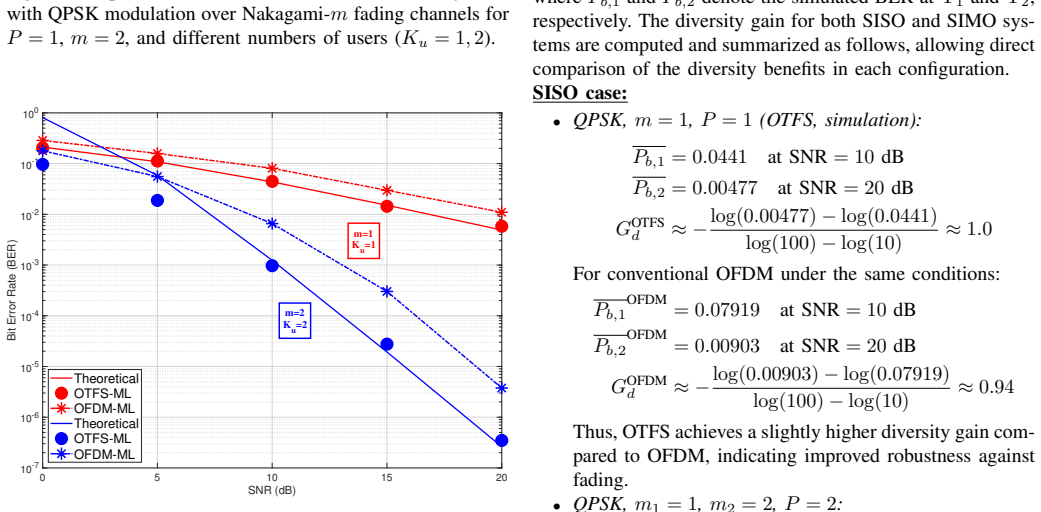
On its own terms, the paper's central claim is that the bit error rate of OTFS over Nakagami-m fading collapses to a small set of closed-form expressions: Eq. (31) for SISO, built from the Erlang PDF of squared-Nakagami path gains, and Eqs. (49)-(50) for multi-user SIMO, built from a Gamma approximation of interference and Meijer-G functions. The paper treats the ML-detected OTFS system as equivalent, for error analysis, to maximal-ratio combining over the P propagation paths, so the standard MRC symbol-error integral with modulation constants A and B applies. Against that model, the derived curves match ML simulations for BPSK and QPSK, single- and two-path channels, and m = 1 and m = 2 Nakagami parameters. The same simulations show OTFS reaching lower BER than OFDM under identical settings, with steeper BER slopes, which the paper reads as a diversity advantage arising from delay-Doppler dispersion.
Load-bearing premise
The closed-form BER expressions assume that maximum-likelihood detection over the OTFS effective channel behaves like maximal-ratio combining over the original Nakagami-m paths, but the paper does not prove that equivalence.
Editorial extensions
If this is right
- For a SISO OTFS link over Nakagami-m fading, BER can be evaluated directly from Eq. (31) for any modulation covered by Table I, without Monte Carlo simulation.
- For multi-user SIMO OTFS, Eq. (50) gives BER as a function of user count, path count, and Nakagami shape parameters, so interference-limited performance can be predicted analytically.
- Under the paper's settings, OTFS achieves lower BER than OFDM at the same SNR in high-mobility EVA channels, with the gap widening as fading becomes milder.
- Empirical diversity gain grows with path count P and Nakagami parameter m, and for SIMO with receive users, OTFS holds a consistent diversity advantage over OFDM.
- Because the A and B parameters in Table I cover BPSK, QPSK, M-PSK, M-QAM, and FSK families, the same formulas extend beyond the two modulations simulated.
Reading between the lines
- Editorial inference: because the derivation never proves that entries of the effective delay-Doppler channel matrix stay Nakagami-m, the formulas' validity on larger OTFS grids, such as M,N greater than 2, is an open testable question rather than an established fact.
- Editorial inference: the Erlang-plus-Meijer-G template could plausibly be carried over to other delay-Doppler waveforms, but the paper does not make that claim.
- Editorial inference: the diversity-gain expressions suggest concrete resource-allocation rules, such as assigning more delay-Doppler bins to users with low Nakagami-m parameters, but the paper does not develop that application.
Editorial analysis
A structured set of objections, weighed in public.
Referee Report
Summary. The paper claims to provide the first comprehensive analytical and simulation-validated BER analysis of OTFS over Nakagami-m fading channels. For the SISO case it derives a closed-form BER by summing P independent squared-Nakagami path gains, whose sum is modeled as Erlang, and then applying the standard MRC SER integral. For the SIMO/multi-user case it approximates the aggregate interference by a Gamma distribution via moment matching and expresses the resulting SER through Meijer-G functions. The analytical expressions are compared with ML-detection-based Monte Carlo simulations and with OFDM under the same channel, and the paper also reports empirical diversity-gain comparisons.
Significance. If correct, the closed-form error-rate expressions would be a useful addition to OTFS performance analysis and would support the claim that OTFS outperforms OFDM in high-mobility Nakagami-m fading. The paper has a clearly stated system model, cites standard statistical results, and includes Monte Carlo validation. However, the central analytical derivation for the SISO case is a legacy MRC result applied to path gains, not a BER derivation for ML detection on the OTFS effective channel; the multi-user derivation is internally inconsistent with the reported simulation trends; and the closed forms contain several algebraic errors. The load-bearing claims therefore do not currently hold.
major comments (5)
- [Section III-A, Eqs. (18), (25), (31)] The Erlang CDF is mis-expanded. Eq. (18) starts the inner sum at i=1 instead of at ℓ=0, so it omits the term exp(-z/μ_i). Eq. (24) correctly includes ℓ=0, but Eq. (25) silently changes the summation to ℓ=1,...,m_i-1 and Eq. (31) inherits this omission. The missing ℓ=0 term contributes a nonzero integral D with ℓ=0 in Eq. (27), so Eq. (31) is not the closed-form BER of the stated Erlang sum model. This error is load-bearing for the main SISO result.
- [Section III-A, Eqs. (21)-(23) vs. Eq. (14) and Section IV-A] The analytical derivation models the SNR as the sum of P independent squared Nakagami path gains and uses the MRC SER integral of Eq. (23). The simulations, however, apply ML detection to the effective channel matrix H_eff of Eq. (14). The paper provides no argument that ML detection on H_eff has the same pairwise error probability as MRC over the P paths, nor that the entries of H_eff, which are linear combinations of the time-domain path gains, remain Nakagami-m distributed. As written, Eq. (31) describes MRC reception over P fading paths, not OTFS MLD, so the claimed validation in Figs. 1-2 does not establish an OTFS-specific analytical BER.
- [Section III-B, Eq. (44)] The CDF expression is incorrect. Since Υ_k = (E_s/N0)/Z_k with Z_k ≥ 1, the correct CDF is F_Υ(y) = P(Z_k ≥ E_s/(N0 y)) = 1 - γ(m_z,(E_s/(N0 y)-1)/Ω_z)/Γ(m_z) = Γ(m_z,(E_s/(N0 y)-1)/Ω_z)/Γ(m_z). Eq. (44) instead states F_Υ(y) = γ(m_z,·)/Γ(m_z), which has the wrong monotonicity and is therefore not a valid CDF. This error propagates into the Meijer-G SER expression.
- [Section III-B, Eqs. (47)-(49)] The Meijer-G derivation contains two algebraic errors. First, the exponential in Eq. (47) should be exp(-(E_s/(N0 y)-1)/Ω_z), not exp(-(E_s/(N0 y)-1)); the factor 1/Ω_z is missing. Second, the final closed form in Eq. (49) omits the 1/Γ(m_z) normalization that the CDF in Eq. (44) requires. Consequently Eq. (49) does not follow from the preceding equations and is not a valid BER expression for the stated model.
- [Section III-B, Eqs. (32)-(35) vs. Fig. 3] The multi-user derivation treats additional users as interference in the denominator of the SINR in Eq. (32), so the analytical model predicts that increasing K_u degrades performance. Fig. 3 shows the opposite: K_u=2 substantially outperforms K_u=1, and the text attributes this to diversity gain. This contradiction indicates that the simulated configuration adds diversity branches rather than realizing the interference model used in the derivation, so the claimed agreement between theory and simulation for the multi-user case is not meaningful.
minor comments (6)
- [Section II-B, Eq. (15)] Eq. (15) defines μ_i = E[h_p^2]/m_i, but for a complex channel coefficient the second moment should be E[|h_p|^2]/m_i; the notation should be corrected for consistency with the subsequent Erlang model.
- [Section III-A, Eqs. (19)-(20)] The coefficient Ξ is very hard to parse because P is used both for the number of paths and as a summation index, and the unit-step function U(a) is defined but never used. A cleaner notation would improve reproducibility.
- [Section III-A, Eq. (31)] The summation index l in Eq. (31) collides with the delay-domain index l used earlier in the paper; renaming the summation index would avoid confusion.
- [Section IV-C, Eqs. (53)-(54)] The diversity-gain formulas are presented without derivation, and the cited source [53] concerns N-Nakagami relaying rather than OTFS. These formulas should be derived or clearly labeled as heuristic approximations.
- [Abstract and Section I] The claim of being the first comprehensive analytical and simulation-validated BER analysis specifically for OTFS over Nakagami-m fading is overstated, given that the SISO derivation reduces to a standard MRC result and the paper itself cites earlier OTFS error-performance studies [16]-[18], [22].
- [Throughout] There are several typographical and formatting issues, including the footnote 'TÜB˙ITAK', the inconsistent spacing in 'E V A', and the use of 'z' in the denominator of Eq. (43) where Ω_z^{m_z} Γ(m_z) is intended. These do not affect the technical conclusions but should be cleaned up.
Circularity Check
The central SISO 'OTFS' closed-form BER (Eq. 31) is constructed from the MRC average-SER integral (Eq. 23) applied to the Erlang sum of P Nakagami path gains; since no OTFS system quantity appears anywhere in the derivation, the claimed OTFS-specific result is the known MRC/Nakagami formula relabeled, with the MLD-on-H_eff identification asserted rather than derived.
-
renaming known result
[Section III-A, Eqs. (23) and (31); Abstract and Section IV validation claims.]
"For an modulated signal in a system employing Maximal Ratio Combining (MRC), the average SER can be expressed as [42], [43], [44], P_e^MRC = A√B/(2√π) ∫_0^∞ y^{−1/2} F^MRC_Υ(y) e^{−By} dy (23). Finally, for single-user case BER can be derived from the SER expression (31). Abstract: 'The derived closed-form BER expressions are validated through maximum likelihood detection based Monte Carlo simulations.'"
Eqs. (15)-(31) contain no OTFS quantity: only the Nakagami/Erlang path-gain PDF (Eq. 16), the Erlang sum of P squared path gains (Eqs. 19-22), and the MRC average-SER integral (Eq. 23) with the CDF of that same sum (Eq. 24). Eq. (31) is therefore, by construction, the textbook MRC-over-P-Nakagami-path closed-form BER of the cited MRC literature ([42]-[44]). The paper never shows that MLD on the OTFS effective channel H_eff (Eq. 14) has this error probability; the abstract's statement that the 'derived closed-form BER expressions are validated through maximum likelihood detection based Monte Carlo simulations' attaches an OTFS label to a result whose derivation never used the OTFS model. The claimed 'first ... BER analysis specifically for OTFS' is the known MRC/Nakagami result renamed.
full rationale
One circular step is identified: the SISO closed-form BER (Eq. 31) is presented as a novel OTFS-specific result ('the first comprehensive analytical and simulation-validated BER analysis specifically for OTFS over Nakagami-m fading channels'), but the derivation chain Eqs. (15)-(31) uses only the Nakagami/Erlang path statistics and the MRC SER integral (Eq. 23), with none of the OTFS model of Eqs. (10)-(14) (H_eff, M, N, delay-Doppler grid) entering the formulas. Eq. (31) is therefore the classical MRC-over-Nakagami result by construction, and the identification with MLD on H_eff is asserted, not derived; this is a renaming-of-known-result circularity affecting the paper's central analytical claim, justifying a partial-circularity score of 6 rather than a clean 0-2. Self-citations are present but not load-bearing: [41] (Aslandogan and Ilhan 2024) is cited alongside the independent external formula [38] (Karagiannidis et al.) for the same sum-of-squared-Nakagami PDF, and [48], [52], [53] support only auxiliary definitions; no claim is forced by a self-citation chain. No fitted constants enter the BER derivations, and the MLD Monte Carlo benchmark is external, which keeps the score below 8. Several correctness risks were considered and deliberately not counted as circularity: (a) the unproved equivalence between MRC over P paths and MLD on H_eff; (b) the multi-user model (Eq. 32) places interfering users in the SINR denominator, predicting worsened BER as K_u grows, while Fig. 3 reports improved BER for K_u=2 and attributes it to 'diversity gain', which is an internal inconsistency; and (c) the diversity-gain formula Eq. (54) is not derived and does not reproduce Table III values (e.g., SIMO P=2, m=2, K_u=2 gives 4 versus 3.45 tabulated). These concerns belong under correctness, not circularity.
Assumptions & free parameters
assumptions (3)
- domain assumption Path gains hp are independent Nakagami-m with positive integer shape parameters, so |hp|^2 is Erlang.
- ad hoc to paper The effective DD-domain channel H_eff inherits the same per-path Nakagami statistics as the time-domain channel, and ML detection is equivalent to MRC over the P path energies.
- domain assumption Multi-user interference can be modeled by a Gamma variable through first two moment matching.
Cite this review
Pith. "Pith review of Bit Error Rate and Performance Analysis of Multi-User OTFS under Nakagami-m Fading for 6G and Beyond Networks." pith.science (2026). https://pith.science/paper/JI356OGZ
@misc{pith2026250519843,
  author       = {Pith},
  title        = {Pith review of: Bit Error Rate and Performance Analysis of Multi-User OTFS under Nakagami-m Fading for 6G and Beyond Networks},
  year         = {2026},
  howpublished = {\url{https://pith.science/paper/JI356OGZ}},
  note         = {Machine review of arXiv:2505.19843}
}
read the original abstract
Orthogonal Time-Frequency Space modulation stands out as a promising waveform for 6G and beyond wireless communication systems, offering superior performance over conventional methods, particularly in high-mobility scenarios and dispersive channel conditions. Error performance analysis remains crucial for accurately characterizing the reliability of wireless communication systems under practical constraints. In this paper, we systematically investigate the bit error rate performance of OTFS modulation over Nakagami-m fading channels in both single-user and multi-user scenarios. In analytical approaches, mathematical frameworks are employed for distinct receiver configurations: the Single-input Single-output scenario leverages Erlang probability density function of squared-Nakagami variables to derive closed-form BER expressions, while the Single-input Multiple-output case applies moment matching techniques with Gamma approximation to model multiple user interference, subsequently yielding Signal-to-interference-plus-noise Ratio characterizations through Meijer-G functions. This study examines single-path and multi-path channel conditions, evaluating the relationship between path multiplicity and error performance metrics while considering various fading intensities through Nakagami-m fading parameters. The derived closed-form BER expressions are validated through maximum likelihood detection based Monte Carlo simulations, demonstrating strong correlation between analytical and numerical results across various SNR regions. Furthermore, comparative benchmark evaluations against conventional orthogonal frequency division multiplexing with MLD reveal that OTFS consistently achieves superior error performance in high-mobility scenarios. In multipath fading environments, OTFS achieves superior diversity gain compared to conventional OFDM, which refers to enhanced error performance.
Figures


Reference graph
Works this paper leans on
-
[1]
Orthogonal Time Frequency Space Mod- ulation,
R. Hadani, S. Rakib, M. Tsatsanis, A. Monk, A. J. Goldsmith, A. F. Molisch, and R. Calderbank, “Orthogonal Time Frequency Space Mod- ulation,” in 2017 IEEE Wireless Communications and Networking Con- ference (WCNC), 2017, pp. 1–6
2017
-
[2]
OTFS Detection Based on Gaussian Mixture Dis- tribution: A Generalized Message Passing Approach,
X. Li and W. Yuan, “OTFS Detection Based on Gaussian Mixture Dis- tribution: A Generalized Message Passing Approach,” IEEE Commun. Lett., vol. 28, no. 1, pp. 178–182, 2024
work page 2024
-
[3]
OTFS: A New Generation of Modulation Addressing the Challenges of 5G,
R. Hadani and A. Monk, “OTFS: A New Generation of Modulation Addressing the Challenges of 5G,” CoRR, vol. abs/1802.02623, 2018. [Online]. Available: http://arxiv.org/abs/1802.02623
arXiv 2018
-
[4]
MIMO-OTFS in High-Doppler Fading Channels: Signal Detection and Channel Esti- mation,
M. Kollengode Ramachandran and A. Chockalingam, “MIMO-OTFS in High-Doppler Fading Channels: Signal Detection and Channel Esti- mation,” in 2018 IEEE Global Communications Conference (GLOBE- COM), 2018, pp. 206–212
work page 2018
-
[5]
Hybrid MAP and PIC Detection for OTFS Modulation,
S. Li, W. Yuan, Z. Wei, J. Yuan, B. Bai, D. W. K. Ng, and Y . Xie, “Hybrid MAP and PIC Detection for OTFS Modulation,” IEEE Trans. V eh. Technol., vol. 70, no. 7, pp. 7193–7198, 2021
work page 2021
-
[6]
Orthogonal Time-Frequency Space Modulation: A Promising Next- Generation Waveform,
Z. Wei, W. Yuan, S. Li, J. Yuan, G. Bharatula, R. Hadani, and L. Hanzo, “Orthogonal Time-Frequency Space Modulation: A Promising Next- Generation Waveform,” IEEE Wireless Commun. , vol. 28, no. 4, pp. 136–144, 2021
work page 2021
-
[7]
Two-Dimensional Convolutional Neural Network-Based Signal Detection for OTFS Systems,
Y . K. Enku, B. Bai, F. Wan, C. U. Guyo, I. N. Tiba, C. Zhang, and S. Li, “Two-Dimensional Convolutional Neural Network-Based Signal Detection for OTFS Systems,” IEEE Wireless Commun. Lett. , vol. 10, no. 11, pp. 2514–2518, 2021. 10
work page 2021
-
[8]
Embedded Pilot-Aided Channel Estimation for OTFS in Delay–Doppler Channels,
P. Raviteja, K. T. Phan, and Y . Hong, “Embedded Pilot-Aided Channel Estimation for OTFS in Delay–Doppler Channels,” IEEE Trans. V eh. Technol., vol. 68, no. 5, pp. 4906–4917, 2019
work page 2019
Show all 53 references
-
[9]
Channel Estimation for Orthogonal Time Frequency Space (OTFS) Massive MIMO,
W. Shen, L. Dai, J. An, P. Fan, and R. W. Heath, “Channel Estimation for Orthogonal Time Frequency Space (OTFS) Massive MIMO,” IEEE Trans. Signal Process. , vol. 67, no. 16, pp. 4204–4217, 2019
2019
-
[10]
OTFS Channel Estimation and Data Detection Designs With Superimposed Pilots,
H. B. Mishra, P. Singh, A. K. Prasad, and R. Budhiraja, “OTFS Channel Estimation and Data Detection Designs With Superimposed Pilots,” IEEE Trans. Wireless Commun. , vol. 21, no. 4, pp. 2258–2274, 2022
2022
-
[11]
Low-Complexity Linear Equal- ization for OTFS Modulation,
G. D. Surabhi and A. Chockalingam, “Low-Complexity Linear Equal- ization for OTFS Modulation,” IEEE Commun. Lett. , vol. 24, no. 2, pp. 330–334, 2020
2020
-
[12]
Receiver Design for OTFS with a Fractionally Spaced Sampling Approach,
Y . Ge, Q. Deng, P. C. Ching, and Z. Ding, “Receiver Design for OTFS with a Fractionally Spaced Sampling Approach,” IEEE Trans. Wireless Commun., vol. 20, no. 7, pp. 4072–4086, 2021
2021
-
[13]
Learning to Equalize OTFS,
Z. Zhou, L. Liu, J. Xu, and R. Calderbank, “Learning to Equalize OTFS,” IEEE Trans. Wireless Commun. , vol. 21, no. 9, pp. 7723–7736, 2022
2022
-
[14]
Interference Can- cellation and Iterative Detection for Orthogonal Time Frequency Space Modulation,
P. Raviteja, K. T. Phan, Y . Hong, and E. Viterbo, “Interference Can- cellation and Iterative Detection for Orthogonal Time Frequency Space Modulation,” IEEE Trans. Wireless Commun., vol. 17, no. 10, pp. 6501– 6515, 2018
2018
-
[15]
Low complexity LMMSE Receiver for OTFS,
S. Tiwari, S. S. Das, and V . Rangamgari, “Low complexity LMMSE Receiver for OTFS,” IEEE Commun. Lett. , vol. 23, no. 12, pp. 2205– 2209, 2019
2019
-
[16]
BER performance analysis of OTFS systems with power allocation,
Z. Wang, Z. Liu, Z. Sun, and X. Ning, “BER performance analysis of OTFS systems with power allocation,” China Commun. , vol. 20, no. 1, pp. 24–35, 2023
2023
-
[17]
Performance Analysis of OTFS Modulation With Receive Antenna Selection,
V . S. Bhat, S. G. Dayanand, and A. Chockalingam, “Performance Analysis of OTFS Modulation With Receive Antenna Selection,” IEEE Trans. V eh. Technol., vol. 70, no. 4, pp. 3382–3395, 2021
2021
-
[18]
Performance Analysis of OTFS Under In-Phase and Quadra- ture Imbalance at Transmitter,
A. Tusha, S. Do ˘gan-Tusha, F. Yilmaz, S. Althunibat, K. Qaraqe, and H. Arslan, “Performance Analysis of OTFS Under In-Phase and Quadra- ture Imbalance at Transmitter,” IEEE Trans. V eh. Technol. , vol. 70, no. 11, pp. 11 761–11 771, 2021
2021
-
[19]
OTFS-Based CV-QKD Systems for Doubly Selective THz Channels,
X. Liu, C. Xu, S. X. Ng, and L. Hanzo, “OTFS-Based CV-QKD Systems for Doubly Selective THz Channels,” IEEE Trans. Commun. , pp. 1–1, 2025
2025
-
[20]
Low-Complexity Polar- Coded Iterative OTFS Receiver,
H. Zhang, L. Jing, N. Zhao, C. He, and Y . Li, “Low-Complexity Polar- Coded Iterative OTFS Receiver,” IEEE Commun. Lett. , vol. 29, no. 1, pp. 60–64, 2025
2025
-
[21]
Turbo BEM OTFS Receiver With Optimized Superimposed Pilot Power,
Y . Liu, Y . L. Guan, and D. G. G., “Turbo BEM OTFS Receiver With Optimized Superimposed Pilot Power,” IEEE Trans. Commun. , vol. 72, no. 1, pp. 601–617, 2024
2024
-
[22]
Error Performance of Rectangular Pulse- Shaped OTFS With Practical Receivers,
C. Shen, J. Yuan, and H. Lin, “Error Performance of Rectangular Pulse- Shaped OTFS With Practical Receivers,” IEEE Wireless Commun. Lett. , vol. 11, no. 12, pp. 2690–2694, 2022
2022
-
[24]
Zak-OTFS Implementation via Time and Frequency Windowing,
S. Gopalam, I. B. Collings, S. V . Hanly, H. Inaltekin, S. R. B. Pillai, and P. Whiting, “Zak-OTFS Implementation via Time and Frequency Windowing,” IEEE Trans. Commun. , vol. 72, no. 7, pp. 3873–3889, 2024
2024
-
[25]
On the Pilot-Aided Channel Estimation for Windowed OTFS With Data Interference in Rapidly Time-Varying Channels,
X. He, W. Yuan, and P. Fan, “On the Pilot-Aided Channel Estimation for Windowed OTFS With Data Interference in Rapidly Time-Varying Channels,” IEEE Trans. Wireless Commun. , vol. 23, no. 11, pp. 16 359– 16 374, 2024
2024
-
[26]
A New Path Division Multiple Access for the Massive MIMO-OTFS Networks,
M. Li, S. Zhang, F. Gao, P. Fan, and O. A. Dobre, “A New Path Division Multiple Access for the Massive MIMO-OTFS Networks,” IEEE J. Sel. Areas Commun. , vol. 39, no. 4, pp. 903–918, 2021
2021
-
[27]
Low Complexity Precoding and Detection in Multi-User Massive MIMO OTFS Downlink,
B. C. Pandey, S. K. Mohammed, P. Raviteja, Y . Hong, and E. Viterbo, “Low Complexity Precoding and Detection in Multi-User Massive MIMO OTFS Downlink,” IEEE Trans. V eh. Technol. , vol. 70, no. 5, pp. 4389–4405, 2021
2021
-
[28]
OTFS-NOMA: An Efficient Approach for Exploiting Heterogenous User Mobility Profiles,
Z. Ding, R. Schober, P. Fan, and H. Vincent Poor, “OTFS-NOMA: An Efficient Approach for Exploiting Heterogenous User Mobility Profiles,” IEEE Trans. Commun. , vol. 67, no. 11, pp. 7950–7965, 2019
2019
-
[29]
OTFS-SCMA: A Code-Domain NOMA Approach for Orthogonal Time Frequency Space Modulation,
K. Deka, A. Thomas, and S. Sharma, “OTFS-SCMA: A Code-Domain NOMA Approach for Orthogonal Time Frequency Space Modulation,” IEEE Trans. Commun. , vol. 69, no. 8, pp. 5043–5058, 2021
2021
-
[30]
Orthogonal Time Frequency Space (OTFS) With Dual-Mode Index Modulation,
H. Zhao, D. He, Z. Kang, and H. Wang, “Orthogonal Time Frequency Space (OTFS) With Dual-Mode Index Modulation,” IEEE Wireless Commun. Lett. , vol. 10, no. 5, pp. 991–995, 2021
2021
-
[31]
A New OTFS-Based Index Modulation System for 6G and Beyond: OTFS-Based Code Index Modulation,
B. A. Ozden, E. Aydin, E. Aslandogan, H. Ilhan, E. Basar, M. Wen, and M. D. Renzo, “A New OTFS-Based Index Modulation System for 6G and Beyond: OTFS-Based Code Index Modulation,” 2025. [Online]. Available: https://arxiv.org/abs/2504.09364
2025 arXiv
-
[32]
Orthogonal Time-Frequency Space (OTFS) Aided Media-Based Modulation System For 6G and Beyond Wireless Communications Networks,
B. A. Ozden, M. Kaymaz, E. Aydin, E. Aslandogan, H. Ilhan, E. Basar, M. Wen, and M. D. Renzo, “Orthogonal Time-Frequency Space (OTFS) Aided Media-Based Modulation System For 6G and Beyond Wireless Communications Networks,” 2025. [Online]. Available: https://arxiv.org/abs/2504.09371
2025 arXiv
-
[33]
Modeling and Analysis of Physical Layer Security of OTFS Systems Under Transmit Antenna Selection and Passive Eavesdropping,
G. Gunjan, S. Shrivastava, and S. Kashyap, “Modeling and Analysis of Physical Layer Security of OTFS Systems Under Transmit Antenna Selection and Passive Eavesdropping,” IEEE Commun. Lett. , vol. 28, no. 3, pp. 483–487, 2024
2024
-
[34]
Orthogonal Time Frequency Space (OTFS) Modulation Based Radar System,
P. Raviteja, K. T. Phan, Y . Hong, and E. Viterbo, “Orthogonal Time Frequency Space (OTFS) Modulation Based Radar System,” in 2019 IEEE Radar Conference (RadarConf) . IEEE, 2019, pp. 1–6
2019
-
[35]
Interference Cancellation and Iterative Detection for Orthogonal Time Frequency Space Modulation,
——, “Interference Cancellation and Iterative Detection for Orthogonal Time Frequency Space Modulation,” IEEE Trans. V eh. Technol., vol. 17, no. 10, pp. 6501–6515, Oct 2018
2018
-
[36]
Practical Pulse- Shaping Waveforms for Reduced-Cyclic-Prefix OTFS,
P. Raviteja, Y . Hong, E. Viterbo, and E. Biglieri, “Practical Pulse- Shaping Waveforms for Reduced-Cyclic-Prefix OTFS,”IEEE Trans. V eh. Technol., vol. 68, no. 1, pp. 957–961, 2019
2019
-
[37]
The m-distribution—a general formula of intensity distribution of rapid fading,
M. Nakagami, “The m-distribution—a general formula of intensity distribution of rapid fading,” in Statistical Methods in Radio Wave Propagation. Elsevier, 1960, pp. 3–36
1960
-
[38]
Closed-form statistics for the sum of squared Nakagami-m variates and its applications,
G. Karagiannidis, N. Sagias, and T. Tsiftsis, “Closed-form statistics for the sum of squared Nakagami-m variates and its applications,” IEEE Trans. Commun., vol. 54, no. 8, pp. 1353–1359, 2006
2006
-
[39]
M. K. Simon and M.-S. Alouini, Digital communication over fading channels. Wiley-Interscience, 2005
2005
-
[40]
I. S. Gradstejn, Table of integrals, series, and products . Acad. Press, 2000
2000
-
[41]
Outage Analysis of Orthogonal Time- Frequency Space Modulation in Nakagami-m Fading Channel,
E. Aslandogan and H. Ilhan, “Outage Analysis of Orthogonal Time- Frequency Space Modulation in Nakagami-m Fading Channel,” in 2024 6th International Conference on Communications, Signal Processing, and their Applications (ICCSPA) , 2024, pp. 1–5
2024
-
[42]
Distribution functions of selection com- biner output in equally correlated Rayleigh, Rician, and Nakagami-m fading channels,
Y . Chen and C. Tellambura, “Distribution functions of selection com- biner output in equally correlated Rayleigh, Rician, and Nakagami-m fading channels,” IEEE Trans. Commun. , vol. 52, no. 11, pp. 1948– 1956, 2004
1948
-
[43]
Performance Analysis of MIMO-MRC in Double-Correlated Rayleigh Environments,
M. R. McKay, A. J. Grant, and I. B. Collings, “Performance Analysis of MIMO-MRC in Double-Correlated Rayleigh Environments,” IEEE Trans. Commun., vol. 55, no. 3, pp. 497–507, 2007
2007
-
[44]
Performance analysis of dual-hop fixed-gain AF relaying systems with OSTBC over Nakagami-m fading channels,
˙Ibrahim Altunba¸ s, A. Yılmaz, ¸ Serife Seda Kucur, and O. Kucur, “Performance analysis of dual-hop fixed-gain AF relaying systems with OSTBC over Nakagami-m fading channels,” AEU - Int. J. Electron. Commun., vol. 66, no. 10, pp. 841–846, 2012. [Online]. Available: https://ww...
2012
-
[45]
I. S. Gradshteyn, I. M. Ryzhik, D. Zwillinger, and V . Moll, Table of integrals, series, and products; 8th ed. Amsterdam: Academic Press,
-
[46]
A. P. Prudnikov, I. A. Brychkov, O. I. Marichev, and N. M. Queen, Integrals and series. vol. 2, special fuctions . Gordon and Breach Science Pub, 1986
1986
-
[47]
Outage Analysis for OTFS- based Single User and Multi-User Transmissions,
R. Chong, S. Li, W. Yuan, and J. Yuan, “Outage Analysis for OTFS- based Single User and Multi-User Transmissions,” in 2022 IEEE Inter- national Conference on Communications Workshops (ICC Workshops) , 2022, pp. 746–751
2022
-
[48]
Performance analysis of cooperative vehicular systems with co-channel interference over cascaded Nakagami-m fading channels,
H. Ilhan, “Performance analysis of cooperative vehicular systems with co-channel interference over cascaded Nakagami-m fading channels,” Wirel. Pers. Commun. , vol. 83, pp. 203–214, 2015
2015
-
[49]
Analysis of Uplink IRS-Assisted NOMA Under Nakagami-m Fading via Moments Matching,
B. Tahir, S. Schwarz, and M. Rupp, “Analysis of Uplink IRS-Assisted NOMA Under Nakagami-m Fading via Moments Matching,” IEEE Wireless Commun. Lett. , vol. 10, no. 3, pp. 624–628, 2021
2021
-
[50]
A. M. Mathai and R. K. Saxena, The H-function with applications in statistics and other disciplines . Wiley, 1978
1978
-
[51]
Evolved Universal Terrestrial Radio Access (E-UTRA); User Equip- ment (UE) Radio Transmission and Reception,
“Evolved Universal Terrestrial Radio Access (E-UTRA); User Equip- ment (UE) Radio Transmission and Reception,” 3rd Generation Partner- ship Project (3GPP), Technical Specification TS 36.101, version 17.6.0, 2024, available: https://www.3gpp.org
2024
-
[52]
Cooperative Diversity for Interve- hicular Communication: Performance Analysis and Optimization,
H. Ilhan, M. Uysal, and I. Altunbas, “Cooperative Diversity for Interve- hicular Communication: Performance Analysis and Optimization,” IEEE Trans. V eh. Technol., vol. 58, no. 7, pp. 3301–3310, 2009
2009
-
[53]
Moment generating function- based performance evaluation of amplify-and-forward relaying in N-Nakagami fading channels,
H. Ilhan, I. Altunbas, and M. Uysal, “Moment generating function- based performance evaluation of amplify-and-forward relaying in N-Nakagami fading channels,” IET Commun. , vol. 5, no. 3, pp. 253–263, 2011. [Online]. Available: https://digital-library.theiet.org/doi/ abs/10.10...
2011
-
[2015]
Available: https://cds.cern.ch/record/1702455
[Online]. Available: https://cds.cern.ch/record/1702455
Reviewed August 7, 2026 · model on record in the stance chip above.
Discussion (0). Sign in to comment.