REVIEW 3 major objections 4 minor 52 references
Selective Enhancement of Optical Chirality and Spin Angular Momentum in Plasmonic Near-Field
T0 review · 3 major / 4 minor · reviewed 2026-08-07 · deepseek-v4-flash
Pith's one-line read The paper claims that circular plasmonic nanostructures can selectively enhance spin angular momentum or optical chirality in the near field, with the choice set by the structure geometry and the wavelength relative to the plasmon…
desk verdict Useful FDTD prediction of selective SAM/OC enhancement, but the OC mechanism is under-supported and needs a field decomposition before the design rule is trusted. read the letter →
The pith
A machine-rendered reading of the paper's core claim, the machinery that carries it, and where it could break.
The reading
What carries the argument
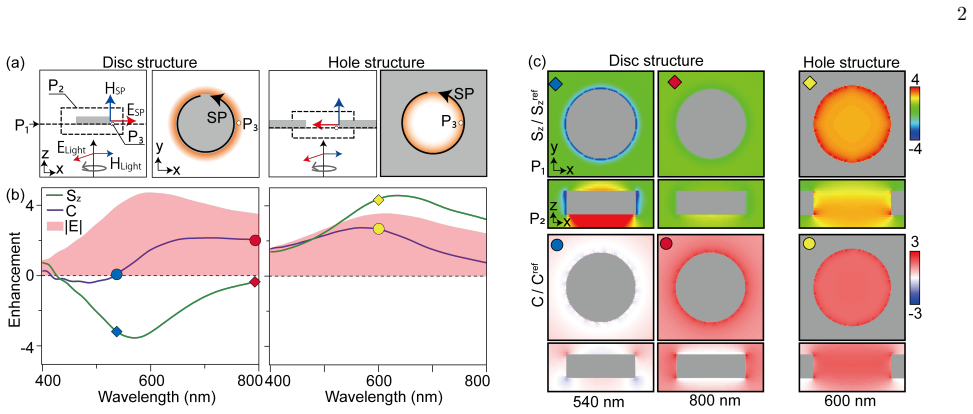
The load-bearing object is the rotating plasmon mode excited by circularly polarized light. For SAM, the relevant mechanism is transverse spin: in a unidirectional evanescent wave the spin direction is tied to the decay direction of the field, so a disk (fields decaying inward) and a hole (fields decaying outward) give opposite near-field spin even though they rotate in the same sense. For OC, the carrier is the phase relationship between the plasmonic electric field and the incident magnetic field; the paper characterizes this with a Lorentz oscillator phase delay $\Delta\phi(\omega)$ whose offset $\phi_0$ distinguishes the disk ($-\pi/2$, electric-type resonance) from the hole ($0$, magnetic-type resonance), and an equivalent LCR circuit analogy translates the two geometries into series and parallel resonators.
What would settle it
A direct falsifier would be measuring the near-field phase of the plasmonic electric field under circularly polarized illumination at the same observation point and wavelength used in the linear-polarization calibration; if the phase delay shifts away from the Lorentzian values, or if the computed optical chirality from the full fields disagrees with the simplified two-field model at positions more than a few nanometres from the wall, the selective-enhancement assignment would fail.
Extended reading notes
Core claim
The central claim is that the circular geometry of the nanostructure, combined with the handedness of the incident light, determines which of the two helicity-sensitive quantities dominates locally. In the disk, a unidirectional rotating plasmon mode produces a transverse spin angular momentum whose sign reverses relative to the excitation, enhancing SAM on the walls above resonance; below resonance, the phase delay of the plasmonic electric field relative to the incident magnetic field becomes dispersive, so optical chirality rises while SAM fades. In the hole, the evanescent field decays outward instead of inward, flipping the SAM direction, while the phase delay stays close to zero at resonance, so both SAM and OC peak together. The paper further claims that these near-field quantities are readable in far-field circular dichroism: the sign and spectral shape of the CD signal track whether the probe layer responds to SAM or OC, and the disk and hole structures give distinct CD spectra. The picture is quantitative: a Lorentzian phase-delay model with a structure-dependent offset reproduces the finite-difference time-domain spectral trends, and finite-element calculations with an absorptive chiral layer reproduce the disk's dispersive and the hole's peak-shaped CD.
Load-bearing premise
The central argument assumes that the phase delay between the plasmonic electric field and the incident field measured under linearly polarized excitation is the same under circularly polarized excitation, and that optical chirality in the near field is dominated by the in-plane plasmonic field plus the incident magnetic field; radiation and scattering fields, which the paper acknowledges add other components, could dominate elsewhere and change the picture.
Editorial extensions
If this is right
- If the claim holds, a single achiral nanostructure can produce a near-field region where SAM is enhanced but OC is not, or vice versa, simply by choosing the illumination wavelength relative to the plasmon resonance.
- The sign of the SAM enhancement reverses between disk and hole under identical circular polarization, so the geometry alone sets the handedness of the near-field spin.
- Circular dichroism spectroscopy of a thin chiral or magneto-optical layer on a disk versus a hole should show different spectral shapes (dispersive vs. peaked), providing a direct test of the mechanism.
- Combining real and imaginary parts of the magneto-optical or Pasteur parameters produces CD spectra that are superpositions of the idealized cases, so the method offers a way to separate the two contributions in a realistic sample.
- The design rule extends the existing toolbox of near-field chirality engineering from intensity enhancement to selective enhancement of one helicity-sensitive observable.
Reading between the lines
- Implicit in the paper is a recipe for sensor design: placing a chiral molecule layer on a hole structure at resonance should maximize OC-driven CD, while a disk structure off-resonance isolates SAM-driven signals; this split has not been demonstrated experimentally.
- The transverse-spin argument suggests that other structures supporting unidirectional evanescent waves, such as gratings or nanowires, could be engineered to produce sign-selected SAM by controlling the decay direction, which the paper only touches on for the circular geometries.
- A testable extension would be to measure the phase delay under linearly polarized excitation at different observation distances from the wall; if the phase offset differs between CP and LP excitation at the same point, the simplified two-field OC model would need revision.
- The authors' own caveat that additional radiation and scattering fields influence the OC distribution implies the selective enhancement may be position-specific; mapping OC across the full volume rather than at a single point would show how robust the frequency selection is.
Signed reviews
Editorial analysis
A structured set of objections, weighed in public.
Referee Report
Summary. The paper investigates, via FDTD simulations, the near-field spin angular momentum (SAM) and optical chirality (OC) around silver disk and hole nanostructures illuminated by circularly polarized light. It reports that the disk structure enhances SAM above resonance and OC below resonance, while the hole structure enhances both near resonance. The authors attribute SAM enhancement to transverse SAM from unidirectional evanescent waves and OC enhancement to interference between the plasmonic electric field and the incident magnetic field, supporting the latter with a Lorentz-oscillator phase-delay model. Separate FEM simulations with magneto-optical and chiral coating layers show circular dichroism spectra whose shapes depend on the nanostructure and on whether the material response is absorptive or birefringent. The central evidence is computational: FDTD spectra and spatial maps, followed by explanatory modeling and FEM predictions.
Significance. If the proposed mechanisms are established, the paper provides a simple design rule for selectively enhancing SAM or OC in plasmonic near-fields, which is relevant for disentangling SAM- and OC-driven contributions to optical activity signals. The manuscript has concrete strengths: the FDTD spectra are direct Maxwell-equation computations with standard Palik silver data; the spatial maps separately visualize electric and magnetic contributions to SAM; and the FEM CD spectra provide falsifiable predictions that distinguish absorptive and birefringent magneto-optical and chiral responses. The distinction between disk and hole phase behavior (electric vs magnetic resonance) is a useful physical insight. The main weakness is that the OC mechanism is asserted rather than quantitatively demonstrated, and the explanatory Lorentz model is fitted to the FDTD results rather than independently validated. These issues are fixable within the scope of a revision.
major comments (3)
- [II.B (Eq. (2))] The central mechanistic claim that OC enhancement is governed by the interference between E_SP and H_Light is not quantitatively supported. The full optical chirality is C = (ω/2c^2) Im(E_total* · H_total), which expands into four bilinear terms involving E_SP, E_Light, H_SP, and H_Light. The manuscript asserts that the in-plane E_SP and H_Light dominate and concedes in the same section that "additional field components arising from radiation and scattering influence the distribution and intensity of OC," but it never reports the relative magnitudes of the neglected terms. This matters because Section II.A shows that the magnetic-field contribution to SAM is comparable to the electric-field contribution on the same structures, so H_SP cannot be assumed negligible in the C product. Please report a decomposition of the FDTD fields at P3 and in the P1 plane at the wavelengths of Fig. 2(c), or otherwise show that |Im(E_SP*·H_Light)| dominates the other bilinear terms.
- [II.B (Eqs. (3)-(4))] The simplified Lorentz model is not an independent check of the OC mechanism. The parameters omega_A, gamma, A0, and phi0 are chosen to reproduce the simulated line shapes (phi0 is read from Fig. 4(a), and A0 and gamma are matched to the amplitude spectrum), so the agreement in Fig. 4(b) is partly built in. To make the model explanatory rather than descriptive, the authors should either use the FDTD-computed phase and amplitude directly as inputs and show that the resulting C(ω) reproduces the full FDTD C(ω), or state clearly that the Lorentz model is a fit and validate its predictions at other observation points or for other radii. As written, the agreement does not independently confirm the interference mechanism.
- [II.B and Fig. 4(a)] The phase-delay data used to motivate the OC mechanism are obtained under linearly polarized excitation, whereas the OC spectra in Fig. 2(b) are computed under circularly polarized excitation. The validity of transferring the LP phase response to CP excitation is not discussed. For a linear, circularly symmetric structure the phase of each Cartesian response may be identical under LP and CP illumination, but this should be stated explicitly and, preferably, verified by computing the phase delay under CP excitation at the same observation point. If the rotating plasmon mode has an off-axis phase structure, the transfer could fail, which would undermine the model's connection to the FDTD OC spectra.
minor comments (4)
- [Fig. 2 caption and Appendix B] The labels P1 and P2 are inconsistent: the Fig. 2 caption defines P1 as the xy-plane at z=5 nm and P2 as the xz-plane at y=0, while Appendix B states the opposite assignment. Please correct this and unify the notation, including the confusing phrase "xz-plane cross section at the P2 plane" in the text.
- [Appendix B] The FDTD simulations use a minimum mesh size of 4 nm while the observation point P3 is only 5 nm from the nanostructure wall. A short mesh-convergence test (e.g., comparing 2 nm and 4 nm meshes) and a check of PML/boundary effects should be reported, since the claimed enhancement spectra are local quantities that can be mesh-sensitive.
- [Appendix C] The paragraph beginning "In each regime summarized in the table..." is duplicated verbatim for the series LCR model. Please remove the duplicate.
- [Appendix E] The text refers to "Fig. S1(c)" and "Fig. S1(d)" but the appendix figures are labeled Fig. E1. Please harmonize the in-text references with the figure labels, and fix the typo "plactical" in the introductory paragraph.
Circularity Check
The OC mechanism rests on a Lorentz model whose amplitude, damping, and phase-offset inputs are taken from the same FDTD data whose OC line shapes it then reproduces, so the disk–hole difference is enforced by construction, even though the FDTD and FEM simulations themselves are self-contained.
-
fitted input called prediction
[Section II.B (Optical chirality), Eqs. (3)–(4), Fig. 4(b)]
"The additional phase ϕ0 accounts for the differences in the phase delay characteristics between the disk (ϕ0 = −π/2) and hole (ϕ0 = 0) structures. ... The red lines in Fig. 4(b) show the phase delay spectrum calculated from Eq. (4), using ωA = 2π×500 THz, γ = 2π×50 THz, and A0 = 2.5×10^5. ... The OC calculated from these phase relations is shown in the bottom panels, and the resulting spectral trends are consistent with those observed in the FDTD simulations in Fig. 2(b)."
The model's inputs are read off the very FDTD data whose OC spectra it claims to reproduce: ϕ0 = −π/2 (disk) and ϕ0 = 0 (hole) are the resonance phase delays measured in Fig. 4(a) from the same structures, and ω0, γ, A0 are chosen to match the simulated amplitude and phase spectra. With C ∝ A(ω) sin(Δϕ(ω) − π/2), the disk's fitted ϕ0 makes ESP and HLight in phase at resonance (zero crossing, dispersive OC), while the hole's ϕ0 preserves the π/2 CP phase difference at resonance (peak OC). The disk/hole line-shape difference is therefore enforced by the fitted ϕ0 values, and because the model contains only the ESP·HLight term by construction, the agreement in Fig.
full rationale
Most of the paper is self-contained: the FDTD spectra (Figs. 2, 3) are direct solutions of Maxwell's equations with the Palik Ag permittivity and no fitted parameters, and the FEM CD spectra (Fig. 5, Appendix E) are forward simulations of explicitly defined MO (g) and chiral (κ) constitutive models; neither reduces to its output. The only step that reduces by construction is the Section II.B simplified model: Eq. (4) supplies Δϕ(ω) with ϕ0 taken from the FDTD phase delay of Fig. 4(a), and Eq. (3) is matched to the simulated electric-field spectrum, so the resulting OC trends in Fig. 4(b) are a curve match to Fig. 2(b), not an independent check of the ESP–HLight interference mechanism. The paper itself concedes that 'additional field components arising from radiation and scattering influence the distribution and intensity of OC,' so the mechanism attribution is partly under-determined. Self-citations (Refs. [22], [26], [38]) support standard relations (S = ∇×P), the rotating-mode picture, and the Lorentz form, but the rotating-mode premise is also evidenced by the paper's own field maps, so these citations are not load-bearing. Overall, the central predictions (selective SAM/OC enhancement, CD line shapes) come from the solvers rather than from a fitted loop; the partial reduction is confined to the explanatory OC model, giving a score of 4.
Assumptions & free parameters
free parameters (6)
- Lorentz resonance frequency omega_A =
2*pi*500 THz
- Lorentz damping gamma =
2*pi*50 THz
- Lorentz amplitude A0 =
2.5e5
- Phase offset phi0 =
-pi/2 (disk), 0 (hole)
- MO anisotropy parameter g =
0.003i or 0.003
- Pasteur parameter kappa =
0.01i or 0.01
assumptions (5)
- standard math Maxwell's equations and the standard definitions of SAM (Eq. 1) and OC (Eq. 2) are the correct field framework.
- domain assumption Chiral media respond to optical chirality and MO media respond to electric SAM.
- domain assumption Disk and hole structures act as complementary electric and magnetic resonances with a pi/2 phase difference.
- domain assumption CP illumination excites a unidirectional rotating plasmon mode with uncancelled transverse SAM.
- ad hoc to paper The OC near field can be approximated by interference between the in-plane plasmonic electric field and the incident magnetic field.
Cite this review
Pith. "Pith review of Selective Enhancement of Optical Chirality and Spin Angular Momentum in Plasmonic Near-Field." pith.science (2026). https://pith.science/paper/QPTVEOR2
@misc{pith2026250519878,
  author       = {Pith},
  title        = {Pith review of: Selective Enhancement of Optical Chirality and Spin Angular Momentum in Plasmonic Near-Field},
  year         = {2026},
  howpublished = {\url{https://pith.science/paper/QPTVEOR2}},
  note         = {Machine review of arXiv:2505.19878}
}
read the original abstract
The interaction between circularly polarized (CP) light and matter is governed by two fundamental quantities: spin angular momentum (SAM) and optical chirality (OC). While these quantities are inseparable in free space, they can be selectively enhanced in plasmonic near-field regions through appropriately designed structures. We demonstrate that the excitation of circular plasmonic nanostructures with CP light enables selective or simultaneous enhancement of SAM and OC through the excitation of rotating plasmon modes. Electromagnetic field analysis reveals that SAM enhancement originates from transverse SAM induced by unidirectional evanescent waves, whereas OC enhancement is governed by the interference between the plasmonic electric field and incident magnetic field. The finite element method simulations confirm that circular dichroism signals arising from these enhanced near fields clearly depend on the SAM and OC of the local fields, underscoring the importance of structural design in the detection and enhancement of optically active phenomena at the nanoscale.
Figures


Figures from the paper (2 more)


Reference graph
Works this paper leans on
-
[1]
G. D. Fasman, Circular Dichroism and the Conformational Analysis of Biomolecules., (Plenum Press, 1996)
work page 1996
-
[2]
In particular, we consideredg= 0.003iandg= 0.003 in the simulation withϵ= 1.43
The real and imaginary parts ofgrep- resent the magnetic CB and magnetic CD, respectively. In particular, we consideredg= 0.003iandg= 0.003 in the simulation withϵ= 1.43. Chirality:To incorporate a chiral medium into the sim- ulations, we modeled the material using the Pasteur pa- rameterκ, which characterizes the coupling between the electric and magneti...
- [3]
-
[4]
T. Kawasaki, M. Sato, S. Ishiguro, T. Saito, Y. Mor- ishita, I. Sato, H. Nishino, Y. Inoue, and K. Soai, Enan- tioselective synthesis of near enantiopure compound by asymmetric autocatalysis triggered by asymmetric pho- tolysis with circularly polarized light, J. Am. Chem. Soc. 127, 3274 (2005)
work page 2005
-
[5]
H. Niinomi, T. Sugiyama, M. Tagawa, K. Murayama, S. Harada, and T. Ujihara, Enantioselective amplifica- tion on circularly polarized laser-induced chiral nucle- ation from a naclo3 solution containing ag nanoparticles, CrystEngComm18, 7441 (2016)
work page 2016
-
[6]
Faraday, Experimental researches in electric- ity.—nineteenth series, Philos
M. Faraday, Experimental researches in electric- ity.—nineteenth series, Philos. Trans. R. Soc. Lond.136, 1 (1846)
-
[7]
B. Han, X. Gao, J. Lv, and Z. Tang, Magnetic circu- lar dichroism in nanomaterials: New opportunity in un- derstanding and modulation of excitonic and plasmonic resonances, Adv. Mat.32, e1801491 (2020)
work page 2020
-
[8]
K. Y. Bliokh and F. Nori, Transverse spin of a surface polariton, Phys. Rev. A85, 061801(R) (2012)
2012
Show all 52 references
-
[9]
P. Shi, L. Du, C. Li, A. Zayats, V, and X. Yuan, Trans- verse spin dynamics in structured electromagnetic guided waves, Proc. Natl. Acad. Sci. (USA)118, e2018816118 (2021)
2021
-
[10]
Tang and A
Y. Tang and A. E. Cohen, Optical chirality and its inter- action with matter, Phys. Rev. Lett.104, 163901 (2010)
2010
-
[11]
Sch¨ aferling, D
M. Sch¨ aferling, D. Dregely, M. Hentschel, and H. Giessen, Tailoring enhanced optical chirality: Design principles for chiral plasmonic nanostructures, Phys. Rev. X2, 031010 (2012)
2012
-
[12]
J. Mun, M. Kim, Y. Yang, T. Badloe, J. Ni, Y. Chen, C.-W. Qiu, and J. Rho, Electromagnetic chirality: from fundamentals to nontraditional chiroptical phenomena, Light-Sci. Appl.9, 139 (2020)
2020
-
[13]
K. Y. Bliokh and F. Nori, Characterizing optical chirality, Phys. Rev. A83, 021803(R) (2011)
2011
-
[14]
M. M. Coles and D. L. Andrews, Chirality and angular momentum in optical radiation, Phys. Rev. A85, 063810 (2012)
2012
-
[15]
A. Wu, Y. Y. Tanaka, R. Fukuhara, and T. Shimura, Continuity equation for spin angular momentum in rela- tion to optical chirality, Phys. Rev. A102, 023531 (2020)
2020
-
[16]
K. A. Forbes, Spin angular momentum and optical chi- rality of poincare vector vortex beams, Journal of Optics 26, 125401 (2024)
2024
-
[17]
G.-M. Choi, A. Schleife, and D. G. Cahill, Optical- helicity-driven magnetization dynamics in metallic fer- romagnets, Nat. Commun.8, 15085 (2017)
2017
-
[18]
Tomita, H
S. Tomita, H. Kurosawa, T. Ueda, and K. Sawada, Meta- materials with magnetism and chirality, J. Phys. D: Appl. Phys.51, 083001 (2018)
2018
-
[19]
T.-L. Chen, A. Salij, K. A. Parrish, J. K. Rasch, F. Zinna, P. J. Brown, G. Pescitelli, F. Urraci, L. A. Aron- ica, A. Dhavamani, M. S. Arnold, M. R. Wasielewski, L. di Bari, R. Tempelaar, and R. H. Goldsmith, A 2d chiral microcavity based on apparent circular dichroism, Nat. ...
2024
-
[20]
K. Y. Bliokh, A. Y. Bekshaev, and F. Nori, Extraordinary momentum and spin in evanescent waves, Nat. Commun. 5, 3300 (2014)
2014
-
[21]
Aiello, P
A. Aiello, P. Banzer, M. Neugebaueru, and G. Leuchs, From transverse angular momentum to photonic wheels, Nat. Photonics9, 789 (2015)
2015
-
[22]
P. Shi, L. Du, and X. Yuan, Spin photonics: from trans- verse spin to photonic skyrmions, Nanophotonics10, 3927 (2021)
2021
-
[23]
Ichiji, D
N. Ichiji, D. Oue, M. Yessenov, K. L. Schepler, A. F. Abouraddy, and A. Kubo, Transverse spin angular mo- mentum of a space-time surface plasmon polariton wave packet, Phys. Rev. A107, 063517 (2023)
2023
-
[24]
Triolo, A
C. Triolo, A. Cacciola, S. Patane, R. Saija, S. Savasta, and F. Nori, Spin-momentum locking in the near field of metal nanoparticles, ACS Photon.4, 2242 (2017)
2017
-
[25]
T. Fu, J. Lin, Y. Xu, J. Jia, Y. Wang, S. Zhang, and H. Xu, Transverse spin-orbit interaction of light, Nano Lett.24, 10783 (2024)
2024
-
[26]
X. Yang, Y. Mou, B. Gallas, S. Bidault, and M. Miv- elle, Skyrmion generation in a plasmonic nanoan- tenna through the inverse faraday effect (2024), arXiv:2402.17426 [physics.optics]
2024 arXiv
-
[27]
Ichiji, T
N. Ichiji, T. Ishida, I. Morichika, D. Oue, T. Tatsuma, and S. Ashihara, Designing rotational motion of charge densities on plasmonic nanostructures excited by circu- larly polarized light, Nanophotonics13, 4751 (2024)
2024
-
[28]
H. U. Yang, R. L. Olmon, K. S. Deryckx, X. G. Xu, H. A. Bechtel, Y. Xu, B. A. Lail, and M. B. Raschke, Accessing the optical magnetic near-field through babinet’s princi- ple, ACS Photon.1, 894 (2014)
2014
-
[29]
Lee and D.-S
D. Lee and D.-S. Kim, Light scattering of rectangular slot antennas: parallel magnetic vector vs perpendicular electric vector, Sci. Rep.6, 18935 (2016)
2016
-
[30]
H. W. Kihm, J. Kim, S. Koo, J. Ahn, K. Ahn, K. Lee, N. Park, and D.-S. Kim, Optical magnetic field mapping using a subwavelength aperture, Opt. Express21, 5625 (2013)
2013
-
[31]
Engheta, A
N. Engheta, A. Salandrino, and A. Al` u, Circuit elements at optical frequencies:: Nanoinductors, nanocapacitors, and nanoresistors, Phys. Rev. Lett.95, 095504 (2005)
2005
-
[32]
D. Zhu, M. Bosman, and J. K. W. Yang, A circuit model for plasmonic resonators, Opt. Express22, 9809 (2014)
2014
-
[33]
Dubey, K
S. Dubey, K. Kumar, and P. Arun, Surface plasmon res- onance in metal nanospheres explained with lcr circuits, Phys. Chem. Chem. Phys.25, 13708 (2023)
2023
-
[34]
Schurig, J
D. Schurig, J. Mock, and D. Smith, Electric-field-coupled resonators for negative permittivity metamaterials, Appl. Phys. Lett.88, 041109 (2006)
2006
-
[35]
Teperik, V
T. Teperik, V. Popov, and F. de Abajo, Giant light ab- sorption by plasmons in a nanoporous metal film, Phys. Status Solidi A202, 362 (2005)
2005
-
[36]
Withayachumnankul, C
W. Withayachumnankul, C. Fumeaux, and D. Abbott, Compact electric-lc resonators for metamaterials, Opt. Express18, 25912 (2010)
2010
-
[37]
M. R. Goncalves, H. Minassian, and A. Melikyan, Plas- monic resonators: fundamental properties and applica- 11 tions, J. Phys. D Appl. Phys.53, 443002 (2020)
2020
-
[38]
Oshikiri, Q
T. Oshikiri, Q. Sun, H. Yamada, S. Zu, K. Sasaki, and H. Misawa, Extrinsic chirality by interference between two plasmonic modes on an achiral rectangular nanos- tructure, ACS Nano15, 16802 (2021)
2021
-
[39]
Ichiji, T
N. Ichiji, T. Ishida, I. Morichika, T. Tatsuma, and S. Ashihara, Rotationally displaced electric field intensity distribution around square nanoantennas induced by cir- cularly polarized light, Phys. Rev. B109, 035428 (2024)
2024
-
[40]
L. Cui, X. Yang, B. Reynier, C. Schwob, S. Bidault, B. Gallas, and M. Mivelle, Achiral magnetic photonic an- tenna as a tunable nanosource of chiral light, ACS Pho- ton.10, 3850 (2023)
2023
-
[41]
Biswas, P
A. Biswas, P. Cencillo-Abad, M. W. Shabbir, M. Kar- makar, and D. Chanda, Tunable plasmonic superchiral light for ultrasensitive detection of chiral molecules, Sci. Adv.10, eadk2560 (2024)
2024
-
[42]
T. J. Davis and E. Hendry, Superchiral electromagnetic fields created by surface plasmons in nonchiral metallic nanostructures, Phys. Rev. B87, 085405 (2013)
2013
-
[43]
W. Li, Q. Yang, O. You, C. Lu, F. Guan, J. Liu, J. Shi, and S. Zhang, Magneto-optical chiral metasurfaces for achieving polarization-independent nonreciprocal trans- mission, Sci. Adv.10, eadm7458 (2024)
2024
-
[44]
Kurosawa, S
H. Kurosawa, S. Tomita, K. Sawada, T. Nakanishi, and T. Ueda, Unity-order magnetochiral effects exhibited by a single metamolecule, Opt. Express30, 37066 (2022)
2022
-
[45]
M. L. Nesterov, X. Yin, M. Schaeferling, H. Giessen, and T. Weiss, The role of plasmon-generated near fields for enhanced circular dichroism spectroscopy, ACS Photon. 3, 578 (2016)
2016
-
[46]
Mohammadi, K
E. Mohammadi, K. L. Tsakmakidis, A. N. Askarpour, P. Dehkhoda, A. Tavakoli, and H. Altug, Nanophotonic platforms for enhanced chiral sensing, ACS Photon.5, 2669 (2018)
2018
-
[47]
Mohammadi, A
E. Mohammadi, A. Tittl, K. L. Tsakmakidis, T. Razi- man, V, and A. G. Curto, Dual nanoresonators for ultra- sensitive chiral detection, ACS Photon.8, 1754 (2021)
2021
-
[48]
A. O. Govorov, Z. Fan, P. Hernandez, J. M. Slocik, and R. R. Naik, Theory of circular dichroism of nanomaterials comprising chiral molecules and nanocrystals: Plasmon enhancement, dipole interactions, and dielectric effects, Nano Lett.10, 1374 (2010)
2010
-
[49]
Mohammadi, T
E. Mohammadi, T. V. Raziman, and A. G. Curto, Nanophotonic chirality transfer to dielectric mie res- onators, Nano Lett.23, 3978 (2023)
2023
-
[50]
E. S. A. Goerlitzer, M. Zapata-Herrera, E. Ponomareva, D. Feller, A. Garcia-Etxarri, M. Karg, J. Aizpurua, and N. Vogel, Molecular-induced chirality transfer to plas- monic lattice modes, ACS Photon.10, 1821 (2023)
2023
-
[51]
E. D. Palik, Handbook of Optical Constants of Solids (AcademicPress, 1985)
1985
-
[52]
H. Lu, L. Li, J. Zhang, S. Xia, X. Kang, M. Huang, K. Shen, C. Dong, and X. Zhang, The generalized analyt- ical expression for the resonance frequencies of plasmonic nanoresonators composed of folded rectangular geome- tries, Sci. Rep.9, 10.1038/s41598-018-37275-2 (2019)
2019 doi
Reviewed August 7, 2026 · model on record in the stance chip above.
Discussion (0). Continue with ORCID to comment.